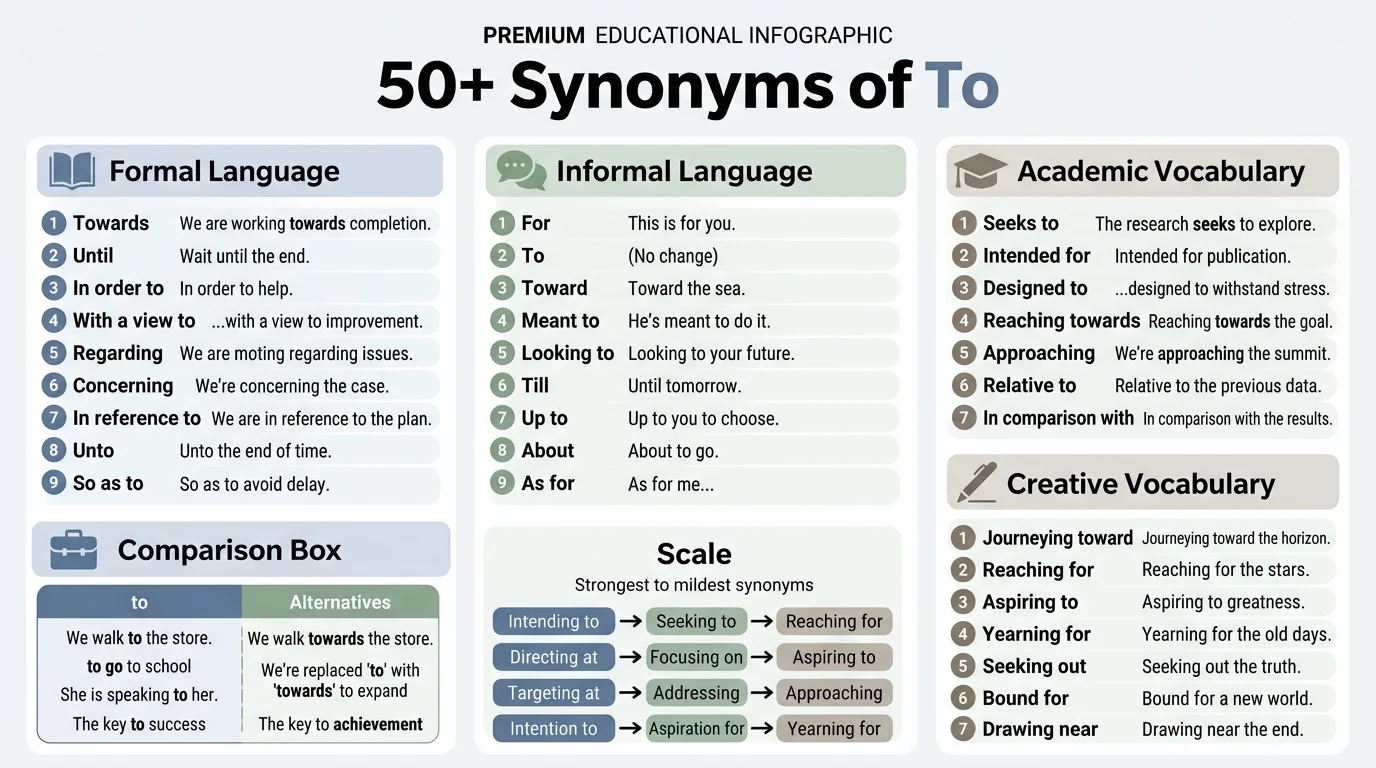
Have you ever stared at a sentence and realized you have used the word “to” three times in a single line? You are not alone. This tiny two-letter word appears constantly in English writing, and overusing it can make your sentences feel repetitive and dull. Whether you are writing an email, crafting a resume, or composing a blog post, finding the right synonyms of “to” can dramatically improve your writing clarity and flow.
The word “to” serves many purposes in English, which makes finding exact replacements challenging. However, understanding the meaning of “to” and its various uses will help you choose stronger, more precise alternatives. This comprehensive guide explores the best synonyms of “to” for every situation, helping you write with greater confidence and variety.
What Are the Best Synonyms of “To”?
The word “to” is a common preposition indicating direction, purpose, or relationship. The best synonyms depend entirely on context. Expressing purpose, use “in order to” or “so as to” in formal writing. For indicating direction, try “toward” or “unto.” For showing relationships, “with” or “for” often work better. Professional settings favor “regarding” and “concerning.”
Meaning, Tone, and Context
Simple Definition
The word “to” functions primarily as a preposition expressing direction, purpose, or connection between elements in a sentence.
Part of Speech
Preposition, infinitive marker, adverb
Overall Tone
Neutral
Formality Level
Neutral to Formal
Common Uses
Native English speakers use “to” constantly in everyday communication. You will find it in directions, expressions of purpose, relationship descriptions, and infinitive verb constructions. Most people use “to” without thinking, which is why finding alternatives can feel challenging.
Word Forms
- Preposition: indicating direction, position, or relationship
- Infinitive marker: used before verbs to form infinitives
- Adverb: in a closed position or toward a closed state
When and How to Use “To”
Understanding when to use “to” helps you decide when to replace it with stronger alternatives.
Professional Context
Using “to” in professional writing often works well, but overuse can make your writing feel repetitive.
Academic Context
Academic writing relies heavily on “to” for expressing purpose and direction. Knowing alternatives improves your scholarly vocabulary.
Workplace Context
In workplace communication, “to” appears in emails, reports, and presentations. Strategic replacements strengthen your professional voice.
Personal Context
Everyday conversation uses “to” constantly. Casual settings allow more flexibility in word choice.
Email Context
Email writing often suffers from excessive “to” usage. Thoughtful alternatives make your messages more engaging.
Resume Context
Resumes require powerful, precise language. Replacing weak “to” constructions with stronger alternatives creates more impact.
Social Media Context
Social media posts benefit from varied vocabulary. Creative alternatives help your content stand out.
Real Life Examples
- Professional: “We need to schedule the meeting for Thursday.” → “We need to schedule the meeting before Thursday.”
- Academic: “The study aims to examine the relationship.” → “The study aims at examining the relationship.”
- Workplace: “Please send the report to the manager.” → “Please send the report for the manager’s review.”
- Personal: “I need to go to the store.” → “I need to go toward the store.”
- Email: “I am writing to confirm our appointment.” → “I am writing so as to confirm our appointment.”
- Resume: “Managed teams to achieve project goals.” → “Managed teams toward achieving project goals.”
- Social Media: “Ready to start my new adventure.” → “Ready for my new adventure.”
Best Synonyms of “To” by Context
No synonym works perfectly in every situation. The right choice depends on your writing purpose, audience, and desired tone.
Professional Writing
Toward: This synonym works best when indicating direction or progress. It sounds more purposeful and active than “to.”
Academic Writing
In order to: This formal alternative expresses purpose clearly and precisely in scholarly contexts.
Business Communication
Regarding: Use this when referring to topics or subjects in professional correspondence.
Casual Conversation
For: This simple replacement works naturally in everyday speech and informal writing.
Emotional Writing
Toward: Expresses movement or inclination with emotional weight.
Creative Writing
Unto: This slightly archaic alternative adds literary flair and dramatic effect.
Resume Writing
Toward: Emphasizes progress, achievement, and forward momentum in professional contexts.
Workplace Communication
Concerning: This professional-sounding synonym works well for formal workplace discussions.
Stronger Meaning
So as to: This construction emphasizes purpose more strongly than “to.”
Softer Meaning
For: This gentle alternative feels less direct and more accommodating.
When Not to Use “To”
When It Sounds Too General
Using “to” repeatedly makes writing feel vague and uninspired. If your sentence contains multiple “to” constructions, find alternatives that add precision.
Better: Use “toward” for directional meaning, “for” when expressing purpose, or “regarding” when indicating subject matter.
When It Sounds Too Formal
Some “to” constructions sound unnecessarily formal in casual contexts. “So as to” belongs in academic papers, not text messages.
Better: Choose simpler alternatives like “for” or “so” in informal writing.
When It Sounds Too Informal
Using casual alternatives in professional writing weakens your credibility. “For” can sound too relaxed in formal business communications.
Better: Select “in order to” or “so as to” for professional documents.
When It Sounds Too Weak
Some “to” constructions lack impact in persuasive writing. “To” often fails to convey urgency or importance.
Better: Replace with “for the purpose of” or “with the goal of” for stronger emphasis.
When It Sounds Too Strong
Overly formal alternatives in personal writing sound pretentious. “In order to” feels out of place in casual emails.
Better: Choose straightforward “to” or simple “for” in personal contexts.
When It Is Outdated
“Unto” rarely appears in modern English except in literary or religious contexts. Using it in everyday writing sounds affected.
Better: Use “to” or “toward” for contemporary writing.
Words Commonly Confused With “To”
To vs For
Difference: “To” indicates direction or purpose, while “for” indicates benefit or duration.
When to Use To: Use when showing movement toward something or expressing an infinitive.
When to Use For: Use when indicating benefit, purpose, or duration.
Example for To: “I walked to the park.”
Example for For: “I walked for the exercise.”
To vs Toward
Difference: “To” indicates arrival at a destination, while “toward” indicates movement in a direction without necessarily arriving.
When to Use To: Use when the destination is reached.
When to Use Toward: Use when indicating direction or progress without completion.
Example for To: “She drove to the office.”
Example for Toward: “She drove toward the office.”
To vs From
Difference: “To” indicates movement toward something, while “from” indicates movement away from something.
When to Use To: Use when showing direction toward a point.
When to Use From: Use when showing origin or starting point.
Example for To: “The train goes to Chicago.”
Example for From: “The train comes from Chicago.”
To vs With
Difference: “To” indicates direction or relationship, while “with” indicates accompaniment or manner.
When to Use To: Use when showing connection between elements.
When to Use With: Use when indicating togetherness or using something.
Example for To: “She spoke to her friend.”
Example for With: “She spoke with her friend.”
To vs So
Difference: “To” appears in infinitive constructions, while “so” functions as a conjunction or adverb.
When to Use To: Use when forming infinitives or expressing purpose.
When to Use So: Use when indicating result or degree.
Example for To: “I need to study.”
Example for So: “I studied so I could pass.”
Best Synonyms of “To” by Context Table
| Context | Best Synonym | Why It Works | Example |
|---|---|---|---|
| Formal Writing | In order to | Expresses clear purpose professionally | “The committee met in order to finalize the budget.” |
| Academic Writing | So as to | Sounds scholarly and precise | “The experiment was designed so as to test the hypothesis.” |
| Professional Communication | Regarding | Indicates subject matter formally | “I am writing regarding the contract renewal.” |
| Business Emails | Concerning | Professional and direct | “Concerning your inquiry, we have prepared the following response.” |
| Resume Writing | Toward | Emphasizes achievement and progress | “Led the team toward exceeding quarterly targets.” |
| Workplace Communication | For | Simple and effective in office settings | “This task is for the marketing department.” |
| Casual Conversation | For | Natural and comfortable in speech | “I want this for my collection.” |
| Everyday Speaking | For | The most natural spoken alternative | “We went out for dinner.” |
| Creative Writing | Unto | Adds literary and dramatic quality | “She brought her gift unto the king.” |
| Storytelling | Toward | Creates movement and direction in narrative | “He walked toward the distant mountains.” |
| Emotional Writing | Toward | Conveys feeling and inclination | “Her heart turned toward forgiveness.” |
| Strong Emphasis | So as to | Adds weight and formality | “We must act so as to prevent further delays.” |
| Mild Tone | For | Gentle and understated | “This is for your consideration.” |
| Social Media Captions | For | Short and engaging | “Ready for the weekend.” |
| American English | Toward | Standard American usage | “We drove toward the coast.” |
How to Choose the Best Synonym of “To”
Choosing the right alternative requires considering several factors.
Consider Your Meaning
First, determine what “to” is doing in your sentence. Is it expressing direction? Purpose? Relationship? Each meaning requires different alternatives.
Consider Your Audience
Professional audiences expect formal language. Academic readers value precision. Casual audiences appreciate natural, comfortable alternatives.
Consider Your Tone
Emotional writing benefits from expressive alternatives. Technical writing demands precise choices. Creative writing welcomes variety.
Consider Emotional Strength
Some alternatives carry more weight than others. “So as to” sounds more purposeful than simple “for.”
Consider Writing Purpose
Resumes require action-oriented alternatives. Emails need professional yet friendly choices. Social media benefits from short, engaging options.
Consider Natural Sounding Usage
The best synonym sounds natural in your sentence. Read your sentence aloud to test whether the replacement flows smoothly.
Real Life Examples of “To”
School Example
Original: “I need to study to pass the test.”
Improved: “I need to study so as to pass the test.”
College Example
Original: “The assignment requires us to analyze the data.”
Improved: “The assignment requires us toward analyzing the data.”
Workplace Example
Original: “I sent the documents to the legal department.”
Improved: “I sent the documents for the legal department.”
Business Example
Original: “We aim to increase our market share.”
Improved: “We aim for increasing our market share.”
Email Example
Original: “I am emailing to request a meeting.”
Improved: “I am emailing so as to request a meeting.”
Resume Example
Original: “Worked to improve customer satisfaction.”
Improved: “Worked toward improving customer satisfaction.”
Conversation Example
Original: “I want to go to the beach.”
Improved: “I want to go toward the beach.”
Storytelling Example
Original: “She walked to the old house.”
Improved: “She walked toward the old house.”
Blogging Example
Original: “We need to find better solutions.”
Improved: “We need better solutions for our challenges.”
Social Media Example
Original: “Ready to take on the day.”
Improved: “Ready for the day ahead.”
18 Best Synonyms of “To”
| Synonym | Simple Meaning | Best Used For | Example Sentence |
|---|---|---|---|
| Toward | Direction without arrival | Describing movement or progress | “She walked toward the exit.” |
| For | Purpose or benefit | Expressing intended use or recipient | “This gift is for you.” |
| In order to | Formal purpose | Professional and academic writing | “We must act in order to succeed.” |
| So as to | Formal purpose | Emphasizing intention and formality | “He studied so as to pass the exam.” |
| Regarding | Subject matter | Professional correspondence | “I have questions regarding your proposal.” |
| Concerning | Subject matter | Business and workplace communication | “She called concerning your application.” |
| Unto | Literary direction | Creative and dramatic writing | “He offered his tribute unto the king.” |
| For the purpose of | Formal intent | Legal and official documents | “Funds were allocated for the purpose of research.” |
| With the aim of | Directed intention | Strategic planning documents | “We launched the campaign with the aim of growth.” |
| With a view to | Future intention | Formal planning language | “We restructured with a view to efficiency.” |
| Prior to | Time relationship | Formal scheduling language | “Please arrive prior to the meeting.” |
| By | Means or method | Explaining how something happens | “We communicated by email.” |
| On | Topic or subject | Describing what something covers | “She wrote a book on climate change.” |
| At | Specific direction | Indicating target or goal | “He aimed at the target.” |
| Across | Movement covering area | Describing movement over space | “The river flows across the valley.” |
| Along | Movement following a path | Describing movement beside something | “We walked along the beach.” |
| Through | Movement inside something | Describing movement within a space | “The train passed through the tunnel.” |
| Upon | Formal position | Literary or formal use | “The decision rests upon evidence.” |
Synonyms of “To” by Usage
Professional vs Personal Synonyms
Professional Contexts
- Regarding
- Concerning
- In order to
- So as to
- For the purpose of
These synonyms sound authoritative and demonstrate professional communication skills.
Personal Contexts
- For
- Toward
- At
- On
These alternatives feel natural and comfortable in everyday conversations.
Formal vs Conversational Synonyms
Formal Synonyms
- So as to
- In order to
- For the purpose of
- With a view to
- Prior to
Conversational Synonyms
- For
- Toward
- At
- On
Academic Synonyms
Academic writing benefits from precise, formal alternatives.
- So as to: Expresses purpose with scholarly precision
- In order to: Clear formal purpose expression
- With the aim of: Indicates research objectives
- For the purpose of: Defines study parameters
- With a view to: Suggests future research directions
Professional and Business Synonyms
Business writing requires clear, professional language.
- Regarding: Perfect for email subject lines
- Concerning: Suitable for formal correspondence
- In order to: Expresses business objectives
- Toward: Shows progress and achievement
- For: Simple and effective in most business contexts
Creative and Literary Synonyms
Creative writing welcomes expressive alternatives.
- Unto: Adds dramatic, literary quality
- Toward: Creates movement and direction
- Across: Suggests journey and exploration
- Through: Implies transformation or complete experience
Slang or Modern Synonyms
Modern English offers few slang alternatives for “to.” The word is so fundamental that casual speakers rarely replace it with slang. When casual alternatives appear, they usually involve dropping or changing the word entirely.
Strongest to Mildest Synonyms
Mild: For, at, on
Moderate: Toward, regarding, concerning
Strong: So as to, for the purpose of, with the aim of
Very Strong: In order to, with a view to
Emotional vs Neutral Synonyms
Emotional Synonyms
- Toward: Suggests feeling and inclination
- Unto: Carries dramatic and serious weight
- Through: Implies personal journey and growth
Neutral Synonyms
- For: Simple information without emotion
- At: Direction without feeling
- On: Topic indication without emotion
Antonyms of “To”
| Antonym | Meaning | Example Sentence |
|---|---|---|
| From | Direction away from | “The train comes from Chicago.” |
| Away from | Movement in opposite direction | “He walked away from the building.” |
| Opposite of | Position facing away | “She sat opposite of her colleague.” |
| Against | In opposition to | “They argued against the proposal.” |
| Without | Lacking something | “She completed the task without assistance.” |
| Apart from | Separated from | “Everything was fine apart from the noise.” |
| Instead of | Replacing something | “He chose water instead of soda.” |
| Away | Moving to a distance | “The ship sailed away.” |
| Off | Moving away from surface | “She jumped off the dock.” |
| Out of | Moving from inside | “He walked out of the room.” |
| Except | Excluding something | “Everyone came except John.” |
| Excluding | Leaving something out | “The price excludes taxes.” |
| Beyond | Moving past something | “The road continues beyond the bridge.” |
| Past | Moving beyond in time or space | “They drove past the old school.” |
| Into | Movement toward interior | “She walked into the house.” |
Comparison: “To” vs Similar Words
To vs Toward
Main Difference: “To” indicates arrival at a destination, while “toward” indicates movement in a direction without necessarily arriving.
Which Is Stronger? “To” feels more definitive and complete. “Toward” suggests ongoing progress.
Which Is More Formal? Both are neutral, but “toward” appears more frequently in formal writing.
When to Use Each
- Use “to” when the destination is reached
- Use “toward” when indicating direction or progress
Examples
- To: “She drove to the office.”
- Toward: “She drove toward the office.”
To vs For
Main Difference: “To” indicates direction or purpose, while “for” indicates benefit or duration.
Which Is Stronger? “To” often feels more direct and purposeful.
Which Is More Formal? Both work in formal contexts, but “for” appears more casual.
When to Use Each
- Use “to” for direction and infinitive constructions
- Use “for” for benefit, purpose, and duration
Examples
- To: “I gave the book to my sister.”
- For: “I bought the book for my sister.”
To vs Regarding
Main Difference: “To” indicates direction or relationship, while “regarding” specifically indicates subject matter.
Which Is Stronger? “Regarding” sounds more professional and specific.
Which Is More Formal? “Regarding” is significantly more formal.
When to Use Each
- Use “to” for general direction or relationship
- Use “regarding” for professional correspondence
Examples
- To: “She spoke to the committee.”
- Regarding: “She spoke regarding the budget.”
To vs Concerning
Main Difference: “To” shows direction or relationship, while “concerning” shows subject matter.
Which Is Stronger? “Concerning” carries more weight and formality.
Which Is More Formal? “Concerning” is much more formal.
When to Use Each
- Use “to” for general use
- Use “concerning” for business and professional writing
Examples
- To: “He referred to the document.”
- Concerning: “He had questions concerning the document.”
To vs In Order To
Main Difference: “To” expresses purpose simply, while “in order to” emphasizes purpose more formally.
Which Is Stronger? “In order to” sounds more deliberate and formal.
Which Is More Formal? “In order to” is much more formal.
When to Use Each
- Use “to” for simple purpose expression
- Use “in order to” for formal or academic writing
Examples
- To: “I went to buy milk.”
- In order to: “I went to the store in order to buy milk.”
To vs So As To
Main Difference: Both express purpose, but “so as to” sounds more scholarly.
Which Is Stronger? “So as to” carries greater emphasis and formality.
Which Is More Formal? “So as to” is among the most formal purpose expressions.
When to Use Each
- Use “to” for everyday writing
- Use “so as to” for academic and formal writing
Examples
- To: “She arrived early to prepare.”
- So as to: “She arrived early so as to prepare thoroughly.”
Common Phrases and Expressions with “To”
To and Fro
Meaning: Moving backward and forward repeatedly.
Example Sentence: “The children ran to and fro across the playground.”
To a T
Meaning: Perfectly or exactly.
Example Sentence: “Her description matched the suspect to a T.”
To the Point
Meaning: Relevant and direct.
Example Sentence: “Please keep your comments to the point.”
To Be Continued
Meaning: The story will continue later.
Example Sentence: “The series ended with ‘to be continued.'”
To Each Their Own
Meaning: Different people have different preferences.
Example Sentence: “I prefer modern art, but to each their own.”
To the Fullest
Meaning: As much as possible.
Example Sentence: “She lived her life to the fullest.”
To a Fault
Meaning: To an excessive degree.
Example Sentence: “He was generous to a fault.”
To and Fro
Meaning: Moving alternately between two places.
Example Sentence: “The pendulum swung to and fro.”
Common Mistakes to Avoid
1: Using “To” When “Toward” Works Better
Incorrect: “She walked to the park but never quite arrived.”
Better: “She walked toward the park but never quite arrived.”
Why: “Toward” better expresses movement without completion.
2: Using “For” When “To” Is Correct
Incorrect: “I gave the letter for her.”
Better: “I gave the letter to her.”
Why: “To” correctly indicates direction and recipient.
3: Overusing “In Order To” in Casual Writing
Incorrect: “I went to the store in order to buy milk.”
Better: “I went to the store to buy milk.”
Why: The formal phrase sounds unnecessary in casual contexts.
4: Confusing “To” and “Too”
Incorrect: “I want to go to.”
Better: “I want to go too.”
Why: “Too” means “also” and is a completely different word.
5: Using “Unto” in Modern Writing
Incorrect: “She spoke unto the crowd.”
Better: “She spoke to the crowd.”
Why: “Unto” sounds archaic in contemporary writing.
6: Repetitive “To” in a Single Sentence
Incorrect: “I need to go to the store to buy milk.”
Better: “I need to go to the store for milk.”
Why: Replacing one “to” with “for” creates variety.
7: Using Informal Alternatives in Professional Emails
Incorrect: “I am writing for your opinion on the proposal.”
Better: “I am writing to ask for your opinion on the proposal.”
Why: “For” sounds too casual in this professional context.
Frequently Asked Questions
1. What are the best synonyms of “to”?
The best synonyms of “to” include “toward,” “for,” “in order to,” “regarding,” and “concerning.” Your choice depends on whether you are expressing direction, purpose, or subject matter.
2. What are the best formal synonyms of “to”?
The best formal synonyms of “to” are “in order to,” “so as to,” “for the purpose of,” and “with a view to.” These alternatives sound professional and precise in formal contexts.
3. What are common informal synonyms of “to”?
Common informal synonyms of “to” include “for,” “at,” and “on.” These simple alternatives work naturally in casual conversations and informal writing.
4. What is another word for “to” in professional writing?
Another word for “to” in professional writing is “toward” when indicating progress, “regarding” when referencing subjects, and “in order to” when expressing purpose clearly.
5. What is the difference between “to” and “toward”?
The main difference is that “to” indicates arrival at a destination, while “toward” indicates movement in a direction without necessarily arriving. Use “to” for completion and “toward” for ongoing progress.
6. What is the opposite of “to”?
The opposite of “to” is “from,” which indicates movement away from something. Other antonyms include “away from,” “against,” and “without” depending on context.
Conclusion
Understanding synonyms of “to” transforms your writing from repetitive to refined. This small word appears constantly in English, making its alternatives valuable tools for any writer. The best synonym depends on your context, audience, and desired tone. Formal writing benefits from “in order to” and “so as to.” Professional communication uses “regarding” and “concerning.” Casual conversation prefers simple alternatives like “for” and “toward.”
Remember that no synonym works perfectly in every situation. Choose alternatives based on what you want to communicate, who you are addressing, and the emotional weight you wish to carry. Practice using different synonyms of “to” in your daily writing, and soon you will naturally select the right word without thinking.
A practical vocabulary improvement tip: read your writing aloud and notice every “to” you use. For each one, consider whether a more precise alternative exists. This simple habit will dramatically improve your writing clarity and variety.