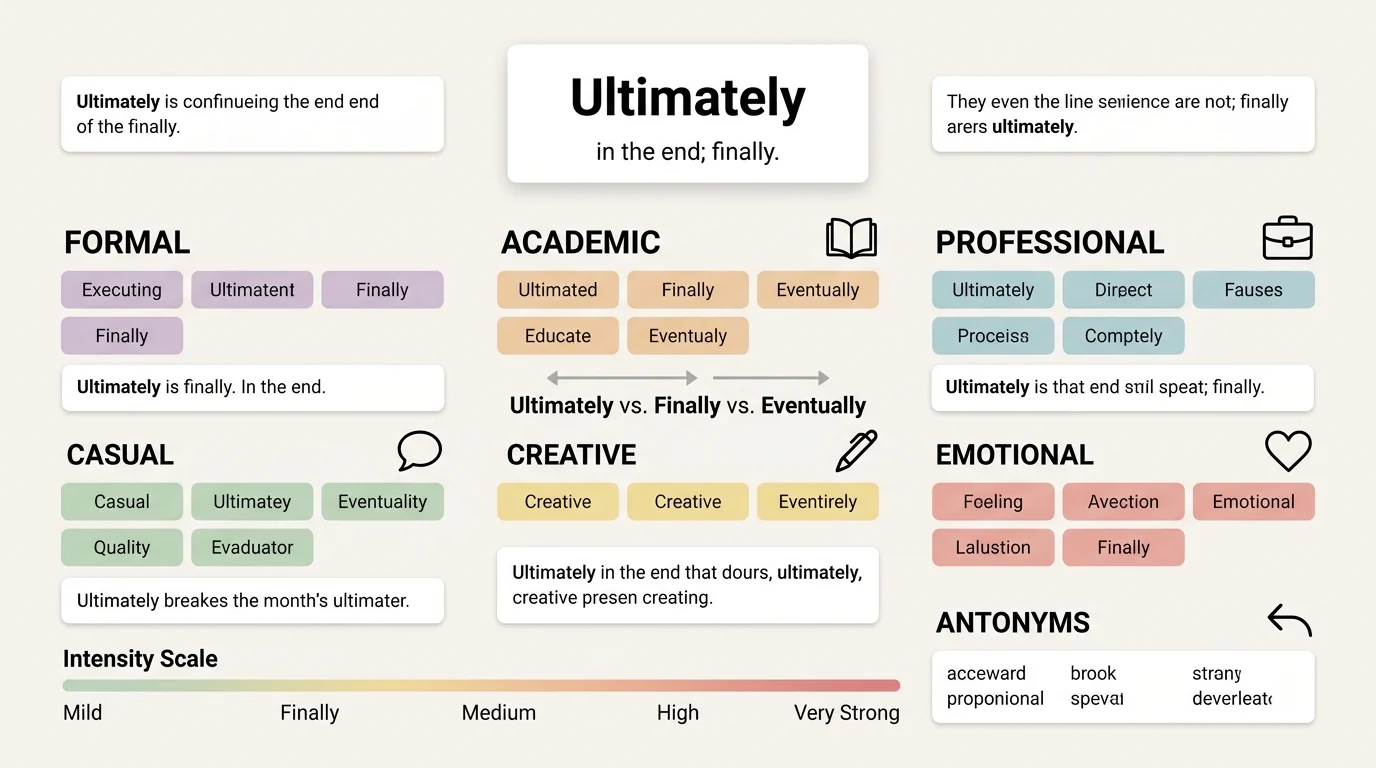
Have you ever found yourself writing an email, an essay, or a social media caption and realized you have used the word “ultimately” three times in two paragraphs? It is a common habit. Many writers rely on this one word to signal a final point or a concluding thought. But repeating any word too often makes your writing feel flat and predictable.
That is where exploring the synonyms of ultimately becomes essential. Whether you are drafting a business report, crafting a college essay, or simply trying to sound more natural in everyday conversation, having a range of alternatives at your disposal makes your communication clearer and more engaging. The right synonym can sharpen your message, adjust your tone, and keep your reader interested from start to finish.
What Are the Best Synonyms of “Ultimately”?
Ultimately means “finally, after a long or complicated process” or “at the most basic level.” For formal writing, use “finally” or “in the end.” For casual conversation, try “at the end of the day.” In academic work, choose “fundamentally” or “essentially.” For professional communication, “conclusively” or “in the final analysis” work well.
Meaning, Tone, and Context
Simple Definition
Ultimately is an adverb that points to the final result of a series of events or the most important conclusion after considering everything.
Part of Speech
Overall Tone
Neutral. The word itself does not carry strong positive or negative emotion. Its tone depends entirely on the context in which you use it.
Formality Level
Semi-formal to formal. “Ultimately” appears frequently in academic papers, business reports, and professional presentations. It also works in serious conversations but may feel too stiff for casual texting or lighthearted social media posts.
Common Uses
Native English speakers use “ultimately” in two main ways:
- To indicate the final outcome after a process: “The negotiations ultimately failed.”
- To emphasize the most important point: “Ultimately, it comes down to trust.”
Word Forms
- Ultimate (adjective): final or best possible. Example: “Their ultimate goal was world peace.”
- Ultimately (adverb): in the end; fundamentally.
When and How to Use “Ultimately”
Choose “ultimately” when you want to stress that a conclusion has been reached after considering multiple factors or after a sequence of events. It works best when you are summarizing, concluding, or identifying the core issue.
Here are seven realistic examples showing how to use “ultimately” in different contexts.
Professional
“After reviewing all proposals, we ultimately selected the vendor with the most experience in sustainable materials.”
Academic
“The study suggests that economic conditions ultimately determine voting patterns in rural districts.”
Workplace
“Several departments contributed to the project, but the design team ultimately bore the responsibility for the final product.”
Personal
“She weighed the pros and cons for weeks and ultimately decided to accept the job offer in another city.”
Email
“We have discussed several options, and we ultimately believe that extending the deadline is the fairest solution.”
Resume
“Led a cross-functional team that ultimately increased quarterly revenue by 22 percent.”
Social Media
After trying five different coffee shops, I ultimately realized the best brew was the one I made at home.”
Best Synonyms of “Ultimately”
No two synonyms are perfectly identical. Each alternative carries a slightly different shade of meaning, emotional weight, or level of formality. Choosing the right one depends on your audience, your purpose, and the tone you want to strike.
Professional writing: “Ultimately” itself is strong, but “in the final analysis” adds authority. It signals careful consideration.
Academic writing: “Fundamentally” or “essentially” work well because they suggest you have identified the underlying principle.
Business communication: “Conclusively” conveys certainty and is useful in reports or recommendations.
Casual conversation: “At the end of the day” feels natural and relatable in everyday speech.
Emotional writing: “When all is said and done” adds a reflective, heartfelt tone.
Creative writing: “In the end” is simple yet effective for storytelling and narrative closure.
Resume writing: Use “ultimately” itself or “in the end” to highlight the final result of your actions.
Workplace communication: “Finally” is direct and clear for internal updates or team meetings.
Stronger meaning: “Inevitably” suggests the outcome was unavoidable.
Softer meaning: “Eventually” softens the finality and emphasizes the passage of time.
When Not to Use “Ultimately”
Sometimes “ultimately” is not the best choice. Here are situations where you should consider a different word.
It sounds too general
If you are describing a simple, immediate result, “ultimately” feels overblown.
- Less effective: “I ultimately finished my homework.”
- Better: “I finally finished my homework.”
- Why: “Finally” is more natural for everyday, short-term tasks.
It sounds too vague
If you need to be precise about a sequence, “ultimately” can be unclear.
- Less effective: “The recipe ultimately called for sugar.”
- Better: “The final step in the recipe called for sugar.”
- Why: “Final step” is more specific and descriptive.
When it sounds too formal
In casual texting or quick updates, “ultimately” can feel stiff.
- Less effective: “I ultimately got the tickets.”
- Better: “I finally got the tickets.”
- Why: “Finally” matches the informal tone.
It sounds too weak
If you want to emphasize an unavoidable outcome, “ultimately” may not feel strong enough.
- Less effective: “The team ultimately lost the match.”
- Better: “The team inevitably lost the match.”
- Why: “Inevitably” suggests the loss was unavoidable.
When it sounds outdated
“Ultimately” is not outdated, but overusing it can make your writing feel repetitive and old-fashioned. Rotate in fresher alternatives.
Words Commonly Confused With “Ultimately”
Several words are often mixed up with “ultimately.” Here is how to tell them apart.
Ultimately vs Finally
Difference: “Finally” often introduces the last item in a list or signals the end of a wait. “Ultimately” points to a final outcome after a process.
When to Use It: Use “finally” for the last step in a sequence. Use “ultimately” for the final result after consideration.
Example (Finally): “Finally, add the cheese to the sauce.”
Example (Ultimately): “Ultimately, the cheese made the dish unforgettable.”
Ultimately vs Eventually
Difference: “Eventually” emphasizes the passage of time before something happens. “Ultimately” emphasizes the final result or conclusion.
When to Use It: Use “eventually” when time is the main point. Use “ultimately” when the outcome is the main point.
Example (Eventually): “He eventually learned to play the guitar.”
Example (Ultimately): “He ultimately became a professional musician.”
Ultimately vs Essentially
Difference: “Essentially” means “at the core” or “in essence.” “Ultimately” means “in the end” or “after everything”.
When to Use It: Use “essentially” to describe the fundamental nature of something. Use “ultimately” to describe the final outcome.
Example (Essentially): “The recipe is essentially a simple tomato sauce.”
Example (Ultimately): “The recipe ultimately won the cooking competition.”
Ultimately vs Basically
Difference: “Basically” is more informal and means “in simple terms.” “Ultimately” is more formal and means “in the end”.
When to Use It: Use “basically” in casual explanations. Use “ultimately” in formal summaries.
Example (Basically): “Basically, we need more time.”
Example (Ultimately): “Ultimately, we need more time to complete the project.”
Ultimately vs Conclusively
Difference: “Conclusively” means “in a way that settles an issue definitively.” “Ultimately” means “in the end” but does not always carry the same sense of final proof.
When to Use It: Use “conclusively” when you have proven something beyond doubt. Use “ultimately” when you are stating a final conclusion.
Example (Conclusively): “The evidence conclusively proved his innocence.”
Example (Ultimately): “Ultimately, the jury reached a verdict.”
Ultimately vs Inevitably
Difference: “Inevitably” means “unavoidably” or “certain to happen.” “Ultimately” means “in the end” but does not necessarily imply inevitability.
When to Use It: Use “inevitably” when the outcome was certain. Use “ultimately” when the outcome was reached after a process.
Example (Inevitably): “Conflict inevitably arises in any large organization.”
Example (Ultimately): “The organization ultimately resolved the conflict through mediation.”
Best Synonyms of “Ultimately” by Context
| Context | Best Synonym | Why It Works | Example |
|---|---|---|---|
| Formal writing | In the final analysis | Signals thorough consideration and authority | “In the final analysis, the policy failed to achieve its objectives.” |
| Academic writing | Fundamentally | Suggests you have identified the underlying principle | “The theory is fundamentally flawed in its assumptions.” |
| Professional communication | Conclusively | Conveys certainty and is suitable for reports | “The data conclusively demonstrates the need for change.” |
| Business emails | In the end | Direct, professional, and widely understood | “In the end, we agreed to the revised terms.” |
| Resume writing | Ultimately | Highlights the final result of your actions | “Ultimately led the team to a successful product launch.” |
| Workplace communication | Finally | Clear and direct for internal updates | “Finally, we resolved the scheduling conflict.” |
| Casual conversation | At the end of the day | Relatable and natural in everyday speech | “At the end of the day, we all just want to be happy.” |
| Everyday speaking | Basically | Simple and informal for quick explanations | “Basically, we ran out of time.” |
| Creative writing | In the end | Simple yet effective for narrative closure | “In the end, love conquered all.” |
| Storytelling | When all is said and done | Adds a reflective, heartfelt tone | “When all is said and done, she knew she had made the right choice.” |
| Emotional writing | At last | Conveys relief or the end of a long wait | “At last, the long winter was over.” |
| Strong emphasis | Inevitably | Suggests the outcome was unavoidable | “Inevitably, the two sides reached an impasse.” |
| Mild tone | Eventually | Softens the finality and emphasizes time | “Eventually, things started to improve.” |
| Social media captions | Finally | Short, punchy, and relatable | “Finally made it to the beach!” |
How to Choose the Best Synonym of “Ultimately”
Choosing the right synonym does not have to be complicated. Ask yourself these questions.
What is my main point?
Are you emphasizing the final result, the passage of time, or the core truth? If you want to stress the result, choose “ultimately,” “in the end,” or “finally.” If time is key, choose “eventually.” You are identifying the essence, choose “fundamentally” or “essentially.”
Who is my audience?
Formal report, use “in the final analysis” or “conclusively.” For a casual conversation, use “at the end of the day” or “basically.” For academic writing, use “fundamentally” or “essentially.”
How strong should my tone be?
If you want to sound certain and definitive, choose “conclusively” or “inevitably.” If you want to sound reflective or mild, choose “eventually” or “in the end.”
What emotion do I want to convey?
For relief or the end of a long wait, use “at last.” A heartfelt reflection, use “when all is said and done.” For a neutral, factual statement, use “ultimately” itself.
The best synonym is the one that communicates your intended message most clearly to your specific reader.
Real Life Examples of “Ultimately”
Seeing “ultimately” in action helps you understand how to use it naturally. Here are examples from various real-world situations.
School
“The science fair project required weeks of experimentation, but ultimately, the results supported the hypothesis.”
College
“She changed her major three times and ultimately graduated with a degree in environmental science.”
Workplace
“The committee considered several locations for the new office and ultimately chose the downtown space.”
Business
“After analyzing the market trends, the company ultimately decided to expand into the European market.”
Email
“We have reviewed your application and ultimately determined that you are the best candidate for the position.”
Resume
“Managed a team of twelve and ultimately delivered the project two weeks ahead of schedule.”
Conversation
“I know you are nervous about the presentation, but ultimately, your preparation will carry you through.”
Storytelling
“The travelers faced many dangers on their journey, but ultimately, they reached the golden city.”
Blogging
“You can try every productivity hack in the book, but ultimately, consistency is what matters most.”
Social Media
“Tried every diet, but ultimately realized that balance is the real secret.”
18 Best Synonyms of “Ultimately”
Synonyms of “Ultimately” by Usage
Professional vs Personal Synonyms
In professional settings, choose words that convey authority and clarity. “Conclusively,” “in the final analysis,” and “fundamentally” work well in reports, presentations, and formal emails. In personal conversations, “at the end of the day,” “basically,” and “in the end” feel more natural and relatable.
Formal vs Conversational Synonyms
For formal writing such as essays, research papers, and business reports, use “ultimately,” “fundamentally,” “essentially,” or “in the final analysis”. For casual conversations, texting, and social media, use “finally,” “basically,” or “at the end of the day”.
Academic Synonyms
In academic writing, precision and authority matter. “Fundamentally” suggests you have identified the underlying principle. “Essentially” helps you define the core of an argument. “Conclusively” is useful when presenting definitive research findings. “In the final analysis” signals thorough examination. These words sound more authoritative and are well-suited for research papers, essays, and academic discussions.
Professional and Business Synonyms
For resumes, interviews, meetings, and client communication, choose words that project confidence and competence. “Ultimately” itself is a strong choice for highlighting results. “Conclusively” works well in performance reviews and recommendations. “In the end” is direct and professional for business emails. “Fundamentally” is useful for strategic discussions.
Creative and Literary Synonyms
For storytelling, fiction, poetry, and descriptive writing, choose words that add emotion and imagery. “At last” conveys relief or the end of a long journey. “When all is said and done” adds a reflective, heartfelt quality. “In the end” is simple yet powerful for narrative closure. “At length” has a formal, literary feel.
Slang or Modern Synonyms
“Ultimately” does not have widely used slang equivalents. “At the end of the day” is a common modern phrase used in casual speech. “Basically” is also very common in informal American English. These are acceptable in conversation but should be avoided in formal writing.
Strongest to Mildest Synonyms
Mild
- Basically (simple, informal)
- Overall (general summary)
- By and large (general, informal)
Moderate
- In the end (neutral, widely used)
- Finally (neutral, common)
- Eventually (emphasizes time)
- After all (adds a concluding thought)
Strong
- Ultimately (definitive, formal)
- Fundamentally (authoritative, academic)
- Essentially (authoritative, academic)
- Conclusively (definitive, formal)
Very Strong
- Inevitably (unavoidable, certain)
- In the final analysis (thorough, formal)
Emotional vs Neutral Synonyms
Emotional Synonyms
These words express stronger feelings or a sense of relief, reflection, or certainty.
- “At last” conveys relief after a long wait.
- “When all is said and done” adds a reflective, heartfelt tone.
- “Inevitably” carries a sense of resignation or certainty.
- “After all” can express a sense of vindication or finality.
Use these in personal writing, storytelling, or when you want to connect with your reader on an emotional level.
Neutral Synonyms
These words simply communicate information without adding strong emotion.
- “Ultimately” itself is neutral.
- “Finally” is neutral and factual.
- “In the end” is neutral and widely used.
- “Eventually” is neutral and emphasizes time.
- “Fundamentally” and “essentially” are neutral and analytical.
Use these in professional, academic, and factual writing where objectivity is important.
Antonyms of “Ultimately”
Comparison: “Ultimately” vs Similar Words
Ultimately vs Finally
Main Difference: “Finally” often introduces the last item in a list or signals the end of a wait. “Ultimately” points to a final outcome after a process.
Which Is Stronger? “Ultimately” is stronger because it implies a conclusion reached after careful consideration.
Which Is More Formal? Both are formal, but “ultimately” is slightly more formal and academic.
When to Use Each: Use “finally” for the last step in a sequence. Use “ultimately” for the final result after consideration.
Examples:
- Ultimately: “Ultimately, the committee approved the proposal.”
- Finally: “Finally, we can move on to the next item.”
Ultimately vs Eventually
Main Difference: “Eventually” emphasizes the passage of time before something happens. “Ultimately” emphasizes the final result or conclusion.
Which Is Stronger? “Ultimately” is stronger because it focuses on the outcome.
Which Is More Formal? Both are formal, but “ultimately” is more commonly used in academic and professional writing.
When to Use Each: Use “eventually” when time is the main point. Use “ultimately” when the outcome is the main point.
Examples:
- Ultimately: “Ultimately, the policy was a failure.”
- Eventually: “The policy eventually led to reform.”
Ultimately vs Essentially
Main Difference: “Essentially” means “at the core” or “in essence.” “Ultimately” means “in the end” or “after everything”.
Which Is Stronger? “Ultimately” is stronger because it implies a final conclusion.
Which Is More Formal? Both are formal, but “essentially” is more common in academic writing.
When to Use Each: Use “essentially” to describe the fundamental nature of something. Use “ultimately” to describe the final outcome.
Examples:
- Ultimately: “Ultimately, the experiment succeeded.”
- Essentially: “The experiment was essentially a test of the new theory.”
Ultimately vs Basically
Main Difference: “Basically” is more informal and means “in simple terms.” “Ultimately” is more formal and means “in the end”.
Which Is Stronger? “Ultimately” is stronger and more definitive.
Which Is More Formal? “Ultimately” is much more formal.
When to Use Each: Use “basically” in casual explanations. Use “ultimately” in formal summaries.
Examples:
- Ultimately: “Ultimately, the decision rests with the board.”
- Basically: “Basically, we need to cut costs.”
Ultimately vs Conclusively
Main Difference: “Conclusively” means “in a way that settles an issue definitively.” “Ultimately” means “in the end” but does not always carry the same sense of final proof.
Which Is Stronger? “Conclusively” is stronger because it implies absolute certainty.
Which Is More Formal? Both are very formal.
When to Use Each: Use “conclusively” when you have proven something beyond doubt. Use “ultimately” when you are stating a final conclusion.
Examples:
- Ultimately: “Ultimately, the jury reached a verdict.”
- Conclusively: “The evidence conclusively proved his guilt.”
Ultimately vs Inevitably
Main Difference: “Inevitably” means “unavoidably” or “certain to happen.” “Ultimately” means “in the end” but does not necessarily imply inevitability.
Which Is Stronger? “Inevitably” is stronger because it suggests the outcome was unavoidable.
Which Is More Formal? Both are formal.
When to Use Each: Use “inevitably” when the outcome was certain. Use “ultimately” when the outcome was reached after a process.
Examples:
- Ultimately: “Ultimately, the company survived the crisis.”
- Inevitably: “Companies inevitably face crises from time to time.”
Common Phrases and Expressions with “Ultimately”
| Phrase | Meaning | Example Sentence |
|---|---|---|
| Ultimately responsible | The person or group who bears final responsibility | “The CEO is ultimately responsible for the company’s performance.” |
| Ultimately decided | Made a final decision after consideration | “The board ultimately decided to reject the merger.” |
| Ultimately led to | Resulted in a final outcome | “His actions ultimately led to his downfall.” |
| Ultimately depends on | The final outcome is determined by a specific factor | “Success ultimately depends on hard work and determination.” |
| Ultimately boils down to | Reduces to a single essential point | “The argument ultimately boils down to a question of ethics.” |
| Ultimately proved to be | Was finally shown to be true or false | “The theory ultimately proved to be correct.” |
| Ultimately, it is up to you | The final decision is yours | “We can offer advice, but ultimately, it is up to you.” |
Common Mistakes to Avoid
Mistake 1: Using “ultimately” when you mean “finally” for a simple end
Incorrect: “I ultimately finished my coffee.”
Better: “I finally finished my coffee.”
Why: “Finally” is more natural for everyday, short-term tasks.
Mistake 2: Confusing “ultimately” with “eventually”
Incorrect: “We ultimately reached the airport after a long drive.”
Better: “We eventually reached the airport after a long drive.”
Why: “Eventually” emphasizes the time it took.
Mistake 3: Using “ultimately” too often in one piece of writing
Incorrect: “Ultimately, we chose the red option. Ultimately, it was the best choice. Ultimately, everyone agreed.”
Better: “Ultimately, we chose the red option. In the end, it was the best choice. Everyone agreed.”
Why: Repeating the same word makes your writing feel repetitive and dull.
Mistake 4: Using “ultimately” in casual conversation when a simpler word works
Incorrect: “I ultimately think we should get pizza.”
Better: “I think we should get pizza.”
Why: “Ultimately” is too formal for simple opinions in casual speech.
Mistake 5: Using “ultimately” when you mean “fundamentally”
Incorrect: “The problem is ultimately a lack of communication.”
Better: “The problem is fundamentally a lack of communication.”
Why: “Fundamentally” better describes the core issue.
Mistake 6: Overusing “ultimately” as a filler word
Incorrect: “Ultimately, like, ultimately, the point is, ultimately, we need to act.”
Better: “The point is, we need to act.”
Why: Filler words weaken your message and make you sound uncertain.
Mistake 7: Using slang synonyms in formal writing
Incorrect: “At the end of the day, the data supports our hypothesis.” (in a research paper)
Better: “Ultimately, the data supports our hypothesis.”
Why: “At the end of the day” is too informal for academic writing.
Frequently Asked Questions
What are the best synonyms of “ultimately”?
The best synonyms depend on your context. Formal writing, use “finally,” “in the end,” or “fundamentally.” For casual conversation, try “at the end of the day” or “basically.” For academic work, choose “essentially” or “conclusively”.
What are the best formal synonyms of “ultimately”?
The best formal synonyms include “finally,” “in the end,” “fundamentally,” “essentially,” “conclusively,” and “in the final analysis.” These words are suitable for academic papers, business reports, and professional presentations.
What are common informal synonyms of “ultimately”?
Common informal synonyms include “at the end of the day,” “basically,” “in the end,” and “finally.” These are widely used in everyday conversation, texting, and social media.
What is another word for “ultimately” in professional writing?
In professional writing, you can use “conclusively,” “in the final analysis,” “fundamentally,” or simply “ultimately” itself. “In the end” also works well for business emails and internal communication.
What is the difference between “ultimately” and “eventually”?
“Ultimately” refers to the final result or outcome after a process. “Eventually” emphasizes the passage of time before something happens. Think of “ultimately” as the destination and “eventually” as the journey.
What is the opposite of “ultimately”?
The opposite of “ultimately” includes words like “initially,” “at first,” “originally,” and “temporarily.” These words refer to the beginning of a process rather than the end.
Conclusion
“Ultimately” is a useful adverb that signals a final conclusion or the most important point after considering everything. Whether you are writing a formal report, a college essay, a business email, or a casual text, having a range of synonyms at your disposal makes your communication clearer and more engaging.
No single synonym works perfectly in every situation. The best choice depends on your audience, your tone, and your purpose. For professional and academic writing, “fundamentally,” “essentially,” and “conclusively” add authority. Casual conversations, “at the end of the day” and “basically” feel natural and relatable. For creative writing, “at last” and “when all is said and done” add emotion and reflection.
The next time you reach for “ultimately,” pause and consider whether a different synonym might serve you better. Your readers will notice the difference.