Do you find yourself using the word “simple” over and over again in your writing, emails, or daily conversations? You are not alone.
Many English learners, students, and professionals struggle with repetitive vocabulary. The word “simple” appears constantly in essays, workplace communication, social media captions, and everyday speech.
Yet relying on the same word can make your writing feel flat and uninspired. It can also make your message less precise than you intend.
This guide will help you move beyond “simple.” You will discover synonyms that fit formal reports, casual conversations, creative writing, and professional settings.
You will learn exactly which synonym to choose based on your audience, tone, and situation. Let us transform your vocabulary.
What Does Simple Mean?
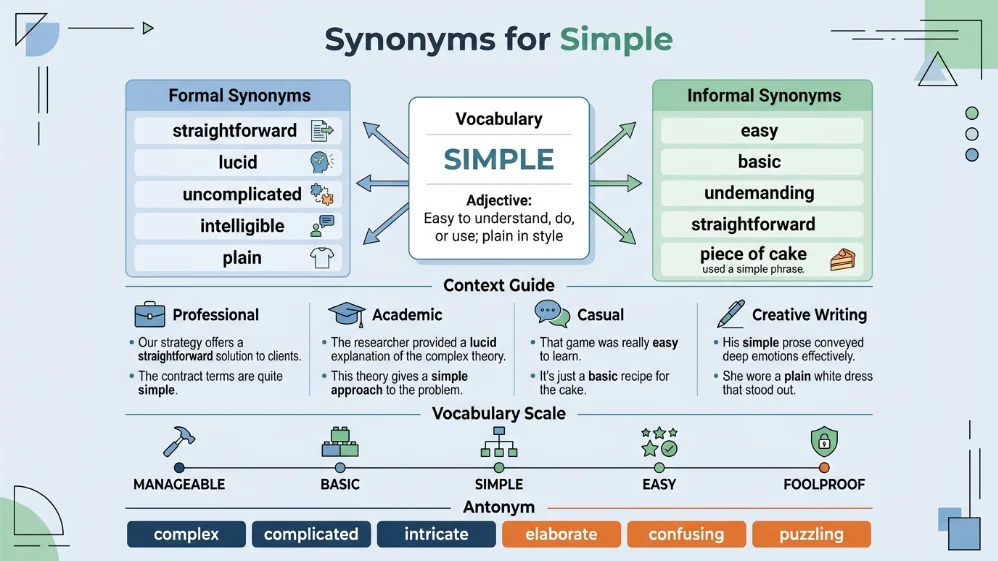
The word “simple” means easy to understand, uncomplicated, or not elaborate. It carries a neutral to positive tone. The best synonyms depend on your context. Use “straightforward” for professional writing, “basic” for casual use, “elementary” for academic explanations, “uncomplicated” for precise clarity, and “plain” for creative descriptions.
Meaning, Tone and Context
1. Simple Definition
Simple describes something that is easy to do, understand, or use. It can also mean something that lacks complexity or decoration.
2. Part of Speech
Simple functions as an adjective. It modifies nouns to describe their nature, difficulty level, or appearance.
3. Positive, Negative, or Neutral Tone
Simple is generally neutral. It can be positive when you mean clear and efficient. It can be negative when you imply something is too basic, unsophisticated, or even foolish.
4. Formality Level
Simple works in all formality levels. It is appropriate for casual conversation, academic writing, and professional communication.
5. Common Use Cases
People use simple to describe instructions, solutions, explanations, designs, meals, decisions, and lifestyles. The word appears in nearly every type of writing and speaking.
6. Important Word Forms
The noun form is “simplicity.” The adverb form is “simply.” The verb form is “simplify.” These related words expand your vocabulary options when discussing ease and clarity.
When and How to Use “Simple”
You should use “simple” when you want to emphasize ease, clarity, or lack of complexity. It works well in many everyday situations.
Here are realistic examples showing different contexts:
Professional Context
The new software has a simple interface that requires minimal training for employees.
Personal Context
My grandmother prefers a simple lifestyle without too many modern gadgets or distractions.
Academic Context
The professor provided a simple explanation of the scientific method for beginners.
Emotional Context
Finding peace after a stressful week often requires simple moments of quiet reflection.
Creative Writing Context
The poet used simple language to evoke deep emotions in her readers.
Social Media Context
Here is a simple three step skincare routine that anyone can follow at home.
Email Context
Please send a simple summary of your findings before our meeting on Thursday.
Resume Context
Developed simple training materials that reduced onboarding time by thirty percent.
Another Word for “Simple”
Professional Writing
Use “straightforward” for workplace communication. It sounds competent and direct without being too casual.
Academic Writing
Use “elementary” or “fundamental” when describing basic concepts in research papers or textbooks.
Casual Conversation
Use “basic” or “easy” when chatting with friends or family. These words feel natural and relaxed.
Emotional Writing
Use “pure” or “uncomplicated” to describe feelings or relationships that are genuine and without hidden issues.
Creative Writing
Use “plain” or “bare” to create vivid imagery. These words add descriptive depth to your storytelling.
Resume and Workplace Use
Use “streamlined” to show efficiency. Use “user friendly” for products or systems.
Social Media Captions
Use “easy” for tutorials. Use “basic” for lifestyle content.
Stronger Meaning
Use “basic” when you want to emphasize fundamental simplicity. Use “elementary” to stress beginner level.
Softer Meaning
Use “easy” for a gentle tone. Use “undemanding” when describing tasks that require little effort.
When Not to Use “Simple”
Sometimes “simple” sounds too vague, too casual, or too general for your intended meaning.
Too Vague
Instead of: The project was simple.
Use: The project was straightforward and required minimal revisions.
Too Casual
Instead of: The legal document is simple.
Use: The legal document is clear and accessible.
Too Weak
Instead of: She has a simple job.
Use: She has an uncomplicated role with clearly defined responsibilities.
Too General
Instead of: The recipe is simple.
Use: The recipe is easy to follow with common kitchen ingredients.
When You Need Precision
Instead of: Simple math is required.
Use: Basic arithmetic is required for this position.
When You Sound Condescending
Instead of: Even a simple person can understand this.
Use: This information is accessible to everyone.
Words Commonly Confused With “Simple”
Simple vs. Easy
“Easy” focuses on effort or difficulty. “Simple” focuses on complexity. A task can be simple in design but not easy to execute.
Simple vs. Basic
“Basic” emphasizes fundamentals and starting points. “Simple” emphasizes lack of complexity. Basic is more about foundations. Simple is more about minimalism.
Simple vs. Plain
“Plain” often describes appearance or decoration. “Simple” describes structure or understanding. Plain food has no extras. Simple food has few ingredients.
Simple vs. Clear
“Clear” focuses on understandability. “Simple” focuses on structure. Clear means free from confusion. Simple means free from complexity.
Simple vs. Foolish
In some contexts, “simple” can mean naive or lacking intelligence. This is informal and potentially offensive. Use “naive” for lack of experience and “uninformed” for lack of knowledge.
Simple vs. Mere
“Mere” emphasizes smallness or insignificance. “Simple” emphasizes lack of complexity. A mere detail is unimportant. A simple detail is easy to understand.
Best Synonym by Context for “Simple”
| Context | Best Synonym | Why It Works | Example |
|---|---|---|---|
| Formal Writing | Straightforward | It sounds professional and precise without being overly complex | The committee adopted a straightforward approach to the budget review |
| Academic Writing | Elementary | It suggests foundational knowledge appropriate for educational settings | Students must understand elementary principles before advancing |
| Professional Business | Streamlined | It implies efficiency and optimization valued in workplace culture | We implemented a streamlined process for client onboarding |
| Resume Use | Clear | It demonstrates communication skills valued by employers | Created clear documentation that reduced errors by forty percent |
| Casual Conversation | Easy | It feels natural and relaxed for everyday speech | The new coffee maker is easy to use even in the morning rush |
| Creative Writing | Plain | It adds descriptive power and visual clarity to narratives | The plain wooden table held memories of a hundred family meals |
| Emotional Tone | Uncomplicated | It suggests relationships or feelings without hidden tension | Their uncomplicated friendship lasted through decades of change |
| Strong Intensity | Bare | It emphasizes extreme minimalism or stark simplicity | The bare room contained only a mattress and a single lamp |
| Soft or Moderate | Gentle | It softens the description to feel less demanding | The gentle pace of village life restored her sense of peace |
| Social Media Captions | Minimal | It aligns with aesthetic trends and clean visual content | Minimal home decor ideas that transform any space instantly |
| US Usage | Easy | American speakers frequently prefer this direct, practical term | The instructions are easy enough for anyone to follow |
| UK Usage | Straightforward | British English often uses this term in both formal and casual contexts | The application process is straightforward with clear guidance |
Which Synonym Should You Choose?
Consider Your Meaning
Think about what you really want to say. Are you describing difficulty, structure, appearance, or understanding? Each aspect requires a different synonym.
Consider Formality Level
Match your word to your audience. Use “straightforward” for professional reports. Use “easy” for casual conversations.
Consider Emotional Intensity
Decide how much feeling you want to convey. “Uncomplicated” suggests emotional relief. “Plain” suggests visual honesty. “Bare” suggests stark vulnerability.
Consider Professional Value
In workplace writing, choose words that demonstrate competence. “Streamlined,” “clear,” and “user friendly” all signal professional communication skills.
Consider Sentence Context
Look at your sentence structure. Short sentences often work best with short synonyms like “easy” or “basic.” Longer sentences can accommodate more sophisticated options like “straightforward” or “uncomplicated.
Real Life Examples of “Simple” in Sentences
School Context
The teacher broke down the complex equation into straightforward steps that even struggling students could follow.
Workplace Context
After streamlining our reporting system, we reduced processing time by nearly half.
Writing Context
Clear prose allows readers to focus on ideas rather than struggling with vocabulary.
Conversation Context
Their uncomplicated approach to problem solving impressed the entire team.
Social Media Context
Basic meal prep strategies that save hours every single week.
Resume Context
Developed user friendly training modules for new employees.
Email Context
Please provide a concise summary of the quarterly results.
Storytelling Context
The bare landscape stretched endlessly under the gray winter sky.
Self Help Content
Living with less often leads to a more fulfilled and peaceful existence.
Product Description
The minimalist design complements any modern interior style.
25 Synonyms for “Simple”
| Synonym | Simple Meaning | Best Used For | Example Sentence |
|---|---|---|---|
| Straightforward | Direct and easy to understand | Professional writing and clear instructions | The contract contains straightforward terms that protect both parties |
| Easy | Requiring little effort | Casual conversation and everyday speech | This recipe is easy enough for beginner cooks to master |
| Basic | Fundamental or elementary | Describing essentials and foundations | You need basic computer skills for this administrative position |
| Uncomplicated | Lacking complexity or difficulty | Precise descriptions of processes | The new time tracking system is uncomplicated and intuitive |
| Plain | Not decorated or elaborate | Creative writing and visual descriptions | She wore a plain black dress that suited her minimalist style |
| Elementary | At the most basic level | Academic and educational contexts | Elementary math concepts form the foundation for advanced study |
| Clear | Free from confusion or ambiguity | Communication and instruction | The manual provides clear guidance for every troubleshooting step |
| Streamlined | Made efficient and simple | Business and professional settings | Our streamlined application process takes just five minutes |
| Minimal | Very small in amount or degree | Social media and design contexts | The minimalist decor creates a calm and focused environment |
| Undemanding | Not requiring much effort or skill | Gentle descriptions of tasks | The position is undemanding and suitable for entry level workers |
| Bare | Having no extra features | Creative writing and stark descriptions | The bare walls reminded him of how little he owned |
| Pure | Free from anything that contaminates | Emotional and descriptive writing | Their pure intentions made the collaboration effortless |
| Mere | Nothing more than | Emphasizing smallness or insignificance | It was a mere misunderstanding that caused the delay |
| Open and shut | Easily decided or resolved | Informal problem solving contexts | The case was open and shut with clear evidence |
| No frills | Basic without extras | Product and service descriptions | The no frills airline offers affordable tickets for budget travelers |
| Straight | Direct and honest | Personal communication | Give me a straight answer about what happened |
| Understandable | Capable of being comprehended | Explaining concepts to others | The professor made the difficult theory understandable |
| Accessible | Easy to approach or understand | Inclusive communication | The website uses accessible language for all reading levels |
| Foolproof | So simple that it cannot fail | Product and system descriptions | This foolproof method guarantees successful results |
| Effortless | Requiring no physical or mental energy | Describing easy experiences | Her effortless style made fashion look natural |
| Painless | Involving no difficulty | Informal descriptions of processes | The registration process was completely painless |
| Uncluttered | Free from unnecessary elements | Design and organization contexts | An uncluttered workspace improves focus and productivity |
| Manageable | Easy to handle or control | Task and project descriptions | Break large projects into manageable daily tasks |
| Readable | Easy to read or understand | Writing and document descriptions | The report is readable even for non technical staff |
| Lucid | Clearly expressed and easy to understand | Formal and academic writing | The author offers a lucid explanation of complex economic theories |
Synonym Groups and Usage Differences
Professional vs. Personal Synonyms
Professional contexts require words that sound capable and efficient. “Streamlined,” “straightforward,” and “clear” all work well in workplace communication.
Personal contexts allow more relaxed language. “Easy,” “basic,” and “effortless” feel natural in conversations with friends and family.
The choice depends on your audience. A job application needs professional synonyms. A text message needs casual synonyms.
Formal vs. Conversational Synonyms
Formal writing suits “lucid,” “straightforward,” and “elementary.” These words appear in reports, academic papers, and professional correspondence.
Conversational English prefers “easy,” “basic,” and “simple” itself. These words keep casual dialogue natural and approachable.
Email communication sits between these levels. Choose based on your relationship with the recipient. Use formal synonyms for clients and supervisors. Use conversational synonyms for colleagues and team members.
Academic Synonyms
Academic writing values precision and clarity. “Elementary,” “fundamental,” and “basic” describe foundational concepts. “Lucid” describes clear explanations.
“Straightforward” works well in research papers. “Uncomplicated” appears in scientific writing when describing processes or results.
Academic synonyms should sound objective and precise. Avoid casual words like “easy” or “effortless” in formal academic work.
Professional and Business Synonyms
Business communication favors words that demonstrate efficiency and competence. “Streamlined” suggests optimized processes. “Clear” suggests effective communication.
“User friendly” describes products or systems. “Manageable” describes workloads and projects. “Straightforward” describes procedures and requirements.
Resumes benefit from “streamlined,” “clear,” and “accessible.” These words show employers that you value clarity and efficiency.
Creative or Literary Synonyms
Creative writing benefits from vivid and evocative synonyms. “Plain” describes visual simplicity. “Bare” suggests emotional vulnerability. “Pure” suggests moral or emotional clarity.
These words add depth to descriptions. A “plain” room feels different from a “bare” room. Plain suggests simple style. Bare suggests emptiness or loneliness.
Choose creative synonyms based on the emotional effect you want. “Uncluttered” feels peaceful. “Bare” feels stark. “Plain” feels honest.
Slang or Modern Synonyms
Modern informal speech uses phrases like “no frills” and “open and shut.” These expressions work well in casual conversation but not in formal writing.
“Straight” as in “straight answer” appears in modern dialogue. It is acceptable in informal settings but too casual for professional communication.
Use slang synonyms carefully. They can make you sound current and approachable. They can also make you sound unprofessional in formal contexts.
Strongest vs. Weaker Synonyms
Intensity scale from mild to strongest for describing simplicity:
- Manageable – Mildest. Suggests something is controllable.
- Understandable – Suggests comprehension is possible.
- Clear – Suggests freedom from confusion.
- Straightforward – Suggests directness and clarity.
- Elementary – Suggests beginner level ease.
- Basic – Suggests fundamental simplicity.
- Uncomplicated – Emphasizes lack of difficulty.
- Effortless – Suggests no effort required at all.
- Foolproof – Strongest. Suggests impossibility of failure.
Choose your intensity based on how easy something really is. A manageable task still requires effort. A foolproof task requires almost none.
Emotional vs. Neutral Synonyms
Emotional synonyms add feeling to your descriptions. “Pure” suggests goodness or innocence. “Bare” suggests vulnerability. “Plain” can suggest honesty or lack of pretension.
Neutral synonyms stay factual. “Straightforward,” “basic,” and “clear” describe without emotional coloring.
Choose emotional synonyms when you want to create atmosphere or feeling. Choose neutral synonyms when you want to state facts objectively.
Antonyms of “Simple”
| Antonym | Meaning | Example Sentence |
|---|---|---|
| Complex | Having many interconnected parts | The complex machinery required extensive maintenance |
| Complicated | Difficult to understand or deal with | The complicated legal procedure confused everyone involved |
| Difficult | Requiring much effort or skill | The difficult exam tested years of accumulated knowledge |
| Sophisticated | Highly developed and complex | The sophisticated software required advanced training |
| Elaborate | Involving many details or decoration | The elaborate wedding cake featured intricate sugar flowers |
| Intricate | Very detailed and complicated | The intricate design took months to complete |
| Advanced | At a high level of development | The advanced course material challenged even the best students |
| Challenging | Testing one’s abilities | The challenging puzzle required hours of concentration |
| Demanding | Requiring much time or attention | The demanding project stretched the team’s resources |
| Detailed | Having many individual elements | The detailed report examined every aspect of the problem |
| Complexified | Made more complex | The complexified system confused new users |
| Opaque | Not clear or transparent in meaning | The opaque contract language hid several important clauses |
| Convoluted | Extremely complex and difficult to follow | The convoluted plot left audiences confused |
| Byzantine | Excessively complicated and intricate | The byzantine bureaucracy frustrated everyone |
| Multifaceted | Having many aspects or sides | The multifaceted problem required multiple solutions |
Comparison: Simple vs. Similar Words
Simple vs. Easy
Main Difference
Simple describes lack of complexity. Easy describes lack of difficulty. A task can be simple in design yet difficult to perform.
Which One Is Stronger
Easy is stronger for effort. Simple is stronger for structure.
Which One Is More Formal
Simple is more formal in academic writing. Easy is more casual.
Example Sentence for Simple
The simple recipe has only three ingredients.
Example Sentence for Easy
The recipe is easy to follow even for beginners.
Simple vs. Basic
Main Difference
Basic means fundamental or essential. Simple means not complex or elaborate. Basic is about essentials. Simple is about minimalism.
Which One Is Stronger
Basic is stronger for foundational meaning. Simple is stronger for lack of complexity.
Which One Is More Formal
Both are acceptable. Basic appears more in academic contexts.
Example Sentence for Simple
Her simple outfit consisted of jeans and a white shirt.
Example Sentence for Basic
Basic algebra skills are required for this position.
Simple vs. Plain
Main Difference
Plain describes appearance or lack of decoration. Simple describes structure or understanding. Plain is visual. Simple is functional.
Which One Is Stronger
Plain is stronger for visual descriptions. Simple is stronger for understanding.
Which One Is More Formal
Simple is more formal. Plain can sound too ordinary in professional writing.
Example Sentence for Simple
The simple explanation helped everyone understand.
Example Sentence for Plain
She preferred plain furniture without any ornamentation.
Simple vs. Straightforward
Main Difference
Straightforward means direct and honest. Simple means not complex. Straightforward emphasizes clarity of direction. Simple emphasizes lack of parts.
Which One Is Stronger
Straightforward is stronger for professional contexts. Simple is broader in use.
Which One Is More Formal
Straightforward is more formal and professional.
Example Sentence for Simple
They took the simple solution to the problem.
Example Sentence for Straightforward
The straightforward solution saved time and resources.
Simple vs. Elementary
Main Difference
Elementary means at the most basic level. Simple means not complex. Elementary suggests a starting point. Simple suggests minimal complexity.
Which One Is Stronger
Elementary is stronger for educational contexts. Simple is broader.
Which One Is More Formal
Elementary is more formal and academic.
Example Sentence for Simple
The simple instructions made assembly quick.
Example Sentence for Elementary
Students learned elementary concepts in the first semester.
Simple vs. Uncomplicated
Main Difference
Uncomplicated emphasizes freedom from complexity. Simple can mean either freedom from complexity or lack of sophistication. Uncomplicated is more clearly positive.
Which One Is Stronger
Uncomplicated is stronger and more positive. Simple can be neutral or negative.
Which One Is More Formal
Uncomplicated is slightly more formal.
Example Sentence for Simple
The simple design appealed to many customers.
Example Sentence for Uncomplicated
The uncomplicated design won praise for its elegance.
Common Phrases and Expressions with “Simple”
1. Keep It Simple
Meaning
A common expression advising people to avoid unnecessary complexity.
Example Sentence
When explaining technical concepts, always keep it simple for your audience.
2. Simple as That
Meaning
Used to emphasize that something is very easy or straightforward.
Example Sentence
Just follow the instructions and you will be finished, simple as that.
3. Simple Truth
Meaning
An obvious or fundamental fact that is easy to understand.
Example Sentence
The simple truth is that consistent effort produces results over time.
4. Simple Pleasures
Meaning
Small, easily accessible things that bring happiness.
Example Sentence
She found joy in simple pleasures like morning coffee and good books.
5. Plain and Simple
Meaning
Used for emphasis to state something that is clearly true.
Example Sentence
The decision was about money, plain and simple.
6. Simple Living
Meaning
A lifestyle that focuses on minimalism and reducing material possessions.
Example Sentence
Simple living appeals to those seeking more meaning with less stress.
7. Simple Simon
Meaning
A name used for someone considered naive or foolish.
Example Sentence
Stop acting like Simple Simon and think carefully before deciding.
8. Simple Interest
Meaning
A financial term for interest calculated only on the original amount.
Example Sentence
Simple interest is easier to calculate than compound interest.
Common Mistakes to Avoid
1. Using “Simple” When a More Precise Synonym Is Better
Many writers default to “simple” when a more accurate word exists. Before using “simple,” ask yourself what you really mean.
The solution was simple.
The solution was straightforward and easy to implement.
2. Confusing “Simple” with “Easy”
Remember that simple means not complex. Easy means not difficult. A simple machine can still be hard to operate correctly.
3. Using a Casual Synonym in Formal Writing
Words like “easy” and “basic” can sound too informal in professional documents. Choose “straightforward” or “clear” for workplace communication.
4. Using an Overly Dramatic Synonym for a Simple Situation
Words like “effortless” and “foolproof” suggest extreme ease. Reserve these for situations that truly require no effort or cannot fail.
5. Repeating the Same Word Too Often
Variety improves your writing. Use different synonyms throughout your text. Your readers will appreciate the diversity.
6. Choosing a Synonym with the Wrong Emotional Tone
“Bare” suggests vulnerability. “Plain” suggests honesty. “Minimal” suggests style. Match your word to your intended emotional effect.
7. Using Slang in Academic or Professional Writing
Avoid “no frills” and “open and shut” in formal contexts. These expressions sound casual and unprofessional in serious documents.
FAQs
1. What is the best synonym for simple?
The best synonym depends on your context. “Straightforward” works well professionally. “Easy” works well casually. “Uncomplicated” offers a precise neutral choice.
2. What is a formal synonym for simple?
“Straightforward” and “lucid” are formal synonyms for simple. Use them in professional reports, academic papers, and formal correspondence.
3. What is an informal synonym for simple?
“Easy” and “basic” are informal synonyms for simple. They work well in conversations, text messages, and casual social media posts.
4. What is another word for simple in professional writing?
Streamlined” and “straightforward” are excellent professional alternatives. “Clear” and “accessible” also work well in workplace communication.
5. What is the difference between simple and straightforward?
Simple means not complex. Straightforward means direct and honest. Straightforward is more professional and suggests clarity in process.
6. What is the opposite of simple?
The main opposites are “complex,” “complicated,” and “sophisticated.” Choose based on whether you mean structure, difficulty, or development.
Conclusion
The word “simple” serves many purposes, but your vocabulary should never stay simple forever. Understanding the subtle differences between synonyms helps you communicate with precision and style.
Remember that context determines your best choice. A straightforward explanation works in professional reports. An easy recipe works in casual conversation. A plain description works in creative writing.
Pay attention to tone, formality, and emotional impact. These factors guide you toward the right synonym every time.
The more alternatives you know, the more control you have over your message. Start small. Replace “simple” with one new synonym in your writing today. Tomorrow, try another. Your vocabulary will grow naturally and effectively.