Have you ever written an email and realized you used the word “focus” three times in two sentences? It happens to everyone. You might be writing a performance review, a college essay, or even a caption for social media. The word feels correct, but it starts to sound repetitive and dull.
Your message becomes less powerful. You want to sound professional or creative, but the constant repetition of “focus” holds you back. This guide will help you break that habit. You will discover the perfect synonym for every situation you face.
What Does Focus Mean?
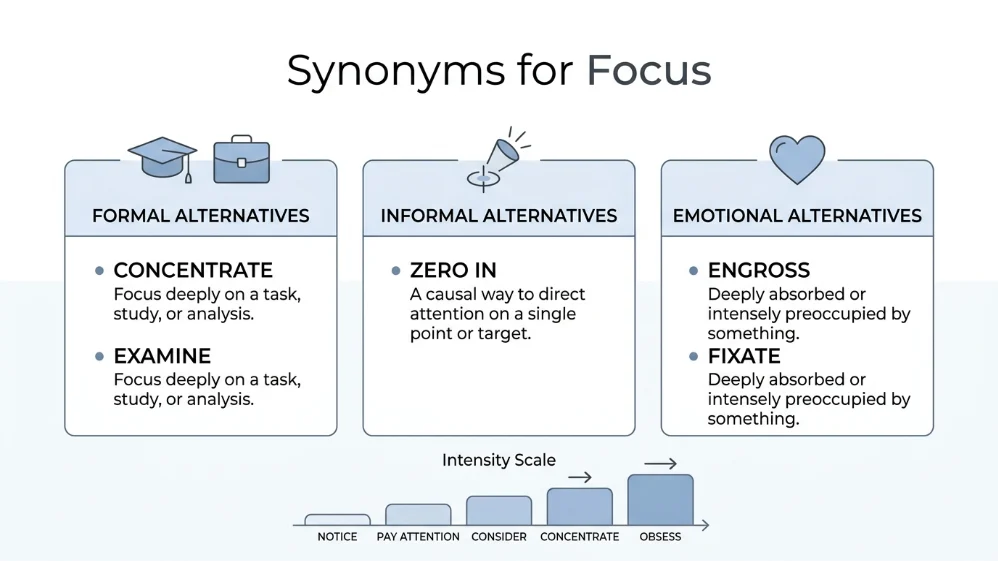
Focus means to direct your attention or effort toward a specific subject or activity. The best synonyms depend on your context. For professional use, try “concentrate” or “prioritize.” For creative writing, use “fixate” or “engross.” In casual conversation, “zero in” works well.
Meaning, Tone and Context
Understanding the core meaning of “focus” is the first step to replacing it effectively.
- Simple definition: To direct your mental energy and attention to a single point or task.
- Part of speech: It functions as both a noun and a verb. For example, “I need to focus” (verb) and “My focus is on the project” (noun).
- Tone: The tone is neutral. It describes a state of being without inherent positive or negative judgment. However, the synonyms you choose will add a specific flavor.
- Formality level: “Focus” is versatile. It is acceptable in all contexts, from casual chats to formal reports. It is a safe, default choice.
- Common use cases: You will see it used in workplaces, schools, personal development, and creative projects. It helps describe goals, attention, and energy.
- Important word forms: The noun “focus” can also be written as “focuses” or “foci” (plural). The adjective form is “focused.” The verb can be conjugated as “focusing” or “focussed.”
When and How to Use “Focus”
Use “focus” when you want to describe the general act of paying attention. It is a great starting point. However, knowing when to use it, and when to choose a specific synonym, makes your writing more precise. Here are realistic examples in different contexts.
- Professional Context: “Our team needs to focus on the quarterly sales goals to ensure we meet our targets.”
- Personal Context: “I find it difficult to focus on my reading when the television is on in the background.”
- Academic Context: “In this essay, I will focus on the economic impacts of the new policy.”
- Creative Context: “The photographer adjusted the lens to focus on the flower in the foreground.”
- Emotional Context: “After the argument, she tried to focus on her breathing to calm down.”
- Resume Context: “I can focus my energy on completing complex tasks under tight deadlines.”
- Social Media Caption: “Focus on the journey, not the destination. Every step counts.”
Another Word for “Focus”
Choosing the single best replacement depends entirely on your goal. Are you trying to sound smarter? Are you trying to show you are a dedicated worker? Or are you trying to express a deep emotional state? Your context determines your choice.
- Professional writing: Concentrate
- Academic writing: Examine
- Casual conversation: Zero in
- Emotional writing: Engross
- Creative writing: Fixate
- Resume or workplace: Prioritize
- Social media captions: Spotlight
- Stronger meaning: Obsess
- Softer meaning: Notice
When Not to Use “Focus”
Sometimes, “focus” sounds too vague or too general. If you are writing a formal report or a creative story, a more precise word will improve your sentence significantly. Avoid using it when you need to show intensity, deep analysis, or specific action.
For instance, “I will focus on the data” is correct. However, it lacks impact. If you are a data analyst, you are not just looking. You are analyzing. A better sentence is, “I will analyze the data for trends.” This shows a higher level of skill and engagement. Using “focus” often downplays the true nature of the action.
Words Commonly Confused With “Focus”
Several words are related to “focus” but have subtle differences. Using the wrong one can confuse your reader or weaken your argument.
- Concentration: This is almost a direct synonym. However, it often refers to the mental effort itself. Focus is the act of directing that effort.
- Attention: This is broader. You can pay attention to many things at once. Focus means singling out one specific thing.
- Obsession: This is a negative and intense form of focus. It implies a lack of control or an unhealthy fixation.
- Attention span: This is a noun that describes the length of time you can focus. It is not a verb to replace “focus.”
- Distraction: This is the exact opposite of focus. It is what pulls your attention away. Do not confuse the two.
- Meditation: While it involves focus, meditation is a specific practice. It does not mean the same as “to focus” in a general sense.
Best Synonym by Context for “Focus”
This table provides the ultimate cheat sheet for selecting the perfect synonym. Choose the word that fits your specific situation.
| Context | Best Synonym | Why It Works | Example |
|---|---|---|---|
| Formal Writing | Concentrate | It is neutral, professional, and universally understood. | “The committee will concentrate on the budget review.” |
| Academic Writing | Examine | It suggests a thorough and critical analysis, not just a glance. | “The study will examine the effects of the treatment.” |
| Professional Use | Prioritize | It shows action and decision making. You are focusing on what is most important. | “Please prioritize the client’s urgent requests.” |
| Resume | Channel | It implies you are directing your energy and skills effectively toward a goal. | “I can channel my efforts to increase team productivity.” |
| Casual Conversation | Zero In | It is modern, conversational, and paints a picture of precision. | “Let’s zero in on the main issue here.” |
| Creative Writing | Fixate | It adds an emotional or psychological intensity to the attention. | “His eyes would fixate on the horizon for hours.” |
| Emotional Tone | Engross | It shows you are completely absorbed and captivated by something. | “She was so engrossed in the book that she forgot the time.” |
| Strong Intensity | Obsess | This is the most powerful option. It shows a consuming, relentless focus. | “He would obsess over every tiny detail in his project.” |
| Soft or Moderate | Notice | This is a gentle form of focus. You are simply giving something your attention. | “She noticed a slight change in his tone of voice.” |
| Social Media Captions | Spotlight | It is a visual and active word. It implies you are highlighting a specific thing. | “Let’s spotlight the hard work of our team members.” |
Which Synonym Should You Choose?
Choosing the right word is a matter of analyzing your goal. First, think about your audience. Are they business executives or close friends? Formal writing requires formal synonyms.
Second, define the intensity of the focus. Are you casually looking at something, or are you completely absorbed? An emotional situation calls for a stronger word like “engrossed,” while a simple observation calls for “notice.”
Finally, consider the action itself. Are you directing energy, analyzing data, or simply watching? This will guide you to the most precise word. The table above is a great place to start your decision making process.
Real Life Examples of “Focus” in Sentences
Seeing synonyms in action helps you understand their true power. Let’s look at how they can transform sentences in everyday situations.
School: Instead of saying “I need to focus on my studies,” try “I need to concentrate on my studies.” It sounds more determined.
Workplace: Rather than “We will focus on customer service,” say “We will prioritize customer service.” This shows clear intention.
Writing: Instead of “I will focus on the character’s motivation,” you can write “I will examine the character’s motivation.” This sounds more analytical.
Conversation: If a friend is talking about a problem, you might say “Let’s zero in on the root cause.” This is more engaging than “Let’s focus on the root cause.”
Social Media: A photo of a sunset is better captioned with “When your mind fixates on the beauty around you” instead of the simple and bland “When you focus on the beauty.”
Email: In an email, you can say “I will channel my efforts into completing this proposal.” This shows dedication more effectively than “I will focus.”
Storytelling: A character in a story can be “engrossed in the mystery,” which is a much more descriptive and immersive phrase than “focused on the mystery.”
25 Synonyms for “Focus”
This table provides a wide array of accurate synonyms. Each one has a unique meaning and best use case to help you diversify your vocabulary.
| Synonym | Simple Meaning | Best Used For | Example Sentence |
|---|---|---|---|
| Concentrate | Direct your attention. | Professional and academic writing. | We must concentrate on the most critical tasks first. |
| Center | Be at the core of something. | Writing about a subject or theme. | The argument centers on the ethical dilemma. |
| Examine | Look closely and analyze. | Academic research and analysis. | The scientist will examine the data carefully. |
| Zero In | Move toward a specific point. | Modern and casual communication. | Let’s zero in on the source of this problem. |
| Hone | Perfect or sharpen a skill. | Personal development and resumes. | I am working to hone my presentation skills. |
| Converge | Come together on a point. | Describing groups or ideas. | The different theories converge on one main idea. |
| Direct | Aim something toward a goal. | Professional and leadership contexts. | We need to direct our resources to marketing. |
| Channel | Direct energy or effort. | Resumes and team management. | She can channel her creativity into great designs. |
| Engross | Capture all your attention. | Creative and emotional situations. | The movie’s plot will engross the entire audience. |
| Fixate | Pay attention in a fixed way. | Psychological or intense description. | He tends to fixate on minor imperfections. |
| Obsess | Dominate your thoughts. | Emotional and strong descriptions. | The writer would obsess over each word choice. |
| Highlight | Emphasize a specific part. | Social media and visual contexts. | This section will highlight the main findings. |
| Spotlight | Shine a light on something. | Presentations and team meetings. | We want to spotlight our employee of the month. |
| Prioritize | Rank as more important. | Business and project management. | We must prioritize the user experience. |
| Attend | Give your attention to. | Formal or polite communication. | He will attend to the matter immediately. |
| Meditate | Reflect or think deeply. | Spiritual or thoughtful contexts. | He would meditate on the question for hours. |
| Contemplate | Think about deeply. | Philosophical and deep thought. | She would contemplate the meaning of the poem. |
| Study | Apply the mind to learning. | Academic and learning contexts. | You must study the material for the test. |
| Pinpoint | Find the exact location of. | Problem solving and analysis. | We need to pinpoint the source of the error. |
| Zoom In | Look at a small detail. | Visual and detailed analysis. | The photographer zoomed in on the flower. |
| Lock On | Fix your attention tightly. | Modern and dynamic phrases. | He locked on to the idea and wouldn’t let go. |
| Absorb | Take in information. | Personal and learning situations. | She absorbed every detail of the lecture. |
| Gaze | Look steadily and intently. | Creative and descriptive writing. | He would gaze at the stars every night. |
| Scrutinize | Examine very carefully. | Formal and detailed analysis. | The auditor will scrutinize every file. |
| Observe | Watch carefully. | Scientific and formal observation. | The doctor will observe the patient’s progress. |
Synonym Groups and Usage Differences
Professional vs. Personal Synonyms
In professional settings, use “prioritize,” “channel,” or “direct.” These are action oriented. They show that you are making strategic decisions. In personal contexts, you might use “focus” itself. However, “center” is also a good choice for describing personal growth. For example, “I need to center myself” feels more personal and holistic than “I need to focus.”
Formal vs. Conversational Synonyms
Formal writing requires precise and standard vocabulary. “Concentrate,” “examine,” and “attend” are perfect for reports and speeches. They are clear and unambiguous. Conversational words like “zero in” and “zoom in” are more modern and fluid. They fit well in casual emails, texts, or friendly conversations.
Academic Synonyms
Academic writing demands accuracy and specificity. Use words like “examine,” “study,” “contemplate,” and “scrutinize.” These words show a high level of intellectual engagement. They suggest that you are not just looking but actively analyzing and engaging with the material. This is crucial for research papers and essays.
Professional and Business Synonyms
In business, time is valuable. You need to show that you are efficient and goal oriented. “Prioritize” is a key word. It shows you can manage time and resources. “Channel” is also useful for showing strategic effort. These words make you sound proactive and effective, which are highly valued traits.
Creative or Literary Synonyms
To add color and emotion to your writing, choose “engross,” “fixate,” or “gaze.” These words create vivid imagery. They help the reader feel the intensity of the character’s or narrator’s attention. A writer must “engross” the reader. A poet might “gaze” at the moon. These words are more evocative than the simple “focus.”
Slang or Modern Synonyms
While there are few modern slang words for “focus,” phrases like “lock on” are contemporary. They are acceptable in modern, dynamic contexts. They are too casual for formal writing. However, they work well in digital marketing, social media, and modern storytelling. Always know your audience before using them.
Strongest vs. Weaker Synonyms
The intensity scale for focus ranges from mild to extreme.
Mild: Notice, observe.
Moderate: Concentrate, examine.
Intense: Engross, fixate.
Extreme: Obsess.
Choose “notice” for a simple observation. Choose “obsess” to describe a very powerful and consuming focus. The middle ground, like “concentrate,” is safe for most situations.
Emotional vs. Neutral Synonyms
Some synonyms are purely factual. “Examine” and “study” have no emotional weight. They describe an action. Other words, like “engross” and “obsess,” are charged with emotion. They describe a feeling. If you are writing a report, stick to neutral words. If you are telling a story, use emotional ones to connect with the reader.
Antonyms of “Focus”
These antonyms are just as important as synonyms. They help you describe the opposite state.
| Antonym | Meaning | Example Sentence |
|---|---|---|
| Distract | To draw attention away. | The noise from outside will distract me. |
| Neglect | To fail to care for properly. | He would neglect his other duties. |
| Ignore | To refuse to take notice. | It is best to ignore the negative comments. |
| Overlook | To fail to notice. | It is easy to overlook a small detail. |
| Disregard | To pay no attention to. | She would disregard his advice. |
| Scatter | To spread things apart. | My thoughts would scatter under pressure. |
| Disperse | To go in different directions. | The crowd will disperse after the event. |
| Wander | To move without a set course. | My mind would wander during the lecture. |
| Drift | To move slowly without purpose. | His attention began to drift. |
| Diverge | To move in different directions. | Our opinions tend to diverge on this topic. |
| Confuse | To make unclear or mislead. | Too many options will confuse the customer. |
| Bewilder | To confuse completely. | The complex instructions will bewilder you. |
| Perplex | To puzzle or confuse. | This problem will perplex the students. |
| Unsettle | To make uncertain or uneasy. | The news would unsettle his focus. |
| Muddle | To cause a state of confusion. | The constant interruptions would muddle my thinking. |
Comparison: Focus vs. Similar Words
Understanding the differences between similar words is key to using them perfectly.
Focus vs. Concentration
The main difference is that concentration is often the effort, while focus is the target. You might say “I need to focus on my breathing.” You could also say “I need to concentrate on my breathing.” However, “concentration” often implies a more intense, sustained effort. “Focus” can be a bit more general. “Concentration” is slightly more formal.
Focus vs. Attention
Attention is the general act of noticing something. Focus is the specific act of singling something out. You can have your attention caught by a loud noise. You choose to focus on a specific task. Attention is more passive. Focus is active.
Focus vs. Fixation
Fixation is an intense and often unhealthy form of focus. It is psychological. Focus can be a healthy, temporary state. Fixation implies a lack of control. You might focus on a project at work. You might fixate on a past mistake, which is much more negative.
Focus vs. Obsession
Obsession is an extreme, negative form of focus. It dominates your thoughts and often has negative consequences. Focus is a neutral, productive state. Obsession is a psychological condition. Use “focus” for work. Use “obsession” to describe a mania or unhealthy interest.
Focus vs. Prioritize
Prioritize is an action. It means to decide that one thing is more important than others. Focus is the state of paying attention. You prioritize your tasks to decide what to do first. You then focus your energy on that task. Prioritize is about planning. Focus is about doing.
Focus vs. Scrutinize
Scrutinize implies a very detailed and critical examination. Focus can be about the general concept. Scrutinize is about the process of looking for flaws or details. You might focus on a painting. An art critic will scrutinize it for technical errors.
Common Phrases and Expressions with “Focus”
1. In Focus
Meaning: Clearly visible or the main point of attention.
Example sentence: The real issue is now in focus for the entire team.
2. Out of Focus
Meaning: Not clear or not the main point of attention.
Example sentence: The background of the photo is out of focus.
3. Focus Group
Meaning: A small group of people gathered to discuss a product or idea.
Example sentence: The marketing team will hold a focus group to test the new product.
4. Focus on the Big Picture
Meaning: To concentrate on the overall goal and not small details.
Example sentence: In this meeting, we need to focus on the big picture rather than minor problems.
5. Laser Focus
Meaning: An extremely intense and sharp concentration.
Example sentence: The team has a laser focus on achieving our record sales this quarter.
6. Shift Your Focus
Meaning: To change your attention from one thing to another.
Example sentence: We must shift our focus from cost cutting to innovation.
7. Bring Into Focus
Meaning: To make something clear and easy to understand.
Example sentence: This new evidence brings the case into sharper focus.
Common Mistakes to Avoid
Avoiding these common errors will instantly improve your writing and speaking.
- Using “focus” when you need action: Don’t say “I will focus on the report” when you can say “I will finish the report.” Focus is the preparation, not the action itself.
- Overusing “focus” for intensity: If the situation is serious or emotional, use a stronger word. “She was obsessed” is more powerful than “She was focused.”
- Using a casual synonym in formal writing: Do not use “zero in” in a legal contract. Use “concentrate” or “examine” for formal accuracy.
- Using an overly dramatic synonym in a simple situation: Saying “I am obsessed with this meal” is too dramatic. Saying “I really like this meal” or “I am focused on enjoying it” is more appropriate.
- Repeating the same word: This is the core problem. If you have used “focus” once, try to use “concentrate” or “center” the next time.
- Choosing a synonym with the wrong emotional tone: Do not use “fixate” in a job interview. It sounds unstable. Use “dedicate” or “commit.”
- Using slang in academic writing: Avoid phrases like “zoom in” in a research paper. Always choose the most precise and formal word available.
FAQs
- What is the best synonym for focus?
“Concentrate” is the best all purpose synonym. It works in nearly every context, from professional to personal. - What is a formal synonym for focus?
“Examine” and “scrutinize” are excellent formal synonyms. They suggest a deeper, more analytical level of attention. - What is an informal synonym for focus?
“Zero in” is a great informal synonym. It is perfect for modern, casual conversations and digital communication. - What is another word for focus in professional writing?
“Prioritize” and “channel” are the best choices for professional writing. They show strategic thinking and action. - What is the difference between focus and concentration?
Concentration often describes the mental effort or act of focusing. Focus describes the specific target of that effort. - What is the opposite of focus?
“Distract” and “ignore” are the primary opposites of focus. They describe a lack of attention or a withdrawal of it.
Conclusion
You now have a powerful tool at your fingertips. “Focus” is a good word, but a single good word becomes repetitive. Replacing it with the right synonym adds depth, clarity, and professionalism to your communication. Remember to consider your context. Think about your audience and the intensity of the situation. Use the tables and examples in this guide to make confident word choices. Your vocabulary will become more precise, and your writing will be far more engaging as a result.