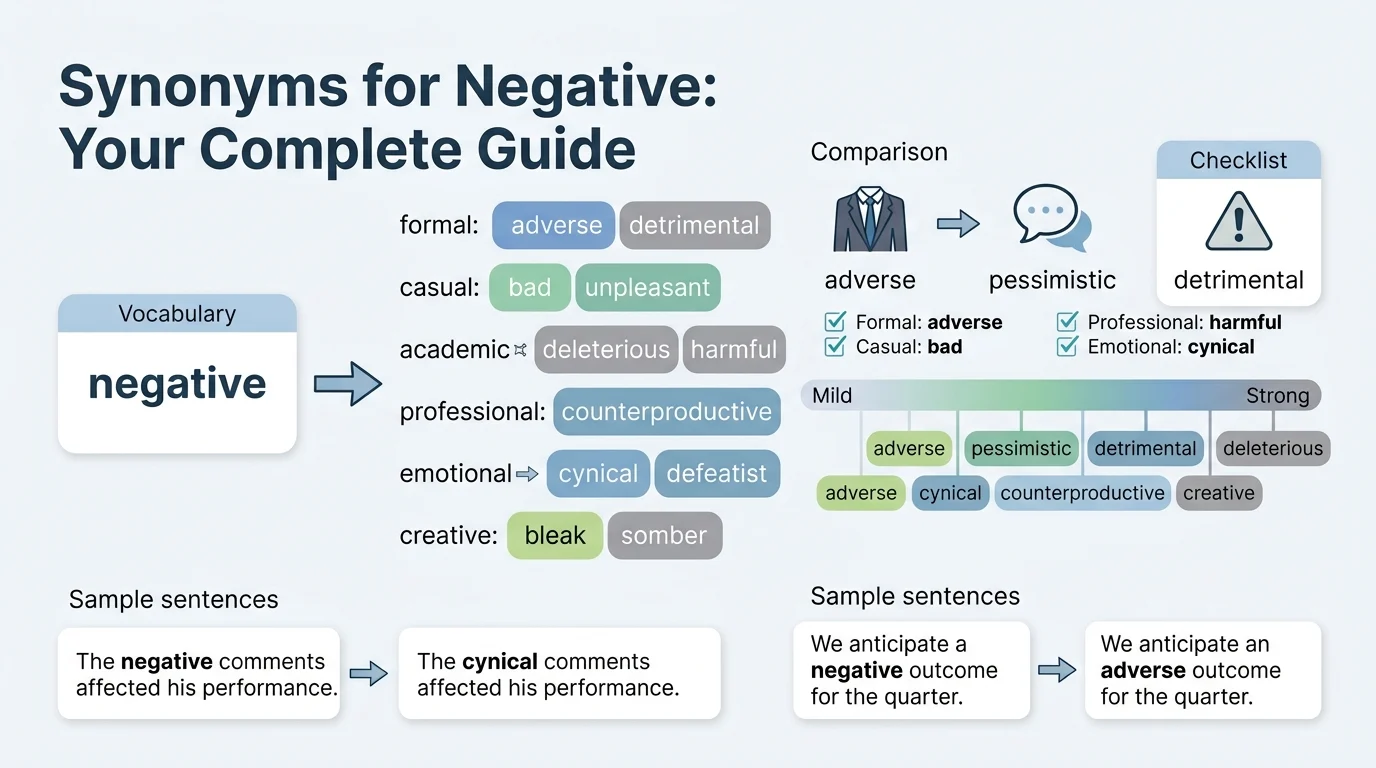
Do you find yourself using the word “negative” over and over again in your writing, emails, or conversations? You are not alone.
Many English learners, students, and professionals struggle to find fresh alternatives for this common word.
Using the same word repeatedly can make your writing feel dull and unoriginal.
Whether you are drafting an email, writing an essay, or preparing a professional presentation, having a rich vocabulary of synonyms for negative will help you communicate more precisely.
This guide will give you over 50 powerful alternatives for “negative” with clear explanations, real examples, and context based recommendations.
You will learn exactly which synonym to choose for every situation, from casual conversations to formal academic writing.
Let us expand your vocabulary and make your communication stronger.
What Does “Negative” Mean?
“Negative” describes something bad, harmful, or expressing refusal or denial. The best synonyms depend on context. Use “adverse” for formal writing, “pessimistic” for attitudes, “detrimental” for harmful effects, and “unfavorable” for professional contexts. For casual speech, try “bad” or “downside.”
Meaning, Tone and Context
Simple Definition
“Negative” refers to something that is bad, harmful, unwanted, or expresses opposition or refusal.
It can describe attitudes, outcomes, feedback, emotions, or the absence of something positive.
Part of Speech
“Negative” functions as an adjective, noun, and verb.
As an adjective, it describes something undesirable. As a noun, it refers to a bad aspect or a photographic image. a verb, it means to reject or veto.
Tone
“Negative” has a clearly negative tone. It conveys disappointment, criticism, harm, or lack of approval.
The tone can range from mild disapproval to strong rejection depending on the context.
Formality Level
“Negative” is neutral and works in almost all contexts, from casual conversation to formal reports.
However, more precise formal synonyms can elevate your writing in professional and academic settings.
Common Use Cases
You will use “negative” to describe feedback, results, emotions, attitudes, consequences, responses, and reviews.
It appears frequently in business communication, academic writing, personal conversations, and emotional expression.
Important Word Forms
Adjective: negative
Noun: negativity, negative
Adverb: negatively
Opposite: positive
When and How to Use “Negative”
Use “negative” when you need a straightforward, neutral word to describe something undesirable or opposing.
It works well in most situations because it is widely understood and not too strong or too weak.
However, for more specific or impactful communication, consider using a synonym that adds precision.
Professional Context
The quarterly report showed negative growth in the European market.
Academic Context
The study found a negative correlation between screen time and sleep quality.
Personal Context
I have been feeling negative about my job prospects lately.
Emotional Context
Her negative reaction to the news surprised everyone in the room.
Creative Context
The character’s negative outlook on life slowly transformed into cautious hope.
Social Media Context
The comments on that post were overwhelmingly negative.
Email Context
Please provide feedback on the proposal, both positive and negative points.
Resume Context
I turned a negative situation into a learning opportunity for the entire team.
Another Word for “Negative”
The best single replacement for “negative” depends entirely on your context and what you want to emphasize.
Professional Writing
Use “unfavorable” for a neutral, business appropriate alternative. It sounds objective and measured.
Academic Writing
Use “adverse” to describe harmful effects or conditions in research papers.
Casual Conversation
Use “bad” for simple, everyday situations where formality is not required.
Emotional Writing
Use “pessimistic” to describe a hopeless or gloomy outlook on life.
Creative Writing
Use “bleak” to create a sense of desolation, hopelessness, or grim reality.
Resume or Workplace Use
Use “constructive criticism” when referring to feedback, or “challenging” to reframe difficulties.
Social Media Captions
Use “toxic” for strong negative energy, or “rough” for a casual description of a bad day.
Stronger Meaning
Use “detrimental” for something seriously harmful or damaging.
Softer Meaning
Use “unfortunate” to describe something disappointing but not terrible.
When Not to Use “Negative”
“Negative” sounds too vague when you need to describe a specific type of harm, attitude, or outcome.
It can feel too weak for serious situations and too formal for casual conversations.
Consider these examples where a more precise synonym improves the sentence.
Weak: The new policy had a negative effect on employee morale.
Better: The new policy had a demoralizing effect on employee morale.
Weak: His negative comments made everyone uncomfortable.
Better: His hostile comments made everyone uncomfortable.
Weak: The weather forecast looks negative for our outdoor event.
Better: The weather forecast looks unfavorable for our outdoor event.
Words Commonly Confused With “Negative”
Negative vs. Pessimistic
“Negative” describes something bad or opposing in general. “Pessimistic” specifically describes a tendency to expect the worst outcome.
Use “negative” for facts or situations. Use “pessimistic” for attitudes and outlooks.
Negative vs. Adverse
“Negative” is a general term for something bad. “Adverse” specifically describes harmful effects or conditions, especially in formal contexts.
Use “adverse” in medical, scientific, or professional writing when discussing harmful consequences.
Negative vs. Detrimental
“Negative” can describe mild to serious bad effects. “Detrimental” always implies significant harm or damage.
Use “detrimental” when you want to emphasize serious negative consequences.
Negative vs. Unfavorable
“Negative” is broad and neutral. “Unfavorable” sounds more objective and is common in business and professional contexts.
Use “unfavorable” in reports, reviews, and professional evaluations.
Negative vs. Nihilistic
“Negative” describes something bad or opposing. “Nihilistic” refers to a philosophical belief that life has no meaning.
Use “nihilistic” only when discussing philosophy or extreme existential despair.
Negative vs. Opposing
“Negative” often implies something bad or harmful. “Opposing” simply means being against something without the bad connotation.
Use “opposing” when you mean disagreement or resistance without judgment.
Best Synonym by Context for “Negative”
| Context | Best Synonym | Why It Works | Example |
|---|---|---|---|
| Formal Writing | Adverse | Sounds precise and authoritative | The adverse conditions delayed the project significantly. |
| Academic Writing | Detrimental | Emphasizes serious harmful effects | Sleep deprivation has detrimental effects on cognitive function. |
| Professional Business | Unfavorable | Remains objective and measured | The company faced unfavorable market conditions. |
| Resume Writing | Challenging | Reframes difficulties positively | I successfully managed challenging client relationships. |
| Casual Conversation | Bad | Simple and universally understood | I had a bad day at work today. |
| Creative Writing | Bleak | Creates vivid imagery and emotion | The abandoned house had a bleak and lonely atmosphere. |
| Emotional Tone | Pessimistic | Describes hopeless outlook accurately | She felt pessimistic about ever finding a solution. |
| Strong Intensity | Damaging | Conveys serious harm clearly | The scandal was damaging to his reputation. |
| Soft or Moderate | Unfortunate | Expresses disappointment gently | It is unfortunate that we could not reach an agreement. |
| Social Media Captions | Toxic | Strong and attention grabbing | That comment section is completely toxic. |
| US Usage | Negative | Standard American English | The review was surprisingly negative. |
| UK Usage | Adverse | Preferred in British professional writing | The adverse weather caused travel disruption. |
Which Synonym Should You Choose?
Consider the Meaning You Want to Convey
Ask yourself what you are describing. Is it an outcome, an attitude, feedback, or a consequence?
Choose “adverse” for formal outcomes, “pessimistic” for attitudes, “critical” for feedback, and “damaging” for consequences.
Consider the Formality Level
Match your word to the situation. Use “unfavorable” in business reports, “detrimental” in academic papers, and “bad” in casual conversations.
Consider Emotional Intensity
Decide how strong you want your message to be. Use “unfortunate” for mild disappointment and “devastating” for serious harm.
Consider Professional Value
In resumes and professional communication, reframe negative situations positively. Use “challenging” instead of “difficult” and “constructive” instead of “critical.”
Consider Your Audience
Think about who will read or hear your words. Use simpler synonyms for general audiences and more precise terms for specialists.
Real Life Examples of “Negative” in Sentences
School Context
The teacher provided negative feedback on my first draft, but I used it to improve my final paper.
Workplace Context
Instead of focusing on negative outcomes, our team brainstormed solutions to the problem.
Writing Context
Using too many negative words in your writing can make the entire piece feel depressing.
Conversation Context
I try to avoid negative people because they drain my energy and optimism.
Social Media Context
The negative reviews on that product made me choose a different brand.
Resume Context
I remain calm under pressure and turn negative situations into opportunities for growth.
Email Context
Please share any negative feedback you have so we can address concerns immediately.
Storytelling Context
The protagonist’s negative experiences shaped her into a resilient and compassionate leader.
25 Synonyms for “Negative”
| Synonym | Simple Meaning | Best Used For | Example Sentence |
|---|---|---|---|
| Adverse | Harmful or unfavorable | Formal writing and reports | The adverse weather forced us to cancel the outdoor event. |
| Detrimental | Causing serious harm | Academic and professional contexts | Smoking has detrimental effects on lung health. |
| Unfavorable | Not helpful or positive | Business and objective writing | The company received an unfavorable review from the auditor. |
| Pessimistic | Expecting the worst | Describing attitudes and outlooks | His pessimistic view of the future prevented him from taking risks. |
| Bleak | Grim, hopeless, or desolate | Creative and emotional writing | The economic forecast looked bleak for small businesses. |
| Damaging | Causing harm or injury | Strong consequences | The leaked emails were damaging to her political career. |
| Critical | Expressing disapproval | Feedback and evaluation | The manager gave critical feedback on the presentation. |
| Destructive | Causing severe damage | Very strong negative impact | Destructive criticism can ruin a person’s confidence. |
| Harmful | Causing physical or emotional damage | General negative effects | Too much screen time is harmful to children’s eyesight. |
| Opposing | Against or in opposition | Neutral disagreement | The opposing argument had some valid points. |
| Unpleasant | Not enjoyable or comfortable | Mild negative experiences | The flight had an unpleasant turbulence. |
| Undesirable | Not wanted or welcome | Professional and formal contexts | The policy had several undesirable side effects. |
| Cynical | Distrusting and mocking | Describing skeptical attitudes | Her cynical remarks made the team feel discouraged. |
| Gloomy | Dark, sad, or depressing | Emotional and atmospheric descriptions | The gloomy weather matched his sad mood. |
| Dire | Extremely serious or urgent | Emergency or crisis situations | The company faced dire financial consequences. |
| Vicious | Cruel or violent | Strong negative behavior | The vicious criticism destroyed her confidence. |
| Toxic | Harmful and poisonous | Modern and social contexts | Toxic workplace culture leads to high employee turnover. |
Synonym Groups and Usage Differences
Professional vs. Personal Synonyms
Professional contexts call for measured, objective words like “adverse,” “unfavorable,” and “detrimental.”
Personal contexts allow for more emotional words like “bad,” “rough,” and “terrible.”
Use professional synonyms in emails, reports, resumes, and business meetings. Use personal synonyms with friends and family.
Formal vs. Conversational Synonyms
Formal writing demands precise, sophisticated words. Use “adverse,” “detrimental,” and “inimical” in reports and essays.
Conversational English prefers simple, direct words. Use “bad,” “rough,” and “awful” in casual speech.
Academic writing requires “detrimental,” “adverse,” and “deleterious.” Business writing prefers “unfavorable,” “damaging,” and “critical.”
Academic Synonyms
Academic writing values precision and formality. Use “deleterious,” “inimical,” “unpropitious,” and “adverse” in research papers.
These words sound scholarly and demonstrate sophisticated vocabulary.
Avoid emotional words like “awful” or “terrible” in academic contexts.
Professional and Business Synonyms
Business communication benefits from objective, measured language. Use “unfavorable,” “damaging,” “critical,” and “undesirable.”
These words sound professional and avoid emotional exaggeration.
Resumes should use “challenging,” “constructive,” and “complex” to reframe negative situations positively.
Creative or Literary Synonyms
Creative writing rewards vivid, evocative language. Use “bleak,” “gloomy,” “foreboding,” and “mournful” for atmosphere and emotion.
These words create strong imagery and help readers feel the mood of your writing.
Avoid generic words like “bad” in descriptive passages.
Strongest vs. Weaker Synonyms
Mild synonyms: unfortunate, undesirable, unfavorable, unpleasant
Moderate synonyms: bad, critical, damaging, harmful
Strong synonyms: detrimental, destructive, devastating, vicious
Extreme synonyms: dire, deplorable, catastrophic, ruinous
Choose the intensity that matches your situation. Do not overstate minor problems or understate serious issues.
Emotional vs. Neutral Synonyms
Emotional synonyms add feeling and subjectivity. Use “gloomy,” “bleak,” “mournful,” and “pessimistic” to express emotions.
Neutral synonyms stay factual and objective. Use “unfavorable,” “adverse,” and “detrimental” for factual descriptions.
Choose emotional words for personal writing and neutral words for professional communication.
Antonyms of “Negative”
| Antonym | Meaning | Example Sentence |
|---|---|---|
| Positive | Good, favorable, or optimistic | She maintained a positive attitude throughout the crisis. |
| Favorable | Beneficial or approving | The committee gave a favorable review of the proposal. |
| Optimistic | Expecting good outcomes | His optimistic outlook inspired the entire team. |
| Beneficial | Producing good effects | Regular exercise has beneficial effects on mental health. |
| Advantageous | Creating an advantage | The new location was advantageous for business growth. |
| Encouraging | Giving hope or confidence | The early results were encouraging for the research team. |
| Constructive | Building up or helpful | She offered constructive feedback to improve the project. |
| Affirmative | Expressing agreement | The board gave an affirmative response to the merger. |
| Promising | Showing potential for success | The startup showed promising growth in its first year. |
| Uplifting | Improving mood or spirits | The inspiring speech had an uplifting effect on everyone. |
| Helpful | Providing assistance | The training program was helpful for new employees. |
| Supportive | Providing encouragement | Her supportive comments boosted my confidence. |
| Valuable | Worth having or useful | The experience was valuable for my career development. |
| Productive | Producing good results | The meeting was productive and achieved all objectives. |
| Hopeful | Feeling or inspiring hope | The new treatment offers hopeful prospects for patients. |
Comparison: Negative vs. Similar Words
Negative vs. Pessimistic
Main difference: “Negative” describes something bad in general. “Pessimistic” specifically describes a tendency to expect the worst.
Which is stronger: “Pessimistic” is stronger for describing attitudes and outlooks.
Which is more formal: Both are neutral, but “negative” is more commonly used in formal writing.
Example with negative: The data showed a negative trend in sales.
Example with pessimistic: He has a pessimistic view of the economy’s future.
Negative vs. Adverse
Main difference: “Negative” is broad and general. “Adverse” specifically describes harmful or unfavorable conditions.
Which is stronger: “Adverse” sounds more serious and formal.
Which is more formal: “Adverse” is significantly more formal and academic.
Example with negative: The feedback was mostly negative.
Example with adverse: The adverse weather conditions caused delays.
Negative vs. Detrimental
Main difference: “Negative” can be mild or serious. “Detrimental” always implies serious harm.
Which is stronger: “Detrimental” is much stronger and more serious.
Which is more formal: Both are formal, but “detrimental” is more academic.
Example with negative: Sugar has negative effects on health.
Example with detrimental: Smoking is detrimental to lung health.
Negative vs. Unfavorable
Main difference: “Negative” is general. “Unfavorable” sounds more objective and businesslike.
Which is stronger: Neither is particularly strong; “unfavorable” is more measured.
Which is more formal: “Unfavorable” is more formal and professional.
Example with negative: The reviews were negative.
Example with unfavorable: The company faced unfavorable market conditions.
Negative vs. Critical
Main difference: “Negative” means bad. “Critical” specifically means expressing disapproval or judgment.
Which is stronger: “Critical” implies active judgment rather than simple badness.
Which is more formal: Both are neutral and used in formal contexts.
Example with negative: The report had a negative conclusion.
Example with critical: The reviewer made critical comments about the methodology.
Negative vs. Opposing
Main difference: “Negative” implies badness. “Opposing” simply means being against something without negative judgment.
Which is stronger: “Opposing” is neutral; “negative” has inherent bad connotations.
Which is more formal: Both work in formal contexts.
Example with negative: The negative response surprised everyone.
Example with opposing: The opposing team played exceptionally well.
Common Phrases and Expressions with “Negative”
1. Negative feedback
Meaning: Criticism or unfavorable responses to someone’s work or performance.
Example sentence: The manager provided negative feedback during the performance review.
2. Negative attitude
Meaning: A pessimistic or unfavorable outlook toward situations or people.
Example sentence: His negative attitude was affecting the entire team’s morale.
3. Negative impact
Meaning: Harmful or damaging effects on something or someone.
Example sentence: The new policy had a negative impact on employee satisfaction.
4. Negative connotation
Meaning: An unpleasant or unfavorable association with a word or idea.
Example sentence: The word “cheap” has a negative connotation in many contexts.
5. Negative reinforcement
Meaning: Removing an unpleasant stimulus to encourage a behavior.
Example sentence: Negative reinforcement can be effective in certain learning situations.
6. Negative space
Meaning: The empty area around and between objects in art or design.
Example sentence: The artist used negative space to create an interesting composition.
7. Negative outcome
Meaning: An undesirable or bad result from an action or situation.
Example sentence: The experiment produced a negative outcome that required further investigation.
8. Negative growth
Meaning: A decline or contraction in economic or business performance.
Example sentence: The country experienced negative growth during the recession.
Common Mistakes to Avoid
1. Using “Negative” When a More Precise Synonym Is Better
“Negative” is often too vague for specific situations. Use “detrimental” for serious harm, “pessimistic” for attitudes, and “adverse” for formal contexts.
Weak: The policy had a negative effect on profits.
Strong: The policy had a detrimental effect on profits.
2. Confusing “Negative” with “Pessimistic”
“Negative” describes something bad or opposing. “Pessimistic” describes expecting the worst. Do not use them interchangeably.
Incorrect: The test results were pessimistic.
Correct: The test results were negative.
3. Using a Casual Synonym in Formal Writing
Avoid “bad,” “awful,” or “terrible” in formal reports, academic papers, or professional emails.
Use “adverse,” “unfavorable,” or “detrimental” instead.
4. Using an Overly Dramatic Synonym for a Simple Situation
Do not call a small mistake “catastrophic” or “devastating.” Match the intensity to the situation.
Use “unfortunate” for minor issues and reserve strong words for serious problems.
5. Repeating the Same Word Too Often
Variety makes writing interesting. Rotate between different synonyms for “negative” to keep your writing fresh.
Instead of repeating “negative,” use “adverse,” “unfavorable,” “detrimental,” and “harmful” throughout your text.
6. Choosing a Synonym with the Wrong Emotional Tone
Understand the emotional weight of each synonym. “Bleak” feels hopeless, “critical” feels judgmental, and “unfavorable” feels objective.
Choose the tone that matches your message and audience.
7. Using Slang in Academic or Professional Writing
Words like “toxic,” “rough,” and “awful” are too casual for formal contexts.
Save these words for social media, personal conversations, and creative writing.
FAQs
1. What is the best synonym for negative?
The best synonym depends on your context. Use “adverse” for formal writing, “pessimistic” for attitudes, and “detrimental” for harmful effects.
2. What is a formal synonym for negative?
“Adverse” is the most formal synonym for negative, especially in academic and professional writing.
3. What is an informal synonym for negative?
Bad” is the simplest and most common informal synonym for negative in everyday conversation.
4. What is another word for negative in professional writing?
“Unfavorable” works best in professional writing because it sounds objective and measured.
5. What is the difference between negative and pessimistic?
Negative describes something bad in general. Pessimistic specifically means expecting the worst outcomes.
6. What is the opposite of negative?
The opposite of negative is positive, which means good, favorable, or optimistic.
Conclusion
“Negative” is a useful, versatile word that describes bad outcomes, harmful effects, opposing views, and pessimistic attitudes.
However, using the same word repeatedly weakens your writing and communication.
The best synonym depends on your context, formality level, emotional intensity, and audience.
For formal writing, choose “adverse” or “detrimental.” Professional contexts, use “unfavorable” or “damaging.” creative writing, try “bleak,” “gloomy,” or “foreboding.”
For casual conversations, simple words like “bad” or “rough” work perfectly.
The key to strong vocabulary is choosing the right word for the right situation.
Pay attention to tone, intensity, and context. Your writing will become more precise, engaging, and professional.
Start practicing today. Replace “negative” with a more specific synonym in your next email, essay, or conversation.
Your readers and listeners will notice the difference.