Have you ever found yourself describing something as “easy” for the fifth time in a single email? You know there is a better word, but your mind goes blank. This happens to everyone, from students writing essays to professionals crafting important presentations.
Repeating the same word makes your writing feel flat and uninspired. The word “easy” is useful, but it does not always capture the full picture. Sometimes a task is effortless, simple, or painless.
Other times it might be straightforward or uncomplicated. This guide will help you find the perfect synonym for every situation you encounter.
What Does “Easy” Mean?
The word “easy” means something that is not difficult to achieve, understand, or accomplish. It describes tasks, concepts, or situations that require minimal effort or skill. The best synonyms depend on your context. Use “effortless” for graceful situations, “straightforward” for clear processes, and “simple” for uncomplicated ideas. Avoid overusing “easy” in formal writing.
Meaning, Tone and Context
The word “easy” has a straightforward meaning, but its usage varies widely across different situations. Understanding these nuances will help you choose better alternatives.
- Simple definition: Not hard to do, understand, or deal with.
- Part of speech: Adjective. The noun form is “ease,” and the adverb form is “easily.”
- Tone: Neutral but leans toward positive and reassuring.
- Formality level: Informal to neutral. It works well in everyday conversation but often feels too casual for academic or professional writing.
- Common use cases: Describing tasks, instructions, processes, decisions, or personal experiences.
- Important word forms: “Ease” as a noun, “easily” as an adverb, and “easier” as the comparative form.
When and How to Use “Easy”
You should use “easy” when you want to reassure someone or describe a situation that requires minimal effort. However, be mindful of overusing it in professional contexts. Here are some examples that show how “easy” fits into different situations.
Professional
The new software update makes data entry easy for our team.
Academic
The professor explained the concept in a way that made it easy to understand.
Personal
Cooking this recipe is easy once you have all the ingredients ready.
Emotional
Talking to her about my problems felt surprisingly easy.
Creative
The melody flowed easily from his fingers as he played the piano.
Social Media
This five minute workout is easy to do right at your desk.
Email
Please let me know if this timeline works for you; the changes should be easy to implement.
Resume
I can easily adapt to new technologies and workflows.
Another Word for “Easy”
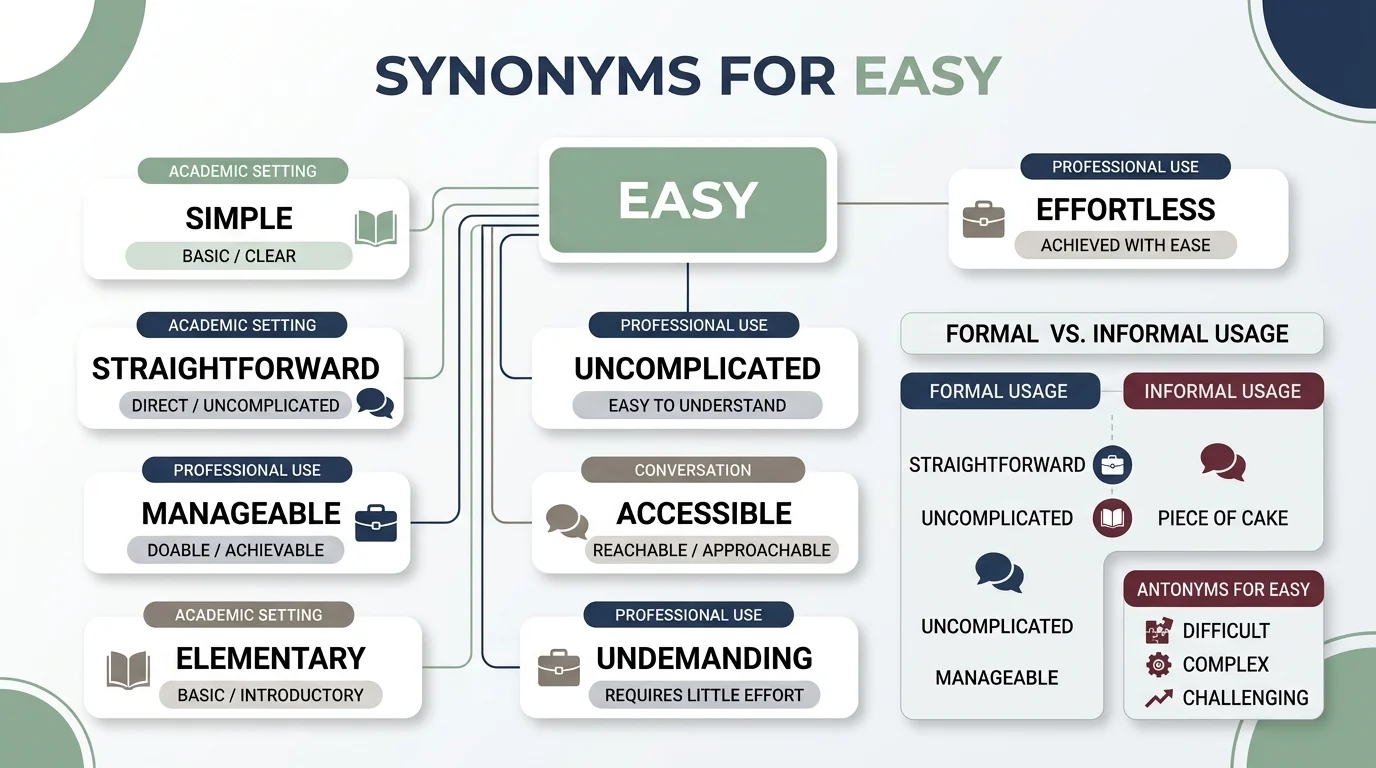
Finding the right replacement for “easy” depends entirely on your context. A single synonym rarely works in every situation. Here are the best alternatives categorized by usage.
Professional writing: Straightforward, clear, manageable, user friendly
Academic writing: Simple, uncomplicated, accessible, intelligible
Casual conversation: Easy, simple, no problem, a breeze
Emotional writing: Effortless, natural, comfortable, gentle
Creative writing: Effortless, fluid, graceful, smooth
Resume or workplace: Accomplishable, practical, streamlined, efficient
Social media captions: Quick, simple, easy, fast
Stronger meaning: Effortless, painless, trouble free, child’s play
Softer meaning: Straightforward, approachable, uncomplicated, accessible
When Not to Use “Easy”
The word “easy” can sound too vague or casual in many situations. It fails to convey the specific type of ease you want to describe. Using a more precise word improves your sentence significantly.
Vague example: The training was easy.
Improved with precise synonym: The training was intuitive.
Too casual: Filing taxes is easy.
Better for professional tone: Filing taxes is straightforward.
Too weak: The exam questions were easy.
Stronger description: The exam questions were basic.
Too general: Making friends was easy.
More emotional precision: Making friends felt natural.
Words Commonly Confused With “Easy”
Many words relate to “easy” but have distinct meanings. Understanding these differences will help you choose the right word.
Easy vs. Simple
“Easy” refers to the level of effort required. “Simple” refers to the level of complexity. A task can be simple but not easy, or easy but not simple. Solving a complex puzzle might be simple in structure but difficult to execute.
Easy vs. Effortless
“Effortless” suggests that something happens without any apparent exertion. It often implies grace or skill. “Easy” simply means not hard. A dancer makes a difficult move look effortless, but it is not necessarily easy for everyone.
Easy vs. Straightforward
“Straightforward” means clear and direct without complications. It suggests a logical path forward. “Easy” focuses more on the effort involved. The instructions were straightforward, so completing the task was easy.
Easy vs. Manageable
“Manageable” means something is within your capacity to handle. It does not mean it is easy, just that it is not overwhelming. The workload was manageable, though not exactly easy.
Easy vs. Uncomplicated
“Uncomplicated” emphasizes the absence of complexity. It focuses on the structure of the task itself. This is similar to simple. The recipe was uncomplicated and easy to follow.
Best Synonym by Context for “Easy”
Choosing the right synonym depends on your specific situation and audience. This table provides the best word for each context.
| Context | Best Synonym | Why It Works | Example |
|---|---|---|---|
| Formal writing | Uncomplicated | Sounds precise and academic | The solution was uncomplicated and effective. |
| Academic writing | Accessible | Emphasizes clarity and understanding | The professor made the theory accessible to all students. |
| Professional or business | Straightforward | Implies clarity and logical structure | The project timeline was straightforward. |
| Resume | Streamlined | Shows efficiency and skill | I streamlined the onboarding process. |
| Casual conversation | Simple | Direct and friendly | The instructions were pretty simple. |
| Creative writing | Effortless | Adds elegance and descriptive depth | Her movements were effortless and graceful. |
| Emotional tone | Natural | Suggests comfort and authenticity | Their friendship developed in a natural way. |
| Strong intensity | Painless | Emphasizes the complete lack of difficulty | The transition was completely painless. |
| Soft or moderate | Approachable | Suggests ease of understanding or interaction | The material is approachable for beginners. |
| Social media captions | Quick | Emphasizes speed and convenience | A quick and healthy dinner idea. |
Which Synonym Should You Choose?
Selecting the perfect synonym requires thoughtful consideration. Think about your audience, your purpose, and the specific shade of meaning you want to convey.
Consider the formality level. Are you writing a research paper or a text message? Academic and professional writing generally requires more formal synonyms like “uncomplicated” or “straightforward.” Casual writing allows for simpler words like “simple” or “quick.
Think about the emotional impact. Do you want to sound reassuring, graceful, or efficient? “Effortless” sounds elegant and impressive. “Manageable” sounds reassuring and realistic. “Streamlined” sounds professional and efficient.
Evaluate the intensity of the ease. Is the task completely without difficulty, or is it just not overly challenging? Use “painless” or “effortless” for the highest intensity. Use “straightforward” or “approachable” for a moderate level.
Match the word to the subject. Are you describing a process, an idea, or a personal experience? “Straightforward” works well for processes. “Accessible” works well for ideas. “Natural” works well for personal experiences.
Real Life Examples of “Easy” in Sentences
Seeing synonyms in action helps you understand their natural usage. Here are examples from various situations.
School
The math problem was so basic that most students finished early. The teacher’s explanation made the entire chapter accessible.
Workplace
We created a streamlined system for client onboarding. The new software interface is highly intuitive for new users.
Writing
Her writing style is fluid and natural. The author presents complex ideas in a simple and engaging manner.
Conversation
Making conversation with him felt completely natural. The directions were clear and we found the place without any trouble.
Social Media
This quick three step routine will transform your mornings. Try this simple hack to save time every day.
Email
The process is straightforward. Please let me know if you have any questions. We aim to make this transition as painless as possible.
Storytelling
The path through the forest was effortless and peaceful. His decision to leave was surprisingly simple.
25 Synonyms for “Easy”
This table provides a diverse list of synonyms along with their meanings and ideal use cases.
| Synonym | Simple Meaning | Best Used For | Example Sentence |
|---|---|---|---|
| Simple | Not complex | General use | The recipe is simple enough for beginners. |
| Effortless | Requiring no exertion | Describing skill or grace | She made the difficult dance look effortless. |
| Straightforward | Clear and direct | Instructions or processes | The application process is straightforward. |
| Uncomplicated | Without complexity | Formal descriptions | The procedure is uncomplicated and quick. |
| Clear | Easy to understand | Explanations | The instructions were clear to everyone. |
| Painless | Without difficulty | Transitions or changes | The software update was completely painless. |
| Manageable | Within capacity | Workloads | The project is manageable with our current team. |
| Accessible | Easy to understand | Academic or technical material | The article makes this topic accessible. |
| Intuitive | Easy to learn naturally | Software or systems | The app has an intuitive user interface. |
| Smooth | Without problems | Processes or events | The meeting went smoothly from start to finish. |
| Fluid | Natural and graceful | Movements or writing | His writing style is fluid and engaging. |
| Natural | Feeling unforced | Emotions or interactions | She is a natural public speaker. |
| Basic | Fundamental or simple | Foundational concepts | The course covers basic vocabulary. |
| Elementary | Extremely simple | Beginning levels | The puzzle was elementary for her. |
| Light | Not demanding | Tasks or workloads | We have a light schedule this week. |
| Undemanding | Not requiring much effort | Relaxed situations | The job is undemanding and flexible. |
| Effortless | Seamless with no struggle | High skill situations | His performance was effortless. |
| Clear cut | Obvious without ambiguity | Decisions or choices | The answer was clear cut. |
| Foolproof | Impossible to fail | Systems or designs | This recipe is absolutely foolproof. |
| User friendly | Easy to use | Technology or products | The website has a user friendly layout. |
| Mild | Gentle or not severe | Conditions | We had a mild winter this year. |
| Gentle | Kind and not harsh | Touches or tones | She spoke in a gentle voice. |
| Breezy | Casual and light | Attitudes | He has a breezy personality. |
| Placid | Calm and peaceful | Situations | The negotiations were placid. |
| Smooth | Without friction | Operations | The transition was smooth. |
Synonym Groups and Usage Differences
Professional vs. Personal Synonyms
Professional synonyms emphasize efficiency, clarity, and logic. “Straightforward,” “streamlined,” and “manageable” sound polished in workplace settings. Personal synonyms focus on comfort, emotion, and individual experience. “Natural,” “simple,” and “gentle” work better for personal conversations and emotional writing.
Formal vs. Conversational Synonyms
Formal synonyms like “uncomplicated” and “accessible” appear in academic papers and professional reports. Conversational synonyms like “simple” and “quick” sound natural in emails, texts, and everyday speech. Avoid overly formal words in casual situations. They can make you sound stiff or unnatural.
Academic Synonyms
Academic writing requires precision and clarity. “Accessible” works well for explaining complex theories. “Uncomplicated” describes research methodologies. “Clear” is essential for presenting findings. These words help you sound knowledgeable and professional in scholarly contexts.
Professional and Business Synonyms
Business communication values clarity and efficiency. “Straightforward” works well for processes and instructions. “User friendly” describes products or systems. “Manageable” reassures stakeholders about workloads. These synonyms project competence and reliability.
Creative or Literary Synonyms
Creative writing benefits from vivid and descriptive language. “Effortless” adds elegance to character descriptions. “Fluid” describes movements or writing style. “Natural” captures authentic emotions and interactions. These words create imagery and emotional depth in your storytelling.
Strongest vs. Weaker Synonyms
An intensity scale helps you match the level of difficulty you want to describe.
Mild: Basic, light, gentle
Moderate: Simple, straightforward, manageable
Strong: Effortless, painless, foolproof
Strongest: Child’s play, effortless, trouble free
Emotional vs. Neutral Synonyms
Emotional synonyms add feeling to your description. “Natural” suggests comfort and authenticity. “Gentle” conveys care and kindness. “Painless” reassures and reduces anxiety. Neutral synonyms like “simple,” “straightforward,” and “uncomplicated” remain factual and objective. Choose based on whether you want to connect emotionally or simply inform.
Antonyms of “Easy”
Understanding opposites helps clarify the meaning of “easy.” Here are common antonyms with examples.
| Antonym | Meaning | Example Sentence |
|---|---|---|
| Difficult | Hard to do | The exam was extremely difficult. |
| Hard | Requiring great effort | Learning a new language is hard work. |
| Challenging | Testing abilities | The project is challenging but rewarding. |
| Complex | Made of many parts | The system is too complex for beginners. |
| Complicated | Difficult to understand | The instructions were too complicated. |
| Demanding | Requiring much effort | Her job is very demanding. |
| Tough | Difficult to handle | The decision was tough to make. |
| Arduous | Involving strenuous effort | The journey across the mountains was arduous. |
| Laborious | Requiring much hard work | Data entry is a laborious process. |
| Strenuous | Requiring great exertion | The workout is quite strenuous. |
| Taxing | Physically or mentally demanding | The test was mentally taxing. |
| Exacting | Making great demands | The professor has exacting standards. |
| Formidable | Inspiring fear or respect | The challenge was formidable. |
| Troublesome | Causing difficulty | The new regulations are troublesome. |
| Backbreaking | Physically exhausting | Moving furniture is backbreaking work. |
Comparison: Easy vs. Similar Words
Easy vs. Simple
Main difference: “Easy” focuses on the required effort. “Simple” focuses on the level of complexity.
Which one is stronger: Neither is stronger; they focus on different aspects.
Which one is more formal: “Simple” often sounds slightly more formal in academic contexts.
Example for easy: The puzzle was easy to solve.
Example for simple: The puzzle had a simple design.
Easy vs. Effortless
Main difference: “Effortless” implies that something appears to require no effort at all. “Easy” just means not hard.
Which one is stronger: “Effortless” is much stronger.
Which one is more formal: “Effortless” is appropriate in both casual and formal contexts.
Example for easy: The math problem was easy.
Example for effortless: Her calligraphy looked effortless.
Easy vs. Straightforward
Main difference: “Straightforward” emphasizes a clear, logical path. “Easy” emphasizes the lack of difficulty.
Which one is stronger: They are similar in intensity but have different focuses.
Which one is more formal: “Straightforward” is more formal.
Example for easy: The recipe is easy.
Example for straightforward: The instructions are straightforward.
Easy vs. Manageable
Main difference: “Manageable” means something is within your capacity. It might still require effort.
Which one is stronger: “Easy” is stronger because it implies less effort.
Which one is more formal: Both work in formal contexts.
Example for easy: The hike was easy.
Example for manageable: The workload is manageable.
Easy vs. Clear
Main difference: “Clear” specifically means easy to understand. “Easy” has a broader meaning.
Which one is stronger: “Clear” is more specific and precise.
Which one is more formal: “Clear” is commonly used in formal writing.
Example for easy: The directions were easy.
Example for clear: The directions were clear.
Easy vs. Natural
Main difference: “Natural” suggests something feels authentic or unforced. “Easy” simply means not difficult.
Which one is stronger: “Natural” adds an emotional dimension.
Which one is more formal: Both are widely used.
Example for easy: The conversation was easy.
Example for natural: The conversation felt natural.
Common Phrases and Expressions with “Easy”
These common phrases show how “easy” appears in everyday English.
1. Take it easy
Meaning: Relax or calm down.
Example sentence: After a long week, I just want to take it easy this weekend.
2. Easy come, easy go
Meaning: Something gained easily is often lost easily.
Example sentence: He spent his lottery winnings in a year; easy come, easy go.
3. Easier said than done
Meaning: Talking about something is easier than actually doing it.
Example sentence: Quitting your job is easier said than done when you have bills to pay.
4. Free and easy
Meaning: Relaxed and without restrictions.
Example sentence: The atmosphere at the party was free and easy.
5. Have an easy time
Meaning: Not experience difficulty.
Example sentence: She had an easy time adjusting to her new school.
6. Easy on the eye
Meaning: Pleasing to look at.
Example sentence: The new design is very easy on the eye.
7. Breathe easy
Meaning: Feel relieved.
Example sentence: I can breathe easy now that the exams are over.
8. Easy money
Meaning: Money earned with little effort.
Example sentence: The freelance job was easy money.
Common Mistakes to Avoid
Many writers struggle with choosing the right synonym for “easy.” Here are the most common pitfalls and how to avoid them.
Using “easy” when a more precise synonym is better
Saying something is “easy” often sounds vague. Be specific. Was it simple, straightforward, or effortless? Choose a word that captures the exact type of ease you mean.
Confusing “easy” with “simple”
“Easy” refers to effort. “Simple” refers to complexity. A task can be simple but not easy, or easy but not simple. Use each word correctly to avoid confusion.
Using a casual synonym in formal writing
Words like “quick,” “breezy,” and “no problem” feel too casual for professional or academic writing. Choose formal alternatives like “uncomplicated” or “straightforward” instead.
Using an overly dramatic synonym for a simple situation
Calling a basic task “effortless” can sound exaggerated. Save strong synonyms for genuinely remarkable situations.
Repeating the same word too often
Using “easy” multiple times in a single paragraph makes your writing repetitive. Vary your vocabulary with different synonyms to keep your reader engaged.
Choosing a synonym with the wrong emotional tone
“Natural” and “gentle” have a warm emotional quality. “Straightforward” and “uncomplicated” are neutral. Match the emotional tone to your message and audience.
Using slang in academic or professional writing
Modern slang synonyms might sound fresh, but they can undermine your credibility in formal contexts. Stick to standard vocabulary in professional settings.
FAQs
What is the best synonym for easy?
The best synonym depends on context. For professional writing, use “straightforward.” For creative writing, use “effortless.” Casual conversation, use “simple.”
What is a formal synonym for easy?
Good formal synonyms include “uncomplicated,” “accessible,” “straightforward,” and “manageable.” These words sound professional in academic and workplace settings.
What is an informal synonym for easy?
Common informal synonyms include “simple,” “quick,” “no problem,” “a breeze,” and “easy peasy.” These are great for casual conversations and friendly communication.
What is another word for easy in professional writing?
“Straightforward,” “streamlined,” “user friendly,” “clear,” and “efficient” are excellent choices. They project competence and professionalism.
What is the difference between easy and effortless?
“Easy” means not difficult. “Effortless” means appearing to require no effort at all. Effortless is a stronger word and often implies grace or skill.
What is the opposite of easy?
The most direct opposite is “difficult.” Other antonyms include “hard,” “challenging,” “complex,” “complicated,” “demanding,” and “arduous.”
Conclusion
“Easy” is a useful word, but it cannot do all the work for you. This versatile term describes tasks that require minimal effort, understanding, or skill. However, using it repeatedly weakens your writing. The best writers know how to vary their vocabulary to match the situation.
Remember to consider your audience and context. Use “straightforward” in professional emails. Choose “effortless” for creative descriptions. Pick “simple” for casual conversations. These small choices make a big difference in how your message is received.
The next time you reach for “easy,” pause for a moment. Think about what you really mean. Select the most precise, appropriate, and powerful word from this guide. Your writing will become clearer, more engaging, and more professional.