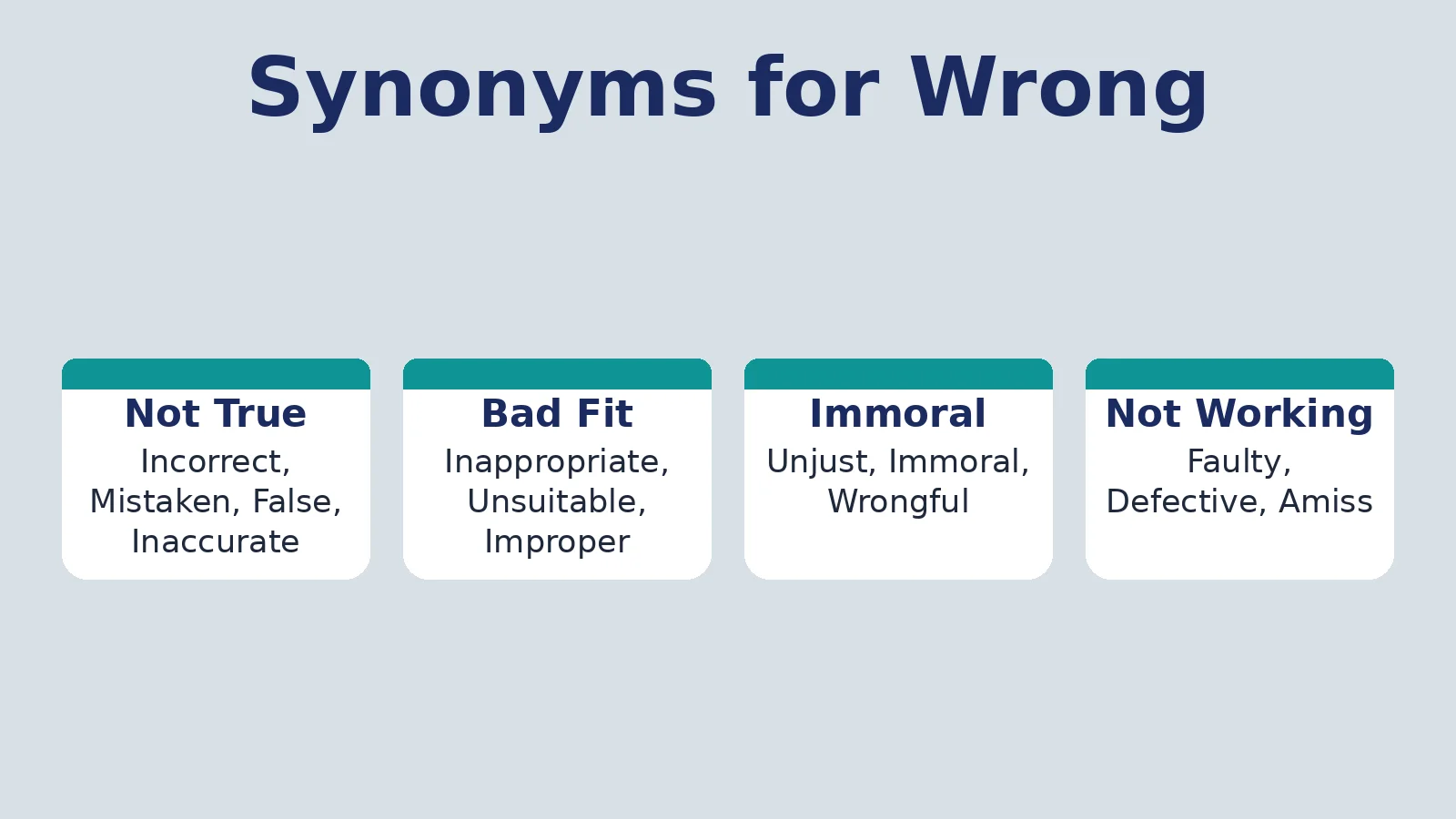
Wrong might be the hardest-working adjective in everyday English. It judges exam answers, broken phones, bad apologies, and outright crimes, all in five letters. The most useful synonyms for wrong include incorrect, mistaken, false, inaccurate, inappropriate, unsuitable, immoral, unjust, faulty, and amiss. Each one fits only part of that range, though. Calling a lie “inaccurate” sounds far too kind, and calling a typo “immoral” sounds absurd.
This guide sorts more than 90 synonyms for wrong by sense, so the differences stay visible. Every group comes with short meanings and example sentences for the key words. A companion guide covers the other side of the pair, synonyms for right, and this one ends with the traps that catch even careful writers.
Top Synonyms for Wrong: Quick Reference
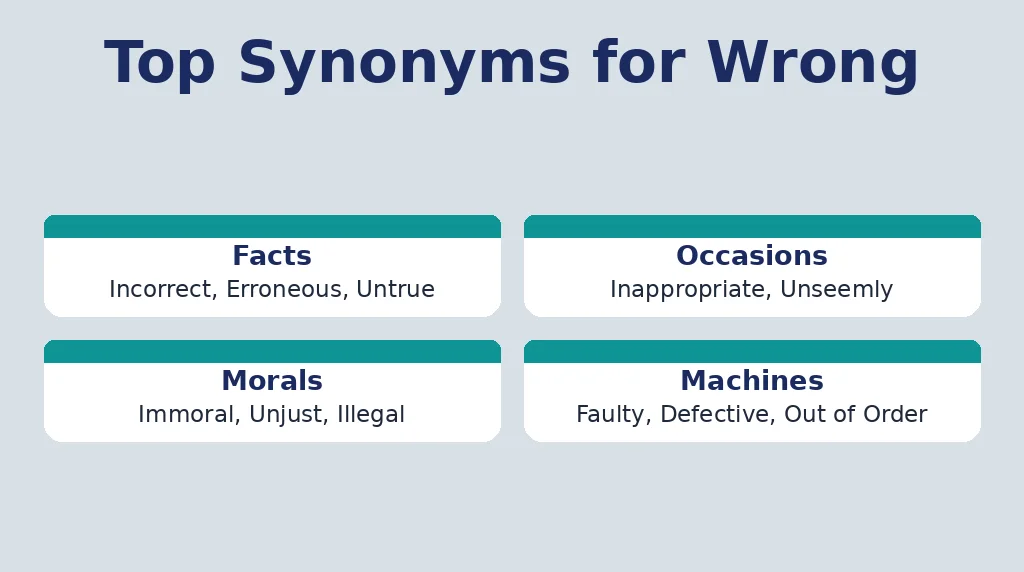
The table below covers the 28 synonyms readers reach for most often. Start here when you need one quick replacement. Later sections sort the full list into finer groups by meaning.
| Word | Meaning in one line | Best for |
|---|---|---|
| Incorrect | Not correct, against the facts | Answers, data, formal writing |
| Mistaken | Based on a wrong belief or judgment | People, assumptions |
| False | Not true, sometimes misleading | Statements, impressions |
| Inaccurate | Not exact or fully correct | Figures, reports, quotes |
| Erroneous | Containing an error, formal | Reports, records, conclusions |
| Untrue | Not matching the truth | Claims, allegations, rumors |
| Fallacious | Built on faulty reasoning, formal | Arguments, logic |
| Unsound | Weakly based, likely to fail | Arguments, methods, advice |
| Inappropriate | Not suitable for the occasion | Behavior, comments, clothing |
| Unsuitable | Not right for the purpose or person | Candidates, tools, films |
| Improper | Against rules or good manners | Conduct, procedure |
| Unseemly | Not proper or decent in public | Behavior, formal tone |
| Immoral | Against accepted moral standards | Acts, systems, choices |
| Unethical | Against professional or moral codes | Business, research, medicine |
| Unjust | Not fair or deserved | Laws, punishments, decisions |
| Unfair | Not treating people equally | Rules, games, criticism |
| Dishonest | Not truthful or straightforward | Dealing, claims, people |
| Wrongful | Unfair or illegal, legal flavor | Dismissal, conviction, arrest |
| Illegal | Against the law | Acts, imports, parking |
| Unlawful | Not allowed by law, formal | Detention, assembly, killing |
| Illicit | Forbidden by law or custom | Drugs, trade, affairs |
| Wicked | Morally very bad | Deeds, characters, stories |
| Sinful | Against religious moral law | Religious contexts |
| Faulty | Having a defect or flaw | Equipment, reasoning |
| Defective | Not working as it should | Products, parts |
| Out of order | Not functioning, British flavor | Machines, signs, lifts |
| Amiss | Not quite right, something off | Feelings, situations |
| Awry | Gone sideways, off the plan | Plans, schemes |
What Does Wrong Mean?
At its core, wrong means not right, measured against some standard. The standard changes from sentence to sentence, and that is the whole secret of this word. Against facts, wrong means incorrect. Against manners, it means inappropriate. Against conscience, it means immoral. Against a working machine, it means faulty.
Because the standard shifts, no single synonym covers the word. Merriam-Webster lists hundreds of similar words for wrong across its adjective, adverb, noun, and verb entries. Collins separates at least nine senses, from “that was the wrong answer” to “iron the shirt on the wrong side.” A good synonym choice starts by asking one question: wrong by which standard?
Wrong also changes job. As an adverb it appears in “you spelled my name wrong.” As a noun it names an injustice, as in “right a wrong.” As a verb it means to treat someone unfairly, usually in the passive: “she felt wronged.” This guide covers the adjective first, then gives the other jobs their own section.
The word’s own history explains its reach. Wrong came into English from Old Norse, where its ancestor meant crooked or awry, something bent away from straight. That physical picture still echoes through the family. Askew and awry describe crooked things and crooked plans. The moral sense grew from the same root idea: a wrong act bends away from the straight path of right. Even the sewing sense fits, since the wrong side is the side turned away from view.
Synonyms for Wrong: Incorrect and Not True
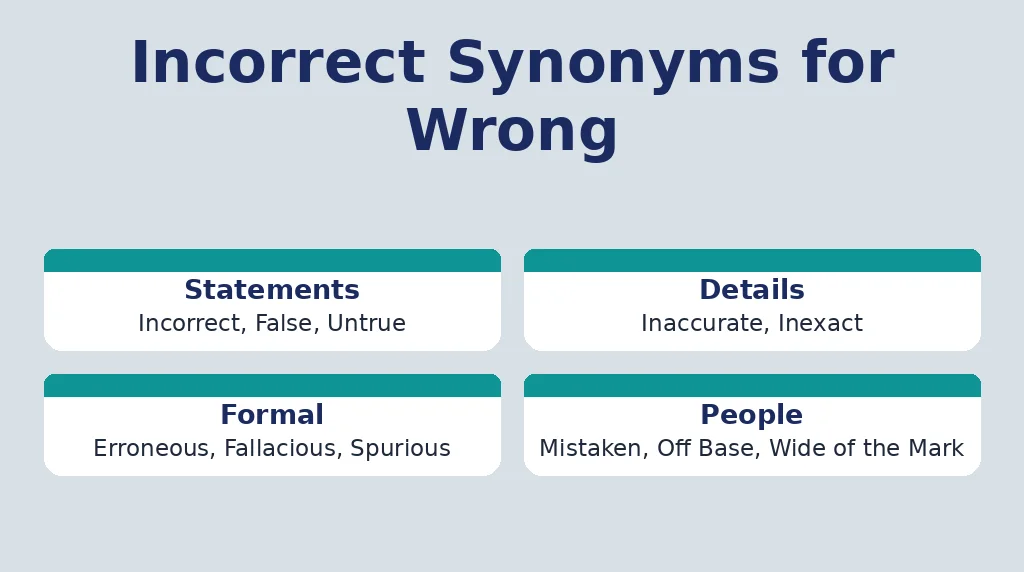
This is the sense exams and fact-checkers live in. Something is wrong when it clashes with reality. The words below differ by tone and by target. Some judge statements, while others judge the people who believed them.
Answers, Facts and Statements
These words describe information that fails the truth test.
- Incorrect: not correct, the standard formal replacement. Example: The information on the website is incorrect.
- False: not true, and it can hint the speaker knows it. Example: The title gives a false impression of the film.
- Untrue: not matching the truth, common for claims and stories. Example: The claims about him are simply untrue.
- Inaccurate: wrong in detail rather than in spirit. Example: Their estimate of the cost was wildly inaccurate.
- Erroneous: containing an error, formal in tone. Example: No one could explain how the erroneous figures got in.
- Fallacious: built on bad reasoning, formal. Example: The reports were fallacious and damaging.
- Inexact: not precise, used for measurements and wording. Example: The translation is inexact in places.
- Spurious: false but presented as genuine, formal. Example: The claim rests on spurious evidence.
- Counterfactual: contrary to what actually happened. Example: The essay defends a counterfactual reading of events.
People and Their Beliefs
When a person holds the wrong idea, English prefers a different shelf of words.
- Mistaken: wrong in belief or judgment. Example: You are mistaken if you think we found nothing.
- In error: formally wrong, common in official corrections. Example: The bank admitted it was in error.
- Off base: quite wrong, American informal. Example: His guess about the price was way off base.
- Off beam: wrong in guess or judgment, informal. Example: Her prediction proved well off beam.
- Off target: missing the point or the aim. Example: The review was funny but off target.
- Wide of the mark: far from correct. Example: The forecast was wide of the mark.
- Astray: led into error, usually in “led astray” or “gone astray.” Example: The data led the team astray.
- At fault: responsible for an error or accident. Example: Neither driver was fully at fault.
- Not right: the plain, gentle option for everyday speech. Example: That date is not right, check it again.
A style note on tone: the further down these lists you travel, the more formal the words become. Incorrect and mistaken fit almost anywhere. Erroneous and fallacious belong in reports, journals, and essays, where their weight sounds at home.
Synonyms for Wrong: Inappropriate and Unsuitable
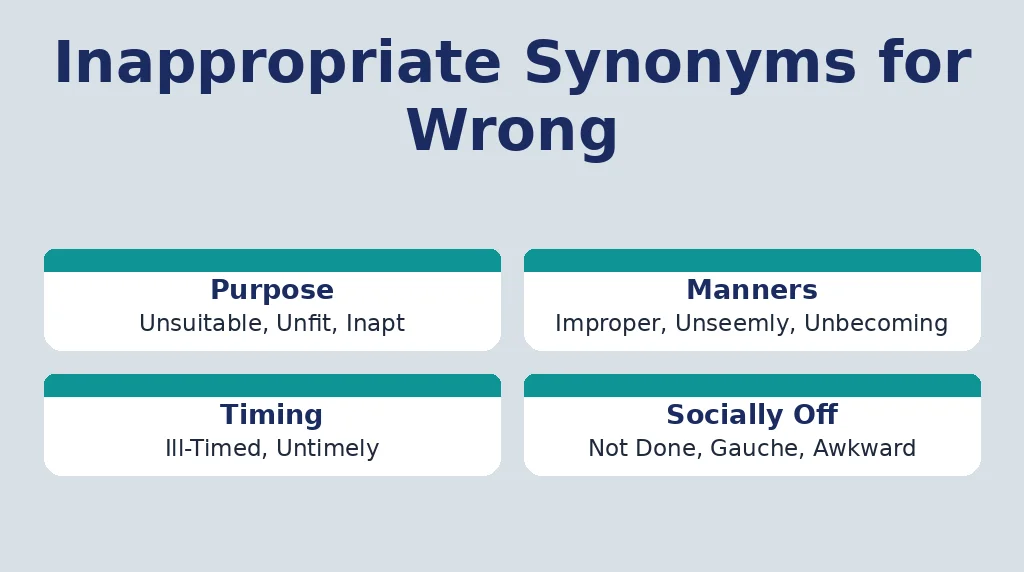
Sometimes nothing is factually false, yet something still feels wrong for the moment. Wrong shoes for a hike, wrong words at a funeral, wrong person for the job. This group judges fit rather than truth.
The Wrong Thing for the Purpose
These words say the choice does not match its job.
- Unsuitable: not right for the purpose or the person. Example: Her shoes were unsuitable for walking far.
- Inappropriate: not fitting the occasion or situation. Example: The joke was inappropriate at a funeral.
- Unfitting: not suitable or proper, slightly formal. Example: Such language is unfitting for a judge.
- Inapt: poorly chosen or not apt, formal. Example: The metaphor was inapt and confused readers.
- Incongruous: out of place because it clashes with its surroundings. Example: The neon sign looked incongruous on the chapel.
- Unconventional: unusual enough to feel wrong in formal settings. Example: His unconventional suit drew stares at the bank.
- Unhappy: badly chosen, in phrases like “an unhappy compromise.” Example: The law was an unhappy compromise from the start.
- Misplaced: given to the wrong target, as with trust or blame. Example: Her confidence in him proved misplaced.
- Ill-advised: unwise and likely to cause trouble. Example: The trip was ill-advised during the storm.
- Unfit: not suitable in quality or condition. Example: The water was declared unfit to drink.
Socially Wrong: Manners and Decency
A second shelf judges behavior against manners rather than purposes.
- Improper: against rules, procedure, or good manners. Example: The payment was improper and was returned.
- Unseemly: not decent or proper in public, formal. Example: It would be unseemly to celebrate during the inquiry.
- Unbecoming: not fitting a person’s position or dignity. Example: The outburst was unbecoming of a captain.
- Infelicitous: unlucky in choice, used for badly worded remarks, formal. Example: His infelicitous remark ended the meeting early.
- Malapropos: out of place, borrowed from French, formal. Example: The joke arrived malapropos, mid-eulogy.
- Not done: socially unacceptable, British informal. Example: Wearing white there is simply not done.
- Awkward: clumsy in a way that makes a moment feel wrong. Example: An awkward silence followed the announcement.
- Gauche: awkward and lacking social grace, slightly literary. Example: His gauche comment embarrassed everyone.
The two shelves overlap at improper, which can judge a tool, a method, or a remark. Context decides which reading your audience will hear.
The Wrong Time: Badly Timed Choices
A third kind of bad fit involves timing rather than objects or manners. A true statement can still be wrong if it lands at a damaging moment.
- Ill-timed: happening at an unsuitable moment. Example: The ill-timed joke broke the silence badly.
- Untimely: happening too soon or at a bad moment, also literary for early death. Example: The untimely rain ruined the outdoor wedding.
- Unseasonable: wrong for the time of year, used for weather. Example: Unseasonable heat closed the trails in March.
Timing words pair naturally with remarks, visits, announcements, and weather. They blame the clock rather than the content, which makes them gentler than inappropriate. A manager who calls feedback “ill-timed” criticizes the delivery, not the person.
Synonyms for Wrong: Immoral and Unjust
The heaviest sense of wrong judges actions against conscience and law. “It was wrong of you” rarely means a factual slip. It means a line was crossed. These words carry real weight, so writers should spend them carefully.
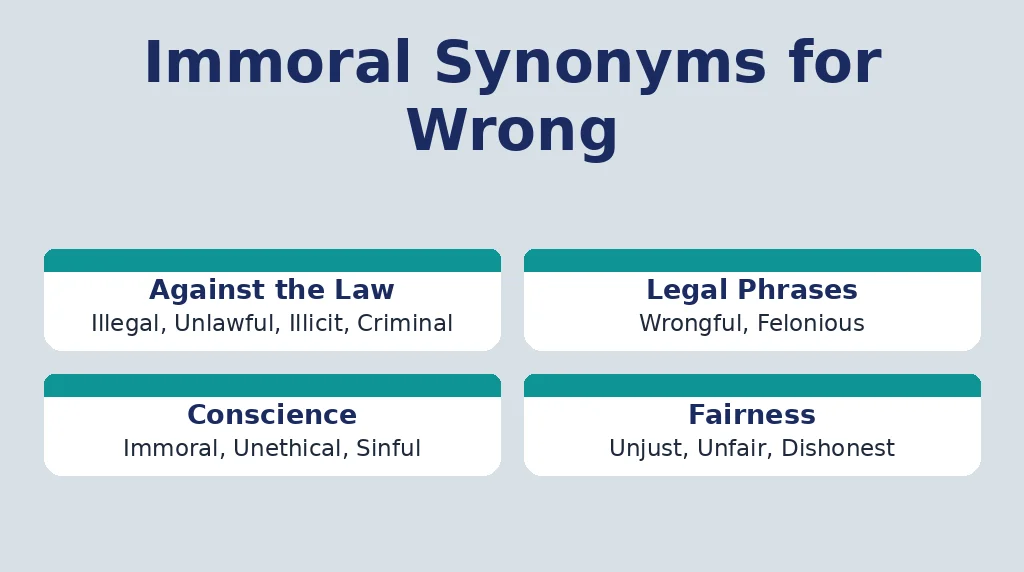
Against the Law
These words describe acts that legal systems punish.
- Illegal: against the law, plain and direct. Example: It is illegal to block the emergency exit.
- Unlawful: not allowed by law, the formal twin of illegal. Example: The court found the detention unlawful.
- Illicit: forbidden by law or custom, often for trade and substances. Example: The ship carried illicit cargo.
- Criminal: involving a crime, or shockingly bad. Example: The few criminal acts shamed the whole party.
- Felonious: relating to serious crime, legal and formal. Example: The charge was felonious assault.
- Wrongful: unfair or illegal, especially in legal phrases. Example: He sued over his wrongful dismissal.
- Under-the-table: secret and dishonest, usually about payments, informal. Example: The under-the-table bonus broke every rule.
Against Conscience and Fairness
These words judge acts that may break no statute yet still cross a moral line.
- Immoral: against accepted standards of right behavior. Example: Many called the policy immoral.
- Unethical: against a professional or moral code. Example: It was unethical to hide the results.
- Unjust: not fair or deserved. Example: They campaigned against unjust laws.
- Unfair: not treating people equally or honestly. Example: The rule change felt unfair to new staff.
- Dishonest: not truthful in dealing with others. Example: He grew rich by dishonest means.
- Sinful: against religious law, used in religious contexts. Example: The sermon called greed sinful.
- Wicked: very bad morally, strong and storybook-flavored. Example: The tale blames a wicked stepmother.
- Evil: extremely bad and harmful, the strongest word in this group. Example: The novel treats the regime as plainly evil.
- Bad: morally wrong in a simple, general way. Example: Stealing is bad, whatever the excuse.
- Amoral: without moral judgment at all, a cooler and rarer term. Example: The market is amoral, rewarding whatever sells.
- Iniquitous: grossly unfair and wicked, formal. Example: The iniquitous tax crushed small farms.
- Reprehensible: deserving strong blame. Example: The cover-up was reprehensible.
- Corrupt: dishonest and willing to abuse power. Example: Corrupt officials sold the contracts.
- Crooked: dishonest, informal. Example: Her crooked deals finally reached the press.
- Not cricket: unfair or unsporting, British informal and dated. Example: Reading her diary was simply not cricket.
Notice the ladder of strength. Unfair is a complaint; unjust is an accusation; immoral is a verdict; evil is a condemnation. Climbing higher than your evidence supports is itself a writing error, and the choosing section returns to it.
Synonyms for Wrong: Faulty and Not Working
When English speakers say something is wrong with a car, a knee, or a plan, no facts or morals are involved. The thing simply fails to work as it should. This group covers machines first, then the vaguer feeling that something is off.
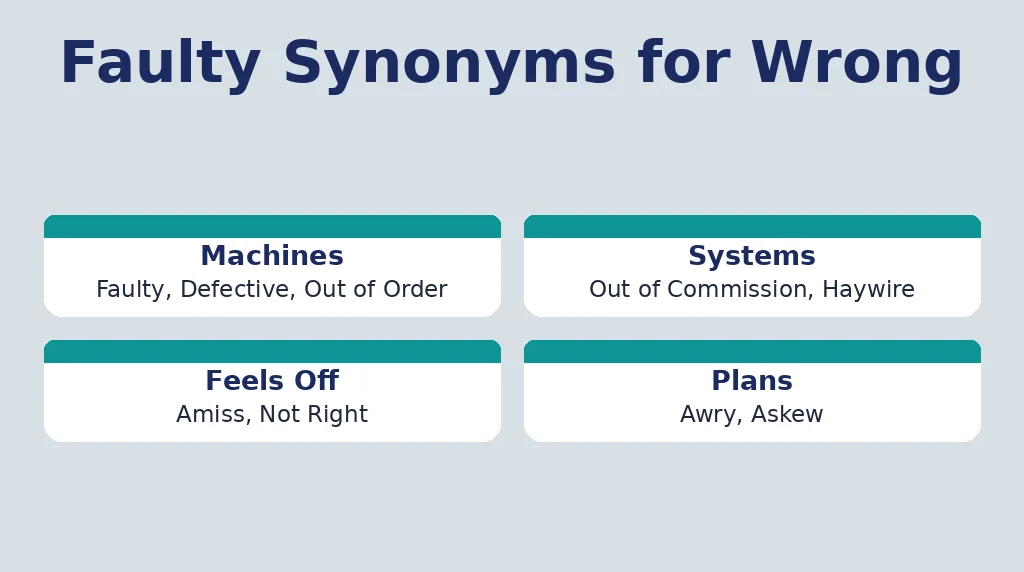
Machines, Parts and Systems
- Faulty: having a defect that stops proper work. Example: They will repair the faulty equipment.
- Defective: not made or working correctly, used for products. Example: Retailers can return defective merchandise.
- Not working: the plain everyday phrase. Example: The printer is not working again.
- Out of order: not functioning, the wording on a thousand signs. Example: The lift is out of order today.
- Out of commission: out of service for a long stretch, often ships and machines. Example: The ferry stayed out of commission all winter.
- Haywire: gone wildly wrong, for systems and plans, informal. Example: The schedule went haywire after the storm.
- Flawed: carrying a defect in design or logic. Example: The plan was flawed from the start.
Something Feels Off
Sometimes nothing is visibly broken, yet a person senses a problem. English has a small, precise shelf for that feeling.
- Amiss: not quite right, used after the verb. Example: Their instincts warned them something was amiss.
- Not right: the gentle everyday version of the same idea. Example: He sounded tired and not right somehow.
- Awry: gone sideways from the plan. Example: The best plans can go awry quickly.
- Askew: crooked or out of line, for physical things. Example: She stood there, hat askew.
That gut-level use is worth a sentence of its own. When writers describe a character sensing trouble before seeing it, amiss does quiet, exact work. Readers exploring how English names feelings can pair this shelf with synonyms for feel, since the two vocabularies meet in sentences like “it feels wrong.”
Wrong With the Body
People use the same pattern for health. “Something is wrong with my knee” reports a fault in a living machine. The knee may be faulty in function without being broken, which is exactly the distinction the mistakes section defends.
Doctors hear this phrasing daily, and patients reach for it because it stays honest about uncertainty. It claims a problem without claiming a diagnosis. Writers describing symptoms can borrow the pattern: not right for a mild worry, amiss for a vaguer one, and plain wrong when the problem is certain but unnamed.
Wrong as a Noun and a Verb
Wrong works three other jobs in English, and each job owns a separate vocabulary. Mixing these lists with the adjective groups above is the fastest route to a strange sentence.
The Noun: A Wrong Done to Someone
As a noun, a wrong is an act that inflicts undeserved hurt. Merriam-Webster’s discussion names grievance, injury, and injustice as its closest synonyms. History essays and courtrooms use this shelf constantly.
- Injustice: an unfair act or situation. Example: They vowed to fight injustice.
- Injury: harm or unfair treatment, including legal injury. Example: She won compensation for the injury to her name.
- Grievance: a real or felt cause for complaint. Example: Workers listed their grievances calmly.
- Offense: an act that breaks a rule or law, US spelling. Example: The offense carries a heavy fine.
- Misdeed: a bad or illegal act, slightly formal. Example: The report listed the officials’ misdeeds.
- Transgression: breaking a rule or moral code, formal. Example: Past transgressions haunted the candidate.
- Crime: an act against the law. Example: He has committed no crime at all.
- Sin: an act against religious law. Example: In his faith, envy is a sin.
- Abuse: cruel or unfair treatment. Example: The inquiry exposed years of abuse.
- Infraction: a minor breaking of a rule, formal. Example: One more infraction means probation.
- Wrongdoing: bad or illegal behavior, general. Example: The audit found no wrongdoing.
- Inequity: unfairness built into a system. Example: Pay inequity drove the protest.
- Unfairness: the quality of not treating people equally. Example: The unfairness of the draw angered fans.
- Immorality: wicked or immoral behavior as a pattern. Example: The essay attacks public immorality.
- Iniquity: gross injustice or wickedness, formal. Example: He rails against the iniquities of the system.
- Wickedness: deliberate evil behavior. Example: The wickedness of the scheme shocked investigators.
Two phrases dominate this shelf. People “right a wrong” when they repair an injustice, and they warn that “two wrongs don’t make a right” when revenge tempts them. Both phrases treat wrong as a countable thing, which adjectives never do.
The Verb: To Wrong Someone
As a verb, wrong means to treat someone unjustly. It appears most often in the passive, in sentences like “she was wronged.” Its synonyms come from the vocabulary of mistreatment.
- Mistreat: treat badly or cruelly. Example: He claimed the guards mistreated him.
- Maltreat: treat cruelly, formal twin of mistreat. Example: The prisoners were not maltreated, inspectors said.
- Ill-treat: treat badly, slightly dated. Example: The hostages said they had not been ill-treated.
- Ill-use: treat unfairly or harshly, dated. Example: The diary tells of servants ill-used for years.
- Abuse: treat with cruelty or misuse power over. Example: Those who abused prisoners faced trial.
- Harm: cause physical or emotional injury. Example: She checked the rope, anxious not to harm him.
- Oppress: keep under harsh and unfair control. Example: The lenders oppressed poor borrowers for decades.
- Take advantage of: use someone unfairly for your own gain. Example: The firm took advantage of new staff.
- Impose upon: burden someone unfairly, formal. Example: I do not wish to impose upon her kindness.
- Dump on: treat badly or blame unfairly, slang. Example: He always dumps on the newest worker.
Doing It Wrong: The Adverbs
As an adverb, wrong itself is informal in careful writing, where wrongly takes over. The family is small but busy.
- Incorrectly: in a wrong or mistaken way. Example: The name was spelled incorrectly.
- Wrongly: unjustly, or by mistake. Example: He was wrongly diagnosed at first.
- Mistakenly: because of a wrong belief. Example: They mistakenly believed the pass was enough.
- Erroneously: by error, formal. Example: It was erroneously reported that he resigned.
- Badly: in a poor or wrong way. Example: She played badly and knew it.
The Wrong Side: Reverse and Inverse
One quiet sense survives in sewing and printing. The wrong side of cloth is the side that faces inward, the one not meant to be seen.
- Reverse: the back or opposite side. Example: Iron the shirt on the reverse side.
- Inverse: reversed in order or effect. Example: The hologram flips to show the inverse image.
- Opposite: facing or turned against the usual side. Example: Print it on the opposite face of the sheet.
Collins and Cambridge both record this sense, yet general thesaurus lists often bury it. Craft writers meet it weekly, so it earns its place here.
How to Choose the Right Synonym for Wrong
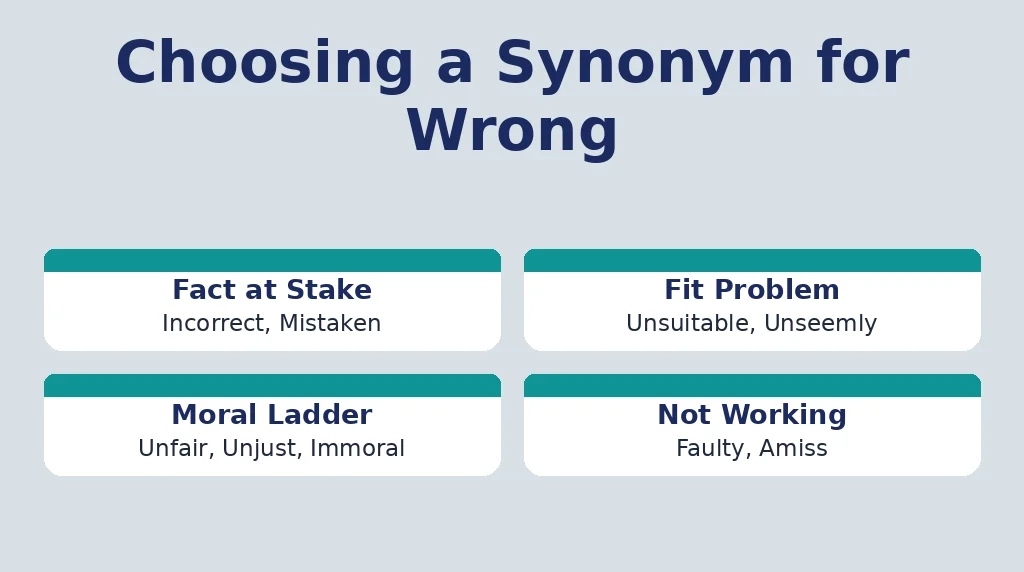
Choosing well starts with the standard question from the meaning section: wrong by which measure? Facts, fit, conscience, and function each claim their own shelf. Four quick checks sort most sentences in seconds.
First, ask whether a fact is at stake. Answers, dates, and statements take the incorrect shelf. Incorrect is the safe default, inaccurate fits near-misses, and erroneous fits formal reports. If a person holds the false belief, mistaken describes the person better.
Second, ask whether fit is the problem. Clothing, tools, timing, and remarks take the inappropriate shelf. Unsuitable judges purposes, unseemly judges public behavior, and improper judges rules and manners. When a writer tells a friend the news, the tone of the chosen word matters too, and the guide to synonyms for tell helps phrase the sentence around it.
Third, weigh the moral ladder. Unfair complains, unjust accuses, immoral condemns, and evil damns. Match the rung to your evidence. Calling a parking fine “an evil policy” spends credibility that careful writers save for real cruelty.
Fourth, ask whether something simply fails to work. Machines take faulty and defective. Plans take awry and haywire. Vague unease takes amiss. If nothing is broken yet something feels off, amiss is almost always the honest word.
The Quick Picker
The table below matches common situations to strong first choices.
| Situation | Strong first choice |
|---|---|
| Wrong answer in a quiz | Incorrect |
| Wrong belief about a friend | Mistaken |
| Wrong shoes for a hike | Unsuitable |
| Wrong remark at a ceremony | Unseemly |
| Wrong act by an official | Unjust |
| Wrong part in a machine | Defective |
| Strange feeling something is off | Amiss |
| Plan that collapsed midway | Awry |
One scene shows the shelves working. “The report was wrong” can mean four things. Its figures may be inaccurate, its tone inappropriate, its claims dishonest, or its file corrupted and faulty. The writer who picks one shelf tells the reader which problem matters.
A final habit ties the checks together. Read your sentence aloud and swap in the plain word wrong. If nothing is lost, your fancier synonym was decoration, and plain wrong may serve better. If something sharpens, keep the synonym. Precision, not novelty, is the goal of every group in this guide.
Synonyms for Wrong in Essays, Exams and Professional Writing
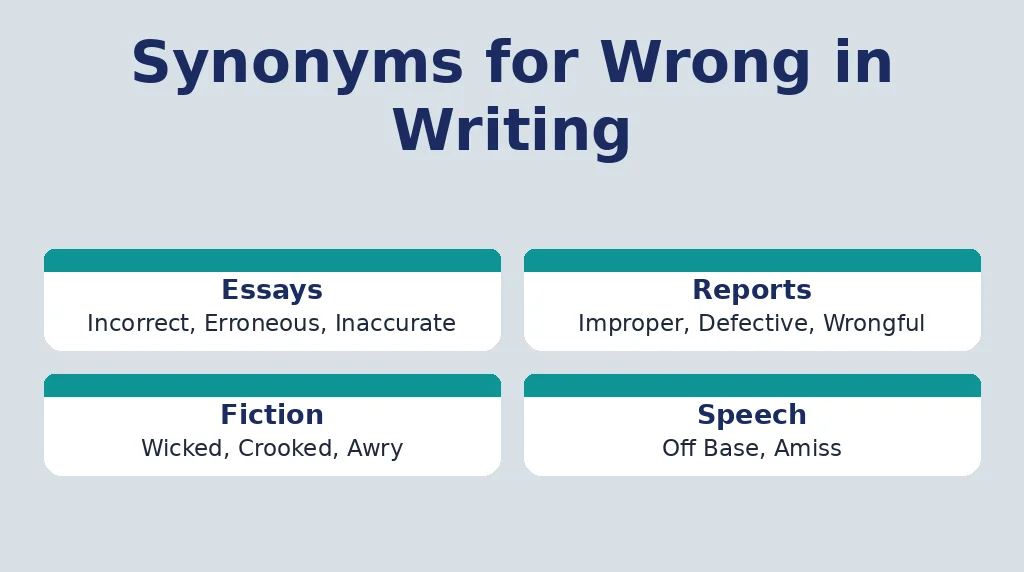
Different kinds of writing reward different shelves. Exams and academic essays live on the incorrect shelf. Incorrect, erroneous, and inaccurate sound measured and fair, while false sounds like an accusation. A student who writes “the theory is false” sounds combative; “the theory is inaccurate” sounds analytical.
Professional reports raise the stakes further. Findings describe procedures as improper and results as defective, because those words are precise and calm. Wrongful belongs in legal and human-resources writing, in fixed phrases like wrongful dismissal. Reports avoid crooked, haywire, and not cricket entirely, since slang undermines their authority.
Fiction and journalism play wider. A narrator can call a villain wicked, a scheme crooked, or a plan gone awry, because voice matters more than neutrality there. Dialogue goes further still: real people say “that’s just wrong,” “way off base,” and “something’s amiss,” and characters should sound like people.
Teachers live in this vocabulary too. Marking a sentence “wrong” is blunt; marking it “incorrect” is professional; explaining that a method is “faulty” teaches something. Good feedback names the shelf every time, because a student fixes facts, methods, and manners in different ways.
British and American habits differ at the edges. Out of order, not done, and not cricket are British favorites. Off base is American, borrowed from baseball. Editors who know their audience choose accordingly, and mixed audiences get the neutral shelf: incorrect, unsuitable, unjust, faulty.
Antonyms for Wrong
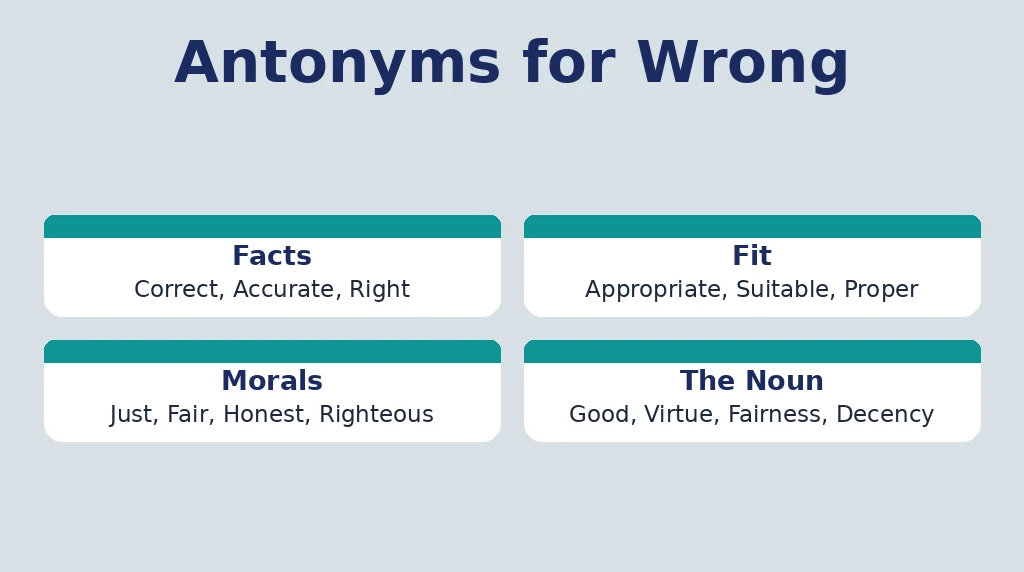
The opposites of wrong mirror its senses. For facts, Cambridge gives correct and accurate as the direct antonyms. Right joins them in everyday speech. A correct answer matches the key, an accurate answer matches reality closely, and a right answer does both at once.
For fit and manners, Collins lists appropriate, suitable, proper, fitting, seemly, and becoming. Each cancels a different failure. Suitable restores purpose, proper restores rules, and seemly restores public decency. Apt and sensible appear in the same list for choices that fit well.
For the moral sense, the opposites grow grander: just, fair, legal, moral, ethical, honest, righteous, lawful, rightful, and virtuous. A just law answers an unjust one. An honest dealer answers a dishonest one. For the noun, Collins offers good, virtue, goodness, morality, honesty, fairness, and decency, the qualities a wrong destroys.
A quick test helps in practice. If a word can complete “the answer is” with praise, it belongs to the correct family. If it can complete “the decision was” with approval, it belongs to the just family. Wrong fails both tests by design.
Common Mistakes: Words That Are Not True Synonyms for Wrong
Accuracy matters in a synonym guide, so this section clears up the words that often sneak into wrong lists wrongly.
A mistake is not an adjective. Mistake names the error itself, while wrong describes it. “A mistake answer” is impossible English; “a wrong answer” and “a big mistake” are the natural forms. Keep each word in its own word class.
Evil overshoots most wrongs. Cheating in a game is wrong, but calling it evil empties the stronger word of meaning. Reserve evil for deliberate, serious harm, and let unjust and immoral handle the middle ground.
Illegal is narrower than wrong. Lying to a friend is wrong, yet no law forbids it. Illegal only works when a statute is broken. Writers who blur the two invent crimes that do not exist.
False does not mean fake. A false statement may be an honest error repeated in good faith. Fake requires intent to deceive. Fact-checkers keep the words apart, and careful writers should too.
Amiss cannot stand before a noun. “Something is amiss” is perfect, but “an amiss feeling” is not English. Amiss works after verbs only, as a predicate. The same trap catches awry, which lives in “gone awry.”
Wrongful belongs to law, not quizzes. Wrongful dismissal, wrongful conviction, and wrongful arrest are set legal phrases. A wrong answer in a quiz is incorrect, never wrongful, because no rights were violated.
Broken claims damage; wrong claims failure. Something wrong with a car might be a sensor giving bad readings, with nothing physically damaged. Broken insists on damage. Mechanics and careful writers keep the distinction, because repairs and bills depend on it.
Frequently Asked Questions
What is the best synonym for wrong?
There is no single best word, because wrong measures against different standards. Incorrect is the safest choice for facts and answers. Inappropriate fits occasions, unjust fits unfair treatment, and faulty fits machines. Naming the standard picks the word.
What is a formal synonym for wrong?
Erroneous is the formal choice for facts, and fallacious is the formal choice for bad reasoning. For behavior, improper and unseemly sound formal. In legal writing, unlawful and wrongful carry the formal weight.
What does “something is wrong” mean?
It means something is amiss: a problem exists, even if nobody can name it yet. People say it about machines, bodies, and moods. Amiss, not right, and awry are its closest synonyms, and all three work after the verb rather than before a noun.
What is the difference between wrong and incorrect?
Incorrect is the formal, narrow word for facts that fail the truth test. Wrong is wider and warmer: it also covers manners, morals, and machines. Every incorrect answer is wrong, but not every wrong thing is incorrect. A wrong turn breaks no fact, yet nobody enjoys taking one.
What is the opposite of wrong?
Correct and accurate oppose the factual sense, while right covers most everyday uses. For behavior, appropriate and proper are the opposites. For moral wrongs, just, fair, and righteous answer back. English splits the antonyms along the same lines as the synonyms.
Is it wrong or wrongly?
Both exist, and the job decides. Wrong works as an informal adverb in phrases like “you got it wrong.” Wrongly is the careful adverb, and it often means unjustly, as in “wrongly accused.” Formal writing prefers incorrectly for facts and wrongly for injustice.
What does “two wrongs don’t make a right” mean?
The proverb says that answering an injustice with another injustice fixes nothing. The second wrong adds harm instead of canceling the first. People quote it against revenge, cheating in return, and answering rudeness with rudeness.
What is a word for morally wrong?
Immoral is the direct word, with unethical for professional conduct. Sinful fits religious contexts, wicked fits stories and strong condemnation, and iniquitous is the formal option. Match the strength of the word to the seriousness of the act.
Final Thoughts
Wrong earns its keep by judging facts, fit, conscience, and function in a single short word. Once you sort its synonyms by the standard being applied, the right choice usually becomes obvious. Answers go incorrect, remarks go unseemly, laws go unjust, and machines go faulty, each in its own lane.
For an even deeper list with related words and near-synonyms, the Merriam-Webster Thesaurus entry for wrong is a reliable next step. Keep this guide bookmarked too, and your sentences will call things wrong for exactly the right reasons. One last habit is worth building before you write another draft: whenever the word wrong appears, underline it and ask which standard it answers to. That ten-second question upgrades more sentences than any thesaurus can, because most weak choices fail the standard test long before they fail the dictionary test.