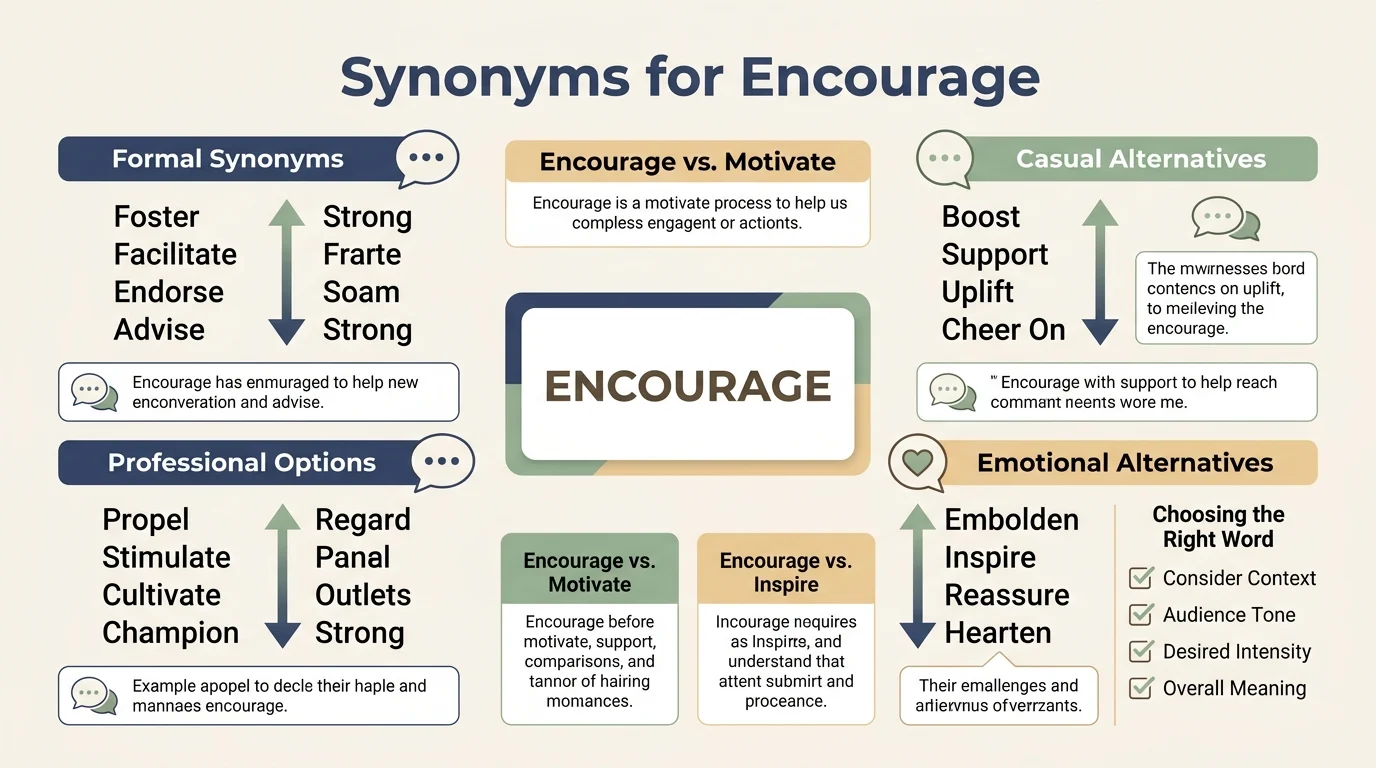
If you need a powerful encourage synonym or want to find every common encourage synonyms, you are in the right place. We cover the best synonyms for encourage, a better synonym for encourage, and the right encouraged synonym to instantly improve your writing.
Have you ever written an email, crafted a speech, or composed a social media caption where you kept using the word “encourage” over and over? You are not alone. Many writers, professionals, and students fall into the habit of repeating this useful but overused word.
Finding the right alternative can transform your writing from repetitive to remarkable. This guide will help you choose the perfect synonym for every situation.
What Does “Encourage” Mean?
Encourage means to give someone support, confidence, or hope. The best synonyms depend on your context. Use “motivate” for professional settings, “inspire” for emotional impact, “urge” for persuasive writing, “support” for personal conversations, and “embolden” for creative or dramatic expression. Each alternative carries a unique tone and level of formality.
Meaning, Tone and Context
Simple Definition
To encourage means to inspire with courage, spirit, or confidence. It involves giving someone the emotional or practical support they need to continue, improve, or take action.
Part of Speech
Encourage is a transitive verb. It requires a direct object, meaning you encourage someone or something.
Tone
Encourage has a positive, uplifting tone. It conveys kindness, support, and optimism. The word itself feels warm and constructive.
Formality Level
Encourage sits comfortably in the middle of the formality scale. It works well in professional emails, academic writing, casual conversation, and even social media posts. Its versatility makes it both useful and overused.
Common Use Cases
People use encourage in performance reviews, motivational speeches, parenting advice, team leadership, academic feedback, personal letters, and everyday conversations. It appears frequently in business communication, educational settings, and emotional support contexts.
Important Word Forms
The noun form is “encouragement.” The adjective form is “encouraging.” The adverb form is “encouragingly.” The opposite is “discourage.” Related forms include “encourager” for a person who encourages others.
When and How to Use “Encourage”
Use encourage when you want to express support, build confidence, or urge someone toward a positive action. It works best when the tone is supportive rather than demanding. The word fits situations where you want to uplift someone without being overly emotional or excessively formal.
Professional Context
“During my performance review, my manager encouraged me to pursue additional leadership training.”
Personal Context
“My best friend encouraged me to apply for my dream job even when I felt unqualified.”
Academic Context
“The professor encouraged her students to explore unconventional research methods.”
Emotional Context
“His kind words encouraged me to keep going during the most difficult moments.”
Creative Context
“The sunset encouraged the painter to capture its colors in a new series of works.”
Social Media Context
“Your supportive comments encouraged me to share more of my creative journey online.”
Resume Context
“Mentored new hires and encouraged team members to develop their technical skills.”
Another Word for “Encourage”
Professional Writing
Use “motivate” or “inspire” in professional contexts. These words convey leadership and vision while maintaining workplace credibility.
Academic Writing
Choose “stimulate” or “prompt” for scholarly work. These terms suggest intellectual engagement and critical thinking.
Casual Conversation
Say “cheer on” or “root for” with friends and family. These phrases feel warm, natural, and supportive.
Emotional Writing
Select “uplift” or “hearten” for personal narratives. These words connect deeply with readers’ feelings.
Creative Writing
Use “embolden” or “kindle” for descriptive passages. These words add imagery and emotional depth.
Resume or Workplace Use
Opt for “mentored,” “guided,” or “coached” to demonstrate leadership on your resume.
Social Media Captions
Choose “boost,” “lift,” or “cheer” for concise, positive captions.
Stronger Meaning
Use “impel,” “compel,” or “drive” when you need urgency or force.
Softer Meaning
Select “suggest,” “recommend,” or “gently urge” for a milder approach.
When Not to Use “Encourage”
Encourage can sound too vague when you need precision. It may feel too casual for formal legal or scientific writing. The word might appear too weak when you need to express strong conviction or urgency.
Example of Vague Usage
“All employees are encouraged to attend the meeting.” This lacks direction. Instead try “All employees must attend the meeting” or “The company requires attendance at the meeting.”
Example of Too Casual
In this scholarly analysis, we encourage readers to consider alternative viewpoints.” In academic writing, try “This analysis invites readers to consider alternative viewpoints.
Example of Too Weak
“I encourage you to finish this project immediately.” The word “encourage” diminishes the urgency. Use “require” or “instruct” instead.
Example of Too General
“The campaign encouraged people to vote.” This statement lacks detail. Try “The campaign mobilized voters through targeted outreach” or “The campaign persuaded undecided voters to participate.”
Example of Misplaced Tone
“The judge encouraged the defendant to plead guilty.” This sounds oddly supportive for a legal setting. Use “advised” or “recommended” to maintain appropriate formality.
Words Commonly Confused With “Encourage”
Encourage vs. Motivate
Encourage involves giving support and confidence. Motivate involves providing a reason or incentive to act. Encourage is about emotional backing, while motivate is about driving action through reward or purpose.
Encourage vs. Inspire
Inspire means to fill someone with the desire or ability to do something creative or worthwhile. It operates on a deeper, more emotional level than encourage. Encouragement is practical and direct. Inspiration is visionary and transformative.
Encourage vs. Urge
Urge is stronger and more insistent than encourage. It carries a sense of pushing or pressuring someone toward an action. Encouragement feels gentler and more supportive.
Encourage vs. Support
Support involves active assistance, resources, or practical help. Encourage focuses on emotional reinforcement and verbal affirmation. Support is tangible. Encouragement is intangible but powerful.
Encourage vs. Persuade
Persuade involves changing someone’s mind through reasoning or argument. Encourage is about building confidence in an existing inclination. Persuasion is intellectual. Encouragement is emotional.
Encourage vs. Promote
Promote means to advocate for an idea, cause, or product. It often involves public endorsement. Encourage is more personal and direct. Promotion is external. Encouragement is interpersonal.
Best Synonym by Context for “Encourage”
| Context | Best Synonym | Why It Works | Example |
|---|---|---|---|
| Formal Writing | Stimulate | Sounds scholarly and precise | The policy stimulated innovation across departments |
| Academic Writing | Prompt | Suggests intellectual engagement | Her research prompted further investigation |
| Professional Use | Motivate | Conveys leadership and vision | The training program motivated staff to excel |
| Resume Use | Mentored | Demonstrates direct leadership | Mentored junior developers in best practices |
| Casual Conversation | Cheer On | Feels natural and friendly | My family cheered me on during the marathon |
| Creative Writing | Embolden | Adds drama and imagery | The victory emboldened the young warrior |
| Emotional Tone | Uplift | Connects with feelings | Her compassion uplifted everyone around her |
| Strong Intensity | Compel | Conveys urgency and force | The evidence compelled immediate action |
| Soft Tone | Recommend | Gentle and nonpressuring | I recommend exploring this opportunity |
| Social Media | Boost | Concise and positive | Let’s boost each other’s creative work |
| US English | Encourage | Standard American usage | We encourage community involvement |
| UK English | Encourage | Also standard in British usage | The organisation encourages volunteer work |
Which Synonym Should You Choose?
Consider your audience first. Formal settings call for precise words like “stimulate” or “prompt.” Professional environments respond well to “motivate” or “inspire.” Personal conversations feel most natural with “support” or “cheer on.”
Think about emotional intensity. Use “compel” or “impel” when urgency matters. Choose “suggest” or “recommend” when you want to be gentle. Select “embolden” or “uplift” for deep emotional impact.
Evaluate your sentence structure. Some synonyms require specific grammatical constructions. For example, “motivate” often pairs with “to” plus an infinitive: “motivate employees to perform.” “Inspire” works with “to” or “by”: “inspire others to achieve” or “inspire by example.”
Consider the action you want to inspire. Is it creative, professional, personal, or academic? Match your synonym to the specific domain. Creative work responds to “inspire” and “kindle.” Professional tasks respond to “motivate” and “drive.” Personal growth responds to “encourage” and “support.”
Real Life Examples of “Encourage” in Sentences
School Context
“Teachers encourage students to ask questions during class discussions.” This could become “Teachers motivate students to participate actively in class.” Stronger yet: “Teachers inspire intellectual curiosity through open dialogue.”
Workplace Context
“Our manager encourages creative problem solving.” Try “Our manager fosters innovation through team collaboration.” For a resume: “Fostered a culture of continuous improvement across departments.”
Writing Context
“Good writers encourage readers to think deeply.” Consider “Skilled writers prompt critical reflection in their readers.” More vivid: “Great writers stimulate meaningful conversations through their work.”
Conversation Context
“I encourage you to try this new restaurant.” In casual speech: “You really should try this new restaurant.” More enthusiastic: “You will love this new restaurant!”
Social Media Context
“We encourage followers to share their stories.” For engagement: “We invite followers to share their experiences.” More interactive: “We love hearing your stories. Share them with us.”
Email Context
“I encourage you to review the attached document.” Professional alternative: “Please review the attached document at your convenience.” Direct version: “Review the attached document before our meeting.”
Storytelling Context
“The old man encouraged the young boy to follow his dreams.” Stronger: “The old man inspired the young boy to pursue his passions.” More poetic: “The old man kindled a fire in the young boy’s heart.”
25 Synonyms
| Synonym | Simple Meaning | Best Used For | Example Sentence |
|---|---|---|---|
| Inspire | Fill with creative vision | Creative and emotional contexts | Her speech inspired the entire organization |
| Motivate | Drive toward action with incentives | Professional and workplace settings | The bonus structure motivated higher performance |
| Uplift | Raise spirits and confidence | Emotional and personal support | Her friendship uplifted me during difficult times |
| Hearten | Give hope and courage | Personal and emotional encouragement | The positive feedback heartened the struggling student |
| Embolden | Give courage and boldness | Creative and dramatic writing | Success emboldened the entrepreneur to take risks |
| Stimulate | Activate interest or growth | Academic and intellectual contexts | The reading list stimulated lively class discussions |
| Prompt | Cause or suggest an action | Neutral and professional use | His question prompted a productive conversation |
| Spur | Urge forward with energy | Action oriented and dynamic | The deadline spurred the team to complete the project |
| Cheer | Express approval and support | Casual and friendly settings | The crowd cheered the performers enthusiastically |
| Bolster | Strengthen or reinforce support | Professional and emotional contexts | The research bolstered her argument effectively |
| Nurture | Encourage growth and development | Long term development contexts | Good leaders nurture talent within their teams |
| Foster | Promote development gradually | Professional and academic growth | The program fosters creativity in young artists |
| Cultivate | Develop through careful attention | Professional and personal growth | Mentors cultivate potential in their students |
| Boost | Increase confidence or morale | Professional and personal motivation | The award boosted her confidence significantly |
| Counsel | Advise and guide wisely | Professional and personal guidance | She counseled him to pursue his passion |
| Advise | Offer recommendations | Professional and formal settings | I advise you to review the contract carefully |
| Recommend | Suggest as beneficial | Professional and informal use | I recommend this course to all new employees |
| Urge | Strongly advise or press | Persuasive and urgent contexts | The coach urged the team to work harder |
| Press | Apply pressure to act | Urgent and demanding situations | Parents pressed the school to improve safety |
| Rally | Bring together for support | Team and community contexts | The speech rallied volunteers to action |
| Back | Support or endorse | Professional and casual use | The board backed the new initiative |
| Propel | Drive forward with force | Dynamic and energetic contexts | Innovation propels companies to market leadership |
| Kindle | Arouse or awaken feelings | Creative and emotional writing | The story kindled her passion for travel |
| Reassure | Remove doubts or fears | Emotional and supportive contexts | Her guidance reassured the worried team |
| Sustain | Maintain support over time | Long term professional contexts | The grant sustains important community programs |
Synonym Groups and Usage Differences
Professional vs. Personal Synonyms
Professional synonyms focus on outcomes and performance. “Motivate” and “stimulate” belong in workplace contexts. Personal synonyms focus on emotions and relationships. “Uplift” and “hearten” suit conversations with family and friends. Choose professional words for business emails and reports. Choose personal words for private correspondence and emotional support.
Formal vs. Conversational Synonyms
Formal synonyms include “stimulate,” “prompt,” and “counsel.” These words appear in academic papers, official documents, and professional speeches. Conversational synonyms include “cheer on,” “boost,” and “root for.” These words work well in texts, casual emails, and everyday discussions. Match the formality level to your audience and purpose.
Academic Synonyms
Academic writing benefits from precise, intellectual synonyms. “Stimulate” suggests engaged thinking. “Prompt” implies intellectual curiosity. “Foster” appears frequently in research about development. “Cultivate” works well in discussions of growth and learning. These words signal scholarly rigor and careful thinking.
Professional and Business Synonyms
Business communication favors action oriented synonyms. “Motivate” drives performance. “Inspire” builds vision. “Bolster” strengthens positions. “Back” shows support. Use these words in presentations, meetings, and professional correspondence. They project confidence and competence.
Creative or Literary Synonyms
Creative writing demands vivid, descriptive alternatives. “Embolden” suggests courage and drama. “Kindle” evokes fire and passion. “Propel” suggests movement and energy. “Uplift” creates emotional resonance. These words add texture and depth to storytelling, poetry, and descriptive prose.
Slang or Modern Synonyms
Modern language offers casual alternatives like “hype up” and “big up.” These work in social media and informal conversations. They are not appropriate for professional or academic writing. Use them carefully and only with audiences who appreciate casual language.
Strongest vs. Weaker Synonyms
The intensity scale from mildest to strongest: Suggest, recommend, encourage, urge, press, compel, drive, impel. Mild options leave room for choice. Strong options demand action. Choose based on the response you want. Gentle suggestions work for personal matters. Strong urgings suit urgent professional situations.
Emotional vs. Neutral Synonyms
Emotional synonyms include “uplift,” “hearten,” and “embolden.” These words carry feeling and connection. Neutral synonyms include “prompt,” “stimulate,” and “advise.” These words stay factual and measured. Choose emotional words for personal contexts. Choose neutral words for professional objectivity.
Antonyms of “Encourage”
| Antonym | Meaning | Example Sentence |
|---|---|---|
| Discourage | Remove confidence or hope | The repeated rejection discouraged him from applying again |
| Deter | Prevent or discourage action | Bad weather deterred us from hiking that day |
| Dissuade | Persuade against an action | Her parents tried to dissuade her from moving abroad |
| Inhibit | Restrain or limit action | Fear inhibited his ability to speak publicly |
| Hinder | Create obstacles or delays | Lack of funding hindered the research project |
| Impede | Slow down or block progress | Bureaucracy impeded the approval process |
| Obstruct | Block or prevent action | Regulations obstructed the development |
| Demoralize | Undermine confidence and morale | Constant criticism demoralized the team |
| Dishearten | Cause loss of hope or enthusiasm | The setback disheartened the volunteers |
| Undermine | Weaken gradually | Office gossip undermined her authority |
| Suppress | Prevent or stop development | The regime suppressed creative expression |
| Stifle | Restrain or prevent growth | Rigid rules stifle innovation |
| Blunt | Reduce effectiveness or intensity | The negative feedback blunted their enthusiasm |
| Deflate | Reduce confidence or pride | The criticism deflated his self esteem |
| Dampen | Reduce enthusiasm or spirit | Bad weather dampened our excitement |
Comparison: Encourage vs. Similar Words
Encourage vs. Motivate
Encourage provides emotional support and confidence. Motivate provides reasons and incentives to act. Encouragement answers “Can I do this?” Motivation answers “Why should I do this?” Use encourage when people need emotional backing. Use motivate when people need concrete reasons to act.
Example with encourage: “The teacher encouraged her students to pursue their interests.” Example with motivate: “The bonus structure motivated employees to exceed their targets.”
Encourage vs. Inspire
Inspire operates on a deeper, more visionary level. Encourage is practical and direct. Inspiration changes how people see themselves. Encouragement changes how people feel about their abilities. Use inspire for creative or transformative moments. Use encourage for everyday support.
Example with inspire: “His story inspired a generation to fight for change.” Example with encourage: “His words encouraged me to keep writing.”
Encourage vs. Urge
Urge carries more pressure and urgency. Encourage feels supportive and optional. Urging suggests stronger conviction. Encouragement suggests gentle support. Use urge when you need action. Use encourage when you want to build confidence.
Example with urge: “The doctor urged him to quit smoking immediately.” Example with encourage: “The doctor encouraged him to consider a healthier lifestyle.”
Encourage vs. Support
Support involves active, practical assistance. Encourage focuses on emotional and verbal reinforcement. You can support someone with time, money, or resources. You encourage someone with words and affirmation. Use support for tangible help. Use encourage for emotional backing.
Example with support: “The foundation supported the community center with funding.” Example with encourage: “The foundation encouraged local leadership development.”
Encourage vs. Promote
Promote suggests public advocacy or advancement. Encourage is personal and direct. You promote a cause, product, or person. You encourage an individual or small group. Use promote for broad advocacy. Use encourage for personal interaction.
Example with promote: “The organization promotes environmental sustainability.” Example with encourage: “The organization encourages individuals to reduce waste.”
Encourage vs. Prompt
Prompt suggests a specific action or response. Encourage builds general confidence and motivation. A prompt triggers immediate action. Encouragement creates lasting motivation. Use prompt for direct actions. Use encourage for ongoing support.
Example with prompt: “The email prompted a quick response from the team.” Example with encourage: “The training encouraged continuous improvement.”
Common Phrases and Expressions with “Encourage”
1. Encourage Someone To Do Something
Meaning: To give someone support or confidence for a specific action.
Example sentence: “My parents always encouraged me to pursue my passions.”
2. Encourage Growth
Meaning: To promote or foster development and improvement.
Example sentence: “The new policy encourages growth in small businesses.”
3. Words Of Encouragement
Meaning: Supportive or uplifting statements meant to boost confidence.
Example sentence: “Her words of encouragement helped me through the interview process.”
4. Encouraging Sign
Meaning: A positive indication that suggests progress or success.
Example sentence: “The early sales numbers were an encouraging sign for the startup.”
5. Encourage Participation
Meaning: To promote involvement or engagement from a group.
Example sentence: “The interactive format encourages participation from all attendees.”
6. Be Encouraged
Meaning: To receive or feel support and optimism.
Example sentence: “Be encouraged by your progress and keep working toward your goals.”
7. Encouraging Words
Meaning: Supportive language intended to build confidence.
Example sentence: “His encouraging words made all the difference in my decision.”
8. Encourage Open Dialogue
Meaning: To foster honest and free communication.
Example sentence: “Effective leaders encourage open dialogue within their teams.”
Common Mistakes to Avoid
1. Using Encourage When You Need Precision
Encourage can be too vague for situations that require specific direction. Instead of “I encourage you to improve,” try “Your reports need more detailed analysis.”
2. Confusing Encourage With Similar Words
Many people use “encourage” and “motivate” interchangeably. Remember that encourage is about support and confidence. Motivate is about providing reasons and incentives. Choose carefully based on your meaning.
3. Using Casual Synonyms in Formal Writing
“Hype up” and “cheer on” have their place in casual conversation. They do not belong in business reports or academic papers. Match your vocabulary to your audience and setting.
4. Using Overly Dramatic Synonyms for Simple Situations
“Embolden” and “kindle” sound grandiose in everyday situations. Reserve these powerful words for truly meaningful contexts. Choose “support” or “cheer” for ordinary encouragement.
5. Repeating the Same Word Too Often
Even the best words become tiresome with repetition. Vary your vocabulary to keep writing fresh. Use a mix of synonyms appropriate to your context and audience.
6. Choosing a Synonym With Wrong Emotional Tone
“Compel” sounds forceful and serious. “Prompt” sounds neutral and professional. “Uplift” sounds warm and caring. Choose words that match your intended emotional message.
7. Using Slang in Professional Writing
Slang alternatives like “big up” have no place in professional communication. They undermine your credibility and distract from your message. Save casual language for appropriate settings.
FAQs
What is the best synonym for encourage?
The best synonym depends on your context. Use “motivate” for professional settings, “inspire” for emotional impact, “prompt” for academic writing, and “support” for personal conversations.
What is a formal synonym for encourage?
Formal synonyms include “stimulate,” “prompt,” “facilitate,” “cultivate,” and “counsel.” These words work well in academic papers, official correspondence, and professional presentations.
What is an informal synonym for encourage?
Informal synonyms include “cheer on,” “root for,” “boost,” “hype up,” and “big up.” These work well in casual conversations, social media, and personal messages.
What is another word for encourage in professional writing?
Professional writing often uses “motivate,” “inspire,” “promote,” “support,” or “foster.” These words convey leadership and constructive influence in workplace contexts.
What is the difference between encourage and motivate?
Encourage focuses on building confidence and providing emotional support. Motivate focuses on providing reasons, incentives, or inspiration to take specific action.
What is the opposite of encourage?
The opposite of encourage includes “discourage,” “deter,” “dissuade,” “inhibit,” “hinder,” “undermine,” and “demoralize.” These words suggest blocking or reducing motivation.
Conclusion
Encourage is a valuable word that builds confidence, fosters growth, and supports positive action. Its versatility makes it useful across many contexts. The key to effective communication lies in choosing the right synonym for each situation. Professional settings benefit from “motivate” and “inspire.” Personal conversations feel warmer with “uplift” and “cheer on.” Academic writing gains precision from “stimulate” and “prompt.” Creative expression thrives with “embolden” and “kindle.”
Remember that tone matters as much as vocabulary. Match your word choice to your audience, purpose, and emotional message. Experiment with different synonyms to discover which ones feel most natural to you. The more alternatives you know, the more precise and engaging your communication becomes.