Have you ever caught yourself using the word “skills” repeatedly in a single resume, cover letter, or professional email? You are not alone. Many job seekers, students, and professionals fall into the habit of overusing this word. It becomes a crutch, especially when discussing qualifications, abilities, and talents.
The English language offers an incredible range of precise alternatives. Choosing the right synonym can transform your writing from basic to brilliant. It can also make you appear more articulate and thoughtful. This guide explores over fifty powerful synonyms for “skills.” Each one carries its own nuance, tone, and best use case. Let us help you find the perfect word for every situation.
What Does “Skills” Mean?
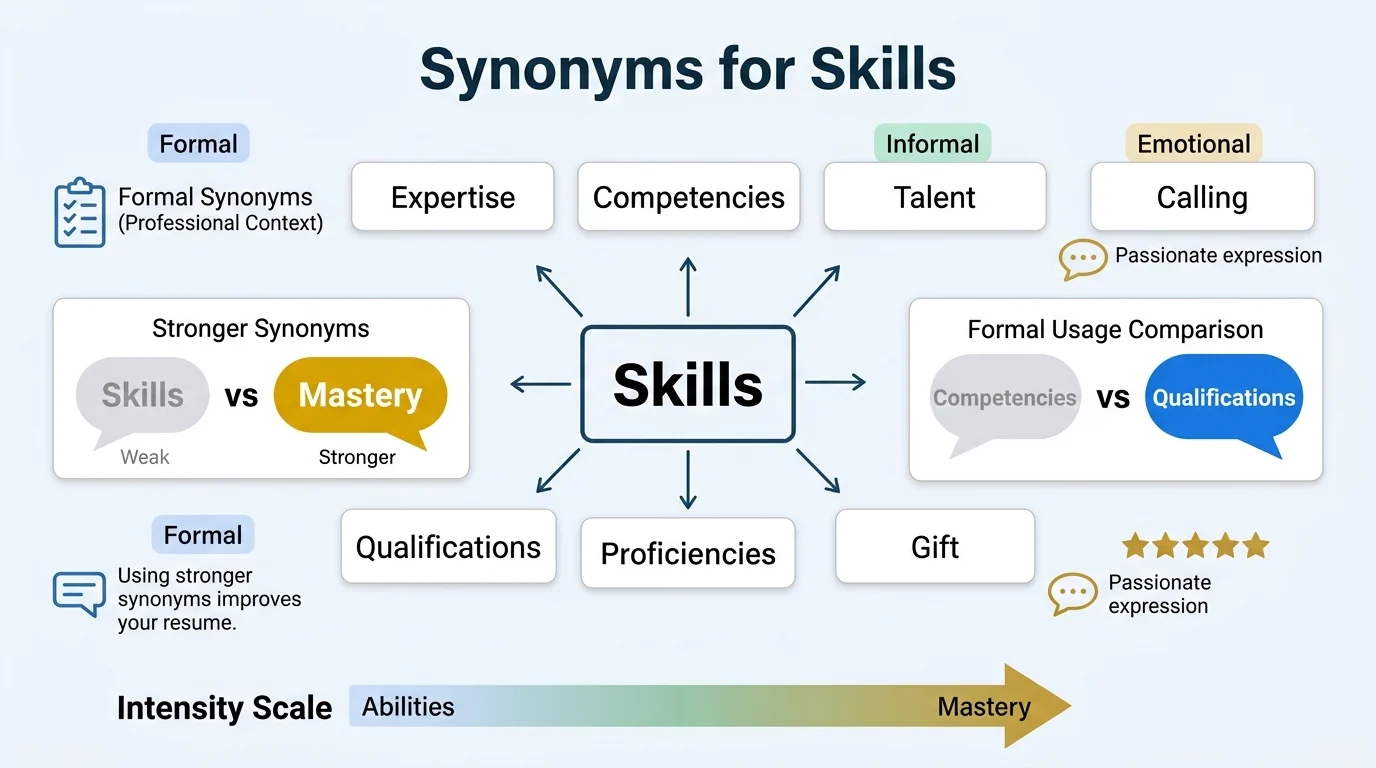
Skills are the learned or innate abilities to perform tasks effectively. For formal writing like resumes, use “competencies” or “expertise.” For casual conversation, try “talents” or “knacks.” Academic contexts favor “proficiencies” or “aptitudes.” Creative writing often uses “gifts” or “craft.” Emotional situations might call for “instincts” or “natural talents.” Choose based on your audience and purpose.
Meaning, Tone and Context
- Simple definition: Skills refer to the ability to do something well, usually gained through training, practice, or experience.
- Part of speech: Noun. It is always used in its plural form when referring to multiple abilities. The singular “skill” is also used.
- Tone: Neutral. The word itself does not carry a positive or negative emotional charge. It is factual and practical.
- Formality level: Moderate. It works in almost any context, from casual chats to formal reports.
- Common use cases: Resumes, job interviews, cover letters, academic essays, professional development discussions, personal bios, and performance reviews.
- Important word forms: The adjective form is “skilled.” The verb form is rarely used but exists as “to skill” in some contexts. Related forms include “skillful” and “skillfully.”
When and How to Use “Skills”
You should use “skills” when you need a general, all purpose term for abilities. It is your default choice. It works well when you are not trying to impress anyone. However, it can become dull with overuse.
Here are some examples of how to use it.
- Professional context: The candidate listed her software skills prominently on her resume.
- Personal context: His cooking skills have improved dramatically since he started taking classes.
- Academic context: The course aims to develop critical thinking skills in students.
- Creative context: Her storytelling skills captivated the entire audience.
- Social media context: Proud of the new baking skills I have been working on. Check out these cupcakes.
- Email context: I am writing to confirm that my technical skills align with the job requirements.
- Casual conversation: His people skills are what make him such a great manager.
Another Word for “Skills”
The best single replacement for “skills” depends entirely on your context. One word cannot fit every situation. You need to match the word to the tone and formality of your writing.
- Professional writing: Use “competencies.” This word signals that you have met specific standards.
- Academic writing: Use “proficiencies.” It suggests a high level of mastery.
- Casual conversation: Use “talents.” This sounds natural and friendly.
- Emotional writing: Use “gifts.” It implies something special and innate.
- Creative writing: Use “craft.” This highlights a developed art form.
- Resume or workplace use: Use “expertise.” It conveys deep knowledge and experience.
- Social media captions: Use “hacks” or “knacks” for a playful tone.
- Stronger meaning: Use “mastery.” It is the highest level of skill.
- Softer meaning: Use “abilities.” It is a gentle, general term.
When Not to Use “Skills”
You should avoid “skills” when it sounds too vague or general. If you are writing a resume, “skills” is often too basic. Hiring managers read this word constantly. It does not make you stand out. You should also avoid it when you need a more formal or academic tone. For example, in a research paper, “proficiencies” sounds more precise.
Consider the difference. “I have skills in data analysis” sounds weak. “I possess advanced competencies in data analysis” sounds much stronger. The second version shows specific, high level ability.
Here is another example. “Her skills in negotiation are good” is acceptable. “Her strategic aptitude in negotiation is exceptional” is far more impressive. The synonym adds weight and clarity.
Words Commonly Confused With “Skills”
Several words are often used interchangeably with “skills,” but they have distinct meanings. Understanding these differences will improve your word choice.
Skills vs. Abilities
Skills are learned through practice and training. Abilities are often natural or innate. You have the ability to learn a language. You develop the skill of speaking it fluently.
Skills vs. Talents
Talent is often seen as a natural gift. Skills are developed through hard work. A person may have a talent for music. They must practice to develop the skill of playing an instrument.
Skills vs. Competencies
Competencies are broader. They include skills, knowledge, and behaviors. Competencies are often used in professional settings to describe a person’s overall fitness for a role.
Skills vs. Aptitudes
Aptitude refers to a natural inclination or potential. It is the capacity to learn a skill. You might have an aptitude for mathematics, but your math skills are what you can actually do.
Skills vs. Expertise
Expertise is a very high level of skill. It implies deep, specialized knowledge. You have skills in marketing. You have expertise in digital marketing strategy.
Skills vs. Proficiencies
Proficiency means being competent or skilled. It is often measured against a standard. You can be proficient in a language. Your skills are the specific parts of that language you know.
Best Synonym by Context for “Skills”
This table provides a quick reference for choosing the best synonym based on your situation.
| Context | Best Synonym | Why It Works | Example |
|---|---|---|---|
| Formal Writing | Competencies | It sounds official and standard based. | The report evaluated the core competencies of the staff. |
| Academic Writing | Proficiencies | It suggests measurable and tested ability. | The study measured students’ reading proficiencies. |
| Professional Use | Expertise | It conveys deep knowledge and experience. | Her expertise in finance is well known in the industry. |
| Resume Writing | Capabilities | It shows what you are able to contribute. | My capabilities include project management and leadership. |
| Casual Conversation | Talents | It is natural, easy, and personable. | His talents for fixing things are incredible. |
| Creative Writing | Craft | It highlights artistry and dedication. | She honed her craft over many years. |
| Emotional Tone | Gifts | It implies something valuable and special. | Her gifts for teaching changed many young lives. |
| Strong Intensity | Mastery | It indicates the highest possible level. | His mastery of the subject was obvious. |
| Soft Tone | Knacks | It suggests a natural, easy ability. | She has a knack for making people feel comfortable. |
| Social Media | Hacks | It is modern and suggests clever solutions. | Here are some productivity hacks I use daily. |
| US Usage | Skills | This is the standard term in American English. | The job requires strong communication skills. |
Which Synonym Should You Choose?
Choosing the right synonym is a practical decision. You should base your choice on four main factors.
First, consider the meaning. What are you trying to say? Are you talking about something learned, or something natural? This will guide you to words like “proficiency” versus “talent.”
Second, think about formality. Are you writing a text to a friend or a report for a CEO? “Knack” is great for a friend. “Competency” is essential for a CEO.
Third, assess the emotional intensity. Do you want to sound passionate and excited, or calm and factual? Use “gift” for passion and “ability” for fact.
Fourth, consider the professional value. If you are in a job interview, you want to sound impressive. Words like “expertise” and “mastery” carry more weight than a simple “skills.” Always match your vocabulary to the situation for maximum impact.
Real Life Examples of “Skills” in Sentences
Here are examples of “skills” and its synonyms in action across different areas of life.
At school, a teacher might say, “We are focusing on building your analytical skills this semester.” A stronger alternative would be, “We are developing your analytical proficiencies.”
In the workplace, a manager might say, “John has excellent problem solving skills.” A more powerful version is, “John demonstrates exceptional problem solving expertise.”
For creative writing, “Her skills as a painter are evolving” becomes “Her craft as a painter is evolving beautifully.”
In conversation, “My cooking skills are not great” can be, “I have no knack for cooking.”
On social media, “Showing off my new editing skills” could be, “Showing off my new editing hacks.”
In an email, “I have the skills you need for this project” changes to “I possess the competencies required for this project.”
For storytelling, “His skills saved the day” becomes “His quick thinking and mastery of the situation saved the day.”
25 Synonyms for “Skills”
This table lists fifteen accurate synonyms. Each one has a unique meaning and use case. We have included example sentences to show them in action.
| Synonym | Simple Meaning | Best Used For | Example Sentence |
|---|---|---|---|
| Expertise | Deep, specialized knowledge | Professional and business writing | Her expertise in cybersecurity made her a valuable asset. |
| Competency | Ability to meet a standard | Performance reviews and HR | He demonstrated his competency in all key areas. |
| Proficiency | Skill measured against a level | Academic and professional tests | She achieved proficiency in Spanish after two years of study. |
| Aptitude | Natural ability to learn | Career counseling and education | His aptitude for logical reasoning is exceptional. |
| Talent | Natural gift or ability | Casual conversation and personal bios | His talent for public speaking is evident to everyone. |
| Craft | Skill in an art or trade | Creative and artistic fields | She has truly mastered her craft as a potter. |
| Knack | Natural, easy skill | Informal and friendly contexts | He has a real knack for fixing old cars. |
| Mastery | Complete and total command | Describing experts and leaders | His mastery of the software is unparalleled in the company. |
| Capability | Potential or capacity | Job descriptions and interviews | Our team has the capability to handle large projects. |
| Savvy | Practical, street smart knowledge | Modern business and marketing | He is known for his marketing savvy in the startup world. |
| Prowess | Great bravery or skill | Describing impressive achievements | The athlete displayed incredible prowess on the field. |
| Facility | Natural ease in doing something | Describing fluent and easy action | She has a remarkable facility with languages. |
| Adroitness | Skill and cleverness in movement | Physical and mental dexterity | His adroitness in negotiations was impressive. |
| Dexterity | Skill in performing tasks, especially with hands | Manual tasks and quick thinking | The surgeon’s dexterity saved the patient’s life. |
| Acumen | Sharpness and insight in a particular field | Business and financial contexts | His business acumen helped the company grow rapidly. |
Synonym Groups and Usage Differences
Professional vs. Personal Synonyms
Professional synonyms include “competencies,” “expertise,” and “acumen.” These words are formal and standard based. Personal synonyms include “talents,” “knacks,” and “gifts.” These are more intimate and focus on the individual. Use professional terms in the boardroom and personal terms with friends.
Formal vs. Conversational Synonyms
Formal synonyms for reports and essays are “proficiencies,” “aptitudes,” and “competencies.” They are precise and academic. Conversational synonyms for texts and emails are “hacks,” “knacks,” and “talents.” These are friendly and easy to understand.
Academic Synonyms
In academic writing, precision is key. Use “proficiencies” to discuss measurable abilities. Use “aptitudes” for potential. “Competencies” works when discussing educational standards. These words show you understand the subject at a deeper level. They are appropriate for essays, research papers, and dissertations.
Professional and Business Synonyms
In the workplace, you want to sound capable and confident. Use “expertise” to show you are an authority. Use “competencies” to prove you meet job requirements. “Savvy” is excellent for modern business language, especially in marketing and tech. “Acumen” is perfect for financial and strategic roles.
Creative or Literary Synonyms
Creative writing thrives on vivid language. “Craft” is a classic choice for artists and writers. “Prowess” suggests heroic skill. “Adroitness” and “dexterity” add a sense of grace and cleverness. These words add imagery and depth to your descriptions. They make characters and scenes come alive.
Slang or Modern Synonyms
Modern language evolves quickly. Words like “hacks” are perfect for social media. They imply clever shortcuts. “Savvy” has become very popular in modern professional settings. “Clout” is a slang term for influence or skill. These terms are acceptable in casual writing and modern marketing. Avoid them in formal reports.
Strongest vs. Weaker Synonyms
Here is an intensity scale from mild to strongest.
Mild: “Abilities” and “capacities”
Moderate: “Skills” and “competencies”
Strong: “Proficiency” and “expertise”
Strongest: “Mastery” and “prowess”
Choose mild words for general statements. Use the strongest words when you need to impress an audience.
Emotional vs. Neutral Synonyms
Neutral synonyms include “abilities,” “competencies,” and “proficiencies.” They state facts. Emotional synonyms add feeling. “Gift” implies something special and loved. “Prowess” suggests awe and admiration. “Knack” adds a sense of charm. Choose emotional words to connect with people. Choose neutral words to remain objective.
Antonyms of “Skills”
| Antonym | Meaning | Example Sentence |
|---|---|---|
| Incompetence | Lack of ability | His incompetence was clear from the project’s failure. |
| Ineptitude | No skill or clumsiness | Her ineptitude with technology was frustrating. |
| Clumsiness | Awkward movement or action | His clumsiness made him drop the vase. |
| Ignorance | Lack of knowledge | Their ignorance of the rules caused many errors. |
| Weakness | A lack of strength or skill | Her weakness in math was holding her back. |
| Inadequacy | Not being good enough | The team’s inadequacy was exposed in the finals. |
| Disability | A physical or mental condition that limits skill | The injury caused a permanent disability. |
| Incapacity | Lack of physical or mental ability | His incapacity to lead became apparent. |
| Awkwardness | Lack of grace or skill | His social awkwardness made him uncomfortable. |
| Uselessness | Having no practical skill | The tool’s uselessness was obvious. |
| Futility | Pointlessness due to lack of skill | The attempt ended in futility. |
| Imbecility | A very low level of skill or intelligence | The plan was one of pure imbecility. |
| Stupidity | Lack of intelligence or skill | His stupidity cost the company money. |
| Foolishness | Unwise or unskilled behavior | Her foolishness was a danger to herself. |
| Unskillfulness | Lacking skill or expertise | His unskillfulness was a hindrance to the project. |
Comparison: Skills vs. Similar Words
Skills vs. Abilities
The main difference is origin. Skills are learned. Abilities are often natural. A baby has the ability to cry. An adult has the skill to debate. “Abilities” is also a more general word. “Skills” suggests a specific, practiced task.
Which one is stronger? Neither is inherently stronger. “Skills” often sounds more impressive because it suggests effort.
Which one is more formal? “Abilities” is slightly more formal in some academic contexts.
Example for Skills: She has excellent writing skills.
Example for Abilities: She has a natural ability for writing.
Skills vs. Talents
Talent is what you are born with. Skill is what you develop. Talent is potential. Skill is performance. Someone can have natural talent for music, but they must develop the skill to play a song. “Talent” is often used for artistic or creative fields.
Which one is stronger? “Skill” often sounds more professional. “Talent” sounds more personal.
Which one is more formal? “Skill” is more formal for business writing.
Example for Skills: He has the skills to manage a team.
Example for Talents: He has a talent for inspiring his team.
Skills vs. Competencies
Competencies are larger than skills. A competency includes skills, but also includes knowledge and behaviors. For example, “leadership” is a competency. It requires many skills like delegation, communication, and motivation. Competencies are often used in HR to describe a whole person.
Which one is stronger? “Competencies” is a stronger, more holistic word.
Which one is more formal? “Competencies” is more formal and professional.
Example for Skills: I have good communication skills.
Example for Competencies: My leadership competencies include strategic thinking and team building.
Skills vs. Expertise
Expertise is a very high level of skill. It implies years of experience and deep knowledge. You can have skills in marketing, but if you have marketing expertise, you are an expert. “Expertise” is a powerful word.
Which one is stronger? “Expertise” is much stronger.
Which one is more formal? Both are professional, but “expertise” carries more weight.
Example for Skills: I have skills in data entry.
Example for Expertise: I have expertise in data analytics.
Skills vs. Aptitudes
Aptitude is the capacity to learn. It is a natural inclination. You have an aptitude for a subject if you pick it up quickly. A skill is what you know how to do after learning it. You might have an aptitude for languages, but your skills in French are still developing.
Which one is stronger? “Skills” is stronger because it shows actual achievement.
Which one is more formal? “Aptitudes” is common in educational and career testing.
Example for Skills: I have skills in French conversation.
Example for Aptitudes: I have an aptitude for learning new languages.
Skills vs. Proficiencies
Proficiency is a measure of skill. It often means you have been tested and reached a certain standard. You are proficient in a language if you can pass a test. Your skills are the individual parts you can perform. “Proficiency” is a formal, academic word.
Which one is stronger? “Proficiency” is stronger and more measurable.
Which one is more formal? “Proficiency” is more formal.
Example for Skills: My skills in English include reading and writing.
Example for Proficiencies: I have a proficiency in English at the advanced level.
Common Phrases and Expressions with “Skills”
1. “Soft Skills”
Meaning: Personal attributes that enable someone to interact effectively with others. Examples are communication, empathy, and teamwork.
Example sentence: Employers are increasingly looking for candidates with strong soft skills, not just technical knowledge.
2. “Hard Skills”
Meaning: Teachable abilities or skill sets that are easy to quantify. Examples are coding, writing, and accounting.
Example sentence: The job description listed several hard skills like proficiency in Excel and Python.
3. “People Skills”
Meaning: The ability to communicate and relate well with others.
Example sentence: His people skills make him the perfect choice for a customer service role.
4. “Skill Set”
Meaning: A person’s range of skills or abilities.
Example sentence: Her unique skill set makes her an invaluable asset to the company.
5. “Transferable Skills”
Meaning: Skills that can be used in many different jobs or industries.
Example sentence: Project management is a highly transferable skill that applies to many fields.
6. “Life Skills”
Meaning: Skills needed to deal effectively with the challenges of everyday life.
Example sentence: Schools are increasingly teaching life skills like financial literacy and cooking.
7. “Core Skills”
Meaning: The fundamental skills needed for a job or activity.
Example sentence: Literacy and numeracy are core skills for all educational programs.
Common Mistakes to Avoid
- Using “skills” when a more precise synonym is better. Do not use a general word when you can use a specific one. Replace “skills” with “proficiencies” or “expertise” to add weight.
- Confusing “skills” with “talents.” Remember the difference. Skills are learned. Talents are natural. Do not say “natural skill” when you mean “talent.”
- Using a casual synonym in formal writing. Do not use “knack” or “hacks” in a formal report. Use “competencies” or “proficiencies” instead.
- Using an overly dramatic synonym for a simple situation. Do not say “mastery” if you are just talking about basic cooking. “Mastery” is for experts. Use “abilities” or “skills” for everyday things.
- Repeating the same word too often. Vary your vocabulary. Use a table or list of synonyms to avoid repetition. This makes your writing more engaging.
- Choosing a synonym with the wrong emotional tone. “Gift” is an emotional word. “Competency” is not. Match the tone to the context. An emotional word may sound out of place in a technical manual.
- Using slang in academic or professional writing. Avoid words like “hacks” or “clout” in academic essays. They are too informal and will damage your credibility. Stick to standard, academic synonyms.
FAQs
What is the best synonym for skills?
The best synonym depends on the context. For formal situations, use “competencies.” For casual use, try “talents.”
What is a formal synonym for skills?
A formal synonym is “competencies” or “proficiencies.” These words are ideal for academic and professional writing.
What is an informal synonym for skills?
An informal synonym is “knack” or “hacks.” These words are perfect for casual conversations and social media.
What is another word for skills in professional writing?
In professional writing, use “expertise,” “competencies,” or “acumen.” These terms show a high level of capability.
What is the difference between skills and abilities?
Skills are learned through practice. Abilities are often natural or innate. You develop a skill, but you possess an ability.
What is the opposite of skills?
The opposite of skills is “incompetence” or “ineptitude.” These words describe a lack of ability or skill.
Conclusion
The word “skills” is a practical and essential part of the English language. It serves as a perfect default for describing your abilities. However, the true power of language comes from precision. Overusing “skills” makes your writing bland. Replacing it with a more specific synonym will elevate your communication. Words like “expertise,” “craft,” and “competency” add depth and clarity.
They show your audience that you are thoughtful about your word choice. Tone and context are your guides. Choose formal words for professional settings. Choose casual words for friendly conversations. This one practical tip can instantly improve your writing, speaking, and professional communication. Your vocabulary is a toolkit. Use the right tool for the job.