Have you ever caught yourself using the word “see” over and over again in an email, essay, or social media caption? You are not alone. The word “see” appears constantly in everyday English, but relying on it too much can make your writing feel dull and repetitive.
Whether you are drafting a professional report, crafting a creative story, or simply trying to express yourself more clearly, finding the right synonym for “see” can transform your communication.
This guide will help you move beyond the basic word and choose the perfect alternative for any situation. You will discover formal options for business writing, casual words for everyday conversation, and descriptive terms for creative work. By the end, you will never have to settle for a vague “see” again.
What Does “See” Mean?
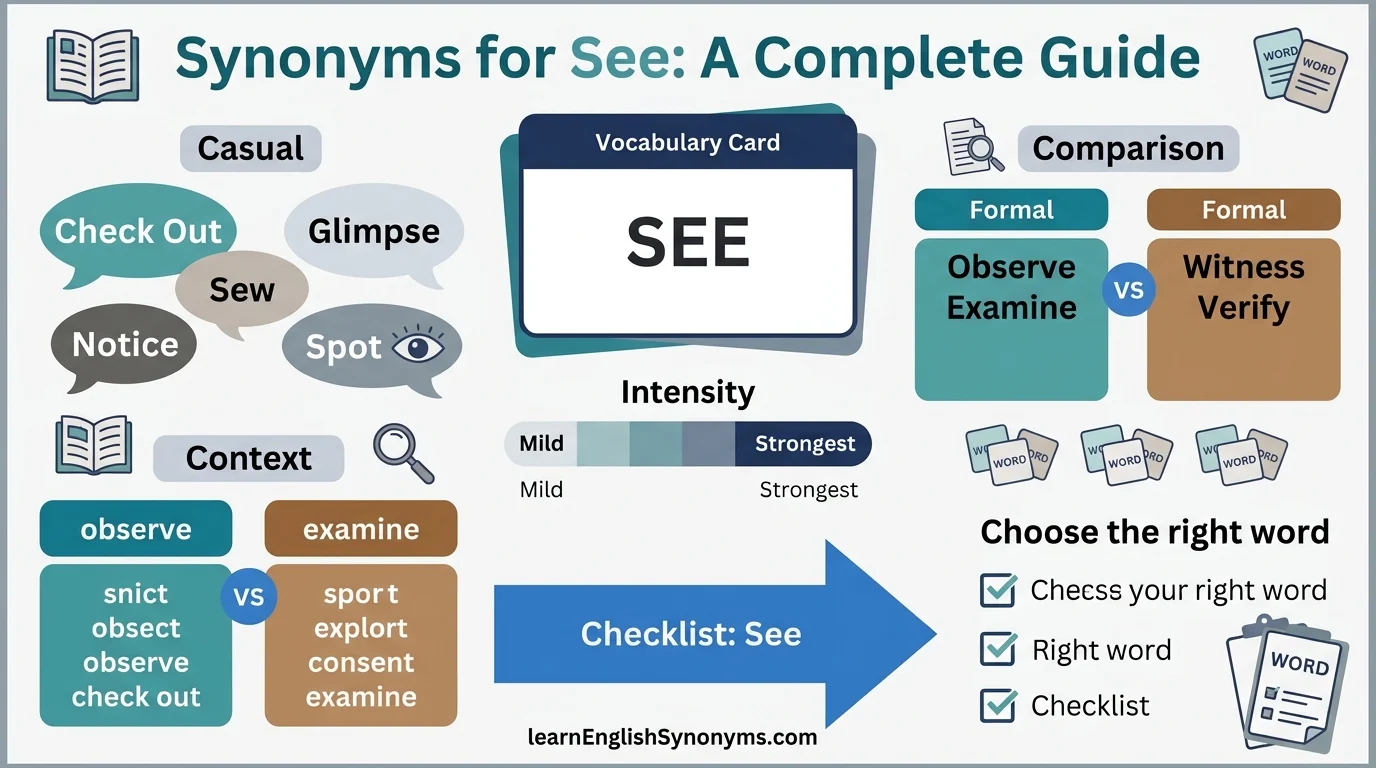
“See” means to perceive with your eyes or to understand something mentally. The best synonym depends on your context. For formal writing, use “observe” or “perceive.” casual conversation, try “spot” or “notice.” For emotional depth, choose “witness” or “behold.” Academic writing often prefers “examine” or “scrutinize.” Professional contexts work well with “review” or “monitor.”
Meaning, Tone and Context
- Simple definition
“See” means to become aware of something through your eyes or through mental understanding. It covers both physical sight and intellectual comprehension. - Part of speech
“See” is primarily a verb. Its past tense is “saw,” and its past participle is “seen.” You can also use it as a noun in phrases like “have a see.” - Positive, negative, or neutral tone
The word “see” is neutral. It does not carry any strong emotional weight on its own. The tone depends entirely on the context and the words around it. - Formality level
“See” is informal to neutral. It works well in everyday conversation but may feel too vague in formal writing or academic papers. - Common use cases
You will use “see” for physical observation, mental understanding, checking information, visiting someone, or experiencing an event. It appears everywhere from casual texts to business emails. - Important word forms
The noun form is “sight.” The adjective “visible” relates to being able to be seen. The opposite is “overlook” or “miss.” Related forms include “seeing” and “seer” for someone who sees.
When and How to Use “See”
You should use “see” when the context is casual and the meaning is clear without extra precision. It works best in everyday speech, informal writing, and situations where the exact type of observation does not matter.
Here are realistic examples labeled by context.
Professional
Please see the attached report for the quarterly numbers.
Personal
I will see you at the coffee shop around three o’clock.
Academic
Let us see how this theory applies to real world situations.
Emotional
She could see the disappointment in his eyes.
Creative
Through the fog, I could barely see the lighthouse.
Social Media
See you all at the concert next weekend.
Email
I see your point, and I agree with your assessment.
Resume
I can see opportunities for improvement in any process.
Another Word for “See”
The best single replacement for “see” depends entirely on your context and the tone you want to achieve. Here are the most effective alternatives for different situations.
Professional writing
Use “review” or “examine” when you need to convey careful attention to details.
Academic writing
Use “observe” or “analyze” to sound precise and methodical.
Casual conversation
Use “spot” or “catch” for quick, informal observation.
Emotional writing
Use “witness” or “behold” to add weight and feeling.
Creative writing
Use “glimpse” or “perceive” for descriptive richness.
Resume or workplace use
Use “monitor” or “assess” to show active evaluation skills.
Social media captions
Use “check out” or “peep” for modern, engaging language.
Stronger meaning
Use “scrutinize” or “inspect” for intense observation.
Softer meaning
Use “notice” or “acknowledge” for gentle awareness.
When Not to Use “See”
The word “see” becomes a problem when it is too vague, too casual, or too weak for your context. You should avoid it in formal reports, academic papers, and professional communications that require precision.
Here is an example of a weak sentence.
Weak: We need to see the data before making a decision.
Improved: We need to analyze the data before making a decision.
Another example shows how a stronger synonym improves clarity.
Weak: She saw the problem immediately.
Improved: She detected the problem immediately.
In creative writing, “see” often fails to create vivid imagery. A descriptive synonym like “glimpse” or “perceive” adds depth and emotion to your narrative.
Words Commonly Confused With “See”
Many words relate to “see” but have distinct meanings. Understanding these differences will help you choose the right word every time.
Watch
This word implies looking at something that is moving or changing over time. You watch a movie or watch a child play.
Look
This word suggests directing your eyes toward something intentionally. You look at a painting or look for your keys.
Observe
This word means to watch carefully and often scientifically. Scientists observe behavior in controlled settings.
View
This word refers to seeing something from a particular position or perspective. You view a property or view the city from a hill.
Witness
This word means to see something happen, often something significant or legal. You witness an accident or witness a ceremony.
Perceive
This word means to become aware of something through your senses or intuition. You perceive a change in mood or perceive a hidden meaning.
Best Synonym by Context for “See”
This table shows the most effective synonyms for different situations.
| Context | Best Synonym | Why It Works | Example |
|---|---|---|---|
| Formal writing | Observe | It sounds objective and precise | The researcher observed the subjects for six weeks |
| Academic writing | Examine | It implies careful, systematic study | We will examine the data to find patterns |
| Professional business | Review | It suggests thorough evaluation | Please review the contract before signing |
| Resume writing | Assess | It shows analytical ability | I assess project risks to prevent delays |
| Casual conversation | Spot | It is quick and natural | I spotted my friend in the crowd |
| Creative writing | Perceive | It adds depth and sensitivity | She perceived the tension in the room |
| Emotional tone | Witness | It conveys importance and feeling | We witnessed a moment of pure kindness |
| Strong intensity | Scrutinize | It shows extreme attention to detail | The editor scrutinized every sentence |
| Soft moderate tone | Notice | It is gentle and unassuming | I noticed a small change in her attitude |
| Social media captions | Peep | It is modern and playful | Peep my new outfit on the story |
| US usage | View | It is widely understood and neutral | Let us view the presentation together |
| UK usage | Spot | It is equally common in British English | I spotted the mistake straight away |
Which Synonym Should You Choose?
Choosing the right synonym for “see” comes down to four key factors.
Consider the meaning
Are you talking about physical sight, mental understanding, or something else? Physical sight works well with “observe” or “spot.” Mental understanding fits better with “perceive” or “comprehend.”
Think about formality
Formal contexts like reports and academic papers require words like “examine” or “review.” Casual conversations and social media allow informal words like “spot” or “check out.”
Evaluate emotional intensity
Do you need a neutral word or an emotional one? “Notice” stays neutral and factual. “Witness” adds weight and significance to the observation.
Match your sentence structure
Some synonyms sound better in certain sentence positions. “Monitor” works well for ongoing action. “Glimpse” works perfectly for brief, momentary sight.
Real Life Examples of “See” in Sentences
These examples show how to replace “see” with stronger synonyms across different situations.
School setting
The teacher observed the students as they completed their experiments.
Better than: The teacher saw the students as they completed their experiments.
Workplace communication
We need to review the financial projections before the meeting.
Better than: We need to see the financial projections before the meeting.
Creative writing
From the window, she glimpsed the first signs of dawn.
Better than: From the window, she saw the first signs of dawn.
Everyday conversation
I spotted your car in the parking lot this morning.
Better than: I saw your car in the parking lot this morning.
Social media post
Check out this amazing sunset I photographed tonight.
Better than: See this amazing sunset I photographed tonight.
Professional email
Please review the attached document and share your feedback.
Better than: Please see the attached document and share your feedback.
Storytelling moment
They witnessed the entire event unfold from start to finish.
Better than: They saw the entire event unfold from start to finish.
15 Synonyms for “See”
This table provides 15 accurate synonyms with clear explanations and natural examples.
| Synonym | Simple Meaning | Best Used For | Example Sentence |
|---|---|---|---|
| Observe | To watch with careful attention | Scientific, academic, or formal observation | The biologist observed the birds for three months |
| Notice | To become aware of something | Casual detection without effort | I noticed a new restaurant opening downtown |
| Spot | To see something briefly or suddenly | Quick, informal recognition | Can you spot the difference between these two images? |
| View | To look at something from a position | Formal or neutral perspective | We will view the property on Saturday afternoon |
| Witness | To see an event happen | Important, emotional, or legal situations | She witnessed the historic signing ceremony |
| Perceive | To understand through senses or intuition | Intellectual or sensory awareness | He perceived a hint of sadness in her voice |
| Glimpse | To see something briefly and partially | Quick, fleeting sight | I glimpsed the celebrity as she entered the hotel |
| Examine | To look at something in detail | Careful, analytical observation | The doctor examined the X ray results |
| Inspect | To check something thoroughly | Detailed evaluation with purpose | The safety officer inspected the equipment |
| Monitor | To watch something over time | Ongoing observation or supervision | We monitor customer feedback on social media |
| Discern | To detect something subtle or hidden | Recognizing small details or differences | It is hard to discern the truth in this situation |
| Behold | To see something impressive or majestic | Dramatic or poetic observation | Behold the beauty of this ancient cathedral |
| Detect | To discover something not obvious | Finding hidden or faint things | The sensor can detect small movements |
| Review | To look over something carefully | Checking documents or information | Please review the proposal before the deadline |
| Contemplate | To look at something thoughtfully | Reflective or meditative observation | She contemplated the meaning of the painting |
Synonym Groups and Usage Differences
Professional vs. Personal Synonyms
Professional contexts demand words that sound competent and thorough. “Review,” “examine,” and “monitor” show that you are actively evaluating information. Personal situations allow softer words like “notice,” “spot,” and “glimpse.” These words feel more natural in everyday conversation and casual writing.
Formal vs. Conversational Synonyms
Formal writing calls for “observe,” “perceive,” and “examine.” These words appear frequently in reports, essays, and official documents. Conversational English prefers “spot,” “check out,” and “catch.” These words feel relaxed and approachable in texts, emails, and spoken language.
Academic Synonyms
Academic writing values precision and objectivity. “Observe” works well for research based descriptions. “Analyze” fits when you are examining data or evidence. “Scrutinize” shows extreme attention to detail in scholarly work. “Perceive” is useful for discussing human perception and cognition.
Professional and Business Synonyms
Business communication benefits from words that demonstrate competence. “Review” is essential for checking documents. “Assess” shows evaluation skills. “Monitor” suggests ongoing supervision. “Inspect” implies thorough quality checks. These words appear frequently in resumes, emails, and presentations.
Creative or Literary Synonyms
Creative writing thrives on vivid imagery. “Glimpse” captures fleeting moments. “Behold” adds dramatic grandeur. “Perceive” brings sensitivity to observations. “Contemplate” suggests deep thought. “Witness” conveys emotional weight. These synonyms help you paint pictures with words.
Slang or Modern Synonyms
Modern English includes casual alternatives for informal situations. “Peep” is popular on social media. “Check out” works in everyday conversation. “Catch” appears in phrases like “catch a movie.” These words are acceptable in casual settings but too informal for professional or academic writing.
Strongest vs. Weaker Synonyms
The intensity of observation varies across synonyms.
Mild: notice, acknowledge, glimpse
Moderate: observe, view, spot
Strong: scrutinize, inspect, examine
Strongest: witness, behold, contemplate
Emotional vs. Neutral Synonyms
Neutral synonyms stick to factual observation. “Observe,” “view,” and “review” carry no emotional weight. Emotional synonyms add depth and feeling to your writing. “Witness” implies significance. “Behold” inspires wonder. “Perceive” suggests intuitive understanding. “Contemplate” involves thoughtful reflection.
Antonyms of “See”
These words express the opposite of seeing and understanding.
| Antonym | Meaning | Example Sentence |
|---|---|---|
| Overlook | To fail to notice something | I overlooked the mistake in the report |
| Miss | To fail to see or catch something | I missed the exit on the highway |
| Disregard | To pay no attention to something | She disregarded the warning signs |
| Ignore | To refuse to acknowledge something | He ignored the email completely |
| Neglect | To fail to care for or notice something | The manager neglected the customer complaints |
| Avoid | To stay away from seeing something | I avoid looking at the news in the morning |
| Unsee | To make oneself unaware of something | I wish I could unsee that disturbing image |
| Blink | To miss something in a moment | I blinked and missed the shooting star |
| Conceal | To hide something from view | The trees conceal the house from the road |
| Mask | To cover or hide something | The smile masked her true feelings |
| Camouflage | To hide by blending in | The animal camouflaged itself against the leaves |
| Shroud | To cover or hide completely | Fog shrouded the entire coastline |
| Obscure | To make something unclear or hidden | The clouds obscure the mountain peak |
| Veil | To cover or hide partially | A thin veil of mist covered the valley |
| Befuddle | To confuse and prevent understanding | The complex instructions befuddle most users |
Comparison: See vs. Similar Words
See vs. Watch
The main difference is duration and attention. “See” is often passive and momentary. “Watch” is active and sustained. You see a bird briefly. You watch a movie for two hours.
“See” is less formal and more general. “Watch” is more specific and requires focus.
Example for “see”: I saw the bus arrive.
Example for “watch”: I watched the bus approach the station.
See vs. Look
“Look” involves intentional direction of your eyes. “See” is the result of that action. You look at something, and then you see it.
“Look” is more active. “See” is more passive. You can look without seeing if your mind is elsewhere.
Example for “see”: I saw the painting on the wall.
Example for “look”: I looked at the painting for several minutes.
See vs. Observe
“Observe” is more deliberate and analytical than “see.” Scientists observe behavior. You see your neighbor walking their dog.
“Observe” is formal and professional. “See” is casual and everyday. Observe suggests careful study. See suggests casual awareness.
Example for “see”: I saw the children playing outside.
Example for “observe”: The researcher observed the children’s play patterns.
See vs. View
“View” often implies a particular perspective or arrangement. view a property. You view a document. You view a scene from a certain angle.
“See” is more general and less formal. “View” sounds more deliberate and often relates to visual media or real estate.
Example for “see”: I see your point about the budget.
Example for “view”: Let us view the presentation together.
See vs. Witness
“Witness” implies seeing something important or significant. You witness a crime. witness a historic moment. You witness a miracle.
“See” is neutral and everyday. “Witness” adds weight and seriousness to the observation.
Example for “see”: I saw the car accident.
Example for “witness”: I witnessed the car accident and called the police.
See vs. Perceive
“Perceive” involves understanding through senses or intuition. You perceive a change in someone’s mood. You perceive a hidden meaning in the text.
“See” is more literal and concrete. “Perceive” is more abstract and intellectual. It involves the mind as much as the eyes.
Example for “see”: I saw the problem in the code.
Example for “perceive”: I perceived a flaw in the logic.
Common Phrases and Expressions with “See”
1. See eye to eye
Meaning: To agree with someone.
Example sentence: My boss and I do not always see eye to eye on project timelines.
2. See red
Meaning: To become extremely angry.
Example sentence: His rude comment made me see red instantly.
3. See the light
Meaning: To suddenly understand or realize something.
Example sentence: After years of resistance, she finally saw the light about renewable energy.
4. Let me see
Meaning: A phrase used when thinking or checking something.
Example sentence: Let me see if I have any openings in my schedule next week.
5. See the bigger picture
Meaning: To understand the overall situation.
Example sentence: You need to see the bigger picture rather than focusing on small details.
6. See for yourself
Meaning: To check something personally.
Example sentence: The results are on the screen. See for yourself.
7. See you later
Meaning: An informal goodbye.
Example sentence: I have to go now. See you later.
8. Wait and see
Meaning: To be patient and watch for results.
Example sentence: We do not know the outcome yet. We will wait and see.
Common Mistakes to Avoid
- Using “see” when a more precise synonym is better
Weak: I saw the numbers in the report.
Strong: I reviewed the numbers in the report. - Confusing “see” with “look”
Incorrect: I looked the bird in the tree.
Correct: I saw the bird in the tree. - Using a casual synonym in formal writing
Incorrect: We need to check out the financial data.
Correct: We need to examine the financial data. - Using an overly dramatic synonym for a simple situation
Overly dramatic: I beheld my morning coffee.
Natural: I saw my morning coffee. - Repeating the same word too often
Repetitive: I saw the dog. I saw the cat. I saw the bird.
Improved: I saw the dog. I spotted the cat. I glimpsed the bird. - Choosing a synonym with the wrong emotional tone
Wrong tone: I witnessed the sunset.
Better tone: I viewed the sunset. - Using slang in academic or professional writing
Incorrect: The researcher peeped the results.
Correct: The researcher reviewed the results.
FAQs
1. What is the best synonym for “see”?
The best synonym depends on your context. Use “observe” for formal situations, “spot” for casual conversation, and “review” for professional writing.
2. What is a formal synonym for “see”?
Formal synonyms include “observe,” “perceive,” “examine,” and “scrutinize.” These words work well in academic and professional writing.
3. What is an informal synonym for “see”?
Informal synonyms include “spot,” “check out,” “catch,” and “peep.” These words are perfect for casual conversations and social media.
4. What is another word for “see” in professional writing?
Professional writing often uses “review,” “examine,” “assess,” or “monitor.” These words show active evaluation and attention to detail.
5. What is the difference between “see” and “watch”?
“See” is passive and momentary. “Watch” is active and sustained. You see a person in passing. You watch a movie for two hours.
6. What is the opposite of “see”?
Antonyms of “see” include “overlook,” “miss,” “ignore,” and “disregard.” These words describe failing to notice or acknowledge something.
Conclusion
“See” is a versatile word that serves as a foundation for many types of observation and understanding. However, expanding your vocabulary with precise synonyms will make your writing more engaging, professional, and clear. The key is to match your word choice to your context. Use formal synonyms like “observe” and “examine” for academic and professional work. Choose casual options like “spot” and “notice” for everyday conversation. Select emotional words like “witness” and “perceive” for creative and expressive writing.
The next time you reach for the word “see,” pause and consider your audience and purpose. A more precise synonym will elevate your communication and help you express exactly what you mean.
Important Note: For precise definitions and usage guidelines, always verify synonyms using trusted dictionaries such as Cambridge, Oxford, Merriam Webster, Collins, or Britannica.