Have you ever written an email, essay, or caption and realized you used the word “influence” five times in three sentences? You are not alone. Many writers, students, and professionals struggle with repeating this versatile word.
Finding the right synonym for influence can transform your writing from repetitive to remarkable. The word carries power, but overusing it makes your language feel flat and unoriginal. Whether you are crafting a cover letter, writing a persuasive essay, or posting on social media, having a rich vocabulary of alternatives helps you communicate with precision and confidence.
This guide will give you the best synonyms across every situation. You will learn the subtle differences between similar words, avoid common mistakes, and choose the perfect word for any context.
What Does “Influence” Mean?
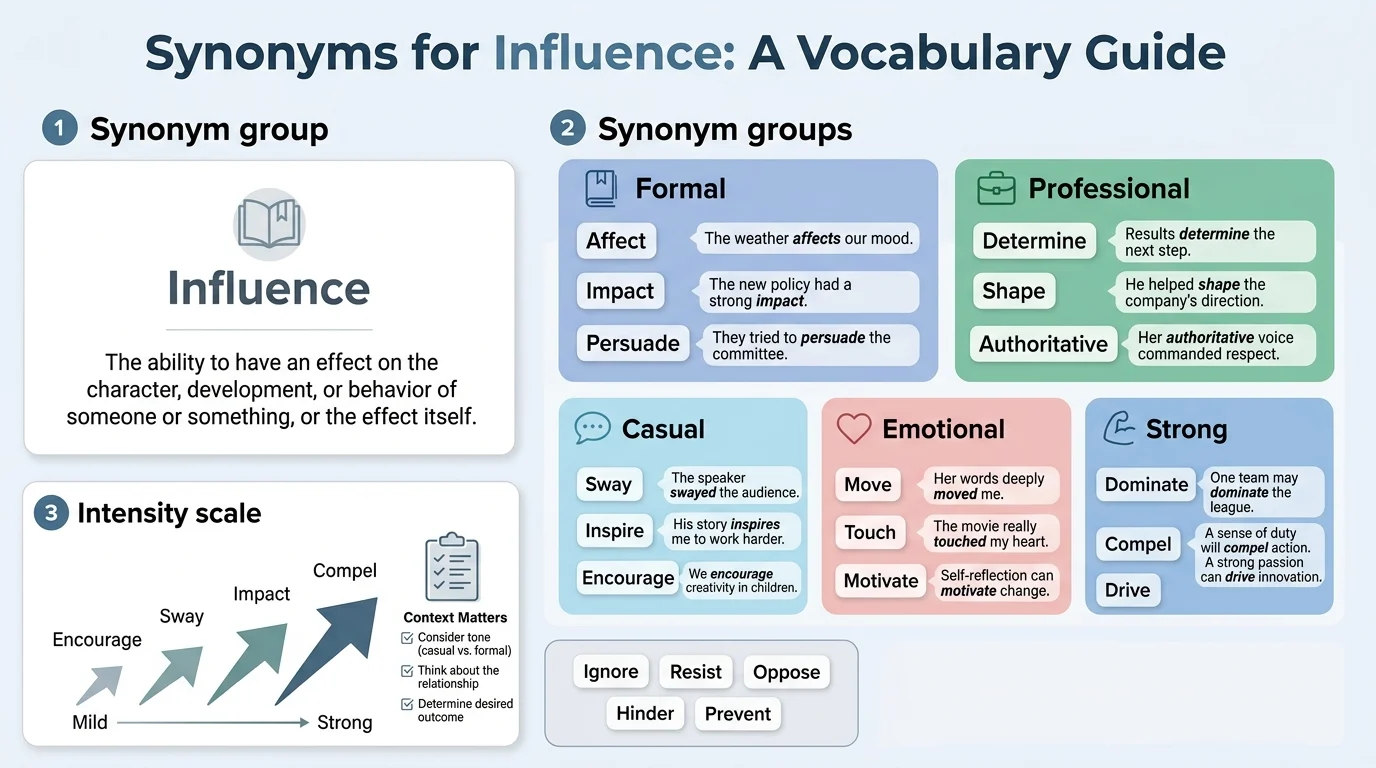
Influence means the capacity to affect someone’s character, development, or behavior. The best synonyms depend on context. For formal writing, consider “affect” or “impact.” For casual conversation, try “sway” or “shape.” Academic work benefits from “determine” or “modify.” Professional settings often use “guide” or “direct.” Emotional writing calls for “inspire” or “touch.”
Meaning, Tone and Context
- Simple definition: Influence is the power to have an effect on people, things, or events without using direct force.
- Part of speech: It works as both a noun and a verb. As a noun, it refers to the power itself. As a verb, it means to exert that power.
- Tone: The word influence is mostly neutral. It can be positive, negative, or neutral depending on the context and what follows it.
- Formality level: Influence sits comfortably in the middle. It works in casual conversation, business reports, academic essays, and creative writing without sounding out of place.
- Common use cases: You will find influence used in psychology, marketing, leadership, education, social commentary, and everyday discussions about how people affect each other.
- Important word forms: The adjective is “influential.” The noun forms include “influencer” for a person who exerts influence and “influenceability” for the capacity to be influenced. The opposite form is “uninfluenced.”
When and How to Use “Influence”
Use influence when you need a versatile word that works across almost any context. It describes both subtle and obvious effects. It suits situations where you want to acknowledge that something or someone has made a difference without being overly dramatic or technical.
Here are examples of influence in different contexts:
Professional Context
Her leadership style greatly influenced the team’s productivity and morale throughout the project.
Academic Context
The study examined how socioeconomic factors influence educational outcomes in urban school districts.
Personal Context
My grandmother influenced my love for cooking through countless afternoons spent together in her kitchen.
Emotional Context
The documentary deeply influenced my perspective on environmental conservation and personal responsibility.
Creative Writing
The light through the stained glass influenced every color in the room, transforming ordinary surfaces into art.
Social Media Caption
Books have influenced my worldview more than any other single thing in my life.
Resume Context
Developed training programs that positively influenced employee retention rates by twenty percent.
Another Word for “Influence”
The best single replacement depends entirely on your situation. Here are the strongest alternatives by context:
- Professional writing: “Affect” is the safest and most neutral choice for business communication.
- Academic writing: “Determine” shows precise causation in research and analytical writing.
- Casual conversation: “Shape” feels natural and conversational without being too informal.
- Emotional writing: “Inspire” adds warmth and personal connection to your message.
- Creative writing: “Color” adds an artistic quality when describing subtle effects.
- Resume or workplace: “Drive” suggests active leadership and measurable results.
- Social media captions: “Spark” feels energetic and engaging for online audiences.
- Stronger meaning: “Dominate” when influence is overwhelming or controlling.
- Softer meaning: “Guide” when influence is gentle and supportive rather than forceful.
When Not to Use “Influence”
Avoid influence when you need more precision about the type of effect you are describing. The word becomes too vague when you need to show direct causation, extreme force, or emotional depth.
Consider these examples where a more precise synonym improves the sentence:
Weak: The new policy influenced employee satisfaction.
Strong: The new policy boosted employee satisfaction by fifteen percent.
Weak: His words influenced her decision completely.
Strong: His words determined her decision completely.
Weak: The teacher influenced the students every day.
Strong: The teacher inspired the students every day.
Influence also sounds weak when you want to describe obvious manipulation or control. Use “manipulate” or “control” when the effect is intentional and forceful. “inspire” or “motivate” when the effect is positive and emotional. Use “determine” or “decide” when the effect is direct and final.
Words Commonly Confused With “Influence”
Many words sit close to influence in meaning, but each has a distinct use. Understanding these differences helps you choose with confidence.
Influence vs. Affect
Affect is more neutral and clinical. It simply describes an effect without implying power or persuasion. Influence suggests a more active and personal force. You would say weather affects crops, but a mentor influences a student.
Influence vs. Impact
Impact is stronger and more direct. It often describes significant or sudden effects. Influence can be gradual and subtle. A news story impacts public opinion quickly, while culture influences behavior over generations.
Influence vs. Persuade
Persuade is more active and intentional. It involves convincing someone to do something specific. Influence can be passive or unconscious. A lawyer persuades a jury, but a role model influences character without trying.
Influence vs. Control
Control suggests power and dominance. It implies direct management or regulation. Influence is softer and allows for independence. A manager controls a budget but influences how employees approach their work.
Influence vs. Inspire
Inspire is purely positive and emotional. It suggests uplifting or motivating someone. Influence is neutral and can be negative or positive. A leader inspires loyalty, but a bad habit influences poor decisions.
Influence vs. Sway
Sway is more informal and suggests a temporary effect. It often involves changing an opinion or decision. Influence is broader and more permanent. A compelling speech might sway a voter, but years of education influence a person’s values.
Best Synonym by Context for “Influence”
| Context | Best Synonym | Why It Works | Example |
|---|---|---|---|
| Formal writing | Affect | It sounds professional and objective without emotional baggage | The new legislation will affect small business operations significantly |
| Academic writing | Determine | Shows clear cause and effect relationships in research | Several variables determine the success of language acquisition |
| Professional business | Shape | Suggests strategic development and organizational growth | Company culture shapes how employees approach problem solving |
| Resume use | Drive | Demonstrates initiative and measurable results | Created systems that drove a forty percent increase in efficiency |
| Casual conversation | Sway | Sounds natural and conversational without being too heavy | Her opinion really swayed my decision on where to eat dinner |
| Creative writing | Color | Adds artistic depth when describing subtle effects | The morning light colored every conversation with gentle optimism |
| Emotional tone | Inspire | Connects to feelings and personal motivation | Her courage inspired everyone around her to pursue their dreams |
| Strong intensity | Dominate | Works when influence is overwhelming or controlling | His presence dominated every discussion in the meeting room |
| Soft moderate tone | Guide | Suggests gentle direction without force | The handbook guides new employees through their first ninety days |
| Social media captions | Spark | Feels energetic and engaging for digital audiences | This book sparked my passion for sustainable living |
| US usage | Influence | Standard American English for most situations | She used her influence to help local businesses |
| UK usage | Influence | Same meaning with identical usage in British English | His influence on British politics was widely acknowledged |
Which Synonym Should You Choose?
Choosing the right synonym requires considering several factors. Start with your audience. Professional colleagues expect precise language, while social media followers appreciate energetic words.
Think about the strength of the effect you are describing. Is it subtle or overwhelming? Is it positive or negative? Does it happen quickly or over time? Your synonym should match these qualities.
Consider the formality of your situation. Academic writing needs clinical precision. Business communication requires professional clarity. Personal messages allow for emotional depth.
Match your word to the actual mechanism of influence. Are you describing persuasion, inspiration, guidance, or control? Each mechanism has its own set of precise synonyms.
Test your word by reading the sentence aloud. Does it sound natural? Does it say exactly what you mean? If you feel unsure, simplify. A clear word beats an impressive but wrong word every time.
Real Life Examples of “Influence” in Sentences
These examples show its synonyms across different real world situations:
School Context
Teachers influence students far beyond academic subjects, shaping their values and work habits for life.
Workplace Context
The CEO’s vision influenced every department to adopt more sustainable practices throughout the organization.
Writing Context
Editors often influence the final manuscript by suggesting structural changes and improvements to clarity.
Conversation Context
My friend’s recommendation influenced my decision to try that new restaurant downtown.
Social Media Context
Content creators significantly influence consumer behavior through product reviews and lifestyle content.
Resume Context
Championed initiatives that influenced company wide adoption of remote work policies.
Email Context
Your feedback will influence the direction of our upcoming product development cycle.
Storytelling Context
The mysterious letter influenced every choice she made, though she never discovered who sent it.
25 Synonyms
| Synonym | Simple Meaning | Best Used For | Example Sentence |
|---|---|---|---|
| Affect | To produce an effect on something | Professional and academic writing | The weather pattern will affect crop yields this season |
| Impact | To have a strong effect | Describing significant change | The new policy impacted hiring practices across the industry |
| Shape | To form or mold something | Creative and developmental contexts | Early education shapes a child’s approach to learning |
| Sway | To influence someone’s opinion | Casual and conversational writing | Her argument swayed the committee’s final decision |
| Guide | To direct or lead gently | Professional and mentoring situations | The handbook guides employees through company procedures |
| Mold | To form or shape character | Personal development contexts | Travel molded his understanding of different cultures |
| Determine | To be the deciding factor | Academic and analytical writing | Genetics determines many physical characteristics |
| Drive | To push forward or motivate | Resume and professional contexts | Strong leadership drove the company to record profits |
| Inspire | To motivate emotionally | Personal and creative contexts | Her story inspired countless people to pursue their goals |
| Touch | To affect emotionally | Personal and reflective writing | His kindness touched everyone he encountered |
| Color | To affect in a subtle way | Creative and descriptive writing | His optimism colored every conversation with positivity |
| Tilt | To shift opinion or balance | Journalistic and persuasive writing | New evidence tilted public opinion toward reform |
| Bias | To influence unfairly | Critical and analytical contexts | Personal experience can bias professional judgment |
| Persuade | To convince through argument | Business and persuasive writing | The presentation persuaded investors to fund the project |
| Manipulate | To control deviously | Negative or critical contexts | He manipulated the situation to benefit himself unfairly |
| Channel | To direct energy or action | Strategic and planning contexts | Effective leaders channel team energy toward common goals |
| Prompt | To cause or bring about | Writing about immediate effects | The incident prompted a complete review of security procedures |
| Induce | To bring about or cause | Scientific and formal contexts | Stress can induce physical symptoms in some patients |
| Motivate | To provide incentive or drive | Personal and professional contexts | Recognition motivates employees to perform at higher levels |
| Steer | To guide in a direction | Casual and strategic contexts | Good mentors steer young professionals toward success |
| Direct | To point toward a goal | Professional and leadership contexts | The manager directs all major project decisions |
| Predispose | To make susceptible | Medical and psychological contexts | Genetics can predispose people to certain conditions |
| Prejudice | To affect unfairly | Legal and social contexts | Unconscious bias can prejudice hiring decisions |
| Lead | To guide or influence | Leadership and personal contexts | Her example led others to pursue similar careers |
| Condition | To influence through training | Psychological and behavioral contexts | Early experiences condition responses to stress |
Synonym Groups and Usage Differences
Professional vs. Personal Synonyms
Professional synonyms like “drive,” “direct,” and “shape” suit workplace communication. They suggest intentional leadership and measurable outcomes. Personal synonyms like “touch,” “inspire,” and “guide” work better for relationships, mentoring, and emotional connections.
Formal vs. Conversational Synonyms
Formal writing prefers “affect,” “determine,” and “impact.” These words sound objective and precise. Conversational writing welcomes “sway,” “steer,” and “tilt.” These words feel natural and approachable. Academic reports demand formal precision, while blog posts allow for conversational flexibility.
Academic Synonyms
writing benefits from “determine,” “affect,” and “predispose.” These words show clear relationships between variables. They work well in research papers and analytical essays. “Induce” appears frequently in scientific writing, while “determine” is common in social science research.
Professional and Business Synonyms
Business communication uses “drive,” “shape,” and “direct.” These words suggest control and strategic thinking. They appear in resumes, performance reviews, and strategy documents. “Guide” works in training materials and professional development content.
Creative or Literary Synonyms
Creative writing uses “color,” “touch,” and “mold.” These words add imagery and emotional depth. They help writers show subtle effects and character development. “Tilt” works for describing shifts in mood or perspective. “Channel” suits stories about directing energy or emotion.
Slang or Modern Synonyms
Contemporary usage includes “flex” when referring to showing off influence. “Clout” describes social influence, especially online. These words are acceptable in casual conversation, social media, and informal writing. They are not appropriate for professional or academic contexts.
Strongest vs. Weaker Synonyms
Mild to strongest scale:
Mild: Touch, color, guide
Moderate: Shape, sway, affect
Strong: Impact, drive, determine
Strongest: Dominate, control, manipulate
Choose based on the intensity of the effect you want to describe. Gentle influence calls for mild words. Overwhelming force demands strong options.
Emotional vs. Neutral Synonyms
Emotional synonyms add feeling and personal connection. “Inspire” suggests positive motivation. “Touch” implies compassion. “Mold” suggests personal growth. Neutral synonyms stay factual and objective. “Affect” describes effects without emotion. “Determine” focuses on causation. “Impact” measures significance without judgment.
Antonyms of “Influence”
| Antonym | Meaning | Example Sentence |
|---|---|---|
| Ignore | To pay no attention | The manager chose to ignore employee feedback entirely |
| Neglect | To fail to care for | He neglected his professional relationships for years |
| Hinder | To create obstacles | Poor communication can hinder project progress significantly |
| Deter | To discourage from action | Negative reviews deterred potential customers from buying |
| Dissuade | To persuade against | Her parents tried to dissuade her from moving abroad |
| Discourage | To deprive of confidence | Constant criticism discouraged the team from taking risks |
| Prevent | To stop from happening | Safety protocols prevent accidents in the workplace |
| Restrain | To hold back from action | Budget limitations restrain our ability to expand |
| Suppress | To stop or subdue | The regime attempted to suppress all opposition |
| Weaken | To reduce in strength | Inconsistent management weakened the department’s effectiveness |
| Undermine | To damage gradually | Gossip can undermine trust within a team |
| Dismiss | To reject as unimportant | He dismissed her contribution to the project |
| Disregard | To pay no attention to | The study disregarded important demographic factors |
| Counteract | To act against something | Proper nutrition can counteract genetic predispositions |
| Resist | To withstand or oppose | Many employees resisted the proposed changes |
Comparison: Influence vs. Similar Words
Influence vs. Affect
Main difference: Influence suggests an active force, while affect is more neutral and clinical. Influence is stronger and implies a personal element. Affect simply describes change without power dynamics.
Which one is stronger: Influence carries more weight and suggests intentional power.
Which one is more formal: Both are formal, but affect appears more frequently in scientific writing.
Example with influence: His mentor’s advice influenced his entire career path.
Example with affect: The humidity affects how quickly paint dries.
Influence vs. Impact
Main difference: Impact is sudden and significant. Influence is often gradual and ongoing. Impact measures results, while influence describes process.
Which one is stronger: Impact is stronger and more dramatic.
Which one is more formal: Both work in formal contexts, but impact is common in business writing.
Example with influence: Cultural traditions influence family structures over time.
Example with impact: The announcement impacted stock prices immediately.
Influence vs. Persuade
Main difference: Persuade is intentional and active. Influence can be passive or unconscious. Persuasion involves direct argument, while influence works through many channels.
Which one is stronger: Persuade is more direct and forceful.
Which one is more formal: Persuade is more common in formal arguments and legal contexts.
Example with influence: Advertising influences consumer preferences subtly.
Example with persuade: The lawyer persuaded the jury with compelling evidence.
Influence vs. Control
Main difference: Control implies direct power and management. Influence allows for independence and subtle direction. Control is absolute, while influence is relative.
Which one is stronger: Control is definitely stronger and more absolute.
Which one is more formal: Control is common in technical and management contexts.
Example with influence: Good leaders influence without controlling.
Example with control: The software controls every aspect of the machine’s operation.
Influence vs. Inspire
Main difference: Inspire is exclusively positive and emotional. Influence is neutral. Inspiration lifts and motivates. Influence simply affects.
Which one is stronger: Inspire is emotionally stronger in positive contexts.
Which one is more formal: Influence is more formal in most professional writing.
Example with influence: Social media influences political opinions.
Example with inspire: Her courage inspired volunteers to join the cause.
Influence vs. Sway
Main difference: Sway is more informal and temporary. Influence can be permanent and profound. Sway often changes opinions, while influence changes behaviors and outcomes.
Which one is stronger: Influence is stronger and more lasting.
Which one is more formal: Influence is formal; sway is conversational.
Example with influence: Education influences career opportunities for life.
Example with sway: The speech swayed the audience’s initial opinion.
Common Phrases and Expressions with “Influence”
1. Under the influence
Meaning: Affected by alcohol or drugs.
Example sentence: He was driving under the influence and lost his license.
2. Sphere of influence
Meaning: An area where someone has power or effect.
Example sentence: The company expanded its sphere of influence to include Asian markets.
3. Positive influence
Meaning: A beneficial effect on someone or something.
Example sentence: Her teacher was a positive influence during her difficult teenage years.
4. Bad influence
Meaning: A negative effect or someone who encourages bad behavior.
Example sentence: His friends were a bad influence on his study habits.
5. Exert influence
Meaning: To use power or authority to affect something.
Example sentence: The committee exerted influence over the final policy decisions.
6. Growing influence
Meaning: Increasing power or effect.
Example sentence: Social media has a growing influence on political campaigns.
7. Strong influence
Meaning: A powerful and significant effect.
Example sentence: Parental expectations have a strong influence on career choices.
8. Lasting influence
Meaning: An effect that continues for a long time.
Example sentence: Her early musical training had a lasting influence on her artistic development.
Common Mistakes to Avoid
- Using influence when a more precise synonym is better. If you mean specific persuasion, say persuade. If you mean emotional motivation, say inspire. If you mean direct causation, say determine. Influence is too general for situations that demand precision.
- Confusing influence with control. Many writers use control when they mean influence. Control is absolute and direct. Influence allows for independence. Describing a mentor as controlling sounds negative and inaccurate. Describing them as influential sounds positive and accurate.
- Using a casual synonym in formal writing. Words like sway and tilt work well in conversation but weaken academic or professional documents. Save casual synonyms for emails, blog posts, and social media.
- Using an overly dramatic synonym for a simple situation. Saying a colleague dominated your opinion sounds excessive when swayed or guided would work better. Match the intensity of your word to the intensity of the effect.
- Repeating the same synonym too often. Variety keeps writing engaging. If you use impact three times in one paragraph, your writing feels repetitive. Alternate between synonyms that fit your context.
- Choosing a synonym with the wrong emotional tone. Using manipulate in a positive context sounds suspicious. Using inspire in a neutral context sounds exaggerated. Match emotional tone to your actual meaning.
- Using slang in academic or professional writing. Words like flex, clout, and pull are inappropriate for formal contexts. They work in casual conversation and social media but undermine professional credibility elsewhere.
FAQs
What is the best synonym for influence?
The best synonym depends on context. For formal writing, affect works well. professional settings, shape or drive fit better. For casual conversation, sway sounds natural.
What is a formal synonym for influence?
Affect and determine are the most formal synonyms. They appear frequently in academic, scientific, and professional writing.
What is an informal synonym for influence?
Sway and steer are excellent informal synonyms. They work well in conversation, personal writing, and casual business communication.
What is another word for influence in professional writing?
In professional writing, drive, shape, and guide are excellent alternatives. These words suggest strategic action and measurable results.
What is the difference between influence and impact?
Influence describes a gradual, ongoing effect. Impact describes a sudden, significant change. Influence works over time. Impact happens quickly.
What is the opposite of influence?
The opposite of influence includes ignore, neglect, deter, and prevent. These words describe lack of effect or active resistance to effect.
Conclusion
Influence is a powerful word that describes how people, events, and ideas shape our world. Its versatility makes it useful in almost any context, from casual conversation to academic research. But that same versatility can make your writing feel vague and repetitive.
The best synonyms depend entirely on your situation. For professional writing, choose drive or shape. academic work, select determine or affect. personal expression, try inspire or touch. For casual conversation, use sway or steer.
Always consider your audience, the intensity of the effect, and the emotional tone you want to convey. A precise synonym transforms good writing into great writing. It shows your readers that you understand the nuances of language and care about clear communication.
Build your vocabulary one word at a time. Practice using different synonyms in your daily writing. Notice how other writers choose words. Soon, finding the perfect alternative to influence will become second nature. Your readers will notice the difference, and your writing will become more compelling and professional.