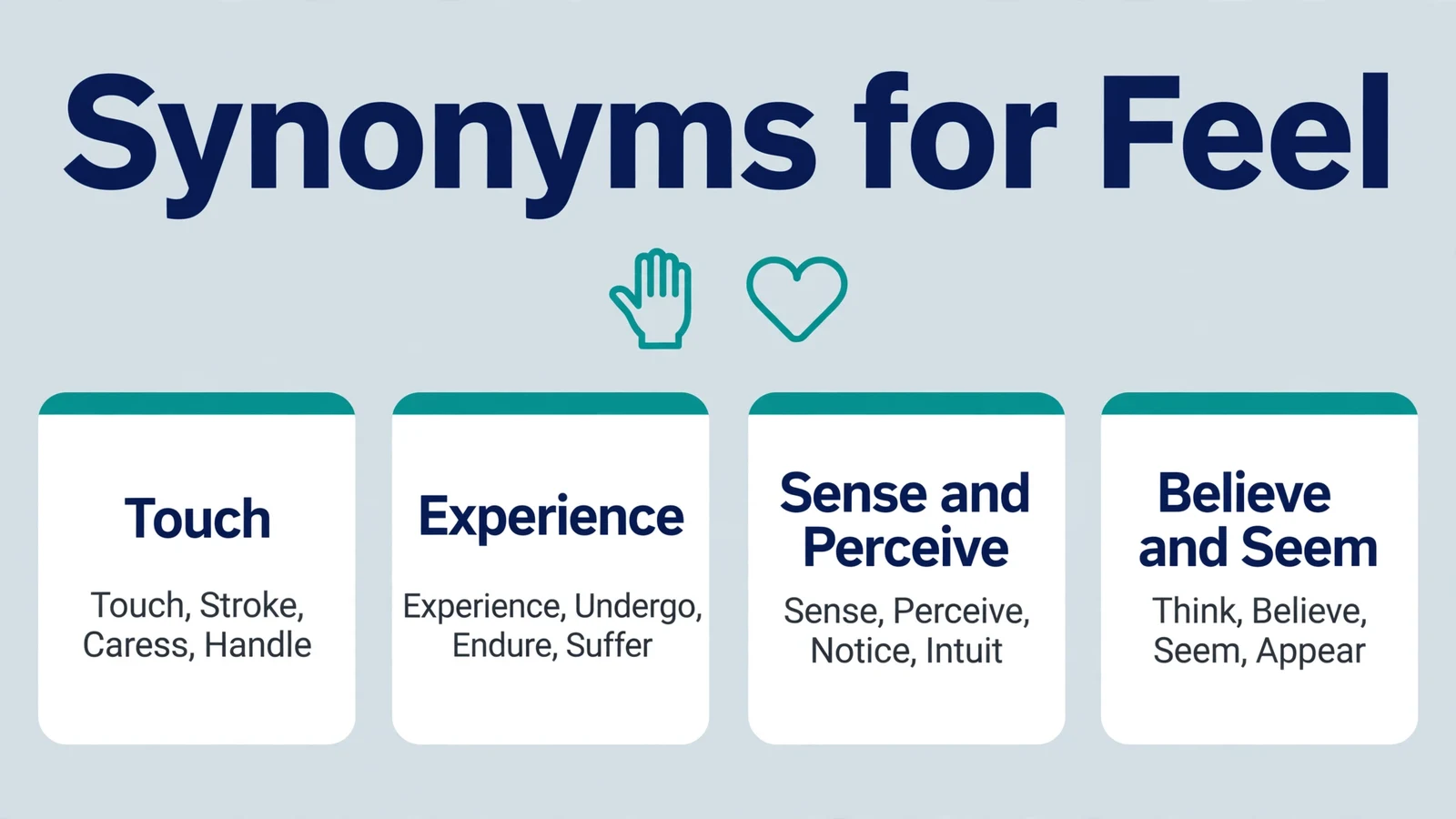
Few verbs work as hard as feel, and few cause as much quiet confusion. You feel a fabric with your fingers, you feel pain, you feel that a plan is wrong, and a room can even feel cold. The most useful synonyms for feel include touch, stroke, handle, experience, undergo, sense, perceive, think, believe, seem, and appear. However, each one belongs to a different sense of the word, and swapping across senses produces odd sentences.
This guide groups more than 50 synonyms for feel by meaning, so the right word is easy to find. Merriam-Webster splits feel into six verb senses, and Collins lists the same map of meanings. The groups below follow that map, and every word carries a short gloss and an example where it helps.
Top Synonyms for Feel: Quick Reference
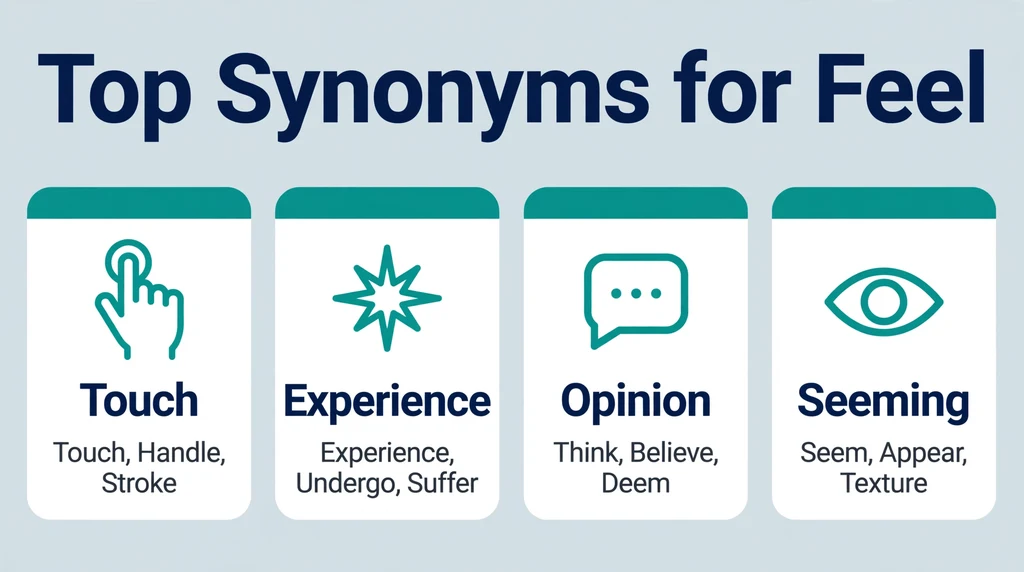
The table below covers the 26 synonyms readers reach for most often. Because feel has several senses, the table names the sense beside each word. Later sections sort the full list into finer groups.
| Word | Meaning in one line | Sense / best for |
|---|---|---|
| Touch | Make contact with your hand or fingers | Touch, the general word |
| Stroke | Move your hand gently over something | Touch, gentle and slow |
| Caress | Touch gently and affectionately | Touch, tender |
| Handle | Hold or move something with your hands | Touch, checking or working |
| Finger | Touch or move with the fingers | Touch, small objects |
| Grope | Search by touch without seeing | Touch, in the dark |
| Fumble | Search or handle clumsily by touch | Touch, awkward searching |
| Palpate | Examine a body part by touch | Touch, medical |
| Experience | Live through an emotion or event | Experience, neutral |
| Undergo | Go through a process or change | Experience, formal |
| Endure | Bear something painful for a long time | Experience, hardship |
| Suffer | Experience pain or distress | Experience, negative only |
| Go through | Experience something difficult | Experience, everyday speech |
Quick picks for sensing, opinion and seeming
The second half of the table covers awareness, opinions, impressions, and the noun uses.
| Word | Meaning in one line | Sense / best for |
|---|---|---|
| Sense | Be aware of something without proof | Sensing, intuition |
| Perceive | Become aware of something | Sensing, slightly formal |
| Notice | Become aware of something present | Sensing, everyday |
| Intuit | Know something by instinct | Sensing, formal |
| Think | Have an opinion based on reasoning | Opinion, neutral |
| Believe | Accept something as true | Opinion, stronger |
| Consider | Regard something in a stated way | Opinion, careful or formal |
| Deem | Judge something to be a certain way | Opinion, formal |
| Hold | Maintain an opinion firmly | Opinion, formal |
| Seem | Give the impression of being | Seeming, general |
| Appear | Give the impression of being | Seeming, slightly formal |
| Texture | The surface quality of something | Noun, touch |
| Atmosphere | The mood of a place | Noun, places |
What Does Feel Mean?
At its core, feel is about contact and awareness. The oldest sense involves the body: you notice something through touch or through a physical sensation. From there, the word stretches to emotions, to gut instinct, and even to opinions. Collins defines the central sense as having a physical or emotional sensation of something. Its example is a man still feeling pain from a stomach injury.
The six senses in brief
Merriam-Webster lists six verb senses, and keeping them apart is the whole skill. First, feel can mean to sense, as in feeling trouble brewing. Second, it can mean to touch, as in feeling a blanket to check its softness. Third, it can mean to experience, as in feeling true happiness. Fourth, it can mean to think, as in feeling that a plan needs more work. Fifth, it can mean to search blindly, as in feeling for a flashlight in a blackout. Finally, it can mean to seem, as in an idea that felt right at the time.
One verb, three grammar shapes
Feel also changes its grammar with its meaning, and the shape of the sentence is a useful clue. With a noun after it, feel usually reports an experience: feel pain, feel joy, feel the cold. With an adjective after it, feel reports a state or a texture: feel tired, feel ready, the soup feels hot. With a that clause after it, feel reports an opinion: I feel that we should leave. A fourth shape uses like: it feels like rain, or the cloth feels like silk. When you are unsure which synonym group you need, look at what follows the verb. The grammar shape almost always names the sense for you.
Where the word comes from
The word is old. Feel comes from the Old English word felan, which already carried the meanings to touch and to perceive. That double meaning explains the modern spread of the verb. Touching and perceiving were never fully separate ideas in English. When you feel a surface, you learn something about it. When you feel that something is wrong, the same verb reports a different kind of learning.
Synonyms for Feel: Touching With Your Hands
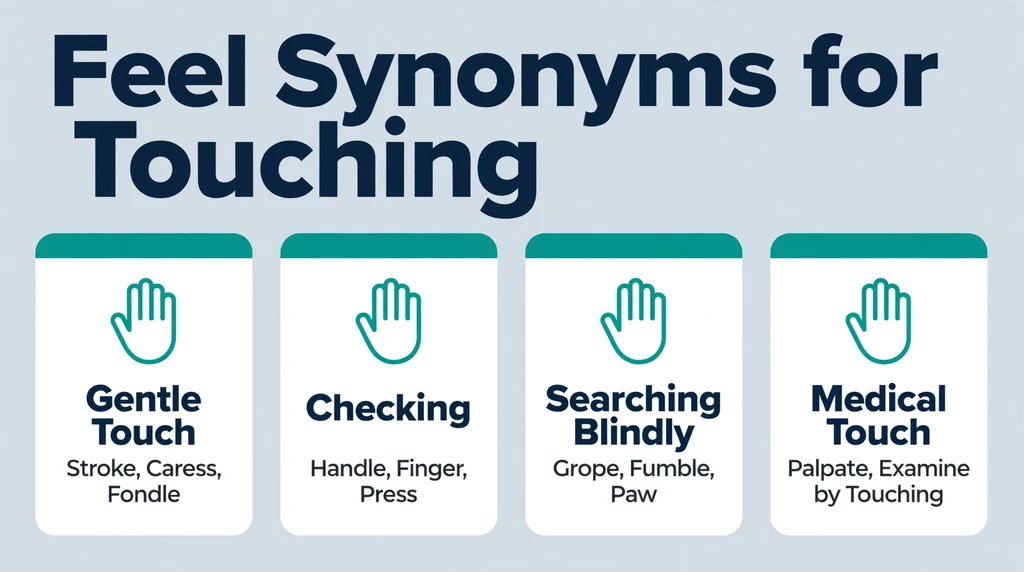
The touch sense is the oldest and most concrete. Here, feel means to become aware of something by handling it, or to examine it with your fingers. Collins gives the doctor as the classic example: the doctor felt his head. The right synonym depends on how the hand moves and why it moves at all.
Gentle touch: stroke, caress, fondle
Stroke means to move your hand gently and slowly over a surface. People stroke cats, stroke a child’s hair, and stroke a smooth tabletop. Caress adds affection: it is a gentle, loving touch, and Collins defines it as touching gently and affectionately. Fondle is also gentle and affectionate, often used for holding a baby or a treasured object. Even so, fondle appears in news reports about unwanted touch, so caress is usually the safer choice in neutral writing.
- She stroked the cat until it fell asleep.
- He caressed the worn cover of his father’s book.
- The jeweler fondled the old coin before naming a price.
Checking and handling: handle, finger, press, manipulate
Handle is the workhorse of this group. It means to hold, move, or examine something with your hands, and shop signs use it in the phrase please do not handle the fruit. Finger narrows the action to the fingers alone, as in fingering the coins in your pocket. Press means to push against something with steady force, like pressing a seal into wax. Manipulate, in this sense, means to handle something skillfully with the hands. A watchmaker manipulates tiny gears, for example. Finally, the phrase run your hands over describes a full checking motion, as when a tailor runs his hands over a seam.
Gripping: grasp and grip
Sometimes the hand does not explore; it holds on. Grasp means to take hold of something firmly, and grip means to hold it tightly so it cannot slip. A climber grasps the rope and grips the rock face. These words fit handles, rails, and tools. They sound wrong for delicate checking, though, because they promise force rather than information.
Searching in the dark: grope, fumble, paw
Merriam-Webster gives this pattern its own sense: to search for something blindly or uncertainly. Grope means to search by touch when you cannot see, like groping in a pocket for your wallet. Fumble adds clumsiness, as in fumbling for the light switch at midnight. Paw means to handle something clumsily or roughly with the whole hand. One caution matters here: grope also has an unwanted sexual sense in modern reporting. For the searching sense, fumble or feel around usually reads more clearly.
The medical word: palpate
Doctors examine the body by touch, and English has a precise verb for it. Palpate means to examine a body part by pressing and feeling it with the hands. Cambridge lists it under perceive by touch, together with the plain phrase examine by touching. Outside clinics, palpate sounds technical, so everyday writing should stick with feel or examine.
Synonyms for Feel: Experiencing Emotions and Sensations
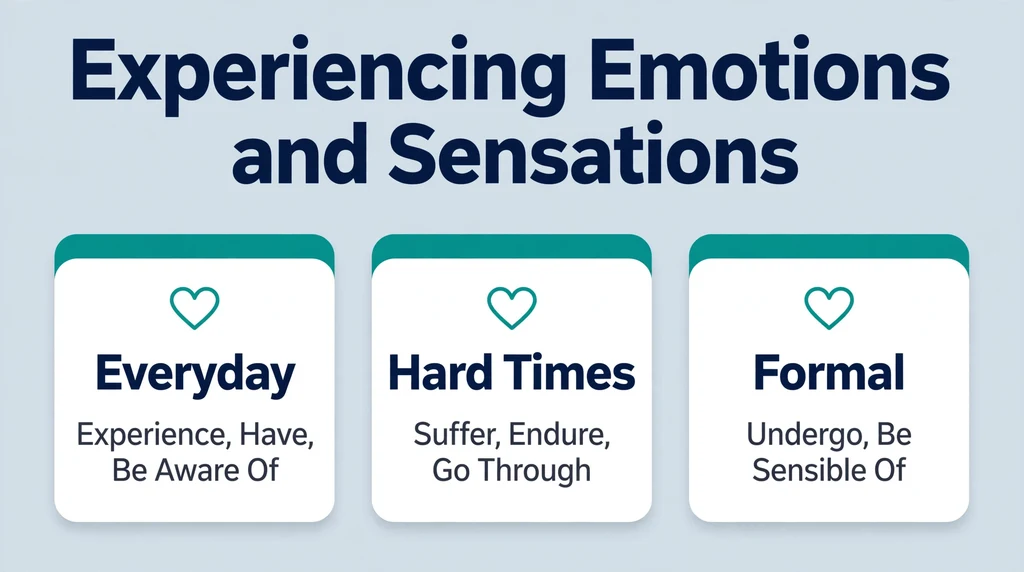
In this sense, feel reports what life does to you from the inside. You feel pain, joy, guilt, cold, and hunger. Collins opens its entry with this sense, and its example involves feeling pain from an injury. The synonyms split neatly by tone: some are neutral, some fit hardship, and some belong in formal writing.
Neutral choices: experience, have, be aware of
Experience is the safest all-purpose replacement. Couples experience joy, patients experience side effects, and teams experience defeat. Have works in set phrases such as have a sensation of warmth or have a headache. The phrase be aware of suits faint physical signals: she was aware of a tightness in her chest. A more formal phrase, have a sensation of, appears in medical and careful descriptive writing. The dated formal variant be sensible of survives mostly in older texts.
Hard experiences: suffer, endure, go through, undergo
Painful experiences take stronger verbs. Suffer means to experience pain or distress, so it only fits negative things: you suffer a loss, not a holiday. Endure means to bear something painful over time, like enduring years of arthritis. Go through is the everyday spoken choice for hard events, from going through a divorce to going through training. Undergo is its formal partner, common in medical and official writing: recruits undergo training, and patients undergo surgery. If you want richer wording for positive states instead, the guide to synonyms for happy covers that ground.
Body sensations: cold, pain, guilt
Not every experience is an emotion. Feel is also the standard verb for body signals, and Cambridge’s own examples show the range: he feels the cold more than most, and I feel great guilt about what happened. Heat, cold, pain, hunger, thirst, nausea, and dizziness all travel through this verb. In this territory the closest replacements are experience for clinical prose and be aware of for faint signals. A doctor writes that the patient experienced sharp pain. A diary more honestly says I felt a wave of nausea. Notice, too, that body words resist the opinion synonyms completely: nobody thinks a headache in this sense.
A note on strength
These verbs are not interchangeable in intensity. Experience is flat and factual. Undergo sounds procedural, as if the event were a process with stages. Endure adds admiration for the person who bears it. Suffer adds pity. Choosing among them is really choosing an attitude toward the event, which is why reports and stories pick different words for the same facts.
Synonyms for Feel: Sensing and Perceiving
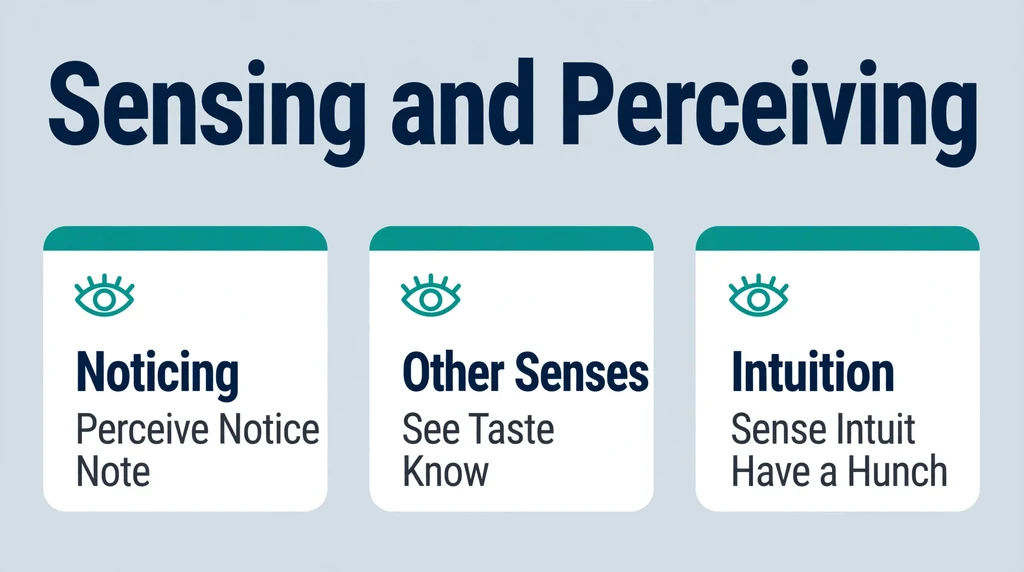
Sometimes nothing touches the skin, yet you still register something. You feel a change in the room, feel eyes on your back, or feel that rain is coming. Merriam-Webster calls this having a vague awareness of something. Collins illustrates it with a warm breeze on a face and with the sentence she felt something was nearby.
Noticing what is around you: perceive, notice, note, know, see, taste
Perceive means to become aware of something, often something subtle. It is slightly formal and common in essays. Notice is the everyday word for suddenly becoming aware of a fact or detail. Note is its brisker cousin, often used for recording an observation: she noted that the rain had stopped. Know can report direct awareness, as in knowing by the smell that dinner was ready. See and taste belong here for a simple reason: English lets every sense verb report awareness. You can taste smoke in the air or see trouble coming, and Merriam-Webster lists these verbs beside feel in the same sense family.
Intuition: sense, intuit, be convinced, have a hunch
The word sense itself is the most precise synonym in this group. To sense something is to pick it up without clear proof, like sensing tension in a meeting. Intuit is the formal verb built for exactly this meaning: to know something by instinct rather than reasoning. Be convinced reports a settled inner certainty, while the phrase have a hunch keeps the tone light and uncertain. Collins also lists the phrases have the impression and have a feeling for this sense. The vivid idiom feel in your bones describes the deepest level of gut certainty.
- He sensed that the interview was going badly.
- She had a hunch that the shop would be closed.
- I feel it in my bones: winter will be long this year.
Synonyms for Feel: Believing and Thinking
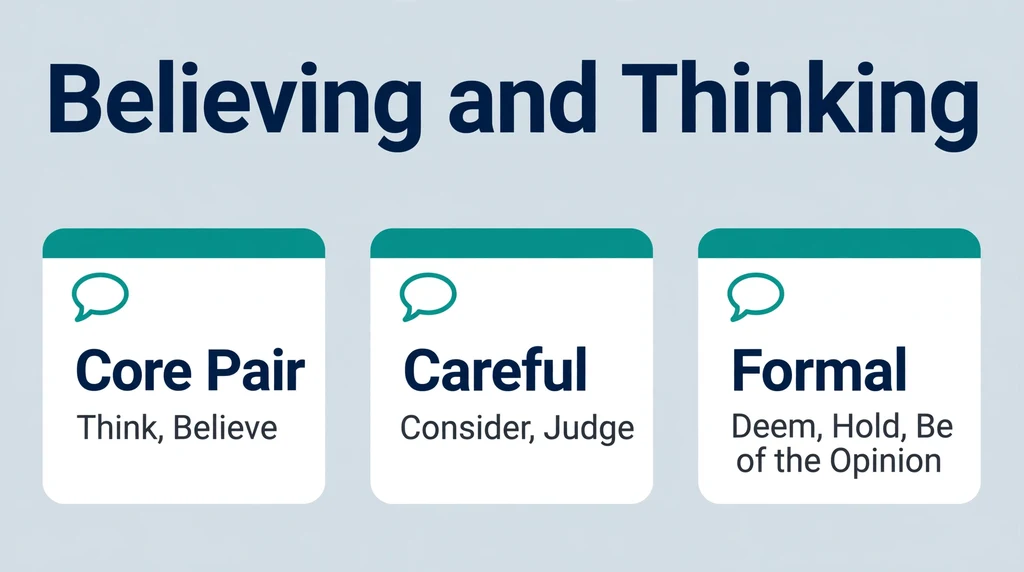
In everyday speech, feel often introduces an opinion: I feel that we should wait. Merriam-Webster defines this sense plainly as having an opinion. Collins labels it to believe or think, and its example is a serious one: they felt that the police could not guarantee their safety.
The core pair: think and believe
Think is the neutral replacement, and it is the headword Merriam-Webster chooses for this sense. Believe is stronger, because it means accepting something as true, not just entertaining it. If evidence matters to your sentence, think is the honest verb. If commitment matters, believe carries more weight. The full guide to synonyms for think sorts the reasoning verbs in more detail.
Careful and formal choices: consider, deem, judge, hold
Consider means to regard something in a particular way: she considered herself lucky. It suits careful, measured opinions. Deem is formal and common in rules and reports, as in the panel deemed the plan unsafe. Judge means to form an opinion after weighing facts, despite its courtroom flavour. Hold reports a firm, maintained position: he holds that taxes should fall. The phrase be of the opinion is the most formal option of all, and it belongs in letters, essays, and official statements. Writers who need the conviction side of this family can also browse synonyms for believe.
Examples in real sentences
- I feel that the rent is too high for this street. (think, believe)
- The committee deemed the evidence incomplete. (formal)
- She holds that practice matters more than talent. (firm opinion)
- We are of the opinion that the trial should move. (very formal)
Feel vs Think: What Is the Difference?
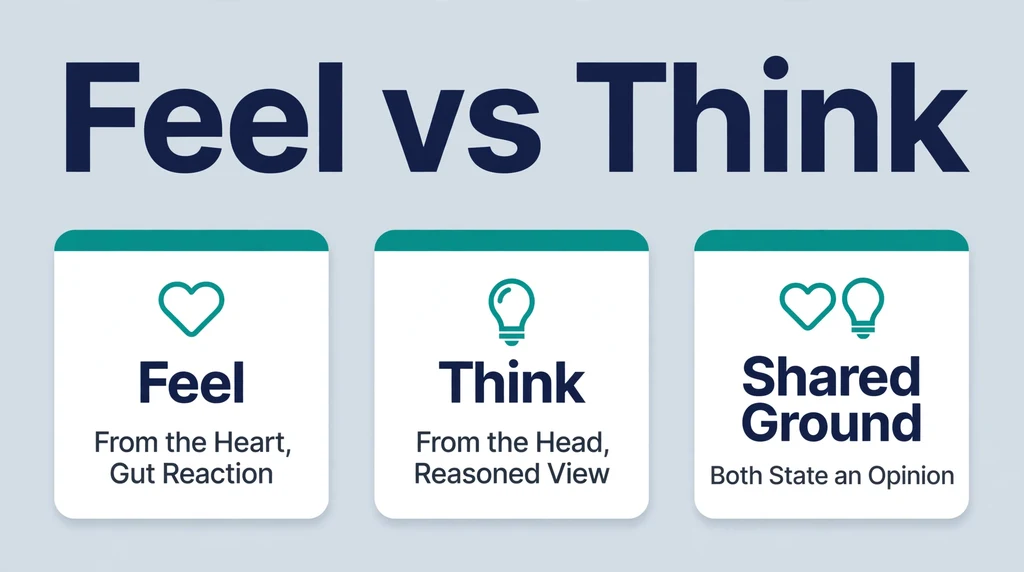
Feel and think both introduce opinions, but they point to different sources for the opinion. Feel reports an emotional or intuitive source. Think reports a reasoning source. When someone says I feel that he is lying, they confess a gut reaction. When they say I think that he is lying, they claim to have weighed the facts.
When feel is the honest choice
Choose feel when the opinion is genuinely personal. It softens claims, signals empathy, and admits uncertainty. Therapists, reviewers, and friends use it for exactly that reason. I feel that this draft drags in the middle is kinder than the same sentence with think. The softness is not weakness, though: in negotiations, feel can state a firm position without sounding like a legal verdict.
When think is the better choice
Choose think when your sentence offers analysis, evidence, or a conclusion. Reports, essays, and technical writing prefer it because it promises reasons. I think the bridge needs repairs invites the question why, and the writer should be ready with load figures. In short, feel speaks for the heart and the gut, while think speaks for the head. Skilled writers pick the one that matches where their opinion really came from.
A tiny dialogue shows the contrast at work. Asked about a job candidate, one manager says, I think she lacks the experience. Another says, I feel she lacks the experience. The first sentence invites a review of the résumé. The second invites a conversation about impressions. Both managers might reach the same decision, but they are reporting different kinds of knowledge, and the verb choice tells the listener which kind to expect.
How Feel Describes States and Textures
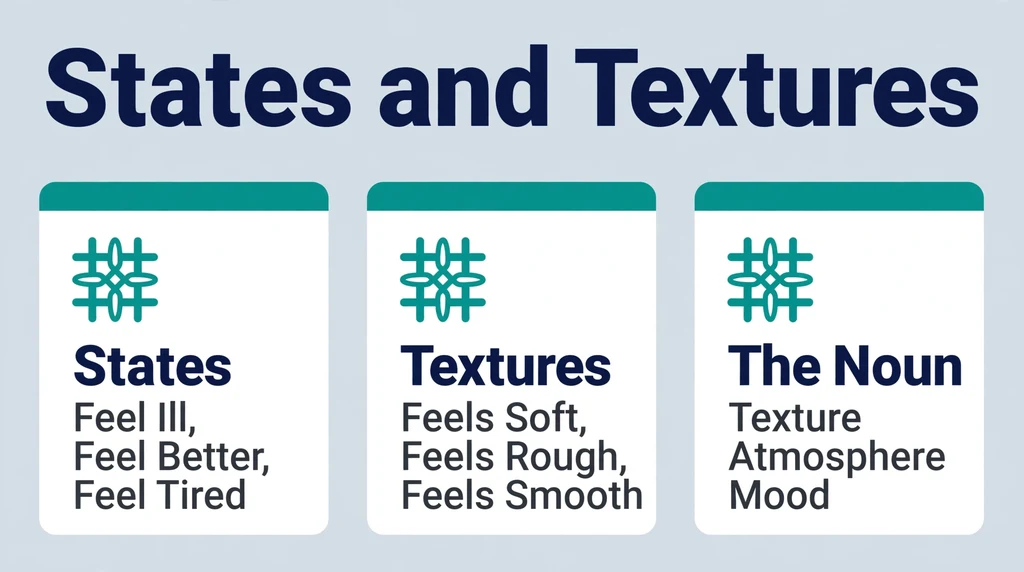
Two common patterns remain, and both work differently from the groups above. In the first, feel teams up with an adjective to report a state. In the second, feel describes how a thing strikes the senses, which makes it a close cousin of seem.
The state pattern: feel ill, feel better
English reports health and mood with the pattern feel plus adjective. You feel ill, feel well, feel sick, feel tired, feel better, or feel worse. There is no true synonym swap here, because the adjective carries the meaning. The plain verb be states the same fact without the inner viewpoint: he is ill is a report, while he feels ill shares the experience. This pattern also covers emotions in short form, as in feel free, feel safe, or feel ready. Learners should treat these phrases as fixed building blocks.
Texture and seeming: seem, appear
When the subject is a thing, feel describes its effect on the senses. The fabric feels soft. The air feels wet and cold, in Collins’s example. Merriam-Webster defines this sense as giving the impression of being, and its example is an idea that felt like a good idea at the time. The verified replacements are seem and appear, which follow the same linking pattern: the fabric seems soft, the room appears cold. The phrase strike you as does similar work for impressions of people: he strikes me as honest. By contrast, look reports only what the eyes receive, so it cannot replace feel for texture.
Feel as a noun: texture and atmosphere
Feel is also a noun, and it names two things. First, it names surface quality: a crisp papery feel, in Collins’s phrase. Its noun synonyms are texture, finish, and surface quality. Second, it names the mood of a place, as when someone wants to get the feel of a room. Here the synonyms are atmosphere, ambience, aura, mood, air, and impression. Cambridge labels the informal member of this family, vibe, as informal, so save it for casual writing.
One phrase deserves its own line: get the feel of something. Collins uses almost exactly this example, a man who wanted to get the feel of the place. The phrase means to become familiar with how something works or how a place behaves. New drivers get the feel of a car, and new staff get the feel of an office. It is the noun sense turned into a small idiom, and it has no tidy one-word replacement, which is precisely why English keeps it.
The feel like pattern
The pattern feel like plus a noun or an ing form does two jobs. First, it reports an impression: it feels like rain, or the day felt like a holiday. This is the seeming sense wearing casual clothes, and seem or appear can replace it in formal writing. Second, it reports a wish: I feel like a walk, or she feels like crying. Here feel like means would like or is in the mood for, and it belongs to conversation rather than documents. Confusing the two jobs is rare in practice, because the sentence around the pattern makes the job obvious.
Feel in Sentences: Examples by Sense
Reading the groups is one thing; seeing the swaps work is another. The examples below keep one base sentence per sense and then show the safest replacement. Notice how the grammar stays fixed while the verb changes.
Touch examples
- She felt the scarf for a price tag. (She fingered the scarf for a price tag.)
- The doctor felt the lump carefully. (The doctor palpated the lump carefully.)
- He felt around the drawer for his keys. (He fumbled around the drawer for his keys.)
Experience examples
- They felt the loss deeply. (They suffered the loss deeply, in formal or sorrowful prose.)
- Recruits feel the strain of training early. (Recruits undergo the strain of training early, in a report.)
- We felt every bump in the road. (We were aware of every bump in the road, for faint signals.)
Sensing and opinion examples
- I felt the mood change when she entered. (I sensed the mood change when she entered.)
- I feel that the price is fair. (I believe that the price is fair, for a firmer stance.)
- The house felt empty after they left. (The house seemed empty after they left.)
These swaps work because each verb stays inside its own sense. The moment a replacement crosses into another group, the sentence wobbles. That wobble is your editing signal: if the new verb makes you reread the sentence, the sense has changed and the word is probably wrong.
How to Choose the Right Synonym for Feel
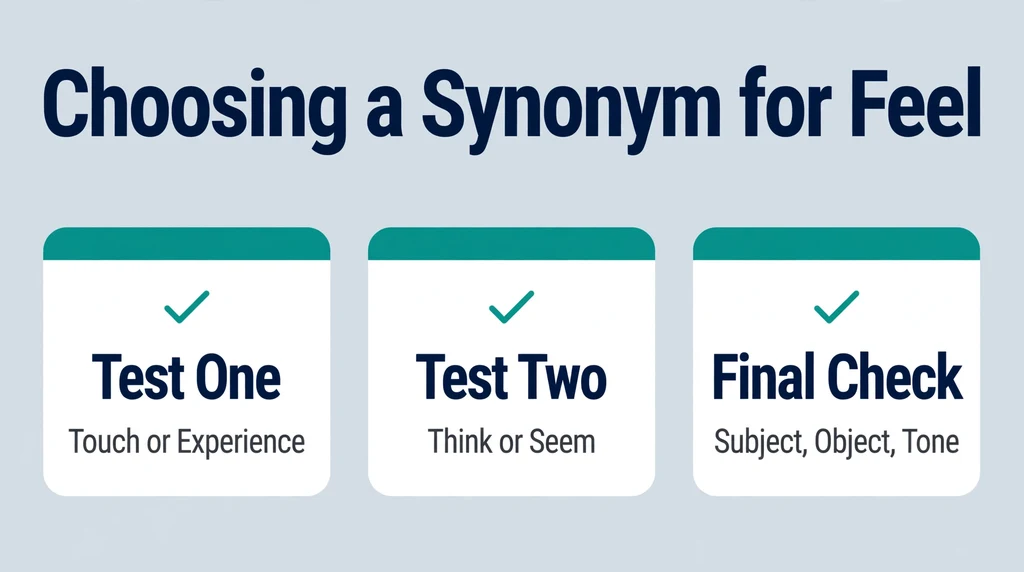
Choosing well starts with one question: which sense of feel is your sentence using? A quick test settles it. If you can replace feel with touch, you need the hands group. If you can replace it with experience, you need the emotion group. If think fits, you need the opinion group, and if seem fits, you need the texture group.
Paired examples
- The nurse felt the patient’s wrist. Swap in palpated in a report, or checked in plain prose.
- The nurse felt the patient’s fear. Here felt means shared awareness; sensed or noticed works, but palpated would be nonsense.
- I feel the plan is risky. Think keeps the reasoning tone; believe adds commitment.
- The plan feels risky. Seem and appear fit, because the plan itself gives the impression.
- She felt the cold through her coat. Experienced or was aware of keeps the physical sense.
A quick checklist
Before you swap the word, check three things. First, check the subject: people feel states, but things feel textures. Second, check the object: hands feel surfaces, minds feel opinions. Third, check the tone: deem, undergo, and intuit belong to formal pages, while go through and have a hunch belong to conversation. Most wrong choices fail one of these three checks, so the fix is usually fast.
Formal and Informal Synonyms for Feel
Register matters because feel itself is neutral and everyday. Formal writing often replaces it with a more precise verb. Essays and reports favour perceive, consider, deem, undergo, and intuit. Medical writing uses palpate and the phrase have a sensation of. Legal and official prose uses be of the opinion and hold. Each of these words sounds at home in a document with letterhead.
Two rewrites show the shift in practice. A friendly email might say I feel that the date is too soon. The same point in a formal letter becomes we are of the opinion that the date is premature. A novel might say she felt the insult for days. A case report would write that the patient experienced lingering distress. The facts barely move, but the voice changes completely, and the verb does most of the work.
Informal English moves the other way. Conversation prefers go through for hard experiences and have a hunch for intuition. The idiom feel in your bones adds warmth and drama to predictions. Vibe, the noun, belongs to casual talk about places and people. None of these choices is wrong in itself. Problems start only when registers collide, as when a formal report says the patient got bad vibes. Match the word to the room it will be read in.
Antonyms for Feel
Opposites depend on the sense, as usual with this verb. For the sensing sense, the true opposites are about absence: to be numb is to be unable to feel, and Cambridge gives numbness and insensibility as the antonyms of the noun feeling. For the noticing sense, miss and overlook reverse notice and perceive: she overlooked the crack in the glaze. For the opinion sense, doubt and disbelieve stand against believe and hold. Touch has no neat single-word opposite. English instead uses expressions such as keep your hands off or leave something untouched, and honest writing should present them as expressions, not as dictionary antonyms.
The state pattern has an indirect opposite worth knowing. Where feel plus adjective shares an inner experience, seem and appear report the outside view, and the two can disagree. A patient can feel feverish while appearing perfectly calm. Writers exploit that gap constantly, because it lets a sentence hold both the truth inside a person and the impression they give to everyone watching.
Common Mistakes: Words That Are Not True Synonyms for Feel
The mistakes below come from real thesaurus lists, which shows why sense checks matter. A word can sit on a feel page and still be wrong in your sentence.
Maul and apperceive
Maul appears in one major thesaurus list for the touch sense, but it means to handle roughly and damage. A shopper who mauls the peaches is bruising them, not checking them. Apperceive appears in the same list, yet it is a rare psychology term about absorbing new ideas into old ones. Almost no reader will know it, so it fails the basic test of a useful synonym.
Sympathy is a different phrase
Feel for means to sympathize, and it is a separate phrasal verb. Its synonyms are sympathize with and have compassion for, as Cambridge shows under share the feelings of. Do not mix these words into the touch or opinion groups. The same care applies to suffer: it only replaces feel for painful experiences, never for pleasant ones. A sentence like she suffered a wonderful evening is not dramatic; it is simply wrong.
Emotion words that overshoot
Finally, beware of grabbing strong emotion verbs for mild sentences. Endure implies a burden carried for a long time, so it overshoots I felt a brief chill. Intuit implies knowledge gained without evidence, so it undershoots careful observations. When in doubt, return to the sense test: touch, experience, sense, think, or seem. The plain word feel is often better than a fancy word in the wrong sense.
Frequently Asked Questions
What is the best synonym for feel?
It depends on the sense. Touch is best for hands, experience for emotions, sense for intuition, think for opinions, and seem for textures. No single word covers every use of feel.
What is a fancy word for feel?
For formal writing, try perceive for awareness, deem for opinions, undergo for experiences, and palpate for medical touch. Each one sounds precise rather than merely fancy.
Is feel a formal word?
Feel itself is neutral and suits almost any context. However, formal documents often choose a more specific verb, such as consider or be of the opinion for opinions.
What is another word for feel with your hands?
Handle and finger are the everyday choices. Stroke and caress describe gentle touch, grope and fumble describe searching without sight, and palpate is the medical term.
What is the difference between feel and touch?
Touch names the physical contact itself. Feel focuses on the awareness that contact brings, which is why feel also extends to emotions, intuition, and opinions.
Can feel mean think?
Yes. In sentences like I feel that we should wait, feel introduces an opinion. Think stresses reasoning, while feel stresses a personal or emotional conviction.
What is the past tense of feel?
The past tense and past participle of feel are both felt. For example: she felt the fabric, they felt nervous, and he had felt better by morning.
What is the opposite of feel?
For physical sensation, the opposite idea is numbness. For opinions, doubt and disbelieve work as opposites. Touch has no single opposite word in common use.
Final Thoughts
Feel earns its place in daily English because it connects the body, the heart, and the mind in one short word. The trick is never to swap it blindly. Name the sense first: touch, experience, sensing, opinion, state, or seeming. Then pick from the matching group, and your sentence will stay accurate and natural. For the full official lists behind this guide, the Merriam-Webster Thesaurus entry for feel is the best place to keep exploring.