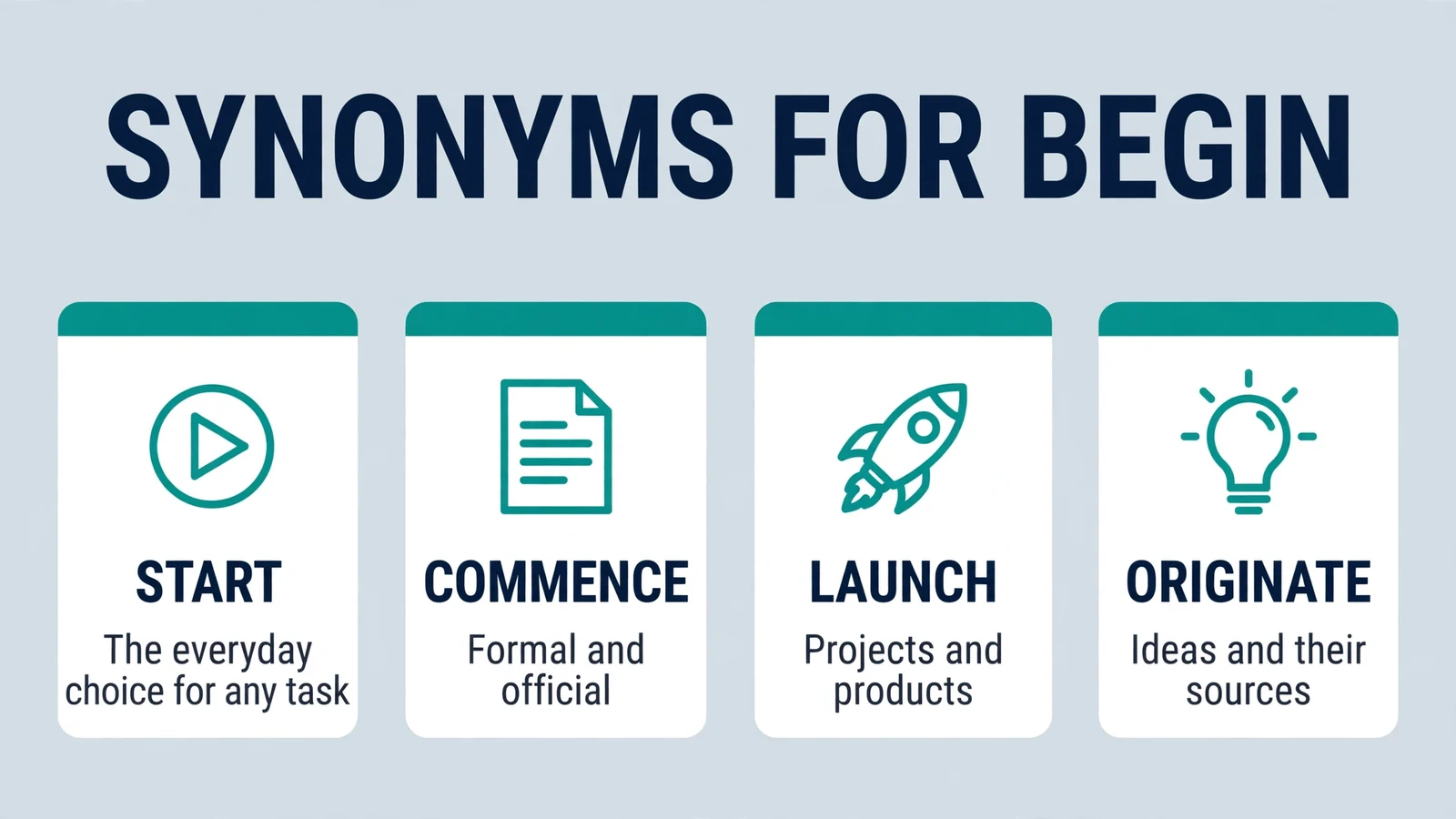
“Begin” is never wrong, but it is often the plainest word on the page. When you need a sharper choice, the strongest synonyms for begin are start, commence, initiate, launch, open, inaugurate, kick off, set out, and originate. Each one fits a different scene. Start suits almost anything you do. Commence sounds formal and official. Kick off belongs at games and events. Originate points back to where something came from.
This guide groups more than 60 dictionary-checked synonyms by the job they do. You will find words for starting a task, opening a meeting, setting out on a journey, and tracing the first moment of an idea. Every word carries a short gloss and a tone label. A begin versus start section near the end then settles the choice that confuses most writers.
Quick Reference: Top Synonyms for Begin
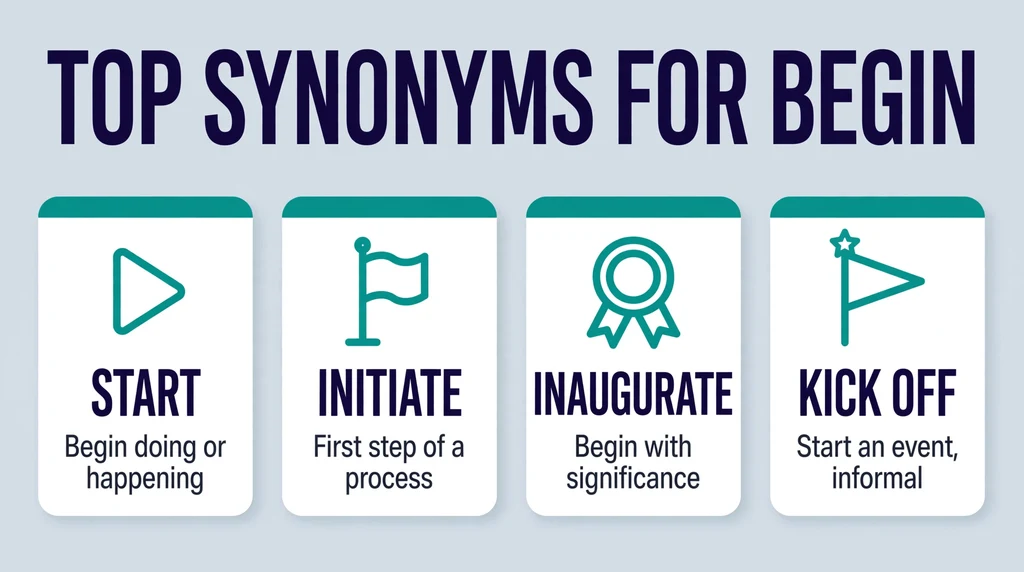
Scan this table first when you just need one good word fast. The sections after it explain each group in full, with examples.
| Word | What it means | Best for / tone |
|---|---|---|
| start | begin doing or happening | everyday, neutral |
| commence | begin, in official language | formal |
| initiate | take the first step of a process | formal |
| inaugurate | begin with ceremony or significance | formal |
| launch | set something new in motion | projects, products |
| open | begin a meeting, event or talk | neutral, formal |
| embark on | start a long or serious undertaking | formal |
| set about | start working on a task | neutral |
| take up | start a hobby, job or position | neutral |
| kick off | start an event or activity | informal |
| lead off | be the first speaker or performer | neutral |
| usher in | introduce a new period or era | formal, lighter than inaugurate |
| institute | put a rule or system into effect | formal |
| introduce | bring in something new | neutral |
| set up | create or arrange something new | neutral |
| establish | found something meant to last | formal |
| found | start an organization or institution | formal |
| set in motion | cause a process to start | neutral |
| get going | start moving or working | informal |
| get the ball rolling | make the first move so others follow | informal idiom |
| set out | start a journey or a plan | neutral |
| originate | come from a source, or start there | formal |
| arise | come into being, appear | formal |
| stem from | grow out of a cause or source | neutral |
| emerge | come out into view | neutral |
| dawn | begin, for a day or a new era | literary |
What Does Begin Mean?
Merriam-Webster’s thesaurus sums up the whole family with one idea: to take the first step in a course, process, or operation. That is the heart of begin. You begin a task, a trip, a meeting, or a story by taking its first step.
Begin also covers things that start by themselves. Rain begins. A friendship begins. A new era begins. In this second use, begin means to come into existence, and no person has to start anything.
The verb is irregular, which trips up many learners. The forms are begin, began, and begun. You write “she began yesterday” and “she has begun today.” Start, by contrast, is regular: start, started, started.
One more point helps later. Begin pairs naturally with the opposite end. A book begins and ends. Start pairs with stop instead. A machine starts and stops. That small difference explains many of the choices in the sections below.
How Begin Works in a Sentence
Begin takes three common shapes. It can take a noun: “They began the rehearsal.” It can take a to-infinitive: “It began to snow.” It can also take an -ing form: “She began laughing.” All three shapes are standard, and most synonyms copy only one or two of them.
That copying limit matters when you swap words. Commence and initiate happily take nouns, so “commence the hearing” and “initiate the review” sound natural. Kick off takes nouns too: “kick off the tour.” But originate runs the other way and describes the thing itself: “The custom originated in ports,” not “she originated the custom” in everyday use, where coin or invent would serve better.
| Your scene | First words to try |
|---|---|
| A task or job | start, set about, commence (formal) |
| A meeting or talk | open, lead off, get the ball rolling |
| A game or festival | kick off, inaugurate (grand) |
| A journey | set out, embark, leave |
| An idea or custom | originate, stem from, arise |
| A new era | usher in, inaugurate, dawn |
Synonyms for Begin When You Start a Task or Activity
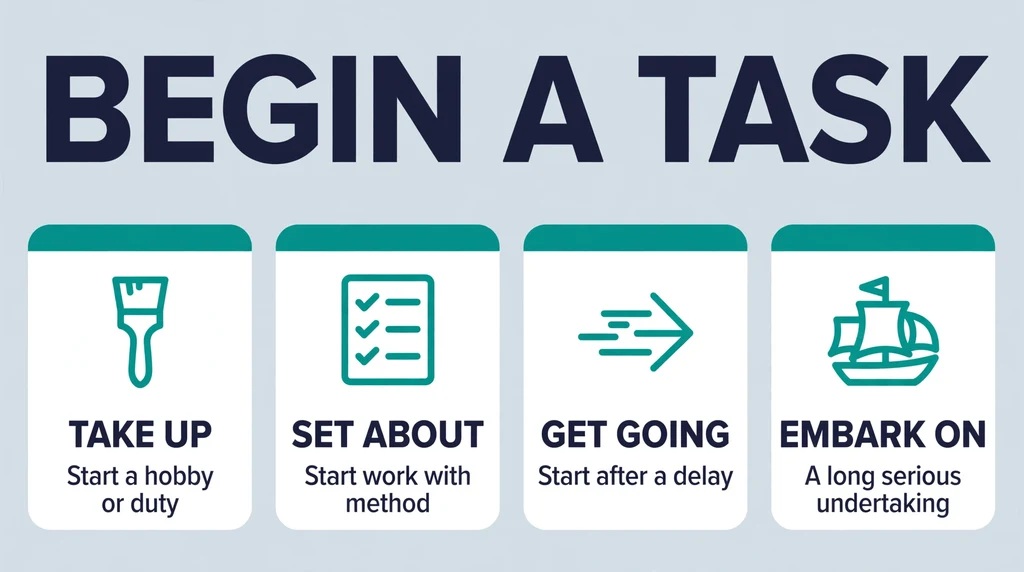
Most searches for another word for begin come from this scene. Someone is about to do something, and “begin” feels flat. Pick your word by tone first, then by how serious the task sounds.
Everyday Choices
Start is the all-purpose replacement. It fits homework, engines, arguments, and careers. If no other word feels right, start almost always works.
Take up means to begin something you will keep doing. People take up painting, take up a post, or take up an offer. It suits hobbies, jobs, and challenges.
Set about means to start work on a task in a deliberate way. “She set about cleaning the kitchen” suggests method, not panic. Set to is its shorter cousin. It means to begin working with energy, often in “set to work.”
Get going is the friendly push. It means to start moving or start working after a delay. Go ahead gives permission or signals the first move: “Go ahead and begin without me.”
Make a beginning is a plain, gentle phrase. Collins lists it in the begin family. It fits when someone makes even a small start on a big job.
Formal and Official Choices
Commence is the formal twin of begin. Courts, armies, and universities commence proceedings, firing, and ceremonies. Merriam-Webster calls it more formal or bookish than begin or start, so save it for formal writing.
Initiate means to take the first step in a process that will continue. Diplomats initiate contacts. Managers initiate reviews. The word promises more steps after the first one.
Enter into or enter upon means to begin a formal state or course of action. Lawyers enter into agreements. Couples enter into marriage. It sounds weighty and deliberate.
Embark on or embark upon suits long, serious undertakings. A student embarks on a degree. A firm embarks on reforms. The journey image inside the word makes the task feel like a voyage.
Undertake means to begin and accept responsibility for a task. It pairs well with projects, journeys, and repairs. Institute means to start a system or rule officially, as in “institute new safety checks.”
Proceed appears in Collins’s begin list, with the example “proceed with the trial.” It means to begin and carry on, usually as the next stage of a formal process. Use it when the groundwork is already laid.
Set on foot is a formal, old-fashioned phrase from the same Collins group. It means to start something moving, but modern readers may find it stiff.
Launching Something New
Launch means to set something new in motion with energy. Teams launch products, campaigns, investigations, and websites. It is the natural choice when the public watches the start.
Set up, establish, and found cover beginnings that create something lasting. You set up a shop or a system. You establish a school or a reputation. You found a company, a charity, or a city.
Create and introduce begin things in a different way. Create brings something into existence from skill or imagination. Introduce brings in a new rule, product, or custom for the first time. When the thing itself needs fresher wording too, our guide to synonyms for new pairs well with these verbs.
Set in motion means to cause a process to start. One decision can set in motion a chain of changes. Activate starts a system, plan, or device that was waiting ready. Trigger starts a reaction or event, often a sudden or unwelcome one.
Usher in and inaugurate open new periods rather than tasks. A discovery can usher in an era. Inaugurate adds ceremony and significance, which the choosing section below explains.
Informal Ways to Begin
Kick off is the everyday favourite for activities. A festival kicks off on Friday. A meeting kicks off with introductions. Cambridge labels it informal, so keep it out of legal writing.
Get cracking urges someone to start work at once. Get the ball rolling means making the first move so that others can follow. Both are warm, spoken idioms.
Break the ice means to begin in a way that removes stiffness, usually social stiffness. A joke breaks the ice at a party. Plunge into means to begin eagerly and all at once, like diving into cold water.
Get off survives in the phrase “get off to a good start.” Jump off is a lively informal option for starting points in AmE speech. Tee off belongs to golf first, where the first shot begins the round, and it now appears for other brisk starts.
Synonyms for Begin at Events, Meetings and Ceremonies
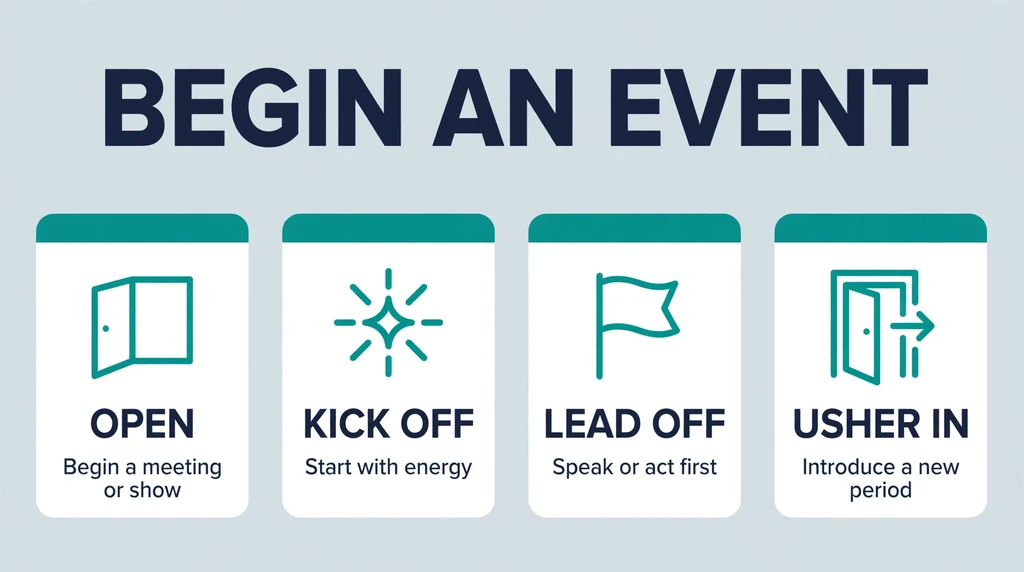
Events do not just begin. They open, they kick off, and sometimes they are inaugurated. The right verb tells your reader how grand the occasion feels.
Meetings, Talks and Discussions
Open is the standard verb for meetings. A chair opens the meeting. A speaker opens with a welcome. Cambridge gives the classic pattern: “I’d like to open the meeting by thanking our hosts.”
Lead off means to be the first to speak or act in a sequence. In Collins’s example, one couple always led off the dancing. At a panel, the moderator may lead off with a question.
Commence appears in formal minutes and agendas. “The meeting commenced with a moment of silence” is a Cambridge example. It signals an official record, not casual chat.
Get the ball rolling fits the first contribution in a group setting. One good question gets the discussion rolling, and then everyone joins in.
Ceremonies, Games and Public Events
Kick off rules the informal end. Matches kick off at three. Festivals kick off with a parade. The image comes from the first kick of a game, and the energy stays in the word.
Inaugurate is the ceremonial heavyweight. It marks a beginning with formality or significance. Collins gives the example of a company that inaugurated the first scheduled flights. Save it for openings that make history, or at least the news.
Usher in opens a period rather than a single event. A new year, an era, or a policy can be ushered in. Merriam-Webster notes it carries slightly less weight than inaugurate.
Open also works for public doors. A museum opens in June. A show opens on Broadway. Here open blends the event sense with the creation sense: the thing begins and welcomes people in at the same time.
Sports and Games
Sport owns a loud corner of this family. A football match begins with a kick off, and the noun form, kickoff, names the moment itself. Golfers tee off to begin a round, hitting the first shot from the tee. Webster’s begin list keeps both phrases, which shows how deeply games shape everyday starting words.
Race commentary adds jump off for a brisk competitive start, as in “the favourite jumped off well.” Even outside sport, these phrases lend energy. A product launch that “kicks off” sounds livelier than one that merely begins, which is exactly why marketers borrow the whistle and the stadium.
Synonyms for Begin on a Journey
Travel writing needs its own set of starting words. These verbs carry bags, roads, and early mornings inside them.
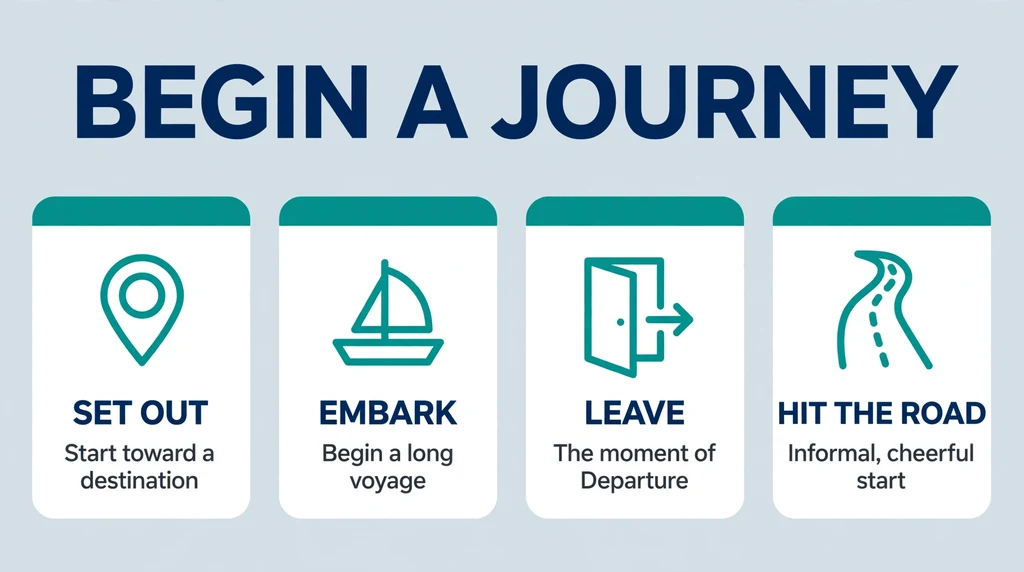
Set out is the classic journey verb. Travellers set out at dawn. Explorers set out for the pole. It also stretches to plans with a goal: “They set out to prove him wrong.” Both uses involve a first step toward a destination.
Embark began life at the harbour, boarding a ship. Today you embark on a voyage, a tour, or any long undertaking. The word still smells of salt air and serious preparation, which is why big projects borrow it.
Leave is the plainest travel starter. The train leaves at six. We leave tomorrow. Thesaurus.com places leave in its strongest list for start because every journey truly begins at the moment of leaving.
Hit the road is the cheerful informal option. It means to begin a journey, especially by car, with energy and good humour. Sally forth is its literary opposite: an old-fashioned, playful phrase for setting out bravely, often from a storybook world.
Get going bridges journeys and tasks. “We had better get going” ends the packing and starts the trip. When the road matters more than the work, set out and embark sound richer.
Choose between set out and embark by length and weight. Set out is neutral and fits a day’s walk as easily as a polar expedition. Embark asks for scale: a season abroad, a research voyage, a career at sea. Nobody embarks on a trip to the corner shop, unless the joke is intended.
Leave works differently from both. It names the moment of departure, not the road ahead. Timetables, stations, and goodbyes all prefer it. Pair it with a time, and the sentence feels exact: “The ferry leaves at dawn, so we set out at five.”
Synonyms for Begin When Something Comes Into Being
Not every beginning has a human hand behind it. Problems, eras, customs, and ideas all begin on their own. English keeps a whole shelf of verbs for these unowned beginnings.
Origins: Where Things Come From
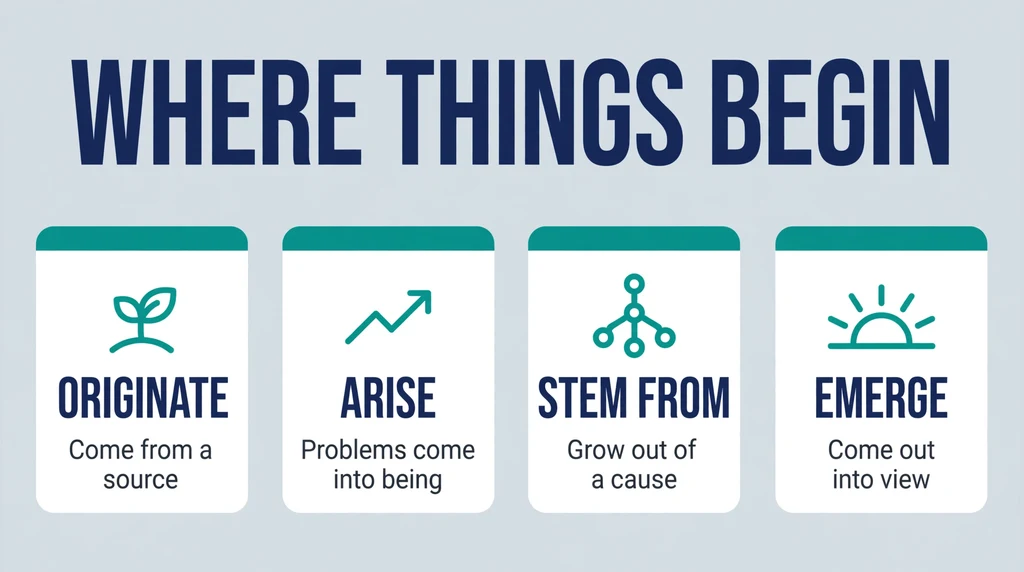
Originate names a definite source or starting point. Merriam-Webster stresses that exactness: the fire originated in the basement. Use originate when you can point to the place, person, or moment.
Stem from describes growth out of a cause. Problems stem from poor planning. Industries stem from space research. Webster’s image is a plant stem branching off, so the result feels like an outgrowth of the source.
Derive from and spring from work the same ground. A word derives from Latin. Courage springs from trust. Emanate and flow from suit things that stream out of a source, like light, heat, or ideas. Issue is the formal member of this set: orders and sounds issue from an office or a speaker.
Appearing and Emerging
Arise is the formal word for problems and situations that come into being. Cambridge labels it formal, and its sample sentence warns that problems might arise at any time.
Emerge and appear bring things into view. A pattern emerges from the data. Cracks appear in the wall. Come along marks the arrival of a change or invention: everything shifted when the internet came along.
Dawn begins days and eras. A new age dawns. Hope dawns. Rise lifts suns, curtains, and bread dough into their start. Be born and the phrases come into being and come into existence state the moment plainly, with be born adding warmth.
Bud, sprout, and germinate borrow the garden’s beginnings. A friendship buds. Rumours sprout. An idea germinates for years before it grows. Take off belongs to success: a career or a song begins to fly.
Two phrases in this group deserve a closer look. Come into being and come into existence mean the same thing, but being feels warmer and existence feels more technical. A tradition comes into being; a species comes into existence in the fossil record. Be born stretches furthest: movements, nations, and stars are born, and the word lends each beginning a hint of struggle and wonder.
Sudden or Unwelcome Beginnings
Break out starts wars, fires, and epidemics. Cambridge pairs it with war, and the word always carries alarm. Crop up is its smaller, informal cousin. Problems crop up. Questions crop up. The surprise matters more than the size.
Set in describes weather, moods, and conditions that arrive and stay. Winter set in early. Panic set in. Happen and occur are the neutral recorders: the change happened overnight; faults occur under pressure.
A quick caution ties this group together. Never use break out for a happy launch, and never let crop up describe a planned opening. Readers feel the accident inside both words.
Formal vs Informal Synonyms for Begin
Register is the fastest filter in this whole guide. A word can be accurate and still wrong for the room it enters. Sort your choice with this simple shelf system.
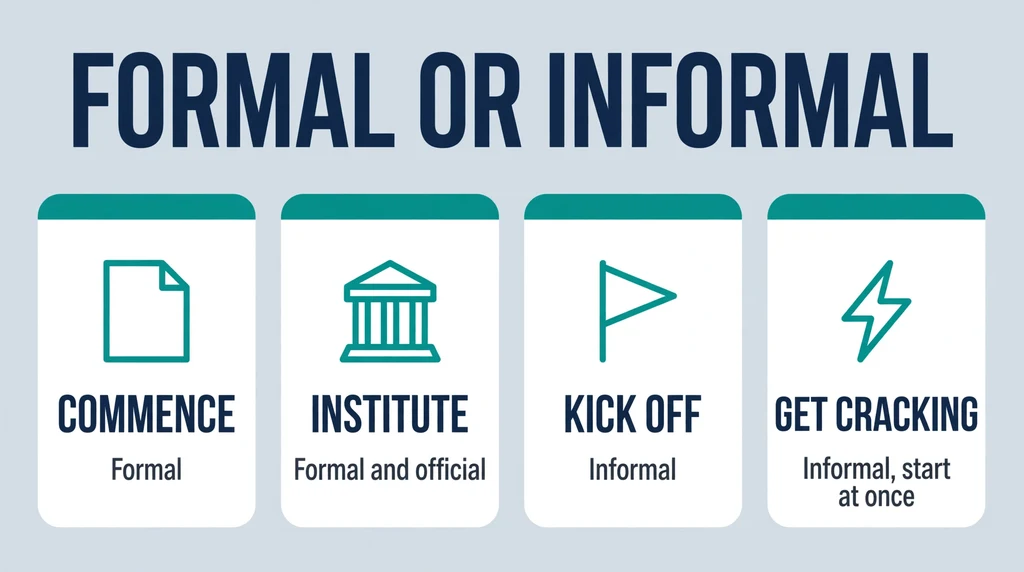
On the formal shelf sit commence, initiate, inaugurate, institute, enter into, embark upon, proceed, and set on foot. These words wear suits. They belong in reports, ceremonies, academic essays, legal notes, and official announcements. A university commences enrolment. A board initiates an inquiry. Nobody at a family picnic talks this way.
On the informal shelf sit kick off, get cracking, get the ball rolling, break the ice, plunge into, get going, hit the road, and crop up. These words wear rolled sleeves. They suit conversation, stories, sports pages, friendly emails, and social posts. A coach kicks off training. Friends hit the road at sunrise.
In the neutral middle stand start, open, set out, set about, take up, launch, emerge, and stem from. These travel anywhere. A formal report can launch a scheme, and a casual story can too.
When in doubt, climb one shelf, not two. Replacing begin with start or open fixes most flat sentences. Reaching straight for inaugurate or set on foot usually overshoots the mark. Tone should match the size of the beginning itself.
Begin vs Start: How to Choose the Right Synonym
Begin and start cause more hesitation than any other pair in this list. Merriam-Webster’s thesaurus settles most of it with a few clean contrasts, and they are worth learning by heart.
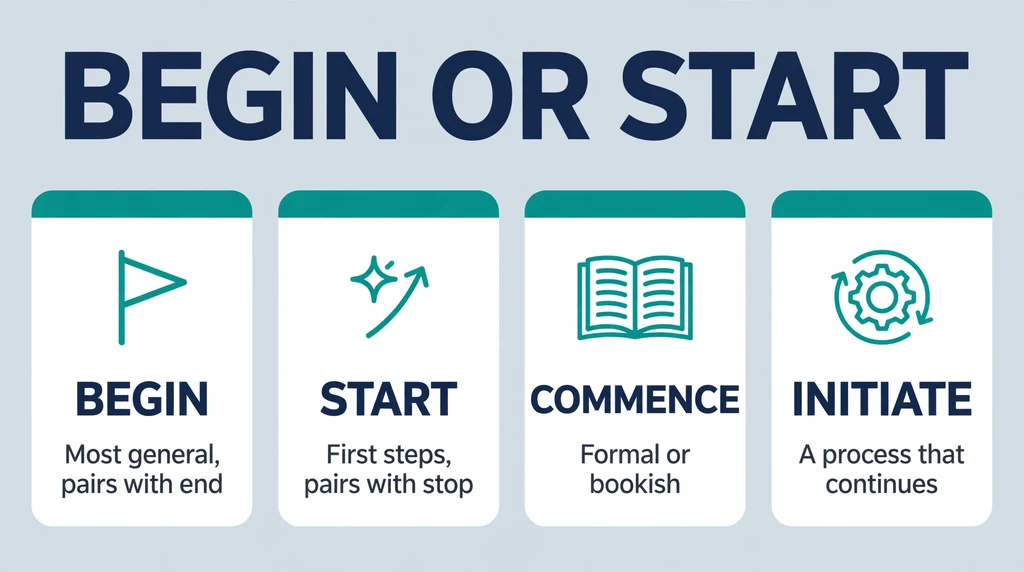
First, the editors say begin, start, and commence are often interchangeable. Begin is the most general of the three. It also pairs with the opposite end, which makes it the natural choice for things with a shape: books, films, meetings, and eras.
Start pairs with the opposite stop. Webster’s says it applies especially to first actions, steps, or stages. That is why start feels physical and immediate. Engines start. Work starts. A race starts the moment the gun fires.
Compare the pair in sentences. “The concert began with a quiet violin piece” treats the concert as a shaped whole. “The car started on the first try” treats the engine as a process that can stop again. Both verbs are correct English, yet each sentence prefers its own.
Commence then adds formality. Webster’s calls it more formal or bookish than begin or start. “The ceremony commenced at noon” belongs in a printed programme. “The ceremony started at noon” belongs in a text message.
Initiate promises a series. It implies a first step in a process that is to continue. You initiate reforms, talks, or treatment because more steps follow. Inaugurate adds ceremony and significance instead. A mayor inaugurates a bridge; a family simply starts a picnic.
Usher in sits one step lower. It introduces a period, not an object, and carries less weight than inaugurate. A single invention can usher in an age of change. For a deeper list built only around the everyday champion, see our full guide to synonyms for start.
Two workplace pairs show the system at work. A hospital can initiate a screening programme, because tests, referrals, and reviews will follow step by step. The same hospital might inaugurate its new wing with a ribbon and a speech, because that beginning carries ceremony. Swap the verbs and both sentences wobble: nobody inaugurates a screening schedule, and a ribbon-cutting deserves more than initiation.
Register settles the last common doubt. In a story, begin often beats start for slow, shaped openings: “The long winter began in October.” In instructions, start beats begin for quick action: “Start the timer when the water boils.” Neither is wrong in the other home, but each sounds most natural in its own.
Antonyms for Begin
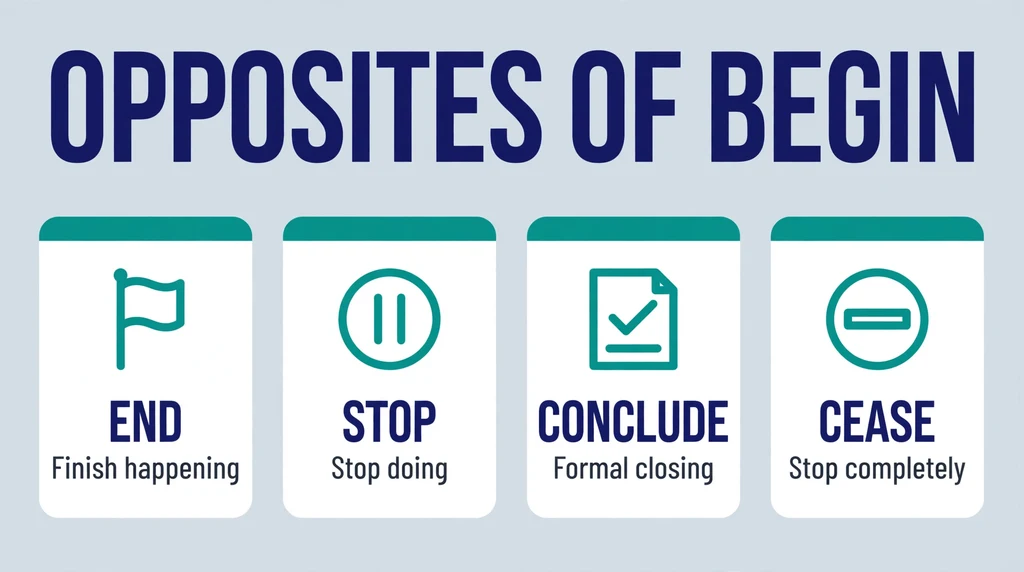
Every beginning casts its shadow. The main antonyms for begin are end, finish, conclude, stop, cease, complete, close, and halt.
Cambridge’s thesaurus keeps the split tidy. For things you do, the opposite of begin is stop: stop talking, stop working. For things that happen, the opposite is end: the concert ends, the rain ends.
Thesaurus.com’s antonym sets add the shades around them. Finish and complete stress that nothing remains undone. Conclude is the formal closer for speeches, trials, and agreements. Cease means to stop completely, often suddenly in tone though gradual in fact. Close ends meetings and chapters. Halt stops movement or progress with a firm hand.
Notice the pairing habit again. Begin matches end in balanced writing: “The story begins in exile and ends at home.” Start matches stop in mechanical writing: “Start the pump, then stop it.” Writers who respect those pairs sound precise without trying. Our companion guide to synonyms for end covers the closing shelf in the same detail.
Common Mistakes With Synonyms for Begin
Treating proceed as a fresh start. Proceed means to begin and carry on, as Collins’s trial example shows. The case, the plan, or the meeting must already exist in some form. For a true first step, choose begin, start, or initiate.
Forgetting the dark tilt of instigate. Collins lists instigate among begin synonyms, but its own example is violence started by former secret police. Instigate usually starts trouble: riots, rumours, plots. Never instigate a birthday party unless the party is a crime.
Inaugurating tiny things. Inaugurate promises formality and significance. “She inaugurated her new kettle” reads as a joke, because the word dwarfs the event. Match the ceremony inside the word to the size of the moment.
Commencing everything. Commence is formal and bookish by design. One commence in a report sounds official. Five in an email sound like a costume. Spread formal words thinly.
Breaking out the good news. Break out belongs to wars, fires, and fevers. “Celebrations broke out” can work as a vivid stretch, but “the picnic broke out” confuses readers. Likewise, crop up signals an unplanned arrival, so a scheduled launch should never crop up.
Using originate without a source. Originate insists on a definite starting point. If you cannot name where the thing came from, pick emerge or arise instead. Dropping the tail of get off is the last trap: the begin sense lives in the full phrase “get off to a start,” not in get off alone.
Example Sentences With Synonyms for Begin
Reading a word in a live sentence fixes it in memory better than any gloss. These examples reuse the groups above, scene by scene.
Tasks and Work
“The committee commenced its inquiry in March, and the first witnesses appeared within a week.” Commence fits because the inquiry is official and recorded.
“Before the movers arrived, Lena set about packing the kitchen, drawer by drawer.” Set about shows method, not rush.
“The studio will launch its new course in September with a free opening class.” Launch suits a public start with an audience watching.
Events and Openings
“The chair opened the meeting by thanking the hosts, then read the agenda.” Open is the standard meeting verb, calm and formal.
“The festival kicked off with fireworks over the harbour.” Kick off gives the evening its informal spark.
“The discovery of penicillin inaugurated a new era in medicine.” This is Merriam-Webster’s own example of inaugurate, where the beginning carries real significance.
Journeys
“We set out before sunrise, hoping to cross the pass by noon.” Set out frames the whole road ahead, not only the door closing behind them.
“After years of saving, he embarked on the voyage he had planned since school.” Embark adds the weight of a long, serious undertaking.
“The overnight train leaves at ten, so the group hit the road for the station at nine.” Leave handles the timetable, and hit the road handles the mood.
Origins and Happenings
“The quarrel stemmed from a misunderstanding about the will.” Stem from traces the trouble back to its root cause.
“Fresh doubts arose when the second report contradicted the first.” Arise is the formal choice for problems that come into being.
“As the frost deepened, a hard winter set in across the valley.” Set in promises the condition will stay a while.
Frequently Asked Questions
What is the best synonym for begin?
Start is the safest all-purpose synonym, because it fits tasks, events, and machines alike. Begin itself stays best for shaped things like books, films, and eras. Beyond those two, let the scene decide: commence for formal writing, kick off for events, set out for journeys, and originate for sources.
What is a formal synonym for begin?
Commence is the classic formal synonym, and Merriam-Webster calls it more formal or bookish than begin or start. Initiate suits formal processes with more steps to come. Inaugurate suits formal openings that carry ceremony or significance. Institute works when a rule or system officially begins.
What is the difference between begin and start?
The two overlap heavily, and both are usually correct. Webster’s thesaurus notes that begin is the most general and pairs with the opposite end, while start pairs with stop and applies especially to first actions, steps, or stages. In practice, begin sounds slightly more formal and literary, and start sounds more active and everyday.
What is another word for began?
Began is the past tense of begin, so its matches are past forms of the same family: started, commenced, opened, launched, initiated, and kicked off. “The meeting began at nine” can become “The meeting opened at nine” or, informally, “The meeting kicked off at nine.” Choose by tone, exactly as you would for begin.
Which synonym for begin works for a journey?
Set out is the classic choice: travellers set out at dawn for the coast. Embark suits longer, more serious travel and keeps a flavour of ships and voyages. Leave is the plain option for timetables, and hit the road is the cheerful informal one for drives and road trips.
How can I say “begin the meeting” in other words?
Open the meeting is the standard formal phrasing, as in opening with a welcome or a prayer. Start the meeting is neutral and always safe. Kick off the meeting is friendly and informal. If you speak first, you can also lead off, and one good opener gets the ball rolling for everyone else.
Does commence mean exactly the same as begin?
Almost, but the tone differs. Both verbs describe taking the first step in a course or process. Commence simply wears formal dress: courts commence hearings, armies commence fire, and universities commence terms. In casual speech it can sound stiff or humorous, so most everyday sentences prefer begin or start.
Final Thoughts
Begin is a good word that suffers from overwork. The fix is not a rarer word but a better-matched one. Let tone filter first: formal, informal, or neutral. Let the scene filter second: task, event, journey, or origin. Commence will then govern the courtroom, kick off will open the festival, set out will walk the road, and originate will name the source.
Writers who build this habit stop hunting for exotic verbs. Instead, they keep a small working set for each scene and reach for it without thinking. Ten minutes with the tables above is enough to stock that set for begin, and the same habit will serve you for every common verb after it.
Keep start as your reliable spare, and reserve inaugurate and usher in for beginnings that truly open an era. For the full dictionary treatment, with every related word and opposite in one place, see the Merriam-Webster Thesaurus entry for begin.