We have all been there. You are writing an important essay, composing a professional email, or crafting a compelling social media caption. You find yourself using the word “indoctrination” repeatedly. The sentence feels heavy. The meaning seems off. You know there has to be a better way to express this complex idea.
This guide will transform your vocabulary. We will explore over 50 powerful synonyms for indoctrination. You will learn exactly which word to use in every situation. Whether you are a student, a professional, or a creative writer, these alternatives will make your communication sharper and more precise.
What Does “Indoctrination” Mean?
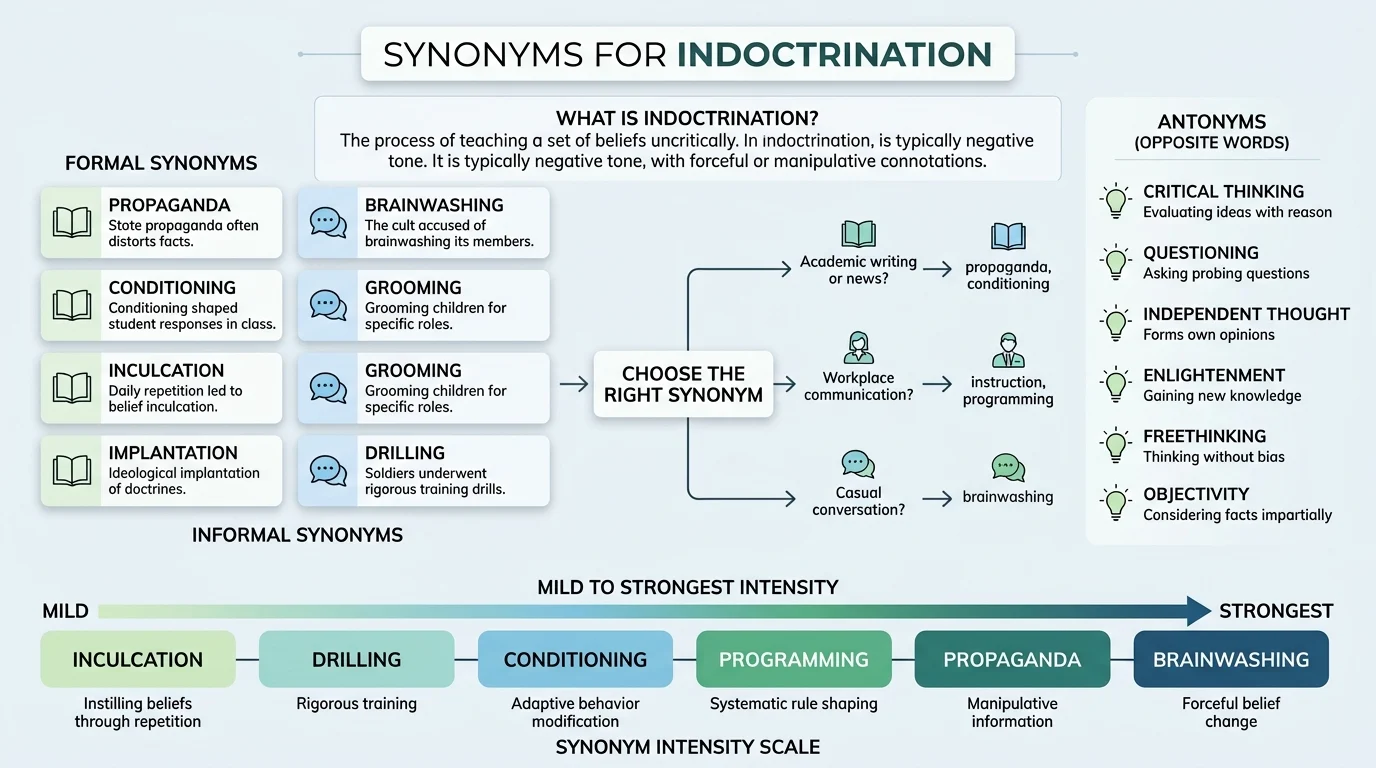
Indoctrination means teaching someone to accept a set of beliefs uncritically. It often carries a negative tone, implying manipulation or forced acceptance. The best synonyms depend on your context. Use “education” for neutral learning, “instruction” for formal teaching, “brainwashing” for extreme manipulation, and “conditioning” for psychological influence.
Meaning, Tone and Context
Simple definition: Indoctrination is the process of teaching a person or group to accept specific doctrines or beliefs without question.
Part of speech: Noun
Tone: Generally negative. The word suggests manipulation, closed mindedness, and a lack of critical thinking.
Formality level: Formal. You will find it in academic writing, political discourse, and serious discussions about education or ideology.
Common use cases: Political discussions, religious contexts, educational critiques, psychological analysis, and historical accounts.
Important word forms: The verb form is “indoctrinate.” The adjective is “indoctrinated.” The person who receives indoctrination is an “indoctrinee.” The person who performs it is an “indoctrinator.”
When and How to Use “Indoctrination”
Use “indoctrination” when you want to emphasize uncritical acceptance. The word works best in serious discussions about belief systems, political regimes, or educational philosophies. Reserve it for situations where the teaching method involves persuasion rather than open inquiry.
Here are realistic examples across different contexts:
Professional context: The company’s orientation program felt more like indoctrination than practical training.
Academic context: The professor criticized the textbook for promoting indoctrination rather than critical thinking.
Personal context: She realized her childhood religious education had been a form of indoctrination.
Political context: The regime relied on indoctrination to maintain control over its citizens.
Historical context: Military boot camps often involve intense indoctrination to build unit cohesion.
Creative context: The novel explored the psychological effects of political indoctrination on young minds.
Casual context: His extreme political views seemed to come from years of indoctrination.
Another Word for “Indoctrination”
The best single replacement depends entirely on your intended meaning and context. Here are direct suggestions for specific situations:
Professional writing: Instruction or training. These terms suggest a neutral transfer of knowledge.
Academic writing: Pedagogy or educational theory. These words emphasize the methods of teaching.
Casual conversation: Teaching or coaching. These words are friendly and approachable.
Emotional writing: Brainwashing or conditioning. These words carry strong emotional weight.
Creative writing: Imprinting or programming. These metaphors add vivid imagery.
Resume or workplace: Professional development or training programs. These phrases sound positive and constructive.
Social media captions: Mindset shaping or belief molding. These phrases are engaging but less technical.
Stronger meaning: Brainwashing or mind control. These words suggest extreme manipulation.
Softer meaning: Education or instruction. These words imply a gentle, open approach.
When Not to Use “Indoctrination”
Avoid “indoctrination” when you mean neutral education or training. The word carries strong negative baggage that can offend or alienate your audience.
Vague usage: His indoctrination at the university was excellent. This sounds like an accusation.
Better option: His education at the university was excellent. This sounds positive and neutral.
Too casual: My mom’s indoctrination about healthy eating made me love vegetables. This is overly dramatic.
Better option: My mom’s guidance about healthy eating made me love vegetables. This is natural and warm.
Too formal: The team’s indoctrination in new software took three days. This sounds suspicious.
Better option: The team’s training in new software took three days. This is professional and clear.
Too weak: The cult’s mild indoctrination techniques were harmless. This minimizes serious harm.
Better option: The cult’s subtle persuasion techniques were concerning. This acknowledges the concern.
Too general: The class involved indoctrination of basic math skills. This misuses the word completely.
Better option: The class involved instruction in basic math skills. This is accurate and appropriate.
Words Commonly Confused With “Indoctrination”
These words are often confused with indoctrination. Understanding their differences will improve your precision.
1. Education: Education implies open inquiry and critical thinking. Indoctrination implies closed acceptance. Education seeks truth. Indoctrination seeks conformity.
2. Training: Training focuses on skills and behaviors. Indoctrination focuses on beliefs and ideologies. Training makes you competent. Indoctrination makes you loyal.
3. Instruction: Instruction involves clear directions and information delivery. Indoctrination involves persuasion and belief shaping. Instruction teaches facts. Indoctrination teaches dogma.
4. Propaganda: Propaganda spreads biased information to promote a cause. Indoctrination is the process of accepting that information. Propaganda is the message. Indoctrination is the absorption.
5. Brainwashing: Brainwashing uses coercive techniques to change beliefs. Indoctrination can be subtle or voluntary. Brainwashing implies force. Indoctrination implies influence.
6. Conditioning: Conditioning uses repetition and reinforcement to create habits. Indoctrination uses repetition to create beliefs. Conditioning is behavioral. Indoctrination is ideological.
Best Synonym by Context for “Indoctrination”
This table shows the best alternative for each situation. Use these recommendations to choose the perfect word.
| Context | Best Synonym | Why It Works | Example |
|---|---|---|---|
| Formal writing | Instruction | It sounds neutral and professional | The school’s instruction followed established educational standards |
| Academic writing | Pedagogy | It focuses on teaching methods and philosophy | The pedagogy encouraged students to question assumptions |
| Professional business | Training | It suggests skill development and competence | The sales training improved performance across the team |
| Resume use | Professional development | It sounds positive and growth oriented | Completed professional development courses in leadership |
| Casual conversation | Teaching | It is friendly and approachable | His teaching about money management really helped me |
| Creative writing | Imprinting | It adds vivid metaphorical imagery | The landscape left an imprint on his artistic vision |
| Emotional tone | Brainwashing | It conveys strong manipulation and control | The documentary exposed the brainwashing techniques used |
| Strong intensity | Coercion | It emphasizes force and pressure | The coercion involved threats and psychological pressure |
| Soft moderate tone | Guidance | It suggests gentle direction and support | Her guidance helped me form my own opinions |
| Social media captions | Mindset shaping | It sounds modern and engaging | Mindset shaping starts with the stories we tell ourselves |
| US English | Education | It is widely understood and neutral | Education is the foundation of a healthy democracy |
| UK English | Tutelage | It has a traditional academic feel | The young scholar benefited from his tutor’s tutelage |
Which Synonym Should You Choose?
Choosing the right synonym requires thoughtful consideration. Follow this practical decision guide to make the best choice.
Consider your audience. If you are writing for a professional audience, choose neutral terms like instruction or training. For an academic audience, use precise terms like pedagogy or didacticism. For a general audience, use accessible terms like teaching or guidance.
Consider your tone. If you want to be neutral, choose education or instruction. If you want to be critical, choose brainwashing or manipulation. If you want to be moderate, choose conditioning or influence.
Consider your purpose. If you want to describe positive learning, choose development or mentorship. If you want to describe negative influence, choose coercion or propaganda. If you want to describe a process, choose systematization or consolidation.
Consider your context. Emotional writing benefits from vivid terms like imprinting or programming. Academic writing requires precise terms like heuristic learning or ideological instruction. Professional writing benefits from constructive terms like training or development.
Consider your sentence structure. Short sentences work well with simple synonyms like teaching or training. Complex sentences can handle longer synonyms like ideological conditioning or systematic persuasion.
Real Life Examples of “Indoctrination” in Sentences
These examples show how to use indoctrination and its synonyms across different situations. Notice how the synonym changes the tone and meaning.
School context: The history teacher encouraged critical thinking rather than indoctrination. Students examined primary sources and formed their own conclusions.
Workplace context: New employees received thorough training, not ideological indoctrination. The focus remained on practical skills and company values.
Writing context: The article used emotional language to achieve indoctrination of its readers. A more balanced approach would have been more persuasive.
Conversation context: I realized my childhood religious education had been a form of indoctrination. I eventually developed my own beliefs.
Social media context: The influencer’s captions promoted subtle indoctrination of her followers. Her content shaped their purchasing decisions.
Email context: The company newsletter avoided indoctrination and instead encouraged open dialogue. Employees felt free to express differing opinions.
Storytelling context: The dystopian novel depicted a society built on indoctrination and control. The protagonist rebelled against the dominant ideology.
15 Synonyms for “Indoctrination”
This table contains fifteen accurate synonyms for indoctrination. Each synonym has a unique meaning and appropriate context.
| Synonym | Simple Meaning | Best Used For | Example Sentence |
|---|---|---|---|
| Education | General learning and knowledge acquisition | Neutral descriptions of formal schooling | His education emphasized critical thinking over memorization |
| Instruction | Formal teaching with clear direction | Professional and academic settings | The instruction covered all safety protocols thoroughly |
| Training | Practical skill development with specific goals | Workplace and sports contexts | The training prepared employees for complex tasks |
| Pedagogy | The art and science of teaching | Academic discussions of teaching methods | The professor’s pedagogy encouraged student participation |
| Cultivation | Nurturing growth and development | Personal development and mentoring | The cultivation of curiosity started in early childhood |
| Inculcation | Repetitive teaching to establish beliefs | Religious and moral education | The inculcation of values began at a young age |
| Propaganda | Biased information to promote a cause | Political and media critiques | The propaganda shaped public opinion through repetition |
| Brainwashing | Coercive belief changing with extreme persuasion | Critical discussions of manipulation | The cult used brainwashing techniques on new members |
| Conditioning | Behavioral shaping through reinforcement | Psychological and behavioral contexts | The conditioning created automatic responses to stimuli |
| Programing | Setting beliefs like computer code | Creative and metaphorical writing | Cultural programming influenced their worldview |
| Socialization | Learning social norms and values | Sociological and anthropological discussions | Socialization prepared children for community participation |
| Orientation | Introduction to a new system or culture | Workplace and educational contexts | The orientation helped new students adjust to college |
| Initiation | Formal admission with ritual learning | Cultural and traditional contexts | The initiation involved learning tribal customs |
| Coercion | Forced acceptance through pressure | Discussions of manipulation and control | The coercion involved threats and psychological pressure |
| Mentorship | Guidance from an experienced person | Professional and personal development | The mentorship focused on skill building and confidence |
Synonym Groups and Usage Differences
Professional vs. Personal Synonyms
Professional synonyms maintain a neutral, constructive tone. Use training, instruction, orientation, and development in workplace contexts. These words emphasize skill building and competence. They do not carry the negative weight of indoctrination.
Personal synonyms can be more flexible and emotionally expressive. Use teaching, guidance, mentorship, and cultivation in personal contexts. These words suggest care, support, and individual growth. They feel warmer and more intimate than professional terms.
Formal vs. Conversational Synonyms
Formal synonyms work best in reports, essays, speeches, and academic writing. Use pedagogy, didacticism, instruction, and propaganda. These words sound precise and authoritative. They demonstrate sophisticated vocabulary.
Conversational synonyms work best in casual writing, texts, friendly emails, and everyday speech. Use teaching, coaching, guidance, and training. These words are simple and accessible. They do not require dictionary lookup.
Academic Synonyms
Academic synonyms sound precise and suitable for essays and research. Use pedagogy, didacticism, and heuristic instruction. These words appear frequently in educational research. They convey a scholarly approach.
Other academic alternatives include ideological transmission, cultural reproduction, and methodological instruction. These phrases are longer but more precise. They demonstrate familiarity with academic discourse.
Professional and Business Synonyms
Professional synonyms work best in emails, reviews, presentations, and workplace communication. Use training, development, orientation, and onboarding. These words suggest progress and improvement.
Other business alternatives include capacity building, staff development, and skills enhancement. These phrases emphasize positive outcomes. They make your communication sound constructive and forward looking.
Creative or Literary Synonyms
Creative synonyms add imagery, emotion, and descriptive depth. Use imprinting, programing, etching, and embedding. These metaphors create powerful visual associations.
Other literary alternatives include shaping, molding, and sculpting. These words suggest an artist’s touch. They make your writing more vivid and engaging.
Slang or Modern Synonyms
Modern synonyms like “brainwashing,” “conditioning,” and “mind control” are acceptable in informal contexts. They have strong emotional weight. Use them carefully.
These terms are too casual for academic or professional writing. They can sound dramatic or exaggerated. Reserve them for creative writing or informal discussions.
Strongest vs. Weaker Synonyms
This intensity scale shows synonyms from mild to strongest.
Mild: Education, instruction, teaching. These words suggest gentle, open learning.
Moderate: Training, socialization, orientation. These words suggest systematic but neutral learning.
Strong: Inculcation, conditioning, propagation. These words suggest persistent influence.
Strongest: Brainwashing, coercion, mind control. These words suggest extreme manipulation.
Emotional vs. Neutral Synonyms
Emotional synonyms add powerful feeling and judgment. Use brainwashing, coercion, manipulation, and propaganda. These words carry strong critical implications.
Neutral synonyms stay factual and objective. Use education, instruction, training, and pedagogy. These words describe processes without judging them.
Antonyms of “Indoctrination”
These antonyms represent the opposite of indoctrination. They emphasize free thinking, open inquiry, and individual choice.
| Antonym | Meaning | Example Sentence |
|---|---|---|
| Education | Open learning with critical thinking | Education encourages students to question established ideas |
| Enlightening | Bringing knowledge and understanding | The enlightening discussion opened everyone’s minds |
| Liberating | Freeing from restrictive beliefs | Travel is a liberating experience that challenges assumptions |
| Emancipation | Freedom from control or oppression | The emancipation of thought leads to personal growth |
| Questioning | Encouraging inquiry and doubt | Questioning authority is essential for democracy |
| Skepticism | Doubt and critical examination | Scientific skepticism prevents blind acceptance of claims |
| Freethinking | Independent thinking without dogma | Freethinking leads to innovative ideas and solutions |
| Open mindedness | Willingness to consider new ideas | Open mindedness helps people understand different perspectives |
| Independency | Self reliance in thought and action | Intellectual independency fosters creative solutions |
| Autonomy | Self governance and self direction | Personal autonomy allows individuals to choose their beliefs |
| Self determination | Making one’s own choices | Self determination is a fundamental human right |
| Critical thinking | Objective analysis and evaluation | Critical thinking protects against manipulation |
| Intellectual freedom | Freedom to explore ideas | Intellectual freedom is essential for university education |
| Liberation | Freedom from oppressive influences | Cultural liberation allows authentic expression |
| Reasoning | Logical thinking and deduction | Reasoning helps people evaluate competing claims |
Comparison: Indoctrination vs. Similar Words
Indoctrination vs. Education
The main difference is the approach to thinking. Education encourages questions and critical analysis. Indoctrination discourages questions and demands acceptance.
Education is stronger in positive contexts. Indoctrination is stronger in negative contexts. Education is more formal in academic writing. Indoctrination is more formal in critical analysis.
Example of indoctrination: The regime used indoctrination to suppress dissent.
Example of education: The university used education to promote intellectual growth.
Indoctrination vs. Training
The main difference is the goal. Training aims to develop specific skills. Indoctrination aims to instill specific beliefs.
Training is stronger in workplace contexts. Indoctrination is stronger in ideological contexts. Training is more formal in professional settings. Indoctrination is more formal in political discussions.
Example of indoctrination: The political party used indoctrination to create loyal members.
Example of training: The company used training to improve employee productivity.
Indoctrination vs. Instruction
The main difference is the depth of influence. Instruction delivers information. Indoctrination shapes core beliefs.
Instruction is stronger in educational contexts. Indoctrination is stronger in religious contexts. Instruction is more formal in classroom settings. Indoctrination is more formal in philosophical discussions.
Example of indoctrination: The cult used indoctrination to control members’ beliefs.
Example of instruction: The teacher used instruction to explain algebra concepts.
Indoctrination vs. Propaganda
The main difference is the focus. Propaganda is the content that spreads ideas. Indoctrination is the process of making those ideas stick.
Propaganda is stronger in media contexts. Indoctrination is stronger in institutional contexts. Propaganda is more formal in political analysis. Indoctrination is more formal in sociological studies.
Example of indoctrination: The education system prevented critical thought through indoctrination.
Example of propaganda: The government used propaganda to shape public opinion.
Indoctrination vs. Brainwashing
The main difference is the method. Brainwashing uses force, coercion, and extreme pressure. Indoctrination can be subtle, voluntary, or even well intentioned.
Brainwashing is stronger in psychological contexts. Indoctrination is stronger in sociological contexts. Brainwashing is more dramatic and alarming. Indoctrination can be more mundane and unnoticed.
Example of indoctrination: The university inadvertently promoted indoctrination through its curriculum.
Example of brainwashing: The captors used brainwashing techniques to change the prisoner’s identity.
Indoctrination vs. Conditioning
The main difference is the target. Conditioning focuses on behaviors and habits. Indoctrination focuses on beliefs and ideologies.
Conditioning is stronger in psychological contexts. Indoctrination is stronger in political contexts. Conditioning is more behavioral. Indoctrination is more cognitive.
Example of indoctrination: Generational indoctrination perpetuated political divisions.
Example of conditioning: Classical conditioning made the dog salivate at the bell.
Common Phrases and Expressions with “Indoctrination”
1. Political indoctrination
Meaning: The process of teaching political beliefs uncritically.
Example sentence: Political indoctrination in schools can undermine democratic values.
2. Religious indoctrination
Meaning: The process of teaching religious beliefs without questioning.
Example sentence: Religious indoctrination often begins in early childhood.
3. Ideological indoctrination
Meaning: The process of instilling a specific ideology.
Example sentence: Ideological indoctrination prevents people from considering alternative viewpoints.
4. Cultural indoctrination
Meaning: The process of teaching cultural norms and values.
Example sentence: Cultural indoctrination happens through media, education, and social interactions.
5. Systematic indoctrination
Meaning: Organized, structured indoctrination over time.
Example sentence: Systematic indoctrination created a generation of loyal supporters.
6. Mass indoctrination
Meaning: Indoctrination of large groups of people.
Example sentence: Mass indoctrination through media can shape entire societies.
Common Mistakes to Avoid
1. Using indoctrination when a more precise synonym is better
Indoctrination is specific. It means uncritical acceptance of beliefs. Do not use it for general learning.
Incorrect: I appreciate your indoctrination in math.
Correct: I appreciate your instruction in math.
2. Confusing indoctrination with education
Education encourages critical thinking. Indoctrination discourages it. They are opposites.
Incorrect: The school’s indoctrination improved test scores.
Correct: The school’s education improved test scores.
3. Using a casual synonym in formal writing
Words like “brainwashing” are too dramatic for academic work.
Incorrect: The university’s brainwashing of students was concerning.
Correct: The university’s ideological instruction raised concerns about academic freedom.
4. Using an overly dramatic synonym for a simple situation
Not every teaching situation is indoctrination. Use measured language.
Incorrect: My mother’s indoctrination about brushing my teeth kept me healthy.
Correct: My mother’s guidance about brushing my teeth kept me healthy.
5. Repeating the same word too often
Repetition weakens your writing. Use synonyms strategically.
Incorrect: The indoctrination process included indoctrination sessions and indoctrination materials.
Correct: The indoctrination process included training sessions and instructional materials.
6. Choosing a synonym with the wrong emotional tone
Some synonyms are positive. Others are negative. Match your tone.
Incorrect: The company’s brainwashing program was appreciated by employees.
Correct: The company’s training program was appreciated by employees.
7. Using slang in academic or professional writing
Avoid casual terms in formal contexts.
Incorrect: The political movement used mind control on citizens.
Correct: The political movement used ideological persuasion on citizens.
FAQs
What is the best synonym for indoctrination?
The best synonym depends on your context. “Education” works for positive learning. “Training” works for skill development. “Brainwashing” works for negative manipulation.
What is a formal synonym for indoctrination?
Formal synonyms include instruction, pedagogy, inculcation, and ideological conditioning. These words appear in academic and professional writing.
What is an informal synonym for indoctrination?
Informal synonyms include brainwashing, programming, and conditioning. These words appear in casual conversation and creative writing.
What is another word for indoctrination in professional writing?
Professional alternatives include training, development, orientation, and onboarding. These words emphasize skill building and career growth.
What is the difference between indoctrination and education?
Education encourages critical thinking and open inquiry. Indoctrination discourages questions and demands acceptance of specific beliefs.
What is the opposite of indoctrination?
The opposite of indoctrination is education, enlightening, or freethinking. These concepts emphasize open inquiry and independent thought.
Conclusion
Indoctrination means teaching someone to accept beliefs without question. It generally carries a negative tone. The best synonym depends on your context, audience, and purpose. Use “education” for positive learning, “instruction” for formal teaching, “training” for skill development, and “brainwashing” for extreme manipulation. Always consider your tone and emotional impact.
Your vocabulary has the power to shape understanding. Choose your words wisely. Match your language to your intention. Replace vague words with precise alternatives. The right synonym can transform your communication from average to outstanding.