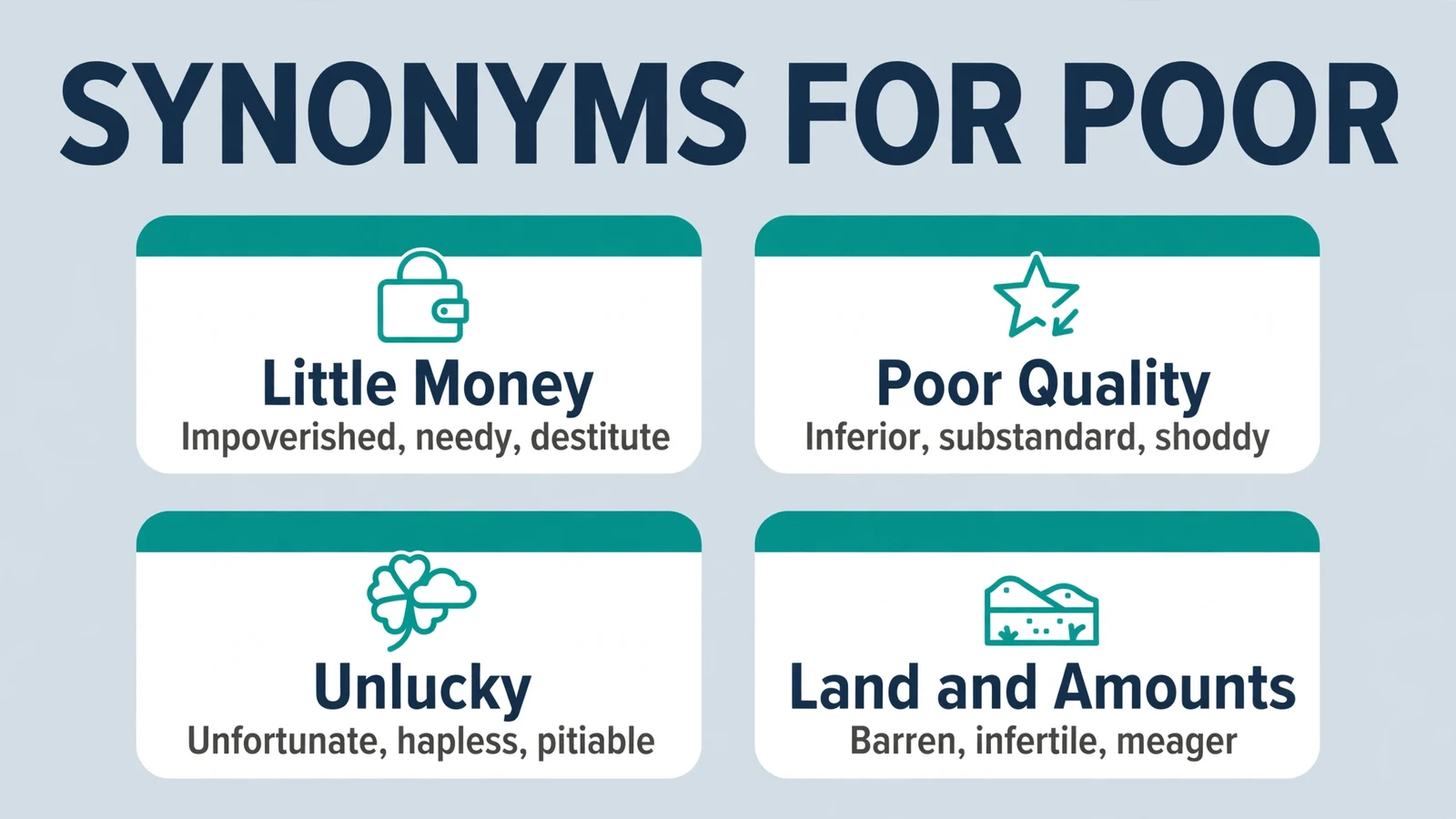
Few everyday words work as hard as poor. It can describe a family with very little money, a badly made chair, an unlucky player, or soil that grows nothing. Each meaning needs its own synonyms. For money, the strongest choices are impoverished, needy, destitute, and penniless. For quality, writers reach for inferior, substandard, and shoddy. For bad luck, unfortunate and hapless fit best.
This guide sorts more than 90 checked synonyms for poor into clear groups, so you can pick the word that matches your sentence. Every word below comes from a major thesaurus entry for poor, and the groups keep the four meanings apart. You will also find register labels, paired examples, antonyms, and the traps that catch even careful writers.
Quick Reference: Top Synonyms for Poor
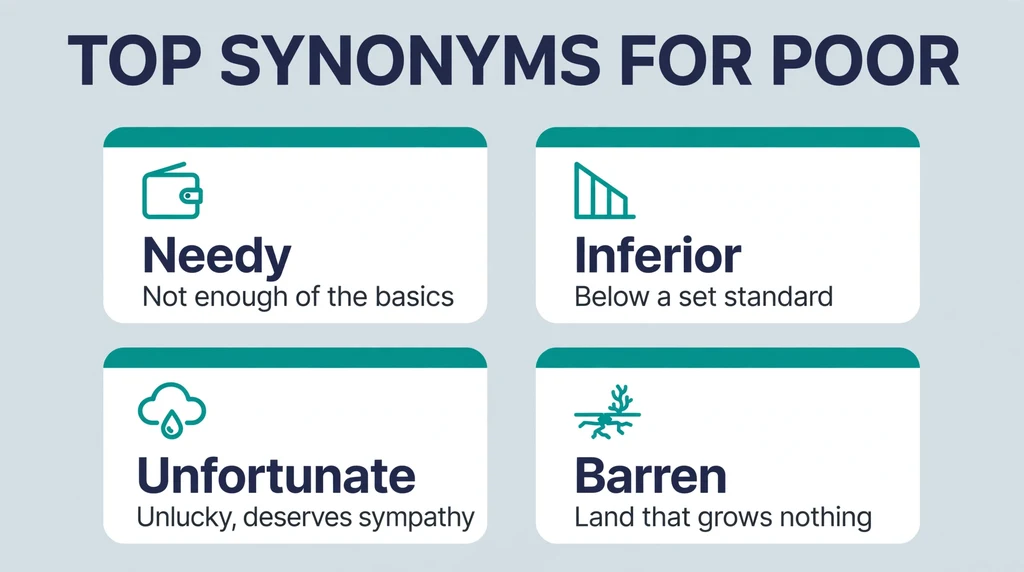
Start here if you need one good word fast. This table holds the 30 most useful options, with the sense each one belongs to.
| Word | One-line meaning | Sense and tone |
|---|---|---|
| Impoverished | Having very little money or resources | Money, formal |
| Needy | Not having enough of the basics | Money |
| Destitute | Lacking food, shelter, and money | Money, strong |
| Penniless | Having no money at all | Money |
| Disadvantaged | Lacking the resources others have | Money, formal |
| Deprived | Without the things a decent life needs | Money |
| Broke | Temporarily out of money | Money, informal |
| Hard up | Short of money for a while | Money, informal |
| Inferior | Below a set standard | Quality |
| Substandard | Not good enough for its purpose | Quality |
| Mediocre | Only average, or a bit below | Quality |
| Shoddy | Badly made or badly done | Quality |
| Unsatisfactory | Not good enough to accept | Quality, formal |
| Lousy | Very bad, in informal speech | Quality, informal |
| Awful | Very bad or unpleasant | Quality, health |
| Abysmal | Extremely bad | Quality, health |
| Unfortunate | Unlucky, or deserving sympathy | Luck |
| Hapless | Unlucky again and again | Luck, literary |
| Pitiable | Deserving pity | Luck, formal |
| Wretched | Miserable and in a bad state | Luck, quality |
Quick Picks for Health, Land, and Amounts
The second half of the table covers health and conditions, land, and amounts that fall short.
| Word | One-line meaning | Sense and tone |
|---|---|---|
| Dire | Very serious and worrying | Health, conditions |
| Grim | Unpleasant and worrying | Health, conditions |
| Barren | Land that produces nothing | Land |
| Infertile | Soil that cannot grow crops well | Land |
| Unproductive | Producing little or nothing | Land, work |
| Meager | Too small in amount | Amount |
| Scant | Barely enough, or not quite enough | Amount |
| Inadequate | Not enough for what is needed | Amount, quality |
| Penurious | Suffering from extreme poverty | Money, formal |
| Paltry | Insultingly small in amount | Amount |
The sections below give each group in full, with example sentences and notes on tone.
What Does Poor Mean?
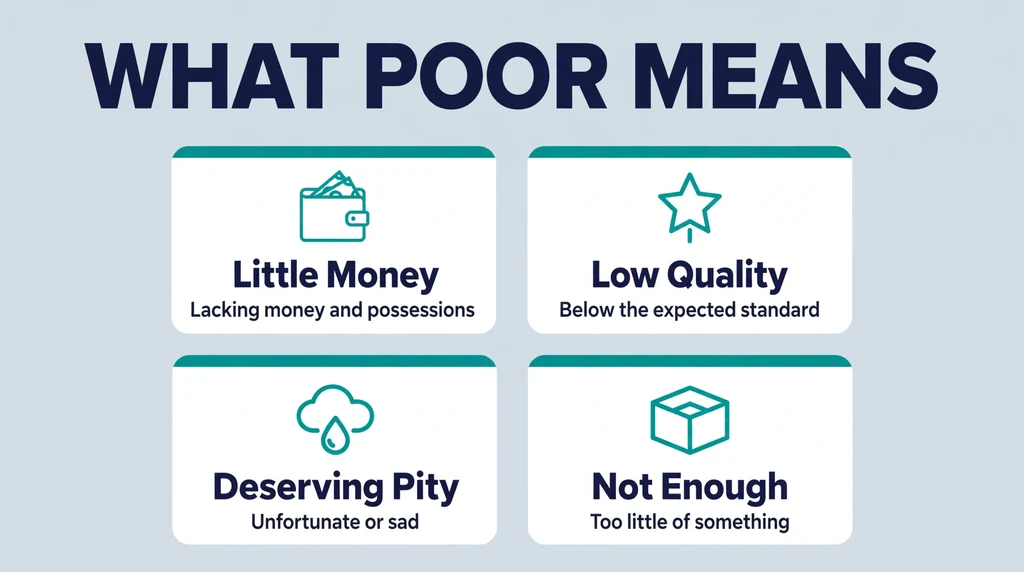
Poor is an adjective with four main jobs in modern English. Merriam-Webster’s thesaurus splits its entry into separate sense lists, and Cambridge and Collins do the same. That split matters, because a synonym from one list can sound completely wrong in another.
The best known job is the money sense: lacking money or material possessions. A poor family, a poor neighborhood, and a poor country all use this sense. English has used the word this way since the 13th century. It reached English through Anglo-French povre, from Latin pauper, the same root behind the English word pauper.
The second job covers quality. A poor result, poor workmanship, or a poor excuse falls short of the standard you expected. Nothing here is about money. The words in this group judge how well something was done or made.
The Pity Sense and the Shortage Sense
The third job asks for sympathy. In “that poor child” or “the poor man never stood a chance,” poor means unfortunate or deserving pity. The speaker feels sorry for the person, and the money sense plays no part at all.
The fourth job means not enough, or not productive. Farmers talk about poor soil that grows little. Patients and doctors talk about poor health. A poor crop or a poor turnout is smaller than it should be. Amount, land, and health all share this idea of falling short.
Poor as a Noun and in Fixed Phrases
Poor can also work as a noun, but only with the in front of it. “The state must care for the poor” uses the word for the whole group of people with little money. You will also meet the forms poorer and poorest in comparisons, as in “the poorest regions of the city.”
Fixed phrases borrow these senses in daily speech. A poor loser is not a person without money; the phrase criticizes how someone takes defeat. A poor sport works the same way. In contrast, poor me and poor thing lean on the pity sense, and they usually sound gentle or playful.
Poor also teams up with everyday nouns: poor visibility, poor signal, poor reception, poor attendance. Each phrase says the thing fell short of what the moment needed.
Synonyms for Poor: Little or No Money
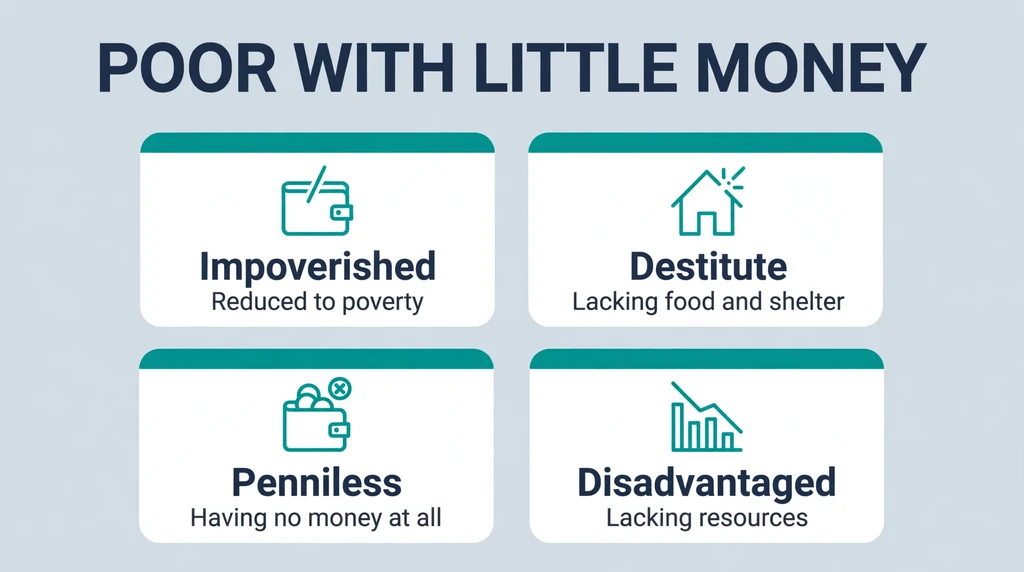
Words in this group describe circumstances, and many of them carry strong feelings. A safe approach is to describe a person’s situation rather than stamp a label on the person. The groups below move from everyday words to formal terms, and then to informal speech. The labels match the ones Cambridge and Collins use.
Everyday Words for Having Little Money
Needy means not having enough money for the basics of life, such as food, housing, and warm clothing. Example: “The food bank serves needy families across the county.”
Impoverished means reduced to poverty, with very little left. Reporters use it for towns, regions, and families. Example: “Years of drought left the farming villages impoverished.”
Deprived means without the things a decent life needs. It often describes areas, schools, or childhoods. Example: “He grew up in a deprived neighborhood with few public services.”
Disadvantaged means lacking the money, schooling, or chances that others take for granted. Schools and charities use it often. Example: “The program offers free tutoring to disadvantaged students.”
Underprivileged works much like disadvantaged, and it appears often in charity and school writing. Example: “She runs a summer camp for underprivileged children.”
Poverty-stricken paints a hard picture of a place or group hit badly by poverty. Example: “Aid workers reached the poverty-stricken villages after the flood.”
The phrase in need softens the same idea for careful writing. Example: “The charity sends warm clothes to families in need.”
All of the words in this group stay safe in news reports, essays, and charity appeals, which is why editors lean on them so often.
Formal Words: Destitute, Indigent, and Impecunious
Destitute is the strongest word in this group. It means lacking food, shelter, and money all at once. Example: “The fire left three families destitute.”
Penniless means having no money at all. It sounds vivid, yet it stays neutral in tone. Example: “He arrived in the city penniless and slept in a shelter.”
Indigent is a formal word for having very little money. Collins marks it formal, and courts and hospitals use it in reports. Example: “The court provides a lawyer for indigent defendants.”
Impecunious is also formal, and slightly old-fashioned. It suits a person more than a place. Example: “The impecunious student took two part-time jobs.”
Necessitous is a rare formal word that simply means in need. Example: “The old fund was set up to support necessitous residents.”
Penurious also appears in Merriam-Webster’s money list, where it means suffering from extreme poverty. Modern readers meet it rarely, and most formal reports prefer impoverished or destitute instead.
Bankrupt and insolvent speak about debts that cannot be paid. Bankrupt usually names a legal state, while insolvent is the finance term. Example: “The insolvent firm could not pay its suppliers.”
Dispossessed means having lost home or property. Example: “Dispossessed families camped near the border crossing.”
Merriam-Webster also lists beggared for someone reduced to poverty, plus pinched and straitened for tight circumstances. Threadbare adds a picture of clothes and budgets worn thin.
Informal Words: Broke, Hard Up, and Skint
Broke is the everyday informal word. It means out of money right now, and it is usually temporary. Example: “I cannot join the trip this month. I am broke.”
Hard up means short of money for a stretch of time. Example: “Her parents were hard up while she was growing up.”
Flat broke pushes broke further. The person has nothing left at all. Example: “After the car repair, he was flat broke.”
Strapped appears in the phrase strapped for cash. People, schools, and councils all use it. Example: “Most small schools are strapped for cash this year.”
Skint is British slang for having no money at the moment. Example: “I cannot come out tonight. I am skint.”
Dirt-poor is an informal American word for extreme poverty, often about a childhood or a region. Example: “He grew up dirt-poor in a mining town.”
Down-and-out describes someone with no money, no home, and few prospects. Example: “The shelter offers beds to people who are down and out.”
Badly off compares quietly with others who have more. Example: “After the factory closed, many households were badly off.”
On the breadline is a British phrase for living at the lowest income level. Hand-to-mouth means living with just enough to survive and nothing saved. Cash-strapped suits organizations that are short of ready money.
A note on respect: informal words suit your own situation or friendly speech. When you write about other people, neutral phrasing works better. Describe the facts, such as households with low incomes or families living in poverty, instead of reaching for the harshest label.
Phrases That Describe the Situation
Some of the most respectful options are phrases rather than single adjectives. Living in poverty describes a state without sticking a label on a person. In straitened circumstances is an older, formal phrase built on straitened, and official reports still use it. News writing also uses the working poor for people who hold jobs yet still cannot cover basic costs. And below the poverty line names an official income threshold in many government reports.
Compare the effect in a headline. “Destitute families queue for aid” sounds dramatic and distant. “Families in need queue for aid” reports the same scene with more dignity. The facts stay identical, while the tone changes completely.
Synonyms for Poor Quality
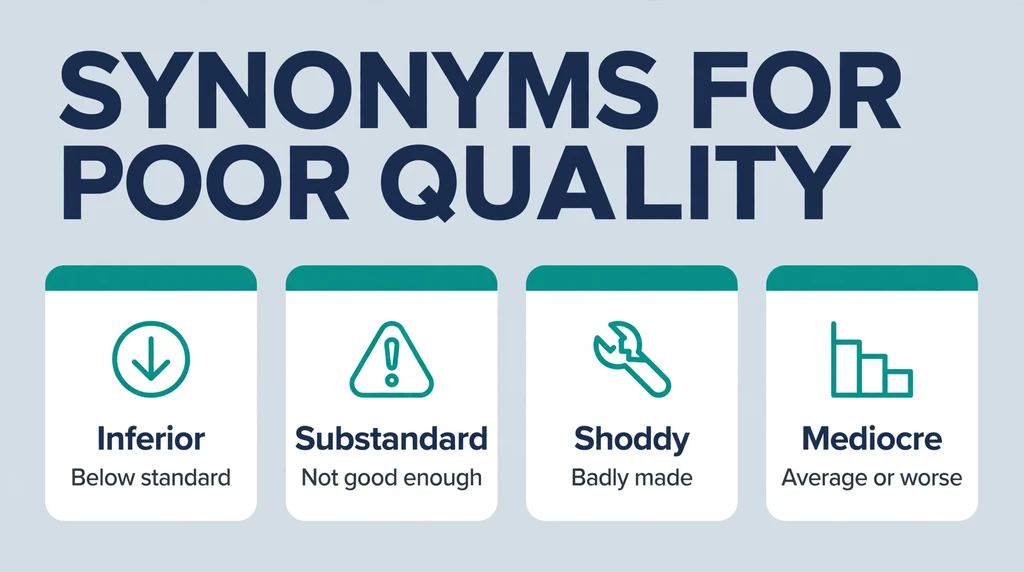
Quality is where poor does its quiet daily work: poor service, poor results, poor workmanship. The words below judge the thing, not a person, and they run from mild disappointment to total failure. If the thing is truly bad rather than merely below standard, the wider synonyms of bad collection goes further.
Below the Standard: Inferior, Substandard, and Mediocre
Inferior means below a standard, or below something else in quality. Example: “The copies are of inferior quality, with pale ink and thin paper.”
Substandard means not reaching the required standard. Inspectors and official reports use it often. Example: “The survey found substandard housing across the district.”
Mediocre means only average, or a little below. Cambridge marks it disapproving. Example: “He was dropped from the team after a mediocre season.”
Unsatisfactory means not good enough to accept. It sounds formal and measured. Example: “A third of the lessons were rated unsatisfactory.”
Unacceptable goes one step further. The thing is so weak that it cannot be allowed. Example: “The waiting times reached an unacceptable level.”
Deficient means lacking something that is needed. Example: “His essay was deficient in evidence and clear structure.”
Second-rate and second-class both mean clearly not among the best. Example: “They settled for a second-rate hotel near the station.”
Low-grade means low in quality or rank. Example: “The chairs were made from low-grade plastic that cracked.”
Subpar is a modern, compact choice with the same job. It suits scores, results, and standards. Example: “The sequel earned subpar reviews from every major critic.”
Badly Made or Badly Done: Shoddy, Lousy, and Rotten
Shoddy means badly made, or done with careless work. Example: “The shoddy stitching split within a week.”
Lousy is an informal word for very bad. Example: “We had lousy weather for the whole trip.”
Rotten is also informal, and it covers bad ideas, bad work, and bad luck with things. Example: “It was a rotten plan from the start.”
Crummy is informal too, and it suggests something shabby and low in quality. Example: “They stayed in a crummy motel by the highway.”
Cheap criticizes low-cost materials and weak quality in this sense. Cambridge marks that use as disapproving. Example: “The cheap plastic cracked the first time she used it.”
Worthless means having no value or use at all. Example: “After the flood, the damaged stock was worthless.”
Useless means unable to do its job. Example: “A broken pump is useless in a flood.”
Three near neighbors split the blame in useful ways. Flawed points to a mistake in design or logic, as in a flawed argument. Defective points to a fault from the making, as in defective brakes. Faulty points to something that fails to work right, as in faulty wiring.
Lame is an informal pick for weak attempts and excuses. Example: “He gave a lame excuse for missing the deadline.”
At the top of the scale sit the all-purpose verdict words. Awful, terrible, dreadful, and horrible all mean very bad. Abysmal and atrocious mean shockingly bad, while appalling means bad enough to shock or anger. Example: “The service was atrocious, and the bill still came.”
Synonyms for Poor: Unlucky and Pitiable
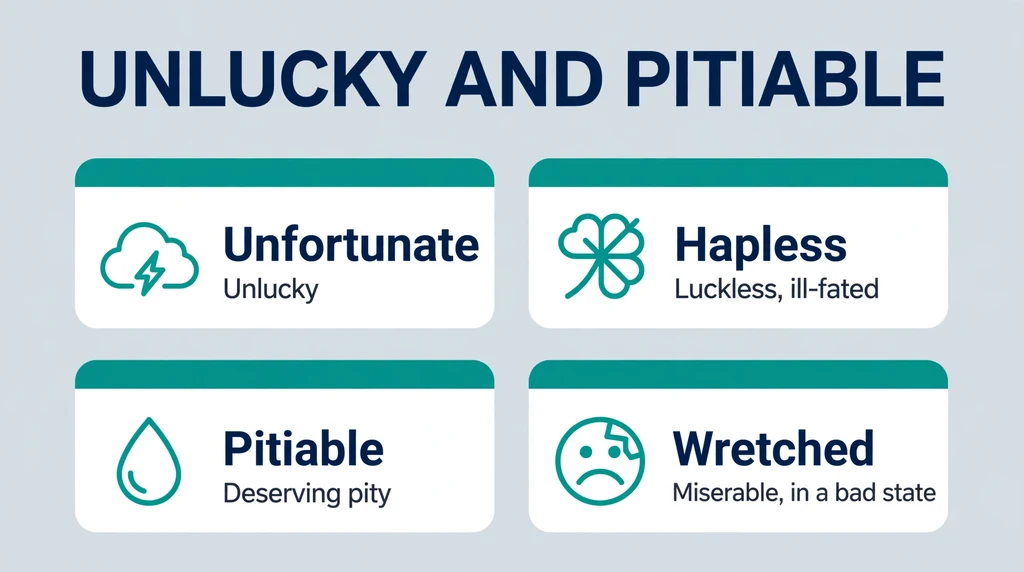
In this sense, poor points at luck, not money or skill. Think of the sentence “Poor old Sam lost his keys, his train, and his umbrella in one morning.” The speaker stands on Sam’s side. Collins groups these words under the definition “pitiable,” and Merriam-Webster heads its list with pitiful. In speech, the phrases poor thing and poor soul carry this same sense, and they usually sound kind rather than cruel. For feelings rather than fortune, the synonyms for sad collection covers the emotional side.
Words for Bad Luck
Unfortunate is the most neutral choice. It means unlucky, and it never sounds rude. Example: “The unfortunate traveler missed the last ferry of the day.”
Unlucky is the plain everyday word for having bad luck. Example: “She was unlucky to slip on the one icy step.”
Hapless sounds literary. It describes someone whom bad luck follows again and again, and it often carries a gentle smile. Example: “The hapless gardener planted his tomatoes one week before the frost.”
Luckless belongs to the same family, though writers use it less often. Example: “The luckless team struck the post three times and lost.”
Ill-fated suits trips, plans, and attempts that seem doomed to end badly. Example: “Their ill-fated expedition turned back on the second day.”
Ill-starred sounds old-fashioned and poetic. It pictures someone born under a bad star. Example: “The ill-starred partnership broke up within a year.”
Words That Ask for Sympathy
Pitiable is a formal word for deserving pity. Example: “The abandoned puppy was a pitiable sight by the gate.”
Pitiful also means deserving pity. It can also suggest something too weak or small, so context does real work here. Example: “We heard a pitiful cry from the box by the road.”
Sorry works in phrases like a sorry sight or a sorry state, where it means sad and pitiable. Example: “The garden was in a sorry state after the storm.”
Woeful is a literary word for full of woe. Example: “He told a woeful tale of delays, lost tickets, and missed calls.”
Wretched is stronger. It means miserable and in a bad condition, and it can describe people, places, or weather. Example: “The travelers spent a wretched night in the open.”
Miserable means very unhappy or uncomfortable. Example: “The children looked cold and miserable in the rain.”
One warning belongs here. Pathetic appears in the thesaurus under both pity and poor quality, so it can insult when you mean to comfort. The mistakes section below explains that trap in full.
Synonyms for Poor Health, Land, and Amounts
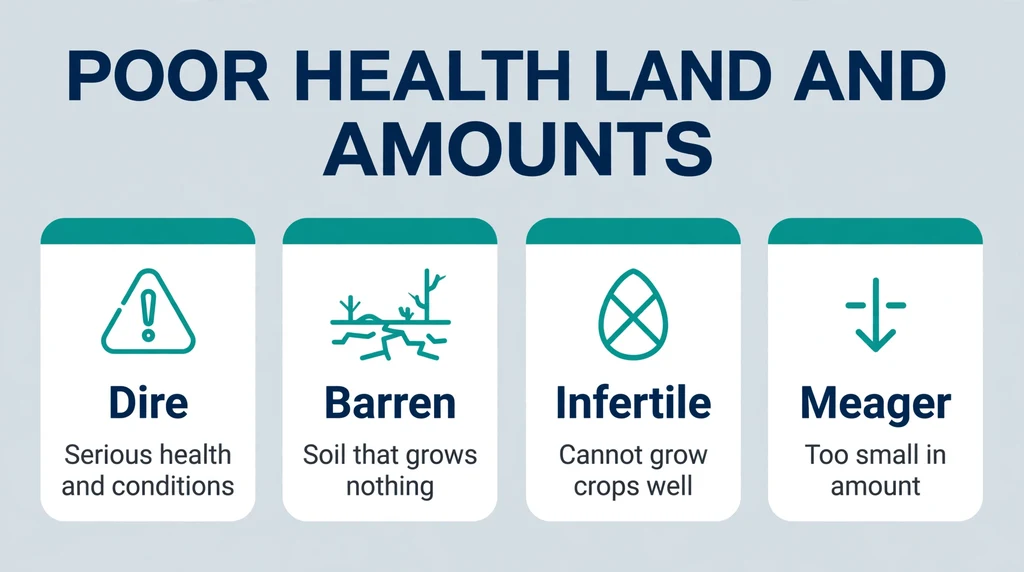
The last sense family shares one simple idea: something falls short. Health fails, soil produces little, or an amount comes up short. Cambridge even opens its bad-conditions list with a health example: “She’s 87 and in poor health.”
Poor Health and Poor Conditions
Bad is the plain all-rounder for this group: bad health, bad conditions, bad weather. It says the fact without drama.
Dire means very serious and worrying. Doctors, reporters, and officials use it for health and conditions alike. Example: “The report describes a dire shortage of nurses in rural clinics.”
Grim means unpleasant and hard to face. Example: “The survey paints a grim picture of mental health care in small towns.”
Awful, dreadful, and horrible give strong everyday verdicts on how something feels or seems. Cambridge notes that dreadful is mainly British in this use.
The strongest set is abysmal, appalling, atrocious, horrendous, ghastly, and horrific. Save these for shocking conditions or events. Example: “Conditions in the flooded camp were appalling.”
Weak fits body parts and senses rather than whole situations. Think of weak eyesight, a weak heart, or weak light in a room. Collins illustrates this use with eyesight that had always been weak.
Older books also use frightful and horrid for bad conditions and shocks. Cambridge marks both words as old-fashioned and informal, so modern reports leave them aside.
Poor Soil and Unproductive Land
Barren is the classic word for land that produces nothing. Example: “Nothing grew in the barren field behind the village.”
Infertile is the technical partner of barren. It describes soil that cannot grow crops well. Example: “Years of overuse left the soil infertile.”
Unproductive means producing little or nothing. It also works for meetings and working days. Example: “The unproductive land was given over to grazing.”
Arid means too dry to support much life. Example: “The arid hills support only scrub and thorn bushes.”
Parched means dried out by heat or by a lack of rain. Example: “Wide cracks ran across the parched earth.”
Depleted and exhausted describe soil with its goodness used up. Example: “Depleted soil needs rest, compost, and time.”
Desolate adds emptiness and bleakness to the picture. Example: “A desolate plain stretched to the horizon.”
Poor Amounts: Too Little of Something
Meager means smaller than it should be. It suits crops, wages, and portions. Example: “The drought gave farmers a meager harvest.”
Scant and scanty mean barely enough, or not quite enough. You will meet scant evidence, scant attention, and scanty rainfall. Example: “There is scant evidence for the claim.”
Sparse means spread thinly over an area. It fits hair, vegetation, crowds, and data. Example: “Sparse rain fell on the valley that spring.”
Skimpy means too small in a way that feels stingy. Example: “The hotel served a skimpy breakfast of tea and toast.”
Paltry means insultingly small, and it usually describes sums of money. Example: “He was offered a paltry sum for the car.”
Measly is the informal twin of paltry. Collins marks it informal. Example: “The prize was a measly ten dollars.”
Slight means small in amount or degree. Example: “The new treatment made only a slight difference.”
Finally, three formal words cover shortages with precision. Inadequate means not enough for the need, insufficient means not enough in quantity, and deficient means missing a needed part. Example: “The region had inadequate clinics, insufficient staff, and diets deficient in protein.”
Synonyms for Poor in Sentences
Reading a word inside a real sentence settles its sense faster than any gloss can. This bank keeps the four groups apart, with a short note after each line.
Money and Quality in Sentences
“The destitute widow applied for emergency housing.” Destitute gives the strongest money sense, with nothing left at all.
“Penniless students can apply to the hardship fund.” Penniless states the simple fact of having no money.
“He felt broke by Friday, though payday was only three days away.” Broke stays informal and temporary.
“The committee rejected the substandard proposal without debate.” Substandard judges the work against a required standard.
“Her shoddy repair lasted exactly one week.” Shoddy blames careless workmanship.
“A mediocre sequel disappointed fans of the first film.” Mediocre gives a mild quality verdict.
Luck, Land, Health, and Amounts in Sentences
“The hapless goalkeeper fumbled the easiest catch of the season.” Hapless follows a person whom luck keeps dodging.
“Farmers abandoned the barren slope and planted the lower field instead.” Barren describes land that produces nothing.
“The small clinic worked under grim conditions after the storm.” Grim suits serious, unpleasant conditions.
“A meager turnout greeted the morning market.” Meager marks an amount smaller than it should be.
How to Choose the Right Synonym for Poor
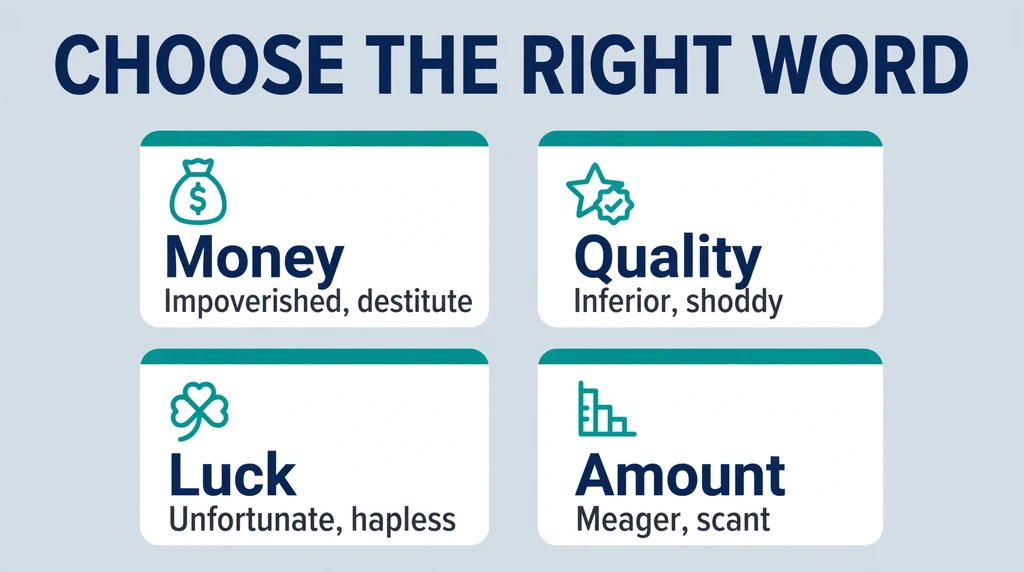
Three quick questions settle almost every choice. Ask them in order before you write the word, and the right group will usually pick itself.
Ask Which Sense You Mean
The sense check comes first, because each group lives in its own world. A charity can support impoverished families, but it cannot publish an impoverished report and mean a bad one. For the report, the quality group gives you shoddy, substandard, or flawed. Swapping words across senses produces nonsense, even when every single word is a real synonym of poor.
Two short sentences prove the point. “The orchestra gave a poor performance” judges skill and practice. “The orchestra raised funds for poor children” describes money and need. One word does both jobs, and only the surrounding words tell you which world you are standing in.
The pity sense needs the same care in news writing. “The poor defendant waited outside the court” can mean the man has no money, or that the writer feels sorry for him. Unfortunate removes the doubt when sympathy is the point.
Match the Strength
Within each group, words climb a ladder from mild to extreme. Pick the rung that matches the facts.
- Money: badly off, then impoverished, then destitute at the top.
- Quality: mediocre, then substandard, then abysmal at the top.
- Amount: slight, then meager, then paltry at the top.
Paired examples show the effect. “After the fee, I was broke” reports a tight week. “After the fire, the family was destitute” reports the loss of everything. The second sentence carries far more weight, so save it for facts that deserve it.
Land and health climb ladders too. Barren is the end point for soil, while unproductive still leaves room for a small yield. For conditions, grim worries the reader, while appalling shocks them. Choosing one rung too high makes careful readers doubt the whole report.
Match the Setting
Formal writing, such as reports, essays, and official letters, favors impoverished, indigent, inadequate, unsatisfactory, and substandard. Friendly speech favors broke, hard up, lousy, and crummy. British readers know skint and on the breadline well, while many American readers do not. School and exam writing rewards the same precision, since substandard and inadequate earn more trust than lousy or crummy.
Watch out for cheap while you choose. In “a cheap ticket,” the word praises a low price. In “a cheap plastic toy,” it criticizes quality, and Cambridge marks that quality sense as disapproving. When you mean low in price and nothing more, inexpensive is the safer choice.
For people, setting also means respect. Neutral descriptions of circumstances travel better than labels. “Families in need” and “households with low incomes” state facts without mocking anyone.
Antonyms for Poor
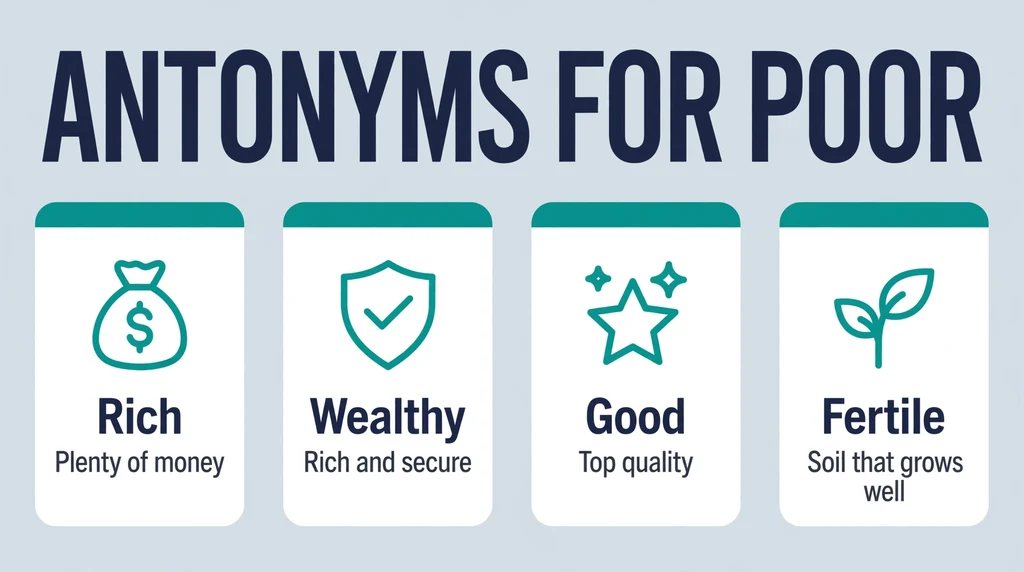
Each sense of poor has its own opposite, so match the antonym to the sense you used.
For money, the standard opposite is rich, and Cambridge lists it as the antonym for this sense. Wealthy works the same way, while affluent sounds formal and often describes areas or societies, as in an affluent suburb. Wealthy often points at assets built over time, while rich stays plain and direct. Well-to-do sits a step lower and means comfortably off. For the other side of the scale in full, see the synonyms for rich collection.
For quality, the basic opposite is good, which Cambridge gives for the quality topics. Excellent and superior raise the praise further, as in a superior performance. A report can move from “poor results” to “excellent results” in one step, and the second version tells the reader exactly how high the work reached.
For land, the opposite pair is fertile and productive soil. Writers also call good soil rich, and dictionaries mark that soil sense of rich as the opposite of poor.
For luck, the opposites are fortunate and lucky. “The fortunate survivors were found within hours” flips the hapless group in one word.
Common Mistakes: Words That Are Not True Synonyms for Poor
Pathetic is the trickiest word in this guide. Merriam-Webster lists it under both the pity sense and the quality sense of poor. “That poor man” invites sympathy. “That pathetic man” can sound like an insult about his weakness. When sympathy is your goal, choose unfortunate or pitiable instead.
Broke does not equal long-term poverty. Broke is informal, and it usually describes a short stretch with no cash. Calling a whole region broke makes real hardship sound like a joke about an empty wallet. For lasting poverty, impoverished or poverty-stricken carries the right weight.
Cheap does not describe a poor person. On things, cheap criticizes quality or praises a low price. On a person, cheap usually accuses them of stinginess, which is a different claim entirely. “A cheap gift” faults the gift. “A cheap uncle” faults his generosity, not his income.
Infertile belongs to soil in this guide. For people, infertile is a medical word about having children. It is never a synonym for having little money, and using it that way would confuse or offend readers.
Lame needs care in formal writing. Merriam-Webster does list lame for weak quality, and “a lame excuse” is common speech. Still, the word carries an older history about disability, so many editors avoid it in print. Weak or unconvincing is the safer formal choice.
Sorry does not always mean an apology. In the pity group, sorry describes a sad sight or state, as in “the team made a sorry showing.” Readers who expect an apology can misread the sentence, so pitiable or miserable is clearer in formal prose.
Frequently Asked Questions
What is the best synonym for poor?
There is no single best word, because poor has four senses. For money, impoverished and destitute lead the list. For quality, inferior and substandard fit most sentences. For luck, unfortunate is the safest pick, and for land, barren is the classic choice. When in doubt, start from the quick table at the top of this guide.
What is a formal synonym for poor?
For money, impoverished is formal, and Collins also labels indigent and impecunious as formal. For quality, unsatisfactory and substandard sound formal. For amounts, inadequate and insufficient are the formal standbys.
What is a slang or informal word for having no money?
Broke is the most common informal word, and hard up and flat broke work too. In British slang, skint means the same thing. Strapped, usually in the phrase strapped for cash, is another informal option.
What is the difference between poor and broke?
Poor is the general, neutral word for lacking money, and it can describe a lasting condition. Broke is informal and usually temporary. A student can be broke on Friday and fine on Monday, while a poor region faces a much longer problem. That is why broke suits diaries and chats, while poor suits reports and essays.
What is another word for poor quality?
Inferior and substandard are the most useful choices. Shoddy suits badly made goods, mediocre suits middling work, and second-rate suits anything clearly below the best. For a stronger verdict, awful, terrible, and abysmal all work.
What is a word for poor soil?
Barren and infertile are the main pair. Barren pictures land that produces nothing, while infertile is the technical term for soil that grows crops badly. Unproductive covers land that yields very little.
What is the opposite of poor?
For money, the opposite is rich, with wealthy and affluent close behind. For quality, use good or excellent. For soil, the opposite is fertile, and for luck, fortunate is the matching word.
Can poor be a noun?
Yes, but only in the phrase the poor, which means people with little money as a group. A sentence like “The state must care for the poor” uses it this way. In all other uses, poor works as an adjective.
Final Thoughts
Poor is really four words wearing one coat. Money, quality, pity, and shortage each own a separate shelf of synonyms, and the thesauri keep those shelves apart for good reason. Once you know which sense your sentence needs, the choice becomes simple: match the sense, match the strength, and match the setting. Bookmark the quick table if you write often; it answers most daily choices in seconds.
Keep the respectful habit from the money section in mind, too. The best word describes a situation clearly without sneering at the people inside it. For the full reference lists behind this guide, see the Merriam-Webster Thesaurus entry for poor.