Have you ever read back an email and realized you used the word “more” five times in two sentences? This happens to almost everyone.
Writers, students, and professionals often rely on “more” as a default word for comparison, addition, and intensity. The problem is that this habit makes your writing feel repetitive and flat. Your readers may not notice consciously, but they will sense that something is missing.
The English language offers dozens of alternatives that can make your message sharper, more professional, and more engaging. Finding the right synonym for “more” depends on your context, your audience, and the emotional tone you want to create.
This guide will help you break free from overusing “more.” You will discover precise replacements for every situation, from academic essays to casual social media posts.
What Does “More” Mean?
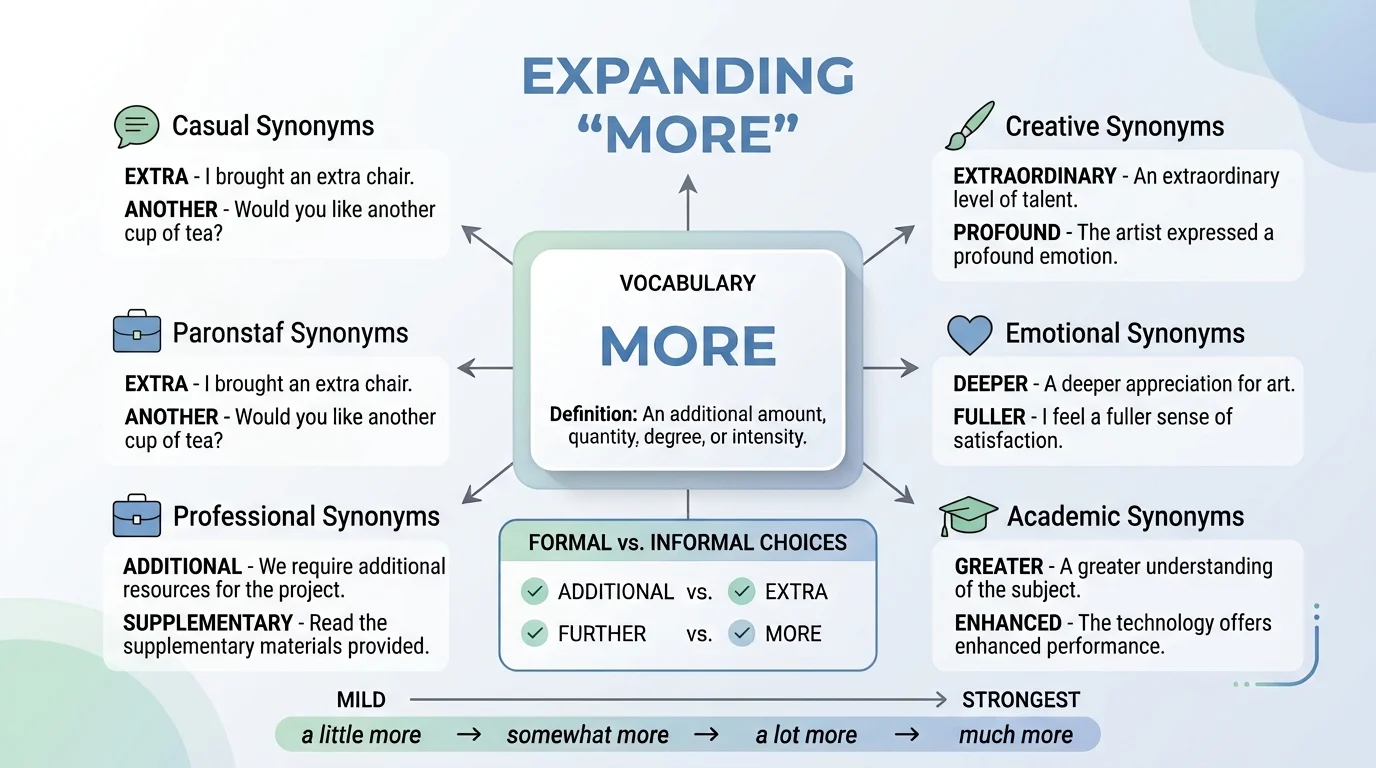
“More” is a comparative word that indicates a greater amount, degree, or intensity. The best synonyms depend on your context. Use “additional” or “further” for professional writing. “extra” for casual conversation. “greater” for academic work. Use “increasingly” for emotional or creative expression. Choose based on your tone and audience.
Meaning, Tone and Context
Simple Definition
“More” means a larger quantity, greater extent, or additional amount compared to something else.
Part of Speech
“More” functions as a determiner, adverb, pronoun, or noun depending on its role in a sentence.
Tone
“More” has a neutral tone. It does not carry positive or negative emotional weight on its own. The surrounding words determine the emotional impact.
Formality Level
“More” is neutral in formality. It works in every setting from casual text messages to formal academic papers.
Common Use Cases
People use “more” for comparisons, to request additional items, to describe increasing intensity, and to indicate continuation.
Important Word Forms
The word “more” does not change form. However, related words include “most” for superlative comparisons and “much” for quantity references.
When and How to Use “More”
Understanding proper usage helps you decide when to keep “more” and when to swap it for a stronger alternative.
Professional Context
The team needs more resources to complete this project successfully.
We should gather more data before making a final decision.
Personal Context
I would like more time to think about this offer.
Could you add more details to your story?
Academic Context
The study requires more evidence to support this hypothesis.
Researchers need more participants for a statistically significant result.
Emotional Context
She felt more confident after the training session.
The speech made him more determined than ever.
Creative Context
The sunset grew more beautiful with each passing minute.
His voice became more urgent as the storm approached.
Social Media Context
We need more content like this on our feed.
This post earned more engagement than our average content.
Email Context
I will send more information by the end of the week.
Please provide more clarification about your request.
Resume Context
I managed more than fifty employees across three departments.
The campaign generated more leads than the previous quarter.
Another Word for “More”
Selecting the perfect replacement requires understanding nuance. Here are the best options by context.
Professional Writing
Use “additional” when you need to sound polished and precise.
The report includes additional findings from the latest audit.
Academic Writing
Use “greater” or “further” for scholarly precision.
The experiment requires further analysis before publication.
Casual Conversation
Use “extra” for everyday dialogue with friends and family.
We need extra chairs for the dinner party.
Emotional Writing
Use “increasingly” to show gradual emotional change.
She became increasingly frustrated with the delays.
Creative Writing
Use “further” or “added” for descriptive depth.
The added detail transformed the scene completely.
Resume or Workplace Use
Use “exceeding” or “substantial” to impress employers.
Exceeding sales targets earned a promotion within six months.
Social Media Captions
Use “more of” or “extra” for engaging social content.
We want more of this energy in 2024.
Stronger Meaning
Use “surpassing” for emphasis.
His performance was surpassing all expectations.
Softer Meaning
Use “slightly more” or “somewhat” for mild comparisons.
The second option is slightly more affordable.
When Not to Use “More”
Overusing “more” dilutes your message and makes you sound unsure. Recognize when to replace it with precision.
Too Vague in Professional Writing
Weak: We need more employees.
Improved: We need additional staff members for the night shift.
The vague version leaves too many questions unanswered. The improved version clarifies exactly what you require.
Too Casual in Academic Work
Weak: The results show more problems.
Improved: The results reveal several significant complications.
Academic writing demands specific language that demonstrates careful thinking.
Too Weak in Emotional Expression
Weak: I love you more.
Improved: My love for you grows deeper every day.
The synonym adds emotional weight that “more” cannot convey.
Too General in Descriptive Writing
Weak: The room became more colorful.
Improved: The room became vibrant and lively.
Specific adjectives create stronger mental images than comparative words.
Too Repetitive in Any Writing
Weak: We need more time, more money, and more people.
Improved: We need additional time, increased funding, and extra staff.
Variety keeps your reader engaged and signals professional writing ability.
Words Commonly Confused With “More”
Several words create confusion because they seem similar to “more” but carry different meanings.
More vs. Most
“More” compares two things. “Most” compares three or more things.
Use “more” for pairs. Use “most” for groups of three or more.
More vs. Greater
“More” refers to quantity. “Greater” refers to size, value, or importance.
Use “more” for countable items. Use “greater” for abstract concepts.
More vs. Further
“More” indicates additional quantity. “Further” indicates additional progress or distance.
Use “more” for adding things. Use “further” for extending actions.
More vs. Additional
“More” is general. “Additional” is specific and formal.
Use “more” casually. Use “additional” professionally.
More vs. Extra
“More” is neutral. “Extra” suggests something beyond what is expected.
Use “more” for standard additions. Use “extra” for special or surplus items.
More vs. Increased
“More” is static. “Increased” shows change or growth.
Use “more” for current states. Use “increased” for changes over time.
Best Synonym by Context for “More”
| Context | Best Synonym | Why It Works | Example |
|---|---|---|---|
| Formal writing | Additional | Sounds official and precise | The committee requested additional documentation |
| Academic writing | Greater | Indicates measurable significance | Greater sample size improves reliability |
| Professional business | Further | Suggests ongoing progress | We need further clarification on this matter |
| Resume writing | Exceeding | Shows achievement above expectations | Exceeding quarterly targets consistently |
| Casual conversation | Extra | Friendly and natural | We have extra pizza in the kitchen |
| Creative writing | Added | Contributes to descriptive imagery | The added layer gave depth to the painting |
| Emotional tone | Increasingly | Shows gradual emotional buildup | She felt increasingly hopeful about her future |
| Strong intensity | Surpassing | Indicates going beyond limits | The results were surpassing our best predictions |
| Soft or moderate | Slightly | Downplays intensity appropriately | The solution is slightly more efficient |
| Social media captions | More of | Engages audience directly | We want more of this positivity |
| US usage | Additional | Standard American preference | Additional information is available online |
| UK usage | Further | Common British preference | Further details can be found below |
Which Synonym Should You Choose?
Making the right choice depends on several factors.
Consider Your Meaning
Ask yourself what you actually want to say. Are you adding quantity, increasing intensity, or extending progress? Each meaning has its own best synonym.
Consider Your Formality
Match your word to your audience. Formal contexts demand “additional” and “further.” Casual contexts welcome “extra” and “more of.” Academic writing prefers “greater” and “increased.”
Consider Your Emotional Intensity
Strong emotions call for stronger words. Use “surpassing” and “increasingly” when you want to move your reader. Use “slightly” or “somewhat” when you want to be moderate.
Consider Your Professional Value
Resumes and professional communications benefit from action words. “Exceeding,” “expanding,” and “enhancing” demonstrate initiative and achievement.
Consider Your Sentence Context
Look at the words around your sentence. Some synonyms flow naturally in certain sentence structures. Read your sentence aloud to test which option sounds best.
Real Life Examples of “More” in Sentences
These examples show how “more” appears across different situations.
School Example
The professor assigned additional reading to deepen our understanding of the topic. The extra pages felt overwhelming at first, but they added valuable context to the lecture.
Workplace Example
Our department needs further training to implement the new software effectively. The additional sessions will help everyone feel confident using the updated system.
Writing Example
The author used increasingly complex vocabulary as the story progressed. The added layers of meaning rewarded careful readers who paid attention to every detail.
Conversation Example
Do you want extra sauce on your pasta? We have more than enough for everyone at the table.
Social Media Example
Our followers want more behind the scenes content from the photoshoot. The engagement on our recent posts shows growing interest in this format.
Resume Example
Managed a budget of exceeding one million dollars while maintaining quality standards. The experience prepared me for greater responsibilities in future roles.
Email Example
I will send additional materials for your review by Wednesday morning. Further questions can be directed to my assistant during my absence.
Storytelling Example
The silence grew deeper as night approached. The shadows became longer and more mysterious with each passing hour. The characters felt increasing unease about the path ahead.
25 Synonyms for “More”
| Synonym | Simple Meaning | Best Used For | Example Sentence |
|---|---|---|---|
| Additional | Extra beyond what exists | Professional, academic, business | We require additional funding for the expansion |
| Further | More in terms of progress | Formal writing, emails, research | Further investigation revealed the truth |
| Extra | Surplus above normal needs | Casual conversation, social media | We have extra snacks for the party |
| Greater | Larger in size or importance | Academic, professional, comparisons | Greater effort produces better outcomes |
| Added | Put with something else | Creative writing, descriptions | The added spice transformed the dish |
| Increasingly | Growing in degree over time | Emotional writing, trends | The situation became increasingly complex |
| Exceeding | Going beyond a limit | Resumes, achievements, performance | Exceeding expectations earned her recognition |
| Expanded | Made larger in scope | Business, professional, plans | Expanded services now reach more customers |
| Enhanced | Improved in quality | Resumes, marketing, professional | Enhanced features attract premium users |
| Surpassing | Going beyond what is typical | Strong emphasis, achievements | Surpassing goals motivated the entire team |
| Augmented | Increased by addition | Technical, academic, formal | Augmented reality changed the experience |
| Amplified | Made stronger or louder | Creative, emotional, dramatic | The music amplified the emotional scene |
| Elevated | Raised to a higher level | Professional, inspirational | Elevated standards improved our reputation |
| Intensified | Made more extreme | Emotional, creative, descriptive | The tension intensified as the deadline approached |
| Extended | Made longer in duration | Professional, planning, scheduling | Extended hours allowed for deeper discussion |
| Supplemental | Added as a complement | Academic, professional, formal | Supplemental materials enhanced the textbook |
| Excessive | Too much beyond normal | Negative emphasis, warnings | Excessive spending caused budget problems |
| Surplus | Amount beyond what is needed | Economic, business, formal | Surplus inventory required additional storage |
Synonym Groups and Usage Differences
Professional vs. Personal Synonyms
Professional contexts demand words that sound competent and clear. “Additional,” “further,” and “expanded” work well in business settings. These words signal that you are organized and thorough.
Personal contexts welcome warmer language. “Extra,” “more of,” and “added” sound friendly and natural in everyday conversation. These words help you connect with friends and family without sounding stiff.
Formal vs. Conversational Synonyms
Formal writing benefits from “additional,” “further,” “greater,” and “substantial.” These words appear in reports, essays, speeches, and official documents. They convey seriousness and precision.
Conversational settings prefer “extra,” “more of,” and “added.” These words flow naturally in texts, emails to friends, and casual workplace chats. They keep communication light and accessible.
Academic Synonyms
Academic writing values precision and evidence based language. “Greater” works well for statistical comparisons. “Further” indicates research progression. “Substantial” suggests meaningful results. “Supplemental” describes added materials that support main content.
Professional and Business Synonyms
Business communication requires words that demonstrate competence. “Expanded” shows growth. “Enhanced” suggests improvement. “Exceeding” signals achievement. “Substantial” implies significant impact. These words make you sound capable and results oriented.
Creative or Literary Synonyms
Creative writing benefits from vivid alternatives. “Amplified” adds audio visual imagery. “Intensified” builds emotional depth. “Elevated” suggests spiritual or intellectual height. “Manifold” offers a literary, almost biblical tone. “Innumerable” creates a sense of wonder and scale.
Slang or Modern Synonyms
Modern English offers casual alternatives for informal settings. “Extra” has become particularly common in social media contexts. “More of” works well for expressing preference or desire. These words are acceptable in texts, captions, and casual conversation. Avoid them in professional or academic writing.
Strongest vs. Weaker Synonyms
Intensity scale from mild to strongest:
Mild: slightly, somewhat, moderately
Medium: added, extra, further
Strong: increased, expanded, enhanced
Strongest: surpassing, exceeding, amplified, intensified
Emotional vs. Neutral Synonyms
Neutral synonyms include “additional,” “further,” and “supplemental.” These words add information without emotional weight. They work well in factual writing and professional documents.
Emotional synonyms include “increasingly,” “intensified,” and “amplified.” These words suggest growing feelings or mounting pressure. They work well in creative writing, personal narratives, and persuasive content.
Antonyms of “More”
| Antonym | Meaning | Example Sentence |
|---|---|---|
| Less | Smaller in amount | We have less time than we expected |
| Fewer | Smaller in number | Fewer people attended this year |
| Reduced | Made smaller | Reduced spending helped balance the budget |
| Decreased | Gotten smaller | The temperature decreased overnight |
| Diminished | Made weaker or smaller | His influence diminished over time |
| Minimal | Very small amount | Minimal effort produced minimal results |
| Limited | Restricted in quantity | Limited resources required creative solutions |
| Insufficient | Not enough for the need | Insufficient evidence led to dismissal |
| Scarce | Not plentiful | Scarce water supplies caused concern |
| Sparse | Thinly distributed | Sparse vegetation covered the desert floor |
| Bare | Very little | The room had bare furnishings |
| Deficient | Lacking in quantity | Deficient funding halted the project |
| Depleted | Used up completely | Depleted reserves needed replenishment |
| Minor | Lesser in importance | Minor changes improved the design |
| Negligible | So small as to be unimportant | Negligible differences existed between versions |
Comparison: More vs. Similar Words
More vs. Further
The main difference lies in usage. “More” adds quantity. “Further” adds progress or distance.
“More” is more common in everyday speech. “Further” sounds more formal and purposeful.
Example with “more”: We need more time to finish.
Example with “further”: We need further time to finish.
More vs. Additional
“More” is general and works in any context. “Additional” is specifically formal and professional.
“More” is less formal. “Additional” is more formal.
Example with “more”: I want more coffee.
Example with “additional”: We need additional funding.
More vs. Extra
“More” suggests a simple increase. “Extra” suggests something beyond what is normal or expected.
“More” is neutral. “Extra” often implies a positive surplus.
Example with “more”: Please give me more information.
Example with “extra”: Please give me extra information.
More vs. Greater
“More” works for countable quantities. “Greater” works for abstract concepts, values, and importance.
“More” is conversational. “Greater” is academic and precise.
Example with “more”: She has more books.
Example with “greater”: She has greater knowledge.
More vs. Increased
“More” describes a current state. “Increased” describes a change from a previous state.
“More” is static. “Increased” shows movement and growth.
Example with “more”: We have more customers.
Example with “increased”: Our customer base increased.
More vs. Exceeding
“More” shows a basic comparison. “Exceeding” shows that something goes beyond a specific standard or limit.
“More” is neutral. “Exceeding” is emphatic and impressive.
Example with “more”: Sales are more than expected.
Example with “exceeding”: Sales are exceeding expectations.
Common Phrases and Expressions with “More”
1. More or Less
Meaning: Approximately or somewhat.
Example: The project will take more or less three weeks to complete.
2. More Than Meets the Eye
Meaning: Something is more complex than it appears.
Example: This issue has more than meets the eye, so we should investigate further.
3. More Power to You
Meaning: An expression of encouragement or approval.
Example: You are starting your own business? More power to you.
4. The More the Merrier
Meaning: Additional people or things are welcome.
Example: Bring your friends to the party. The more the merrier.
5. More Often Than Not
Meaning: Usually or most of the time.
Example: More often than not, she arrives early to meetings.
6. More Than Enough
Meaning: Sufficient and then some.
Example: We have more than enough food for the entire group.
7. More to Come
Meaning: Additional information or items will follow.
Example: We announced the first phase, but there is more to come.
8. More Than Anything
Meaning: Above all else or most importantly.
Example: More than anything, she valued honesty in her relationships.
Common Mistakes to Avoid
1. Using “More” When a Precise Synonym Is Better
Many writers default to “more” because it is easy. However, “additional,” “further,” or “greater” often communicate your meaning more clearly. Review your writing and replace vague “more” with specific alternatives.
2. Confusing “More” with “Most”
“More” compares two things. “Most” compares three or more. Use “more” for pairs. Use “most” for groups. This mistake appears frequently in casual writing.
3. Using Casual Synonyms in Formal Writing
“Extra” and “more of” sound natural in conversation but unprofessional in business reports. Choose “additional” or “further” for professional contexts. Your credibility depends on appropriate word choice.
4. Using Overly Dramatic Synonyms for Simple Situations
“Surpassing” and “amplified” sound impressive but feel excessive when describing routine matters. Save strong synonyms for situations that genuinely deserve dramatic language. Moderation makes strong words more effective when you use them.
5. Repeating the Same Word Too Often
Even good synonyms lose impact through repetition. Vary your word choices across paragraphs. Use “additional” in one sentence, “further” in another, and “extra” in a third for variety.
6. Choosing a Synonym with the Wrong Emotional Tone
“Excessive” sounds negative. “Abundant” sounds positive. Consider the emotional effect of each word. Choose words that match the feeling you want to create.
7. Using Slang in Academic or Professional Writing
“Extra” belongs in social media, not research papers. “Added” may work in some contexts but check your audience. Formal writing demands formal synonyms.
FAQs
1. What is the best synonym for “more”?
The best synonym depends on your context. Use “additional” for professional writing, “greater” for academic work, and “extra” for casual conversation.
2. What is a formal synonym for “more”?
“Additional” and “further” are the most formal synonyms. Both work well in professional, academic, and official contexts.
3. What is an informal synonym for “more”?
Extra” is the most common informal synonym. It fits casual conversations, texts, and social media posts perfectly.
4. What is another word for “more” in professional writing?
“Additional” is the professional standard. “Further” works well for processes and investigations. “Expanded” shows growth and development.
5. What is the difference between “more” and “further”?
“More” adds quantity. “Further” adds progress or distance. Use “more” for amounts. Use “further” for actions or advancement.
6. What is the opposite of “more”?
“Less” is the direct opposite for quantity. “Fewer” works for countable items. “Reduced” describes a decrease from a previous state.
Conclusion
The word “more” serves as a reliable workhorse in the English language. Its neutrality makes it appropriate for almost any situation. However, relying on it too heavily can make your writing feel repetitive and unimaginative.
The best approach involves variety and precision. Use “additional” and “further” in professional contexts. Choose “greater” and “substantial” for academic writing. Pick “extra” and “more of” for casual conversations. Reserve “surpassing” and “amplified” for moments that demand emotional intensity.
Your word choices reveal your attention to detail and your respect for your audience. A thoughtful writer who selects precise synonyms communicates more effectively and earns greater trust.
Start today by reviewing your last piece of writing. Find every instance of “more” and consider whether a stronger, more specific word would improve your message. Your readers will notice the difference.