You are in a meeting or writing an email about a difficult situation at work. You keep using the word “animosity” over and over again. It feels repetitive. Maybe the word sounds too strong or not quite accurate for what you want to express.
Many English learners and writers face this challenge. You need to describe tension, dislike, or conflict but you want to sound precise and natural. This guide will help you choose the perfect synonym for animosity in any situation.
You will learn the meaning, tone, and context of each alternative so your writing and speaking improve immediately.
What Does “Animosity” Mean?
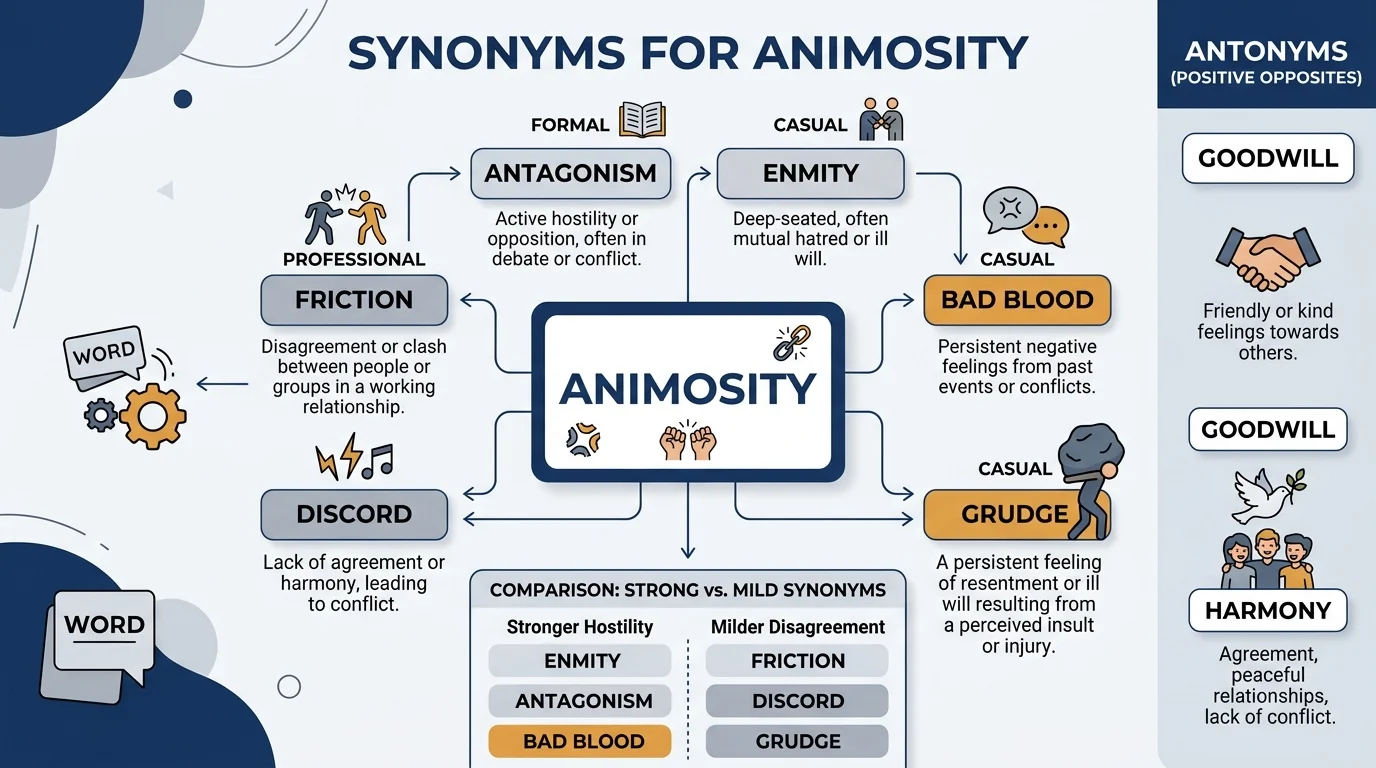
Animosity means a strong feeling of dislike or hostility toward someone or something. The best synonyms depend on your context. For formal writing, try antagonism or enmity. casual use, try bad blood or grudge. For professional settings, use friction or discord. strong emotions, use hatred or loathing. softer tones, use ill will or displeasure.
Meaning, Tone and Context
Simple definition
Animosity is a powerful negative emotion directed at a person or group. It suggests deep seated anger or opposition.
Part of speech
Noun. The adjective form is animose. The adverb form is animosely.
Positive, negative, or neutral tone
This is a negative word. It describes conflict and emotional tension.
Formality level
Animosity is neutral to formal. It works in academic writing, journalism, and professional reports.
Common use cases
Use animosity when describing long term feuds. Use it for political divisions. it for workplace conflict. Use it for historical grievances between groups.
Important word forms
The adjective is animose. The adverb is animosely. The opposite is goodwill or friendliness.
When and How to Use “Animosity”
Use animosity when the feeling is persistent and personal. It is not a fleeting annoyance. It describes a lasting emotional state that affects relationships and behavior.
Here are examples with different contexts.
Professional example
The merger created animosity between the two departments.
This sentence is workplace appropriate. It shows tension without naming individuals.
Personal example
After the argument, there was animosity between the siblings.
This describes a family conflict that lasted beyond the initial disagreement.
Academic example
The researcher studied the animosity between rival political factions during the election period.
This suits an essay or research paper.
Emotional example
She could not hide her animosity toward her former partner.
This reveals deep personal feeling.
Creative example
The kingdom was divided by animosity that had festered for generations.
This fits storytelling and descriptive writing.
Social media example
Social media debates often fuel animosity between opposing viewpoints.
This is relevant for online discussion posts.
News or journalism example
The policy change increased animosity among community leaders.
This is appropriate for reporting.
Another Word for “Animosity”
Here are direct replacement suggestions based on your specific situation.
Professional writing
Use friction or discord. These words describe disagreement without sounding overly emotional.
Academic writing
Use enmity or antagonism. These terms sound precise and research oriented.
Casual conversation
Use bad blood or grudge. These words are natural and easy to understand.
Emotional writing
Use hatred or loathing. These words convey intense personal feeling.
Creative writing
Use rancor or bitterness. These words add literary depth and imagery.
Resume or workplace use
Use tension or disagreement. Avoid strong words that sound unprofessional.
Social media captions
Use drama or conflict. These words are common and relatable online.
Stronger meaning
Use abhorrence or detestation. These are more intense than animosity.
Softer meaning
Use ill will or displeasure. These are milder and less confrontational.
When Not to Use “Animosity”
Do not use animosity when the feeling is temporary or minor.
If you are annoyed with a coworker for one day, that is not animosity. Use irritation or frustration instead.
If you disagree with a friend about a movie, that is not animosity. Use disagreement or difference of opinion.
If you feel competitive with a rival, that is not necessarily animosity. Use rivalry or competition.
Animosity is too strong for everyday disagreements. It implies a lasting and deep seated hostility.
Using animosity in a casual situation sounds overdramatic. It may confuse your audience or make you seem extreme.
Example of improvement
Weak sentence: I have animosity toward my noisy neighbor.
Improved sentence: I feel frustrated with my noisy neighbor.
Another example
Weak sentence: There is animosity between the two teams.
Improved sentence: There is strong competition between the two teams.
Words Commonly Confused With “Animosity”
Animosity vs. Enmity
Both words mean hostility. Enmity is more formal and often used in historical or political contexts. Animosity is more personal and emotional.
Animosity vs. Antagonism
Antagonism implies active opposition or conflict. feeling that may not result in direct action.
Hatred
Hatred is more intense and visceral. can be a cooler, more controlled form of dislike.
Rivalry
Rivalry involves competition. involves personal dislike. Rivals may respect each other. People with animosity do not.
Grudge
A grudge is a specific grievance held over time. Animosity is a broader feeling of hostility.
Dislike
Dislike is mild and general. Animosity is strong and specific.
Animosity vs. Bitterness
Bitterness often comes from disappointment or unfair treatment. can exist without personal injury.
Best Synonym by Context for “Animosity”
| Context | Best Synonym | Why It Works | Example |
|---|---|---|---|
| Formal writing | Antagonism | Precise and scholarly | The policy increased antagonism between the two nations. |
| Academic writing | Enmity | Formal and historically accurate | The study examined the enmity between rival ethnic groups. |
| Professional business | Friction | Neutral and professional | Office friction slowed down the project timeline. |
| Resume or cover letter | Disagreement | Mild and acceptable | Managed disagreement between team members effectively. |
| Casual conversation | Bad blood | Natural and common | There is bad blood between those two families. |
| Creative writing | Rancor | Literary and expressive | His rancor was evident in every word he spoke. |
| Emotional tone | Loathing | Strong and personal | She felt loathing for the man who deceived her. |
| Strong intensity | Abhorrence | Powerful and absolute | His abhorrence of corruption was well known. |
| Soft moderate tone | Ill will | Milder and less accusatory | No ill will exists between the former partners. |
| Social media captions | Drama | Relatable and casual | Too much drama in the group chat today. |
| US usage | Hostility | Widely understood | Hostility grew after the unfair decision. |
| UK usage | Antipathy | Common in British English | Antipathy between the two MPs was obvious. |
Which Synonym Should You Choose?
Your choice depends on several factors.
Consider the meaning you want
If you want to describe active opposition, use antagonism. If you want to describe a long term grudge, use enmity. If you want to describe tension without blame, use friction.
Consider the formality level
For reports and essays, use antagonism or enmity. For emails and meetings, use tension or disagreement. For conversations, use bad blood or drama.
Consider the emotional intensity
For extreme feeling, use hatred or loathing. For moderate feeling, use dislike or ill will. For a neutral tone, use discord or conflict.
Consider the professional value
At work, avoid hatred, loathing, and abhorrence. Use friction, tension, or discord. These words sound objective and manageable.
Consider the sentence context
Look at the surrounding words. If you describe a relationship, use animosity. you describe a situation, use conflict. If you describe a specific act, use opposition.
Real Life Examples of “Animosity” in Sentences
School example
The students felt animosity toward the teacher who gave unfair grades.
Workplace example
Years of animosity between the sales and marketing teams hurt company performance.
Writing example
Her memoir captured the animosity she experienced during her childhood.
Conversation example
“Why is there so much animosity in the group chat today?” she asked.
Social media example
Online forums often breed animosity among anonymous users.
Resume example
Resolved animosity among staff members through mediation and clear communication.
Email example
I want to address any animosity that may have arisen during the meeting.
Storytelling example
The animosity between the two families finally erupted into open conflict.
15 Synonyms for “Animosity”
| Synonym | Simple Meaning | Best Used For | Example Sentence |
|---|---|---|---|
| Antagonism | Active opposition | Formal writing and conflict descriptions | Antagonism between the two leaders made negotiations difficult. |
| Enmity | Deep hostility | Academic and historical contexts | The enmity between the tribes lasted for centuries. |
| Hatred | Intense dislike | Strong emotional expression | His hatred of injustice drove his political activism. |
| Hostility | Unfriendly behavior | General and widely understood | Hostility from the crowd forced the speaker to leave early. |
| Malice | Desire to harm | Legal and ethical discussions | The accusation was made with pure malice. |
| Spite | Petty meanness | Personal and emotional contexts | She acted out of spite after losing the promotion. |
| Rancor | Bitter resentment | Literary and descriptive writing | The rancor in his voice surprised everyone. |
| Grudge | Lingering resentment | Personal relationships | He held a grudge for years after the argument. |
| Bad blood | Mutual hostility | Casual conversation | Bad blood between the teams created a tense atmosphere. |
| Ill will | Unfriendly feeling | Soft and moderate tone | There is no ill will between us, just a difference of opinion. |
| Friction | Minor conflict | Professional and workplace settings | Friction among team members delayed the project. |
| Discord | Lack of harmony | Formal and group contexts | Discord within the committee prevented any progress. |
| Bitterness | Resentful feeling | Emotional and personal writing | Bitterness crept into her voice as she spoke about the past. |
| Antipathy | Natural dislike | British English and formal use | His antipathy toward modern art was well known. |
| Loathing | Strong disgust | Intense emotional contexts | She looked at him with loathing after his betrayal. |
Synonym Groups and Usage Differences
Professional vs. Personal Synonyms
Professional synonyms focus on the situation, not the emotion. They describe conflict as a problem to be solved. Words like friction, discord, and tension are appropriate for emails, meetings, and reports. Personal synonyms focus on individual feelings. Words like grudge, bad blood, and resentment describe emotional states between people. Use professional synonyms at work. Use personal synonyms with friends and family.
Formal vs. Conversational Synonyms
Formal synonyms appear in essays, news articles, and official documents. Enmity, antagonism, and antipathy are formal choices. They sound precise and scholarly. Conversational synonyms appear in everyday speech and informal writing. Bad blood, grudge, and drama are conversational. They are easy to understand and relatable.
Academic Synonyms
Academic writing requires precise language. Enmity and antagonism are top choices for research papers. These words have specific meanings and are commonly used in social science and history. Hostility also works well in academic contexts. Avoid casual words like bad blood or drama in essays.
Professional and Business Synonyms
The best professional synonyms are friction, discord, and tension. These words describe conflict without assigning blame. They sound objective and manageable. Use these words in performance reviews, team meetings, and client communications. Avoid strong words like hatred or loathing. They are unprofessional and inflammatory.
Creative or Literary Synonyms
Creative writers need descriptive language. Rancor, bitterness, and loathing add emotional depth. These words paint vivid pictures for readers. They work well in fiction, poetry, and personal narratives. Use them to show a character’s inner life or to build tension in a scene.
Slang or Modern Synonyms
Slang options are rare for animosity. Drama is a modern word that describes conflict and tension in groups. It is acceptable in casual conversation and social media. Use it when the conflict is trivial or exaggerated. Avoid drama in formal settings.
Strongest vs. Weaker Synonyms
Here is an intensity scale from mild to strongest.
Mild: Dislike, ill will, displeasure.
Moderate: Hostility, friction, antagonism.
Strong: Enmity, rancor, bitterness.
Very Strong: Hatred, loathing, abhorrence.
Emotional vs. Neutral Synonyms
Emotional synonyms carry personal feeling. Rancor, loathing, and malice are emotional. They reveal the speaker’s attitude and judgment. Neutral synonyms describe the situation objectively. Discord, friction, and tension are neutral. They focus on the relationship, not the feeling.
Antonyms of “Animosity”
| Antonym | Meaning | Example Sentence |
|---|---|---|
| Goodwill | Friendly feeling | Goodwill between the two companies benefited both. |
| Friendship | Mutual trust and support | Their friendship survived despite the disagreement. |
| Harmony | Peaceful agreement | Harmony among team members improved productivity. |
| Affection | Fondness and care | She felt affection for her childhood friend. |
| Amity | Peaceful friendship | The treaty restored amity between the nations. |
| Cordiality | Warm politeness | Cordiality marked their first meeting. |
| Benevolence | Kindness and generosity | His benevolence was known throughout the community. |
| Kindness | Gentle and caring behavior | Kindness diffused the tense situation. |
| Sympathy | Understanding of another’s feelings | Sympathy replaced the earlier hostility. |
| Rapport | Mutual understanding | Rapport between the teacher and students was excellent. |
| Cooperation | Working together | Cooperation ended the conflict between departments. |
| Peace | Absence of conflict | Peace returned to the divided community. |
| Comity | Mutual respect among groups | Comity between the states ensured smooth governance. |
| Friendliness | Pleasant and kind behavior | Friendliness made the new employee feel welcome. |
| Understanding | Mutual empathy | Understanding resolved the long standing dispute. |
Comparison: Animosity vs. Similar Words
Animosity vs. Antagonism
Main difference
Animosity is a feeling. Antagonism is active opposition or conflict.
Which one is stronger
Animosity feels more personal. Antagonism feels more situational.
Which one is more formal
Antagonism is slightly more formal and academic.
Example for animosity
Their animosity was obvious in every interaction.
Example for antagonism
The antagonism between the two political parties grew during the debate.
Animosity vs. Enmity
Main difference
Enmity is formal and often historical. Animosity is personal and emotional.
Which one is stronger
Enmity suggests a longer and deeper conflict.
Which one is more formal
Enmity is more formal than animosity.
Example for animosity
She felt animosity toward her rival.
Example for enmity
The enmity between the two families dated back three generations.
Animosity vs. Hatred
Main difference
Hatred is more intense and visceral. Animosity is a strong dislike but can be restrained.
Which one is stronger
Hatred is stronger.
Which one is more formal
Animosity is more formal.
Example for animosity
The employees had animosity toward the new policy.
Example for hatred
He had hatred for the regime that oppressed his people.
Animosity vs. Bitterness
Main difference
Bitterness comes from disappointment or unfair treatment. Animosity does not require a personal injury.
Which one is stronger
Animosity can be stronger and more active.
Which one is more formal
Animosity is more formal than bitterness.
Example for animosity
The animosity between the groups was long standing.
Example for bitterness
Her bitterness grew after she lost the election unfairly.
Animosity vs. Grudge
Main difference
A grudge is tied to a specific wrong. Animosity is a general feeling of hostility.
Which one is stronger
Animosity is broader and often stronger.
Which one is more formal
Animosity is more formal.
Example for animosity
The animosity between the rival schools was well known.
Example for grudge
He held a grudge because she broke her promise.
Animosity vs. Friction
Main difference
Friction describes minor conflict and tension. Animosity describes deep and lasting hostility.
Which one is stronger
Animosity is much stronger.
Which one is more formal
Both are formal, but friction is common in professional writing.
Example for animosity
The animosity between the leaders threatened the peace process.
Example for friction
There was friction between the two departments over budget allocation.
Common Phrases and Expressions with “Animosity”
1. Feel animosity toward
Meaning: To have hostile feelings for someone.
Example sentence: She felt animosity toward her former business partner.
2. Hold animosity
Meaning: To keep hostile feelings over time.
Example sentence: He still holds animosity toward his high school bullies.
3. Breed animosity
Meaning: To cause or create hostile feelings.
Example sentence: Unfair policies breed animosity among employees.
4. Stir up animosity
Meaning: To deliberately cause hostile feelings.
Example sentence: The politician stirred up animosity between the two communities.
5. Deep seated animosity
Meaning: Hostility that is firmly established over time.
Example sentence: There was deep seated animosity between the rival gangs.
6. Mutual animosity
Meaning: Hostility felt by both sides.
Example sentence: Mutual animosity made the peace talks impossible.
7. Open animosity
Meaning: Hostility that is visible and undisguised.
Example sentence: Open animosity erupted during the meeting.
8. Animosity toward someone
Meaning: Specific hostile feelings directed at a person.
Example sentence: His animosity toward the new manager was obvious.
Common Mistakes to Avoid
1. Using animosity when a more precise synonym is better
Animosity is not always the best choice. If you mean active opposition, use antagonism. you mean a long term grudge, use enmity. If you mean minor tension, use friction.
2. Confusing animosity with rivalry
Rivalry involves competition. Animosity involves personal dislike. Rivals can be friendly competitors. People with animosity are not friendly.
3. Using a casual synonym in formal writing
Avoid bad blood and drama in essays and reports. Use antagonism or hostility instead. Casual words weaken your authority.
4. Using an overly dramatic synonym for a simple situation
Do not use hatred or loathing for everyday disagreements. Use dislike or ill will. Overdramatic language makes you sound unreasonable.
5. Repeating the same word too often
Variety improves your writing. Use synonyms to keep your language fresh and engaging. Rotate between animosity, hostility, and antagonism.
6. Choosing a synonym with the wrong emotional tone
Match the tone to the situation. Use neutral words like discord in professional settings. Use emotional words like bitterness in personal writing.
7. Using slang in academic or professional writing
Slang like drama has no place in formal contexts. Stick with precise vocabulary to maintain credibility.
FAQs
What is the best synonym for animosity?
The best synonym depends on context. Use antagonism for formal writing. bad blood for casual conversation. Use hatred for strong emotion.
What is a formal synonym for animosity?
Enmity and antagonism are formal synonyms. They are appropriate for academic essays and professional reports.
What is an informal synonym for animosity?
Bad blood and grudge are informal synonyms. They work well in everyday conversation and personal writing.
What is another word for animosity in professional writing?
Friction and discord are excellent choices for professional writing. They describe conflict objectively.
What is the difference between animosity and hatred?
Hatred is more intense and emotional. Animosity is a strong dislike that may be more controlled and long lasting.
What is the opposite of animosity?
Goodwill and friendship are direct opposites. They describe positive feelings and cooperation.
Conclusion
Animosity is a powerful word that describes deep and lasting hostility. It works well in formal and professional contexts. But you have many alternatives to choose from. antagonism for active opposition. Use enmity for historical conflicts. Use friction for workplace tension. bad blood for personal disagreements. The right synonym depends on your audience, your setting, and your emotional tone. Pay attention to these factors to choose wisely. A varied vocabulary makes your writing and speaking more precise and engaging. Try using one new synonym from this guide in your next conversation or email.