Have you ever found yourself writing an email, an essay, or a social media caption and realized you have used the word “vulnerable” three times in two paragraphs? You know the meaning is right, but the repetition makes your writing feel flat. This happens to everyone. The good news is that English offers a rich collection of synonyms of vulnerable that can add precision and variety to your communication. Choosing the right synonym does more than avoid repetition. It clarifies your meaning, adjusts your tone, and helps your reader understand exactly what you intend to say.
What Are the Best Synonyms of “Vulnerable”?
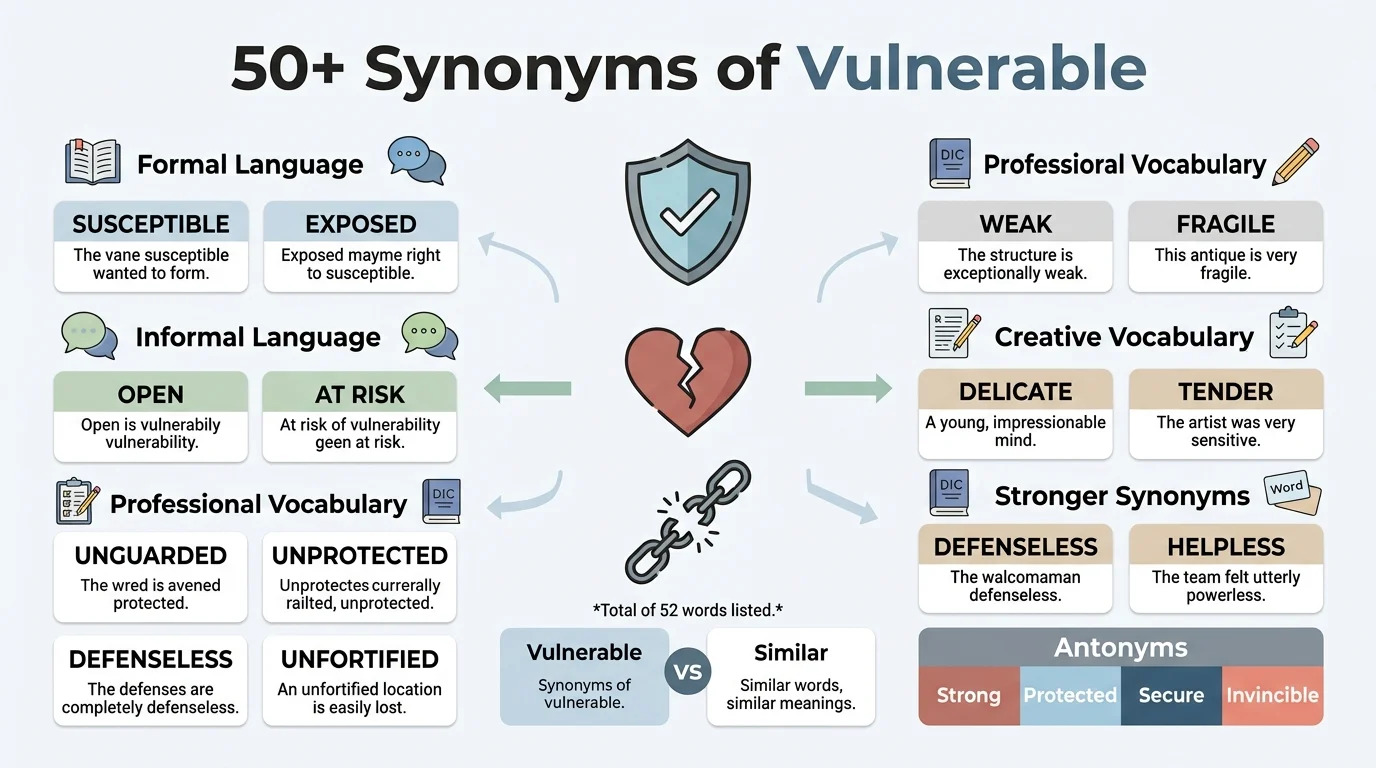
The word “vulnerable” means being open to physical or emotional harm, attack, or influence. It carries a neutral to slightly negative tone. The best synonym depends on your context. Formal writing, choose “susceptible” or “exposed.” For casual conversation, use “open” or “at risk.” For academic work, “susceptible” and “sensitive” work well. In professional communication, try “exposed” or “unprotected.” For emotional writing, “fragile” and “defenseless” are strong choices. Creative writing benefits from “delicate” and “tender.”
Meaning, Tone, and Context
Simple Definition
Vulnerable describes someone or something that can be easily hurt, attacked, or influenced, either physically or emotionally.
Part of Speech
Adjective
Overall Tone
Neutral to slightly negative. The word itself does not carry strong judgment, but it often describes situations involving risk, weakness, or exposure to harm.
Formality Level
Neutral. “Vulnerable” works in formal writing, professional settings, and everyday conversation. It is not overly academic, nor is it casual slang.
Common Uses
Native English speakers use “vulnerable” in many situations. Describe people who are physically weak or sick, such as patients. Use it for emotional states, like feeling exposed after sharing personal information. They also apply it to systems, buildings, or countries that lack protection against attacks or disasters.
Word Forms
- Noun: vulnerability
- Adverb: vulnerably
- Related adjective: invulnerable (opposite)
When and How to Use “Vulnerable”
Choose “vulnerable” when you want to communicate that someone or something lacks protection and is therefore at risk of harm. It works best when the threat is real and the lack of defense is clear. Here are examples in different contexts.
Professional: Our supply chain remains vulnerable to disruptions because we rely on a single shipping partner.
Academic: The study found that children from low-income households are more vulnerable to developmental delays.
Workplace: New employees are often vulnerable during their first few weeks because they do not yet understand company policies.
Personal: Sharing my writing with others makes me feel vulnerable, but I know it helps me grow.
Email: Please review the security protocol. Our current system is vulnerable to phishing attacks.
Resume: Developed crisis management strategies to protect vulnerable populations during natural disasters.
Social Media: Being vulnerable online takes courage, but it also builds genuine connections with your audience.
Best Synonyms of “Vulnerable”
No two synonyms are identical. Each word carries a slightly different shade of meaning, tone, and emotional weight. Here are the best synonyms of vulnerable for specific situations.
Professional writing: “Exposed” works well because it suggests a clear, identifiable risk without sounding overly emotional.
Academic writing: “Susceptible” is precise and widely used in research papers, especially in medical and social sciences.
Business communication: “At risk” is direct and commonly understood in corporate settings.
Casual conversation: “Open” is simple and natural when talking about emotional or situational vulnerability.
Emotional writing: “Fragile” conveys deep sensitivity and a need for careful handling.
Creative writing: “Delicate” adds elegance and works well for describing people, relationships, or situations.
Resume writing: “Underserved” or “at-risk” are appropriate when describing work with communities or populations.
Workplace communication: “Unguarded” suggests a lack of caution or preparation.
Stronger meaning: “Defenseless” emphasizes a complete lack of protection.
Softer meaning: “Tender” suggests mild sensitivity without implying serious danger.
When Not to Use “Vulnerable”
Sometimes “vulnerable” is not the best choice. Here are situations where a different word works better.
When the word sounds too general. If you are describing a specific weakness, “vulnerable” can feel vague. Instead of saying “The system is vulnerable,” say “The system is susceptible to malware attacks.” This gives your reader a clearer picture.
When the word sounds too weak. If the situation involves serious danger, “vulnerable” may not communicate enough urgency. Instead of “The building is vulnerable,” say “The building is defenseless against a major earthquake.” This adds weight to your warning.
When the word sounds too formal. In casual conversation, “vulnerable” can feel stiff. Instead of “I feel vulnerable about my presentation,” say “I feel nervous about my presentation.” This sounds more natural among friends.
When the word sounds outdated. “Vulnerable” is not outdated, but in some contexts, newer terms like “at-risk” have become more common, especially in education and social services.
When you need a positive tone. “Vulnerable” often carries a negative connotation. If you want to describe openness in a positive way, try “receptive” or “open-hearted” instead.
Words Commonly Confused With “Vulnerable”
Vulnerable vs Susceptible
Difference: “Susceptible” focuses on the likelihood of being affected by something specific, often a disease or influence. “Vulnerable” is broader and includes the idea of being exposed to harm or attack.
When to use it: Use “susceptible” in medical or scientific contexts. Use “vulnerable” when discussing general risk or emotional exposure.
Example (susceptible): Older adults are more susceptible to the flu.
Example (vulnerable): Older adults are more vulnerable during natural disasters.
Vulnerable vs Defenseless
Difference: “Defenseless” means having no protection at all. “Vulnerable” means being at risk but not necessarily completely unprotected.
When to use it: Use “defenseless” when you want to emphasize total lack of protection. Use “vulnerable” when there is some protection but it is insufficient.
Example (defenseless): The baby birds were defenseless against the storm.
Example (vulnerable): The baby birds were vulnerable to predators even with their mother nearby.
Vulnerable vs Exposed
Difference: “Exposed” emphasizes being uncovered or revealed to danger. “Vulnerable” emphasizes the resulting risk of harm.
When to use it: Use “exposed” when the focus is on being uncovered. Use “vulnerable” when the focus is on the potential for harm.
Example (exposed): The workers were exposed to toxic chemicals.
Example (vulnerable): The workers were vulnerable to long-term health problems.
Vulnerable vs Weak
Difference: “Weak” describes a lack of physical or structural strength. “Vulnerable” describes openness to harm, which can result from weakness but also from other factors like location or situation.
When to use it: Use “weak” for physical or structural descriptions. Use “vulnerable” for broader risk scenarios.
Example (weak): The bridge is weak and needs reinforcement.
Example (vulnerable): The bridge is vulnerable to flooding during heavy rain.
Vulnerable vs Fragile
Difference: “Fragile” describes something that breaks easily. “Vulnerable” describes something that can be harmed, which includes but is not limited to physical breaking.
When to use it: Use “fragile” for physical objects or delicate emotional states. Use “vulnerable” for risk of any kind of harm.
Example (fragile): The antique vase is fragile and must be handled carefully.
Example (vulnerable): The antique vase is vulnerable to damage during the move.
Vulnerable vs Insecure
Difference: “Insecure” often describes a lack of confidence or an unstable situation. “Vulnerable” describes exposure to harm from external threats.
When to use it: Use “insecure” for emotional uncertainty or unstable positions. Use “vulnerable” for risk of attack or harm.
Example (insecure): She felt insecure about her job performance.
Example (vulnerable): She felt vulnerable when her manager criticized her publicly.
Best Synonyms of “Vulnerable” by Context
| Context | Best Synonym | Why It Works | Example |
|---|---|---|---|
| Formal writing | Susceptible | Precise and widely accepted in academic and professional texts | The population is susceptible to respiratory illnesses. |
| Academic writing | Sensitive | Commonly used in research to describe responsiveness to conditions | The ecosystem is sensitive to changes in temperature. |
| Professional communication | Exposed | Clearly communicates risk without emotional language | Our financial data is exposed to potential breaches. |
| Business emails | At risk | Direct and easily understood in corporate environments | Your account is at risk if you do not update your password. |
| Resume writing | Underserved | Professional term for work with vulnerable populations | Provided legal aid to underserved communities. |
| Workplace communication | Unguarded | Suggests lack of preparation or caution | The proposal left us unguarded against competitor bids. |
| Casual conversation | Open | Simple and natural for everyday talk | I am open to feedback on my idea. |
| Everyday speaking | Wide open | Informal and vivid | Leaving your laptop in the car leaves it wide open for theft. |
| Creative writing | Delicate | Adds elegance and emotional depth | Her delicate heart could not bear another disappointment. |
| Storytelling | Tender | Conveys gentleness and vulnerability in characters | He spoke with tender honesty about his fears. |
| Emotional writing | Fragile | Emphasizes deep sensitivity and need for care | After the loss, she felt fragile and withdrawn. |
| Strong emphasis | Defenseless | Communicates total lack of protection | The civilians were defenseless against the attack. |
| Mild tone | Tender | Soft and gentle without alarming the reader | The topic requires tender handling. |
| Social media captions | Raw | Trendy and authentic for personal posts | Sharing this raw moment because growth matters. |
| American English | Vulnerable | Standard usage across all contexts | The team is vulnerable without their star player. |
How to Choose the Best Synonym of “Vulnerable”
Choosing the right synonym starts with understanding your purpose. Ask yourself these questions.
What is the exact meaning I want to communicate? If you mean “likely to be affected by something,” choose “susceptible.” If you mean “completely without protection,” choose “defenseless.”
What is my tone? For formal writing, use “susceptible” or “exposed.” For emotional writing, use “fragile” or “tender.” For casual conversation, use “open” or “at risk.”
Who is my audience? Academic readers expect precise language like “susceptible.” Business readers appreciate direct terms like “at risk.” Friends and family respond better to simple words like “open.”
How much emotional strength do I need? For mild situations, use “tender” or “sensitive.” For serious situations, use “defenseless” or “endangered.”
What is my writing purpose? If you are writing a report, clarity matters most. If you are writing a story, emotional impact matters more.
The best synonym is the one that communicates your intended message most clearly to your specific reader.
Real Life Examples of “Vulnerable”
School: The new student felt vulnerable on her first day because she did not know anyone.
College: Freshmen are especially vulnerable to poor grades if they do not manage their time well.
Workplace: Employees who work remotely can feel vulnerable without the support of an in-person team.
Business: Small businesses are vulnerable to economic downturns because they have fewer resources.
Email: We are vulnerable to supply chain delays, so please place your orders early.
Resume: Coordinated emergency response efforts for vulnerable populations during the hurricane season.
Conversation: I know I am vulnerable when I talk about my fears, but I trust you.
Storytelling: The castle stood vulnerable on the hill, its walls crumbling and its gates unguarded.
Blogging: Being vulnerable in your writing is not weakness. It is the bravest thing you can do.
Social media: Vulnerability is not about oversharing. It is about showing up as your real self.
18 Best Synonyms of “Vulnerable”
Synonyms of “Vulnerable” by Usage
Professional vs Personal Synonyms
In professional settings, choose words that sound objective and clear. “Exposed,” “at risk,” and “susceptible” work well in reports, presentations, and business emails. In personal conversations, simpler words like “open,” “sensitive,” and “fragile” feel more natural and relatable. “I feel open with you” sounds warmer than “I feel exposed with you.”
Formal vs Conversational Synonyms
Formal writing includes reports, essays, and academic papers. Use “susceptible,” “exposed,” and “assailable” in these contexts. Conversational synonyms include “open,” “wide open,” and “at risk.” “The plan is wide open to problems” works in casual talk but would not suit a formal report.
Academic Synonyms
Academic writing demands precision. “Susceptible” is the gold standard for research papers, especially in medicine and social sciences. “Sensitive” works well in environmental and psychological studies. “Precarious” suits discussions of unstable conditions. These words sound authoritative and are widely recognized in scholarly literature.
Professional and Business Synonyms
For resumes, interviews, and client communication, choose words that demonstrate competence and clarity. “At-risk” is common in social services and healthcare. “Exposed” works in cybersecurity and finance. “Unguarded” suits strategic discussions. These words show you understand risk and can communicate it effectively.
Creative and Literary Synonyms
Storytelling and poetry benefit from evocative language. “Delicate” adds grace. “Tender” conveys warmth and care. “Fragile” creates emotional depth. “Raw” suggests unpolished honesty. These words help readers feel the emotion behind the situation.
Slang or Modern Synonyms
“Vulnerable” does not have widespread slang equivalents. However, “raw” has become popular in social media and personal writing to describe honest, unguarded moments. “Open book” is an informal expression meaning someone is easy to understand or read emotionally. Use these in casual contexts but avoid them in formal writing.
Strongest to Mildest Synonyms
Here is an intensity scale from mildest to strongest.
Mild: Tender, Sensitive, Open
Moderate: Exposed, At risk, Susceptible
Strong: Fragile, Weak, Unguarded
Very Strong: Defenseless, Helpless, Powerless, Endangered
The emotional intensity increases as you move down the scale. Choose milder words for everyday situations and stronger words when the stakes are high.
Emotional vs Neutral Synonyms
Emotional Synonyms: Fragile, Tender, Helpless, Powerless, Raw. These words carry strong feelings and work well in personal writing, storytelling, and emotional appeals.
Neutral Synonyms: Susceptible, Exposed, At risk, Open, Unguarded. These words communicate information without adding emotional weight. They are ideal for reports, business communication, and academic writing.
Antonyms of “Vulnerable”
Comparison: “Vulnerable” vs Similar Words
Vulnerable vs Susceptible
Main Difference: “Susceptible” focuses on the likelihood of being affected by something specific, often a disease or influence. “Vulnerable” is broader and includes the idea of being exposed to harm or attack.
Which Is Stronger? “Vulnerable” is generally stronger because it implies actual risk of harm, while “susceptible” implies possibility of being affected.
Which Is More Formal? Both are formal, but “susceptible” is more common in academic and medical writing.
When to Use Each: Use “susceptible” for specific conditions or diseases. Use “vulnerable” for general risk or exposure.
Examples:
- Vulnerable: The coastal town is vulnerable to hurricanes.
- Susceptible: The coastal town is susceptible to flooding during hurricanes.
Vulnerable vs Defenseless
Main Difference: “Defenseless” means having no protection at all. “Vulnerable” means being at risk but not necessarily completely unprotected.
Which Is Stronger? “Defenseless” is stronger because it implies total lack of protection.
Which Is More Formal? “Vulnerable” is more versatile and works in formal and informal contexts. “Defenseless” is somewhat more emotional.
When to Use Each: Use “defenseless” when you want to emphasize complete vulnerability. Use “vulnerable” when there is some protection but it is insufficient.
Examples:
- Vulnerable: The country is vulnerable to cyberattacks.
- Defenseless: The country is defenseless against a full-scale invasion.
Vulnerable vs Exposed
Main Difference: “Exposed” emphasizes being uncovered or revealed to danger. “Vulnerable” emphasizes the resulting risk of harm.
Which Is Stronger? “Vulnerable” is often stronger because it implies actual harm, while “exposed” implies being open to it.
Which Is More Formal? Both are formal, but “exposed” is common in journalism and professional writing.
When to Use Each: Use “exposed” when the focus is on being uncovered. Use “vulnerable” when the focus is on the potential for harm.
Examples:
- Vulnerable: The company is vulnerable to market fluctuations.
- Exposed: The company’s weaknesses were exposed during the audit.
Vulnerable vs Weak
Main Difference: “Weak” describes a lack of physical or structural strength. “Vulnerable” describes openness to harm, which can result from weakness but also from other factors.
Which Is Stronger? “Vulnerable” is often stronger because it implies risk of harm, while “weak” simply describes a condition.
Which Is More Formal? Both are neutral, but “weak” is more common in everyday speech.
When to Use Each: Use “weak” for physical or structural descriptions. Use “vulnerable” for broader risk scenarios.
Examples:
- Vulnerable: The team is vulnerable without their best player.
- Weak: The team’s defense is weak this season.
Vulnerable vs Fragile
Main Difference: “Fragile” describes something that breaks easily. “Vulnerable” describes something that can be harmed, which includes but is not limited to physical breaking.
Which Is Stronger? “Fragile” emphasizes delicacy and ease of damage. “Vulnerable” emphasizes risk of harm from external threats.
Which Is More Formal? Both are neutral, but “fragile” is more common in descriptive writing.
When to Use Each: Use “fragile” for physical objects or delicate emotional states. Use “vulnerable” for risk of any kind of harm.
Examples:
- Vulnerable: The ceasefire agreement is vulnerable to collapse.
- Fragile: The ceasefire agreement is fragile and requires careful handling.
Vulnerable vs Insecure
Main Difference: “Insecure” often describes a lack of confidence or an unstable situation. “Vulnerable” describes exposure to harm from external threats.
Which Is Stronger? “Vulnerable” is often stronger because it implies actual danger, while “insecure” implies uncertainty.
Which Is More Formal? Both are neutral, but “insecure” is more common in psychological contexts.
When to Use Each: Use “insecure” for emotional uncertainty or unstable positions. Use “vulnerable” for risk of attack or harm.
Examples:
- Vulnerable: The building is vulnerable to earthquakes.
- Insecure: The building’s foundation is insecure.
Common Phrases and Expressions with “Vulnerable”
Phrase: Vulnerable to attack
Meaning: Open to being attacked or criticized.
Example Sentence: The army’s position made them vulnerable to attack from the hills.
Phrase: Vulnerable population
Meaning: A group of people who are at higher risk of harm.
Example Sentence: Aid organizations focus on helping vulnerable populations during crises.
Phrase: Feel vulnerable
Meaning: Experience a sense of being exposed or at risk emotionally.
Example Sentence: She felt vulnerable after sharing her personal story.
Phrase: Vulnerable position
Meaning: A situation where someone is exposed to risk or harm.
Example Sentence: The company is in a vulnerable position without a backup plan.
Phrase: Most vulnerable
Meaning: The group or individuals at the highest risk.
Example Sentence: Are among the most vulnerable during heatwaves.
Phrase: Especially vulnerable
Meaning: Particularly at risk in a specific situation.
Example Sentence: Newborns are especially vulnerable to infections.
Phrase: Vulnerable to criticism
Meaning: Open to being criticized or judged.
Example Sentence: The politician’s comments made him vulnerable to criticism.
Common Mistakes to Avoid
1: Choosing a vague synonym instead of a precise one.
- Incorrect: The system is weak to attacks.
- Better: The system is vulnerable to attacks.
- Why: “Weak” describes a lack of strength, while “vulnerable” describes exposure to harm. “Vulnerable” is more precise in this context.
2: Confusing “vulnerable” with “susceptible.”
- Incorrect: The community is susceptible to earthquakes.
- Better: The community is vulnerable to earthquakes.
- Why: “Susceptible” usually applies to diseases or influences. “Vulnerable” is better for physical disasters like earthquakes.
3: Using an informal synonym in formal writing.
- Incorrect: The proposal is wide open to problems.
- Better: The proposal is vulnerable to problems.
- Why: “Wide open” is casual and informal. “Vulnerable” is more appropriate for professional documents.
4: Selecting an overly dramatic synonym.
- Incorrect: The team is defenseless without their coach.
- Better: The team is vulnerable without their coach.
- Why: “Defenseless” implies total lack of protection, which is too strong for a sports context. “Vulnerable” is more balanced.
5: Repeating the same word too often.
- Incorrect: The vulnerable patients need care. The vulnerable children need support. The vulnerable need protection.
- Better: The vulnerable patients need care. The at-risk children need support. The defenseless need protection.
- Why: Varying your word choice keeps writing engaging and precise.
6: Choosing a synonym with the wrong emotional tone.
- Incorrect: The fragile economy is showing signs of growth.
- Better: The vulnerable economy is showing signs of growth.
- Why: “Fragile” suggests something that breaks easily, while “vulnerable” suggests exposure to risk. In economic contexts, “vulnerable” is more appropriate.
7: Using slang in academic or professional writing.
- Incorrect: The data is raw and needs more analysis.
- Better: The data is vulnerable to misinterpretation and needs more analysis.
- Why: “Raw” is informal and vague in this context. “Vulnerable” is more precise and professional.
Frequently Asked Questions
1. What are the best synonyms of “vulnerable”?
The best synonyms depend on your context. Formal writing, use “susceptible” or “exposed.” For casual conversation, use “open” or “at risk.” For emotional writing, use “fragile” or “defenseless.” Each synonym fits a specific situation.
2. What are the best formal synonyms of “vulnerable”?
The best formal synonyms are “susceptible,” “exposed,” and “assailable”. These words are precise and widely accepted in academic, professional, and business writing. They communicate risk clearly without emotional language.
3. What are common informal synonyms of “vulnerable”?
Common informal synonyms include “open,” “wide open,” and “at risk”. These words work well in everyday conversation, social media posts, and casual emails. They are simple and easy to understand.
4. What is another word for “vulnerable” in professional writing?
“Exposed” is an excellent choice for professional writing. It clearly communicates that something is uncovered and open to risk. “At risk” is also common in business and healthcare contexts.
5. What is the difference between “vulnerable” and “susceptible”?
“Vulnerable” is broader and refers to being open to harm or attack. “Susceptible” is more specific and usually refers to being likely to be affected by a disease or influence. Use “vulnerable” for general risk and “susceptible” for specific conditions.
6. What is the opposite of “vulnerable”?
The opposite of “vulnerable” is “invulnerable,” which means cannot be harmed or attacked. Other opposites include “protected,” “secure,” “strong,” and “safe”.
Conclusion
The word “vulnerable” describes being open to physical or emotional harm, attack, or influence. It is a versatile word that works in many contexts, but no single synonym fits every situation. The best synonym depends on your audience, your tone, and your purpose. Formal writing, choose “susceptible” or “exposed.” For casual conversation, use “open” or “at risk.” For emotional writing, try “fragile” or “defenseless.” Understanding the nuances of these synonyms of vulnerable will make your writing clearer, more precise, and more engaging. The next time you reach for “vulnerable,” pause and ask yourself which word truly communicates your intended meaning. Your readers will notice the difference.