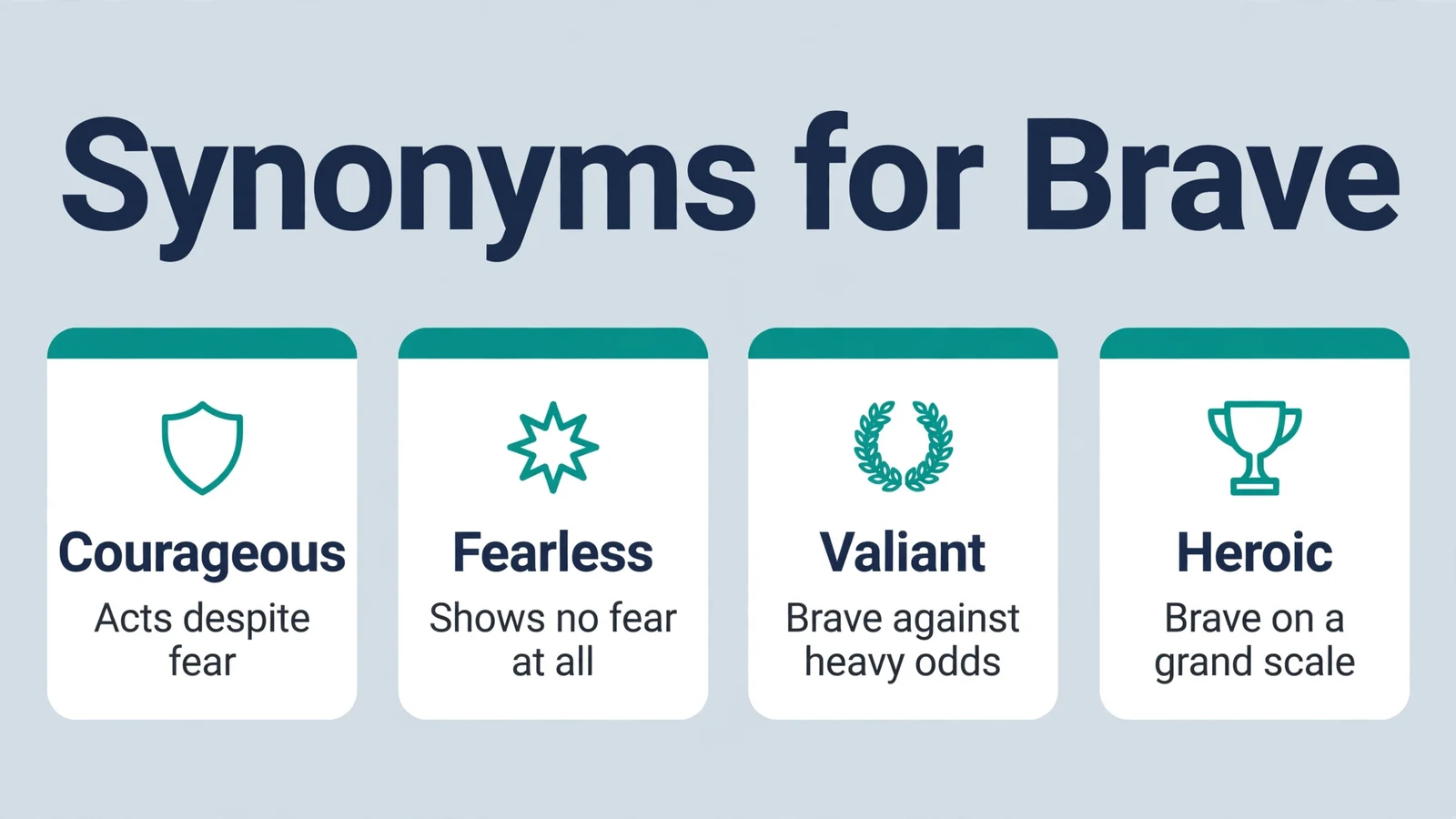
“Brave” is a word we reach for constantly, for soldiers and firefighters, but also for a child sleeping without a night-light. Used too often, though, it starts to say very little. The strongest synonyms for brave are courageous, fearless, valiant, heroic, gallant, bold, daring, intrepid, undaunted and resolute. Each one shades the idea differently. Some belong on a battlefield, others in an office, and a few in a text message to a friend.
This guide groups more than 70 synonyms for brave by context, tone and strength. It is built for the moment you catch yourself typing brave for the third time in one page. Every word here is checked against standard thesaurus sources, and each group explains when the word fits. You will also find the verb forms, the antonyms, and a short list of tempting words that do not quite mean brave at all.
Quick Reference: Top Synonyms for Brave
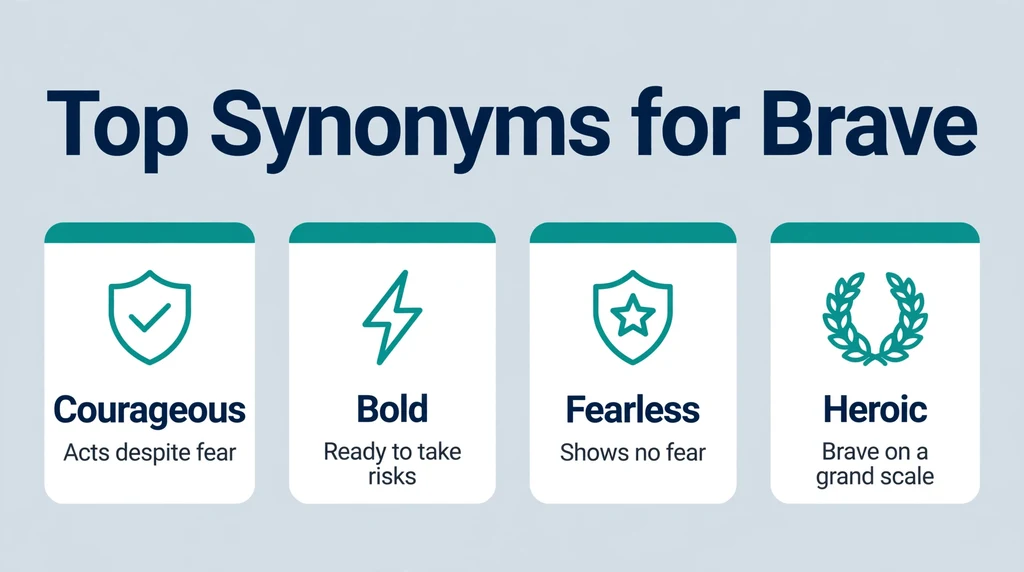
If you need one good word fast, start here. The table below collects the most useful synonyms for brave, with a one-line meaning and the setting where each one works best. The sections after the table then widen the list and explain the finer differences.
The safe all-rounders
| Word | Meaning in one line | Best for / tone |
|---|---|---|
| Courageous | Acts with courage despite fear or risk | General, respectful, formal or neutral |
| Fearless | Feels or shows no fear at all | Strong praise, dramatic contexts |
| Bold | Ready to take risks and speak up | Everyday, confident, neutral |
| Daring | Fond of bold, risky action | Adventure, lively writing |
| Heroic | Brave on a grand, life-or-death scale | Rescues, emergencies, epics |
| Valiant | Brave and determined, often in a struggle | Literary, formal, battles |
| Gallant | Brave in a noble, courteous way | Older formal style, soldiers, gentlemen |
| Intrepid | Fearless and undiscouraged by danger | Explorers, reporters, travellers |
| Undaunted | Not discouraged by difficulty or danger | Setbacks, long struggles |
| Resolute | Firmly determined, will not waver | Formal, speeches, leadership |
| Dauntless | Incapable of being daunted or scared off | Literary, heroic tone |
| Lionhearted | As brave as a lion, big-hearted courage | Literary, tributes |
The specialised words
The second half of the table holds the more specialised words, the ones that reward a careful writer.
| Word | Meaning in one line | Best for / tone |
|---|---|---|
| Plucky | Bravely cheerful against the odds | British-flavoured, informal, underdogs |
| Gutsy | Bold in a raw, instinctive way | Informal, sport, entertainment |
| Adventurous | Keen to try new and risky experiences | Travel, lifestyle, friendly tone |
| Audacious | Bold to the point of shock or cheek | Business, art, daring plans |
| Stalwart | Strong, loyal and reliably brave | Formal, loyal supporters |
| Unflinching | Does not hesitate or look away | Facing facts, duty, criticism |
| Indomitable | Impossible to defeat or discourage | Formal, admiring, strong |
| Hardy | Tough enough to endure hard conditions | Outdoor life, endurance |
| Gritty | Brave with dogged, rough determination | Sport, crime stories, comebacks |
| Venturesome | Willing to take risks and try new things | Slightly literary, adventure |
| Stouthearted | Brave and resolute at heart | Literary, old-fashioned warmth |
| Chivalrous | Brave with old-style courtesy and honour | Romance, knights, gallantry |
Notice how few of these are true swaps for each other. A gutsy goalkeeper and a gallant soldier are both brave, but the words paint very different pictures. Choosing well is mostly about matching the word to the size of the moment.
Read the table from top to bottom and the words roughly descend from the most universally safe to the most specialised. Courageous and bold will almost never embarrass you. The further down you go, the more each word demands the right setting: chin-up confidence for a job interview, lionhearted praise for a retirement speech. When in doubt, pick the word whose tone column matches the room you are writing for.
What Brave Means, and Where the Word Comes From
Merriam-Webster defines brave as having or showing mental or moral strength to face danger, fear or difficulty. Cambridge puts it more simply: a brave person shows no fear of dangerous or difficult situations. Collins describes the same idea as having or displaying courage, resolution or daring. However the wording changes, three ingredients stay constant: danger, fear, and a decision to go forward anyway.
The word itself has a travelled history. English borrowed brave from Middle French. French had taken it from Italian *bravo*, meaning courageous or wild, and the trail possibly runs back to Latin *barbarus*. One surprise hides in the dates. Merriam-Webster records the adjective’s first known use in 1568, and that earliest sense was not courage at all. It meant making a fine show, splendid or colourful, as in brave banners flying in the wind. The verb came later, in 1590, from French *braver*, to challenge or flout.
That history explains a leftover you still meet in older books. When Shakespeare’s Miranda cries “O brave new world,” she means a splendid, wonderful world, not a courageous one. The courage sense won out in modern English, but the older shine survives in literary corners.
One modern use deserves a note, because dictionaries single it out. Merriam-Webster illustrates the adjective with “a brave smile” and a “brave fight against the disease.” In this pattern brave does not describe daring at all. It describes dignity under suffering, a face held steady while something hurts. Much of the undaunted family below exists to serve exactly this quiet sense.
Heroic Synonyms for Brave: Warriors, Rescuers and Big Moments
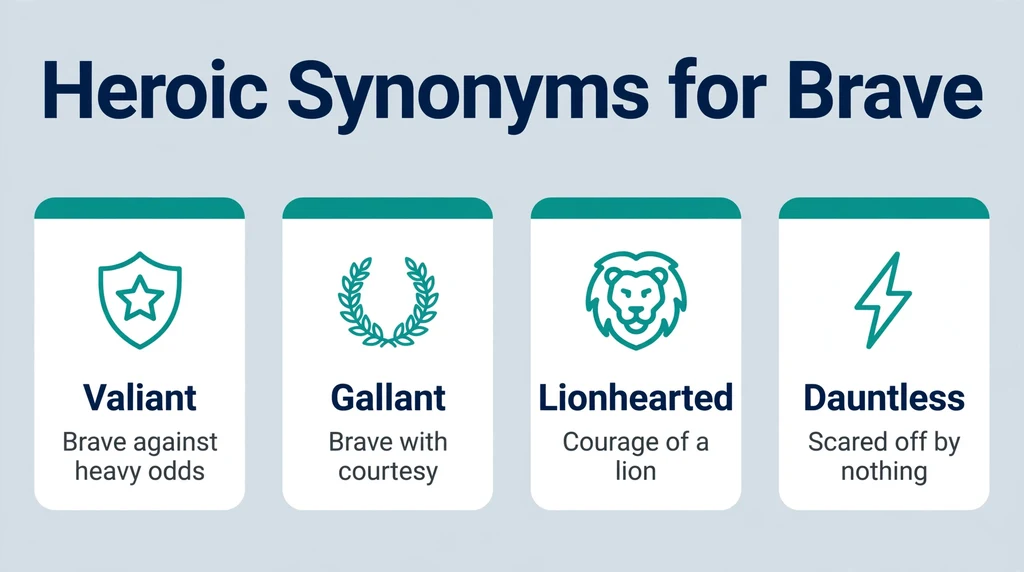
Some brave words are built for scale. They suit battles, rescues, disasters and public heroism, and they can sound overblown when the stakes are small. Use them when the danger is real and the moment is large.
Battle and rescue words
Heroic is the heavyweight of this group. It describes courage on a grand scale, usually with lives at stake. Firefighters who enter a burning building act heroically. A valiant person or effort is brave and determined, often against heavy odds, and the word carries a literary glow: a valiant attempt, a valiant last stand. Dauntless means incapable of being daunted, scared off by nothing, and it suits epic or poetic writing.
Two animal-hearted words add colour. A lionhearted person has the courage of a lion, big and generous bravery. Stouthearted is its gentler cousin, brave and resolute at heart, with an old-fashioned warmth. Both sound literary rather than conversational.
Noble and courteous words
Gallant blends bravery with courtesy and honour. It is the classic word for soldiers and gentlemen of an older code: gallant officers, a gallant bow after a brave act. Chivalrous leans even further into that code, bravery wrapped in politeness, protection of the weak and good manners. Today it often describes courteous behaviour more than combat.
Valorous is the formal noun-like adjective from valor, used in military and ceremonial writing: valorous deeds, a valorous regiment. Doughty is a sturdy old word for brave and determined, now mostly playful or historical. Herolike, finally, is the plain descriptive option, resembling a hero, useful when heroic itself feels too strong.
Save this whole group for people and actions that deserve ceremony. Calling a colleague gallant for answering a hard email will read as a joke, and sometimes that is exactly the effect a writer wants.
Used straight, though, these words earn their keep in headlines and tributes. “Valiant medics worked through the night” tells readers the effort was both brave and costly. “A lionhearted captain” promises a character, not just an action. Reach for this shelf when you want the reader to feel the weight of the moment before you describe a single detail of it.
Everyday Synonyms for Brave: Bold Choices in Normal Life
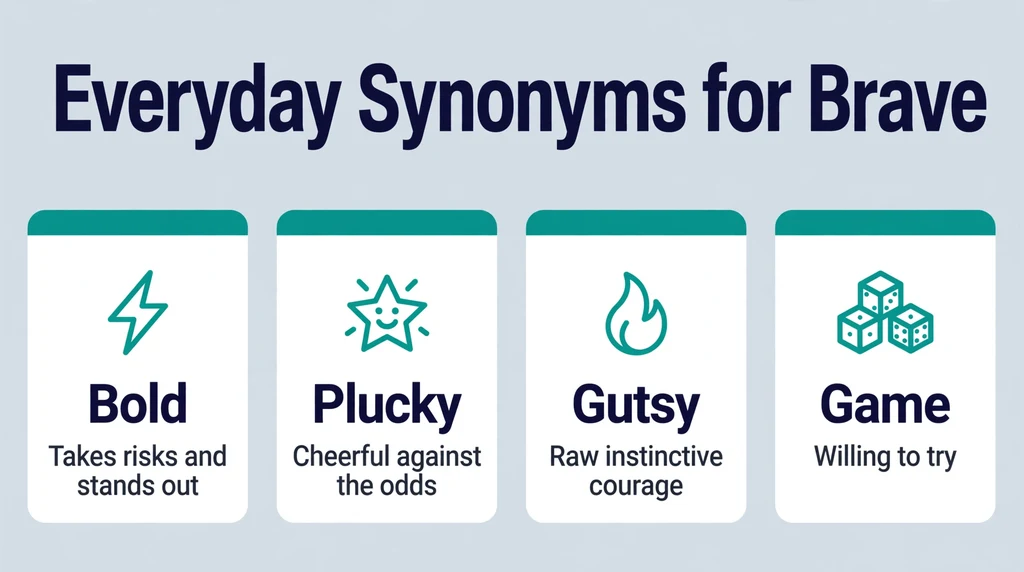
Most bravery is not cinematic. It is resigning from a safe job, speaking first in a meeting, or telling an uncomfortable truth. These everyday synonyms for brave fit ordinary life, conversation and modern writing.
Confident, everyday words
Bold is the most flexible word in this article. It covers brave speech, brave design and brave decisions, anything that takes a risk and stands out. Daring adds movement and appetite: a daring rescue is heroic, but a daring outfit or a daring recipe simply shows flair and risk. Unafraid states the fact plainly: she was unafraid to disagree. It is honest and unadorned, good for news writing.
Game is the willing volunteer of the group. Someone who is game is ready to try something difficult or new: “I’m game if you are.” Confident appears in thesaurus lists for brave, and it often travels with bravery, but the overlap is partial. Confidence means trusting your own ability, and it can exist with no danger present at all. For the fuller picture, see our guide to synonyms for confident.
Informal words with a grin
Gutsy praises raw, instinctive courage; dictionaries tag it informal or slang. A gutsy call by a coach, a gutsy performance by a singer. Plucky is cheerful bravery against the odds, often for someone smaller or weaker: the plucky schoolgirl who would not give up. British readers know it best, and Cambridge labels it informal too.
Spunky means brave in a lively, spirited way, popular in American English for children, older people and small dogs. Nervy praises bold nerve, though it can tip toward cheeky, so context matters. Chin-up is the rarest here, more a phrase of attitude than a true adjective, best kept for light, encouraging contexts.
At work, this family does quiet heavy lifting. A bold proposal, a daring pilot project, a manager unafraid to give honest feedback. None of these involves danger, yet each borrows courage’s good name to praise initiative. The borrowing works because readers sense the small social risk underneath, the meeting that could go badly, the idea that could be laughed down. That borrowed glow is precisely why bold is the most reached-for flavour of brave in professional writing.
Synonyms for Brave That Mean Not Backing Down
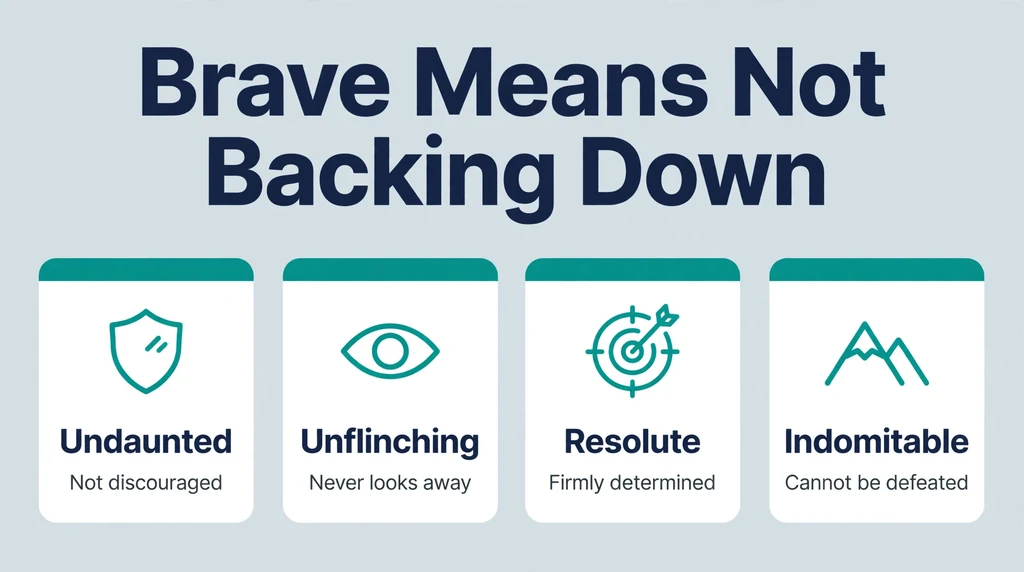
A second flavour of bravery is not charging forward. It is standing still, absorbing pressure, and refusing to retreat. Writers reach for these words when the story is about endurance through grief, illness, criticism or a long campaign.
Facing fear and holding your ground
Courageous is the benchmark word of this whole field. Unlike fearless, it quietly admits that fear exists and praises the person who acts anyway. That makes it the safest respectful choice for real people in hard situations. Intrepid describes someone fearless and undiscouraged, classically an explorer or a travelling reporter: three intrepid journalists crossed the border.
Undaunted means not daunted, not discouraged by danger or difficulty, and undismayed is its close twin for bad news received calmly. Undauntable exists too, though it is rare and rather grand. Unflinching is a favourite of news writers: an unflinching account looks at hard facts without blinking, and an unflinching official does not dodge questions. Its older cousin unblenching means the same, without flinching, and now lives mostly in poetry. Unabashed, honestly, is the weakest fit in this group: it means not embarrassed or ashamed, so it suits bold honesty more than physical courage.
Steady strength that does not waver
Resolute means firmly determined, decided and unmoving in purpose. It is formal and pairs well with leaders, statements and silence. Indomitable goes further: an indomitable spirit cannot be defeated or subdued at all. Stalwart adds loyalty to strength, the stalwart supporter who never leaves.
Firm is the quiet everyday option, a firm stand, a firm refusal. Hardy praises toughness that survives hard weather and hard work. Gritty brings dogged, rough-edged determination, the word sports writers choose for a team that wins ugly. Defiant, finally, is bravery with its chin out: it means openly resisting authority or pressure, brave, yes, but never neutral about it.
You meet this family most often in obituaries, hospital reporting and long political campaigns, places where the story is measured in months rather than minutes. An undaunted patient, a resolute campaigner, an indomitable grandmother: the praise is for staying, not charging. If your sentence is about someone who simply refuses to be finished, this is your shelf.
The vocabulary of courage only makes sense beside its opposite, so it is worth browsing the synonyms for fear as well. The two word-fields lean on each other.
Adventurous Synonyms for Brave: The Risk-Loving Words
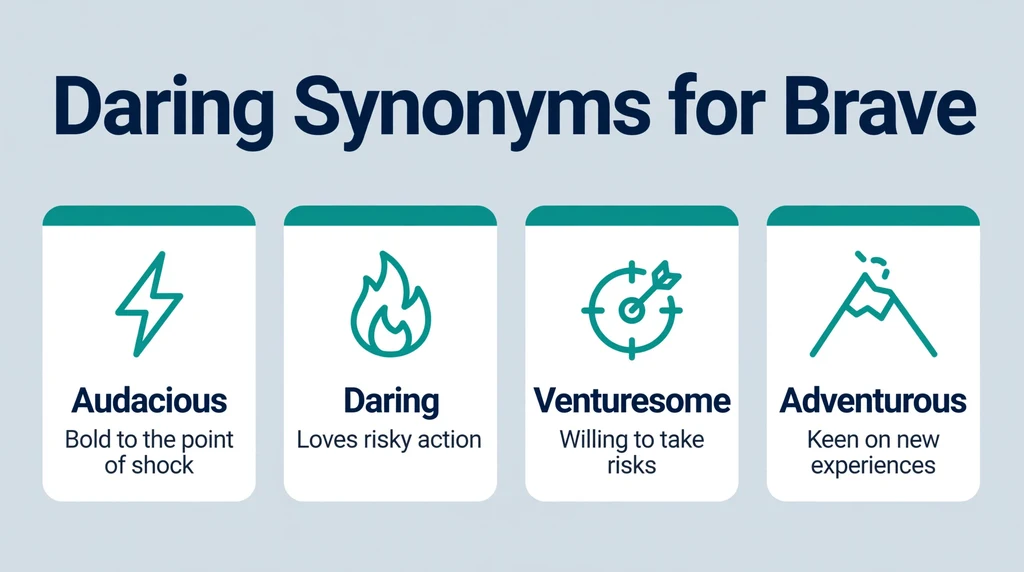
A third family of brave words is less about duty and more about appetite. These describe people who lean toward risk, novelty and movement. They are praise, but praise with raised eyebrows.
Adventurous is the friendly head of this group: eager for new and risky experiences, from mountain climbing to start-ups. Audacious takes boldness to a shocking or cheeky level. An audacious plan might be brilliant, but nobody calls it safe. Venturesome is a slightly literary way to say willing to take risks, built from the same root as venture.
Dashing describes brave behaviour performed with style and speed, the dashing pilot, the dashing cavalry officer. Spirited is broader and warmer: full of energy and courage, a spirited defence, a spirited debate. Stout, in its older sense, means strong and resolute, as in a stout resistance. Modern readers may first think of body shape or beer, though, so choose it knowingly.
Three more words need care. Strong is listed as a brave synonym because strength and courage overlap in phrases like a strong stand, yet it usually says more about power than bravery; our separate guide to synonyms for strong maps that field properly. Forward can mean bold and ready, but it also means presumptuous, too familiar, and that second sense often wins. Militant describes bravery hardened into aggression and confrontation, a fighting stance rather than quiet courage.
In travel and lifestyle writing this family is pure praise. An adventurous eater, a venturesome traveller, an audacious itinerary: the risk is the selling point. The same words turn cautious in news writing, where an audacious raid or a venturesome investment hints that someone may have gone too far. Tone, once again, is set by the genre around the word.
Brave as a Verb: Facing and Enduring
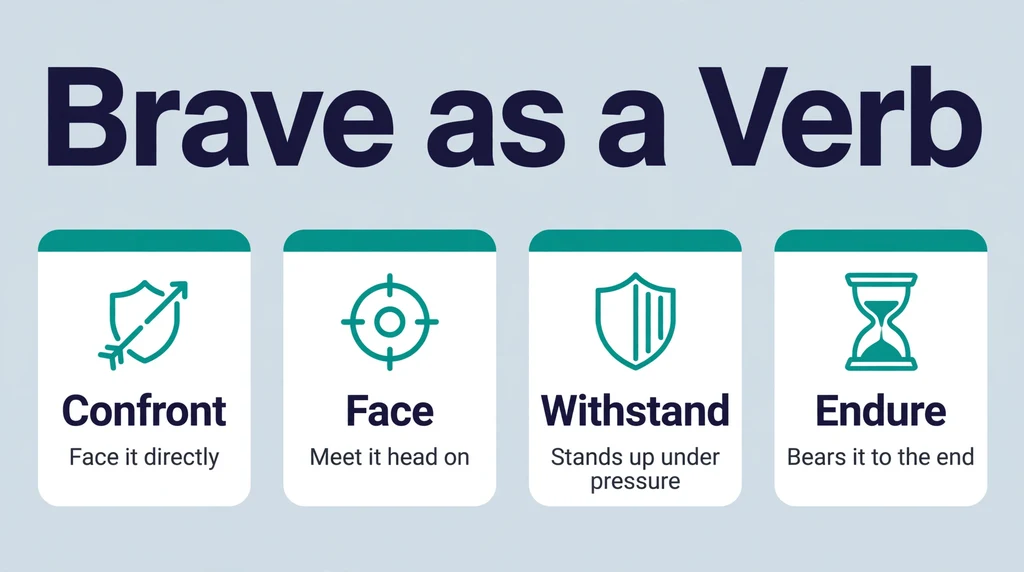
Brave is also a verb, and a useful one. To brave something is to face it or endure it with courage: fans braved the rain, she braved the traffic, the crew braved the storm. Merriam-Webster defines the verb as opposing something hostile or dangerous with firmness or courage. The synonyms split neatly into two camps.
Verbs of confronting
Confront and face are the clear, modern choices: confront the problem, face the press, face your fears. Challenge adds opposition, to brave an opponent’s claim is to challenge it. Tackle is the practical, hands-on cousin, common in British and sports English: tackle the issue head-on.
Defy means to confront with open resistance: they defied the ban. Phrases carry much of this territory. To stand up to someone is to resist them bravely. To take on a challenge or a champion is to accept the fight. To face off is to confront an opponent directly, usually in sport or showdowns. To fly in the face of means to defy openly, used for rules, evidence and expectations. Two literary rarities close the set: to beard someone, from beard the lion in his den, means to confront them boldly on their own ground. Outdare simply means to surpass someone in daring.
Verbs of enduring and risking
Endure and withstand describe surviving pressure without breaking: withstand criticism, endure hardship. Bear in this sense means to put up with something painful bravely, and suffer covers undergoing hardship rather than fleeing it. To go through something is the plain spoken version of the same idea.
The risk verbs complete the picture. To dare is to brave a challenge directly. To venture is to proceed despite risk, nothing ventured, nothing gained. To risk and to court danger, disaster or failure name the exposure itself. Journalists love this whole family because it turns weather, queues and bureaucracy into small acts of heroism.
The classic pattern: brave the something
The verb has a favourite shape: brave plus the plus an obstacle. People brave the storm, brave the cold, brave the crowds and brave the rush-hour traffic, all examples in the same pattern the dictionaries record. Weather is the most common obstacle, followed by journeys and then people, as in braved her anger. If you are unsure whether the verb fits, try this frame. If “braved the” sounds natural before your noun, the sentence works.
Formal, Literary and Older Synonyms for Brave
Register decides whether a brave word sounds like a citation, a novel or a chat. The formal shelf holds courageous, resolute, valorous, intrepid and stalwart, the vocabulary of speeches, obituaries and award citations. Nobody sounds wrong choosing them, but they do dress the sentence up.
The literary shelf is older and more colourful: valiant, gallant, dauntless, lionhearted, stouthearted, doughty and unblenching. These are the words of ballads, fantasy novels and historical fiction. In a modern news report they would clank like armour, but in a story they are gold.
Then there is the genuine antique. Remember that brave once meant splendid and fine. Merriam-Webster still lists wonderful, excellent and lovely under that older thesaurus sense, “of the very best kind,” with the example of a shop making a brave, meaning excellent, start. You will meet this sense in Shakespeare and in the phrase brave new world. Do not use it yourself in modern prose unless you are quoting or joking, because readers will take the courage sense first.
At the other end of the scale sit the informal words, gutsy, plucky, spunky and nervy. A good rule: the bigger the ceremony, the older the word. Medals want valiant. Group chats want gutsy.
British and American spelling splits one word in this family. The quality is valor in American English and valour in British English, while the adjective valorous keeps the shorter spelling on both sides of the Atlantic. Valiant, gallant and dauntless are spelled the same everywhere, one less thing to check before you submit the essay.
How to Choose the Right Synonym for Brave
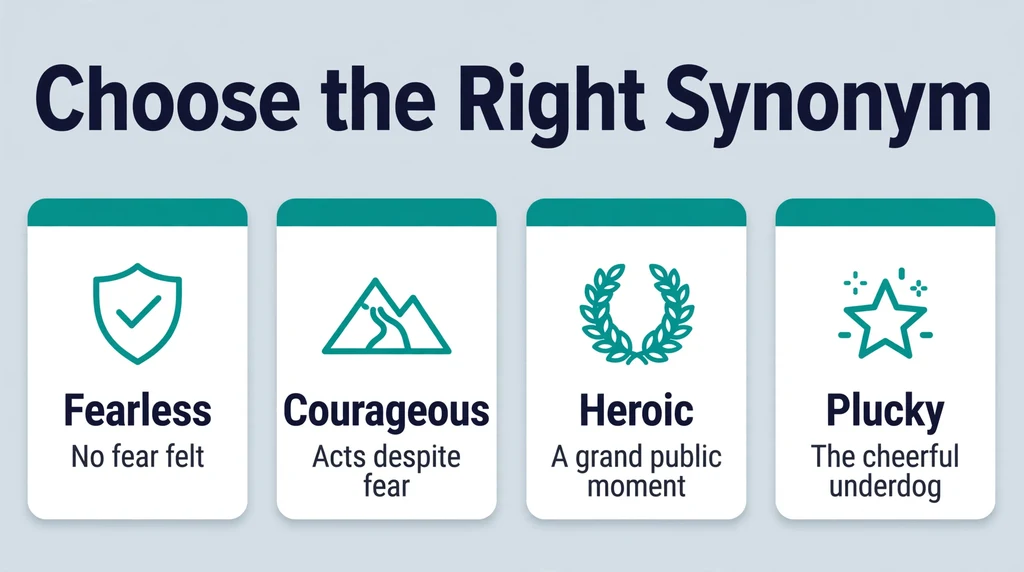
Four comparisons settle most real choices. Learn these pairs and the rest of the list falls into place.
Courageous or fearless?
These two disagree about fear itself. A fearless person feels no fear: the fearless toddler walks up to the big dog. A courageous person feels fear and acts anyway: the nervous speaker who presents regardless is courageous, not fearless. For real adults in real danger, courageous is usually the truer and kinder compliment.
Brave or bold?
Brave needs danger, pain or fear in the picture. Bold needs only risk and visibility. A bold colour scheme and a bold business move involve no physical or moral danger, so bold fits and brave does not. When someone risks reputation rather than safety, bold, daring or audacious usually wins.
Undaunted or resolute?
These two describe people who will not move, but they point in different directions. Undaunted looks backward at the discouragement already absorbed: setback after setback, and still going. Resolute looks forward at the decision already made: the plan is fixed and nothing will reopen it. A campaigner stays undaunted through defeats and resolute about the goal.
Heroic or valiant?
Scale and outcome separate these. Heroic belongs to grand, often life-saving acts in the present tense of news: a heroic rescue. Valiant often praises the attempt regardless of result, and it shines in defeat: a valiant effort, a valiant last stand. If the attempt failed nobly, choose valiant.
People, actions and things
People can be any of these words. Actions narrow the field: a decision can be brave, bold or courageous; an attempt can be valiant or heroic; a stand can be resolute or unflinching. Things narrow it further: a smile can be brave, meaning it hides pain, while a headline or a flavour can only be bold. Matching the word to the noun is the fastest accuracy check there is.
One last habit: read the sentence aloud. Brave synonyms carry volume as well as meaning, and your ear will catch a gallant spreadsheet or an indomitable sandwich before your eye does.
Synonyms for Brave in Essays, Stories and Speeches
Students and speechwriters search for brave synonyms more than anyone, usually because brave has already appeared twice in one paragraph. A few swaps keep school and college writing both varied and accurate.
In essays, stay on the formal shelf. Courageous is the default upgrade, resolute suits arguments about character, and intrepid enlivens history writing about explorers and campaigners. Valiant works in literature essays, especially for tragic heroes. Avoid gutsy, spunky and nervy in examined writing; examiners read them as chat, not analysis.
In stories, let the word fit the world you have built. Fantasy and historical fiction can carry valiant, gallant, dauntless and lionhearted without strain. Contemporary fiction usually cannot, unless a character speaks in jest. Modern narrators live on bold, daring, unafraid and unflinching, with plucky reserved for underdogs readers are meant to root for.
In speeches, rhythm matters as much as meaning. Short Anglo-Saxon brave still lands hardest at a climax, while the longer Latin-flavoured words build the road toward it: courageous, resolute, indomitable. Memorial speeches traditionally reach for valiant and gallant. Business speeches, by contrast, should borrow bold and audacious, which praise risk without borrowing the language of war.
Professional writing has its own etiquette. In reports and references, courageous and resolute praise character without drama, while bold describes decisions, strategies and designs. Reference letters borrow stalwart for loyal reliability. Customer-facing writing should avoid the war shelf entirely, since gallant pricing and valiant software updates read as parody. The plainer the workplace, the plainer the brave word should be.
Antonyms for Brave
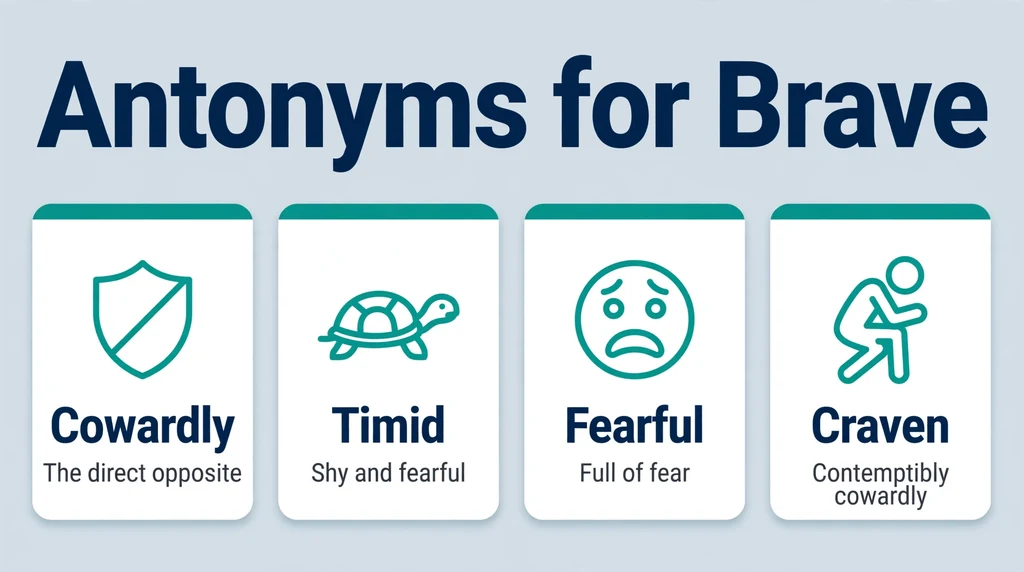
Every brave word casts a shadow, and the antonyms are just as useful for writers. The core opposites are cowardly, the direct antonym in every major dictionary, fearful, timid and afraid. Close behind come frightened and scared, which describe the feeling rather than the character, and craven, a strong literary word for contemptibly cowardly.
A second tier carries flavour. Timorous and faint-hearted sound old and poetic. Pusillanimous is the longest, most formal option, meaning showing a lack of courage or determination, and it belongs in elevated or mocking prose. Shrinking describes someone who draws back in fear, a shrinking violet. Yellow survives as dated slang for cowardly, joined in American slang by yellow-livered; handle both as period colour, not current speech. Milder character opposites include meek, shy, irresolute, unadventurous and weak.
The verb has opposites too. Against brave the storm stand surrender, yield and give up, with dodge, run away and retreat from for the less dignified exits.
A quick example fixes the pairs in memory: the brave guard held the gate; the cowardly one ran. Brave decisions get praised in speeches; timid ones get forgotten by lunch.
For quick pairing practice, set the families side by side: courageous against cowardly, fearless against fearful, bold against timid, undaunted against irresolute, adventurous against unadventurous, heroic against craven. Notice that each opposite attacks a different flank: some deny the courage, some deny the decision, and some, like unadventurous, merely deny the appetite for risk.
Words That Are Not Quite Synonyms for Brave
Honesty is this guide’s selling point, so here is the awkward drawer. Several words sit in thesaurus lists for brave yet mislead anyone who swaps them blindly.
Brave but careless
Foolhardy heads the list. Thesaurus.com places it among the strongest brave synonyms, but dictionaries define it as recklessly bold, brave in a way that ignores obvious danger. Foolhardy is brave plus bad judgement, and it is never a compliment. Reckless behaves the same way: it praises speed and daring while quietly accusing the person of not caring about consequences. Imprudent is the formal version of the same accusation, unwise rather than courageous.
Brave only by association
Confident, mentioned earlier, fails a different test. Confidence is belief in your own ability. A confident driver may never face danger in a whole journey, so the word says nothing about courage until risk appears. Swap brave for confident only when self-assurance, not danger, is the point.
Strong is too broad to be a true synonym. It covers muscle, flavour, currency and arguments, and only occasionally leans on courage, as in a strong stand. Militant borrows bravery’s posture but adds aggression and a cause; a militant campaigner is confrontational first and courageous second. Forward, finally, is a trap: its brave sense, bold and ready, is buried under its commoner meaning of presumptuous and over-familiar.
Tough misleads in a friendlier way. It means strong, durable and able to endure hardship, which is why commentators call soldiers and negotiators tough. But toughness is about withstanding, not about choosing to face fear. Plenty of tough things, boots, meat, exam questions, have nothing to do with courage at all.
The rule that protects you is simple. If the word suggests carelessness, aggression or mere self-belief, it is a neighbour of brave, not a synonym. Good writing keeps the neighbours in view but calls them by their own names.
Frequently Asked Questions
What is the strongest synonym for brave?
Heroic is usually the strongest, because it adds scale: life at risk, a public deed, an exceptional person. Indomitable is strongest for character rather than deeds, since it means impossible to defeat or discourage. For pure feeling, fearless is the most absolute claim of all. Journalists therefore tend to reserve heroic for rescues and emergencies rather than everyday kindness.
What is a formal word for brave?
Courageous is the safest formal choice for essays, reports and speeches. Valiant and valorous are more elevated and literary, while resolute and intrepid work well in professional and ceremonial writing. All five appear in standard thesaurus entries for brave.
What is the opposite of brave?
The direct opposite is cowardly. Other common antonyms are fearful, timid, afraid and craven. For the verb, the opposites are surrender, yield and give up. Choose by strength: timid is mild, while craven and pusillanimous are severe and literary.
Is fearless the same as brave?
Not quite. Fearless means the person feels no fear in the first place. Brave, and especially courageous, usually implies fear or danger that the person faces anyway. Many writers treat courageous as the more realistic compliment for adults.
What is a slang or informal word for brave?
Gutsy is the most common informal choice, especially in sport and entertainment. Plucky and spunky praise cheerful, spirited bravery, and nervy admires bold nerve. All four suit conversation and features writing better than essays or formal reports.
Can brave be used as a verb?
Yes. To brave something means to face or endure it with courage, as in braved the storm, braved the traffic or braved her anger. Useful verb synonyms include confront, face, defy, withstand, endure and stand up to.
How do you use brave synonyms in a sentence?
Match the word to the size of the moment. Try: “The valiant crew held the ship together through the storm,” for epic scale, and “It was a bold decision to resign without a new job,” for everyday life. If the sentence sounds like a medal ceremony at a bus stop, step down one level. The grouped sections above give you a ladder for almost every situation.
What is another word for brave that suits a child or beginner writer?
Bold is the easiest upgrade for young writers, with daring close behind for adventure stories. Plucky is a friendly next step for characters who keep trying against the odds. All three are simpler to spell and use correctly than words like pusillanimous or indomitable.
Final Thoughts
Brave is a small word carrying a huge idea, and its synonyms let you aim that idea with precision. Reach for courageous when fear is real and someone acts anyway. Choose valiant when the effort deserves honour, gutsy when the tone is warm and informal, and unflinching when nobody is allowed to look away. Keep foolhardy and reckless in the warning drawer where they belong.
If you want to check any word here against the source itself, the Merriam-Webster Thesaurus entry for brave lists the same families of courageous, fearless, valiant and gallant, along with the verb sense of confronting and facing. Pair this guide with a honest look at your own draft, and the right word will usually step forward on its own.
A last thought on taste: bravery language inflates fast, in word choice as in headlines. If every character in a story is heroic and every decision is audacious, the words stop meaning anything by page three. Spend the big words rarely, and they will still be worth something when the truly brave moment arrives.