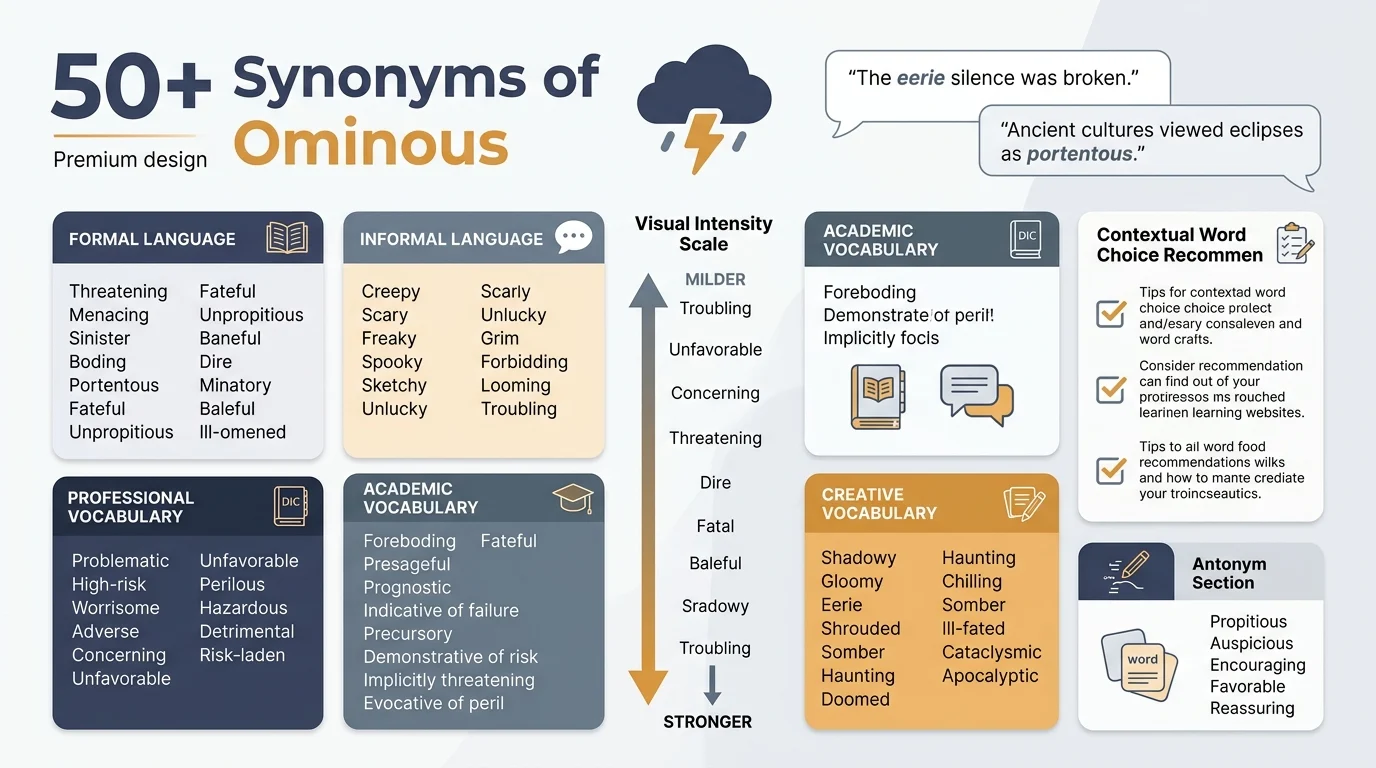
Have you ever found yourself writing an email, an essay, or a social media caption and realized you have used the word “ominous” three times in two paragraphs? It happens to everyone. You know the word works, but repeating it makes your writing feel flat and uninspired. The solution is not to guess at random synonyms. It is to understand what “ominous” really means and which alternative fits each situation perfectly.
This guide helps you move beyond basic thesaurus entries. You will learn the exact meaning of “ominous,” discover the best synonyms of ominous for every context, and understand the subtle differences that separate a good word choice from a great one. Whether you are writing a business report, a college essay, or a creative story, you will leave with the confidence to choose the right word every time.
What Are the Best Synonyms of “Ominous”?
“Ominous” describes something that suggests something bad is going to happen. It carries a negative, threatening tone and is moderately formal. Professional writing, use “menacing” or “threatening.” For casual conversation, try “sinister” or “foreboding.” Academic work, choose “portentous” or “inauspicious.” For creative writing, consider “baleful” or “dire.”
Meaning, Tone, and Context
Simple Definition
“Ominous” is an adjective that describes something giving the impression that something bad or unpleasant is going to happen in the future.It comes from the Latin word “omen,” which means a sign or warning of future events.When you call something ominous, you are saying it feels like a warning of danger or trouble ahead.
Part of Speech
Adjective
Overall Tone
Negative. “Ominous” always suggests concern, fear, or unease about what is coming next. It is not a neutral word and never carries a positive meaning.
Formality Level
Semi-formal to formal. You will find “ominous” in news articles, literature, professional reports, and everyday conversation. It is not overly academic, but it is also not casual slang.
Common Uses
Native English speakers use “ominous” to describe:
- Weather conditions that suggest a storm is coming
- Silence that feels tense or worrying
- Statements or predictions about negative outcomes
- Facial expressions or body language that seem threatening
- Situations where something feels “off” or dangerous
Word Forms
- Noun: ominousness
- Adverb: ominously
- Adjective: ominous (comparative: more ominous; superlative: most ominous)
When and How to Use “Ominous”
Choose “ominous” when you want to describe a situation, event, or sign that makes you feel uneasy about what might happen next. It works best when the threat is implied rather than stated directly. The word creates atmosphere and tension without being overly dramatic.
Here are seven realistic examples showing how “ominous” fits different contexts.
Professional:
The quarterly numbers showed an ominous trend that concerned the entire executive team.
Academic:
The researcher noted an ominous pattern in the data that warranted further investigation.
Workplace:
His ominous tone during the meeting made everyone wonder what bad news was coming.
Personal:
I had an ominous feeling about taking that shortcut through the dark alley.
Email:
The client’s ominous response suggested they were not happy with our proposal.
Resume:
(Use sparingly) Detected ominous warning signs in financial reports that prevented a major loss.
Social Media:
The sky turned an ominous shade of green right before the storm hit. #weather
Best Synonyms of “Ominous”
No synonym is identical in every situation. The right choice depends on your audience, your purpose, and the emotional weight you want to carry. Here are the best synonyms of ominous for specific contexts.
Professional writing: “Menacing” works best because it implies a clear and present danger without sounding overly emotional. It suggests seriousness without melodrama.
Academic writing: “Portentous” carries the weight of significance and is often used in scholarly analysis to describe events that signal important outcomes.
Business communication: “Threatening” is direct and clear. It leaves no room for misinterpretation when you need to communicate risk.
Casual conversation: “Sinister” is common in everyday speech and carries a slightly dramatic but accessible tone.
Emotional writing: “Foreboding” captures the internal feeling of dread and unease that ominous situations create.
Creative writing: “Baleful” adds a literary, slightly old-fashioned quality that works well in fiction and descriptive prose.
Resume writing: Use “dire” sparingly when describing how you identified serious risks or prevented major problems.
Workplace communication: “Forbidding” describes situations or environments that feel unwelcoming or dangerous.
Stronger meaning: “Dire” suggests extremely serious and urgent danger.
Softer meaning: “Unpromising” suggests a negative outcome without the same level of threat or fear.
When Not to Use “Ominous”
When the Word Sounds Too General
“Ominous” can feel vague if you do not specify what makes the situation threatening.
Instead of: “The report was ominous.”
Try: “The report’s projections were alarming.”
The second version tells the reader exactly what is ominous about the report.
When the Word Sounds Too Formal
In casual conversation or text messages, “ominous” can feel overly serious.
Instead of: “That text was ominous.”
Try: “That text felt creepy.”
“Creepy” is more natural in informal settings.
When the Word Sounds Too Weak
Sometimes you need a word with more urgency.
Instead of: “The warning signs were ominous.”
Try: “The warning signs were dire.”
“Dire” communicates a more severe level of danger.
When the Word Sounds Too Strong
In some situations, “ominous” overstates the concern.
Instead of: “The cloudy forecast looked ominous.”
Try: “The cloudy forecast looked unpromising.”
“Unpromising” suggests a negative outcome without the dramatic weight of “ominous.”
When the Word Feels Outdated
“Ominous” is not outdated, but in very modern, casual contexts, simpler words often work better. For social media or texting, “sketchy” or “off” might communicate the same feeling more naturally.
Words Commonly Confused With “Ominous”
Ominous vs. Sinister
Difference: “Ominous” focuses on what might happen in the future. “Sinister” suggests evil intent or a wicked quality in the subject itself.
When to Use It: Use “sinister” when describing a person, motive, or force that seems inherently evil. Use “ominous” for situations, signs, or atmospheres.
Example (ominous): The dark clouds looked ominous.
Example (sinister): There was something sinister about his smile.
Ominous vs. Menacing
Difference: “Menacing” implies an active threat or intention to harm. “Ominous” can be passive, like a feeling or a sign.
When to Use It: Use “menacing” for behavior, gestures, or words that directly threaten. Use “ominous” for atmospheres, trends, or signs.
Example (ominous): The silence in the room was ominous.
Example (menacing): He took a menacing step toward me.
Ominous vs. Portentous
Difference: “Portentous” emphasizes the significance of what is being signaled, often with a sense of great importance. “Ominous” is more directly about threat or danger.
When to Use It: Use “portentous” in formal or literary contexts where the event’s importance matters as much as its danger. Use “ominous” for straightforward warnings.
Example (ominous): The ominous rumble came from the volcano.
Example (portentous): The portentous announcement changed the course of history.
Ominous vs. Foreboding
Difference: “Foreboding” is often an internal feeling or sense of dread. “Ominous” describes external signs or situations.
When to Use It: Use “foreboding” when describing emotions, intuitions, or premonitions. Use “ominous” for observable signs.
Example (ominous): The ominous message arrived by email.
Example (foreboding): A sense of foreboding settled over her.
Ominous vs. Threatening
Difference: “Threatening” is more direct and active. “Ominous” can be subtle or implied.
When to Use It: Use “threatening” when there is a clear source of danger. Use “ominous” when the danger is implied or atmospheric.
Example (ominous): The ominous music built tension.
Example (threatening): He received a threatening letter.
Ominous vs. Inauspicious
Difference: “Inauspicious” is about bad luck or unfavorable conditions. “Ominous” is about danger or harm.
When to Use It: Use “inauspicious” for beginnings, starts, or conditions that seem unlucky. Use “ominous” for anything that signals danger.
Example (ominous): The ominous warning made everyone nervous.
Example (inauspicious): The team’s inauspicious start worried the fans.
Best Synonyms of “Ominous” by Context
| Context | Best Synonym | Why It Works | Example |
|---|---|---|---|
| Formal writing | Portentous | Adds gravity and significance | The portentous decision shaped the company’s future. |
| Academic writing | Inauspicious | Precise and scholarly | The study began under inauspicious conditions. |
| Professional communication | Menacing | Clear and direct | The competitor’s menacing strategy worried investors. |
| Business emails | Threatening | Unambiguous and professional | The threatening market conditions required action. |
| Resume writing | Dire | Conveys urgency and importance | Identified dire financial risks before they escalated. |
| Workplace communication | Forbidding | Describes unwelcoming environments | The forbidding office culture drove talent away. |
| Casual conversation | Sinister | Accessible and slightly dramatic | That movie had a sinister vibe from the start. |
| Everyday speaking | Creepy | Natural and informal | The abandoned house looked creepy. |
| Creative writing | Baleful | Literary and evocative | The baleful creature emerged from the shadows. |
| Storytelling | Foreboding | Builds emotional tension | A foreboding silence fell over the crowd. |
| Emotional writing | Dreadful | Emphasizes fear and anxiety | The dreadful news arrived without warning. |
| Strong emphasis | Dire | Highest level of seriousness | The dire situation required immediate action. |
| Mild tone | Unpromising | Softens the negative implication | The forecast looked unpromising for the weekend. |
| Social media captions | Sketchy | Modern and casual | That deal seemed sketchy from the beginning. |
| American English | Ominous | Standard usage across all contexts | The ominous clouds rolled in from the west. |
How to Choose the Best Synonym of “Ominous”
Choosing the right synonym starts with asking yourself a few simple questions.
What is your audience? If you are writing for academics or professionals, choose words like “portentous” or “inauspicious.” If you are texting a friend, “creepy” or “sketchy” will sound more natural.
What is your purpose? Are you warning someone about a real danger? Use “threatening” or “menacing.” Are you creating atmosphere in a story? Try “baleful” or “foreboding.”
How strong do you want to be? “Unpromising” is mild. “Dire” is very strong. Match the intensity to the situation.
Are you describing a feeling or a fact? Use “foreboding” for internal emotions. Use “ominous” or “menacing” for external observations.
What is your tone? Formal writing favors words like “portentous.” Creative writing welcomes more expressive choices like “baleful.” Casual conversation prefers simpler words like “sinister” or “creepy.”
The best synonym is the one that communicates your intended message most clearly to your specific reader.
Real Life Examples of “Ominous”
School
The teacher’s ominous announcement about a pop quiz sent panic through the classroom.
College
The professor’s ominous warning about the final exam motivated students to study harder.
Workplace
The CEO’s ominous email about upcoming changes created anxiety across the entire department.
Business
The ominous drop in customer satisfaction scores forced the company to rethink its strategy.
“Your response raises some ominous questions about the project timeline,” she wrote.
Resume
Recognized ominous patterns in quarterly data and implemented corrective measures.
Conversation
“That sound is really ominous,” she whispered. “We should leave.”
Storytelling
An ominous figure stood at the end of the hall, silhouetted against the dim light.
Blogging
The ominous headlines about the economy made everyone nervous about the future.
Social Media
This ominous fog rolled in and made the whole city look like a movie set. #atmosphere
18 Best Synonyms of “Ominous”
Synonyms of “Ominous” by Usage
Professional vs Personal Synonyms
In professional settings, choose words that communicate clearly without emotional exaggeration. “Menacing,” “threatening,” and “alarming” work well in reports, emails, and presentations because they are direct and serious. In personal conversations, “sinister,” “creepy,” and “sketchy” feel more natural and less formal. Use “foreboding” when describing personal feelings of dread.
Formal vs Conversational Synonyms
Formal (reports, essays, business writing, presentations): Portentous, inauspicious, minatory, fateful. These words carry weight and authority. They signal that you are writing for a serious audience.
Conversational (emails, casual conversations, texting): Sinister, creepy, sketchy, dark. These words are accessible and natural in everyday speech. They communicate the same basic meaning without sounding stiff.
Academic Synonyms
For research papers, essays, and academic discussions, precision matters. “Inauspicious” is excellent for describing unfavorable conditions or starts. “Portentous” signals significance and importance. “Minatory” is formal and rarely used outside academic or legal contexts. These words sound authoritative and demonstrate vocabulary range.
Professional and Business Synonyms
In resumes, interviews, meetings, and client communication, clarity is king. “Menacing” describes competitive threats or serious risks. “Threatening” is direct and leaves no room for misinterpretation. “Alarming” works well for data or trends that demand attention. “Dire” communicates urgency and importance. These choices show that you understand the seriousness of the situation without resorting to emotional language.
Creative and Literary Synonyms
For storytelling, fiction, poetry, and speeches, choose words that paint vivid pictures. “Baleful” adds a literary, slightly archaic quality. “Foreboding” builds emotional tension. “Grim” creates a harsh, unforgiving atmosphere. “Ill-boding” has a poetic rhythm. These words engage the reader’s imagination and add depth to your writing.
Slang or Modern Synonyms
“Sketchy” is the closest modern slang synonym for “ominous.” It means suspicious or potentially dangerous in an informal way. Use it in casual conversation, social media, and text messages. Avoid it in professional, academic, or formal writing. “Creepy” is also common in informal settings and describes something that causes unease or fear.
Strongest to Mildest Synonyms
Mild:
- Unpromising
- Inauspicious
- Dark
Moderate:
- Sinister
- Foreboding
- Threatening
- Forbidding
Strong:
- Menacing
- Alarming
- Grim
- Baleful
Very Strong:
- Dire
- Dreadful
- Fateful
- Minatory
The emotional intensity increases as you move down the list. Choose milder words for neutral observations. Choose stronger words when the danger is serious or the emotion is intense.
Emotional vs Neutral Synonyms
Emotional Synonyms
These words express stronger feelings of fear, dread, or anxiety:
- Foreboding (internal fear)
- Dreadful (extreme fear)
- Baleful (menacing and harmful)
- Grim (harsh and hopeless)
- Dire (urgent and serious)
Use emotional synonyms when you want the reader to feel the fear or tension. They work well in creative writing, personal stories, and emotional appeals.
Neutral Synonyms
These words communicate information without adding strong emotion:
- Inauspicious (unfavorable conditions)
- Unpromising (not likely to succeed)
- Portentous (significant, not necessarily emotional)
Use neutral synonyms in academic writing, reports, and professional contexts where objectivity matters. They communicate the same basic meaning without manipulating the reader’s emotions.
Antonyms of “Ominous”
| Antonym | Meaning | Example Sentence |
|---|---|---|
| Auspicious | Conducive to success; favorable | The auspicious beginning promised a bright future. |
| Promising | Showing signs of future success | The promising forecast lifted everyone’s spirits. |
| Favorable | Advantageous or positive | The favorable conditions made the project easy. |
| Propitious | Giving or indicating a good chance of success | The propitious timing worked in our favor. |
| Encouraging | Giving hope or confidence | The encouraging news came just in time. |
| Reassuring | Restoring confidence and reducing fear | The reassuring message calmed everyone down. |
| Hopeful | Feeling or inspiring optimism | The hopeful outlook motivated the team. |
| Optimistic | Expecting a positive outcome | The optimistic report boosted investor confidence. |
| Bright | Full of promise and positivity | The bright future seemed within reach. |
| Benign | Gentle, kind, and not harmful | The benign environment encouraged creativity. |
| Lucky | Having good fortune | The lucky break changed everything. |
| Cheerful | Noticeably happy and optimistic | The cheerful atmosphere made work enjoyable. |
| Uplifting | Inspiring hope and happiness | The uplifting speech energized the crowd. |
| Advantageous | Involving or creating favorable circumstances | The advantageous position gave us an edge. |
| Opportune | Well-chosen or particularly favorable | The opportune moment arrived just in time. |
Comparison: “Ominous” vs Similar Words
Ominous vs Sinister
Main Difference: “Ominous” points to future events. “Sinister” points to evil character or intent.
Which Is Stronger? “Sinister” is stronger because it implies actual evil rather than just a warning.
Which Is More Formal? Both are moderately formal. “Sinister” is slightly more common in casual speech.
When to Use Each: Use “ominous” for signs and situations. Use “sinister” for people, motives, or forces.
Examples:
- Ominous: The ominous headlines made everyone nervous.
- Sinister: The sinister figure lurked in the shadows.
Ominous vs Menacing
Main Difference: “Menacing” implies active threat. “Ominous” can be passive.
Which Is Stronger? “Menacing” is stronger because it suggests intentional harm.
Which Is More Formal? Both are similar in formality.
When to Use Each: Use “menacing” for behavior or words that threaten. Use “ominous” for atmospheres or signs.
Examples:
- Ominous: The ominous silence filled the room.
- Menacing: He gave a menacing glare.
Ominous vs Portentous
Main Difference: “Portentous” emphasizes significance. “Ominous” emphasizes danger.
Which Is Stronger? “Portentous” is stronger in terms of importance. “Ominous” is stronger in terms of fear.
Which Is More Formal? “Portentous” is more formal and literary.
When to Use Each: Use “portentous” for momentous events. Use “ominous” for threatening signs.
Examples:
- Ominous: The ominous warning was ignored.
- Portentous: The portentous announcement shook the nation.
Ominous vs Foreboding
Main Difference: “Foreboding” is an internal feeling. “Ominous” is an external quality.
Which Is Stronger? “Foreboding” is stronger emotionally because it describes a personal experience of dread.
Which Is More Formal? Both are moderately formal.
When to Use Each: Use “foreboding” for emotions and intuitions. Use “ominous” for observable signs.
Examples:
- Ominous: The ominous music built tension.
- Foreboding: She felt a deep foreboding about the trip.
Ominous vs Threatening
Main Difference: “Threatening” is direct and active. “Ominous” is often indirect or atmospheric.
Which Is Stronger? “Threatening” is stronger because it implies an immediate danger.
Which Is More Formal? Both are similar in formality.
When to Use Each: Use “threatening” for direct warnings or clear sources of danger. Use “ominous” for subtle or implied warnings.
Examples:
- Ominous: The ominous clouds gathered on the horizon.
- Threatening: The threatening email arrived at midnight.
Ominous vs Inauspicious
Main Difference: “Inauspicious” is about bad luck. “Ominous” is about danger.
Which Is Stronger? “Ominous” is stronger because it suggests actual harm rather than just bad luck.
Which Is More Formal? “Inauspicious” is more formal and academic.
When to Use Each: Use “inauspicious” for unfavorable starts or conditions. Use “ominous” for warnings of danger.
Examples:
- Ominous: The ominous warning stopped them in their tracks.
- Inauspicious: The inauspicious beginning worried the investors.
Common Phrases and Expressions with “Ominous”
Ominous silence
Meaning: A silence that feels tense and threatening, suggesting something bad is about to happen.
Example: The ominous silence in the boardroom told everyone the news was bad.
Ominous clouds
Meaning: Dark clouds that signal an approaching storm or trouble.
Example: The ominous clouds rolled in just as we started our hike.
Ominous warning
Meaning: A warning that suggests serious danger or negative consequences.
Example: The ominous warning from the consultant made the CEO reconsider.
Ominous sign
Meaning: A signal or indication that something bad is coming.
Example: The sudden drop in sales was an ominous sign for the company.
Ominous tone
Meaning: A way of speaking that suggests threat or bad news.
Example: His ominous tone made everyone in the room uncomfortable.
Ominous feeling
Meaning: A sense of unease or dread about what might happen.
Example: I had an ominous feeling about taking that job.
Ominous presence
Meaning: A person or thing that creates a sense of threat or danger.
Example: The ominous presence of the security guard made the protesters nervous.
Ominous forecast
Meaning: A prediction of bad weather or negative outcomes.
Example: The ominous forecast kept travelers off the roads.
Common Mistakes to Avoid
1: Using a Vague Synonym Instead of a Precise One
Incorrect: “The situation was ominous.”
Better: “The situation was alarming.”
Why: “Alarming” tells the reader specifically that the situation caused worry, while “ominous” is more general.
2: Confusing “Ominous” with “Sinister”
Incorrect: “The sinister clouds gathered overhead.”
Better: “The ominous clouds gathered overhead.”
Why: Clouds do not have evil intent. “Sinister” implies evil character, which does not fit weather. “Ominous” works perfectly for natural signs.
3: Using Informal Synonyms in Formal Writing
Incorrect: “The creepy data patterns concerned the researchers.”
Better: “The ominous data patterns concerned the researchers.”
Why: “Creepy” is too informal for academic or professional writing. “Ominous” maintains the serious tone.
4: Selecting an Overly Dramatic Synonym
Incorrect: “The dire weather made me carry an umbrella.”
Better: “The ominous weather made me carry an umbrella.”
Why: “Dire” suggests life-threatening danger, which is too strong for ordinary weather. “Ominous” matches the situation better.
5: Repeating the Same Word Too Often
Incorrect: “The ominous sky looked ominous, and the ominous wind made everything feel ominous.”
Better: “The ominous sky looked threatening, and the foreboding wind made everything feel sinister.”
Why: Varying your word choices keeps writing fresh and engaging.
6: Choosing a Synonym with the Wrong Emotional Tone
Incorrect: “The foreboding report showed declining profits.”
Better: “The alarming report showed declining profits.”
Why: “Foreboding” describes a feeling, not a document. “Alarming” correctly describes the report’s effect.
7: Using Slang in Professional Writing
Incorrect: “The sketchy financial numbers worried the board.”
Better: “The alarming financial numbers worried the board.”
Why: “Sketchy” is too informal for a boardroom context. “Alarming” maintains professionalism while communicating concern.
Frequently Asked Questions
1. What are the best synonyms of “ominous”?
The best synonyms of ominous depend on your context. For professional writing, use “menacing” or “threatening.” For casual conversation, try “sinister” or “foreboding.”Academic work, choose “portentous” or “inauspicious.” Creative writing benefits from “baleful” or “dire.”
2. What are the best formal synonyms of “ominous”?
The best formal synonyms of ominous include “portentous,” “inauspicious,” “minatory,” and “fateful.” These words carry weight and authority, making them suitable for academic papers, official reports, and professional correspondence.
3. What are common informal synonyms of “ominous”?
Common informal synonyms of ominous include “sinister,” “creepy,” and “sketchy.” These words are natural in everyday conversation, text messages, and social media posts. They communicate the same basic meaning without sounding overly formal or dramatic.
4. What is another word for “ominous” in professional writing?
Another word for ominous in professional writing is “menacing” or “threatening.” Both words communicate serious risk or danger clearly and directly. They are appropriate for business emails, reports, and presentations where clarity is essential.
5. What is the difference between “ominous” and “foreboding”?
The difference between ominous and foreboding is that ominous describes external signs or situations that suggest danger, while foreboding describes an internal feeling of dread or unease. Ominous is about what you see. Foreboding is about what you feel.
6. What is the opposite of “ominous”?
The opposite of ominous includes “auspicious,” “promising,” “favorable,” and “reassuring.”These words suggest positive outcomes, good fortune, or hope rather than danger or misfortune. Choose them when you want to communicate optimism instead of fear.
Conclusion
“Ominous” is a powerful word that signals danger, trouble, or misfortune ahead. It carries a negative, threatening tone and works well in both formal and informal contexts. But no single word fits every situation. The best synonyms of ominous range from the mild “unpromising” to the intense “dire,” from the formal “portentous” to the casual “sinister.” Each choice changes the emotional weight and clarity of your message.
The key to better writing is not memorizing long lists of synonyms. It is understanding the subtle differences between them and choosing the one that fits your audience, purpose, and tone. The next time you reach for “ominous,” pause and ask yourself what you really mean. Is it a warning? A feeling? A threat? The right word is waiting.
One practical tip: keep a personal list of your favorite synonyms for common words and review it before you write. Over time, better word choices will become second nature.
Definitions, meanings, and usage recommendations should be verified with trusted language references before publication. Recommended sources include Cambridge Dictionary, Oxford English Dictionary, Merriam Webster, Collins Dictionary, and Britannica.