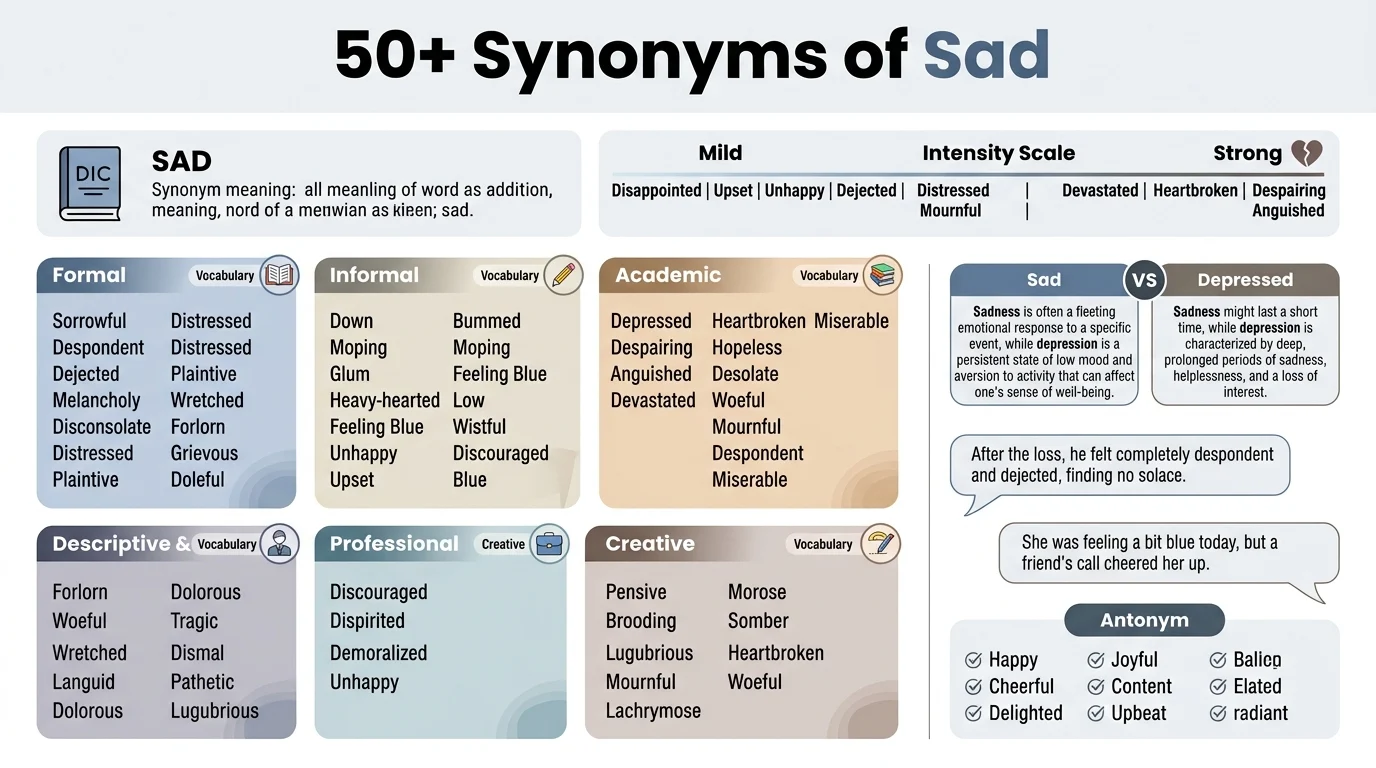
A single word can describe a heavy feeling, but sad does not always tell the full story. Sometimes you feel down. Sometimes you are heartbroken, disappointed, gloomy, or deeply distressed. The right word depends on the situation, emotion, and level of intensity.
This guide covers 50+ synonyms of sad with clear meanings, practical uses, and real examples. So, what are synonyms of sad? They are words that express unhappiness, sorrow, disappointment, or emotional pain in different ways. You will find common synonyms for sad, formal alternatives, strong expressions, and words that work well in essays and everyday conversations.
You may also be looking for deep disappointment synonyms, feeling sad synonyms, or the strongest word for sad. We cover those too. Whether you need another word for sad for writing or want natural sad synonyms for conversation, this list helps you choose the right expression.
You may even find searches such as synonims of sad or synomyns for sad here. No matter how you search, you will find clear and useful word choices.
What Are the Best Synonyms of “Sad”?
Sad means feeling or showing sorrow, unhappiness, or disappointment. It is a general, neutral word for emotional distress. Formal writing, choose “sorrowful” or “melancholy.” For casual conversation, use “down” or “blue.” For professional communication, “disappointed” or “discouraged” work well. Emotional writing, “heartbroken” or “grieving” convey deeper feeling. Creative writers often prefer “somber” or “wistful.”
Meaning, Tone, and Context
Simple Definition
Sad describes a feeling of unhappiness, sorrow, or disappointment. It can refer to a temporary mood or a deeper emotional state. The word also describes things that cause unhappiness, such as a sad movie or sad news.
Part of Speech
Adjective. The noun form is “sadness.” The adverb form is “sadly.”
Overall Tone
Sad is a negative word. It expresses emotional pain, loss, or disappointment.
Formality Level
Sad is neutral. It works in almost any context, from casual conversation to formal writing. However, in very formal or academic writing, more precise synonyms often communicate more effectively.
Common Uses
Native English speakers use “sad” in many situations. They use it to describe personal feelings, such as “I feel sad today.” They use it to describe events, such as “That was a sad story.” Also use it to express sympathy, such as “I am sad to hear about your loss.”
Word Forms
| Form | Word |
|---|---|
| Adjective | sad |
| Noun | sadness |
| Adverb | sadly |
| Verb | sadden (to make someone sad) |
When and How to Use “Sad”
Choose “sad” when you need a simple, clear, and widely understood word. It works well when you do not need to emphasize the intensity or specific nature of the unhappiness.
Here are seven realistic examples showing how native speakers use “sad” in different contexts.
Professional:
“The team was sad to learn that the project had been postponed.”
Academic:
“The study found that students who felt sad performed worse on creative tasks.”
Workplace:
“I was sad to see my colleague leave the company after five years.”
Personal:
She felt sad when she realized her childhood home had been sold.
Email:
“I am sad to inform you that we cannot accept your proposal at this time.”
Resume (cover letter):
“I was sad to leave my previous role, but I am excited about new opportunities.”
Social Media:
“Feeling sad today. Sometimes you just need to let yourself feel it.”
Best Synonyms of “Sad”
No synonym is identical to “sad” in every situation. Each alternative carries a slightly different tone, intensity, or formality. The best choice depends on your audience, purpose, and the specific emotion you want to express.
Professional Writing
Disappointed or discouraged. These words sound composed and professional. They acknowledge negative feelings without sounding overly emotional. Use them in business emails, reports, and client communication.
Academic Writing
Melancholy or somber. These words sound thoughtful and precise. They appear frequently in literary analysis, psychology papers, and philosophical writing. They convey a reflective, intellectual tone.
Business Communication
Regretful or disheartened. These words express disappointment in a professional manner. They work well in formal correspondence, performance reviews, and official statements.
Casual Conversation
Down or blue. These are the most common informal synonyms. They sound natural in everyday speech, text messages, and social media posts. They suggest mild, temporary sadness.
Emotional Writing
Heartbroken or grieving. These words express intense emotional pain. Use them when describing loss, betrayal, or deep personal suffering. They create a powerful emotional impact.
Creative Writing
Wistful or forlorn. These words add nuance and imagery to descriptive writing. They suggest longing, loneliness, or quiet sorrow. They work well in fiction, poetry, and personal essays.
Resume Writing
Avoid using “sad” in resumes. Instead, focus on positive or neutral language. If you must acknowledge a difficult situation, use “disappointed” or “challenged.”
Workplace Communication
Concerned or troubled. These words express worry or unease without sounding unprofessional. They are useful in meetings, emails, and performance discussions.
Stronger Meaning
Devastated or desolate. These words convey extreme sadness. Use them when ordinary words cannot capture the depth of your emotion.
Softer Meaning
Unhappy or displeased. These words suggest mild dissatisfaction rather than deep sorrow. They are useful when you want to acknowledge a negative feeling without exaggerating.
When Not to Use “Sad”
When the Word Sounds Too General
Sad is a broad word. It does not specify the cause or nature of the unhappiness. In many situations, a more precise word communicates more effectively.
Incorrect: “The news made me sad.”
Better: “The news left me disappointed.” (Specifies the emotion more precisely.)
When the Word Sounds Too Vague
Sad can mean almost any kind of unhappiness. This vagueness can weaken your writing.
Incorrect: “She felt sad about the situation.”
Better: “She felt discouraged by the situation.” (Describes the specific feeling.)
When the Word Is Too Informal
In very formal writing, such as legal documents or official reports, “sad” may sound too casual.
Incorrect: “The committee is sad to report a decline in funding.”
Better: “The committee regrets to report a decline in funding.”
When the Word Is Too Weak
Sometimes “sad” does not capture the intensity of the emotion.
Incorrect: “He was sad when his father passed away.”
Better: “He was grieving when his father passed away.”
When the Word Sounds Outdated
Sad is not outdated, but some synonyms may sound old-fashioned. Avoid words like “doleful” or “lugubrious” in everyday writing unless you are aiming for a specific literary effect.
Words Commonly Confused With “Sad”
Sad vs Unhappy
Difference: “Unhappy” suggests a longer-lasting dissatisfaction or discontent. “Sad” is often more immediate and situational.
When to Use Each: Use “unhappy” for ongoing dissatisfaction. Use “sad” for temporary feelings.
Sad: “She felt sad when her flight was canceled.”
Unhappy: “She has been unhappy in her job for years.”
Sad vs Depressed
Difference: “Depressed” suggests a deeper, more persistent, and often clinical level of sadness. “Sad” is temporary and situational.
When to Use Each: Use “sad” for normal emotional responses. Use “depressed” for more serious, prolonged states.
Sad: “I felt sad after watching that movie.”
Depressed: “He has been feeling depressed for months and struggles to get out of bed.”
Sad vs Melancholy
Difference: “Melancholy” suggests a reflective, lingering, and often poetic sadness. “Sad” is more direct and immediate.
When to Use Each: Use “melancholy” in creative or reflective writing. Use “sad” in everyday speech.
Sad: “She looked sad as she walked away.”
Melancholy: “A melancholy silence settled over the room.”
Sad vs Sorrowful
Difference: “Sorrowful” implies sadness caused by a specific loss or disappointment. It is more formal and intense than “sad.”
When to Use Each: Use “sorrowful” in formal or emotional writing about loss. Use “sad” for general unhappiness.
Sad: “He was sad to miss the party.”
Sorrowful: “The sorrowful widow mourned her husband.”
Sad vs Dejected
Difference: “Dejected” suggests discouragement or a loss of hope or confidence. It implies a sense of being defeated.
When to Use Each: Use “dejected” when someone appears visibly defeated or hopeless. Use “sad” for general unhappiness.
Sad: “She felt sad about the test results.”
Dejected: “He walked out of the interview looking dejected.”
Sad vs Gloomy
Difference: “Gloomy” can describe a person’s mood or a dark, depressing atmosphere. “Sad” primarily describes a feeling.
When to Use Each: Use “gloomy” for moods or environments. Use “sad” for personal feelings.
Sad: “I feel sad today.”
Gloomy: “The gloomy weather matched his mood.”
Best Synonyms of “Sad” by Context
| Context | Best Synonym | Why It Works | Example |
|---|---|---|---|
| Formal writing | Sorrowful | Sounds dignified and precise | “The sorrowful announcement brought tears to many eyes.” |
| Academic writing | Melancholy | Conveys thoughtful, reflective sadness | “The poet’s melancholy tone pervades the entire collection.” |
| Professional communication | Disappointed | Maintains composure while acknowledging negative feelings | “We are disappointed by the quarterly results.” |
| Business emails | Regretful | Polite and professional | “We regretfully inform you that your application was unsuccessful.” |
| Resume writing | (Avoid) | Resumes should focus on positive achievements | N/A |
| Workplace communication | Discouraged | Sounds professional without being overly emotional | “The team felt discouraged after the setback.” |
| Casual conversation | Down | Natural, informal, and widely understood | “I’ve been feeling a bit down lately.” |
| Everyday speaking | Blue | Friendly and idiomatic | “She’s been feeling blue since her friend moved away.” |
| Creative writing | Wistful | Adds nuance and imagery | “He cast a wistful glance at the photograph.” |
| Storytelling | Forlorn | Creates a vivid sense of loneliness or abandonment | “The forlorn child sat alone on the steps.” |
| Emotional writing | Heartbroken | Conveys intense emotional pain | “She was heartbroken when their relationship ended.” |
| Strong emphasis | Devastated | Expresses extreme sadness | “The community was devastated by the tragedy.” |
| Mild tone | Unhappy | Soft and general | “He seemed unhappy with the decision.” |
| Social media captions | Blue | Short, relatable, and visually evocative | “Feeling a little blue today.” |
How to Choose the Best Synonym of “Sad”
Choosing the right synonym depends on several factors. Here is a practical decision guide.
Consider your audience. Who is reading your writing? Formal synonyms work well for professors, clients, and employers. Informal synonyms suit friends, family, and social media followers.
Consider your purpose. Are you expressing personal emotion, delivering bad news, or describing a character? Different purposes call for different words.
Consider the emotional strength. How intense is the feeling? Mild sadness calls for “unhappy” or “down.” Deep sorrow calls for “heartbroken” or “devastated.”
Consider the tone. Do you want to sound professional, poetic, casual, or serious? Choose a synonym that matches your desired tone.
Consider natural usage. Does the synonym sound natural in your sentence? Read it aloud. If it feels forced, choose a different word.
The goal is not to use fancy words. The goal is to communicate your intended message as clearly and accurately as possible.
Real Life Examples of “Sad”
School
“Maria felt disappointed when she received a B on her history paper. She had studied for weeks.”
College
“The graduating seniors looked wistful as they walked across the campus for the last time.”
Workplace
“After the merger was announced, the office felt somber. Everyone knew changes were coming.”
Business
“The CEO expressed regret over the company’s decision to downsize.”
“I am sorry to hear about your loss. Please let me know if there is anything I can do.”
Resume (Cover Letter)
“While I was disheartened to leave my previous position, I am eager to bring my skills to a new challenge.”
Conversation
“Are you okay? You seem a bit down today.”
Storytelling
“The forlorn figure stood at the edge of the cliff, staring at the endless ocean.”
Blogging
“There is something melancholy about autumn. The falling leaves remind us that all things must end.”
Social Media
“Feeling blue today. Sometimes you just need a quiet evening and a good book.”
18 Best Synonyms of “Sad”
| Synonym | Simple Meaning | Best Used For | Example Sentence |
|---|---|---|---|
| Unhappy | Not feeling pleased or content | General, everyday situations | “She was unhappy with the service at the restaurant.” |
| Sorrowful | Full of deep sadness, often due to loss | Formal and emotional writing | “The sorrowful mother clutched her son’s photograph.” |
| Melancholy | A deep, reflective, and lingering sadness | Creative and academic writing | “A melancholy atmosphere hung over the empty house.” |
| Dejected | Sad and discouraged, often after failure | Describing visible disappointment | “He looked dejected after losing the championship match.” |
| Downcast | Sad with a drooping posture or expression | Describing appearance or mood | “Her downcast eyes revealed her disappointment.” |
| Gloomy | Dark, depressing, or sad in mood | Describing moods or environments | “The gloomy weather made everyone feel tired.” |
| Mournful | Expressing grief or sorrow, often for the dead | Writing about loss or death | “The mournful sound of the bagpipes filled the air.” |
| Wistful | Sad with a sense of longing or nostalgia | Creative and reflective writing | “She gave a wistful sigh as she remembered her childhood.” |
| Forlorn | Sad and lonely, often abandoned | Storytelling and descriptive writing | “The forlorn puppy waited by the empty bowl.” |
| Heartbroken | Overwhelmed with grief or disappointment | Emotional and personal writing | “He was heartbroken when his marriage ended.” |
| Despondent | Feeling hopeless and discouraged | Describing deep hopelessness | “After months of rejection, she felt despondent.” |
| Disconsolate | So sad that nothing can comfort you | Intense emotional writing | “The disconsolate widow sat alone in the church.” |
| Somber | Dark, serious, and sad in mood | Formal and serious contexts | “The somber ceremony honored the fallen soldiers.” |
| Doleful | Expressing sorrow in a mournful way | Literary and descriptive writing | “The dog gave a doleful howl as its owner left.” |
| Crestfallen | Sad and disappointed because of failure | Describing disappointment | “He was crestfallen when his proposal was rejected.” |
| Woeful | Full of sorrow or misery | Emphasizing extreme sadness | “The woeful refugees told stories of their escape.” |
| Pensive | Engaged in deep, often sad, thought | Describing thoughtful sadness | “She sat in pensive silence, staring out the window.” |
| Dispirited | Lacking enthusiasm or hope | Describing low morale | “The dispirited team trudged off the field.” |
Synonyms of “Sad” by Usage
Professional vs Personal Synonyms
In professional settings, choose words that sound composed and measured. “Disappointed,” “discouraged,” and “regretful” work well in emails, meetings, and reports. They acknowledge negative feelings without sounding overly emotional.
In personal conversations, you have more freedom. Down,” “blue,” and “bummed” sound natural and relatable. They convey mild sadness without drama.
Formal vs Conversational Synonyms
Formal synonyms include “sorrowful,” “melancholy,” “somber,” and “despondent.” These words appear in reports, essays, presentations, and formal emails. They sound authoritative and precise.
Conversational synonyms include “down,” “blue,” “bummed,” and “low.” These words appear in text messages, casual conversations, and social media posts. They sound friendly and approachable.
Academic Synonyms
For research papers, essays, and academic discussions, choose precise vocabulary. “Melancholy” works well in literary analysis. “Somber” fits historical or sociological writing. “Despondent” appears in psychology papers. These words sound authoritative and demonstrate advanced vocabulary.
Professional and Business Synonyms
For resumes, interviews, and business communication, choose words that project professionalism. “Disappointed” is safe and widely acceptable. “Discouraged” works in performance reviews. “Regretful” fits formal correspondence. Avoid overly emotional words like “heartbroken” or “devastated” in professional settings.
Creative and Literary Synonyms
For storytelling, fiction, and poetry, choose expressive alternatives. “Wistful” adds longing and nostalgia. “Forlorn” creates a sense of abandonment. “Melancholy” evokes a reflective, poetic mood. “Somber” sets a serious, grave tone. These words add depth and imagery to descriptive writing.
Slang or Modern Synonyms
American English has several informal ways to express sadness. “Bummed” means mildly disappointed or sad. “Down in the dumps” means feeling very low. “Blue” is a classic informal term for mild sadness. These words are acceptable in casual conversation and social media. Avoid them in formal or professional writing.
Strongest to Mildest Synonyms
Here is an intensity scale from mildest to strongest.
Mild: Unhappy, displeased, down, blue
Moderate: Disappointed, discouraged, gloomy, wistful
Strong: Sorrowful, dejected, mournful, forlorn
Very Strong: Heartbroken, devastated, despondent, disconsolate
Emotional vs Neutral Synonyms
Emotional Synonyms: Heartbroken, grieving, devastated, mournful, forlorn. These words express intense feelings. Use them in personal writing, creative writing, and emotional communication.
Neutral Synonyms: Unhappy, disappointed, discouraged, displeased. These words simply communicate information without adding strong emotion. Use them in professional and academic writing.
Antonyms of “Sad”
| Antonym | Meaning | Example Sentence |
|---|---|---|
| Happy | Feeling pleasure or joy | “She felt happy when she received the good news.” |
| Joyful | Full of joy and happiness | “The joyful children ran through the park.” |
| Cheerful | Noticeably happy and optimistic | “He remained cheerful despite the bad weather.” |
| Glad | Feeling pleased or relieved | “I am glad that you could make it.” |
| Delighted | Very pleased and happy | “She was delighted by the surprise party.” |
| Elated | Extremely happy and excited | “He felt elated after winning the award.” |
| Jubilant | Feeling great joy and triumph | “The jubilant fans celebrated their team’s victory.” |
| Merry | Cheerful and lively | “The merry group sang songs around the campfire.” |
| Joyous | Full of happiness and joy | “The joyous occasion brought everyone together.” |
| Upbeat | Cheerful and optimistic | “She maintained an upbeat attitude throughout the crisis.” |
| Buoyant | Cheerful and optimistic | “His buoyant personality lifted everyone’s spirits.” |
| Content | Satisfied and at peace | “She felt content with her simple life.” |
| Ecstatic | Overwhelmingly happy | “He was ecstatic when he got the job offer.” |
| Exuberant | Filled with energy and excitement | “The exuberant crowd cheered for their hero.” |
| Radiant | Glowing with happiness | “The bride looked radiant on her wedding day.” |
Comparison: “Sad” vs Similar Words
Sad vs Unhappy
Main Difference: “Unhappy” suggests a longer-lasting dissatisfaction. “Sad” is often more immediate and situational.
Which Is Stronger? “Sad” can be stronger in the moment. “Unhappy” suggests ongoing discontent.
Which Is More Formal? Both are neutral, but “unhappy” appears slightly more formal in some contexts.
When to Use Each: Use “unhappy” for chronic dissatisfaction. Use “sad” for temporary feelings.
Sad: “She felt sad when her flight was canceled.”
Unhappy: “She has been unhappy in her job for years.”
Sad vs Depressed
Main Difference: “Depressed” suggests a deeper, more persistent, and often clinical level of sadness.
Which Is Stronger? “Depressed” is much stronger and more serious.
Which Is More Formal? “Depressed” is more formal and clinical.
When to Use Each: Use “sad” for normal emotional responses. Use “depressed” for serious, prolonged states.
Sad: “I felt sad after watching that movie.”
Depressed: “He has been feeling depressed for months.”
Sad vs Melancholy
Main Difference: “Melancholy” suggests a reflective, lingering, and often poetic sadness.
Which Is Stronger? “Melancholy” is not necessarily stronger, but it is deeper and more enduring.
Which Is More Formal? “Melancholy” is more formal and literary.
When to Use Each: Use “melancholy” in creative or reflective writing. Use “sad” in everyday speech.
Sad: “She looked sad as she walked away.”
Melancholy: “A melancholy silence settled over the room.”
Sad vs Sorrowful
Main Difference: “Sorrowful” implies sadness caused by a specific loss or disappointment.
Which Is Stronger? “Sorrowful” is stronger and more intense.
Which Is More Formal? “Sorrowful” is more formal.
When to Use Each: Use “sorrowful” in formal or emotional writing about loss. Use “sad” for general unhappiness.
Sad: “He was sad to miss the party.”
Sorrowful: “The sorrowful widow mourned her husband.”
Sad vs Dejected
Main Difference: “Dejected” suggests discouragement or a loss of hope or confidence.
Which Is Stronger? “Dejected” implies a sense of defeat that is often stronger than simple sadness.
Which Is More Formal? “Dejected” is more formal.
When to Use Each: Use “dejected” when someone appears visibly defeated. Use “sad” for general unhappiness.
Sad: “She felt sad about the test results.”
Dejected: “He walked out of the interview looking dejected.”
Sad vs Gloomy
Main Difference: “Gloomy” can describe a person’s mood or a dark, depressing atmosphere.
Which Is Stronger? “Gloomy” suggests a more pervasive, visible sadness.
Which Is More Formal? Both are neutral, but “gloomy” is slightly more formal.
When to Use Each: Use “gloomy” for moods or environments. Use “sad” for personal feelings.
Sad: “I feel sad today.”
Gloomy: “The gloomy weather matched his mood.”
Common Phrases and Expressions with “Sad”
Sad to say
Meaning: Unfortunately; used to express regret about something.
Example Sentence: “Sad to say, the project was canceled due to budget cuts.”
Sad news
Meaning: News that causes unhappiness or disappointment.
Example Sentence: “We received the sad news that our grandfather had passed away.”
Sad state of affairs
Meaning: A situation that is unfortunate or unsatisfactory.
Example Sentence: “It is a sad state of affairs when children go to bed hungry.”
Better safe than sorry (related)
Meaning: It is wise to be cautious. (Note: “sorry” here means regretful, not apologetic.)
Example Sentence: “I will bring an umbrella, just to be safe rather than sorry.”
Sad sack
Meaning: An inept or unfortunate person. (Informal, slightly dated.)
Example Sentence: “He always manages to mess things up, the poor sad sack.”
Sad eyes
Meaning: Eyes that express sorrow or unhappiness.
Example Sentence: “The dog looked at me with sad eyes, begging for a treat.”
Common Mistakes to Avoid
1: Choosing a Vague Synonym Instead of a Precise One
Incorrect: “The news made me feel bad.”
Better: “The news left me disheartened.”
Using “bad” is too vague. “Disheartened” specifies the exact emotion.
2: Confusing “Sad” with “Unhappy”
Incorrect: “She was unhappy when her friend moved away.” (This suggests long-term dissatisfaction.)
Better: “She was sad when her friend moved away.” (This captures the temporary, situational feeling.)
3: Using an Informal Synonym in Formal Writing
Incorrect: “The committee was bummed about the results.”
Better: “The committee was disappointed by the results.”
“Bummed” is too casual for formal writing.
4: Selecting an Overly Dramatic Synonym
Incorrect: “I was devastated when my favorite coffee shop closed.”
Better: “I was disappointed when my favorite coffee shop closed.”
“Devastated” is too strong for minor disappointments.
5: Repeating the Same Word Too Often
Incorrect: “She felt sad. The sad movie made her cry. It was a sad day.”
Better: “She felt melancholy. The poignant movie made her cry. It was a somber day.”
Variety makes your writing more engaging.
6: Choosing a Synonym with the Wrong Emotional Tone
Incorrect: “He gave a mournful shrug when he heard the news.” (Too dramatic for a simple shrug.)
Better: “He gave a disappointed shrug when he heard the news.”
Match the emotional intensity to the situation.
7: Using Slang in Academic or Professional Writing
Incorrect: “The study found that participants felt blue after the test.”
Better: “The study found that participants felt unhappy after the test.”
Slang has no place in formal writing.
Frequently Asked Questions
What are the best synonyms of “sad”?
The best synonyms depend on your context. Formal writing, use “sorrowful” or “melancholy.” For casual conversation, use “down” or “blue.” Professional communication, use “disappointed” or “discouraged.” For emotional writing, use “heartbroken” or “devastated.”
What are the best formal synonyms of “sad”?
The best formal synonyms include “sorrowful,” “melancholy,” “somber,” “despondent,” and “disconsolate.” These words appear in academic papers, professional reports, and formal correspondence. They sound authoritative and precise.
What are common informal synonyms of “sad”?
Common informal synonyms include “down,” “blue,” “bummed,” and “low.” Native speakers use these words in everyday conversation, text messages, and social media posts. They suggest mild, temporary sadness.
What is another word for “sad” in professional writing?
In professional writing, use “disappointed,” “discouraged,” “regretful,” or “disheartened.” These words acknowledge negative feelings while maintaining a composed, professional tone. Avoid overly emotional words like “heartbroken” or “devastated.”
What is the difference between “sad” and “melancholy”?
“Sad” is a general, immediate feeling of unhappiness. “Melancholy” suggests a deeper, more reflective, and lingering sadness. “Melancholy” is more formal and often appears in literary or creative writing. “Sad” works in almost any context.
What is the opposite of “sad”?
The opposite of “sad” is “happy.” Other antonyms include “joyful,” “cheerful,” “glad,” “delighted,” “elated,” and “jubilant.” These words express positive emotions ranging from mild contentment to extreme joy.
Conclusion
Sad is a simple, clear, and widely useful word. It describes the universal human experience of unhappiness, sorrow, and disappointment. However, relying on it too often makes your writing feel flat and imprecise.
The best synonyms of sad depend on your audience, purpose, and the specific emotion you want to express. For formal writing, choose “sorrowful” or “melancholy.” Casual conversation, choose “down” or “blue.” For professional communication, choose “disappointed” or “discouraged.”Emmotional writing, choose “heartbroken” or “devastated.”
No synonym works perfectly in every situation. The key is to think about what you really mean and choose the word that communicates that meaning most clearly. Your readers will notice the difference.
Here is one practical tip: the next time you write “sad,” pause and ask yourself what kind of sadness you mean. Is it disappointment? Loss? Longing? Discouragement? Choose the word that fits.