You are drafting an important email to your boss. You write “I will get back to you quickly” three times in the same message. Something feels off. The word repeats too often, and it does not sound professional enough for the situation.
Maybe you are writing a college essay. You use “quickly” five times in one paragraph. Your professor will notice the lack of variety. Your writing looks lazy and unpolished.
This happens to everyone. English learners, students, writers, and professionals all struggle with overusing common words. The word “quickly” is one of the most repeated adverbs in everyday communication.
The good news is that English offers dozens of precise alternatives. Each synonym carries a unique tone and works best in specific situations. This guide will help you choose the perfect word every time. You will learn which synonyms sound professional, which work best in creative writing, and which are too casual for formal settings.
What Does “Quickly” Mean?
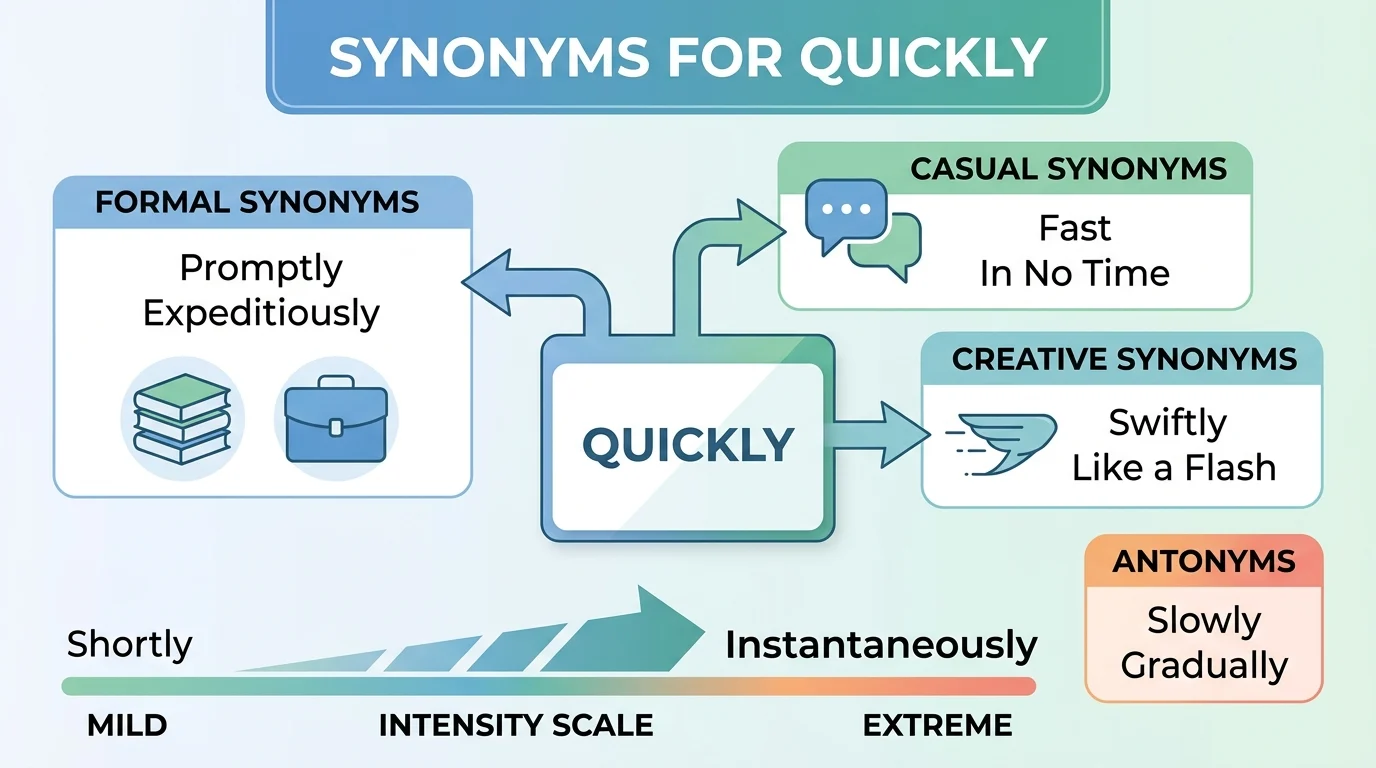
“Quickly” means at a fast speed, in a short time, or without delay. The best synonyms depend on your context. For professional writing, use “promptly” or “efficiently.” For casual conversation, use “fast” or “swiftly.” Academic writing prefers “rapidly” or “expeditiously.” Creative writing benefits from “briskly,” “hastily,” or “like a flash.”
Meaning, Tone and Context
- Simple definition
Quickly describes an action that happens at a fast pace or in a brief amount of time. - Part of speech
Quickly is an adverb. It modifies verbs, adjectives, or other adverbs. - Positive, negative, or neutral tone
The word “quickly” is neutral. It simply describes speed without emotional judgment. However, the context determines whether fast action is good or bad. A quick response is positive. A quick decision without thought is negative. - Formality level
Quickly is a common word used across all formality levels. It fits casual conversations, professional emails, and academic writing equally well. - Common use cases
You use quickly to describe movement, actions, responses, changes, processes, and time based events. It appears in instructions, requests, descriptions, and storytelling. - Important word forms
The adjective form is “quick.” The noun form is “quickness.” The comparative form is “quicker.” The superlative form is “quickest.”
When and How to Use “Quickly”
Use quickly when you want to describe speed or short duration. The word works in almost any situation. It is safe, clear, and widely understood.
However, relying on this single word makes your writing repetitive and vague. More precise synonyms add clarity and emotional impact to your message.
Professional example:
“I will respond to your email quickly.”
Better alternative: “I will respond to your email promptly.”
Academic example:
“The cells divided quickly.”
Better alternative: “The cells divided rapidly.”
Casual example:
“She finished her lunch quickly.”
Better alternative: “She finished her lunch in a flash.”
Creative example:
“He moved quickly through the crowd.”
Better alternative: “He weaved briskly through the crowd.”
Personal example:
“My baby grew quickly.”
Better alternative: “My baby grew at an astonishing pace.”
Resume example:
“I quickly learned the new software.”
Better alternative: “I rapidly mastered the new software.”
Social media example:
“This recipe comes together quickly.”
Better alternative: “This recipe comes together in no time.”
Another Word for “Quickly”
The best single replacement for quickly depends entirely on your situation. Here are the top recommendations for specific contexts.
Professional writing
Use “promptly” for email responses and customer service. Use “efficiently” for process descriptions.
Academic writing
Use “rapidly” for scientific observations. Use “expeditiously” for research methodology.
Casual conversation
Use “fast” for everyday speech. Use “quick” as an adjective in informal settings.
Emotional writing
Use “urgently” when describing anxiety or pressure. Use “frantically” for panic.
Creative writing
Use “swiftly” for elegant movement. Use “hastily” for careless speed.
Resume or workplace use
Use “efficiently” for task completion. Use “productively” for work output.
Social media captions
Use “in no time” for relatable content. Use “lightning fast” for energetic posts.
Stronger meaning
Use “instantaneously” for immediate action. Use “like a flash” for dramatic effect.
Softer meaning
Use “soon” for vague timing. Use “without delay” for polite requests.
When Not to Use “Quickly”
Quickly sounds too vague when you need precise speed descriptions. It sounds too casual in formal legal or medical writing. It sounds too weak when describing urgent situations.
Example of weak usage:
“The patient’s condition worsened quickly.”
Better alternative: “The patient’s condition deteriorated rapidly.”
Example of vague usage:
“Our sales increased quickly.”
Better alternative: “Our sales surged at a rate of 30 percent per quarter.”
Example of casual usage:
“The board approved the merger quickly.”
Better alternative: “The board approved the merger without hesitation.”
Example of general usage:
“She responded quickly to the emergency.”
Better alternative: “She responded immediately to the emergency.”
Words Commonly Confused With “Quickly”
Quickly is often confused with similar words. Understanding these differences will improve your word choice significantly.
Quickly vs. Fast
Fast is an adjective that describes a noun. Quickly is an adverb that describes a verb. You say “a fast car” but “the car moved quickly.”
Quickly vs. Rapidly
Rapidly suggests continuous speed over time. Quickly suggests a single fast action. A company grows rapidly over years. A person answers quickly in one moment.
Quickly vs. Swiftly
Swiftly suggests smooth, graceful speed. Quickly suggests direct, efficient speed. A bird flies swiftly. A computer processes data quickly.
Quickly vs. Hastily
Hastily implies careless or rushed action. Quickly is neutral about quality. You might pack hastily and forget items. You might pack quickly but carefully.
Quickly vs. Promptly
Promptly means without delay or exactly on time. Quickly means with high speed. A meeting starts promptly at 9 AM. The speaker talks quickly.
Quickly vs. Immediately
Immediately means instantly with no time passing. Quickly means in a short time. You respond immediately to a fire alarm. You eat quickly but not immediately.
Best Synonym by Context for “Quickly”
| Context | Best Synonym | Why It Works | Example |
|---|---|---|---|
| Formal writing | Promptly | Shows respect and reliability | The committee will respond promptly to all applicants |
| Academic writing | Rapidly | Indicates measurable speed | The temperature rose rapidly during the experiment |
| Professional business | Efficiently | Focuses on productivity | The team processed claims efficiently |
| Resume | Productively | Highlights value and output | I managed multiple projects productively |
| Casual conversation | Fast | Natural and friendly | Can we walk a bit faster? |
| Creative writing | Swiftly | Adds elegance and imagery | The river flowed swiftly beneath the bridge |
| Emotional tone | Urgently | Creates tension and importance | She urgently requested medical attention |
| Strong intensity | Instantaneously | Emphasizes immediate speed | The system responded instantaneously |
| Soft moderate tone | Shortly | Gentle and polite | I will arrive shortly |
| Social media | In no time | Relatable and engaging | This trick will save you time in no time |
| US usage | Quickly | Standard American English | The package will arrive quickly |
| UK usage | Quickly | Also standard in British English | The post will arrive quickly |
Which Synonym Should You Choose?
Choosing the right synonym for quickly requires four simple considerations.
First, identify your audience. Are you writing to a professor, a boss, a friend, or a social media follower? Formal audiences expect words like “promptly” and “rapidly.” Casual audiences prefer “fast” and “in no time.”
Second, determine the emotional tone. Do you want to sound neutral, urgent, dramatic, or professional? “Urgently” creates pressure. “Swiftly” adds beauty. “Promptly” sounds reliable. “Fast” is straightforward.
Third, check the intensity level. Is the speed moderate, high, or instant? Use “briskly” for moderate speed. Use “rapidly” for high speed. “instantaneously” for no delay at all.
Fourth, consider the sentence structure. Does the word modify an action verb? Does it describe a process? Different synonyms work better with different grammar patterns.
A quick decision guide:
- For emails and customer service: choose promptly
- For scientific or research writing: choose rapidly
- For creative stories: choose swiftly
- For urgent warnings: choose immediately
- For casual texts: choose fast
- For job applications: choose efficiently
- For social media: choose in no time
- For dramatic descriptions: choose like a flash
Real Life Examples of “Quickly” in Sentences
School setting:
“The students completed the assignment promptly and received full credit.”
Better: “The students completed the assignment promptly and received full credit.”
Workplace setting:
“The IT team resolved the server issue efficiently, minimizing downtime.”
Better: “The IT team resolved the server issue efficiently.”
Creative writing:
“She dashed down the hallway, her footsteps echoing against the marble floor.”
Instead of: “She moved quickly down the hallway.”
Conversation:
“We need to leave soon or we will miss the movie.”
Instead of: “We need to leave quickly.”
Social media:
“This lasagna recipe disappears fast in my house.”
Instead of: “This lasagna recipe disappears quickly.”
Resume example:
“I managed urgent client requests without sacrificing quality.”
Instead of: “I managed client requests quickly.”
Email example:
“I will forward the documents without delay.”
Instead of: “I will send the documents quickly.”
Storytelling example:
“Within seconds, the entire room fell silent.”
Instead of: “The room became quiet quickly.”
25 Synonyms for “Quickly”
| Synonym | Simple Meaning | Best Used For | Example Sentence |
|---|---|---|---|
| Promptly | Without delay, on time | Professional emails and customer service | The support team responded promptly to my complaint |
| Rapidly | At a fast and continuous rate | Scientific or academic writing | The population grew rapidly over the decade |
| Swiftly | With smooth, graceful speed | Creative and literary writing | The horse galloped swiftly across the meadow |
| Efficiently | With maximum productivity | Business and workplace contexts | The new system processes data efficiently |
| Immediately | With no time passing, instantly | Emergency situations | Call 911 immediately |
| Fast | At high speed | Casual conversation | She drives too fast |
| Hastily | In a rushed or careless way | Describing mistakes or poor decisions | He hastily signed the contract without reading it |
| Briskly | With quick energy and purpose | Walking or movement descriptions | The manager walked briskly to the meeting |
| Instantly | Without any delay | Strong emphasis on immediate action | The photo uploaded instantly |
| Prompt | Without delay, punctual | Formal requests and responses | Please send your payment prompt |
| Expeditiously | In an efficient and timely manner | Legal and official documents | The court processed the case expeditiously |
| Like a flash | Very suddenly and quickly | Casual and storytelling contexts | He disappeared like a flash |
| Shortly | In a short time, soon | Polite and gentle timing | I will join you shortly |
| In no time | Very quickly, almost immediately | Relatable and engaging language | The kids finished their homework in no time |
| At full speed | With maximum speed | Physical movement descriptions | The race car drove at full speed |
| By leaps and bounds | Rapidly increasing or improving | Progress and growth descriptions | Her skills improved by leaps and bounds |
| At breakneck speed | Extremely fast, often dangerous | Cautionary descriptions | The project moved at breakneck speed |
| Straightaway | Immediately, without hesitation | British English and formal contexts | She accepted the offer straightaway |
| Instanter | Immediately, without delay | Legal and official language | The court order takes effect instanter |
| Posthaste | With great urgency and speed | Older or literary language | He rode posthaste to deliver the message |
| Quickly but surely | Fast yet carefully | Balanced descriptions | She worked quickly but surely |
| With alacrity | With cheerful willingness and speed | Formal and positive descriptions | The volunteers accepted the task with alacrity |
| Without delay | Immediately | Professional and clear instructions | Submit your application without delay |
| At once | Immediately | Urgent and direct communication | Leave the building at once |
| Double time | At twice the normal speed | Military and organizational contexts | The soldiers marched double time |
Synonym Groups and Usage Differences
Professional vs. Personal Synonyms
Professional synonyms like “promptly,” “efficiently,” and “expeditiously” show respect, reliability, and competence. Personal synonyms like “fast,” “in no time,” and “like a flash” sound friendly and relatable.
Use professional synonyms in emails to bosses, client communications, resumes, and official documents. Use personal synonyms in texts to friends, social media posts, casual conversations, and personal stories.
Formal vs. Conversational Synonyms
Formal synonyms work well in reports, essays, speeches, and academic papers. These include “rapidly,” “expeditiously,” and “with alacrity.” They demonstrate precision and sophistication.
Conversational synonyms suit casual writing, texts, emails to colleagues, and social media. These include “fast,” “in no time,” and “like a flash.” They sound natural, approachable, and modern.
Academic Synonyms
Academic writing requires precise, measurable, and objective language. “Rapidly” fits scientific observations and data descriptions. “Gradually” works for slow processes. “Exponentially” describes growth rates. “Steadily” indicates consistent change.
Use “rapidly” in research papers, lab reports, and scholarly articles. Avoid “fast” or “like a flash” in academic contexts.
Professional and Business Synonyms
Workplace communication benefits from words that highlight productivity and competence. “Efficiently” shows you save time and resources. “Promptly” demonstrates reliability. “Productively” emphasizes output and value. “Without delay” signals urgency and action.
Use these words in emails, presentations, performance reviews, resumes, and client communications.
Creative or Literary Synonyms
Creative writing flourishes with descriptive synonyms that paint pictures in the reader’s mind. “Swiftly” suggests grace and elegance. “Briskly” implies energy and purpose. “Hastily” reveals carelessness. “Like a flash” adds drama and surprise.
Writers choose synonyms based on the mood, character, and scene. A hero might move “swiftly.” A villain might act “hastily.” A messenger might ride “posthaste.”
Strongest vs. Weaker Synonyms
Intensity scale from mild to strongest:
Mild: shortly, soon, in a moment
Moderate: quickly, fast, briskly
Strong: rapidly, swiftly, promptly
Very strong: immediately, instantly, without delay
Extreme: instantaneously, at once, like a flash
Choose the intensity that matches your message. A casual invitation needs mild or moderate language. An emergency requires extreme intensity.
Emotional vs. Neutral Synonyms
Neutral synonyms describe speed without emotional judgment. These include “quickly,” “rapidly,” and “fast.” They are safe and clear.
Emotional synonyms add feeling to your writing. “Urgently” creates anxiety and importance. “Frantically” shows panic. “Hastily” implies regret or carelessness. “With alacrity” suggests enthusiasm and positivity.
Antonyms of “Quickly”
| Antonym | Meaning | Example Sentence |
|---|---|---|
| Slowly | At a low speed | The tortoise moved slowly across the road |
| Gradually | Over time, not suddenly | The temperature dropped gradually throughout the night |
| Leisurely | Without rush, relaxed | We walked leisurely along the beach |
| Steadily | At a constant, even pace | Her confidence grew steadily over the years |
| Deliberately | With careful thought and purpose | She deliberately checked every detail |
| Cautiously | With care to avoid danger | He cautiously approached the edge of the cliff |
| Sluggishly | Lacking energy, moving slowly | The old computer operated sluggishly |
| Lazily | Without effort or speed | The cat stretched lazily in the sun |
| Unhurriedly | Without rushing | They enjoyed their unhurried breakfast |
| Gradually | In small stages over time | The city expanded gradually over centuries |
| Tediously | In a boring, slow manner | The meeting progressed tediously |
| Protractedly | Extended in time | The negotiations continued protractedly |
| Languidly | Slowly and without energy | She waved languidly from the couch |
| Ploddingly | In a slow, heavy, laborious way | The workers ploddingly carried the bricks |
| Dilatorily | Slower than expected or required | The government responded dilatorily |
Comparison: Quickly vs. Similar Words
Quickly vs. Fast
Main difference: Quickly is an adverb. Fast is an adjective. Use quickly to modify verbs. Use fast to modify nouns.
Which one is stronger: Neither is stronger. They describe different parts of speech.
Which one is more formal: Quickly is slightly more formal than fast.
Example with quickly: The machine processes data quickly.
Example with fast: The machine has a fast processor.
Quickly vs. Rapidly
Main difference: Rapidly suggests ongoing speed over time. Quickly suggests a single fast event.
Which one is stronger: Rapidly implies continuous momentum and is often stronger.
Which one is more formal: Rapidly is more formal and academic.
Example with quickly: She quickly answered the phone.
Example with rapidly: Her heart rate increased rapidly.
Quickly vs. Swiftly
Main difference: Swiftly describes smooth, graceful speed. Quickly describes direct, efficient speed.
Which one is stronger: Both have the same intensity but different textures.
Which one is more formal: Swiftly is more literary and creative.
Example with quickly: The cashier quickly scanned the items.
Example with swiftly: The dancer swiftly turned across the stage.
Quickly vs. Hastily
Main difference: Hastily implies carelessness or rushing. Quickly is neutral about quality.
Which one is stronger: Hastily carries stronger negative judgment.
Which one is more formal: Both are used in formal and casual contexts.
Example with quickly: She quickly finished the project.
Example with hastily: She hastily finished the project and missed errors.
Quickly vs. Promptly
Main difference: Promptly means exactly on time or without delay. Quickly means with high speed.
Which one is stronger: Promptly implies reliability and punctuality.
Which one is more formal: Promptly is more formal and professional.
Example with quickly: The taxi arrived quickly.
Example with promptly: The taxi arrived promptly at 9 AM.
Quickly vs. Immediately
Main difference: Immediately means instantly. Quickly means in a short time.
Which one is stronger: Immediately is much stronger and more urgent.
Which one is more formal: Both are formal, but immediately is more urgent.
Example with quickly: The fire spread quickly.
Example with immediately: Call the fire department immediately.
Common Phrases and Expressions with “Quickly”
1. Quick as a flash
Meaning: Extremely fast, almost instant.
Example sentence: The magician disappeared from the stage quick as a flash.
2. Quick on your feet
Meaning: Able to think and react rapidly.
Example sentence: During the debate, she was quick on her feet with rebuttals.
3. Quick fix
Meaning: A fast but temporary solution.
Example sentence: There is no quick fix for this complex problem.
4. Quick to judge
Meaning: Likely to form opinions too rapidly.
Example sentence: People are quick to judge others without knowing the facts.
5. Quick witted
Meaning: Able to think and respond rapidly with clever ideas.
Example sentence: The comedian was known for being quick witted.
6. Quick off the mark
Meaning: Acting rapidly in response to a situation.
Example sentence: The sales team was quick off the mark with their holiday campaign.
7. Quick study
Meaning: Someone who learns new things rapidly.
Example sentence: She is a quick study when it comes to new software.
8. Quick march
Meaning: A military command to move rapidly.
Example sentence: The soldiers began the quick march toward the base.
Common Mistakes to Avoid
- Using quickly when a more precise synonym fits better
Instead of: The company grew quickly.
Better: The company grew rapidly or exponentially.
The word “rapidly” adds clarity and strength to your statement. - Confusing quickly with fast
Incorrect: She speaks fast English.
Correct: She speaks English quickly.
Use fast only as an adjective. Use quickly as an adverb. - Using a casual synonym in formal writing
Instead of: The committee approved the budget fast.
Better: The committee approved the budget promptly.
Casual synonyms sound unprofessional in formal contexts. - Using an overly dramatic synonym for a simple situation
Instead of: I ate my lunch instantaneously.
Better: I ate my lunch quickly.
Dramatic words lose their power when used too frequently. - Repeating the same word too often
Instead of: The team quickly responded. The server quickly processed. The client quickly approved.
Better: The team promptly responded. The server efficiently processed. The client swiftly approved.
Variety improves your writing quality and readability. - Choosing a synonym with the wrong emotional tone
Instead of: The children hastily opened their presents on Christmas morning.
Better: The children eagerly opened their presents on Christmas morning.
Hastily implies carelessness. Eagerly implies excitement and joy. - Using slang in academic or professional writing
Instead of: The patient healed lightning fast.
Better: The patient healed rapidly.
Academic and professional writing requires formal, precise language.
FAQs
- What is the best synonym for quickly?
The best synonym depends on your context. Use promptly for professional writing, rapidly for academic writing, and fast for casual conversation. - What is a formal synonym for quickly?
Expeditiously and promptly are formal synonyms. These words appear in legal documents, business reports, and official communications. - What is an informal synonym for quickly?
In no time and like a flash are informal synonyms. Use them in casual conversation, texts, and social media posts. - What is another word for quickly in professional writing?
Use efficiently or productively in professional writing. These words emphasize output and competence. - What is the difference between quickly and fast?
Fast is an adjective that modifies nouns. Quickly is an adverb that modifies verbs. You say fast car but drive quickly. - What is the opposite of quickly?
Slowly is the direct opposite. Other antonyms include gradually, leisurely, and sluggishly.
Conclusion
Quickly is a useful word, but it should not dominate your vocabulary. The English language offers dozens of precise alternatives that add clarity, emotion, and professionalism to your writing.
Formal situations call for words like promptly and expeditiously. Academic writing requires rapidly and steadily. Creative stories benefit from swiftly and like a flash. Casual conversation welcomes fast and in no time.
Your word choice shapes how others perceive your message. A promptly delivered response shows reliability. A rapidly changing situation demands attention. A swiftly moving scene creates elegance and beauty.
Practice using these synonyms in your daily writing. Send emails with promptly instead of quickly. Write essays with rapidly instead of quickly. Send texts with in no time instead of quickly.
Over time, these alternatives will become natural. Your writing will become more precise, more engaging, and more professional. The right word makes all the difference.