You’re writing a performance review and you pause, knowing you cannot possibly call a colleague’s decision “stupid.” Later, you’re texting a friend and “stupid” feels too harsh for the silly mistake they just described.
And then you’re drafting an essay where “stupid” simply sounds too vague and juvenile. The word serves a purpose, but it often lands wrong. It can sound insulting, unprofessional, or simply lazy when a sharper, more precise word exists.
This guide helps you replace “stupid” with the exact right word for every situation, from casual chats to formal reports, without losing your meaning or your credibility.
What Does “Stupid” Mean?
Stupid describes a lack of intelligence, judgment, or common sense. In modern use, it can mean an action was foolish, a comment was unintelligent, or a situation was frustratingly senseless. The best synonyms depend entirely on context.
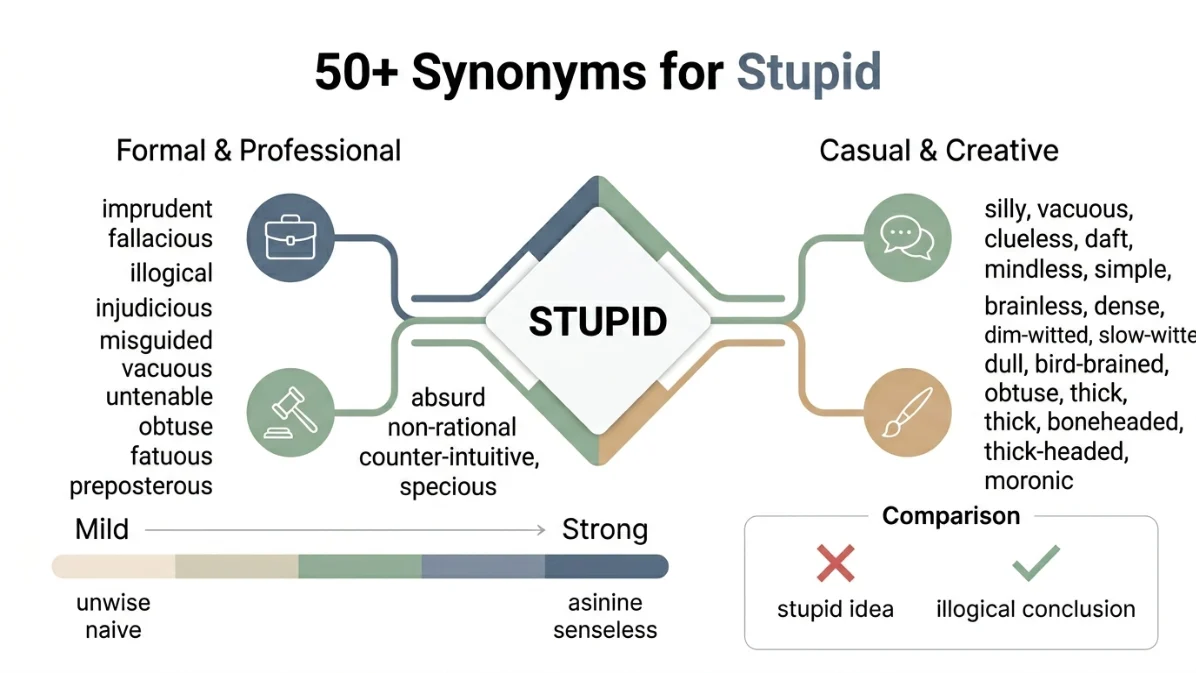
For formal writing, “imprudent” or “ill-advised” work well. In casual speech, “dumb” or “silly” are common. For professional settings, “illogical” or “counterproductive” sound objective rather than insulting.
Meaning, Tone and Context
Stupid is an adjective. Its core definition points to a notable lack of intelligence, understanding, or reason. The word can apply to people, decisions, ideas, mistakes, or even frustrating objects and events. However, its tone is almost always negative, and its formality level is generally low to neutral.
Using it in serious or professional contexts often creates a harsh, judgmental, or immature impression. The related noun is “stupidity,” and the adverb is “stupidly.” Common opposites include intelligent, smart, clever, wise, and sensible.
When and How to Use “Stupid”
The word stupid works in informal settings where strong emotion or playful exaggeration is expected. You might use it with close friends, in hyperbolic storytelling, or when expressing frustration about minor, inconsequential things.
It rarely belongs in professional documents, academic papers, or diplomatic communication. Even in casual settings, applying it to a person can feel like a direct character attack, so use caution.
Here are realistic examples using the word in various contexts, though most benefit from a synonym:
- Casual: I made a stupid mistake on my grocery list and bought almond milk twice.
- Emotional: It was a stupid argument that didn’t need to happen.
- Personal: Sometimes I feel stupid when I can’t follow technical instructions.
- Creative: The character was written as a lovable but stupid sidekick.
- Social Media: That was a stupidly fun concert. (Hyperbolic usage)
- Academic (Avoid): The policy was stupid. (Better: The policy lacked empirical justification.)
- Professional (Avoid): It was a stupid proposal. (Better: The proposal overlooked a critical financial risk.)
Another Word for “Stupid”
The single best replacement for stupid depends entirely on your meaning. If you mean “unwise,” use “foolish.” If you mean “lacking knowledge,” use “ignorant.” You mean “senseless,” use “absurd.”
Here are direct suggestions for different writing and speaking needs:
- Professional writing: ill-advised, shortsighted, counterproductive, unsound.
- Academic writing: unfounded, fallacious, irrational, empirically weak.
- Casual conversation: silly, dumb, goofy, clueless.
- Emotional writing: senseless, absurd, asinine, ridiculous.
- Creative writing: vacuous, fatuous, dim-witted, laughable.
- Resume or workplace use: Do not use stupid. Use inefficient, underdeveloped, or unrefined.
- Social media captions: ridiculous, silly, wild, no thoughts just vibes (phrase).
- Stronger meaning: idiotic, imbecilic, moronic, brainless.
- Softer meaning: unwise, thoughtless, naive, impractical.
When Not to Use “Stupid”
The word stupid is a poor choice any time you need to sound objective, respectful, or precise. It tells the reader you are judging, but it does not explain what went wrong. In a workplace setting, calling an approach “stupid” makes you sound unprofessional.
Saying the approach was “unsustainable” or “inefficient” provides specific, actionable feedback. In academic writing, “stupid” is an emotional dismissal, not a logical critique. Replacing it with “logically inconsistent” or “unsupported by evidence” strengthens your argument.
When describing a person, even in fiction, “stupid” can feel flat. A character described as “naively trusting” or “willfully ignorant” has far more depth than one simply labeled “stupid.”
Words Commonly Confused With “Stupid”
Several words overlap with stupid but carry distinct meanings. Understanding the difference helps you choose the most accurate word.
Stupid implies a general lack of intelligence. Ignorant specifically means lacking knowledge or awareness, which is a condition that can be fixed. Foolish emphasizes a lapse in judgment or common sense, often in a specific situation.
Naive points to a lack of worldly experience or sophistication, suggesting innocence. Illogical describes a breakdown in reasoning, where a conclusion does not follow from the facts. Senseless means devoid of meaning, purpose, or rational explanation, often applied to events.
A person can be ignorant of a topic without being stupid, and a brilliant person can make a foolish decision without being a fool.
Best Synonym by Context for “Stupid”
| Context | Best Synonym | Why It Works | Example |
|---|---|---|---|
| Formal writing | imprudent | It sounds objective and focuses on a lapse in judgment, not inherent intelligence. | The board’s imprudent investment led to significant losses. |
| Academic writing | fallacious | It identifies a specific flaw in logic, which is the core of scholarly critique. | The paper’s central argument is fallacious and ignores contrary evidence. |
| Professional or business | counterproductive | It evaluates the action based on its results, not the person. | Micromanaging the team is a counterproductive strategy. |
| Resume (self-description) | Do not use. Reframe strength. | Never frame a past action or yourself as stupid. Frame it as a learning curve. | I identified an inefficiency in the workflow and developed a new system. |
| Casual conversation | silly | It softens the criticism and can even sound playful. | Don’t be silly, it was an honest mistake. |
| Creative writing | vacuous | It suggests an emptiness of thought or expression, adding descriptive depth. | She wore a vacuous smile that revealed nothing of her true feelings. |
| Emotional tone | senseless | It conveys a deep frustration with the meaninglessness of an event. | It was a senseless act of vandalism with no clear motive. |
| Strong intensity | asinine | It is a powerful, judgmental word meaning utterly foolish. | His asinine comment during the meeting embarrassed the entire team. |
| Soft or moderate tone | unwise | It is gentle and suggests a choice that was simply not the best. | Choosing to hike without water was an unwise decision. |
| Social media captions | ridiculous | It is lively, exaggerated, and commonly used for humorous effect. | The amount of coffee I drank this morning is ridiculous. |
Which Synonym Should You Choose?
Start by asking yourself what you really mean. Are you judging a person’s intelligence, or are you evaluating an action’s outcome? An action is “shortsighted,” a person’s knowledge gap is “ignorance,” and a flawed argument is “illogical.” Next, match the word to your relationship with the audience.
A boss can read “counterproductive.” A friend can hear “silly.” The emotional intensity also matters. “Unwise” is a gentle redirection, while “asinine” is a verbal hammer. Finally, consider professional value. In a resume or meeting, never label yourself or others as stupid.
Instead, diagnose the exact issue with words like “inefficient,” “underdeveloped,” or “uninformed.” Choose the word that diagnoses the problem, not just the one that labels it.
Real Life Examples of “Stupid” in Sentences
Using a stronger synonym instantly changes the impact of a sentence. These examples show how to replace “stupid” in everyday situations.
- School: My initial thesis was unfounded, so I had to return to the research.
- Workplace: Abandoning the client feedback was a shortsighted move that hurt the launch.
- Writing: The character’s naive trust in the villain made readers want to warn her.
- Conversation: I felt clueless when the mechanic started explaining the engine repair.
- Social Media: This autocorrect fail is absolutely ridiculous. I’m leaving it.
- Email: Our initial approach proved inefficient, so we have adopted a new process.
- Storytelling: His refusal to ask for directions was pure, laughable stubbornness.
15 Synonyms for Stupid
| Synonym | Simple Meaning | Best Used For | Example Sentence |
|---|---|---|---|
| Foolish | Lacking good judgment. | Unwise personal or financial decisions. | It was foolish to drive through the flooded street. |
| Ignorant | Lacking knowledge. | Highlighting a correctable gap in facts. | He wasn’t stupid, just ignorant of the local customs. |
| Silly | Lightly foolish; not serious. | Playful, affectionate, or mild criticism. | We took a silly photo with the giant sunglasses filter. |
| Absurd | Completely unreasonable. | Illogical arguments or bizarre situations. | The idea that we can finish by Friday is absurd. |
| Irrational | Not based on reason or logic. | Emotional arguments or phobias. | Her fear of the tiny, harmless spider was irrational. |
| Imprudent | Not showing care for consequences. | Formal warnings about risky actions. | The journalist’s imprudent disclosure of the source was dangerous. |
| Dumb | Informal for stupid; temporarily unable to speak (archaic). | Very casual conversation. | It was a dumb horror movie where everyone makes bad choices. |
| Illogical | Containing clear flaws in reasoning. | Debating a point in a meeting or essay. | His conclusion was illogical because he skipped a key step in the data. |
| Senseless | Without meaning or purpose. | Describing tragic violence or destruction. | The senseless graffiti on the historic monument saddened everyone. |
| Naive | Overly simple and trusting. | Describing a lack of worldly experience. | It was naive of me to believe the email promising a free prize. |
| Asinine | Extremely stupid; ridiculous. | Strong, emotionally charged criticism. | The internet comment section was filled with asinine conspiracy theories. |
| Laughable | So foolish as to be worthy of mockery. | Emphasizing the sheer absurdity of something. | His excuse for being four hours late was laughable. |
Synonym Groups and Usage Differences
Professional vs. Personal Synonyms
In a professional setting, replace stupid with words that critique the process or outcome, not the person. Use “counterproductive,” “shortsighted,” “illogical,” or “inefficient.” These words allow you to challenge an idea while maintaining a respectful, collaborative tone. In your personal life, you have far more latitude. You can use “silly,” “dumb,” “clueless,” or “goofy” with friends and family, where the stakes are lower and affection is understood.
Formal vs. Conversational Synonyms
Formal writing and speeches require you to replace stupid with reasoned, non inflammatory vocabulary. “Imprudent,” “fallacious,” “unfounded,” and “irrational” are all excellent formal choices that elevate your tone. Conversational English is direct. “Dumb,” “dense,” “ditzy,” and “crazy” (as in “a crazy idea”) are common informal switches. In a text message, “dumb idea” works perfectly. In a legal document, you would say the idea was “without reasonable merit.”
Academic Synonyms
Academic writing dismantles ideas with precision, not insults. The word stupid should never appear as a descriptor for an opposing argument. Replace it with “fallacious,” which pinpoints faulty logic, or “empirically unfounded,” which signals a lack of data. You might also use “logically inconsistent,” “conceptually weak,” or “unsupported.” These words perform an intellectual critique that contributes to scholarly debate.
Professional and Business Synonyms
Business communication demands that you avoid personally charged language. Instead of saying a strategy is stupid, you can say it is “unsustainable,” “unviable,” or “high risk.” A stupid email would more accurately be described as “unclear” or “poorly timed.” A stupid meeting is “unproductive” or “lacking a clear agenda.” In a resume, never say you fixed a stupid process. You “revamped an inefficient workflow” or “resolved a critical bottleneck.” This vocabulary presents you as a problem solver, not a complainer.
Creative or Literary Synonyms
In creative writing, a word like “vacuous” does more than stupid because it paints a picture of an empty mind and a blank expression. “Fatuous” suggests a self satisfied, smug silliness. “Dim-witted” conveys a slow, lumbering thought process. “Harebrained” makes a scheme sound wildly reckless. These synonyms add texture, imagery, and a clear narrative voice that the word stupid cannot achieve on its own.
Slang or Modern Synonyms
Modern slang offers terms like “no thoughts, head empty,” which describes a blissfully vacant or distracted state. “Brain dead” is a hyperbolic way to describe someone acting without thinking, often used playfully for oneself after a long day. “Smooth brained” is a highly informal and pejorative internet insult. These phrases are strictly for online use, texting, or very casual conversation with close friends. They have no place in academic, professional, or formal writing and can easily cause offense.
Strongest vs. Weaker Synonyms
The intensity of a synonym can range from a gentle tease to a severe insult. The mildest words include “unwise,” “naive,” “silly,” and “impractical.” They criticize a single choice, not a person’s capacity. The middle tier includes “foolish,” “dumb,” “irresponsible,” and “shortsighted.” The strongest words are absolute judgments. “Asinine,” “moronic,” “imbecilic,” and “brainless” are scorching criticisms that attack fundamental intelligence and are rarely, if ever, productive.
Emotional vs. Neutral Synonyms
When you want to analyze a problem calmly, choose a neutral synonym. Words like “illogical,” “inefficient,” “counterproductive,” and “uninformed” are factual and objective. They let you point out a flaw without revealing your emotional state. Emotional synonyms, on the other hand, express your feelings of frustration, anger, or disbelief. Words like “senseless,” “absurd,” “outrageous,” and “ridiculous” communicate that you are not just in disagreement. You are emotionally affected by what has happened.
Antonyms of “Stupid”
| Antonym | Meaning | Example Sentence |
|---|---|---|
| Intelligent | Having a high mental capacity. | She is an intelligent student who always asks insightful questions. |
| Smart | Quick-witted and clever. | That was a smart solution to a complicated problem. |
| Wise | Having deep experience and good judgment. | My grandmother offered wise advice during a difficult time. |
| Brilliant | Exceptionally clever or talented. | The physicist had a brilliant breakthrough in the lab. |
| Clever | Skilled at solving problems, sometimes unconventionally. | Her clever use of the budget saved the project. |
| Sensible | Acting with good practical judgment. | Wearing a helmet is the sensible thing to do on a bike. |
| Prudent | Showing careful thought for the future. | A prudent investor diversifies their portfolio. |
| Logical | Characterized by clear, sound reasoning. | His argument was logical and difficult to refute. |
| Astute | Having an accurate ability to assess situations. | An astute manager can sense team morale shifts quickly. |
| Rational | Based on reason, not emotion. | Let’s try to stay rational and consider the facts. |
| Perceptive | Noticing and understanding things quickly. | Her perceptive review caught a detail everyone else missed. |
| Insightful | Showing a deep and accurate understanding. | The book was an insightful look into political history. |
| Educated | Having received a high level of knowledge. | He holds an educated opinion on the matter, backed by years of study. |
| Sharp | Mentally quick and observant. | You need to be sharp to work in a fast paced newsroom. |
| Knowledgeable | Knowing a lot of information. | The tour guide was incredibly knowledgeable about ancient history. |
Comparison: Stupid vs. Similar Words
Stupid vs. Ignorant
The main difference is capacity versus awareness. Stupid implies a permanent inability to understand, whereas ignorant means you simply lack information right now. Ignorant is the more neutral and accurate word when describing a knowledge gap. Ignorance can be cured with a fact. Stupidity cannot.
- Stupid: The tutorial was for advanced users, and I felt completely stupid.
- Ignorant: I’m completely ignorant about cryptocurrency and need to learn the basics.
Stupid vs. Foolish
Foolish is a softer, more situational word than stupid. It almost always describes an action or a choice, not a person’s overall intellect. A brilliant scientist can make a foolish bet. Calling a decision foolish criticizes the judgment, while calling a person stupid criticizes their core being.
- Stupid: The character was the stereotypical stupid jock.
- Foolish: Skipping the final interview was a foolish mistake after all that hard work.
Stupid vs. Naive
Naive is a much gentler word that suggests innocence, inexperience, or an overly trusting nature. It does not attack intelligence. A naive person fails to see the world’s darker, more complex side because they haven’t encountered it yet. A stupid person fails to see it because they can’t.
- Stupid: She felt stupid for not seeing the scam coming.
- Naive: He was young and naive, and believed every promise from the charismatic leader.
Stupid vs. Illogical
Illogical refers exclusively to the structure of a thought, argument, or plan. It means the reasoning is broken. It has nothing to do with a person’s natural talent. This makes it a safe, clinical word for a classroom or boardroom. A stupid idea feels wrong. An illogical idea demonstrably is wrong.
- Stupid: I had a stupid idea to build a boat in my garage without measuring the door.
- Illogical: Her argument was illogical because it contradicted her initial premise.
Stupid vs. Absurd
Absurd highlights a ridiculous, laughable violation of common sense. It is often used for humorous or extreme situations. Stupid can feel flat, but absurd adds a layer of dark comedy or outrageous disbelief. The idea is so bad, it’s almost funny.
- Stupid: The movie had a stupid plot twist that ruined the ending.
- Absurd: The film was filled with an absurd amount of explosions and talking animals.
Stupid vs. Ridiculous
Ridiculous means something is worthy of mockery or extreme disbelief. It’s a highly expressive, emotional word that is perfect for social media and casual conversation. Stupid can sound mean spirited, whereas ridiculous often sounds more amused and exaggerated.
- Stupid: My new haircut makes me feel stupid.
- Ridiculous: The price of this small cup of juice is absolutely ridiculous.
Common Phrases and Expressions with “Stupid”
1. Stupid o’clock
Meaning: A humorous, exaggerated way to describe an unreasonably early or late time of day.
Example sentence: I had to wake up at stupid o’clock to catch my flight.
2. Stupid money
Meaning: An informal phrase for an absurdly large, often unjustified, amount of money.
Example sentence: The professional athlete signed a contract for stupid money.
3. Stupid easy
Meaning: Extremely simple; so easy that failing would feel stupid.
Example sentence: The video game’s first level is stupid easy, but it gets much harder.
4. Stupid is as stupid does
Meaning: A proverb meaning that intelligence is judged by actions, not appearance or words.
Example sentence: Even after his degree, he made bad choices. Stupid is as stupid does, I guess.
5. Play stupid
Meaning: To pretend to be unintelligent or not understand something.
Example sentence: Don’t play stupid. I know you saw the notification on your phone.
6. A stupid mistake
Meaning: A careless error that could have been easily avoided.
Example sentence: The typo in the client’s name was just a stupid mistake.
7. Stupid with fear
Meaning: So terrified that you are unable to think or act rationally.
Example sentence: The character was stupid with fear and couldn’t run away.
Common Mistakes to Avoid
- Using stupid when a more precise word is better. Calling a failed business plan stupid gives no insight. Calling it shortsighted, underfunded, or illogical explains exactly what went wrong and positions you as an analyst.
- Confusing ignorant with stupid. This is perhaps the most frequent and harmful mix up. Never call a person stupid simply because they have not yet learned a fact. It is a sign of intellectual disrespect.
- Using a casual synonym in formal writing. A sentence like “The senator’s proposal was dumb” will ruin your credibility in a formal essay or report. You must use terms like “imprudent,” “untenable,” or “ill-considered.”
- Using an overly dramatic synonym for a simple situation. Telling a friend they were “asinine” for buying the wrong pasta brand is a massive overreaction that can damage a relationship. The word “silly” matches the low stakes of the mistake.
- Repeating stupid too often. Even in casual writing, a string of sentences using only stupid feels lazy and repetitive. Vary your vocabulary with words like foolish, absurd, clueless, or senseless to keep the reader engaged.
- Choosing a synonym with the wrong emotional tone. Using a neutral word like “illogical” to describe a tragic, heartbreaking event can sound cold and robotic. That’s when an emotional word like “senseless” is the only fitting choice.
- Using slang in academic or professional writing. Words like “brain dead,” “smooth brained,” or “ditzy” are never acceptable in a cover letter, a performance review, or an academic journal. They will instantly disqualify you in the reader’s mind.
FAQs
1. What is the best synonym for stupid?
The best synonym depends on context. “Foolish” is great for unwise actions, “ignorant” for a lack of knowledge, and “illogical” for flawed reasoning. There is no single replacement.
2. What is a formal synonym for stupid?
Excellent formal synonyms include imprudent, fallacious, irrational, shortsighted, and counterproductive. These words critique the idea or action objectively without personal insult.
3. What is an informal synonym for stupid?
Common informal synonyms are silly, dumb, goofy, and clueless. Internet slang like “no thoughts, head empty” is also very informal and only suitable for social media or close friends.
4. What is another word for stupid in professional writing?
In a business setting, use inefficient, unsustainable, ill-advised, or counterproductive. These words identify a problem with a process or strategy, not a person’s intellect.
5. What is the difference between stupid and ignorant?
Stupid implies a permanent lack of intelligence. Ignorant means someone currently lacks specific knowledge or information. Ignorance can be fixed with learning. Stupidity cannot.
6. What is the opposite of stupid?
Common opposites include intelligent, smart, wise, sensible, and clever. The best antonym also depends on context. A wise decision is the opposite of a foolish one, not necessarily a stupid one.
Conclusion
Stupid is a broad and often clumsy word for describing a lack of intelligence, judgment, or sense. Its power is limited because it judges without explaining. The true value lies in choosing a synonym that illuminates the problem. An action is foolish, a statement is ignorant, a plan is shortsighted, and an argument is fallacious.
By matching the word to your meaning, tone, and audience, your communication becomes more precise, more persuasive, and more professional. Remember that “ignorant” is not an insult but a starting point for learning. Adopting that mindset is the single best vocabulary tip for using these words wisely.