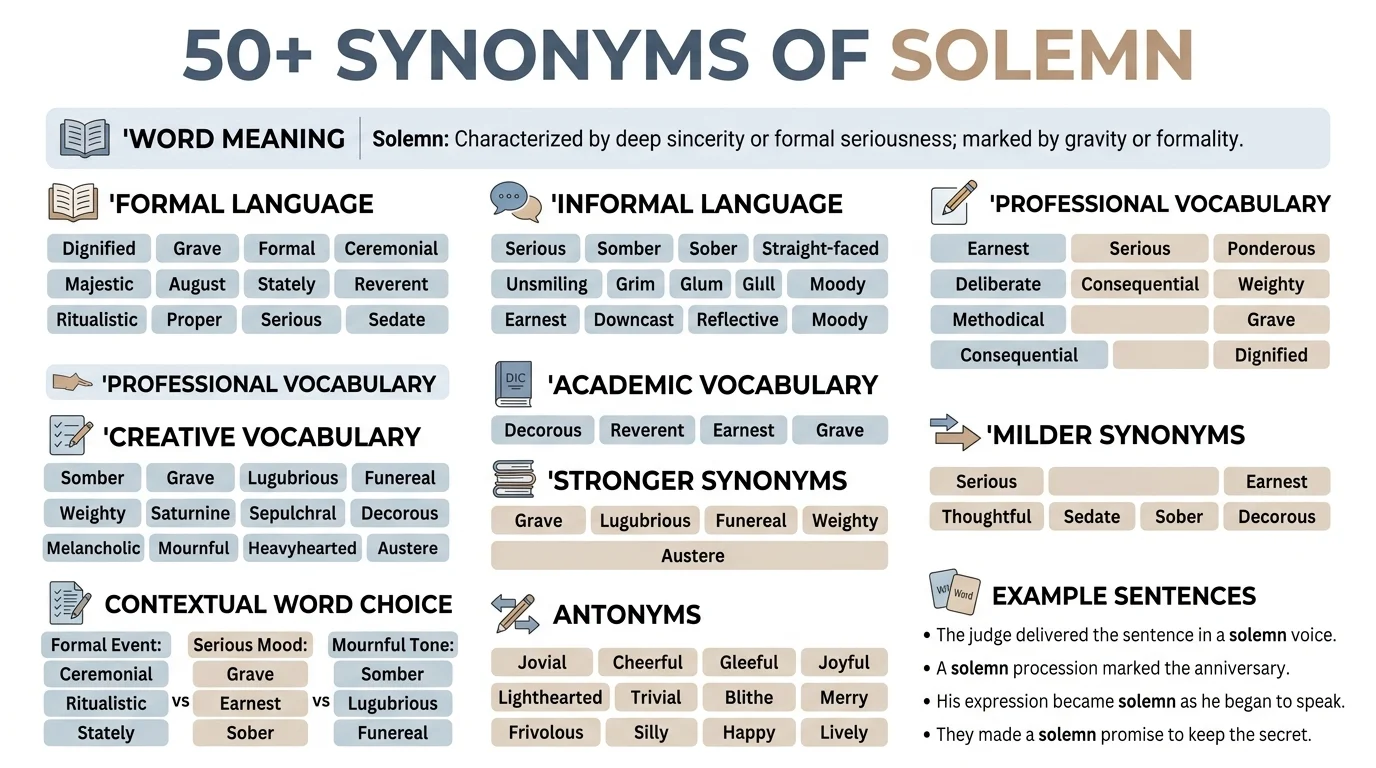
Have you ever found yourself writing an important email, a heartfelt message, or a formal announcement and realized you have used the word “solemn” three times in two paragraphs? You know the word fits the tone, but repeating it makes your writing feel flat and uninspired. Whether you are drafting a college essay, preparing a business presentation, or writing a eulogy, finding the right synonyms of solemn can transform your communication from adequate to exceptional.
Choosing the right synonym is not about showing off your vocabulary. It is about clarity, tone, and precision. The word “solemn” carries weight. It signals seriousness, formality, and sincerity. But not every situation that calls for seriousness demands the exact same word. A courtroom oath requires a different kind of gravity than a reflective moment in a personal journal. Understanding the subtle differences between synonyms of solemn helps you communicate exactly what you mean, without guessing or settling for a word that almost fits.
What Are the Best Synonyms of “Solemn”?
Solemn means deeply serious, formal, and sincere, often in a way that is dignified or ceremonious. The best synonym depends on your context. For formal writing, choose “grave” or “earnest.” For casual conversation, “serious” works well. Academic writing, use “sober” or “thoughtful.” Emotional writing, “somber” or “pensive” are excellent choices. Professional communication, “dignified” and “staid” convey the right tone.
Meaning, Tone, and Context
Simple Definition
Solemn describes something that is very serious and formal. It can refer to a person’s expression, a mood or atmosphere, a ceremony, or a promise made with complete sincerity. When you describe something as solemn, you are signaling that it is not to be taken lightly. The word comes from the Latin sollemnis, which means formal or ceremonial.
Part of Speech
Solemn is an adjective.
Overall Tone
Solemn is neutral to slightly formal. It does not carry a positive or negative judgment by itself. A solemn occasion can be a wedding (positive) or a funeral (sad). The tone depends entirely on the context.
Formality Level
Solemn is formal. It is appropriate in academic writing, professional settings, religious contexts, and legal language. It sounds out of place in casual texting or everyday conversation unless you are being deliberately dramatic or ironic.
Common Uses
Native English speakers use solemn most often in these situations:
- Describing ceremonies and formal events: “a solemn wedding ceremony”
- Referring to promises and oaths: “a solemn vow”
- Describing someone’s serious expression or demeanor: “a solemn face”
- Setting a serious mood or atmosphere: “a solemn moment”
- Referring to religious or sacred matters: “a solemn religious ceremony”
Word Forms
- Noun: solemnity (the quality of being solemn)
- Adverb: solemnly (in a solemn manner)
- Verb: solemnize (to perform with ceremony or to make solemn)
When and How to Use “Solemn”
Choose “solemn” when you need to convey deep seriousness, formality, and sincerity. It is the right word for moments that demand respect, reflection, or a sense of gravity. Here are seven realistic examples showing how to use it in different contexts.
Professional Context
“The board members observed a solemn moment of silence before beginning the annual meeting.”
Academic Context
“The professor’s solemn tone reminded the students that the research they were about to conduct carried real ethical responsibilities.”
Workplace Context
“The CEO made a solemn commitment to improve workplace safety after the incident.”
Personal Context
“She gave me a solemn promise that she would keep my secret, and I believed her.”
Email Context
“Please treat this matter with the solemn attention it deserves. The implications affect every department.”
Resume Context
“Led a solemn remembrance ceremony for fallen colleagues, demonstrating leadership and emotional intelligence.”
Social Media Context
“Today marks a solemn anniversary. We remember those we lost and honor their legacy.”
Best Synonyms of “Solemn”
No synonym is identical to “solemn” in every situation. Each alternative carries its own shade of meaning, emotional weight, and level of formality. Here are the best synonyms for specific contexts.
Professional Writing: Choose “dignified.” It conveys seriousness with a sense of composure and respect. It sounds polished without being overly emotional.
Academic Writing: Choose “sober.” It suggests a calm, measured seriousness that is appropriate for research and analysis. It avoids the emotional weight of “somber” while still communicating gravity.
Business Communication: Choose “earnest.” It signals sincerity and genuine intent without sounding stiff or overly formal. It works well in client communications and internal memos.
Casual Conversation: Choose “serious.” It is the most natural and versatile choice for everyday speech. It communicates the same basic meaning without sounding pretentious.
Emotional Writing: Choose “somber.” It adds a layer of sadness or melancholy that “solemn” does not always carry. It is perfect for personal reflections, memorials, and heartfelt messages.
Creative Writing: Choose “pensive.” It suggests thoughtful seriousness rather than ceremonial formality. It works well for character descriptions and introspective scenes.
Resume Writing: Choose “composed” or “dignified.” These words suggest professionalism and emotional control without sounding heavy or sad.
Workplace Communication: Choose “staid.” It conveys seriousness with a sense of stability and reliability. It is appropriate for describing company culture or professional demeanor.
Stronger Meaning: Choose “grave.” It carries a sense of impending seriousness or potential danger. It is stronger than “solemn” because it suggests high stakes.
Softer Meaning: Choose “thoughtful.” It suggests seriousness that comes from careful reflection rather than formality or ceremony. It is gentler and more approachable.
When Not to Use “Solemn”
Using “solemn” in the wrong context can make your writing sound awkward, overly dramatic, or even comical. Here are situations where you should choose a different word.
When the situation is too casual. Using “solemn” to describe a casual lunch with friends sounds ridiculous. “We had a solemn lunch at the diner” creates an unintentionally funny image. Use “serious” or “quiet” instead.
When the tone is too vague. “Solemn” is a strong word. If you use it to describe something that is only mildly serious, it sounds exaggerated. “The meeting was solemn” suggests something significant happened. If the meeting was just routine, use “formal” or “serious.”
When the word sounds too formal. In everyday conversation, “solemn” can sound stiff and unnatural. “I had a solemn talk with my mom” sounds like something from a novel. Use “serious” or “earnest” instead.
When the word is too weak. If you are describing a life-threatening situation or a moment of extreme gravity, “solemn” may not be strong enough. “The doctor’s solemn warning” sounds less urgent than “the doctor’s grave warning.” Use “grave” for higher stakes.
When the word feels outdated. While “solemn” is still current, some of its synonyms like “staid” can sound old-fashioned in certain contexts. Be aware of how your word choice lands with a modern audience.
Incorrect: “We had a solemn discussion about where to go for dinner.”
Better: “We had a serious discussion about where to go for dinner.”
Why: “Solemn” is too heavy for choosing a restaurant. “Serious” communicates that the decision required genuine thought without sounding ridiculous.
Words Commonly Confused With “Solemn”
Solemn vs Serious
Difference: “Serious” is the broader, more common word. It simply means not joking or not trivial. “Solemn” is more specific. It adds formality, dignity, and often a ceremonial quality.
When to Use It: Use “serious” for most everyday situations. Use “solemn” when you need the extra weight of formality and ceremony.
Example (Serious): “She had a serious look on her face during the interview.”
Example (Solemn): “The judge’s solemn expression silenced the courtroom.”
Solemn vs Somber
Difference: “Somber” (or “sombre” in British English) carries a darker emotional tone. It suggests sadness, gloom, or melancholy. “Solemn” suggests seriousness and formality without necessarily implying sadness.
When to Use It: Use “somber” when you want to emphasize sadness or a gloomy atmosphere. Use “solemn” when the emphasis is on formality and dignity.
Example (Somber): “The family returned home in a somber mood after the funeral.
Example (Solemn): “The solemn ceremony honored the veterans with dignity and respect.”
Solemn vs Grave
Difference: “Grave” suggests a more urgent and potentially dangerous seriousness. It often implies high stakes or threatening consequences. “Solemn” is broader and can refer to ceremonies, promises, or dignified moments.
When to Use It: Use “grave” when the situation involves serious consequences or danger. Use “solemn” for formal occasions and sincere promises.
Example (Grave): “The doctor delivered the grave news with compassion.”
Example (Solemn): “They exchanged solemn vows at their wedding.”
Solemn vs Earnest
Difference: “Earnest” emphasizes sincerity, genuine feeling, and a lack of pretense. “Solemn” emphasizes formality and dignity. “Earnest” feels warmer and more personal. “Solemn” feels more official and ceremonial.
When to Use It: Use “earnest” when you want to convey heartfelt sincerity. Use “solemn” when you need to convey formal seriousness.
Example (Earnest): “He made an earnest plea for understanding.”
Example (Solemn): “The ambassador delivered a solemn statement to the press.”
Solemn vs Sober
Difference: “Sober” suggests a calm, restrained seriousness, often free from excitement or emotion. “Solemn” can be more emotionally weighty and ceremonious.
When to Use It: Use “sober” for a measured, unemotional seriousness. Use “solemn” for occasions that demand dignity and ceremony.
Example (Sober): “The committee gave a sober assessment of the financial situation.”
Example (Solemn): “The nation observed a solemn day of remembrance.”
Solemn vs Pensive
Difference: “Pensive” suggests thoughtful reflection, often with a slightly sad or dreamy quality. “Solemn” suggests formal seriousness without the same focus on deep thought.
When to Use It: Use “pensive” to describe someone who is deeply thoughtful. Use “solemn” to describe a formal, serious atmosphere or demeanor.
Example (Pensive): “She stared out the window with a pensive expression.”
Example (Solemn): “He spoke in a solemn tone about the importance of the decision.”
Best Synonyms of “Solemn” by Context
| Context | Best Synonym | Why It Works | Example |
|---|---|---|---|
| Formal writing | Grave | Conveys high seriousness and weight | “The committee issued a grave warning about the economic outlook.” |
| Academic writing | Sober | Suggests measured, calm seriousness | “The study offers a sober analysis of the long-term effects.” |
| Professional communication | Dignified | Signals composure and respect | “She handled the difficult situation in a dignified manner.” |
| Business emails | Earnest | Conveys sincerity without stiffness | “I want to express my earnest commitment to this project.” |
| Resume writing | Composed | Suggests emotional control and professionalism | “Remained composed under pressure during client negotiations.” |
| Workplace communication | Staid | Conveys stability and seriousness | “The company maintains a staid and professional culture.” |
| Casual conversation | Serious | Natural and versatile | “We need to have a serious talk about your plans.” |
| Everyday speaking | Serious | Most common and natural choice | “He seemed serious about changing his habits.” |
| Creative writing | Pensive | Suggests thoughtful, introspective seriousness | “He wore a pensive look as he considered her question.” |
| Storytelling | Somber | Adds emotional depth and melancholy | “The somber landscape mirrored his troubled thoughts.” |
| Emotional writing | Somber | Emphasizes sadness and gravity | “The somber news left everyone speechless.” |
| Strong emphasis | Grave | Carries urgency and high stakes | “The situation is far more grave than we realized.” |
| Mild tone | Thoughtful | Suggests gentle, reflective seriousness | “She gave a thoughtful response to his question.” |
| Social media captions | Solemn | Appropriate for memorials or serious announcements | “A solemn moment of reflection on this important day.” |
| American English | Solemn | Standard usage across all formal contexts | “The solemn occasion brought the community together.” |
How to Choose the Best Synonym of “Solemn”
Choosing the right synonym is about matching your word to your audience, your purpose, and the emotional tone you want to convey. Here is a practical decision guide.
Consider your audience. Are you writing for academics, business professionals, friends, or a general audience? Academic and professional audiences respond well to “sober,” “dignified,” and “earnest.” Friends and casual readers prefer “serious” or “thoughtful.”
Consider your purpose. Are you describing a ceremony, delivering bad news, making a promise, or setting a mood? Ceremonies call for “solemn” or “dignified.” Bad news calls for “grave” or “somber.” Promises call for “earnest” or “sincere.” Mood-setting calls for “pensive” or “somber.”
Consider the emotional weight. How strong do you need your word to be? “Thoughtful” and “serious” are mild. “Solemn” and “earnest” are moderate. “Grave” and “somber” are strong. Choose the intensity that matches your message.
Consider the formality level. Are you writing a formal report, a business email, or a text message? Formal writing calls for “solemn,” “dignified,” or “grave.” Business emails work well with “earnest” or “serious.” Text messages should use “serious” at most.
Trust your ear. Read your sentence aloud with each synonym you are considering. Which one sounds most natural? If a word feels forced or awkward, it is probably the wrong choice. The best synonym is the one that communicates your meaning clearly without drawing attention to itself.
Real Life Examples of “Solemn”
School Context
“The principal delivered a solemn address about the importance of academic integrity before the final exams.”
College Context
“The graduation ceremony was a solemn occasion, marking the end of four years of hard work and the beginning of new journeys.”
Workplace Context
“The team observed a solemn moment of silence for their departed colleague before resuming their work.”
Business Context
“The partners signed the agreement with solemn formality, understanding the weight of the commitment they were making.”
Email Context
“I write to you with a solemn sense of responsibility regarding the decision we must make by Friday.”
Resume Context
“Organized and led a solemn memorial service for company employees, coordinating logistics and managing communications with families.”
Conversation Context
“His voice grew solemn as he described the challenges they had faced during the rescue mission.”
Storytelling Context
“The forest lay under a solemn hush as the travelers entered the ancient grove, the trees standing like silent witnesses to centuries of history.”
Blogging Context
“There is something deeply solemn about standing in a place where history was made, where decisions of immense consequence were reached.”
Social Media Context
“Today we mark a solemn anniversary. We remember those who served and sacrificed.”
18 Best Synonyms
Synonyms of “Solemn” by Usage
Professional vs Personal Synonyms
Professional synonyms work best in workplaces, client communications, and formal business settings. These include “dignified,” “staid,” “composed,” and “earnest.” They convey seriousness without emotional excess.
Personal synonyms sound more natural in conversations with friends, family, and in personal writing. These include “serious,” “thoughtful,” and “somber.” They are less formal and more emotionally accessible.
Recommendation: In professional writing, choose “dignified” or “earnest.” In personal writing, choose “serious” or “thoughtful.”
Formal vs Conversational Synonyms
Formal synonyms fit reports, essays, business writing, presentations, and formal emails. These include “solemn,” “grave,” “august,” “dignified,” and “ceremonial.”
Conversational synonyms work in everyday speech, texting, and casual writing. These include “serious,” “somber,” and “glum.”
Recommendation: For formal documents, use “solemn” or “grave.” For casual conversations, use “serious” or “somber.”
Academic Synonyms
Academic writing demands precision and authority. The best academic synonyms for “solemn” include “sober,” “earnest,” “grave,” and “thoughtful.”
Why they work: “Sober” suggests a measured, analytical seriousness. “Earnest” conveys genuine intellectual commitment. “Grave” signals high importance. “Thoughtful” indicates careful consideration. These words sound authoritative without being overly emotional.
Academic example: “The researcher’s sober analysis revealed significant implications for public policy.
Professional and Business Synonyms
Professional settings require words that convey competence, reliability, and seriousness. The strongest choices include “dignified,” “staid,” “composed,” and “earnest.”
Why they fit: These words suggest emotional control, professionalism, and trustworthiness. They avoid the sadness of “somber” and the urgency of “grave” while still communicating seriousness.
Resume example: “Demonstrated composed leadership during high-stakes negotiations.”
Business email example: “I want to express my earnest commitment to meeting our quarterly targets.”
Creative and Literary Synonyms
Creative writing benefits from expressive, evocative language. The best creative synonyms include “somber,” “pensive,” “portentous,” and “majestic.”
Why they work: “Somber” adds emotional depth. “Pensive” suggests introspection. “Portentous” hints at foreshadowing. “Majestic” creates visual grandeur. These words help writers paint vivid pictures and set specific moods.
Storytelling example: “The pensive hero stared at the horizon, knowing the portentous words would soon come true.”
Slang or Modern Synonyms
There is no direct slang equivalent for “solemn.” The word is too formal to have a casual slang counterpart. However, in informal contexts, people might use “heavy” to describe a serious situation or “deep” to describe a thoughtful moment. These are not true synonyms and should only be used in very casual speech.
Strongest to Mildest Synonyms
Mild
- Thoughtful
- Serious
- Sedate
Moderate
- Earnest
- Sober
- Dignified
- Staid
Strong
- Solemn
- Somber
- Stern
Very Strong
- Grave
- Portentous
- August
The emotional intensity increases as you move down the scale. “Thoughtful” suggests gentle reflection. “Grave” suggests urgent seriousness with potential consequences.
Emotional vs Neutral Synonyms
Emotional Synonyms express stronger feelings and often carry sadness, melancholy, or deep sincerity.
- Somber (sadness, gloom)
- Glum (dejection, mild sadness)
- Portentous (ominous, foreboding)
- Reverent (deep respect, awe)
Use emotional synonyms when you want your reader to feel something specific. They are ideal for personal writing, storytelling, and emotional appeals.
Neutral Synonyms simply communicate seriousness without adding emotional coloring.
- Serious (straightforward)
- Sober (measured, restrained)
- Dignified (composed, respectful)
- Staid (stable, serious)
Use neutral synonyms when you want to convey seriousness without manipulating your reader’s emotions. They are ideal for professional writing, academic work, and objective reporting.
Antonyms of “Solemn”
Comparison: “Solemn” vs Similar Words
Solemn vs Serious
Main Difference: “Serious” is the everyday word. “Solemn” is the formal, ceremonial version. “Serious” covers everything from a serious movie to a serious injury. “Solemn” is reserved for moments of formal gravity.
Which Is Stronger? “Solemn” is stronger because it carries the added weight of formality and ceremony.
Which Is More Formal? “Solemn” is more formal. It belongs in official statements, legal language, and ceremonial contexts.
When to Use Each: Use “serious” for everyday seriousness. Use “solemn” for formal occasions, ceremonies, and sincere promises.
Serious: “He had a serious conversation with his daughter about college.”
Solemn: “The priest spoke in solemn tones during the funeral Mass.”
Solemn vs Somber
Main Difference: “Somber” emphasizes sadness and gloom. “Solemn” emphasizes formality and dignity. A solemn occasion can be happy (a wedding). A somber occasion is almost always sad.
Which Is Stronger? Both are strong, but they emphasize different things. “Somber” is stronger emotionally. “Solemn” is stronger in terms of formality.
Which Is More Formal? “Solemn” is more formal. “Somber” is used in both formal and informal contexts.
When to Use Each: Use “somber” when you want to emphasize sadness. Use “solemn” when you want to emphasize formality and dignity.
Somber: “The somber news cast a shadow over the entire community.”
Solemn: “The solemn ceremony honored the bravery of the first responders.”
Solemn vs Grave
Main Difference: “Grave” suggests serious consequences or danger. “Solemn” suggests formal seriousness. “Grave” often implies that something bad could happen. “Solemn” does not necessarily imply negativity.
Which Is Stronger? “Grave” is stronger because it implies urgency and potential consequences.
Which Is More Formal? Both are formal, but “grave” is often used in medical, legal, and emergency contexts.
When to Use Each: Use “grave” when the stakes are high. Use “solemn” for ceremonies and sincere promises.
Grave: “The doctor’s grave diagnosis changed everything.”
Solemn: “They made a solemn vow to protect each other.”
Solemn vs Earnest
Main Difference: “Earnest” emphasizes sincerity and genuine feeling. “Solemn” emphasizes formality and ceremony. “Earnest” feels personal and heartfelt. “Solemn” feels official and ceremonial.
Which Is Stronger? Neither is inherently stronger. “Earnest” is stronger in sincerity. “Solemn” is stronger in formality.
Which Is More Formal? “Solemn” is more formal. “Earnest” can be used in both formal and informal contexts.
When to Use Each: Use “earnest” when you want to convey heartfelt sincerity. Use “solemn” when you need formal seriousness.
Earnest: “She made an earnest plea for forgiveness.”
Solemn: “The judge delivered a solemn ruling.”
Solemn vs Sober
Main Difference: “Sober” suggests calm, restrained seriousness. “Solemn” can be more emotionally weighty and ceremonious. “Sober” often implies a lack of excitement or emotion.
Which Is Stronger? “Solemn” is generally stronger because it carries ceremonial weight.
Which Is More Formal? Both are formal, but “sober” is common in academic and analytical writing.
When to Use Each: Use “sober” for measured, analytical seriousness. Use “solemn” for ceremonial or deeply sincere moments.
Sober: “The committee gave a sober assessment of the risks.”
Solemn: “The nation observed a solemn day of remembrance.”
Solemn vs Pensive
Main Difference: “Pensive” means engaged in deep thought, often with a slightly sad quality. “Solemn” means formal and serious. “Pensive” is about thinking. “Solemn” is about tone and demeanor.
Which Is Stronger? “Solemn” is stronger in terms of formality and gravity. “Pensive” is stronger in terms of thoughtfulness.
Which Is More Formal? “Solemn” is more formal. “Pensive” is used in both formal and creative writing.
When to Use Each: Use “pensive” to describe someone who is deep in thought. Use “solemn” to describe a serious tone or ceremony.
Pensive: “He stared out the window with a pensive expression.”
Solemn: “The solemn ceremony proceeded with quiet dignity.”
Common Phrases and Expressions with “Solemn”
Solemn vow
Meaning: A very serious and sincere promise, often made in a formal or religious context.
Example Sentence: “The couple exchanged solemn vows before their families and friends.”
Solemn oath
Meaning: A formal and binding promise, often made in a legal or official setting.
Example Sentence: “The president took a solemn oath to uphold the Constitution.”
Solemn promise
Meaning: A serious and sincere commitment to do something.
Example Sentence: “She made a solemn promise to return before sunset.”
Solemn occasion
Meaning: A formal and serious event or ceremony.
Example Sentence: “The memorial service was a solemn occasion that brought the community together.”
Solemn moment
Meaning: A brief period of time characterized by deep seriousness and reflection.
Example Sentence: “There was a solemn moment of silence before the proceedings began.”
Solemn duty
Meaning: A serious responsibility that must be fulfilled.
Example Sentence: “It is our solemn duty to protect the rights of all citizens.”
Solemn expression
Meaning: A serious, unsmiling look on someone’s face.
Example Sentence: “The judge wore a solemn expression as she delivered the verdict.”
Solemn silence
Meaning: A quiet, serious atmosphere with no talking.
Example Sentence: “A solemn silence fell over the crowd as the flag passed by.”
Common Mistakes
Mistake 1: Using “solemn” for everyday seriousness.
Using “solemn” to describe routine situations makes your writing sound exaggerated and unintentionally funny.
Incorrect: “I had a solemn conversation with my roommate about the dishes.”
Better: “I had a serious conversation with my roommate about the dishes.”
Why: “Solemn” is too formal and heavy for everyday roommate discussions.
Mistake 2: Confusing “solemn” with “somber.”
“Solemn” emphasizes formality and dignity. “Somber” emphasizes sadness and gloom. They are not interchangeable.
Incorrect: “The wedding was a somber occasion filled with joy.”
Better: “The wedding was a solemn occasion filled with joy.”
Why: Weddings are happy. “Somber” suggests sadness. “Solemn” suggests dignified formality.
Mistake 3: Using an informal synonym in formal writing.
“Serious” is too casual for some formal contexts. Choose “solemn,” “grave,” or “dignified” instead.
Incorrect: “The serious ceremony honored the veterans.”
Better: “The solemn ceremony honored the veterans.”
Why: “Serious” lacks the ceremonial weight that “solemn” provides.
Mistake 4: Selecting an overly dramatic synonym.
“Portentous” and “grave” are strong words. Using them for minor situations sounds dramatic and insincere.
Incorrect: “The portentous decision about which movie to watch divided the group.”
Better: “The serious decision about which movie to watch divided the group.”
Why: Choosing a movie is not “portentous.” Save strong words for genuinely important situations.
Mistake 5: Repeating the same word too often.
Using “solemn” multiple times in a short passage makes your writing feel repetitive and unimaginative.
Incorrect: “The solemn ceremony began with a solemn prayer and ended with a solemn pledge.”
Better: “The solemn ceremony began with a reverent prayer and ended with a sincere pledge.”
Why: Varying your word choice keeps your writing fresh and engaging.
Mistake 6: Choosing a synonym with the wrong emotional tone.
“Somber” adds sadness. “Earnest” adds sincerity. “Grave” adds urgency. Choose the emotional tone that matches your message.
Incorrect: “He gave a somber promise to love her forever.”
Better: “He gave an earnest promise to love her forever.”
Why: “Somber” suggests sadness, which is inappropriate for a loving promise.
Mistake 7: Using slang in academic or professional writing.
Words like “heavy” or “deep” are too casual for formal contexts. Stick with established synonyms.
Incorrect: “The heavy implications of the research were clear.”
Better: “The grave implications of the research were clear.”
Why: “Heavy” is slang. “Grave” is the appropriate formal choice.
Frequently Asked Questions
1. What are the best synonyms of “solemn”?
The best synonyms depend on your context. Formal writing, choose “grave” or “dignified.” For casual conversation, use “serious.” Emotional writing, choose “somber.” For academic work, use “sober” or “thoughtful.”
2. What are the best formal synonyms of “solemn”?
The best formal synonyms are “grave,” “dignified,” “august,” “ceremonial,” and “staid.” These words convey seriousness with the appropriate level of formality for professional, academic, and official contexts.
3. What are common informal synonyms of “solemn”?
There are no direct informal synonyms for “solemn” because the word itself is formal. In casual contexts, native speakers use “serious,” “somber,” or “glum” to convey similar meanings without sounding overly formal.
4. What is another word for “solemn” in professional writing?
In professional writing, choose “dignified,” “earnest,” or “composed.” These words convey seriousness and professionalism without the ceremonial weight that “solemn” carries. They are appropriate for emails, reports, and workplace communication.
5. What is the difference between “solemn” and “somber”?
“Solemn” emphasizes formality, dignity, and ceremony. “Somber” emphasizes sadness, gloom, and melancholy. A solemn occasion can be happy (a wedding). A somber occasion is almost always sad (a funeral).
6. What is the opposite of “solemn”?
The opposites of “solemn” include “frivolous,” “lighthearted,” “jocular,” “cheerful,” and “playful.” These words describe attitudes and atmospheres that are not serious, formal, or dignified.
Conclusion
“Solemn” is a powerful word that conveys deep seriousness, formality, and sincerity. It is the right choice for ceremonies, sincere promises, and moments that demand dignity and respect. But no single word works perfectly in every situation. The best writers know when to use “solemn” and when to choose “grave,” “somber,” “earnest,” “dignified,” or “sober” instead.
The key to strong vocabulary is not knowing more words. It is knowing which word fits each situation. Before you write, consider your audience, your purpose, and the emotional tone you want to convey. Choose the synonym that communicates your meaning most clearly and naturally.
A practical tip for improving your vocabulary: keep a list of synonyms for words you use frequently. When you write, review your list and choose the word that best matches your context. Over time, the right word will come to you naturally, and your writing will become clearer, more precise, and more engaging.
Remember that synonyms of solemn are tools for communication, not decorations. Use them to make your meaning clearer, not to impress your reader with your vocabulary. The best word is always the one that serves your message.