Have you ever proofread an email, essay, or social media caption and realized you used the word “we” in nearly every sentence? It happens to everyone. Whether you are writing a team update, a college essay, a blog post, or a resume, relying too heavily on one pronoun can make your writing feel repetitive and dull. Finding the right synonyms of we can transform your message, making it clearer, more engaging, and better suited to your audience.
What Are the Best Synonyms of “We”?
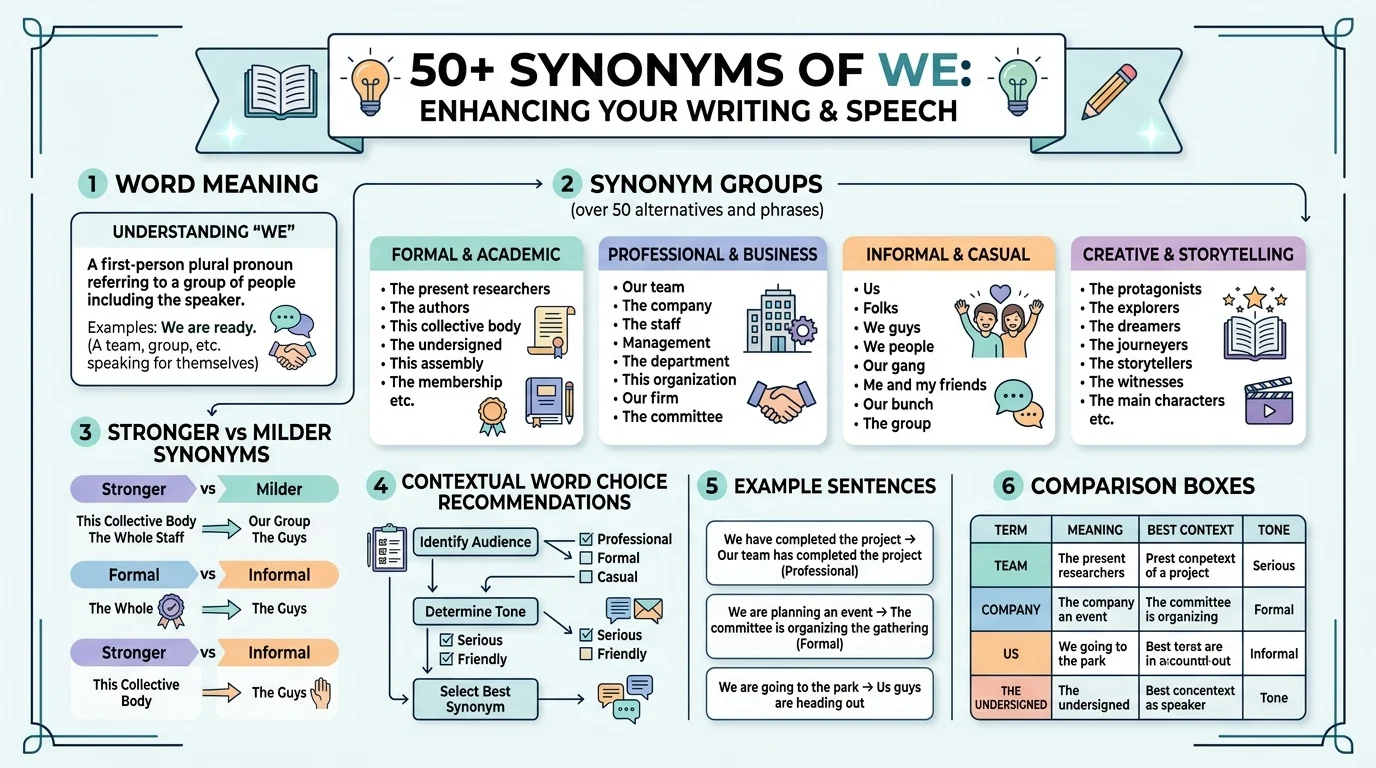
“We” is a first-person plural pronoun meaning the speaker and at least one other person. For formal writing, use “the committee,” “our team,” or “one.” For casual conversation, try “all of us” or “us.” In professional settings, “our group” or “the department” often sound more precise.
Meaning, Tone, and Context
Simple Definition
“We” is a pronoun used by a speaker or writer to refer to themselves along with one or more other people. It is the first-person plural subject pronoun, meaning it performs the action in a sentence.
Part of Speech
Pronoun (first-person plural, nominative case)
Overall Tone
Neutral. “We” does not carry strong positive or negative emotional weight on its own. Its tone is shaped entirely by the words and context around it.
Formality Level
Neutral to Semi-Formal. “We” works in almost any situation, from casual texting to business meetings to academic papers. However, in very formal or legal writing, writers sometimes avoid “we” to sound more objective.
Common Uses
Native English speakers use “we” constantly in everyday life. Common uses include:
- Referring to yourself and another person: “We are going to the store.”
- Referring to a group you belong to: “We close at 5 PM.”
- Referring to people in general: “We all need water to survive.”
- The editorial “we,” used by writers to represent a collective viewpoint
- The royal “we,” used by monarchs to refer to themselves formally
Word Forms
- Pronoun (subject): we
- Pronoun (object): us
- Possessive adjective: our
- Possessive pronoun: ours
- Reflexive pronoun: ourselves
When and How to Use “We”
Choosing “we” is usually the right call when you are part of the group you are talking about. Here are seven realistic examples showing how “we” fits naturally into different contexts.
Professional
“We will finalize the quarterly budget by Friday and share it with the board.”
Academic
“In this study, we analyzed data from 500 participants across three age groups.”
Workplace
“We need to align our messaging before the client presentation next week.”
Personal
“We are planning a road trip along the Pacific Coast Highway this summer.”
“We appreciate your patience as we resolve this technical issue.”
Resume
“We increased sales by 20% within six months of launching the new product line.”
“We cannot believe how fast this year has flown by. Thank you for all the support!”
Best Synonyms of “We”
No synonym is identical to “we” in every situation. The best alternative depends on your audience, purpose, and tone. Here are the best synonyms for specific contexts.
Professional Writing
Our team or the department. These alternatives sound polished and specific, showing exactly who you mean without being vague.
Academic Writing
This study or the researchers. These phrases maintain objectivity and remove the first-person pronoun when formality is required.
Business Communication
Our group or the committee. These terms clarify the specific people involved while keeping a professional tone.
Casual Conversation
All of us or everyone. These phrases feel warm, inclusive, and natural in everyday speech.
Emotional Writing
We ourselves adds emphasis and emotional weight, highlighting personal involvement or shared sentiment.
Creative Writing
Our band, our crew, or the ensemble. These descriptive terms add color and personality to storytelling.
Resume Writing
My team and I or our division. These phrases showcase leadership and collaboration without sounding self-centered.
Workplace Communication
Our staff or the group. These alternatives sound professional and clearly define who is involved.
Stronger Meaning
We ourselves adds intensity and emphasis, making the group’s role more prominent.
Softer Meaning
Folks or everyone softens the tone, making the group sound more approachable and less formal.
When Not to Use “We”
Sometimes “we” is not the best choice. Here are situations where you should choose a different word.
When It Sounds Too Vague
If your reader does not know who “we” refers to, the sentence becomes confusing.
Weak: “We need to approve this.”
Stronger: “The board needs to approve this.”
When It Sounds Too Informal
In highly formal documents like legal contracts or official policies, “we” can feel too casual.
Weak: “We require all employees to sign this form.”
Stronger: “All employees are required to sign this form.”
When It Sounds Too Weak
If you want to take personal responsibility, using “we” can hide your individual role.
Weak: “We made a mistake on the report.”
Stronger: “I made a mistake on the report.”
When It Sounds Too Strong
If you are not actually part of the group, using “we” can feel presumptuous or even condescending.
Weak: “We are feeling a bit tired today, aren’t we?” (said to a patient)
Stronger: “How are you feeling today?”
Words Commonly Confused With “We”
We vs Us
Difference: “We” is a subject pronoun (performs the action). “Us” is an object pronoun (receives the action).
When to Use It: Use “we” before verbs. Use “us” after verbs or prepositions.
Example (We): “We walked to the park.”
Example (Us): “She gave us the tickets.”
We vs Our
Difference: “We” is a pronoun that stands alone. “Our” is a possessive adjective that modifies a noun.
When to Use It: Use “we” as the subject. Use “our” to show ownership.
Example (We): “We finished the project.”
Example (Our): “Our project was a success.”
We vs Ourselves
Difference: “Ourselves” is a reflexive pronoun used when the subject and object are the same.
When to Use It: Use “ourselves” when the group performs an action on or for itself.
Example (We): “We painted the house.”
Example (Ourselves): “We painted the house ourselves.”
We vs You
Difference: “We” includes the speaker. “You” addresses the listener directly. Sometimes “we” is used informally in place of “you”.
When to Use It: Use “we” for inclusive statements. Use “you” for direct address.
Example (We): “We should all recycle more.”
Example (You): “You should recycle more.”
We vs One
Difference: “One” is a formal, impersonal pronoun referring to people in general.
When to Use It: Use “one” in very formal or academic writing to sound objective.
Example (We): “We should always tell the truth.”
Example (One): “One should always tell the truth.”
We vs They
Difference: “We” includes the speaker. “They” excludes the speaker and refers to other people.
When to Use It: Use “we” when you are part of the group. Use “they” when you are not.
Example (We): “We support the new policy.”
Example (They): “They support the new policy.”
Best Synonyms of “We” by Context
| Context | Best Synonym | Why It Works | Example |
|---|---|---|---|
| Formal writing | One | Sounds objective and impersonal | “One must consider all options.” |
| Academic writing | This study | Removes first-person bias | “This study examines the data.” |
| Professional communication | Our team | Specifies the group clearly | “Our team will handle the account.” |
| Business emails | The department | Sounds official and professional | “The department will review your request.” |
| Resume writing | My team and I | Shows leadership and collaboration | “My team and I launched the campaign.” |
| Workplace communication | Our staff | Clearly defines employees | “Our staff will implement the changes.” |
| Casual conversation | All of us | Feels warm and inclusive | “All of us are going to the game.” |
| Everyday speaking | Everyone | Simple and natural | “Everyone needs to eat lunch.” |
| Creative writing | Our crew | Adds personality and flavor | “Our crew sailed through the storm.” |
| Storytelling | The group | Keeps the narrative clear | “The group decided to explore further.” |
| Emotional writing | We ourselves | Adds emphasis and feeling | “We ourselves witnessed the miracle.” |
| Strong emphasis | We ourselves | Highlights personal involvement | “We ourselves built this from nothing.” |
| Mild tone | Folks | Soft and approachable | “Folks around here are friendly.” |
| Social media captions | Us | Short and engaging | “Come join us for the adventure.” |
How to Choose the Best Synonym of “We”
Choosing the right synonym comes down to four simple questions.
Who is your audience? For a boss or professor, choose formal alternatives like “the committee” or “this study.” For friends, choose casual options like “all of us” or “everyone.”
What is your purpose? If you are taking responsibility, say “I” instead of hiding behind “we.” If you are giving credit to a team, say “our team” or “the group.”
How much emotion do you want? For neutral statements, stick with “we” or “our group.” For emotional emphasis, use “we ourselves” or “our very own.”
Does the reader know who you mean? If there is any confusion, name the group directly. “The marketing department” is always clearer than “we” when the reader does not know who is on the team.
The best synonym is the one that communicates your intended message most clearly to your specific reader.
Real Life Examples of “We”
Here are realistic examples showing how replacing “we” with stronger synonyms can improve your writing.
School
Original: “We presented our science fair project.”
Improved: “Our group presented the science fair project.”
College
Original: “We argue that the data supports this conclusion.”
Improved: “This paper argues that the data supports this conclusion.”
Workplace
Original: “We will finish the report by Friday.”
Improved: “Our department will finish the report by Friday.”
Business
Original: “We appreciate your business.”
Improved: “Everyone at our company appreciates your business.”
Original: “We will get back to you soon.”
Improved: “Our support team will get back to you soon.”
Resume
Original: “We increased revenue by 15%.”
Improved: “My team and I increased revenue by 15%.”
Conversation
Original: “We should go to the movies.”
Improved: “All of us should go to the movies.”
Storytelling
Original: “We walked through the haunted house.”
Improved: “Our small band walked through the haunted house.”
Blogging
Original: “We believe this is the best method.”
Improved: “In our experience, this is the best method.”
Original: “We are so excited for this launch!”
Improved: “Our whole team is so excited for this launch!”
18 Best Synonyms of “We”
| Synonym | Simple Meaning | Best Used For | Example Sentence |
|---|---|---|---|
| All of us | Every person in the group | Casual and inclusive statements | “All of us agreed to the plan.” |
| Our team | The group working together | Professional and workplace settings | “Our team meets every Monday morning.” |
| The group | A collection of people | Neutral, clear references | “The group decided to take a vote.” |
| Ourselves | We as both subject and object | Reflexive or emphatic statements | “We built the entire house ourselves.” |
| The committee | An official decision-making group | Formal and business contexts | “The committee will review the proposal.” |
| Our staff | Employees of an organization | Workplace and professional communication | “Our staff is trained to handle emergencies.” |
| The department | A specific division within an organization | Business and academic settings | “The department approved the new curriculum.” |
| Everyone | All people in a group | Everyday conversation | “Everyone is invited to the party.” |
| Our crew | A close-knit working group | Creative and informal contexts | “Our crew finished the film ahead of schedule.” |
| This study | The research being conducted | Academic and scientific writing | “This study focuses on climate change.” |
| The researchers | People conducting research | Academic and formal writing | “The researchers published their findings.” |
| We ourselves | Emphasizing the group’s direct involvement | Emotional or emphatic statements | “We ourselves witnessed the event.” |
| Our division | A subsection of a larger organization | Professional and corporate contexts | “Our division exceeded its quarterly targets.” |
| The ensemble | A group performing together | Creative and artistic writing | “The ensemble received a standing ovation.” |
| Our party | A group traveling or acting together | Social and informal contexts | “Our party arrived at the restaurant first.” |
| Folks | People in a friendly, informal way | Casual conversation and social media | “Folks around here are incredibly kind.” |
| The public | People in general | Formal and official statements | “The public is encouraged to attend the meeting.” |
| One | People in general (formal) | Very formal or academic writing | “One must always consider the consequences.” |
Synonyms of “We” by Usage
Professional vs Personal Synonyms
In professional settings, choose specific group labels like “our team,” “the department,” or “our staff.” These terms sound polished and clearly define who is involved.
In personal conversations, choose warm, inclusive options like “all of us,” “everyone,” or “folks.” These feel natural and friendly.
Formal vs Conversational Synonyms
For formal writing such as reports, essays, and business presentations, use “one,” “the committee,” or “this study.” These alternatives remove the first-person pronoun and create an objective tone.
For casual conversations, texting, and social media, use “all of us,” “everyone,” or “us.” These are simple, direct, and conversational.
Academic Synonyms
In academic writing, precision and authority matter. Use “this study,” “the researchers,” or “the data” as the subject of your sentences. These phrases sound more authoritative than “we” and maintain the objectivity expected in scholarly work.
Professional and Business Synonyms
For resumes, interviews, meetings, and client communication, choose “our team,” “my team and I,” or “our division.” These alternatives showcase collaboration and leadership without sounding overly personal or vague.
Creative and Literary Synonyms
For storytelling, fiction, poetry, and speeches, choose descriptive alternatives like “our crew,” “the ensemble,” or “our band.” These add personality, imagery, and emotional depth to your writing.
Slang or Modern Synonyms
There are no widely used slang synonyms for “we.” In very casual digital communication, some people use “we fam” or “us” in place of “we,” but these are not standard and should be avoided in professional or academic writing.
Strongest to Mildest Synonyms
Mild: folks, everyone
Moderate: all of us, our group, the team
Strong: we ourselves, our very own
Very Strong: we ourselves (with heavy emphasis)
Emotional vs Neutral Synonyms
Emotional Synonyms: “we ourselves” and “our very own” add feeling and personal investment. Use these when you want to emphasize shared experience or personal involvement.
Neutral Synonyms: “the group,” “the committee,” and “one” simply communicate information without adding emotion. Use these for objective, factual, or formal writing.
Antonyms of “We”
| Antonym | Meaning | Example Sentence |
|---|---|---|
| I | The speaker alone | “I will handle this myself.” |
| You | The person being addressed | “You should go first.” |
| They | Other people, excluding the speaker | “They are not coming to the meeting.” |
| He | One male person | “He is responsible for the project.” |
| She | One female person | “She completed the report on time.” |
| It | One object or animal | “It needs to be fixed.” |
| Me | The speaker as an object | “She gave the award to me.” |
| Him | One male as an object | “I spoke to him yesterday.” |
| Her | One female as an object | “We invited her to the party.” |
| Them | Other people as an object | “We sent them the documents.” |
| Myself | The speaker alone (reflexive) | “I did it myself.” |
| Yourself | The person addressed alone | “You should believe in yourself.” |
| Himself | One male alone (reflexive) | “He hurt himself.” |
| Herself | One female alone (reflexive) | “She taught herself French.” |
| Itself | One object or animal alone | “The door closed by itself.” |
Comparison: “We” vs Similar Words
We vs I
Main Difference: “We” refers to the speaker and at least one other person. “I” refers to the speaker alone.
Which Is Stronger? “I” is stronger for taking personal responsibility. “We” is stronger for showing teamwork.
Which Is More Formal? Both are neutral, but “I” can feel too personal in some formal writing.
When to Use Each: Use “I” when you want to own your actions. Use “we” when you are speaking for a group.
Examples
- We: “We appreciate your feedback.”
- I: “I appreciate your feedback.”
We vs Our
Main Difference: “We” is a subject pronoun. “Our” is a possessive adjective that must be followed by a noun.
Which Is Stronger? “We” is stronger as a subject. “Our” is stronger for showing ownership.
Which Is More Formal? Both are neutral.
When to Use Each: Use “we” as the subject of a sentence. Use “our” to modify a noun.
Examples
- We: “We finished the project.”
- Our: “Our project was a success.”
We vs Us
Main Difference: “We” is a subject pronoun. “Us” is an object pronoun.
Which Is Stronger? “We” is stronger in subject position. “Us” is weaker because it receives the action.
Which Is More Formal? Both are neutral.
When to Use Each: Use “we” before verbs. Use “us” after verbs or prepositions.
Examples
- We: “We went to the store.”
- Us: “She went with us.”
We vs Ourselves
Main Difference: “Ourselves” is a reflexive pronoun used when the subject and object are the same.
Which Is Stronger? “Ourselves” adds emphasis and can make the action feel more significant.
Which Is More Formal? Both are neutral.
When to Use Each: Use “ourselves” when the group performs an action on or for itself.
Examples
- We: “We painted the house.”
- Ourselves: “We painted the house ourselves.”
We vs You
Main Difference: “We” includes the speaker. “You” addresses the listener directly. Sometimes “we” is used informally in place of “you”.
Which Is Stronger? “You” is more direct. “We” can be more polite or inclusive.
Which Is More Formal? “You” is more direct. “We” can be more diplomatic.
When to Use Each: Use “you” for direct address. Use “we” for inclusive statements or when being polite.
Examples
- We: “We should all try harder.”
- You: “You should try harder.”
We vs One
Main Difference: “One” is a formal, impersonal pronoun referring to people in general.
Which Is Stronger? “We” feels more personal and inclusive. “One” feels more objective and detached.
Which Is More Formal? “One” is much more formal.
When to Use Each: Use “one” in very formal or academic writing to sound objective. Use “we” in almost every other situation.
Examples
- We: “We should always tell the truth.”
- One: “One should always tell the truth.”
Common Phrases and Expressions with “We”
Common Mistakes to Avoid
Mistake 1: Using “We” When You Mean “Us”
Incorrect: “The manager gave we the report.”
Better: “The manager gave us the report.”
Why: “Us” is the object pronoun and should follow the verb.
Mistake 2: Using “We” Too Vaguely
Incorrect: “We need to approve this.” (Who is “we”?)
Better: “The board needs to approve this.”
Why: Naming the specific group removes confusion.
Mistake 3: Using “We” to Avoid Responsibility
Incorrect: “We made a mistake.” (when you alone made the mistake)
Better: “I made a mistake.”
Why: Taking personal responsibility sounds more honest and professional.
Mistake 4: Using “We” When You Are Not Part of the Group
Incorrect: “We are feeling tired today, aren’t we?” (said to a patient)
Better: “How are you feeling today?”
Why: Using “we” to refer to someone else can sound condescending.
Mistake 5: Overusing “We” in Writing
Incorrect: “We think we should we move forward with we plan.”
Better: “Our team recommends moving forward with the plan.”
Why: Replacing repeated “we” with varied synonyms improves readability.
Mistake 6: Using Slang “We” in Professional Writing
Incorrect: “We fam gonna crush this presentation.”
Better: “Our team will deliver an excellent presentation.”
Why: Slang is inappropriate in professional contexts.
Mistake 7: Confusing “We” with “Our”
Incorrect: “We project needs more time.”
Better: “Our project needs more time.”
Why: “Our” is the possessive form and must modify a noun.
Frequently Asked Questions
What are the best synonyms of “we”?
The best synonyms depend on your context. Professional writing, use “our team” or “the department.” For casual conversation, use “all of us” or “everyone.” For academic writing, use “this study” or “the researchers.”
What are the best formal synonyms of “we”?
The best formal synonyms include “one,” “the committee,” “this study,” and “the researchers.” These alternatives remove the first-person pronoun and create an objective, authoritative tone suitable for formal and academic writing.
What are common informal synonyms of “we”?
Common informal synonyms include “all of us,” “everyone,” “folks,” and “us.” These alternatives feel warm, inclusive, and natural in everyday conversation, texting, and social media.
What is another word for “we” in professional writing?
In professional writing, use “our team,” “the department,” “our staff,” or “our division.” These terms sound polished and clearly define who is involved, making your communication more precise and professional.
What is the difference between “we” and “us”?
“We” is a subject pronoun used as the subject of a sentence. “Us” is an object pronoun used as the object of a verb or preposition. For example, “We went to the store” (subject) versus “She went with us” (object).
What is the opposite of “we”?
The opposite of “we” is any pronoun that refers to a single person or excludes the speaker. Common opposites include “I,” “you,” “he,” “she,” “it,” and “they.” The most direct opposite is “I,” which refers to the speaker alone.
Conclusion
“We” is a simple, powerful pronoun that connects the speaker to others. It is neutral, versatile, and works in almost every situation. But no single word works perfectly every time. The best synonyms of we depend on your audience, tone, and purpose. Formal writing, choose “one” or “the committee.” For professional settings, choose “our team” or “the department.” For casual conversation, choose “all of us” or “everyone.” The key to great writing is choosing the word that communicates your message most clearly. Next time you write, read your sentences aloud. If you hear “we” too often, swap in a stronger, more specific synonym. Your readers will notice the difference.
2 thoughts on “50+ Synonyms of We | Meanings, Uses, Examples, and Best Alternatives”