Have you ever read back your own writing and noticed the word “so” appearing in nearly every sentence? This tiny word has a sneaky habit of creeping into our emails, essays, and conversations far too often. The problem is not that “so” is incorrect. The problem is that it makes your writing sound repetitive and your vocabulary feel limited.
Picture this scenario. You are writing an important cover letter or a professional email. You reread your work and spot “so” used five times in one paragraph. The message is clear but the impact is weak. Your reader might notice the repetition before they notice your actual qualifications or ideas. That is exactly why learning synonyms for so can transform your communication.
Think about the times you have struggled to find the right word in a conversation. You wanted to sound confident but ended up using filler words. Or perhaps you are a student working on an essay and your teacher has marked every “so” with a note asking for more precise language. These situations happen to everyone and they highlight the importance of vocabulary flexibility.
This guide will help you move beyond that single word. We will explore the nuanced meanings behind “so” and provide you with a complete toolkit of alternatives. You will learn which words work best in professional settings, which ones add emotional weight to creative writing, and which ones keep your academic papers sounding precise. By the end of this article, you will never have to overuse “so” again.
What Does “So” Mean?
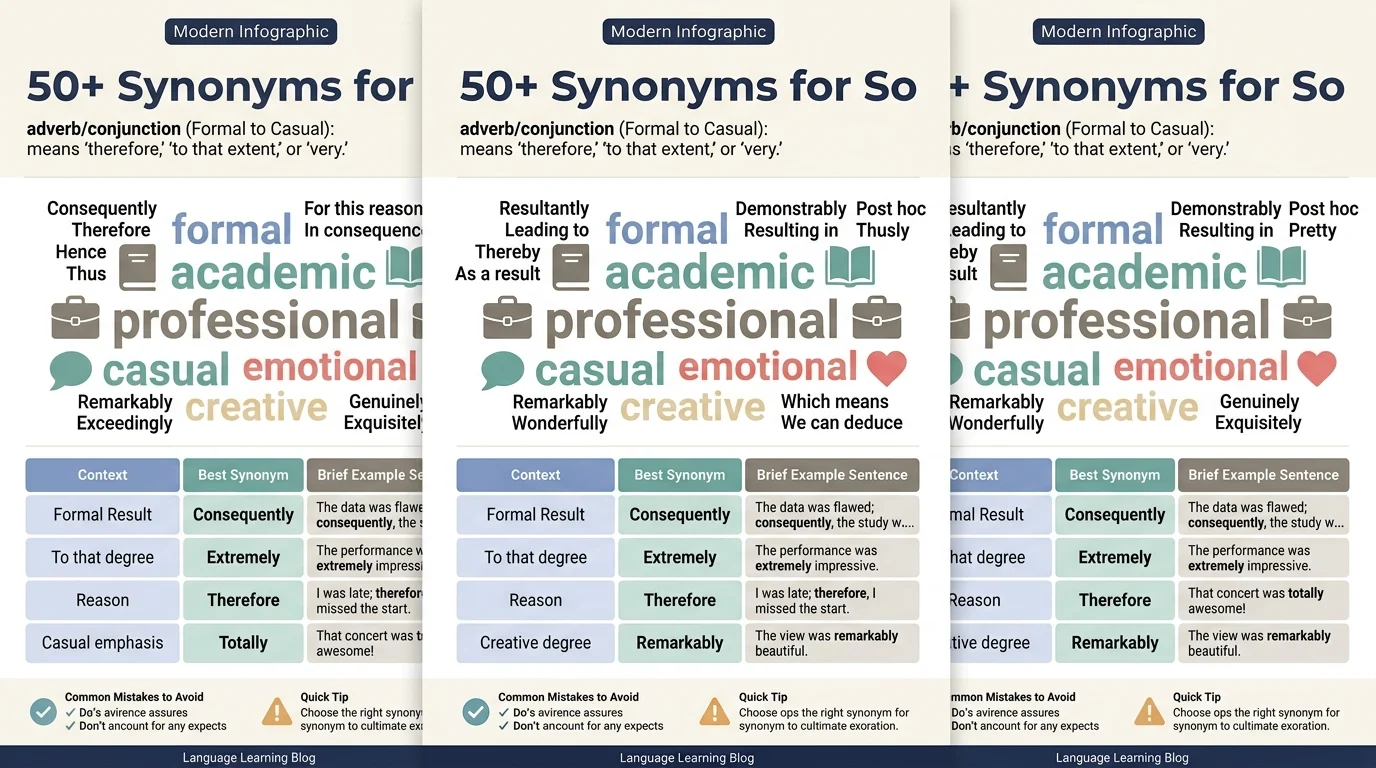
So is a versatile English word that functions as an adverb, conjunction, or adjective. It expresses degree, consequence, or agreement. The best synonyms depend on your context. For formal writing use therefore or consequently. For casual conversation use thus or hence. Emotional expression use extremely or incredibly. For professional communication use accordingly or as a result.
Meaning, Tone and Context
Simple Definition
So primarily indicates a high degree of something or shows a logical result. It can also be used to agree with a statement or to introduce a new topic. This small word carries significant weight in English sentences.
Part of Speech
So functions as an adverb, a conjunction, and occasionally as an adjective. This flexibility makes it one of the most commonly used words in English.
Positive, Negative, or Neutral Tone
The tone of so varies widely. It can be neutral when used as a conjunction. Becomes emphatic when used as an adverb. It can sound casual or informal depending on the context. The tone shifts based on how and where you place it.
Formality Level
So is generally informal in most of its uses. It works well in everyday conversation and casual writing. Formal writing often requires more precise alternatives.
Common Use Cases
You will find so used to express intensity, show cause and effect, agree with someone, or transition between ideas. It appears in spoken English more frequently than in written English.
Important Word Forms
So does not have many word forms. However, the phrase “so that” introduces purpose. The structure “so…that” expresses degree and result. These forms have their own grammatical rules.
When and How to Use “So”
So serves multiple purposes in English sentences. You can use it to emphasize an adjective or adverb. You can also use it to connect two ideas where one causes the other. This flexibility makes it useful but also easy to overuse.
Professional Example: The project was so complex that we needed additional team members to complete it on time.
Personal Example: I was so tired after work that I fell asleep on the couch immediately.
Academic Example: The experiment yielded significant results, so the researchers decided to expand their study.
Emotional Example: She was so excited about her new job opportunity that she could barely contain her joy.
Creative Example: The sunset painted the sky so beautifully that everyone stopped to take photographs.
Social Media Example: This recipe is so easy to make and tastes absolutely delicious.
Email Example: I have attached the revised document, so please review it at your convenience.
Casual Example: The movie was so good that I watched it twice in one weekend.
Another Word for “So”
The best single replacement for so depends entirely on your context. You need to consider what role so plays in your sentence. Is it showing intensity? Is it showing a result? Each function requires a different synonym.
Professional Writing: Use therefore, consequently, or accordingly. These words sound polished and precise. They show logical thinking and clear reasoning.
Academic Writing: Use thus, hence, or consequently. These words carry scholarly weight. They demonstrate intellectual rigor and careful argumentation.
Casual Conversation: Use really, very, or extremely. These words feel natural in everyday speech. They keep your tone friendly and approachable.
Emotional Writing: Use incredibly, immensely, or unbelievably. These words add passion and feeling. They help readers connect with your emotions.
Creative Writing: Use profoundly, remarkably, or exceptionally. These words paint vivid pictures. They add depth and texture to your descriptions.
Resume Writing: Use significantly, substantially, or notably. These words highlight achievements. They make your accomplishments sound impressive.
Social Media Captions: Use totally, absolutely, or literally. These words feel current and engaging. They match the energetic style of social platforms.
Stronger Meaning: Use exceedingly, exceptionally, or extraordinarily. These words amplify your message. They leave no doubt about your intensity.
Softer Meaning: Use fairly, moderately, or somewhat. These words tone down your statement. They add nuance and subtlety to your writing.
When Not to Use “So”
So can sound too vague in formal writing. Consider this weak sentence: The company performed well this quarter, so we are increasing bonuses. The word so does not explain the connection clearly. A stronger version would be: The company performed well this quarter. Therefore, we are increasing bonuses.
So can sound too casual in academic papers. Writing “The results were so significant” lacks precision. Academic readers expect formal language. Write “The results were highly significant” or “The results were remarkably significant.”
So can sound too weak in professional emails. Saying “I am so sorry for the delay” feels informal and slightly unprofessional. Instead write “I sincerely apologize for the delay” or “I deeply regret the delay.”
So can sound repetitive in creative writing. Using “so beautiful, so elegant, so perfect” loses impact quickly. Replace each instance with varied and descriptive synonyms.
So can make your writing appear immature. Overusing any word makes you sound like a less experienced writer. Strong writing uses precise vocabulary and varied sentence structures.
Consider this upgrade: Original: The presentation was so long that people lost interest. Better: The presentation was excessively long and people lost interest.
Words Commonly Confused With “So”
Therefore: Therefore shows a direct logical conclusion. It is more formal than so. Use therefore when you want to emphasize reasoning.
Thus: Thus is similar to therefore but slightly more formal. It works well in academic writing. Use thus when you need a scholarly tone.
Hence: Hence is old fashioned but still useful in formal contexts. It often means “from this point forward.” Use hence in legal or very formal writing.
Very: Very emphasizes degree but does not show cause and effect. You cannot use very to replace so when so connects two clauses. These words serve different grammatical functions.
Really: Really adds emphasis in casual speech. It is not appropriate for formal writing. Use really only in informal situations.
Extremely: Extremely shows high intensity. It can replace so when so modifies an adjective or adverb. It cannot replace so as a conjunction.
Best Synonym by Context for “So”
| Context | Best Synonym | Why It Works | Example |
|---|---|---|---|
| Formal Writing | Therefore | Shows clear logical conclusion in official documents | The evidence was compelling. Therefore, the committee approved the proposal. |
| Academic Writing | Thus | Adds scholarly precision to research papers | The data supports this hypothesis. Thus, further investigation is warranted. |
| Professional Business | Consequently | Demonstrates professional cause and effect reasoning | Sales increased significantly. Consequently, we expanded our operations. |
| Resume Writing | Significantly | Highlights achievement magnitude for employers | I significantly improved team productivity through new training methods. |
| Casual Conversation | Really | Feels natural and friendly in everyday speech | This pizza is really delicious. We should order from here more often. |
| Creative Writing | Profoundly | Adds emotional depth to descriptive passages | The music affected her profoundly, bringing tears to her eyes. |
| Emotional Tone | Incredibly | Expresses strong feelings authentically | She was incredibly grateful for all the support she received. |
| Strong Intensity | Exceedingly | Amplifies your message with maximum emphasis | The task was exceedingly difficult but we completed it successfully. |
| Soft or Moderate | Somewhat | Tones down your statement for nuance | I am somewhat concerned about the timeline but remain optimistic. |
| Social Media | Totally | Feels current and engaging for online audiences | This new coffee shop is totally worth visiting. The ambiance is perfect. |
| US Usage | So | Acceptable across all contexts in American English | The traffic was so heavy this morning that I was late. |
| UK Usage | Thus | More commonly used in British academic writing | The study concluded thus: further research is needed. |
Which Synonym Should You Choose?
Choosing the right synonym requires understanding your purpose and audience. Start by identifying what role so plays in your sentence. Are you showing intensity or demonstrating a result? The answer to this question narrows your options significantly.
Consider your formality level next. A research paper demands different vocabulary than a text message. Match your word choice to the expectations of your reader. Professional documents require precise and polished language.
Think about emotional intensity. Some synonyms carry strong emotional weight. Others remain neutral and factual. Choose based on whether you want to express feeling or simply state information.
Consider your sentence structure. Some synonyms work better at the beginning of a clause. Others fit naturally in the middle. Test your chosen word in the actual sentence to ensure it flows smoothly.
Evaluate the professional value of your word. Some synonyms sound more impressive to employers and colleagues. These words can elevate your professional reputation when used appropriately.
Remember that context matters more than the word itself. A synonym that works perfectly in one situation may sound awkward in another. Practice using different alternatives to develop your instinct for the right choice.
Real Life Examples of “So” in Sentences
School Example: The teacher explained the concept so clearly that every student understood it immediately.
Workplace Example: We completed the project ahead of schedule. Consequently, the client awarded us additional work.
Writing Example: The author described the setting so vividly that readers could picture every detail.
Conversation Example: I am really looking forward to the weekend. We have so many fun plans.
Social Media Example: This view from the mountain top is absolutely breathtaking. Everyone should experience this at least once.
Resume Example: I successfully reduced operating costs by implementing new efficiency measures.
Email Example: I have reviewed your proposal. Therefore, I recommend we proceed with implementation.
Storytelling Example: The hero faced impossible odds. Nevertheless, she never gave up hope.
25 Synonyms for “So”
| Synonym | Simple Meaning | Best Used For | Example Sentence |
|---|---|---|---|
| Therefore | As a result of something | Formal reports and professional documents | The budget was reduced. Therefore, we scaled back our plans. |
| Consequently | Following as a result | Showing logical outcomes | The weather worsened. Consequently, the event was moved indoors. |
| Thus | In this way or as a result | Academic and scholarly writing | The experiment proved successful. Thus, the theory was validated. |
| Hence | From this point forward | Formal and legal contexts | The contract was signed. Hence, all parties are bound by its terms. |
| Accordingly | In a way that is appropriate | Professional correspondence | We received your request. Accordingly, we have made the changes. |
| Extremely | To a very high degree | Emphasizing intensity | The movie was extremely entertaining and kept everyone engaged. |
| Incredibly | In a way that is hard to believe | Expressing strong emotion | The team worked incredibly hard to meet the deadline. |
| Remarkably | In a way that is unusual or surprising | Highlighting exceptional qualities | She performed remarkably well in her first leadership role. |
| Exceptionally | To an unusually high degree | Describing outstanding performance | The food was exceptionally good at the new restaurant. |
| Profoundly | In a deep or intense way | Creative and emotional writing | His words affected me profoundly and changed my perspective. |
| Significantly | In a way that is important | Professional and academic writing | The new policy significantly improved employee satisfaction. |
| Substantially | To a large or considerable degree | Business and financial contexts | The company substantially increased its market share. |
| Notably | In a way that is deserving attention | Highlighting key achievements | She notably contributed to the success of the project. |
| Exceptionally | To an unusual degree | Describing standout qualities | The service was exceptionally friendly and professional. |
| Unbelievably | In a way that is hard to believe | Casual and emotional expression | The news was unbelievably good and we celebrated immediately. |
| Very | To a great degree | General emphasis in speech | This task is very important and requires careful attention. |
| Really | Actually or truly | Informal conversation and writing | I really appreciate your help with this project. |
| Totally | Completely or absolutely | Modern and casual contexts | I totally agree with your assessment of the situation. |
| Absolutely | Without any doubt | Emphatic statements | The presentation was absolutely brilliant and well received. |
| Completely | To the fullest extent | Strong emphasis | The renovation completely transformed the old building. |
| Entirely | Wholly or fully | Formal emphasis | The decision was entirely based on the available evidence. |
| Fairly | To a moderate degree | Softening statements | The results were fairly consistent across all test groups. |
| Somewhat | To a limited extent | Expressing moderate opinions | I am somewhat concerned about the project timeline. |
| Moderately | Within reasonable limits | Balanced descriptions | The temperature was moderately warm for this time of year. |
| Slightly | To a small degree | Minor emphasis | The new model is slightly more efficient than the previous one. |
Synonym Groups and Usage Differences
Professional vs. Personal Synonyms
Professional synonyms emphasize logic and clarity. Therefore, consequently, and accordingly show careful reasoning. These words build credibility in workplace communication. Personal synonyms emphasize feeling and connection. Really, incredibly, and totally express genuine emotions. These words build rapport in personal relationships. Choose based on whether you are building professional authority or personal connection.
Formal vs. Conversational Synonyms
Formal synonyms include therefore, thus, and hence. These words appear in official documents, academic papers, and legal writing. Conversational synonyms include really, totally, and absolutely. These words appear in everyday speech, text messages, and social media. Mixing these levels can make you sound confused or inauthentic. Match your vocabulary to your audience.
Academic Synonyms
Academic writing demands precision and formality. Thus, hence, and consequently are standard choices. These words signal logical reasoning and scholarly thinking. Use them in research papers, essays, and academic presentations. Avoid casual synonyms like really or totally in academic contexts. Professors and reviewers notice vocabulary choices.
Professional and Business Synonyms
Business writing requires clear cause and effect language. Therefore, accordingly, and consequently work well. These words demonstrate professional thinking. Use them in emails, reports, and presentations. They show that you understand business logic and professional standards. Avoid informal synonyms that might reduce your professional credibility.
Creative or Literary Synonyms
Creative writing benefits from varied and vivid vocabulary. Profoundly, remarkably, and exceptionally add depth. These words create imagery and emotional resonance. Use them in fiction, poetry, and descriptive writing. They help readers visualize and feel your words. Ordinary synonyms cannot match their creative impact.
Slang or Modern Synonyms
Modern slang like lowkey, hella, or deadass should be avoided in formal writing. These words appear in casual speech and social media. They change meaning quickly and may confuse older readers. Use modern synonyms only when writing for young audiences. Always consider whether your readers will understand and appreciate slang terms.
Strongest vs. Weaker Synonyms
Intensity scale from mild to strongest: slightly, somewhat, fairly, moderately, very, really, extremely, incredibly, remarkably, exceptionally, profoundly, exceedingly. Choose your intensity level carefully. Too much intensity sounds exaggerated. Too little intensity sounds weak. Match your intensity to the situation and your emotional state.
Emotional vs. Neutral Synonyms
Emotional synonyms like incredibly, profoundly, and unbelievably add feeling. Neutral synonyms like therefore, consequently, and thus stay factual. Emotional words engage readers on a personal level. Neutral words convey information clearly. Choose based on whether you want to inform or connect.
Antonyms of “So”
| Antonym | Meaning | Example Sentence |
|---|---|---|
| Slightly | To a small degree | The results improved only slightly from the previous test. |
| Somewhat | To a moderate extent | I am somewhat disappointed with the outcome. |
| Barely | Only just | The team barely met the deadline despite their efforts. |
| Hardly | Almost not at all | The changes hardly affected the final results. |
| Minimally | To the smallest possible degree | The new features added minimally to the overall cost. |
| Moderately | Within reasonable limits | The temperature was moderately warm during the afternoon. |
| Marginally | To a very small extent | Performance improved marginally after the training. |
| Insignificantly | Without importance | The differences were statistically insignificant. |
| Negligibly | So small as to be unimportant | The error affected the outcome negligibly. |
| Scarcely | Only just or hardly | We scarcely had time to prepare before the meeting. |
| Partially | Not completely | The project was partially completed by the deadline. |
| Incompletely | Not fully finished | The task was incompletely done and needed revision. |
| Not very | To a lesser degree | The speech was not very inspiring to the audience. |
| Sparse | Scattered or thin | Information about the topic was sparse in the report. |
| Insufficient | Not enough | The evidence was insufficient to support the claim. |
Comparison: So vs. Similar Words
So vs. Therefore
The main difference is formality. So is informal and conversational. Therefore is formal and professional. Therefore works better in academic and business writing. So works better in casual speech and personal writing. Which one is stronger? Therefore carries more logical weight. Example with so: The test was difficult, so I studied more. Example with therefore: The test proved challenging. Therefore, I dedicated additional time to study.
So vs. Thus
Thus is more formal than so. It appears in scholarly and legal writing. So appears in everyday conversation. Thus suggests a more deliberate logical connection. So suggests a natural or obvious connection. Example with so: It was raining, so we stayed inside. Example with thus: The weather forecast predicted rain. Thus, we rescheduled the outdoor event.
So vs. Hence
Hence is old fashioned but still used formally. It often means “from this point forward.” So is modern and versatile. Hence sounds more decisive and final. So sounds more casual and open. Example with so: The deadline is tomorrow, so we need to work fast. Example with hence: The deadline is tomorrow. Hence, all work must be submitted by 5 PM.
So vs. Very
Very only shows intensity. So shows intensity but can also show results. Very cannot connect two clauses. So can function as a conjunction. Very is an adverb only. So is an adverb and a conjunction. Example with so: She was so tired that she slept for twelve hours. Example with very: She was very tired and fell asleep quickly.
So vs. Really
Really is more casual than so. Really adds authenticity in speech. So can show both intensity and results. Really only shows intensity. Really sounds more personal. So sounds more general. Example with so: The movie was so good that I watched it twice. Example with really: The movie was really good and I enjoyed it immensely.
So vs. Extremely
Extremely is stronger than so. Extremely shows maximum intensity. So is more moderate and flexible. Extremely is formal and precise. So is casual and general. Example with so: The coffee was so hot that I burned my tongue. Example with extremely: The coffee was extremely hot and required careful handling.
Common Phrases and Expressions with “So”
1. So far so good
Meaning: Everything is going well up until this point. Example: We have completed the first three phases of the project. So far so good.
2. So to speak
Meaning: In a manner of speaking or in a way. Example: He is the team leader, so to speak, even without the official title.
3. So long as
Meaning: Provided that or on condition that. Example: So long as you complete your assignments on time, you will pass the course.
4. Ever so
Meaning: Very or extremely, used for emphasis. Example: Thank you ever so much for your generous contribution to the fundraiser.
5. So what
Meaning: A dismissive response indicating lack of concern. Example: So what if we arrive a few minutes late. The event will still be happening.
6. Not so fast
Meaning: Used to tell someone to slow down or reconsider. Example: Not so fast. We need to review the budget before making any decisions.
7. So be it
Meaning: An acceptance of a situation despite reluctance. Example: If that is the final decision, so be it. We will make it work.
8. So and so
Meaning: Used in place of a name or specific detail. Example: He mentioned that so and so from the marketing department would be joining us.
Common Mistakes to Avoid
Overusing So in Formal Writing
Many writers rely on so as a crutch. This habit weakens your professional communication. Replace so with precise synonyms that show logical thinking. Your readers will notice the improvement in your writing quality.
Confusing So with Then
Then shows sequence in time. So shows cause and effect. Using then when you mean so creates confusion about your meaning. Check whether you are showing time order or logical result.
Using Casual Synonyms in Formal Writing
Words like really and totally have no place in academic papers. These words sound informal and unsophisticated. Choose formal alternatives like consequently and therefore instead. Your writing will appear more professional and credible.
Using Overly Dramatic Synonyms Casually
Words like profoundly and exceedingly sound exaggerated in everyday conversation. Use them sparingly and only when appropriate. Save dramatic language for situations that genuinely warrant strong emotion.
Repeating the Same Synonym
Finding one good synonym does not solve your problem. Varying your vocabulary keeps readers engaged. Use multiple synonyms throughout your writing. This shows vocabulary range and linguistic awareness.
Choosing Incorrect Emotional Tone
Some synonyms carry more emotional weight than others. Consider whether your message should sound neutral, passionate, or something in between. Match your emotional intensity to the situation and your audience.
Using Slang in Professional Contexts
Slang like lowkey or hella may confuse older professionals. These terms also become outdated quickly. Stick to standard English in professional settings. Save slang for casual conversations with friends.
FAQs
What is the best synonym for so?
The best synonym depends on your context. Use therefore for formal writing, really for casual conversation, and extremely for emphasis. Always match your word choice to your audience.
What is a formal synonym for so?
Therefore and consequently are excellent formal synonyms. Thus and hence also work well in formal contexts. Choose these words for academic papers and professional documents.
What is an informal synonym for so?
Really, totally, and absolutely are common informal synonyms. These words work well in everyday conversation and casual writing. They should not appear in formal documents.
What is another word for so in professional writing?
Accordingly, consequently, and therefore are professional alternatives. These words demonstrate clear thinking and precise language. They build credibility in workplace communication.
What is the difference between so and therefore?
So is informal and conversational. Therefore is formal and academic. Therefore carries more logical weight in professional contexts. So feels more natural in everyday speech.
What is the opposite of so?
Slightly, somewhat, and barely are antonyms of so. These words indicate a small degree or limited extent. They are useful when you want to tone down your statement.
Conclusion
The word so may seem small and insignificant, but its impact on your writing is substantial. Overusing this single word can make your vocabulary appear limited and your thinking seem repetitive. Learning to replace so with precise alternatives will transform your communication in every context.
We have explored the many functions of so and discovered dozens of powerful synonyms. You now understand that the right word depends on your audience, your purpose, and your emotional tone. Formal writing requires professional synonyms like therefore and consequently. Casual conversation welcomes informal choices like really and totally. Creative writing benefits from vivid alternatives like profoundly and remarkably.
Here is a practical vocabulary tip for your everyday writing. Before you type the word so, pause and ask yourself what role it is playing in your sentence. Are you showing intensity or demonstrating a result? This quick mental check will help you choose the most effective synonym every time.
Your readers will notice the difference. Your writing will sound more polished, more professional, and more engaging. You will communicate your ideas with greater clarity and impact. Start practicing these synonyms today and watch your vocabulary grow stronger with every sentence you write.