Have you ever found yourself writing an email, an essay, or a social media caption and realized you have used the word “knowledge” three times in two sentences? It happens to everyone. You know what you want to say, but the same word keeps appearing, and your writing starts to feel repetitive and dull.
Finding the right synonyms of knowledge can transform your writing from monotonous to engaging. The word itself is perfectly fine, but overusing it weakens your message. Choosing a more precise alternative helps you communicate exactly what you mean while keeping your reader interested.
Whether you are drafting a professional report, working on a school assignment, or simply trying to express yourself more clearly, having a strong vocabulary of synonyms of knowledge at your disposal makes a significant difference.
What Are the Best Synonyms of “Knowledge”?
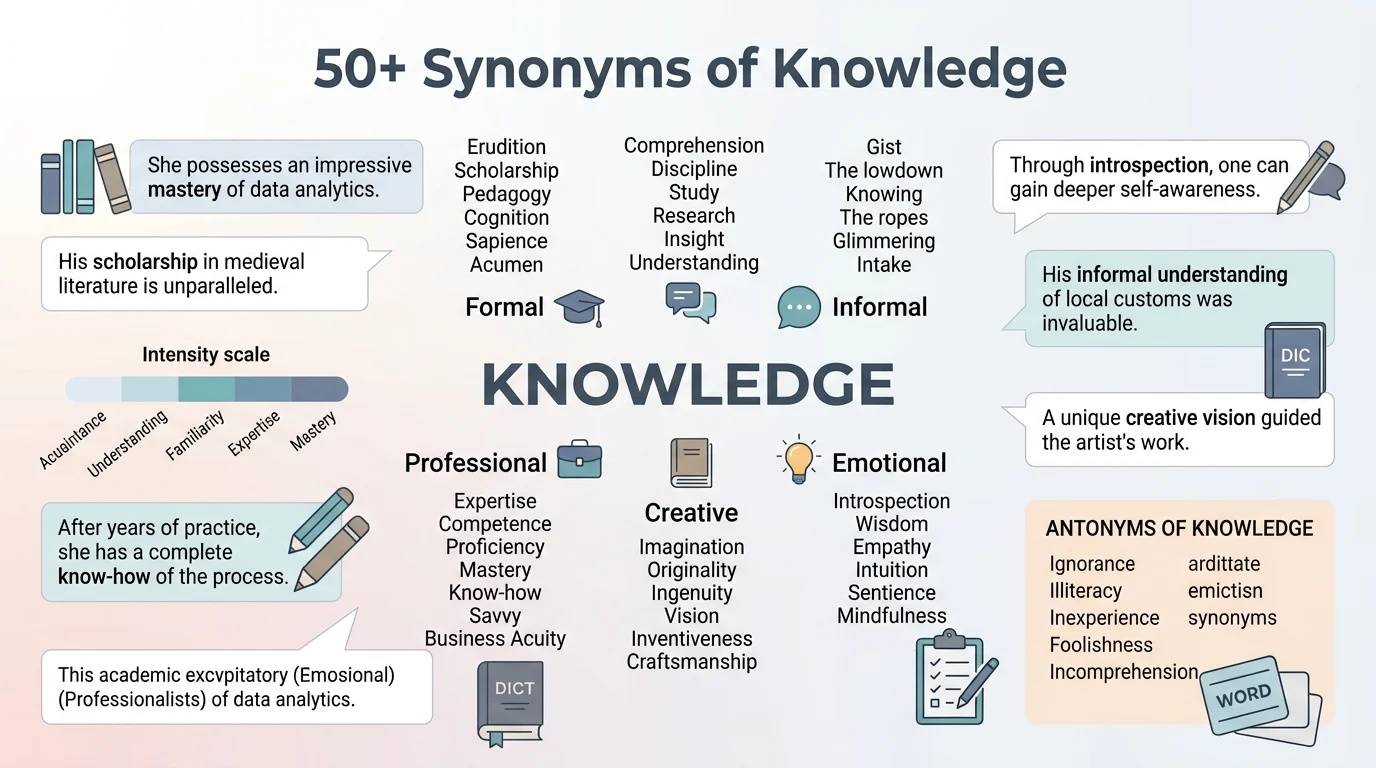
Knowledge means information, understanding, or skill gained through experience or education. For formal writing, choose expertise, erudition, or scholarship. For casual conversation, use know-how, smarts, or grip. In academic contexts, comprehension and insight work well.
For professional communication, proficiency and acumen are strong choices. Emotional writing benefits from wisdom and enlightenment, while creative writing calls for lore and cognition.
Meaning, Tone, and Context
Simple Definition
Knowledge is the collection of facts, information, and skills that a person acquires through learning, experience, or discovery. It represents what you know about a subject, whether that knowledge comes from reading books, attending classes, or living through real-world situations.
Part of Speech
Knowledge is a noun. It is uncountable in most uses, meaning you do not say “knowledges”. You can, however, refer to “a piece of knowledge” or “bodies of knowledge” when discussing specific areas of understanding.
Overall Tone
Knowledge is a neutral word. It does not carry strong positive or negative emotional weight on its own. The tone depends entirely on how you use it. In a sentence like “She has extensive knowledge of marine biology,” the tone is respectful and admiring. In “He acted without knowledge of the consequences,” the tone becomes cautious or critical.
Formality Level
Knowledge sits comfortably in the neutral to semi-formal range. It works in almost any setting, from casual conversation to academic writing. You can use it in a text message or a research paper without sounding out of place. However, when you need to sound more formal or more casual, synonyms help you adjust the tone appropriately.
Common Uses
Native English speakers use knowledge constantly. You hear it in classrooms, workplaces, news reports, and everyday conversations. People talk about “general knowledge,” “common knowledge,” “inside knowledge,” and “working knowledge.” The word appears in phrases like “to the best of my knowledge” and “knowledge is power.” It describes everything from academic learning to practical skills.
Word Forms
- Noun: knowledge
- Adjective: knowledgeable
- Adverb: knowledgeably
- Related noun: knower (rare)
- Opposite form: ignorance, unawareness
When and How to Use “Knowledge”
Choose knowledge when you want to refer broadly to what someone knows without specifying the depth, source, or type of that understanding. It is your default word for general references to learning, information, and awareness.
Here are seven realistic examples showing how knowledge fits into different contexts.
Professional
The candidate demonstrated strong knowledge of project management methodologies during the interview.
Academic
Her knowledge of 19th-century French literature impressed the entire dissertation committee.
Workplace
Our team’s collective knowledge of the client’s industry gave us a competitive advantage.
Personal
My grandmother’s knowledge of traditional herbal remedies has been passed down through generations.
I appreciate you sharing your knowledge of the new software system with the rest of the department.
Resume
Applied technical knowledge to streamline manufacturing processes and reduce waste by 15 percent.
Never stop learning. Every new piece of knowledge opens a door you did not know existed.
Best Synonyms of “Knowledge”
No synonym is identical in every situation. Each alternative carries its own shade of meaning, emotional weight, and level of formality. The best choice depends on your audience, your purpose, and the specific nuance you want to convey.
Professional Writing: Expertise
Expertise emphasizes specialized skill and deep understanding in a particular field. Choose this when you want to highlight practical competence rather than general awareness. It sounds confident and authoritative in business contexts.
Academic Writing: Erudition
Erudition refers to extensive, scholarly knowledge, especially in literature, history, and other academic subjects. This word signals serious intellectual depth and is perfect for research papers and academic discussions.
Business Communication: Acumen
Acumen means the ability to make good judgments and quick decisions in a specific area. It suggests sharpness and practical intelligence, making it ideal for business and financial contexts.
Casual Conversation: Know-How
Know-how is an informal term for practical knowledge or skill. It sounds natural and approachable in everyday speech. Use it when you want to sound friendly rather than formal.
Emotional Writing: Wisdom
Wisdom goes beyond knowledge to include good judgment and the ability to apply what you know. It carries a warm, respectful tone and works well in personal essays, speeches, and reflective writing.
Creative Writing: Lore
Lore refers to traditional knowledge, stories, and beliefs passed down through generations. It adds a mythical, storytelling quality to your writing and works beautifully in fiction and descriptive prose.
Resume Writing: Proficiency
Proficiency indicates competence and skill in doing something effectively. It is a strong, professional word that shows you can actually perform the work, not just understand it theoretically.
Workplace Communication: Understanding
Understanding suggests a clear grasp of how something works or why something happens. It is slightly softer than knowledge and implies deeper comprehension rather than just factual awareness.
Stronger Meaning: Mastery
Mastery means complete command or thorough knowledge of a subject. It is stronger than knowledge and suggests you have reached the highest level of skill or understanding.
Softer Meaning: Familiarity
Familiarity indicates casual or general awareness without deep understanding. Use this when you want to acknowledge that someone knows about something but is not an expert.
When Not to Use “Knowledge”
When the Word Sounds Too General
Knowledge is a broad term. In situations where you need to be specific about the type of understanding involved, it can feel vague and unimpressive.
Why It Is Less Effective: Saying someone has “knowledge of marketing” does not tell the reader much. It could mean anything from basic awareness to years of hands-on experience.
Better Synonym: Expertise or proficiency
Rewrite:
Weak: She has knowledge of digital marketing.
Stronger: She has expertise in digital marketing strategy and execution.
When the Word Sounds Too Formal
In casual conversations, text messages, or friendly social media posts, knowledge can feel stiff and overly serious.
Why It Is Less Effective: You do not need formal vocabulary when chatting with friends or writing an informal caption.
Better Synonym: Know-how or smarts
Rewrite:
Weak: I do not have the knowledge to fix this printer.
Stronger: I do not have the know-how to fix this printer.
When the Word Sounds Too Weak
Sometimes you need a word that conveys depth, mastery, or practical application. Knowledge alone may not carry enough weight.
Why It Is Less Effective: In a resume or performance review, “knowledge of” sounds passive. You want to show what you can do with that knowledge.
Better Synonym: Proficiency or mastery
Rewrite:
Weak: Knowledge of Python programming.
Stronger: Proficiency in Python programming with three years of development experience.
When the Word Is Outdated in Context
While knowledge itself is not outdated, some of its uses can feel old-fashioned. Phrases like “carnal knowledge” are archaic and should be avoided in modern writing unless used deliberately for historical effect.
Words Commonly Confused With “Knowledge”
Knowledge vs Wisdom
Difference: Knowledge is knowing facts and information. Wisdom is knowing how to apply that knowledge with good judgment.
When to Use It: Use knowledge when you are talking about what someone knows. Use wisdom when you are talking about their ability to make sound decisions based on what they know.
Example:
Knowledge: He has extensive knowledge of constitutional law.
Wisdom: His wisdom in interpreting complex legal precedents earned him respect from colleagues.
Knowledge vs Understanding
Difference: Knowledge is the accumulation of facts. Understanding is the ability to see how those facts connect and why they matter.
When to Use It: Use knowledge for factual awareness. Use understanding when you want to emphasize comprehension of relationships, causes, or meanings.
Example:
Knowledge: She has knowledge of the company’s financial history.
Understanding: She has a deep understanding of why the company’s financial strategy succeeded.
Knowledge vs Information
Difference: Information is raw data or facts. Knowledge is information that has been processed, understood, and integrated.
When to Use It: Use information when referring to data, facts, or details. Use knowledge when referring to the assimilation and comprehension of that information.
Example:
Information: The report contains useful information about market trends.
Knowledge: Her knowledge of market trends allows her to predict consumer behavior accurately.
Knowledge vs Education
Difference: Education is the formal process of acquiring knowledge. Knowledge is what you actually gain from that process.
When to Use It: Use education when referring to schooling, training, or the learning process. Use knowledge for the actual content or skills acquired.
Example:
Education: She received her education at Stanford University.
Knowledge: Her knowledge of economics came from both formal education and real-world experience.
Knowledge vs Insight
Difference: Knowledge is broad and factual. Insight is a deep, often sudden understanding of a specific situation or problem.
When to Use It: Use knowledge for general understanding. Use insight when you want to highlight a particularly perceptive or illuminating understanding.
Example:
Knowledge: He has knowledge of consumer behavior patterns.
Insight: His insight into why customers abandoned their shopping carts saved the company millions.
Knowledge vs Cognition
Difference: Knowledge is what you know. Cognition is the mental process of knowing, including perception, reasoning, and memory.
When to Use It: Use knowledge in everyday contexts. Use cognition in psychology, neuroscience, or academic discussions about mental processes.
Example:
Knowledge: The child’s knowledge of animal names grew quickly.
Cognition: The study examined cognitive development in early childhood.
Best Synonyms of “Knowledge” by Context
| Context | Best Synonym | Why It Works | Example |
|---|---|---|---|
| Formal writing | Erudition | Signals deep scholarly learning | His erudition on the subject was evident in every lecture. |
| Academic writing | Comprehension | Emphasizes deep intellectual grasp | The exam tests comprehension of complex theoretical frameworks. |
| Professional communication | Expertise | Highlights specialized practical skill | Her expertise in supply chain management is widely recognized. |
| Business emails | Acumen | Suggests sharp business judgment | His financial acumen helped the company navigate the downturn. |
| Resume writing | Proficiency | Shows practical competence | Proficiency in data analysis and visualization tools. |
| Workplace communication | Understanding | Conveys thoughtful comprehension | We need a shared understanding of the project goals. |
| Casual conversation | Know-how | Sounds natural and approachable | She has the know-how to get this project done right. |
| Everyday speaking | Awareness | Simple and clear for basic knowledge | Public awareness of the issue has grown significantly. |
| Creative writing | Lore | Adds depth and storytelling quality | The village preserved ancient lore about the forest spirits. |
| Storytelling | Cognition | Brings psychological depth to characters | His cognition of the situation shifted dramatically after the revelation. |
| Emotional writing | Wisdom | Carries warmth and moral weight | Her wisdom comes from a lifetime of learning and reflection. |
| Strong emphasis | Mastery | Conveys complete command of a subject | He achieved mastery of the violin after decades of practice. |
| Mild tone | Familiarity | Soft and unassuming | She has a basic familiarity with the software. |
| Social media captions | Smarts | Casual and engaging | Book smarts are great, but street smarts get you further. |
| American English | Knowledge | Standard usage across all contexts | She has a solid knowledge of American history. |
How to Choose the Best Synonym of “Knowledge”
Choosing the right synonym starts with asking yourself a few simple questions.
What exactly are you trying to communicate?
Are you talking about facts someone has memorized? Practical skills they can perform? Deep understanding of why things work? The nature of the knowledge itself should guide your choice.
Who is your audience?
A formal report for executives calls for words like expertise, acumen, or proficiency. A casual conversation with friends calls for know-how or smarts. An academic paper demands erudition, comprehension, or scholarship.
How much emotional weight do you want?
Neutral words like information and awareness simply communicate facts. Words like wisdom and enlightenment carry emotional and moral weight. Choose based on the feeling you want to create.
How strong does the word need to be?
Familiarity is mild. Understanding is moderate. Expertise is strong. Mastery is very strong. Match the intensity to the message you want to send.
What sounds most natural in your sentence?
Read your sentence aloud with each synonym. The right word will sound smooth and effortless. The wrong word will feel clunky or out of place.
The goal is not to use the fanciest word. The goal is to use the most accurate word for your specific situation.
Real Life Examples of “Knowledge”
School
The teacher assessed the students’ knowledge of basic geometry through a series of practical problems.
College
Her knowledge of Renaissance art history made her the ideal candidate for the museum internship.
Workplace
The new hire brought fresh knowledge of social media algorithms that revitalized our marketing campaigns.
Business
The CEO’s knowledge of international trade regulations prevented a costly legal dispute.
Thank you for sharing your knowledge of the grant application process. It saved our team weeks of research.
Resume
Weak: Knowledge of customer relationship management software.
Stronger: Proficiency in Salesforce and HubSpot, with five years of implementation experience.
Conversation
Weak: Do you have knowledge of how to change a tire?
Stronger: Do you have the know-how to change a tire?
Storytelling
Weak: The old man had knowledge of the mountain paths.
Stronger: The old man carried generations of lore about the mountain paths in his memory.
Blogging
Weak: This post shares knowledge about meal prepping.
Stronger: This post shares practical wisdom about meal prepping that will change your weekly routine.
Weak: Sharing my knowledge of photography today.
Stronger: Sharing what I have learned about photography over ten years behind the lens. 📸
18 Best Synonyms of “Knowledge”
| Synonym | Simple Meaning | Best Used For | Example Sentence |
|---|---|---|---|
| Understanding | Clear grasp of how something works | General use, workplace communication | She has a solid understanding of the new software system. |
| Expertise | Specialized skill in a specific field | Professional writing, resumes | His expertise in cybersecurity is unmatched in the industry. |
| Wisdom | Knowledge applied with good judgment | Emotional writing, personal reflection | Years of experience gave her the wisdom to handle difficult clients. |
| Comprehension | Deep intellectual understanding | Academic writing, education | The course improves comprehension of complex scientific concepts. |
| Insight | Perceptive understanding of a specific issue | Business, analysis, problem-solving | Her insight into customer needs drove the product redesign. |
| Erudition | Extensive scholarly learning | Academic writing, formal contexts | His erudition was evident in every footnote and citation. |
| Scholarship | Formal academic knowledge and study | Academic writing, research | The professor’s scholarship on medieval literature is widely respected. |
| Proficiency | Practical competence and skill | Resumes, professional contexts | Proficiency in multiple programming languages is required for the role. |
| Acumen | Sharp judgment in a specific domain | Business, finance, leadership | His business acumen helped the startup secure major funding. |
| Awareness | Conscious recognition of facts | Social issues, general communication | Public awareness of climate change has increased dramatically. |
| Cognition | The mental process of knowing | Psychology, academic writing | The study examined cognition in older adults. |
| Grasp | Firm understanding of a concept | Everyday use, education | She has a good grasp of the basic principles. |
| Mastery | Complete command of a subject | Strong emphasis, resumes | He achieved mastery of the guitar after twenty years of practice. |
| Know-how | Practical skill and expertise | Casual conversation, everyday use | She has the know-how to fix almost any engine problem. |
| Familiarity | Casual or general awareness | Mild tone, basic knowledge | He has some familiarity with the subject but is not an expert. |
| Learning | Knowledge acquired through study | Education, personal development | A love of learning stays with you for life. |
| Intelligence | The ability to acquire and apply knowledge | General use, cognitive ability | His intelligence and curiosity made him a great researcher. |
Synonyms of “Knowledge” by Usage
Professional vs Personal Synonyms
In professional settings, choose words that convey competence, reliability, and specialized skill. Expertise, proficiency, acumen, and mastery signal that you are not just aware of something but can actually perform at a high level. These words belong on resumes, in performance reviews, and in client communications.
In personal settings, softer and more familiar words work better. Know-how, smarts, understanding, and familiarity sound natural and approachable. You would use these with friends, family, or in casual social media posts.
Formal vs Conversational Synonyms
For reports, essays, business writing, and presentations, choose erudition, scholarship, comprehension, or cognition. These words sound authoritative and demonstrate intellectual rigor.
For emails, casual conversations, and texting, choose know-how, smarts, grip, or clue. These words keep your tone friendly and accessible without sacrificing meaning.
Academic Synonyms
In research papers, essays, and academic discussions, precision matters. Erudition signals deep scholarly knowledge. Comprehension emphasizes thorough understanding. Scholarship refers to formal academic study. Cognition is the technical term for mental processes of knowing. These words sound authoritative and demonstrate familiarity with academic language.
Professional and Business Synonyms
For resumes, interviews, meetings, and client communication, choose words that project confidence and capability. Expertise shows specialized knowledge. Proficiency demonstrates practical skill. Acumen suggests sharp business judgment. Mastery indicates complete command of a subject. These words make you sound competent and experienced.
Creative and Literary Synonyms
In storytelling, fiction, and descriptive writing, choose words that add texture and emotion. Lore brings a sense of tradition and mystery. Wisdom adds moral and emotional weight. Cognition can add psychological depth to characters. Enlightenment suggests profound revelation. These alternatives make your writing more vivid and engaging.
Slang or Modern Synonyms
Smarts is an informal synonym for intelligence or knowledge. It works well in casual conversation and social media but should be avoided in formal or professional writing. Know-how is informal but widely accepted in business contexts when the tone is friendly. Grip and clue are casual terms for understanding or awareness. Use these only in informal settings.
Strongest to Mildest Synonyms
| Intensity | Synonym |
|---|---|
| Mild | Familiarity, awareness, clue |
| Moderate | Understanding, comprehension, grasp, knowledge |
| Strong | Expertise, proficiency, acumen, insight |
| Very Strong | Mastery, erudition, wisdom, scholarship |
Emotional vs Neutral Synonyms
Emotional Synonyms:
Wisdom carries warmth and moral weight. Enlightenment suggests profound personal transformation. Insight implies a moment of clarity or revelation. These words add feeling to your writing and work well in personal essays, speeches, and reflective pieces.
Neutral Synonyms:
Information is purely factual. Awareness simply indicates recognition. Cognition is a clinical term for mental processes. These words communicate without adding emotional coloring. Use them in technical writing, reports, and objective analysis.
Antonyms of “Knowledge”
| Antonym | Meaning | Example Sentence |
|---|---|---|
| Ignorance | Lack of knowledge or information | His ignorance of basic safety procedures put everyone at risk. |
| Unawareness | Not knowing about something | Her unawareness of the new policy caused confusion. |
| Inexperience | Lack of practical knowledge from doing something | His inexperience showed during the client presentation. |
| Illiteracy | Inability to read or lack of knowledge in a specific area | Financial illiteracy is a major problem for young adults. |
| Misunderstanding | Incorrect interpretation of information | The misunderstanding between the teams delayed the project. |
| Misconception | A false or incorrect view or idea | The misconception that vaccines cause autism has been debunked. |
| Nescience | Lack of knowledge; ignorance | The committee’s nescience of the issue was concerning. |
| Naivety | Lack of experience, wisdom, or judgment | Her naivety about business negotiations cost her the deal. |
| Innocence | Lack of knowledge or experience, often in a positive sense | His innocence about office politics was refreshing. |
| Confusion | Lack of clear understanding | The confusing instructions led to widespread confusion. |
| Bewilderment | State of being perplexed or confused | The complex regulations left everyone in bewilderment. |
| Darkness | Figurative lack of knowledge or understanding | The community remained in darkness about the proposed changes. |
| Oblivion | State of being unaware or unconscious | The company drifted into oblivion about its market position. |
| Unfamiliarity | Lack of knowledge about something | His unfamiliarity with the software slowed down the team. |
| Cluelessness | Complete lack of understanding (informal) | Her cluelessness about technology was endearing but frustrating. |
Comparison: “Knowledge” vs Similar Words
Knowledge vs Wisdom
Main Difference: Knowledge is knowing facts. Wisdom is knowing how to apply those facts with good judgment.
Which Is Stronger? Wisdom carries greater emotional and moral weight.
Which Is More Formal? Both are neutral, but wisdom is more often used in philosophical or reflective contexts.
When to Use Each:
- Use knowledge for factual awareness and learned information.
- Use wisdom for sound judgment, life experience, and practical application.
Examples:
Knowledge: She has extensive knowledge of financial markets.
Wisdom: Her wisdom in knowing when to buy and sell made her fortune.
Knowledge vs Understanding
Main Difference: Knowledge is accumulation of facts. Understanding is comprehension of how facts connect and why they matter.
Which Is Stronger? Understanding implies a deeper level of comprehension than mere knowledge.
Which Is More Formal? Both are neutral, but understanding often sounds more thoughtful and reflective.
When to Use Each:
- Use knowledge when referring to what someone knows.
- Use understanding when referring to how deeply someone grasps a subject.
Examples:
Knowledge: He has knowledge of the company’s policies.
Understanding: He has a deep understanding of why those policies exist.
Knowledge vs Information
Main Difference: Information is raw data. Knowledge is processed, understood information.
Which Is Stronger? Knowledge implies assimilation and comprehension, making it stronger than mere information.
Which Is More Formal? Both are neutral and widely used in all contexts.
When to Use Each:
- Use information for facts, data, and details.
- Use knowledge for what someone has learned and integrated.
Examples:
Information: The website provides information about local events.
Knowledge: Her knowledge of local history comes from years of research.
Knowledge vs Education
Main Difference: Education is the process of learning. Knowledge is what you gain from that process.
Which Is Stronger? Knowledge is the outcome; education is the means. Neither is inherently stronger.
Which Is More Formal? Education is often more formal, referring to institutional learning.
When to Use Each:
- Use education for schooling, training, or the learning process.
- Use knowledge for the content, skills, or understanding acquired.
Examples:
Education: She completed her education at a prestigious university.
Knowledge: Her knowledge of the subject came from both school and personal study.
Knowledge vs Insight
Main Difference: Knowledge is broad and general. Insight is a specific, perceptive understanding of a particular issue.
Which Is Stronger? Insight implies a deeper, more penetrating understanding of a specific situation.
Which Is More Formal? Both are professional and widely used in business and academic contexts.
When to Use Each:
- Use knowledge for general awareness or learning.
- Use insight for a particularly revealing or perceptive understanding.
Examples:
Knowledge: He has knowledge of consumer behavior.
Insight: His insight into why customers left the platform was invaluable.
Knowledge vs Expertise
Main Difference: Knowledge is general. Expertise is specialized, practical knowledge in a specific field.
Which Is Stronger? Expertise implies a higher level of skill and practical application.
Which Is More Formal? Expertise is more professional and often used in business contexts.
When to Use Each:
- Use knowledge for general awareness or learning.
- Use expertise when highlighting specialized, practical skill.
Examples:
Knowledge: She has knowledge of digital marketing.
Expertise: She has expertise in search engine optimization and content strategy.
Common Phrases and Expressions with “Knowledge”
To the best of my knowledge
Meaning: Used to say that you think something is true but are not completely sure.
Example Sentence:
To the best of my knowledge, the meeting has not been rescheduled.
Common knowledge
Meaning: Something that everyone knows.
Example Sentence:
It is common knowledge that exercise improves mental health.
Working knowledge
Meaning: Enough practical knowledge to function effectively in a particular area.
Example Sentence:
She has a working knowledge of Spanish, enough to handle basic conversations.
Body of knowledge
Meaning: The total amount of information and understanding in a particular field.
Example Sentence:
The body of knowledge in medical science expands every year.
Knowledge is power
Meaning: Having knowledge gives you influence and control.
Example Sentence:
She always believed that knowledge is power, so she never stopped learning.
Inside knowledge
Meaning: Information or understanding that is not available to the general public.
Example Sentence:
His inside knowledge of the industry gave him a competitive edge.
General knowledge
Meaning: Basic information about a wide range of subjects that most people know.
Example Sentence:
The quiz tested general knowledge of history, science, and geography.
Common Mistakes to Avoid
Choosing a Vague Synonym Instead of a Precise One
Incorrect:
She has good knowledge of the subject.
Better:
She has deep expertise in the subject.
Why: “Good knowledge” is vague and unimpressive. “Expertise” communicates specific, practical skill.
Confusing Knowledge With Wisdom
Incorrect:
His knowledge guided the team through the crisis.
Better:
His wisdom guided the team through the crisis.
Why: Guiding people through challenges requires judgment and perspective, not just facts. Wisdom is the right word here.
Using an Informal Synonym in Formal Writing
Incorrect:
The candidate’s know-how in financial analysis was impressive.
Better:
The candidate’s expertise in financial analysis was impressive.
Why: “Know-how” is too casual for a formal report or resume. “Expertise” sounds more professional.
Selecting an Overly Dramatic Synonym
Incorrect:
I have some enlightenment about the new software.
Better:
I have some understanding of the new software.
Why: “Enlightenment” suggests profound spiritual or intellectual revelation. It is too dramatic for everyday situations.
Repeating the Same Word Too Often
Incorrect:
Her knowledge of history is impressive. Her knowledge of geography is also strong. Her knowledge of science is average.
Better:
Her knowledge of history is impressive. Her understanding of geography is also strong. Her grasp of science is average.
Why: Varying your word choice keeps writing engaging and shows vocabulary range.
Choosing a Synonym With the Wrong Emotional Tone
Incorrect:
The report provided useful wisdom about market trends.
Better:
The report provided useful insight about market trends.
Why: Wisdom implies moral or life judgment, not data analysis. Insight is the appropriate word for business analysis.
Using Slang in Academic or Professional Writing
Incorrect:
The study contributes to our smarts about cognitive development.
Better:
The study contributes to our understanding of cognitive development.
Why: “Smarts” is too informal for academic writing. “Understanding” is neutral and appropriate.
Frequently Asked Questions
What are the best synonyms of “knowledge”?
The best synonyms depend on your context. For professional writing, use expertise or proficiency. For academic writing, use erudition or comprehension. Casual conversation, use know-how or smarts. Emotional writing, use wisdom.
What are the best formal synonyms of “knowledge”?
The best formal synonyms include erudition, scholarship, comprehension, cognition, and expertise. These words sound authoritative and are appropriate for academic papers, professional reports, and formal presentations.
What are common informal synonyms of “knowledge”?
Common informal synonyms include know-how, smarts, grip, clue, and brainpower. These words work well in casual conversation, text messages, and social media posts but should be avoided in formal writing.
What is another word for “knowledge” in professional writing?
In professional writing, use expertise, proficiency, acumen, or mastery. These words signal practical competence and specialized skill, making them ideal for resumes, business emails, and performance reviews.
What is the difference between “knowledge” and “wisdom”?
Knowledge is the accumulation of facts and information. Wisdom is the ability to apply that knowledge with good judgment. You can have knowledge without wisdom, and you can gain wisdom through experience even without formal knowledge.
What is the opposite of “knowledge”?
The primary opposite of knowledge is ignorance, which means a lack of knowledge or information. Other antonyms include unawareness, inexperience, misunderstanding, and illiteracy.
Conclusion
Knowledge is a powerful and versatile word that describes the information, understanding, and skills we gain through experience and education. While it works in almost any context, choosing the right synonym can make your writing more precise, engaging, and effective. Expertise and proficiency shine in professional settings. Erudition and comprehension belong in academic writing. Know-how and smarts keep conversations casual and friendly. Wisdom and insight add emotional depth and reflective quality. No single synonym works perfectly in every situation. The best choice depends on your audience, your purpose, and the specific nuance you want to convey. The next time you reach for the word “knowledge,” pause and ask yourself whether a more precise alternative would communicate your message more clearly. Your readers will notice the difference.