Have you ever found yourself repeating the word “understanding” in an email, essay, or conversation? You know there must be a better word, but your mind goes blank. This happens to everyone from students to executives. Finding the right synonym can elevate your writing, make your speech more precise, and help you communicate with greater impact.
In this guide, you will discover over 50 powerful alternatives for understanding. You will learn exactly when to use each one, how to avoid common mistakes, and how to choose the perfect word for any situation.
What Does “Understanding” Mean?
Understanding means the ability to comprehend, interpret, or grasp the meaning of something. It can also refer to empathy or mutual agreement. The best synonyms depend on your context. For formal writing, use comprehension or discernment. casual conversation, try grasp or get it. emotional situations, choose empathy or sympathy. For professional settings, consider insight or awareness. The right synonym makes your message clearer and more effective.
Meaning, Tone and Context
Simple Definition
Understanding is the mental process of comprehending information, ideas, emotions, or situations. It involves recognizing meaning, making connections, and interpreting significance.
Part of Speech
Understanding can function as a noun, adjective, or verb in its present participle form. As a noun, it refers to the mental process or the quality of being empathetic. As an adjective, it describes someone who is compassionate or tolerant.
Positive, Negative, or Neutral Tone
Understanding generally carries a positive or neutral tone. It suggests intelligence, awareness, or kindness. In some contexts, it can imply a lack of action, as in understanding a problem without solving it.
Formality Level
Understanding is versatile and works across all formality levels. It is appropriate in casual conversation, academic writing, professional emails, and formal speeches. However, synonyms can adjust the formality to better fit your audience.
Common Use Cases
You use understanding when discussing knowledge, emotions, agreements, or interpretations. It appears in academic essays, workplace feedback, personal conversations, and creative writing. It is one of the most flexible words in English.
Important Word Forms
The adjective form is “understanding.” The verb form is “understand.” The adverb form is “understandably.” The opposite can be “misunderstanding” or “incomprehension.” Related forms include “understood” and “understandable.”
When and How to Use “Understanding”
Understanding works well when you need a general, versatile word. It fits almost any context. However, using it too often makes your writing repetitive. Here are examples of understanding in different situations.
Professional Context
The manager showed a deep understanding of the project challenges. Her team appreciated her realistic approach to deadlines.
Personal Context
My friend has a wonderful understanding of what I am going through. She always knows the right thing to say.
Academic Context
A thorough understanding of historical context is essential for interpreting this novel. Students should read the background materials carefully.
Emotional Context
His understanding of her grief made him a comforting presence. He never pushed her to talk before she was ready.
Creative Context
The artist has a unique understanding of light and shadow. Her paintings capture moods that words cannot express.
Social Media Caption
Growing my understanding of different cultures through travel has been life changing. Every trip teaches me something new.
Email Context
Thank you for your understanding during this transition period. We will provide updates as the situation evolves.
Resume Context
Developed a strong understanding of customer needs through years of direct service experience. This insight improved client retention rates.
Another Word for “Understanding”
Choosing the best single replacement for understanding depends entirely on your context. Here are the top alternatives for different situations.
Professional Writing
Use insight. This word suggests deeper perception and valuable knowledge. It works well in business reports and performance reviews.
Academic Writing
Use comprehension. This word signals thorough mental grasp of complex material. It is precise and scholarly.
Casual Conversation
Use grasp. This word feels natural and easy in everyday speech. It indicates basic comprehension without formality.
Emotional Writing
Use empathy. This word focuses on feeling and connection. It works best when discussing human experiences and relationships.
Creative Writing
Use perception. This word adds an artistic or philosophical dimension. It suggests seeing beyond the obvious.
Resume or Workplace Use
Use awareness. This word highlights practical knowledge and attention to detail. It shows you pay attention to what matters.
Social Media Captions
Use vibe. This modern term works for informal posts. It suggests intuitive understanding of a situation or person.
Stronger Meaning
Use discernment. This word implies exceptional judgment and the ability to distinguish subtle differences.
Softer Meaning
Use sympathy. This word suggests a gentle, caring understanding without full emotional participation.
When Not to Use “Understanding”
Understanding can sound too vague in some situations. It may also feel too general when you need precision.
When It Sounds Too Vague
Saying you have understanding of a problem is not always enough. A more precise synonym like “analysis” or “diagnosis” shows deeper engagement. For example, “I have an understanding of the issue” is weaker than “I have analyzed the issue thoroughly.”
When It Sounds Too Casual
In formal legal or medical writing, understanding may seem unsophisticated. Use “comprehension” or “cognition” instead. The sentence “The patient lacks understanding” is less precise than “The patient shows diminished cognitive comprehension.”
When It Sounds Too Formal
In casual text messages, understanding can feel stiff. Use “get” or “catch” instead. “I get what you mean” is more natural than “I have understanding of your point.”
When It Sounds Too Weak
Understanding does not always convey authority. In leadership contexts, use “mastery” or “command.” For example, “She has understanding of the data” is weaker than “She commands the data with expertise.”
When You Need Action
Understanding without action can seem passive. When you want to show problem solving, use “diagnosis” or “recognition.” “His recognition of the pattern led to a solution” sounds more active.
Words Commonly Confused With “Understanding”
Several words share meaning with understanding but have distinct differences. Using the wrong one can change your message entirely.
Understanding vs. Knowledge
Knowledge is information you possess. Understanding is how you interpret and apply that information. You can know facts without understanding their significance. Understanding goes deeper.
Understanding vs. Awareness
Awareness means noticing something exists. means knowing what it means and how it works. You can be aware of climate change but not understand its causes.
Understanding vs. Sympathy
Sympathy means feeling pity or sorrow for someone. Understanding means comprehending their situation intellectually. Sympathy is emotional. Understanding is cognitive.
Understanding vs. Empathy
Empathy means feeling what another person feels. means perceiving what they think or experience. Empathy shares emotion. shares perspective.
Understanding vs. Interpretation
Interpretation is your personal explanation of something. Understanding is your general grasp of it. Interpretation is subjective. can be more objective.
Understanding vs. Perception
Perception is how you sense or view something. Understanding is what you conclude from that perception. Perception is initial. Understanding is processed.
Best Synonym by Context for “Understanding”
| Context | Best Synonym | Why It Works | Example |
|---|---|---|---|
| Formal Writing | Comprehension | Signals intellectual rigor and precision | The study measured reading comprehension in elementary students |
| Academic Writing | Grasp | Shows thorough intellectual command | Scholars need a solid grasp of statistical methods |
| Professional Business | Insight | Suggests valuable strategic perception | Her market insight improved our quarterly planning |
| Resume Writing | Proficiency | Indicates practical skill and knowledge | Demonstrated proficiency in multiple programming languages |
| Casual Conversation | Get | Sounds natural and conversational | I get what you are saying about the new policy |
| Creative Writing | Perception | Adds depth and artistic quality | His perception of human nature made his characters believable |
| Emotional Tone | Empathy | Focuses on emotional connection | She showed deep empathy for struggling students |
| Strong Intensity | Discernment | Implies exceptional judgment | His discernment of quality set him apart from other buyers |
| Soft Moderate Tone | Appreciation | Shows respect without overstatement | My appreciation of the problem grew over time |
| Social Media Captions | Vibe | Feels current and relatable | I am getting a good vibe from this new project |
| US Usage | Understanding | Standard American English usage | We have an understanding about the deadline |
| UK Usage | Comprehension | More common in British academic writing | Students demonstrated excellent comprehension of the material |
Which Synonym Should You Choose?
Choosing the right synonym for understanding requires thinking about your audience, purpose, and message. Here is a practical decision guide.
Consider Your Audience
For academic or professional readers, choose formal synonyms like comprehension or discernment. For friends or social media, choose casual options like get or vibe.
Consider Your Purpose
If you want to show deep knowledge, use insight or mastery. you want to show emotional connection, use empathy or sympathy. If you want to show practical ability, use proficiency or capability.
Consider Your Tone
Positive emotional contexts call for words like appreciation or recognition. Neutral factual contexts work well with comprehension or awareness. Strong authoritative contexts benefit from mastery or command.
Consider Your Medium
Written formal documents need precise synonyms. Spoken conversations allow more casual choices. Emails fall somewhere in between, depending on your relationship with the reader.
Consider Your Message Strength
Sometimes you want a mild word that does not overstate. Use recognition or appreciation. Other times you need a strong word. Use discernment or penetration. Match the intensity to your meaning.
Test Your Choice
Read your sentence with the synonym. Does it sound natural? Does it convey exactly what you mean? If not, try another option. The best word is the one that fits perfectly.
Real Life Examples of “Understanding” in Sentences
These examples show understanding and its synonyms across different situations. Notice how each synonym changes the tone and meaning.
School Example
Her comprehension of advanced calculus impressed the professor. She solved problems that puzzled other students.
Workplace Example
The team leader showed remarkable insight into client concerns. She addressed issues before they became problems.
Writing Example
The author has a profound perception of human relationships. Her characters feel authentic and multidimensional.
Conversation Example
I finally get why you made that decision. The circumstances were more complicated than I realized.
Social Media Example
My awareness of sustainability issues has grown this year. Small changes really do add up.
Resume Example
Developed proficiency in digital marketing strategies. Increased engagement by 40 percent through targeted campaigns.
Email Example
Thank you for your patience and empathy during this challenging project. Your support made a significant difference.
Storytelling Example
His recognition of the villain’s motive came too late. The betrayal had already destroyed their friendship.
25 Synonyms for “Understanding”
| Synonym | Simple Meaning | Best Used For | Example Sentence |
|---|---|---|---|
| Comprehension | Full mental grasp | Academic and formal contexts | Reading comprehension improves with consistent practice |
| Grasp | Intellectual hold on concepts | General and conversational use | Students quickly developed a grasp of basic grammar rules |
| Insight | Deep perceptive understanding | Professional and analytical contexts | Her insight into market trends saved the company from loss |
| Awareness | Conscious knowledge | Social and practical situations | Public awareness of health issues has increased dramatically |
| Perception | Interpretive understanding | Creative and philosophical writing | His perception of beauty transformed ordinary scenes into art |
| Discernment | Ability to judge well | Leadership and decision making | His discernment of character made him an excellent hiring manager |
| Empathy | Emotional identification | Personal and psychological contexts | Her empathy for grieving families made her a skilled counselor |
| Sympathy | Compassionate concern | Caring and supportive situations | The community showed sympathy for the flood victims |
| Appreciation | Recognition of value | Grateful and respectful contexts | Her appreciation of art grew during her years in Europe |
| Recognition | Identification of significance | Professional and technical writing | Early recognition of symptoms can save lives |
| Proficiency | Skilled capability | Job applications and resumes | Language proficiency is essential for international business |
| Mastery | Complete command | Expert level achievements | His mastery of classical piano amazed the audience |
| Knowledge | Accumulated information | Educational and factual contexts | Scientific knowledge expands with new research |
| Interpretation | Personal explanation | Analytical and creative contexts | Her interpretation of the poem revealed hidden meanings |
| Diagnosis | Analytical identification | Medical and technical fields | Accurate diagnosis depends on careful understanding of symptoms |
| Intelligence | Mental capacity | Cognitive and psychological contexts | Emotional intelligence predicts success in leadership roles |
| Wisdom | Experienced judgment | Life experience and advice | Her wisdom came from decades of international travel |
| Savvy | Practical intelligence | Business and modern contexts | Financial savvy helped him navigate the stock market |
| Acumen | Sharp perception | Business and professional contexts | Business acumen separates good managers from great ones |
| Apprehension | Grasp of ideas | Academic and formal writing | Clear apprehension of concepts leads to better grades |
| Cognizance | Conscious awareness | Legal and formal documents | Full cognizance of risks is required before signing |
| Comprehension | Intellectual grasp | Educational assessments | Science comprehension improved with hands on experiments |
| Realization | Becoming aware | Personal growth moments | His realization of his own privilege was life changing |
| Assessment | Evaluative understanding | Professional evaluations | Accurate assessment of team skills leads to better projects |
| Interpretation | Meaning assignment | Creative and analytical writing | Her interpretation of the data challenged old assumptions |
Synonym Groups and Usage Differences
Professional vs. Personal Synonyms
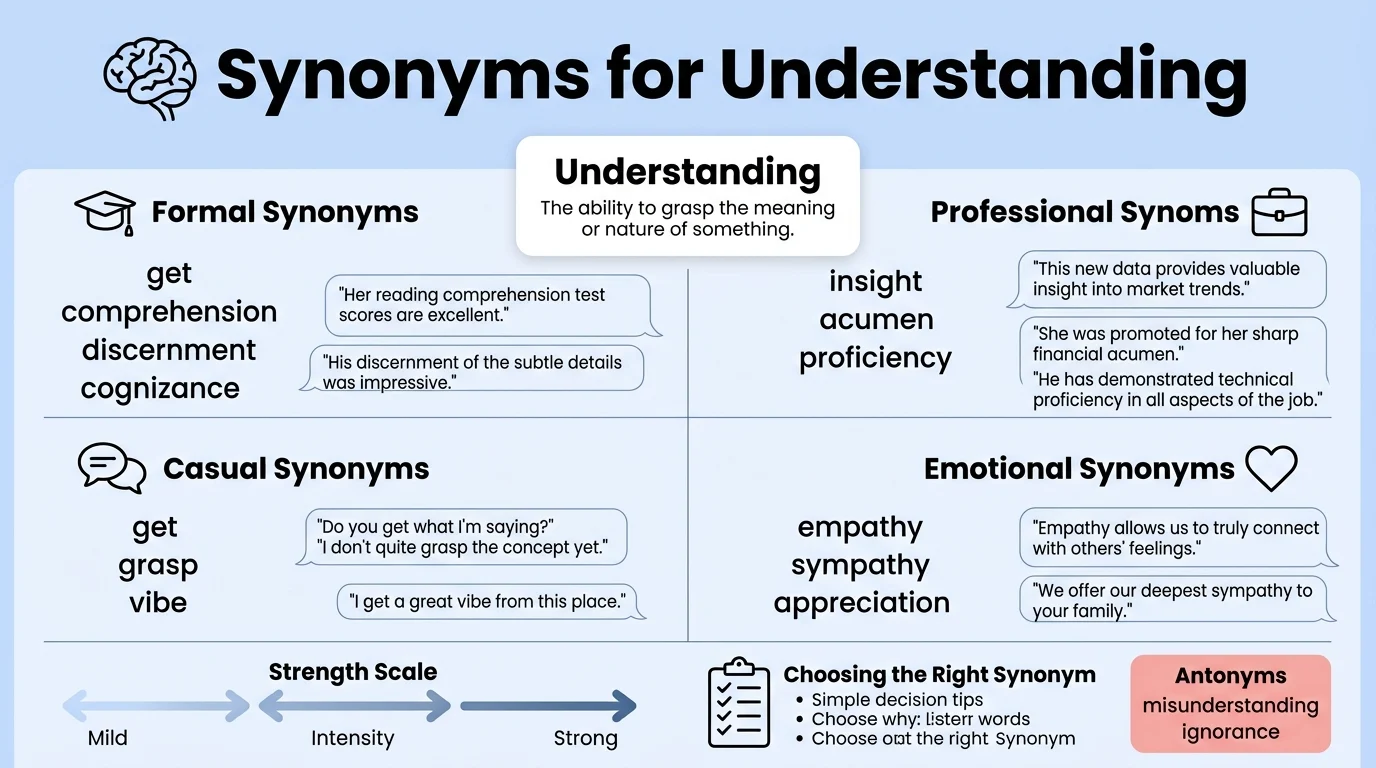
Professional synonyms like insight, acumen, and proficiency belong in business settings. They emphasize competence and valuable knowledge. Personal synonyms like empathy, sympathy, and appreciation work better in relationships. They emphasize emotional connection and caring.
Formal vs. Conversational Synonyms
Formal synonyms include comprehension, discernment, and cognizance. These words belong in reports, essays, and speeches. Conversational synonyms include get, grasp, and vibe. These words fit texts, casual emails, and everyday talk. Mixing them incorrectly can make you sound stiff or unprofessional.
Academic Synonyms
Academic writing demands precision. Comprehension, apprehension, and interpretation are excellent choices. They sound scholarly and accurate. Avoid casual words like get or vibe in research papers. Stick to terms that appear in peer reviewed journals.
Professional and Business Synonyms
Business communication benefits from insight, acumen, and awareness. These words suggest practical value. Use them in emails, presentations, and performance reviews. They show you understand not just ideas but their real world applications.
Creative or Literary Synonyms
Creative writing thrives on perception, realization, and interpretation. These words add depth and imagery. They allow for philosophical reflection and emotional nuance. Literary works often explore understanding as a journey of discovery.
Strongest vs. Weaker Synonyms
Intensity varies widely among synonyms. Mild words include recognition and appreciation. Moderate words include comprehension and grasp. Strong words include mastery and discernment. Choose intensity based on your meaning and emphasis.
Emotional vs. Neutral Synonyms
Emotional synonyms like empathy and sympathy carry feeling. They connect to human experience. Neutral synonyms like comprehension and awareness stay factual. They report information without emotional coloring. Choose based on whether you want to engage feelings or intellect.
Antonyms of “Understanding”
| Antonym | Meaning | Example Sentence |
|---|---|---|
| Misunderstanding | Incorrect interpretation | Misunderstanding caused a major conflict between coworkers |
| Confusion | Lack of clarity | Confusion about the rules led to multiple mistakes |
| Ignorance | Lack of knowledge | His ignorance of basic safety procedures endangered everyone |
| Misperception | Wrong view | Misperception of the situation worsened the disagreement |
| Incomprehension | Inability to grasp | Her incomprehension of the manual delayed the project |
| Disagreement | Lack of shared opinion | Disagreement about the budget delayed the vote |
| Disregard | Lack of attention | His disregard for instructions caused the error |
| Misinterpretation | Wrong explanation | Misinterpretation of the data led to false conclusions |
| Unawareness | Lack of conscious knowledge | Unawareness of the deadline resulted in late submission |
| Confusion | Mental uncertainty | Confusion reigned during the chaotic meeting |
| Obstinacy | Stubborn refusal to understand | His obstinacy prevented productive negotiation |
| Indifference | Lack of concern | Her indifference to their plight was disappointing |
| Neglect | Failure to recognize | Neglect of warning signs made the problem worse |
| Inattention | Lack of focus | Inattention to details created quality issues |
| Disconnection | Lack of relationship | Disconnection between teams caused inefficiency |
Comparison: Understanding vs. Similar Words
Understanding vs. Knowledge
Main difference: Knowledge is information. Understanding is interpretation.
Which one is stronger: Understanding is deeper and more practical.
Which one is more formal: Both are appropriate in formal contexts.
Example for knowledge: She has extensive knowledge of European history.
Example for understanding: She has a nuanced understanding of European politics.
Understanding vs. Awareness
Main difference: Awareness is noticing. Understanding is comprehending.
Which one is stronger: Understanding goes further than awareness.
Which one is more formal: Awareness works in professional and casual contexts.
Example for awareness: He has awareness of the new company policy.
Example for understanding: He understands the implications of the new policy.
Understanding vs. Empathy
Main difference: Empathy shares feelings. Understanding shares perspective.
Which one is stronger: Both are powerful in different ways.
Which one is more formal: Empathy is appropriate in psychological and human resources contexts.
Example for empathy: Her empathy made her an excellent therapist.
Example for understanding: Her understanding of trauma informed her counseling approach.
Understanding vs. Perception
Main difference: Perception is sensing. Understanding is concluding.
Which one is stronger: Understanding requires more cognitive processing.
Which one is more formal: Perception is common in academic and scientific writing.
Example for perception: His perception of color is exceptionally refined.
Example for understanding: His understanding of color theory came from years of study.
Understanding vs. Interpretation
Main difference: Interpretation is subjective. Understanding can be objective.
Which one is stronger: Both have value in different contexts.
Which one is more formal: Interpretation is common in legal and literary analysis.
Example for interpretation: Her interpretation of the law was challenged in court.
Example for understanding: Her understanding of legal precedents was thorough.
Understanding vs. Intelligence
Main difference: Intelligence is capacity. Understanding is application.
Which one is stronger: Understanding depends on intelligence but goes beyond it.
Which one is more formal: Intelligence is used in educational and psychological contexts.
Example for intelligence: His intelligence was evident in his test scores.
Example for understanding: His understanding of complex systems came from practical experience.
Common Phrases and Expressions with “Understanding”
1. On the understanding that
Meaning: Based on the agreement or condition that.
Example sentence: We proceeded with the project on the understanding that funding would be available.
2. Mutual understanding
Meaning: Shared comprehension between people or groups.
Example sentence: Their mutual understanding made collaboration effortless.
3. Deep understanding
Meaning: Thorough and profound comprehension.
Example sentence: She has a deep understanding of corporate finance.
4. Lack of understanding
Meaning: Insufficient comprehension or awareness.
Example sentence: The conflict arose from a lack of understanding between departments.
5. Working understanding
Meaning: Functional knowledge sufficient for basic tasks.
Example sentence: I have a working understanding of Spanish for travel purposes.
6. Common understanding
Meaning: Shared interpretation accepted by a group.
Example sentence: We reached a common understanding about the project goals.
7. Understanding glance
Meaning: A look that communicates shared knowledge or empathy.
Example sentence: She gave him an understanding glance across the room.
8. Beyond understanding
Meaning: Too complex or strange to be comprehended.
Example sentence: His behavior was beyond understanding at the meeting.
Common Mistakes to Avoid
Using Understanding When a More Precise Synonym Is Better
Saying you have an understanding of a problem is often too vague. Use analysis, diagnosis, or assessment instead. These words show you have done the work. For example, “My understanding of the budget issue” is weaker than “My analysis of the budget issue.”
Confusing Understanding with Agreement
Understanding does not mean agreement. You can understand someone’s position while disagreeing with it. This confusion can cause communication problems. Be clear about whether you comprehend or concur.
Using Casual Synonyms in Formal Writing
Words like get, vibe, and catch are too casual for academic papers or professional reports. Use comprehension, grasp, or insight instead. The wrong choice can undermine your credibility.
Using Overly Dramatic Synonyms for Simple Situations
Words like discernment and mastery sound pretentious for everyday comprehension. Use simpler words like grasp or appreciation. Match your vocabulary to the situation.
Repeating the Same Word Too Often
Variety improves your writing. Repeating understanding in every sentence makes your prose dull. Use synonyms to keep your language fresh and engaging.
Choosing a Synonym with the Wrong Emotional Tone
Empathy implies emotional connection. If you mean intellectual comprehension, use insight or awareness. Emotional synonyms do not always fit factual contexts.
Using Slang in Academic or Professional Writing
Slang words like vibe and catch are inappropriate in formal documents. They make you sound unserious. Save them for social media and casual conversation.
FAQs
What is the best synonym for understanding?
The best synonym depends on your context. For general use, comprehension and grasp work well. emotional situations, empathy is superior. For professional settings, insight is excellent.
What is a formal synonym for understanding?
Comprehension and discernment are excellent formal synonyms. They appear in academic writing, legal documents, and professional reports. Cognizance is another strong formal option.
What is an informal synonym for understanding?
Get, grasp, and vibe are common informal synonyms. They work well in conversation, text messages, and social media. These words feel natural and relaxed.
What is another word for understanding in professional writing?
Insight and acumen are strong professional alternatives. They suggest valuable knowledge and practical judgment. Proficiency and awareness also work well in workplace contexts.
What is the difference between understanding and empathy?
Understanding is intellectual comprehension. Empathy is emotional sharing. You can understand someone’s situation intellectually without feeling what they feel.
What is the opposite of understanding?
Misunderstanding is the most direct opposite. Other antonyms include ignorance, confusion, and misinterpretation. These words indicate failure or refusal to comprehend.
Conclusion
Understanding is a powerful and versatile word, but it should not be your only option. The English language offers dozens of synonyms that add precision, color, and impact to your communication. Formal contexts call for comprehension and discernment. Casual settings welcome grasp and get. Emotional moments benefit from empathy and sympathy. Professional environments value insight and awareness. The best writers and speakers choose words that fit their audience, purpose, and tone. They avoid repetition and select synonyms that add depth to their message. Now you have the vocabulary to express understanding in any situation. Start using these alternatives today and watch your communication improve.