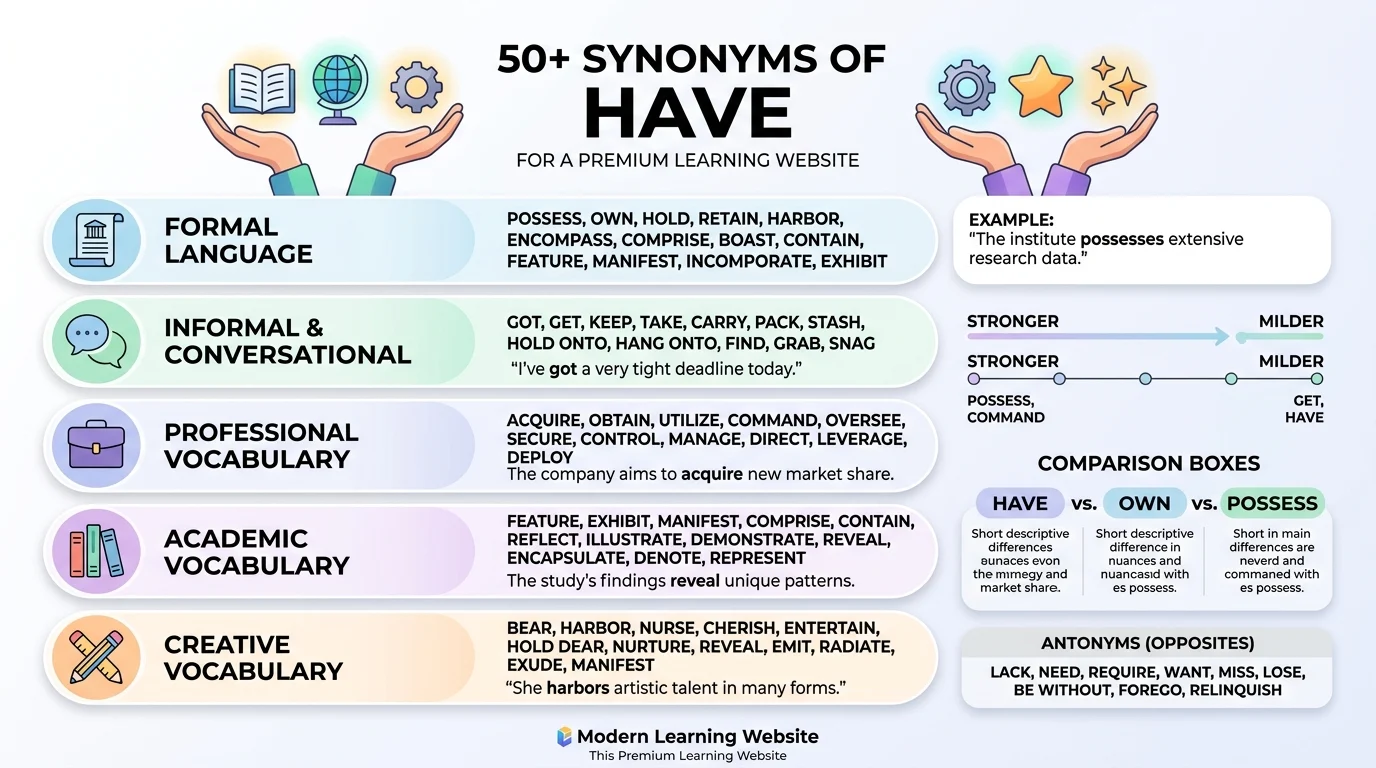
Have you ever paused mid-sentence while writing an email, essay, or social media caption because you realized you had already used the word “have” three times in two paragraphs? You are not alone. “Have” is one of the most frequently used verbs in English. It appears everywhere from casual conversations to formal business reports. But overusing this single word can make your writing sound repetitive, vague, and unpolished. That is why understanding the synonyms of have is essential for anyone who wants to communicate with clarity and confidence. Choosing the right synonym can transform a dull sentence into one that feels precise, professional, and engaging. This guide will help you master every alternative so you never have to settle for the same old word again.
What Are the Best Synonyms of “Have”?
The word “have” means to possess, own, hold, or experience something. It is a neutral, everyday verb used in countless situations. The best synonyms depend on your context. Formal writing, choose “possess” or “maintain.” For casual conversation, “have got” or “got” works well. For academic work, use “comprise,” “contain,” or “exhibit.” Professional settings, “hold,” “own,” or “retain” sound stronger and more authoritative.
Meaning, Tone, and Context
Simple Definition
“Have” means to hold, possess, or own something. It can also mean to experience something, to contain something, or to be required to do something.
Part of Speech
Verb (transitive and auxiliary)
Overall Tone
Neutral. “Have” does not carry strong positive or negative emotional weight on its own.
Formality Level
Neutral to informal. Have” works in almost any setting, but more formal synonyms exist for professional and academic contexts.
Common Uses
Native English speakers use “have” constantly. They use it to talk about ownership (“I have a car”), relationships (“She has two brothers”), physical traits (“He has blue eyes”), experiences (“We had a great time”), obligations (“I have to go”), and countless other situations.
Word Forms
- Have (base form)
- Has (third-person singular)
- Had (past tense)
- Having (present participle)
When and How to Use “Have”
Choose “have” when you need a simple, neutral, and widely understood verb. It works in almost every situation, but it is not always the most precise or powerful choice. Here are seven realistic examples showing how “have” appears in different contexts.
Professional
“We have three major clients in the tech sector.”
Academic
“The study has several limitations that must be acknowledged.”
Workplace
“I have a meeting with the director at 2 PM.”
Personal
“I have two sisters and a golden retriever.”
“I have attached the revised proposal for your review.”
Resume
“Have five years of experience in project management.”
“We have the best coffee in town, hands down.”
Best Synonyms of “Have”
No synonym is identical to “have” in every situation. Each alternative carries its own shade of meaning, tone, and level of formality. Here are the best synonyms for specific contexts.
Professional writing: Possess — sounds more authoritative and deliberate than “have.”
Academic writing: Comprise or exhibit — these words sound precise and analytical.
Business communication: Hold — suggests control and responsibility, ideal for positions and assets.
Casual conversation: Have got — informal but natural in everyday speech.
Emotional writing: Experience or endure — these words carry feeling and depth.
Creative writing: Bear or possess — adds a literary, expressive quality.
Resume writing: Maintain or retain — suggests ongoing responsibility and reliability.
Workplace communication: Oversee or manage — implies active control rather than passive possession.
Stronger meaning: Command or control — suggests authority and power.
Softer meaning: Enjoy or benefit from — suggests a positive, gentle relationship with what you have.
When Not to Use “Have”
Using “have” is not always the best choice. Here are situations where you should reach for a stronger, more precise synonym.
Sounds too general
Weak: “The company has a good reputation.”
Better: “The company maintains a strong reputation.”
The word “maintains” suggests active effort and ongoing care.
“Have” sounds too vague
Weak: “She has many skills.”
Better: “She possesses many valuable skills.”
“Possesses” sounds more deliberate and impressive.
“Have” sounds too informal for a formal document
Weak: “The proposal has several key advantages.”
Better: “The proposal offers several key advantages.”
“Offers” sounds more persuasive and professional.
When “have” sounds too weak for a resume
Weak: “Have experience managing teams.”
Better: “Hold extensive experience managing teams.”
“Hold” sounds more confident and established.
When “have” sounds too cold for emotional writing
Weak: “They have a difficult relationship.”
Better: “They endure a difficult relationship.”
“Endure” conveys struggle and emotional weight.
“have” is outdated in certain expressions
“Have” itself is rarely outdated, but some phrases using “have” can sound old-fashioned. For example, “I have a mind to…” is less common today. Consider “I am considering…” instead.
Words Commonly Confused With “Have”
Have vs Own
Difference: “Have” is general and neutral. “Own” specifically means legal or rightful possession.
When to Use It: Use “own” when you want to emphasize legal ownership or personal property.
Example: “I own this house, but I have a mortgage on it.”
Have vs Possess
Difference: “Possess” is more formal and often implies something valuable or notable. “Have” is everyday language.
When to Use It: Use “possess” in formal writing, legal documents, or when describing desirable qualities.
Example: “She possesses a rare combination of intelligence and empathy.”
Have vs Hold
Difference: “Hold” suggests active control or keeping something in your grasp. “Have” is more passive.
When to Use It: Use “hold” when referring to positions, records, or things you actively keep.
Example: “He holds the record for the fastest marathon time.”
Have vs Contain
Difference: “Contain” specifically refers to having something inside or as part of a whole. “Have” is broader.
When to Use It: Use “contain” when describing what is inside a container, document, or system.
Example: “The report contains all the necessary data.”
Have vs Experience
Difference: “Experience” focuses on going through something. “Have” is more neutral about the event itself.
When to Use It: Use “experience” when you want to emphasize the personal impact of an event.
Example: “They experienced a significant loss during the economic downturn.”
Have vs Get
Difference: “Get” implies acquiring or obtaining. “Have” implies already possessing.
When to Use It: Use “get” when the focus is on the process of obtaining something.
Example: “I need to get a new laptop. I have an old one that barely works.”
Best Synonyms of “Have” by Context
| Context | Best Synonym | Why It Works | Example |
|---|---|---|---|
| Formal writing | Possess | Adds authority and precision | “The organization possesses the resources to complete the project.” |
| Academic writing | Comprise | Sounds analytical and structured | “The sample comprises 200 participants.” |
| Professional communication | Hold | Suggests responsibility and control | “She holds a senior position at the firm.” |
| Business emails | Offer | Sounds proactive and helpful | “We offer a wide range of services.” |
| Resume writing | Maintain | Suggests ongoing reliability | “Maintained client relationships for over five years.” |
| Workplace communication | Oversee | Implies active management | “He oversees daily operations.” |
| Casual conversation | Have got | Natural and conversational | “I have got a great feeling about this.” |
| Everyday speaking | Got | Very informal but widely used | “I got a new phone.” |
| Creative writing | Bear | Literary and expressive | “She bore the weight of expectation gracefully.” |
| Storytelling | Endure | Adds emotional depth and struggle | “They endured countless hardships together.” |
| Emotional writing | Experience | Emphasizes personal impact | “We experienced profound joy that day.” |
| Strong emphasis | Command | Suggests authority and power | “He commands respect from everyone he meets.” |
| Mild tone | Enjoy | Sounds positive and gentle | “We enjoy the support of our community.” |
| Social media captions | Rock | Casual and fun | “We rock the best style in town.” |
How to Choose the Best Synonym of “Have”
Choosing the right synonym for “have” comes down to four key factors: your audience, your purpose, the emotional tone you want to convey, and the level of formality required.
First, consider your audience. Are you writing for a professor, a boss, a friend, or a social media following? Academic and professional audiences expect more precise and formal language. Friends and casual readers appreciate simpler, more conversational choices.
Second, think about your purpose. Are you simply stating a fact, or are you trying to persuade, impress, or move someone emotionally? A resume needs confident words like “possess” and “maintain.” A personal story benefits from emotional words like “experience” and “endure.”
Third, evaluate the emotional strength you need. Do you want to sound neutral, powerful, or gentle? “Have” is neutral. “Command” is powerful. “Enjoy” is gentle. Match the emotional weight to your message.
Fourth, check the formality level. Formal writing demands words like “possess,” “comprise,” and “retain.” Informal settings welcome “got,” “have got,” and even “rock” in very casual contexts.
The best synonym is the one that communicates your intended message most clearly to your specific audience. When in doubt, read your sentence aloud. If “have” feels flat or repetitive, swap it for a synonym that adds precision and personality.
Real Life Examples of “Have”
School
“I have three assignments due this week.” → Better: “I face three assignments due this week.” (“Face” adds a sense of challenge.)
College
“The course has a heavy reading load.” → Better: “The course carries a heavy reading load.” (“Carries” sounds more formal and academic.)
Workplace
“We have a strict deadline.” → Better: “We operate under a strict deadline.” (“Operate under” sounds more professional.)
Business
“Our company has a strong market presence.” → Better: “Our company commands a strong market presence.” (“Commands” sounds powerful and confident.)
“I have attached the document.” → Better: “I have attached the document for your review.” (Sometimes “have” is perfectly fine, but adding purpose strengthens the sentence.)
Resume
“Have managed budgets over $1 million.” → Better: “Managed budgets over $1 million.” (Removing “have” makes the statement more direct and powerful.)
Conversation
“I have a lot of work to do.” → Better: “I have got a lot of work to do.” (“Have got” sounds more natural in casual American English.)
Storytelling
“She had a difficult childhood.” → Better: “She endured a difficult childhood.” (“Endured” conveys struggle and resilience.)
Blogging
“This recipe has amazing flavors.” → Better: “This recipe boasts amazing flavors.” (“Boasts” adds personality and enthusiasm.)
“We have the best fans.” → Better: “We have the absolute best fans.” (Sometimes adding an intensifier is all you need.)
18 Best Synonyms of “Have”
Synonyms of “Have” by Usage
Professional vs Personal Synonyms
Professional settings demand words that sound competent and reliable. “Possess,” “maintain,” “retain,” and “hold” project confidence and stability. These words belong in resumes, performance reviews, and client communications.
Personal conversations allow for simpler, warmer choices. “Have got,” “got,” and “enjoy” sound natural and friendly. Use these with friends, family, and in casual social media posts.
Formal vs Conversational Synonyms
Formal writing includes reports, essays, business documents, and presentations. Choose “possess,” “comprise,” “contain,” “obtain,” and “acquire.” These words add weight and authority to your writing.
Conversational English includes texting, casual emails, and everyday speech. “Have got” and “got” are perfectly acceptable and widely used by native speakers.
Academic Synonyms
Academic writing rewards precision and formality. Use these words to sound more authoritative in research papers, essays, and reports.
- Comprise — “The data set comprises 500 responses.”
- Exhibit — “The participants exhibited significant improvement.”
- Demonstrate — “The findings demonstrate a clear pattern.”
- Contain — “The appendix contains the raw data.”
- Possess — “The study possesses several methodological strengths.”
Professional and Business Synonyms
Strong professional writing sets you apart. These synonyms work best in resumes, interviews, meetings, presentations, and client communication.
- Hold — “I hold a degree in business administration.”
- Maintain — “Maintained a 95% client satisfaction rate.”
- Retain — “Retained key accounts during a difficult quarter.”
- Oversee — “Oversee a team of 15 marketing professionals.”
- Secure — “Secured $2 million in new funding.”
- Command — “Command a budget of over $500,000.”
Creative and Literary Synonyms
Creative writing thrives on expressive, image-rich language. These alternatives add emotion and imagery to fiction, poetry, and descriptive writing.
- Bear — “She bore the weight of her family’s expectations.”
- Endure — “He endured the long winter without complaint.”
- Boast — “The valley boasts breathtaking sunsets.”
- Possess — “He possessed an old-world charm that captivated everyone.”
- Command — “Her voice commanded attention the moment she spoke.”
Slang or Modern Synonyms
Modern English offers a few casual alternatives. Use these sparingly and only in appropriate contexts.
- Got — Very informal. Acceptable in casual conversation and texting. Avoid in professional or academic writing.
- Rock — Informal slang meaning to have or display something impressively. “We rock the best playlist.” Use only in very casual settings.
- Sport — Informal, means to have or wear something noticeable. “He sports a new haircut.” Acceptable in casual writing.
Strongest to Mildest Synonyms
Mild → Enjoy, have got, include
Moderate → Have, contain, possess, hold, own
Strong → Maintain, retain, secure, acquire, obtain
Very Strong → Command, endure, bear, boast
The emotional intensity increases as you move from mild to very strong. “Enjoy” for gentle positivity. Choose “command” for authority and power. Choose “endure” for struggle and resilience.
Emotional vs Neutral Synonyms
Emotional Synonyms express feelings and experiences. “Experience,” “endure,” “undergo,” “bear,” and “boast” carry emotional weight. Use them in personal stories, creative writing, and emotional appeals.
Neutral Synonyms communicate information without added emotion. “Possess,” “contain,” “comprise,” “include,” and “hold” simply state facts. Use them in reports, academic papers, and professional documents where objectivity matters.
Antonyms of “Have”
| Antonym | Meaning | Example Sentence |
|---|---|---|
| Lack | To be without or not have enough | “I lack the experience required for this role.” |
| Need | To require something that is missing | “We need additional resources to complete the project.” |
| Miss | To feel the absence of | “I miss the support I had at my previous job.” |
| Want | To desire something not possessed | “She wants more time to finish the report.” |
| Desire | To strongly wish for | “He desires a leadership position.” |
| Require | To need as necessary | “The position requires five years of experience.” |
| Lose | To cease to have | “They lost their competitive edge after the merger.” |
| Forfeit | To lose or give up as a penalty | “He forfeited his claim to the property.” |
| Surrender | To give up possession | “She surrendered her role as team leader.” |
| Relinquish | To voluntarily give up | “He relinquished control of the company.” |
| Abandon | To give up completely | “They abandoned their original plan.” |
| Discard | To throw away or get rid of | “We discarded the outdated policies.” |
| Cede | To give up power or territory | “The CEO ceded decision-making authority.” |
| Divest | To strip of or remove | “The company divested its underperforming assets.” |
| Deprive | To take away from | “The budget cuts deprived us of essential tools.” |
Comparison: “Have” vs Similar Words
Have vs Possess
Main Difference: “Have” is the everyday, general word for owning or holding something. “Possess” is more formal and often implies something valuable or notable.
Which Is Stronger? “Possess” carries more weight and formality.
Which Is More Formal? “Possess” is significantly more formal.
When to Use Each: Use “have” in everyday conversation and general writing. Use “possess” in formal documents, academic writing, and when describing admirable qualities.
Examples:
- Have: “I have a new laptop.”
- Possess: “She possesses a rare talent for negotiation.”
Have vs Own
Main Difference: “Have” is broad and neutral. “Own” specifically means legal or rightful possession.
Which Is Stronger? “Own” is stronger regarding legal rights.
Which Is More Formal? Both are neutral, but “own” is more precise in legal contexts.
When to Use Each: Use “have” for general possession. Use “own” when you want to emphasize legal ownership or personal property.
Examples:
- Have: “We have a dog.”
- Own: “We own this house outright.”
Have vs Hold
Main Difference: “Have” is passive possession. “Hold” suggests active control or keeping something in your grasp.
Which Is Stronger? “Hold” implies more active control.
Which Is More Formal? “Hold” is more formal in professional contexts.
When to Use Each: Use “have” for general statements. Use “hold” when referring to positions, records, or things you actively control.
Examples:
- Have: “He has a job.”
- Hold: “He holds a senior position at the firm.”
Have vs Contain
Main Difference: “Have” is general. “Contain” specifically means having something inside or as part of a whole.
Which Is Stronger? “Contain” is more precise.
Which Is More Formal? “Contain” is more formal and technical.
When to Use Each: Use “have” for general possession. Use “contain” when describing what is inside something.
Examples:
- Have: “The box has old photos.”
- Contain: “The box contains old family photos.”
Have vs Experience
Main Difference: “Have” is neutral about events. “Experience” focuses on going through something personally.
Which Is Stronger? “Experience” carries more emotional weight.
Which Is More Formal? Both are appropriate in formal and informal contexts.
When to Use Each: Use “have” for simple statements. Use “experience” when you want to emphasize the personal impact of an event.
Examples:
- Have: “We had a great time.”
- Experience: “We experienced pure joy that day.”
Have vs Get
Main Difference: “Get” implies acquiring or obtaining. “Have” implies already possessing.
Which Is Stronger? Neither is stronger; they focus on different stages.
Which Is More Formal? “Have” is more formal than “get” in most contexts.
When to Use Each: Use “have” when you already possess something. Use “get” when the focus is on obtaining something.
Examples:
- Have: “I have the tickets already.”
- Get: “I need to get the tickets tomorrow.”
Common Phrases and Expressions with “Have”
Have a good day
Meaning: A polite farewell wishing someone well.
Example Sentence: “Thanks for your help. Have a good day!”
Have a seat
Meaning: A polite invitation to sit down.
Example Sentence: “Please have a seat while you wait for the doctor.”
Have a look
Meaning: To examine or inspect something.
Example Sentence: “Can you have a look at this document and tell me what you think?”
Have in mind
Meaning: To be thinking of or considering something.
Example Sentence: “I have a specific candidate in mind for the position.”
Have to do with
Meaning: To be related to or connected with something.
Example Sentence: “This issue has to do with budget constraints, not performance.”
Have it your way
Meaning: An expression of concession, often said when someone insists on their preference.
Example Sentence: “Fine, have it your way. I will go along with your plan.”
Have a blast
Meaning: To have a great time.
Example Sentence: “We had a blast at the concert last night.”
Common Mistakes to Avoid
Choosing a Vague Synonym Instead of a Precise One
Incorrect: “The report has many charts.”
Better: “The report contains detailed charts illustrating market trends.”
Why: “Contains” is more precise than “has” when describing what is inside something.
Confusing “Have” with “Get”
Incorrect: “I got a cold.” (While common, “got” technically means acquired, not suffered.)
Better: “I have a cold.”
Why: “Have” is the correct verb for describing an ongoing condition or illness.
Using an Informal Synonym in Formal Writing
Incorrect: “The study has got several limitations.”
Better: “The study has several limitations.” or “The study possesses several limitations.”
Why: “Have got” is too informal for academic writing.
Selecting an Overly Dramatic Synonym
Incorrect: “I endure a new phone.”
Better: “I have a new phone.”
Why: “Endure” implies suffering. It is inappropriate for neutral statements about possession.
Repeating the Same Word Too Often
Incorrect: “We have a new policy. We have new procedures. We have new training.”
Better: “We have a new policy. We implemented new procedures. We introduced new training.”
Why: Varying your word choices keeps writing fresh and engaging.
Choosing a Synonym with the Wrong Emotional Tone
Incorrect: “We enjoy a serious budget deficit.”
Better: “We face a serious budget deficit.”
Why: “Enjoy” is positive. It sounds inappropriate and confusing when paired with negative situations.
Using Slang in Academic or Professional Writing
Incorrect: “The company rocks a strong market position.”
Better: “The company holds a strong market position.”
Why: “Rocks” is slang. It undermines professionalism in formal contexts.
Frequently Asked Questions
What are the best synonyms of “have”?
The best synonyms depend on context. Formal writing, use “possess” or “maintain.” For casual conversation, use “have got.” For professional settings, use “hold” or “retain.” Academic writing, use “comprise” or “contain.”
What are the best formal synonyms of “have”?
The best formal synonyms include “possess,” “hold,” “contain,” “comprise,” “obtain,” “acquire,” “retain,” and “maintain.” These words add authority and precision to reports, essays, and professional documents.
What are common informal synonyms of “have”?
Common informal synonyms include “have got” and “got.” “Have got” is very common in casual American English. “Got” alone is even more informal and best reserved for texting and very casual conversation.
What is another word for “have” in professional writing?
In professional writing, choose “hold,” “possess,” “maintain,” or “retain.” “Hold” works well for positions and records. “Maintain” suggests ongoing responsibility. “Retain” implies keeping something valuable.
What is the difference between “have” and “possess”?
“Have” is the general, everyday word for possession. “Possess” is more formal and often implies something valuable or notable. Use “have” in casual contexts. Use “possess” in formal writing and when describing admirable qualities.
What is the opposite of “have”?
The most direct opposite of “have” is “lack.” Other opposites include “need,” “miss,” “want,” “lose,” “forfeit,” “surrender,” and “relinquish.” These words all describe not having something or giving it up.
Conclusion
The word “have” is simple, versatile, and essential. But relying on it too heavily can make your writing feel flat and repetitive. The synonyms of have are numerous and varied. “Possess” and “maintain” add formality. “Have got” and “got” feel natural in conversation. “Experience” and “endure” bring emotional depth. “Hold” and “retain” project professional confidence. No single synonym works perfectly in every situation. The best choice depends on your audience, your purpose, and the tone you want to convey. The next time you write, pause before you type “have.” Ask yourself if a stronger, more precise word could do the job better. Your readers will notice the difference.