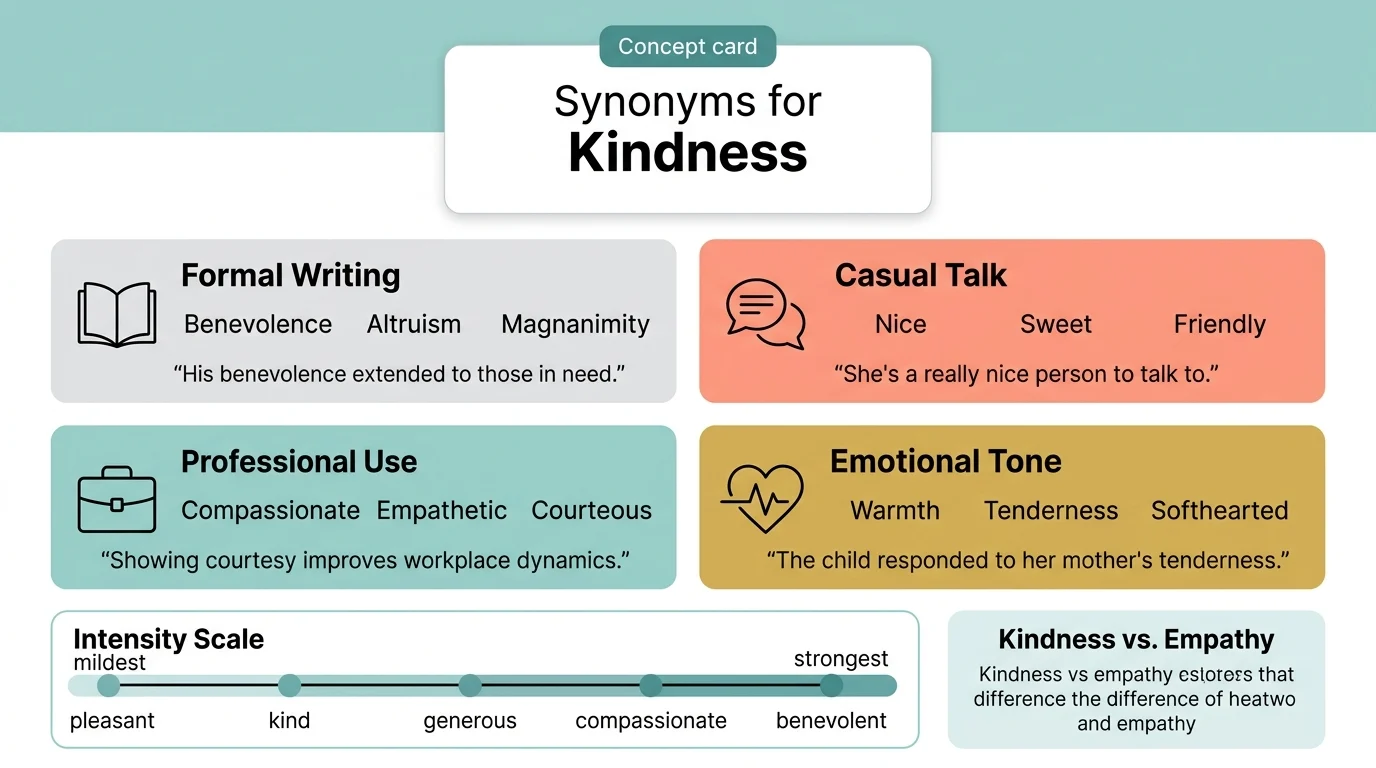
Have you ever caught yourself using the word “kindness” over and over again in a letter, a speech, or a social media caption? You know the feeling. You want to express warmth and generosity, but the same word keeps appearing. It makes your writing feel flat and repetitive.
A wider vocabulary helps you communicate with more precision and emotional impact. This guide provides a comprehensive list of synonyms for kindness. You will learn which words fit formal settings, casual conversations, professional environments, and creative writing. Your communication will become sharper and more engaging.
What Does “Kindness” Mean?
Kindness means the quality of being friendly, generous, and considerate toward others. For formal writing, use compassion or benevolence. For casual use, try warmth or heart. In professional settings, consider thoughtfulness or consideration. Creative writers might prefer tenderness or graciousness. Emotional contexts work well with empathy or gentleness.
Meaning, Tone and Context
- Simple definition: Kindness is the act of showing care, concern, and goodwill toward other people. It involves being helpful and thoughtful without expecting anything in return.
- Part of speech: Kindness is a noun. Its related adjective form is kind, and its adverb form is kindly.
- Positive, negative, or neutral tone: The tone is overwhelmingly positive. Kindness is universally admired as a virtue and a strength.
- Formality level: The word is neutral and works in almost any context. It fits casual conversation and formal writing equally well without sounding out of place.
- Common use cases: You use kindness when describing someone’s character, praising an action, or encouraging a positive culture. It appears in personal notes, professional references, and philosophical discussions.
- Important word forms: The opposite of kindness is cruelty or unkindness. Related verbs include to be kind, to show kindness, or to treat with kindness.
When and How to Use “Kindness”
Use kindness when you want to describe a general, consistent trait of goodwill. It works best for actions that are helpful, gentle, or generous. The word is safe and widely understood. However, relying on it too much can make your writing feel vague. Stronger or more specific synonyms often improve your message.
Here are realistic examples with different contexts:
- Professional context: The manager showed great kindness by allowing the team to leave early before the holiday break. This creates a positive workplace culture.
- Personal context: Her kindness toward neighbors makes her a beloved member of the community. It reflects her true character.
- Academic context: The study measured the effects of kindness on student collaboration and overall classroom atmosphere. The results were significant.
- Emotional context: I will never forget the kindness you showed me during my most difficult days. Your support meant everything.
- Creative context: The story explores the quiet kindness that exists between strangers in a busy city. It finds beauty in small moments.
- Social media caption: A little kindness goes a long way. Share this reminder with someone who needs to hear it today.
- Resume context: Recognized for kindness and patience when training new employees during a high pressure period.
Another Word for “Kindness”
Choosing the right synonym depends entirely on your situation. The best single replacement for kindness is compassion when you mean deep sympathy. Consider benevolence for a formal or old fashioned tone. For everyday conversation, think about using warmth or heart.
Here are direct suggestions based on specific needs:
- Professional writing: Use consideration or thoughtfulness. These words sound polished and describe respectful behavior toward colleagues.
- Academic writing: Use altruism or benevolence. These terms carry a precise, research friendly meaning.
- Casual conversation: Use warmth or heart. These are approachable and convey a genuine feeling of care.
- Emotional writing: Use compassion or tenderness. These words evoke a deep sense of connection and empathy.
- Creative writing: Use graciousness or magnanimity. These add a literary or historical richness to your description.
- Resume or workplace: Use supportiveness or people skills. These highlight your ability to work well with others.
- Social media captions: Use goodness or love. These are simple, powerful, and easy to share.
- Stronger meaning: Use empathy or charity. These imply active, selfless giving of your time or resources.
- Softer meaning: Use gentleness or patience. These focus on a mild, nonjudgmental approach to others.
When Not to Use “Kindness”
Kindness sounds too vague in situations that require a specific term. It fails to capture the intensity of deep sacrifice or the political nature of fairness. It also appears weak if the action required great courage or strength.
Consider these examples that improve precision:
Vague: His kindness was remarkable.
Better: His generosity was remarkable. This specifies giving.
Vague: She handled the conflict with kindness.
Better: She handled the conflict with diplomacy. This highlights tactical skill.
Vague: The teacher showed kindness to the struggling student.
Better: The teacher showed patience to the struggling student. This focuses on a specific virtue.
Words Commonly Confused With “Kindness”
Many words relate to kindness but have distinct meanings. Using the wrong one confuses your reader.
Kindness vs. Empathy: Empathy is the ability to understand and share the feelings of another person. Kindness is the action you take based on that understanding. You can have empathy without being kind, and you can be kind without fully understanding someone’s feelings. Empathy is internal, while kindness is external.
Kindness vs. Generosity: Generosity specifically involves giving resources, time, or money. Kindness is a broader concept that includes generosity but also includes patience, compliments, and helpfulness. You can be kind without being generous.
Kindness vs. Compassion: Compassion is a stronger word. It means a deep awareness of another’s suffering combined with a desire to relieve it. can be a small, everyday gesture, but compassion implies a serious commitment.
Kindness vs. Politeness: Politeness is about following social rules and good manners. Kindness comes from genuine care. You can be polite to someone you dislike, but kindness requires goodwill.
Kindness vs. Sympathy: Sympathy means feeling pity or sorrow for someone else’s misfortune. Kindness is more active. It means doing something helpful or supportive.
Kindness vs. Charity: Charity often implies giving to those in need, especially through organized institutions. Kindness can be personal, informal, and directed at anyone, including the wealthy.
Best Synonym by Context for “Kindness”
This table helps you select the perfect word for your specific situation. Each synonym is chosen for its fit in that context.
| Context | Best Synonym | Why It Works | Example |
|---|---|---|---|
| Formal Writing | Benevolence | It sounds sophisticated and authoritative. | The organization is founded on principles of benevolence and community service. |
| Academic Writing | Altruism | It is a precise, technical term for selfless concern. | The study examined altruism in children across different age groups. |
| Professional / Business | Thoughtfulness | It shows respect for colleagues and clients. | Thank you for your thoughtfulness in preparing the detailed report. |
| Resume | Supportiveness | It describes a valuable team skill clearly. | Praised for supportiveness during cross departmental collaboration. |
| Casual Conversation | Warmth | It feels natural and friendly in everyday talk. | I really appreciate the warmth of this neighborhood. |
| Creative Writing | Graciousness | It adds elegance and literary charm to descriptions. | The character is known for her quiet graciousness. |
| Emotional Tone | Compassion | It conveys deep care and understanding. | The nurse showed incredible compassion during the difficult procedure. |
| Strong Intensity | Charity | It implies active giving and selflessness. | His charity extended beyond money to his valuable time. |
| Soft / Moderate Tone | Gentleness | It suggests a mild, nonthreatening approach. | She spoke to the frightened child with gentleness. |
| Social Media Captions | Goodness | It is simple, inspiring, and easily quotable. | Spread a little goodness today. The world needs it. |
Which Synonym Should You Choose?
Making the right choice involves asking yourself a few key questions. First, consider your audience. Are you writing for a professor, a friend, or a hiring manager? A formal audience calls for words like benevolence or consideration. A casual audience prefers warmth or heart.
Next, think about the emotional intensity of the situation. Are you describing a heroic sacrifice or a small favor? Use compassion or charity for serious acts. Use friendliness or courtesy for everyday gestures.
Finally, examine your sentence structure. Do you need a noun, an adjective, or a verb? This guide focuses on nouns, but remember that changing the form of the word, such as using “compassionate” instead of “compassion,” can alter the flow of your sentence. Always prioritize clarity over fancy vocabulary.
Real Life Examples of “Kindness” in Sentences
These examples show how synonyms for kindness can transform your writing. They cover school, workplace, conversation, and other common areas.
School: The teacher’s patience with the struggling student was truly admirable. This avoids the vague use of kindness and specifies the virtue.
Workplace: The team leader’s thoughtfulness was evident when she remembered everyone’s coffee order. This is more specific than saying she showed kindness.
Writing: The memoir is a testament to human compassion. This sounds more profound than using kindness.
Conversation: I am grateful for your support during my job search. This is a practical and sincere expression.
Social Media: Let’s all practice a little more understanding today. This is a direct call to action.
Resume: Demonstrated empathy by resolving customer complaints with genuine care. This is a powerful and specific skill statement.
Email: Your consideration of my request is greatly appreciated. This sounds professional and respectful.
Storytelling: The old man’s generosity surprised everyone in the village. This creates a clear picture of a specific action.
15 Synonyms for “Kindness”
This table presents a curated list of 15 accurate synonyms. Each entry includes a clear explanation and a natural example.
| Synonym | Simple Meaning | Best Used For | Example Sentence |
|---|---|---|---|
| Compassion | Deep awareness of suffering and desire to help. | Emotional, serious situations. | She felt deep compassion for the homeless families. |
| Benevolence | General goodwill and desire to do good. | Formal, old fashioned, or ethical contexts. | The charity depends on the benevolence of its donors. |
| Altruism | Selfless concern for the well being of others. | Academic, scientific, or philosophical writing. | His actions were driven by pure altruism. |
| Generosity | Willingness to give time, money, or resources. | Describing giving and sharing. | His generosity was known throughout the town. |
| Thoughtfulness | Careful consideration for others’ needs. | Professional and personal appreciation. | Thank you for your thoughtfulness in calling to check on me. |
| Warmth | Friendly and approachable affection. | Casual conversation and personal interactions. | There is a real warmth to her personality. |
| Graciousness | Elegant kindness and good manners. | Creative writing and formal compliments. | The queen accepted the gift with graciousness. |
| Gentleness | Mild, tender, and nonviolent behavior. | Describing a soft approach to sensitive topics. | The doctor handled the patient with gentleness. |
| Consideration | Careful thought for the feelings of others. | Workplace and professional settings. | Please show consideration for other library users. |
| Sympathy | Feeling sorrow or pity for another’s loss. | Expressing condolences. | We offer our sympathy to the grieving family. |
| Charity | Generous giving to those in need. | Describing philanthropic actions. | Her charity work focuses on education. |
| Tenderness | Affectionate and soft expression of care. | Emotional and romantic contexts. | He held the child with tenderness. |
| Goodwill | Friendly, helpful, or cooperative feelings. | Business and diplomatic relations. | The meeting was conducted in a spirit of goodwill. |
| Hospitality | Generous and friendly treatment of guests. | Describing hosting and welcoming. | Their hospitality made us feel at home. |
| Helpfulness | The quality of providing useful assistance. | Everyday actions and practical support. | His helpfulness around the house is appreciated. |
Synonym Groups and Usage Differences
Professional vs. Personal Synonyms
In professional settings, words like thoughtfulness and consideration are valued. They imply a respect for colleagues and clients. In personal settings, words like warmth and tenderness create a closer, more emotional connection. Using “consideration” with family sounds too formal, while using “tenderness” in a boardroom is inappropriate.
Formal vs. Conversational Synonyms
Formal writing, such as academic essays or official reports, benefits from benevolence and altruism. These words carry a sense of gravity and intellectual rigor. Conversational English relies on simpler words like warmth and heart. These are easy to understand and sound authentic in everyday talk. A text message to a friend should use “warmth,” not “benevolence.”
Academic Synonyms
For academic writing, precision is key. Altruism is a specific term used in psychology and sociology. Compassion is frequently discussed in the fields of healthcare and ethics. These words help you maintain a scholarly tone and demonstrate a precise understanding of complex concepts.
Professional and Business Synonyms
In the business world, focusing on action is important. Words like supportiveness and thoughtfulness are valued in performance reviews and resumes. They show that you are a team player who contributes to a positive culture. Using “goodwill” is also effective when discussing client relationships and company reputation.
Creative or Literary Synonyms
Creative writers look for words with imagery and depth. Graciousness evokes a historical or aristocratic scene. Tenderness suggests a soft, intimate moment. Magnanimity conveys a grand, almost heroic sense of forgiveness or generosity. These words help paint vivid pictures and develop rich characters.
Slang or Modern Synonyms
There are no common slang equivalents for kindness in modern American English. The concept is generally treated with respect. However, in very casual online spaces, you might see terms like “good vibes” or “positive energy,” which are related concepts but not direct synonyms.
Strongest vs. Weaker Synonyms
This scale shows the intensity of different synonyms for kindness, from mild to the most powerful.
Mild: Politeness, Friendliness
Moderate: Gentleness, Helpfulness
Strong: Compassion, Generosity
Strongest: Charity, Altruism
Emotional vs. Neutral Synonyms
Many synonyms are emotionally charged. Compassion, tenderness, and sympathy evoke deep feelings. Others are more neutral and factual. Helpfulness and supportiveness describe actions without as much emotional weight. Choosing between them depends on whether you want to appeal to the reader’s heart or simply state a fact.
Antonyms of “Kindness”
Understanding the opposite of kindness clarifies its meaning. These 15 antonyms represent the spectrum of unkind behavior.
| Antonym | Meaning | Example Sentence |
|---|---|---|
| Cruelty | A desire to cause pain or suffering. | Cruelty to animals is a serious crime. |
| Hostility | Unfriendly and antagonistic behavior. | His hostility toward new ideas stifled creativity. |
| Harshness | Severe and unpleasant treatment. | The harshness of the criticism was unexpected. |
| Selfishness | A lack of concern for others. | His selfishness prevented him from sharing. |
| Meanness | A petty and spiteful nature. | Her meanness alienated everyone around her. |
| Indifference | A lack of interest or concern. | His indifference to her plight was shocking. |
| Malice | The intention to do harm. | The rumor was spread with pure malice. |
| Spite | A desire to hurt or annoy someone. | He did it out of spite, not for any good reason. |
| Unkindness | The direct opposite of kindness. | He regretted his unkindness to his brother. |
| Callousness | Showing no concern for others’ feelings. | The company’s callousness led to a public outcry. |
| Hardness | A lack of sympathy or feeling. | There was a hardness in his heart. |
| Coldness | A lack of warmth or affection. | Her coldness drove him away. |
| Inhumanity | Extremely cruel and brutal behavior. | The inhumanity of the act was condemned. |
| Animosity | A strong hostility or dislike. | Animosity between the two groups grew. |
Comparison: Kindness vs. Similar Words
These comparisons help you choose between kindness and other related terms. Each comparison offers a clear distinction and example.
Kindness vs. Empathy
Main difference: Kindness is an action or behavior. Empathy is an internal feeling of understanding. You show kindness by doing something. You feel empathy by sharing another’s perspective.
Which one is stronger: Both are valuable, but kindness is active and visible. Empathy is the foundation that often leads to kindness.
Which one is more formal: Empathy is more clinical and formal. It is a psychological concept. Kindness is more general and accessible.
Example with Kindness: His kindness was shown through his helpful actions.
Example with Empathy: Her empathy allowed her to understand his frustration.
Kindness vs. Generosity
Main difference: Generosity focuses on giving. It involves a transfer of resources like money, time, or gifts. Kindness is broader and can include giving, but also includes actions like patience or a kind word.
Which one is stronger: Generosity is more specific and often implies a greater sacrifice. It is a powerful form of kindness.
Which one is more formal: Generosity is neutral. It fits both casual and formal contexts.
Example with Kindness: Her kindness was felt by everyone.
Example with Generosity: His generosity provided the school with new computers.
Kindness vs. Compassion
Main difference: Compassion is a deeper, more intense form of kindness. It specifically responds to suffering. Kindness can be shown in happy or neutral situations too.
Which one is stronger: Compassion is significantly stronger. It implies deep care and a motivation to relieve pain.
Which one is more formal: Both are appropriate for formal and informal use.
Example with Kindness: She showed kindness by holding the door open.
Example with Compassion: She showed compassion by starting a fundraiser for his medical bills.
Kindness vs. Politeness
Main difference: Politeness is about following rules of etiquette. It is a social convention. Kindness comes from genuine care. You can be polite while feeling angry, but kindness requires goodwill.
Which one is stronger: Kindness is stronger and more meaningful.
Which one is more formal: Politeness is more formal and conventional.
Example with Kindness: His kindness made her feel valued.
Example with Politeness: His politeness was evident in his formal greeting.
Kindness vs. Sympathy
Main difference: Sympathy is feeling pity or sorrow for someone. Kindness is acting on that feeling. Sympathy is a passive emotion, while kindness is active.
Which one is stronger: Kindness is stronger because it results in action.
Which one is more formal: Sympathy is often used in formal expressions of condolences.
Example with Kindness: He showed kindness by helping her carry her bags.
Example with Sympathy: He expressed sympathy for her loss.
Kindness vs. Hospitality
Main difference: Hospitality is a specific type of kindness. It is the generous treatment of guests or strangers. Kindness is a general character trait.
Which one is stronger: Hospitality is more specific, not necessarily stronger.
Which one is more formal: Hospitality is a neutral term.
Example with Kindness: Her kindness made everyone welcome.
Example with Hospitality: Their hospitality was legendary.
Common Phrases and Expressions with “Kindness”
These common phrases incorporate the word kindness. Understanding them enriches your vocabulary and helps you use the word naturally.
1. Kill them with kindness
Meaning: To respond to a hostile person with exaggerated friendliness. This often disarms them and makes them feel guilty.
Example sentence: Whenever she gets a rude email, she replies politely to kill them with kindness.
2. An act of kindness
Meaning: A specific, deliberate action performed to help or benefit someone else. It is often used to describe small, unexpected gestures.
Example sentence: Paying for the stranger’s coffee was a simple act of kindness.
3. Out of the kindness of one’s heart
Meaning: Doing something because of genuine goodwill, not for personal gain or recognition. It emphasizes the pure motive behind the action.
Example sentence: He helped me out of the kindness of his heart, not expecting a reward.
4. Kindness begets kindness
Meaning: The idea that one kind action encourages another. It suggests that kindness is a social force that creates a chain reaction.
Example sentence: Remember that kindness begets kindness, so your simple gesture can inspire many.
5. To treat someone with kindness
Meaning: To handle or interact with someone in a gentle, caring, and considerate manner. It is a common directive for good behavior.
Example sentence: The best leaders treat their employees with kindness and respect.
6. An overflow of kindness
Meaning: An abundant, generous display of kindness that goes beyond what is expected.
Example sentence: We were overwhelmed by the overflow of kindness from our community after the fire.
Common Mistakes to Avoid
Avoid these frequent errors to ensure your writing is clear and appropriate.
- Using kindness when a more precise synonym is better: Describing a specific act of giving as “kindness” is correct but weak. Using “generosity” is far more descriptive.
- Confusing kindness with empathy: Remember, empathy is feeling, kindness is doing. Do not use empathy to describe an action and vice versa. For example, “His empathy was shown by giving money” is incorrect. “His kindness was shown by giving money” is correct.
- Using a casual synonym in formal writing: Avoid using “warmth” in an academic essay. Instead, use “altruism” or “benevolence” to maintain a serious tone.
- Using an overly dramatic synonym for a simple situation: Describing someone holding a door open as an act of “magnanimity” is exaggerated. This word is for grand, heroic gestures. Use “politeness” for the door holding.
- Repeating the same word too often: Use the synonyms in this guide to add variety. Instead of saying “kindness” multiple times in a sentence, swap in “compassion” or “consideration.”
- Choosing a synonym with the wrong emotional tone: “Sympathy” is for sad events. Using it in a happy context sounds strange. Use “warmth” for positive situations.
- Using slang in academic or professional writing: There is no slang for kindness, so this is rarely an issue. However, be cautious with overly casual terms like “nice” or “good vibes” in formal documents.
FAQs
1. What is the best synonym for kindness?
The best synonym depends on the context. For general use, “compassion” is excellent. formal writing, choose “benevolence.” For casual talk, use “warmth.”
2. What is a formal synonym for kindness?
A formal synonym for kindness is “benevolence.” “Altruism” is also a formal choice, especially in academic writing.
3. What is an informal synonym for kindness?
An informal synonym for kindness is “warmth.” “Heart” is another casual way to describe the same quality.
4. What is another word for kindness in professional writing?
In professional writing, use “thoughtfulness” or “consideration.” These words convey respect and a positive workplace attitude.
5. What is the difference between kindness and empathy?
Kindness is the action of being helpful and caring. Empathy is the internal feeling of understanding another’s perspective. Empathy often leads to kindness.
6. What is the opposite of kindness?
The most direct opposite of kindness is “cruelty.” Other opposites include “hostility,” “selfishness,” and “indifference.”
Conclusion
Kindness is a powerful and essential word that describes the best of human behavior. But you now know it is not the only word. Your vocabulary for this concept can be rich and varied. Using synonyms like compassion, generosity, and thoughtfulness helps you communicate more clearly and connect with your audience on a deeper level. Your choice of word should always match the tone, the context, and the emotional intensity of your message. By avoiding overused language and selecting the perfect synonym, you will become a more precise and engaging communicator. Remember, the best word is the one that makes your meaning clear and resonates with your reader.