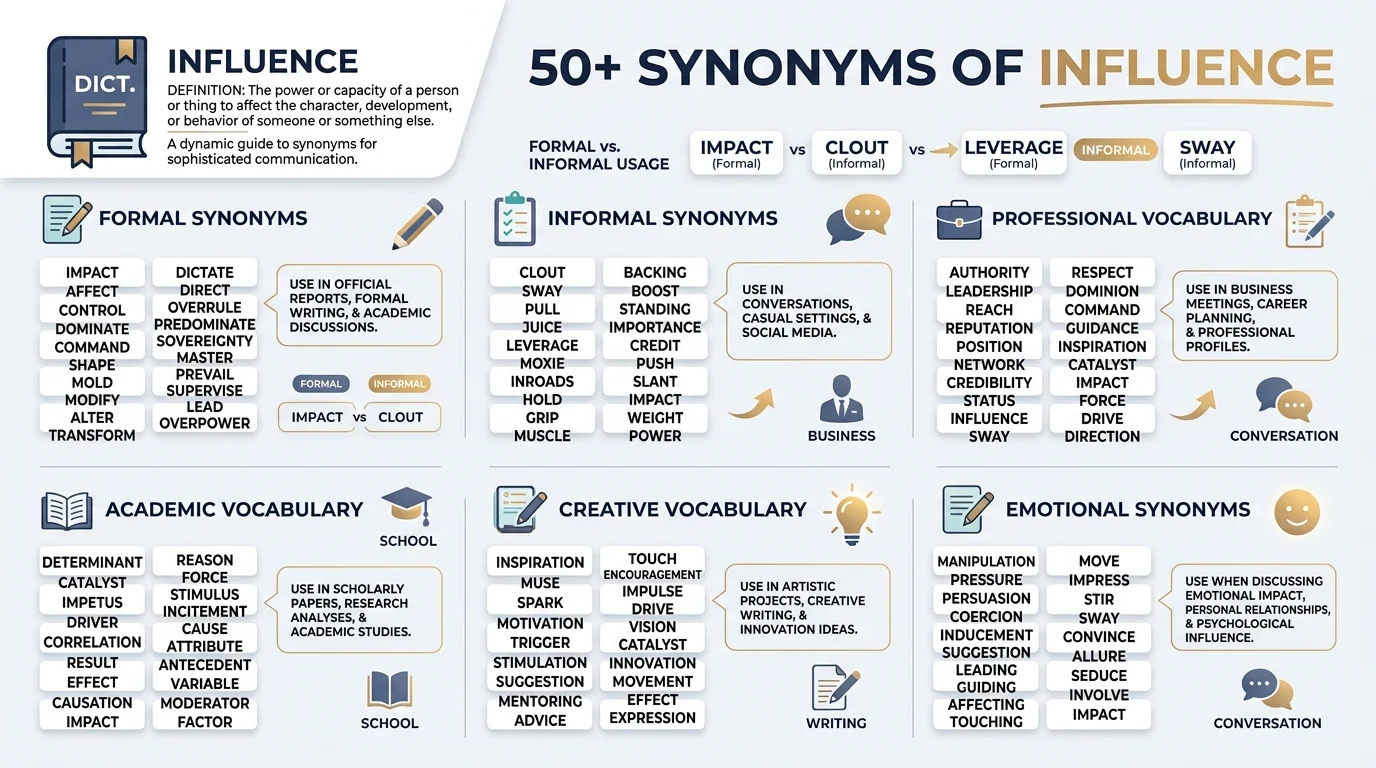
Have you ever written an email, essay, or social media post and realized you used the word “influence” five times in three sentences? You are not alone. Most writers overuse common words like influence without realizing how many powerful alternatives exist.
The right synonym can transform a dull sentence into something precise and memorable. When you know the best synonyms of influence, you can communicate exactly what you mean. This guide will help you understand the meaning of influence, discover the best synonyms, and learn when to use each one. Whether you are writing a business report, an academic paper, or a casual message, you will find the perfect word for your situation.
What Are the Best Synonyms of “Influence”?
The word “influence” means the capacity to affect the character, development, or behavior of someone or something. Formal writing, use “impact” or “affect.” Professional settings, choose “sway” or “shape.” For emotional contexts, “inspire” or “move” work well. For creative writing, “color” or “tinge” add vividness.
Meaning, Tone, and Context
Simple Definition
Influence means the power or ability to change how someone thinks, feels, or acts. It can also refer to the effect that one person, idea, or thing has on another.
Part of Speech
Influence is primarily used as a noun and a verb.
- Noun: The influence of social media on young people is significant.
- Verb: Her speech influenced the way I view the issue.
Overall Tone
The tone of “influence” is neutral. The word itself does not carry a positive or negative charge. The surrounding context determines whether the influence is good or bad.
For example, “positive influence” suggests a beneficial effect, while “negative influence” suggests a harmful one. The word remains neutral, which is one reason writers often overuse it.
Formality Level
Influence is semi-formal. It works well in professional emails, academic writing, and everyday conversation. You can use it in almost any setting without sounding out of place. However, in very formal legal or scientific writing, more precise alternatives often serve better.
Common Uses
Native English speakers use “influence” in many everyday situations.
- Discussing how parents affect their children’s choices.
- Describing the power of advertising on consumer behavior.
- Explaining how a mentor shaped someone’s career.
- Talking about cultural trends that affect fashion or music.
- Describing the effect of weather on mood.
- Discussing political or social movements.
- Explaining how one decision impacts future outcomes.
Word Forms
- Noun: influence (the power or effect)
- Verb: influence (to affect or shape)
- Adjective: influential (having great influence)
- Adverb: influentially (in a way that has influence)
- Opposite: uninfluenced (not affected)
When and How to Use “Influence”
Choose “influence” when you need a neutral, general word for affecting something or someone. It works best when you do not need to specify the exact nature of the effect.
Professional Context
The new marketing strategy influenced our sales figures this quarter.
Academic Context
Several key factors influenced the outcome of the experiment.
Workplace Context
His feedback influenced the direction of the entire project.
Personal Context
My grandmother influenced my love of cooking from a young age.
Email Context
I believe the new policy will influence employee satisfaction positively.
Resume Context
Successfully influenced cross-functional teams to adopt new workflow processes.
Social Media Context
Her content has influenced how I think about sustainable living.
Best Synonyms of “Influence”
No synonym perfectly replaces “influence” in every situation. Each alternative carries slightly different shades of meaning, emotional weight, and formality. The best choice depends on your audience, purpose, and tone.
Professional Writing
Best synonym: Shape
“Shape” suggests actively molding or forming something. It implies a more intentional and lasting effect than “influence.”
Why it works: In business and professional writing, “shape” sounds active and decisive. It suggests you took deliberate action rather than simply having a passive effect.
Academic Writing
Best synonym: Determine
“Determine” suggests a clear, measurable effect. It implies that one factor directly caused or decided an outcome.
Why it works: Academic writing values precision and cause-and-effect relationships. “Determine” provides that clarity.
Business Communication
Best synonym: Sway
“Sway” suggests influencing someone’s opinion or decision through persuasion or argument.
Why it works: In business settings, you often need to describe how you persuaded others. “Sway” sounds professional yet direct.
Casual Conversation
Best synonym: Rub off on
This informal phrase describes how someone’s behavior or attitude affects another person gradually.
Why it works: This phrase feels natural in everyday speech. It sounds friendly and relatable.
Emotional Writing
Best synonym: Move
“Move” describes a deep emotional impact that changes how someone feels.
Why it works: When you want to describe powerful emotional influence, “move” captures the feeling better than “influence.”
Creative Writing
Best synonym: Color
“Color” suggests subtly shaping or tinting something without fully changing it.
Why it works: Creative writers need vivid, sensory language. “Color” adds visual imagery and nuance.
Resume Writing
Best synonym: Shape
Why it works: Resumes need strong action verbs. “Shape” sounds proactive and confident.
Workplace Communication
Best synonym: Guide
“Guide” suggests providing direction and leadership.
Why it works: “Guide” implies supportive influence rather than controlling influence.
Stronger Meaning
Best synonym: Control
“Control” suggests complete authority over something or someone.
Why it works: When you need to emphasize absolute influence, “control” provides the strongest meaning.
Softer Meaning
Best synonym: Nudge
“Nudge” describes a small, gentle influence that encourages someone to act differently.
Why it works: When you want to minimize the forcefulness of the influence, “nudge” softens the meaning.
When Not to Use “Influence”
When the Word Sounds Too General
“Influence” can sound vague when you need to describe a specific type of effect.
Incorrect: Her speech influenced me.
Better: Her speech inspired me to volunteer.
Why: “Inspired” tells the reader exactly how you were affected. “Influenced” leaves too much guesswork.
When the Word Sounds Too Vague
Sometimes “influence” does not provide enough information about the outcome.
Incorrect: The training influenced my performance.
Better: The training improved my performance by twenty percent.
Why: The second sentence gives specific, measurable information.
When the Word Sounds Too Formal
In casual conversation, “influence” can sound stiff.
Incorrect: My friend influenced me to try sushi.
Better: My friend convinced me to try sushi.
Why: “Convinced” sounds more natural in everyday speech.
When the Word Sounds Too Weak
Sometimes “influence” does not capture the strength of the effect.
Incorrect: The new policy influenced company culture.
Better: The new policy transformed company culture.
Why: “Transformed” suggests a complete, dramatic change.
When the Word Sounds Too Strong
Using “influence” can sometimes make an effect sound more significant than intended.
Incorrect: The weather influenced my decision to bring a jacket.
Better: The weather prompted me to bring a jacket.
Why: “Prompted” sounds more natural for a simple, practical decision.
When the Word Sounds Outdated
While “influence” itself is not outdated, some of its forms can sound old-fashioned.
Incorrect: He was a man of great influence in the community.
Better: He was highly respected and influential in the community.
Why: The second sentence sounds more modern and natural.
Words Commonly Confused With “Influence”
Influence vs Impact
Difference: “Impact” suggests a stronger, more direct effect. “Influence” can be more gradual or subtle.
When to Use It: Use “impact” when you want to emphasize the force or significance of the effect.
Example: The new law had a significant impact on small businesses.
Influence vs Affect
Difference: “Affect” is a verb that simply means to produce a change. “Influence” often implies a more deliberate or guiding effect.
When to Use It: Use “affect” when you need a neutral, straightforward verb for causing change.
Example: The weather affects my mood more than I realize.
Influence vs Persuade
Difference: “Persuade” specifically involves getting someone to do or believe something through reasoning or argument. “Influence” can be less intentional.
When to Use It: Use “persuade” when you actively try to change someone’s mind.
Example: I persuaded my team to adopt the new software.
Influence vs Sway
Difference: “Sway” often describes influencing opinions or decisions, usually through persuasion. “Influence” is broader.
When to Use It: Use “sway” when talking about changing someone’s position on an issue.
Example: Her argument swayed the jury.
Influence vs Shape
Difference: “Shape” suggests actively molding or forming something. “Influence” can be more passive.
When to Use It: Use “shape” when describing how something was deliberately formed or developed.
Example: His mentorship shaped my entire career.
Influence vs Inspire
Difference: “Inspire” implies motivating someone to do something positive or creative. “Influence” is neutral.
When to Use It: Use “inspire” when you want to describe uplifting, motivating effects.
Example: Her courage inspired everyone around her.
Best Synonyms of “Influence” by Context
| Context | Best Synonym | Why It Works | Example |
|---|---|---|---|
| Formal Writing | Shape | Suggests deliberate formation | Economic policies shape societal outcomes. |
| Academic Writing | Determine | Implies clear cause and effect | Several variables determined the study results. |
| Professional Communication | Guide | Suggests leadership and direction | The manager guided the team toward success. |
| Business Emails | Sway | Professional yet persuasive | The data will sway stakeholder opinions. |
| Resume Writing | Shape | Sounds proactive and confident | Shaped company strategy over three years. |
| Workplace Communication | Direct | Implies clear leadership | She directed the project toward completion. |
| Casual Conversation | Rub off on | Natural and friendly | Her enthusiasm rubbed off on everyone. |
| Everyday Speaking | Convince | Direct and conversational | I convinced my friend to join the club. |
| Creative Writing | Color | Adds vivid imagery | Memories colored her perception of the town. |
| Storytelling | Mold | Suggests careful development | Life experiences molded his character. |
| Emotional Writing | Move | Captures deep feeling | Her story moved the entire audience. |
| Strong Emphasis | Control | Suggests complete authority | Fear controlled every decision he made. |
| Mild Tone | Nudge | Gentle and subtle influence | The reminder nudged him to finish the task. |
| Social Media Captions | Inspire | Positive and shareable | This book inspired me to travel more. |
| American English | Influence | Standard in all American contexts | Her work influenced the entire field. |
How to Choose the Best Synonym of “Influence”
Choosing the right synonym depends on several factors.
Meaning
Ask yourself what kind of effect you want to describe. Is the effect direct or indirect? Is it intentional or unintentional? Does it change someone’s mind, their actions, or their feelings?
Tone
Consider the emotional charge you want to convey. Do you want a neutral word like “affect” or something more powerful like “transform”? The tone of your writing should match the situation.
Audience
Think about who will read your writing. Academic readers expect precise, formal language. Casual readers appreciate conversational words. Professionals respond to confident, active vocabulary.
Emotional Strength
How strong is the influence you are describing? Choose stronger words like “control” or “dominate” for powerful effects. Choose milder words like “nudge” or “prompt” for gentle influence.
Writing Purpose
Are you writing to inform, persuade, entertain, or inspire? Each purpose calls for different kinds of words. Persuasive writing benefits from words like “convince” and “sway.” Inspirational writing needs words like “inspire” and “move.”
Level of Formality
Match your word choice to the formality of your situation. Formal writing suits words like “determine” and “shape.” Informal writing welcomes phrases like “rub off on” and “get to.”
Natural Sounding Usage
Read your sentence aloud. Does the synonym sound natural in context? If it feels awkward, try another word. The best synonym is the one that sounds right to your ear.
Real Life Examples of “Influence”
School
The teacher’s encouragement influenced my decision to study science in college.
College
Several professors influenced my research interests during my undergraduate years.
Workplace
His calm demeanor influenced how the rest of the team handled the crisis.
Business
The marketing campaign significantly influenced consumer purchasing behavior.
I hope this information influences your decision about the partnership.
Resume
Influenced key strategic decisions as a member of the executive leadership team.
Conversation
Her advice really influenced how I approach difficult conversations at work.
Storytelling
The old man’s words influenced every choice the young hero made thereafter.
Blogging
This experience has influenced everything I write about personal growth.
Social Media
Her daily posts have influenced thousands of people to start composting.
Improved Examples with Stronger Synonyms
Original: His speech influenced the audience.
Better: His speech moved the audience to tears.
Original: The policy influenced employee behavior.
Better: The policy transformed employee behavior.
Original: My mentor influenced my career path.
Better: My mentor shaped my entire career path.
18 Best Synonyms of “Influence”
| Synonym | Simple Meaning | Best Used For | Example Sentence |
|---|---|---|---|
| Shape | To actively mold or form something | Professional writing, resumes | His leadership shaped the company culture. |
| Impact | To have a strong, direct effect | Academic writing, reports | The research impacted public health policy. |
| Affect | To produce a change | Neutral, everyday writing | The weather affects my productivity. |
| Sway | To change someone’s opinion through persuasion | Business, politics | The argument swayed the committee members. |
| Guide | To provide direction and leadership | Mentorship, workplace | She guided the team toward the goal. |
| Inspire | To motivate positive action | Emotional writing, speeches | Her courage inspired the entire community. |
| Determine | To be the decisive factor | Academic, scientific writing | Genetics determine some aspects of personality. |
| Persuade | To convince through reasoning | Personal, professional communication | I persuaded my colleagues to support the plan. |
| Mold | To carefully develop or form | Creative writing, character development | Life experiences molded his worldview. |
| Color | To subtly affect or tint | Creative writing, descriptive language | Nostalgia colored her memories of childhood. |
| Move | To affect deeply emotionally | Emotional writing, storytelling | Her story moved everyone who heard it. |
| Direct | To guide toward a specific outcome | Leadership, management | He directed the project toward completion. |
| Control | To have complete authority over | Strong emphasis, serious contexts | Greed controlled his every decision. |
| Prompt | To cause a response or action | Everyday situations, practical writing | The email prompted me to respond immediately. |
| Nudge | To gently encourage or influence | Soft influence, subtle persuasion | Her comment nudged me in the right direction. |
| Drive | To strongly influence toward action | Business, motivation | Ambition drove her to succeed against all odds. |
| Condition | To train or influence behavior over time | Psychology, behavioral contexts | Society conditions us to follow certain norms. |
| Bias | To unfairly influence in one direction | Critical analysis, journalism | Confirmation bias influenced how he read the data. |
Synonyms of “Influence” by Usage
Professional vs Personal Synonyms
Professional synonyms: shape, guide, direct, drive, determine
These words sound confident and active. They work well in business writing, performance reviews, and leadership communication. They suggest intentional, purposeful influence.
Personal synonyms: rub off on, move, inspire, convince, nudge
These words feel warmer and more natural in everyday conversation. They work well when talking about relationships, friendships, and personal growth.
Formal vs Conversational Synonyms
Formal synonyms: determine, affect, impact, shape, condition
These words suit reports, essays, academic papers, and formal presentations. They sound authoritative and precise.
Conversational synonyms: rub off on, convince, nudge, prompt, sway
These words sound natural in casual conversations, texting, and social media. They make your writing feel friendly and approachable.
Academic Synonyms
For research, essays, and academic discussions, choose precise vocabulary.
Determine suggests clear cause-and-effect relationships.
Affect works well as a neutral verb for change.
Impact emphasizes significant effects.
Condition describes how behavior is shaped over time.
Bias describes unfair or prejudiced influence.
These words carry authority and precision in academic contexts. They signal that you understand the subject deeply.
Professional and Business Synonyms
For resumes, interviews, meetings, presentations, and client communication, choose these strongest options.
Shape sounds active and influential.
Drive suggests motivation and energy.
Guide implies leadership and direction.
Direct suggests clear authority.
Influence itself remains appropriate in business writing.
These words project confidence and competence. They show that you take initiative and produce results.
Creative and Literary Synonyms
For storytelling, fiction, poetry, and descriptive writing, use these expressive alternatives.
Color adds visual imagery and subtlety.
Mold suggests careful, artistic development.
Move describes deep emotional impact.
Tinge suggests a slight, almost imperceptible influence.
Permeate describes influence that spreads throughout.
These words add texture and emotion to your writing. They help readers visualize and feel the influence you describe.
Slang or Modern Synonyms
Rub off on is an informal phrase common in everyday American English. It describes how someone’s behavior or attitude gradually affects another person.
Example: Her work ethic rubbed off on the whole team.
Use this phrase in casual conversations, social media, and friendly emails. Avoid it in formal writing, academic papers, and professional documents.
Strongest to Mildest Synonyms
Mild
- Nudge
- Prompt
- Tinge
- Color
Moderate
- Affect
- Influence
- Sway
- Guide
- Shape
Strong
- Impact
- Drive
- Mold
- Persuade
Very Strong
- Determine
- Control
- Transform
- Dominate
The emotional intensity increases as you move down the scale. Mild synonyms suggest gentle or subtle influence. Strong synonyms suggest powerful or absolute influence.
Emotional vs Neutral Synonyms
Emotional Synonyms
These words express stronger feelings and personal reactions.
Inspire uplifts and motivates.
Move describes deep emotional response.
Color suggests personal perception and feeling.
Persuade involves personal conviction.
Use these words when you want to connect with readers emotionally. They work well in storytelling, speeches, and personal writing.
Neutral Synonyms
These words simply communicate information without adding emotion.
Affect states a simple cause-and-effect relationship.
Determine describes a factual outcome.
Impact describes a measurable effect.
Shape describes a process of formation.
Use these words when you want to stay objective. They work well in reports, academic writing, and professional communication.
Antonyms of “Influence”
| Antonym | Meaning | Example Sentence |
|---|---|---|
| Ignore | To pay no attention to someone or something | The manager chose to ignore the employee’s concerns. |
| Neglect | To fail to care for or pay attention to | He neglected his health for years. |
| Disregard | To treat as unimportant or unworthy of consideration | The study disregarded several key variables. |
| Deter | To discourage or prevent action | The high cost deterred many applicants. |
| Discourage | To cause someone to lose confidence or enthusiasm | Negative feedback discouraged her from continuing. |
| Hinder | To create difficulty that slows progress | Bureaucratic red tape hindered the project. |
| Prevent | To stop something from happening | Proper planning prevented most problems. |
| Resist | To withstand or oppose influence | She resisted the pressure to conform. |
| Defy | To openly resist or refuse to obey | The protesters defied government orders. |
| Oppose | To actively resist or disagree with | Many citizens opposed the new policy. |
| Dismiss | To reject as unimportant or unworthy | He dismissed her suggestions without consideration. |
| Disobey | To refuse to follow rules or orders | The soldiers were trained never to disobey orders. |
| Reject | To refuse to accept or consider | The committee rejected the proposed changes. |
| Negate | To make ineffective or invalid | The new evidence negated the previous conclusions. |
| Undermine | To weaken or damage slowly | Gossip undermined her authority in the office. |
Comparison: “Influence” vs Similar Words
Influence vs Affect
Main Difference: “Affect” simply means to produce a change. “Influence” often implies a more deliberate or guiding effect.
Which Is Stronger? “Influence” suggests a more significant, lasting effect.
Which Is More Formal? Both are appropriate in formal writing, but “affect” is more neutral.
When to Use Each: Use “affect” when you need a straightforward verb for change. Use “influence” when you want to suggest a guiding or shaping effect.
Examples:
- Influence: Her advice influenced my career decisions for years.
- Affect: The new schedule affects my daily routine.
Influence vs Impact
Main Difference: “Impact” suggests a stronger, more direct effect. “Influence” can be more gradual or subtle.
Which Is Stronger? “Impact” is stronger and more forceful.
Which Is More Formal? Both are accepted in formal writing.
When to Use Each: Use “impact” when you want to emphasize significance. Use “influence” for more gradual effects.
Examples:
- Influence: The teacher influenced generations of students.
- Impact: The earthquake had a devastating impact on the city.
Influence vs Persuade
Main Difference: “Persuade” specifically involves active argument or reasoning. “Influence” can be unintentional or passive.
Which Is Stronger? “Persuade” implies active effort and success.
Which Is More Formal? Both are appropriate in formal writing.
When to Use Each: Use “persuade” when you actively try to change someone’s mind. Use “influence” for broader effects.
Examples:
- Influence: Social media influences how people view themselves.
- Persuade: I persuaded her to accept the job offer.
Influence vs Sway
Main Difference: “Sway” often describes influencing opinions or decisions. “Influence” is broader.
Which Is Stronger? “Sway” suggests successful persuasion.
Which Is More Formal? “Influence” is more formal. “Sway” is slightly less formal.
When to Use Each: Use “sway” when talking about changing someone’s position on an issue. Use “influence” for general effects.
Examples:
- Influence: His background influenced his writing style.
- Sway: Her argument swayed the undecided voters.
Influence vs Shape
Main Difference: “Shape” suggests active, deliberate formation. “Influence” can be more passive.
Which Is Stronger? “Shape” implies more intentional control.
Which Is More Formal? Both are appropriate in formal and professional writing.
When to Use Each: Use “shape” when describing how something was deliberately formed. Use “influence” for less intentional effects.
Examples:
- Influence: His childhood experiences influenced his values.
- Shape: His mentors shaped his approach to leadership.
Influence vs Inspire
Main Difference: “Inspire” implies motivating someone to do something positive. “Influence” is neutral.
Which Is Stronger? “Inspire” has more emotional power.
Which Is More Formal? “Influence” is more neutral. “Inspire” carries emotional weight.
When to Use Each: Use “inspire” when you want to describe uplifting, motivating effects. Use “influence” for neutral effects.
Examples:
- Influence: The news influenced public opinion.
- Inspire: Her courage inspired me to pursue my dreams.
Common Phrases and Expressions with “Influence”
Under the influence
Meaning: Affected by alcohol or drugs.
Example Sentence: He was arrested for driving under the influence.
Sphere of influence
Meaning: The area or range where someone or something has power or control.
Example Sentence: The company expanded its sphere of influence through strategic partnerships.
Influential figure
Meaning: A person who has significant influence.
Example Sentence: She became an influential figure in the fashion industry.
Influencing factor
Meaning: A factor that contributes to a decision or outcome.
Example Sentence: Cost was the most significant influencing factor in their choice.
To exert influence
Meaning: To use one’s power or position to affect something.
Example Sentence: The union exerted influence on the new labor policies.
Bad influence
Meaning: Someone or something that causes negative effects.
Example Sentence: His friends worried that she was a bad influence on him.
Good influence
Meaning: Someone or something that causes positive effects.
Example Sentence: Her mentor was a consistently good influence on her career.
Common Mistakes to Avoid
Choosing a Vague Synonym
Incorrect: The speech influenced the audience.
Better: The speech moved the audience to action.
Why: “Moved” provides more specific information about how the audience was affected.
Confusing Influence with a Similar Word
Incorrect: I want to effect the outcome.
Correct: I want to influence the outcome.
Why: “Effect” as a verb means to bring about or cause. “Influence” means to affect or shape.
Using an Informal Synonym in Formal Writing
Incorrect: Her positive attitude rubbed off on the team. (In a business report)
Better: Her positive attitude shaped the team culture.
Why: “Rubbed off on” is too informal for a business report.
Selecting an Overly Dramatic Synonym
Incorrect: The new coffee shop transformed my morning routine. (For a minor effect)
Better: The new coffee shop enhanced my morning routine.
Why: “Transformed” suggests a dramatic change that a coffee shop likely does not produce.
Repeating the Same Word Too Often
Incorrect: The policy influenced hiring decisions. It also influenced employee morale and influenced retention rates.
Better: The policy shaped hiring decisions. It also impacted employee morale and improved retention rates.
Why: Varying synonyms makes your writing more interesting and precise.
Choosing a Synonym with the Wrong Emotional Tone
Incorrect: Her kindness controlled my decision. (Wrong tone)
Better: Her kindness inspired my decision.
Why: “Controlled” suggests negative, manipulative influence. “Inspired” fits a positive context.
Using Slang in Academic Writing
Incorrect: The study shows that environment rubs off on personality.
Better: The study shows that environment shapes personality development.
Why: Academic writing requires more formal vocabulary.
Frequently Asked Questions
What are the best synonyms of “influence”?
The best synonyms depend on your context. Professional writing, use “shape” or “guide.” For academic writing, use “determine” or “impact.” For casual conversation, use “rub off on” or “convince.” Emotional writing, use “inspire” or “move.”
What are the best formal synonyms of “influence”?
The best formal synonyms are “determine,” “impact,” “affect,” “shape,” and “condition.” These words sound authoritative and precise. They work well in academic papers, research reports, and professional documents where clarity and formality matter.
What are common informal synonyms of “influence”?
Common informal synonyms include “rub off on,” “convince,” “nudge,” “prompt,” and “get to.” These phrases sound natural in everyday conversation. Use them when talking with friends, posting on social media, or writing casual emails.
What is another word for “influence” in professional writing?
In professional writing, “shape,” “guide,” “direct,” and “drive” work well. These words sound confident and proactive. They show that you take initiative and produce results. Use them in resumes, performance reviews, and business communication.
What is the difference between “influence” and “impact”?
“Influence” suggests a gradual or shaping effect that may be subtle. “Impact” suggests a stronger, more direct effect that is immediately noticeable. Use “influence” for long-term, gradual effects. Use “impact” for significant, measurable outcomes.
What is the opposite of “influence”?
The opposite of influence includes “ignore,” “neglect,” “disregard,” “deter,” “discourage,” and “hinder.” These words describe actions that prevent or reduce effect. Choose an antonym based on whether you mean to pay no attention, discourage, or actively resist.
Conclusion
The word “influence” captures a wide range of effects, from subtle nudges to powerful transformations. Understanding the best synonyms of influence helps you communicate more precisely in every situation.
For professional writing, choose “shape” or “guide.”Academic work, select “determine” or “impact.” For casual conversation, use “rub off on” or “convince.” Emotional impact, choose “inspire” or “move.”
Remember that no synonym works perfectly in every situation. The best choice depends on your audience, tone, and purpose. Always ask yourself what kind of effect you want to describe and which word will make your meaning clearest.
A practical tip: keep a list of your favorite synonyms near your writing space. When you catch yourself using “influence,” glance at your list and choose a more precise alternative. Your writing will become clearer, more engaging, and more memorable.
Discover More Post:
50+ Synonyms for Team Player | Meanings, Examples, and …
Synonyms for explain | Meaning, Examples and Better Word …
50+ Synonyms for Confused | Meanings, Examples, and Best …