Have you ever stared at a sentence knowing you needed a better word than “eager” but could not think of one? Maybe you were writing a cover letter, an academic essay, or even a simple email. You typed “eager” once, then again, and suddenly your writing felt repetitive and flat.
This happens to everyone. The word “eager” is useful, but overusing it weakens your message. Choosing the right synonym of eager can transform your writing from ordinary to compelling. It can make you sound more professional, more precise, and more engaging.
This guide will help you understand what “eager” really means, when to use it, and which synonyms work best in every situation. You will learn the subtle differences between similar words so you can communicate with confidence and clarity.
What Are the Best Synonyms of “Eager”?
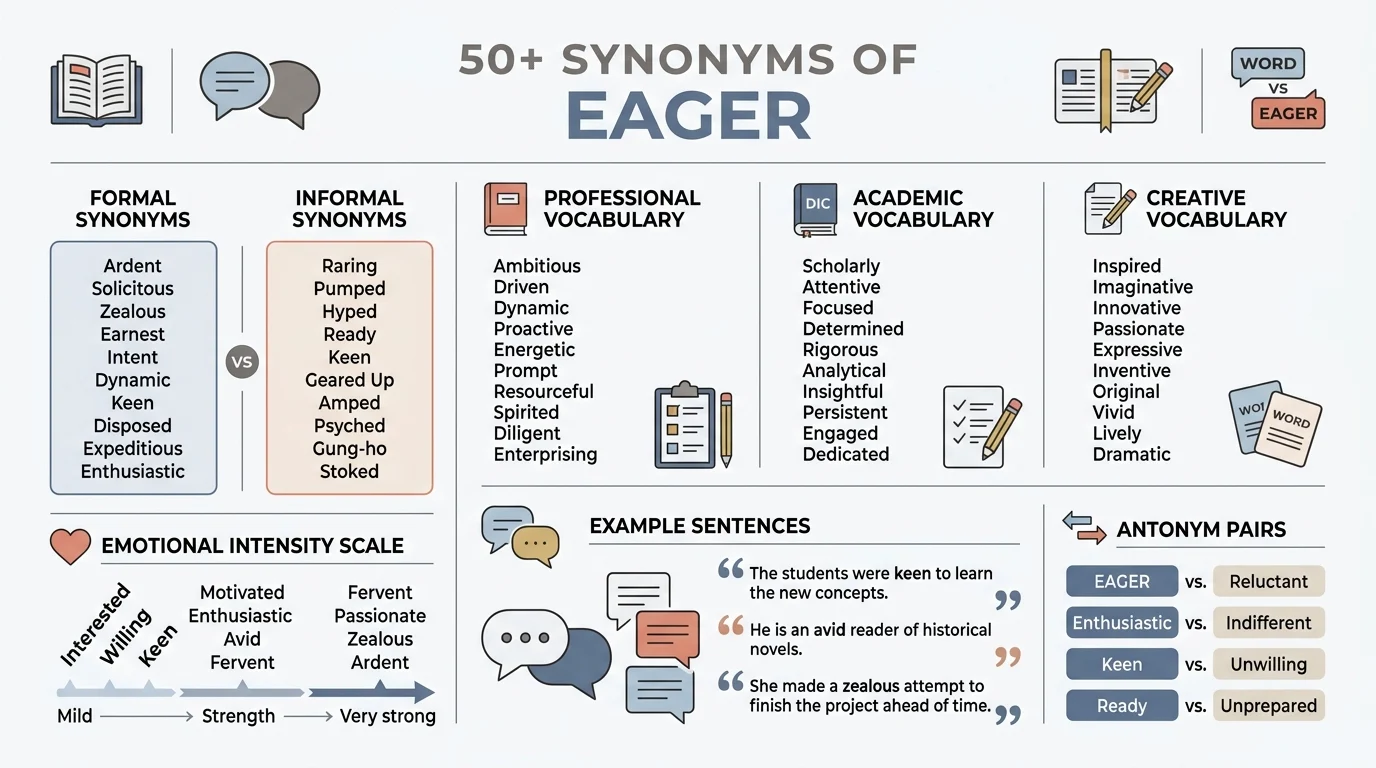
“Eager” means having a strong desire or enthusiasm to do or have something, often with a sense of impatient expectancy. For formal writing, use “keen” or “avid.” For casual conversation, try “raring” or “dying to.” In professional settings, “motivated” and “driven” work well. For emotional writing, choose “ardent” or “fervent.” For creative writing, consider “hungry” or “passionate.”
Meaning, Tone, and Context
Simple Definition
Eager describes a state of wanting something very much. It combines excitement with a sense of readiness to act. When you are eager, you are not just interested. You are actively looking forward to something and feel a pull toward it.
Part of Speech
Adjective
Overall Tone
Positive to neutral. Eager carries a favorable connotation. It suggests enthusiasm, initiative, and a willingness to engage. However, in some contexts, it can imply impatience or even overeagerness, which may be seen as slightly negative.
Formality Level
Neutral. Eager works in almost any setting, from casual conversation to professional emails. It is not overly formal, but it is not slang either. This versatility makes it a go-to word, but also one that can feel generic if used too often.
Common Uses
Native English speakers use “eager” in many everyday situations. You might hear someone say they are eager to start a new job, eager to learn a skill, or eager to see a friend. It appears in workplace conversations, school settings, personal messages, and social media posts. It is one of those words that fits comfortably almost everywhere.
Word Forms
- Adjective: eager
- Adverb: eagerly
- Noun: eagerness
- Opposite: uneager
When and How to Use “Eager”
You should choose “eager” when you want to express genuine enthusiasm and readiness. It works best when you are describing your own feelings or someone else’s visible excitement about an upcoming event or opportunity.
Here are seven realistic examples showing how “eager” appears in different contexts.
Professional:
The new hire was eager to contribute ideas during her first team meeting.
Academic:
The graduate students were eager to present their research at the conference.
Workplace:
Our team is eager to implement the new software system next quarter.
Personal:
She was eager to introduce her partner to her family over the holidays.
Email:
I am eager to discuss the project details during our call on Thursday.
Resume:
Eager to apply my marketing skills in a fast-paced agency environment.
Social Media:
So eager for the concert this weekend! Who else is going?
Best Synonyms of “Eager”
No synonym is identical in every situation. Each alternative carries its own shade of meaning, emotional weight, and level of formality. Here are the best synonyms for specific contexts.
Professional writing: Motivated – This word suggests internal drive and purpose, which sounds more substantial than simple eagerness in business contexts.
Academic writing: Keen – Keen implies sharpness of interest and intellectual engagement, making it ideal for scholarly work.
Business communication: Driven – This conveys ambition and determination, qualities that resonate in professional environments.
Casual conversation: Raring to go – This informal phrase captures the same impatient enthusiasm in a friendly, natural way.
Emotional writing: Ardent – Ardent adds passion and intensity, perfect for expressing deep feeling.
Creative writing: Hungry – This metaphorical use suggests a consuming desire that adds vividness to descriptive prose.
Resume writing: Enthusiastic – This is a strong, professional word that shows positive energy without sounding desperate.
Workplace communication: Ready – Simple and confident, “ready” communicates willingness without overpromising.
Stronger meaning: Fervent – This conveys intense, burning desire and passionate commitment.
Softer meaning: Interested – This is milder and more measured, suitable when you want to express curiosity without urgency.
When Not to Use “Eager”
Using “eager” is not always the best choice. Here are situations where a different word will serve you better.
When the word sounds too general
Problem: Eager is so common that it can feel vague. It does not always communicate the specific nature of your interest.
Better synonym: Enthusiastic, motivated, or passionate
Rewrite:
- Weak: “I am eager to join your team.”
- Stronger: “I am enthusiastic about joining your team and contributing to your mission.”
When the word sounds too informal
Problem: In very formal writing, such as legal documents or official reports, “eager” may feel too casual.
Better synonym: Desirous, solicitous, or earnest
Rewrite:
- Weak: “The committee is eager to receive your proposal.”
- Stronger: “The committee is earnest in its desire to receive your proposal.”
When the word sounds too weak
Problem: Sometimes you need a word with more weight and conviction.
Better synonym: Driven, determined, or resolute
Rewrite:
- Weak: “She is eager to succeed in her career.”
- Stronger: “She is driven to succeed in her career.”
When the word sounds too strong
Problem: In sensitive situations, “eager” can seem pushy or overbearing.
Better synonym: Willing, open, or receptive
Rewrite:
- Weak: “I am eager to hear your feedback.”
- Softer: “I am open to hearing your feedback.”
When the word is outdated
Problem: While “eager” itself is not outdated, some synonyms like “athirst” are rarely used in modern English. Avoid them unless you are writing period fiction.
Words Commonly Confused With “Eager”
Eager vs Anxious
Difference: Eager implies positive enthusiasm and excitement. Anxious implies worry, fear, or unease about what might happen.
When to Use It: Use “eager” when you are excited about something. Use “anxious” when you are worried or nervous.
Example:
- Eager: “I am eager to start my new job.”
- Anxious: “I am anxious about the interview tomorrow.”
Eager vs Enthusiastic
Difference: Eager focuses on the desire to do or get something. Enthusiastic focuses on the outward expression of enjoyment and approval.
When to Use It: Use “eager” when you want to emphasize readiness and anticipation. Use “enthusiastic” when you want to emphasize positive energy and enjoyment.
Example:
- Eager: “The students were eager to begin the exam.”
- Enthusiastic: “The students were enthusiastic about the field trip.”
Eager vs Keen
Difference: Keen suggests sharpness of interest and quick responsiveness. It is slightly more intellectual than eager.
When to Use It: Use “keen” in academic or professional writing where precision matters. Use “eager” in more general contexts.
Example:
- Eager: “She was eager to help.”
- Keen: “He has a keen interest in medieval history.”
Eager vs Avid
Difference: Avid adds the implication of insatiability or greed. It suggests a hunger that is difficult to satisfy.
When to Use It: Use “avid” for long-term passions and hobbies. Use “eager” for specific, time-bound desires.
Example:
- Eager: “I am eager to read that book.”
- Avid: “She is an avid reader of science fiction.”
Eager vs Impatient
Difference: Impatient emphasizes the frustration of waiting. Eager emphasizes the positive desire itself.
When to Use It: Use “impatient” when delay is the main issue. Use “eager” when the desire itself is the focus.
Example:
- Eager: “The children were eager to open their presents.”
- Impatient: “The children grew impatient waiting for their turn.”
Eager vs Excited
Difference: Excited suggests a higher level of emotional arousal, often with physical manifestations like energy or restlessness.
When to Use It: Use “excited” for moments of high emotion. Use “eager” for a steadier, more focused desire.
Example:
- Eager: “I am eager to learn more about this topic.”
- Excited: “I am excited about our vacation next week.”
Best Synonyms of “Eager” by Context
| Context | Best Synonym | Why It Works | Example |
|---|---|---|---|
| Formal writing | Earnest | Conveys sincerity and seriousness without emotional excess | The committee offered its earnest support for the proposal. |
| Academic writing | Keen | Suggests intellectual sharpness and focused interest | The researchers were keen to explore new methodologies. |
| Professional communication | Motivated | Highlights internal drive and purpose | We are motivated to deliver exceptional results. |
| Business emails | Enthusiastic | Projects positive energy while remaining professional | I am enthusiastic about collaborating on this initiative. |
| Resume writing | Driven | Conveys ambition and determination | Driven professional with a proven track record in sales. |
| Workplace communication | Ready | Communicates confidence and willingness | Our team is ready to take on the new project. |
| Casual conversation | Raring to go | Sounds natural and friendly in everyday speech | I am raring to go on our road trip this weekend. |
| Everyday speaking | Excited | Relatable and emotionally clear | I am so excited to see you! |
| Creative writing | Hungry | Adds vivid metaphorical imagery | She was hungry for adventure and new experiences. |
| Storytelling | Ardent | Brings passion and intensity to character descriptions | He was an ardent believer in the cause. |
| Emotional writing | Fervent | Conveys deep, burning emotion | Her fervent desire was to make a difference. |
| Strong emphasis | Zealous | Suggests unwavering dedication and passion | She was a zealous advocate for education reform. |
| Mild tone | Interested | Expresses curiosity without urgency | I am interested in learning more about your work. |
| Social media captions | Dying to | Informal and expressive, perfect for engagement | Dying to try this new restaurant downtown. |
| American English | Eager | The standard choice across all contexts | The crowd was eager for more. |
How to Choose the Best Synonym of “Eager”
Choosing the right synonym comes down to understanding your audience, your purpose, and the emotional tone you want to convey.
Consider your audience. Are you writing for a professor, a boss, a friend, or a general audience? Formal settings call for words like “keen” or “earnest.” Casual settings welcome “raring” or “dying to.”
Consider your purpose. Are you trying to persuade, inform, express emotion, or simply describe? Persuasive writing benefits from “driven” or “passionate.” Descriptive writing shines with “avid” or “ardent.”
Consider emotional strength. How strong is the feeling you want to express? Mild interest, use “interested” or “curious.” For moderate enthusiasm, use “eager” or “keen.” For intense desire, use “fervent,” “zealous,” or “passionate.”
Consider formality. Match your word to the situation. Academic papers and business reports need professional vocabulary. Text messages and social media posts can handle more casual language.
Consider naturalness. The best synonym is the one that sounds natural in context. Read your sentence aloud. If the word feels forced or out of place, choose another.
Real Life Examples of “Eager”
Here are realistic examples showing how “eager” and its synonyms appear in everyday situations.
School:
The fourth graders were eager to show their parents what they had learned during the school year.
College:
As a freshman, I was eager to join campus organizations and meet new people.
Workplace:
Our department is eager to pilot the new project management software next month.
Business:
The startup founders were eager to pitch their idea to potential investors.
Email:
I am eager to schedule a time to discuss the quarterly results with you.
Resume:
Eager professional seeking opportunities to apply my project management expertise.
Conversation:
“Are you eager to try that new Italian place?” “Absolutely. I have been waiting for weeks.”
Storytelling:
The young knight was eager to prove his worth, his hand never far from his sword.
Blogging:
I am eager to share my top ten tips for saving money on groceries.
Social Media:
Eager for the weekend? Same here. What are your plans?
18 Best Synonyms of “Eager”
Synonyms of “Eager” by Usage
Professional vs Personal Synonyms
Professional synonyms work best in workplaces, resumes, and business communication. These include “motivated,” “driven,” “enthusiastic,” “keen,” and “committed.” They project competence, reliability, and purpose.
Personal synonyms sound better in everyday conversations with friends and family. These include “excited,” “raring,” “dying to,” and “pumped.” They feel warmer and more relatable.
Formal vs Conversational Synonyms
Formal synonyms fit reports, essays, business writing, and presentations. Choose “earnest,” “solicitous,” “ardent,” or “fervent.” These words carry weight and sophistication.
Conversational synonyms fit casual emails, texts, and everyday speech. Choose “raring,” “excited,” “dying to,” or “pumped.” These words feel natural and approachable.
Academic Synonyms
For research papers, essays, and academic discussions, choose precise vocabulary that sounds authoritative. “Keen” suggests intellectual sharpness. “Earnest” conveys serious intent. “Avid” implies sustained interest. “Diligent” suggests careful and persistent effort. These words elevate your writing and demonstrate command of the language.
Professional and Business Synonyms
For resumes, interviews, meetings, presentations, performance reviews, client communication, and business emails, choose words that project confidence and capability.
“Motivated” shows internal drive. “Driven” conveys ambition and determination. “Enthusiastic” projects positive energy. “Committed” suggests reliability. “Proactive” implies initiative. These words help you stand out in competitive professional environments.
Creative and Literary Synonyms
For storytelling, fiction, poetry, descriptive writing, and speeches, choose expressive alternatives that add emotion and imagery.
“Ardent” brings passion. “Fervent” adds intensity. “Zealous” suggests unwavering dedication. “Hungry” creates vivid metaphorical imagery. “Breathless” evokes dramatic anticipation. These words help you paint pictures with language.
Slang or Modern Synonyms
“Raring to go” is informal but widely accepted in casual American English. “Dying to” is hyperbolic and expressive. “Pumped” is contemporary slang for excited and ready. Use these in social media, texts, and casual conversations. Avoid them in professional or academic writing.
Strongest to Mildest Synonyms
Here is an intensity scale from mild to very strong.
Mild: Interested, willing, curious
Moderate: Eager, keen, enthusiastic, ready
Strong: Avid, ardent, passionate, motivated
Very Strong: Fervent, zealous, driven, hungry, dying to
Choose the level of intensity that matches your message. A mild word works for casual interest. A strong word works for deep commitment or urgent desire.
Emotional vs Neutral Synonyms
Emotional synonyms express stronger feelings and add warmth to your writing. These include “ardent,” “fervent,” “zealous,” “passionate,” and “hungry.” Use them when you want to convey deep emotion or strong conviction.
Neutral synonyms simply communicate information without adding emotional weight. These include “keen,” “interested,” “willing,” and “ready.” Use them when you want to sound objective, professional, or measured.
Antonyms of “Eager”
| Antonym | Meaning | Example Sentence |
|---|---|---|
| Apathetic | Showing no interest or concern | The students were apathetic about the upcoming election. |
| Indifferent | Having no particular interest or sympathy | She was indifferent to the outcome of the game. |
| Reluctant | Unwilling and hesitant | He was reluctant to share his opinion in the meeting. |
| Uninterested | Not interested or curious | The audience seemed uninterested in the presentation. |
| Uneager | Lacking enthusiasm or desire | The staff were uneager to adopt the new system. |
| Unenthusiastic | Showing little or no excitement | Her unenthusiastic response suggested she did not care. |
| Disinterested | Impartial or lacking personal involvement | A disinterested judge made the final decision. |
| Lethargic | Sluggish and lacking energy | He felt lethargic and unmotivated all afternoon. |
| Listless | Lacking energy or enthusiasm | The hot weather made everyone listless and tired. |
| Averse | Having a strong dislike or opposition | She is averse to taking unnecessary risks. |
| Hesitant | Slow to act due to uncertainty | He was hesitant to commit to the project timeline. |
| Halfhearted | Lacking enthusiasm or full effort | She made a halfhearted attempt to finish the assignment. |
| Unconcerned | Not worried or interested | He remained unconcerned about the upcoming deadline. |
| Nonchalant | Calmly unconcerned or indifferent | His nonchalant attitude annoyed his colleagues. |
| Phlegmatic | Calm and unemotional in temperament | The phlegmatic manager rarely showed excitement about anything. |
Comparison: “Eager” vs Similar Words
Eager vs Anxious
Main Difference: Eager is positive; anxious is negative. Eager expresses enthusiastic desire. Anxious expresses worry or fear.
Which Is Stronger? Both can be strong, but in different directions. Eager is strong in positive desire. Anxious is strong in negative concern.
Which Is More Formal? Anxious is slightly more formal and is often used in psychological or medical contexts. Eager is neutral.
When to Use Each: Use “eager” when you are excited. Use “anxious” when you are worried or when uncertainty creates unease.
Examples:
- Eager: “I am eager to begin my new role.”
- Anxious: “I am anxious about the challenging workload ahead.”
Eager vs Enthusiastic
Main Difference: Eager focuses on desire and readiness. Enthusiastic focuses on outward enjoyment and positive energy.
Which Is Stronger? Enthusiastic often appears stronger because it is more visible and expressive.
Which Is More Formal? Enthusiastic is slightly more formal and commonly appears in professional writing.
When to Use Each: Use “eager” when anticipation is the key. Use “enthusiastic” when visible excitement and approval matter.
Examples:
- Eager: “The team is eager to start the project.”
- Enthusiastic: “The team gave an enthusiastic response to the proposal.”
Eager vs Keen
Main Difference: Keen suggests sharper, more intellectual interest. Eager suggests warmer, more emotional desire.
Which Is Stronger? Both are moderate in strength, but keen implies precision and focus.
Which Is More Formal? Keen is more formal and academic.
When to Use Each: Use “keen” in academic or professional writing where intellectual engagement matters. Use “eager” in everyday contexts.
Examples:
- Eager: “She was eager to meet her new colleagues.”
- Keen: “He has a keen understanding of market dynamics.”
Eager vs Avid
Main Difference: Avid implies an insatiable, almost greedy desire. Eager implies enthusiastic readiness.
Which Is Stronger? Avid is stronger because it suggests a desire that is difficult to satisfy.
Which Is More Formal? Avid is neutral to formal and often appears in literary contexts.
When to Use Each: Use “avid” for long-term passions and hobbies. Use “eager” for specific, time-bound desires.
Examples:
- Eager: “I am eager to try that new restaurant.”
- Avid: “He is an avid collector of vintage records.”
Eager vs Impatient
Main Difference: Eager emphasizes positive desire. Impatient emphasizes the frustration of waiting.
Which Is Stronger? Impatient can feel stronger because it carries negative emotional weight.
Which Is More Formal? Impatient is neutral but can sound critical in professional contexts.
When to Use Each: Use “eager” when you want to sound positive. Use “impatient” only when delay is the central issue.
Examples:
- Eager: “The children were eager for summer vacation.”
- Impatient: “The children grew impatient waiting for summer vacation.”
Eager vs Excited
Main Difference: Excited suggests higher emotional arousal and often physical energy. Eager suggests focused desire.
Which Is Stronger? Excited is usually stronger and more emotionally charged.
Which Is More Formal? Eager is more formal and measured. Excited is more casual and emotional.
When to Use Each: Use “eager” in professional or academic contexts. Use “excited” in personal or social contexts.
Examples:
- Eager: “I am eager to see the results of the study.”
- Excited: “I am excited about our vacation next week.”
Common Phrases and Expressions with “Eager”
Eager beaver
Meaning: A person who is extremely enthusiastic and hardworking, often to the point of being annoying.
Example Sentence: “Our new intern is a real eager beaver, always the first to volunteer for extra assignments.”
Eager to please
Meaning: Wanting very much to make others happy or satisfied.
Example Sentence: “The new employee was friendly and eager to please, which made her popular with the team.”
Eager for
Meaning: Wanting something very much.
Example Sentence: “She was eager for her parents’ approval and worked hard to earn it.”
Eager to do something
Meaning: Wanting very much to perform an action.
Example Sentence: “Everyone in the class seemed eager to learn and participate.”
Eager eyes
Meaning: Eyes that show strong interest or desire.
Example Sentence: “The children’s eager eyes followed the magician’s every move.”
Eager crowd
Meaning: A group of people showing strong interest and anticipation.
Example Sentence: “An eager crowd gathered outside the stadium hours before the concert.”
Common Mistakes to Avoid
1: Using “anxious” when you mean “eager”
Incorrect: “I am anxious to start my new job.” (This implies worry.)
Better: “I am eager to start my new job.” (This implies excitement.)
Why: Anxious suggests fear or unease. Eager suggests positive enthusiasm. Using “anxious” when you mean “eager” can confuse your reader about your emotional state.
2: Choosing a vague synonym
Incorrect: “I am interested in joining your team.” (Too weak for a cover letter.)
Better: “I am enthusiastic about joining your team and contributing to your mission.”
Why: “Interested” is too mild for a job application. “Enthusiastic” shows genuine energy and commitment.
3: Using informal synonyms in formal writing
Incorrect: “I am dying to work for your company.” (Too casual for a cover letter.)
Better: “I am eager to work for your company and contribute my skills.”
Why: “Dying to” is hyperbolic and informal. It does not belong in professional documents.
4: Selecting an overly dramatic synonym
Incorrect: “I am fervent about attending the team meeting.” (Too intense for a routine event.)
Better: “I am eager to attend the team meeting and hear the updates.”
Why: “Fervent” implies deep emotional commitment. It is too strong for everyday situations.
5: Repeating the same word too often
Incorrect: “I am eager to start. I am eager to learn. I am eager to contribute.”
Better: “I am eager to start. I am keen to learn. I am ready to contribute.”
Why: Repetition makes writing dull. Using different synonyms keeps your writing fresh and engaging.
6: Choosing a synonym with the wrong emotional tone
Incorrect: “The bored students were eager for the lecture to end.” (Contradictory tone.)
Better: “The bored students were impatient for the lecture to end.”
Why: “Eager” implies positive excitement. “Impatient” fits negative feelings about waiting.
7: Using slang in academic or professional writing
Incorrect: “I am pumped to join your research team.” (Too casual.)
Better: “I am eager to join your research team and contribute to your work.”
Why: “Pumped” is slang. It undermines your credibility in formal contexts.
Frequently Asked Questions
1. What are the best synonyms of “eager”?
The best synonyms depend on your context. Formal writing, use “keen,” “earnest,” or “avid.” For professional settings, use “motivated” or “enthusiastic.” Casual conversation, use “raring” or “excited.” For emotional writing, use “ardent” or “fervent.”
2. What are the best formal synonyms of “eager”?
The best formal synonyms include “earnest,” “solicitous,” “ardent,” “fervent,” and “avid.” These words convey seriousness and sophistication, making them suitable for academic papers, business reports, and official correspondence.
3. What are common informal synonyms of “eager”?
Common informal synonyms include “raring to go,” “dying to,” “pumped,” and “excited.” These words work well in casual conversations, text messages, and social media posts. Avoid them in professional or academic writing.
4. What is another word for “eager” in professional writing?
In professional writing, use “motivated,” “driven,” “enthusiastic,” or “committed.” These words project competence and purpose. For example, instead of “eager to learn,” write “motivated to develop new skills”.
5. What is the difference between “eager” and “anxious”?
Eager expresses positive enthusiasm and excitement. Anxious expresses worry, fear, or unease. Use “eager” when you are excited about something. Use “anxious” when you are worried or nervous about it.
6. What is the opposite of “eager”?
The opposite of eager includes “apathetic,” “indifferent,” “reluctant,” “uninterested,” and “uneager”. These words describe a lack of interest, enthusiasm, or willingness.
Conclusion
“Eager” is a versatile word that captures the feeling of enthusiastic desire and readiness. It works in many contexts, from casual conversation to professional communication. But no single word fits every situation.
The best synonyms of eager depend on your audience, your purpose, and the emotional tone you want to convey. Formal writing, choose “keen” or “earnest.” Professional settings, choose “motivated” or “driven.” In casual conversation, choose “raring” or “excited.” In emotional writing, choose “ardent” or “fervent.”
Remember that no synonym works perfectly in every situation. The key to great writing is choosing words that match your meaning, your tone, and your readers’ expectations. The more you practice, the more natural these choices will become.
Here is one practical tip: before you write, ask yourself what feeling you want to communicate. Then choose the word that best captures that feeling. Your writing will become clearer, stronger, and more engaging.
Definitions, meanings, and usage recommendations should be verified with trusted language references before publication. Recommended sources include Cambridge Dictionary, Oxford English Dictionary, Merriam-Webster, Collins Dictionary, and Britannica.