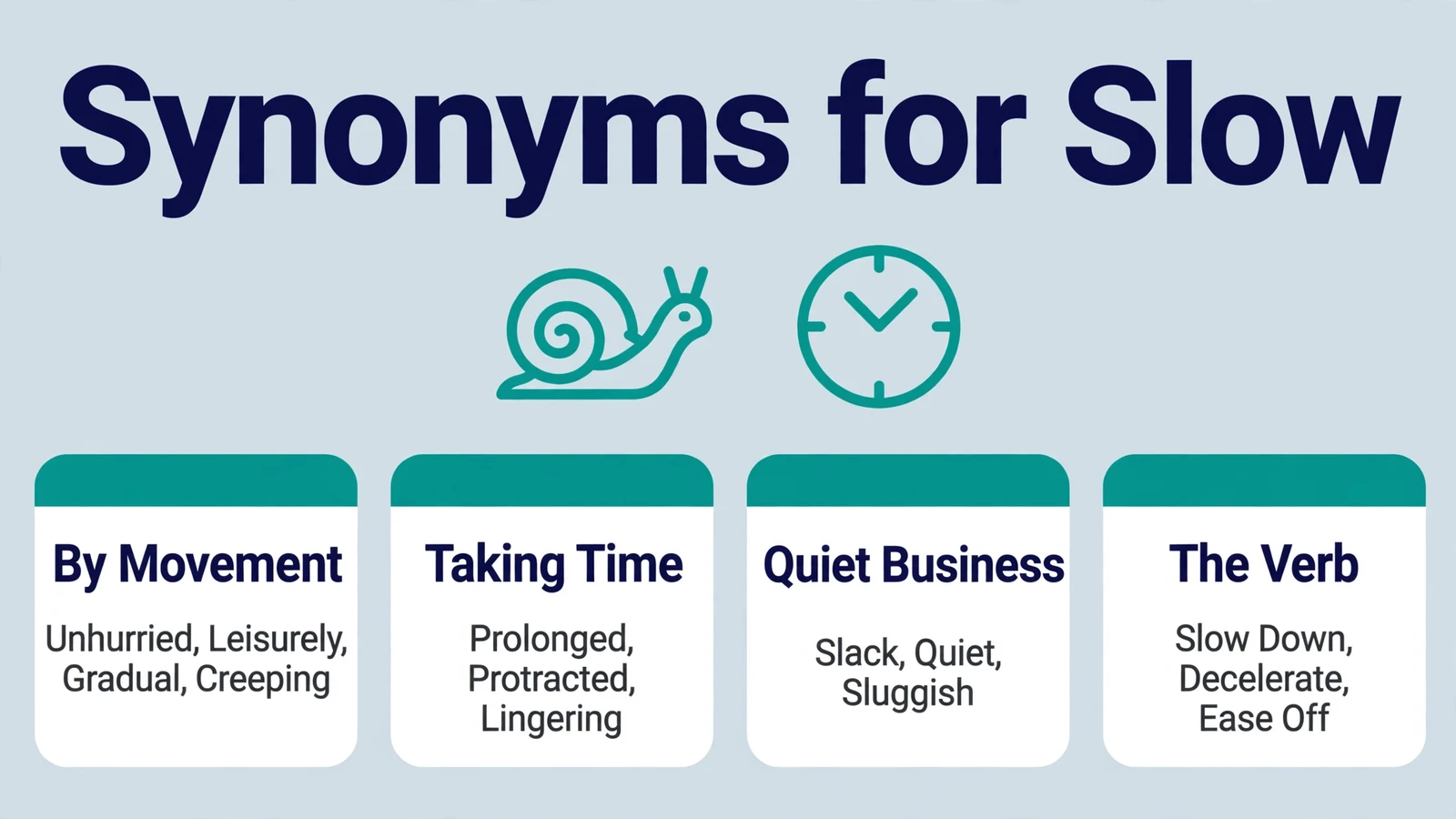
Slow is a small word that does a lot of heavy lifting. It describes traffic, recoveries, business days, clocks, and even computers. The most useful synonyms for slow include unhurried, leisurely, gradual, sluggish, creeping, prolonged, and quiet. Each one fits a different situation, though, which is why picking the right word changes the whole sentence.
This guide sorts more than 70 synonyms for slow by sense. Movement words sit in one group, long processes in another, and quiet business days in a third. You also get the clock sense, the verb slow down, and a plain guide to slow versus slowly. Every word comes with a short meaning, and the key words include examples. The lists rest on major dictionaries and thesauruses, so each word here is one you can use with confidence.
Top Synonyms for Slow: Quick Reference
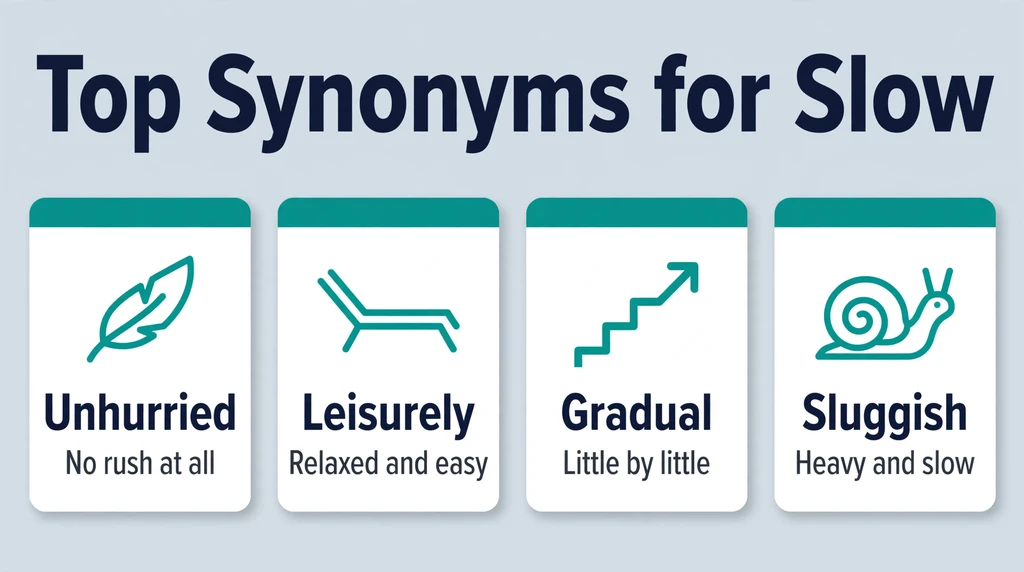
The table below covers the 28 movement synonyms readers reach for most often. Use it when you need one quick replacement. Later sections sort the full list by sense, so a word for traffic never gets mixed up with a word for trade.
| Word | Meaning in one line | Best for |
|---|---|---|
| Unhurried | Moving without any rush | Calm scenes, relaxed people |
| Leisurely | Relaxed and taking plenty of time | Walks, meals, holidays |
| Gradual | Happening little by little | Change, recovery, improvement |
| Deliberate | Slow on purpose, with care | Movements, decisions, speech |
| Measured | Steady and carefully controlled | Steps, tones, responses |
| Steady | Moving at an even, regular pace | Progress, rain, work |
| Gentle | Soft and not forceful | Slopes, exercise, breezes |
| Slow-moving | Moving at a low speed | Traffic, queues, rivers |
| Slow-paced | Set at a relaxed speed | Films, games, lifestyles |
| Creeping | Moving very slowly, almost secretly | Traffic, shadows, plants |
| Crawling | Barely moving at all | Traffic, queues, insects |
| Lagging | Falling behind the expected pace | Work, students, economies |
| Dawdling | Moving slower than needed, wasting time | Children, errands, walkers |
| Plodding | Slow, heavy and steady | Work, walking, progress |
| Loitering | Lingering in a place without purpose | Streets, crowds, teenagers |
| Lingering | Slow to leave or fade away | Smells, doubts, illnesses |
| Sluggish | Slow and heavy, lacking energy | Engines, people, markets |
| Lethargic | Without energy or enthusiasm | People, afternoons, animals |
| Leaden | Heavy and slow, like lead | Skies, limbs, footsteps |
| Ponderous | Slow because heavy and clumsy | Speeches, machinery, animals |
| Heavy | Slow and full, hard to move | Traffic, air, limbs |
| Easy | Gentle and unforced | Paces, mornings, instructions |
| Moderate | Medium, neither fast nor extreme | Speeds, growth, exercise |
| Lazy | Relaxed, or unwilling to hurry | Rivers, afternoons, people |
| Snaillike | As slow as a snail | Playful descriptions |
| Tortoiselike | Extremely slow and steady | Formal or humorous writing |
| Poky | Slow, US informal | Computers, cars, service |
| Snail-paced | Moving at a snail’s pace, informal | Traffic, progress reports |
What Does Slow Mean?
At its core, slow means moving, flowing, or proceeding at less than the usual speed. Merriam-Webster puts it almost exactly that way, and the same entry adds a second core idea: taking a long time. A slow recovery and a slow queue both lack speed, but one is about duration and the other is about movement.
That double core explains why slow has so many senses. Dictionaries give it at least seven. It can describe movement, as in slow traffic. It can describe time, as in a slow process. It can also describe reduced activity, as in a slow news week. In addition, a clock can be slow, and that sense means the clock shows a time behind the correct one.
Slow also works as more than an adjective. As a verb, it means to become slower or to make something slower, as in slow down. As an adverb, it appears in phrases like go slow, which the grammar section below covers in detail. Because the word wears so many hats, this guide keeps every sense in its own section.
A few general words sit close to the core meaning. Steady stresses an even pace rather than a fast one. Moderate places the speed in the middle of the scale. Easy suggests no force or strain at all. These neutral options suit reports and instructions, where strong colour would only distract the reader.
The word itself is ancient. Merriam-Webster traces it to Old English slaw, and its first known use dates from before the 12th century. Interestingly, that old word already carried the seed of the understanding sense, since its Germanic cousins meant dull as well as slow. Few English words have held so many senses for so long, which is one more reason slow rewards careful sorting.
Synonyms for Slow Movement
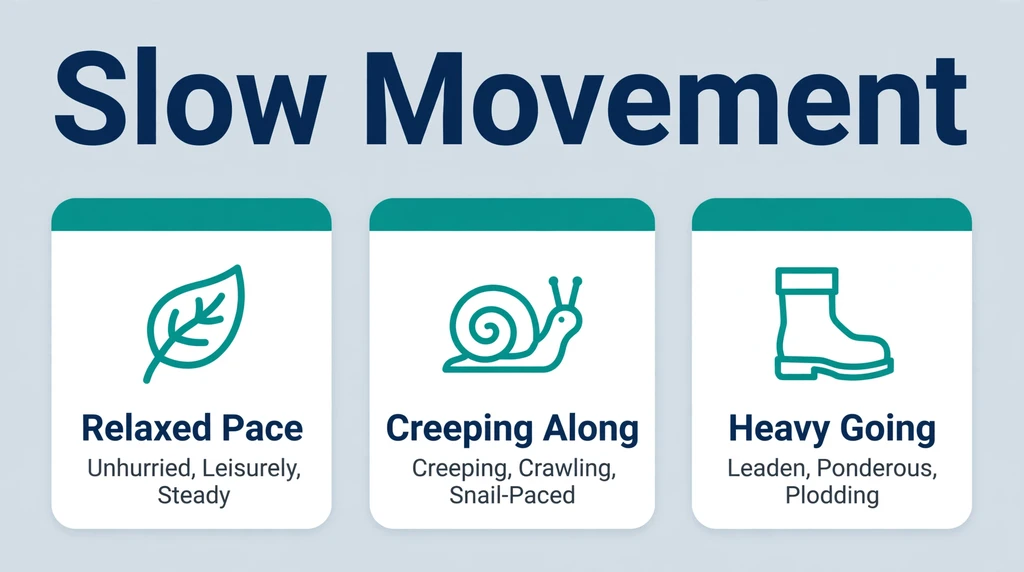
Movement is the sense readers picture first, so it gets the biggest group. The scale below runs from calm and relaxed to heavy and barely moving. Each subgroup adds one clear extra detail to the basic idea of low speed.
Relaxed and Unhurried
These words describe movement with no pressure behind it. The pace is slow, and nobody minds. Use them when the scene feels calm and time feels generous.
- Unhurried: moving without any sense of rush. Example: She gave an unhurried answer and poured more tea.
- Leisurely: relaxed, with plenty of time to spare. Example: We took a leisurely drive along the coast.
- Steady: regular and even, neither racing nor stopping. Example: He swam at a steady pace for an hour.
- Gentle: soft and mild rather than forceful. Example: Start with a gentle jog, then build up.
- Easy: smooth and unforced. Example: The path follows an easy slope down to the river.
- Measured: careful and controlled, step by step. Example: She replied in a measured tone.
Creeping Along
Sometimes slow means almost stopped. These words suit traffic jams, queues, and anything that advances inch by inch. The mood here is usually frustration, not calm.
- Creeping: moving very slowly, often barely noticed. Example: Creeping traffic filled both lanes.
- Crawling: so slow it feels like crawling on the ground. Example: The queue was crawling toward the desk.
- Slow-moving: the plain, neutral label for this pace. Example: A slow-moving lorry held up the road.
- Slow-paced: set at a relaxed speed by design. Example: Critics called the film slow-paced but beautiful.
- Snail-paced: informal, and slightly teasing. Example: Progress on the house was snail-paced.
- Snaillike and tortoiselike: playful comparisons to famously slow animals. Example: The old printer worked at a snaillike speed.
Heavy and Tired
The last movement group feels heavy. These words suggest weight, low energy, or effort, so they fit engines, limbs, and long afternoons better than holidays.
- Sluggish: slow and heavy, as if energy is missing. Example: The engine felt sluggish on cold mornings.
- Lethargic: lacking energy or enthusiasm. Example: After lunch, the whole office turned lethargic.
- Plodding: slow, heavy, and steady, without flair. Example: He made plodding progress through the report.
- Leaden: heavy as lead, hard to lift or move. Example: Her leaden legs refused the stairs.
- Ponderous: slow because something is big and clumsy. Example: The ponderous truck turned with great care.
- Lagging: falling behind where it should be. Example: Sales were lagging in the second quarter.
- Dawdling: slower than needed, wasting time on purpose or by habit. Example: Stop dawdling and finish your breakfast.
- Loitering: staying in a place slowly, without a clear reason. Example: A few fans were loitering near the stage door.
The Everyday Middle Ground
Between the calm words and the heavy ones sits a plain middle group. These words make no strong claim about mood. They simply place the speed low on the scale, so they fit almost any subject.
- Moderate: neither fast nor very slow, safely in the middle. Example: The bike keeps a moderate pace on hills.
- Lazy: relaxed to the point of not wanting to hurry. Example: A lazy river wound through the fields.
- Heavy: full and slow, hard to push through. Example: Heavy traffic clogged the bridge by eight.
- Lingering: slow to leave, fade, or finish. Example: A lingering smell of paint filled the room.
Slow Processes: Words for Things That Take a Long Time
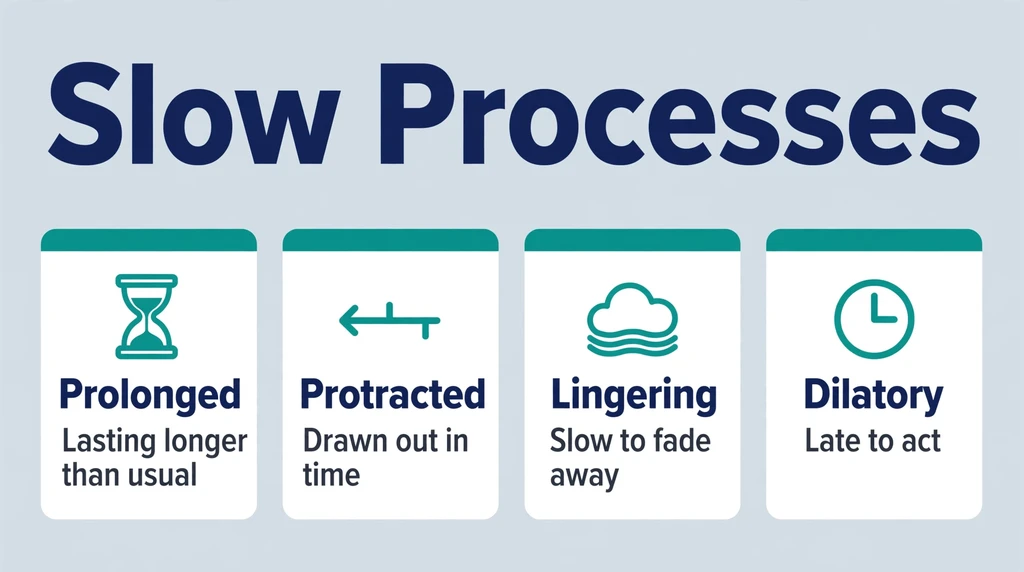
Some things do not move slowly; they simply take forever. Recoveries, reforms, deliveries, and repairs all belong here. These words measure duration rather than speed, so swapping them into a traffic sentence would sound odd.
- Gradual: happening in small steps over time. Example: Weight loss is usually a gradual process.
- Prolonged: lasting longer than usual or expected. Example: A prolonged drought dried the fields.
- Protracted: drawn out, often painfully or formally. Example: The talks were bitter and protracted.
- Drawn-out and long-drawn-out: stretched well beyond the comfortable point. Example: It was a long-drawn-out meeting.
- Lingering: slow to end or disappear. Example: A lingering cough kept him home.
- Time-consuming: needing a lot of time to complete. Example: Filling in the form is time-consuming.
Projects often suffer a slow start before they settle into a rhythm. Writers describing that pattern usually pair these duration words with plain verbs. The recovery was gradual, for example, sounds natural. The recovery was creeping, by contrast, sounds strange.
Slow to Reply or Act
People and offices can be slow in a different way: they respond late. English has a sharper set of words for that behaviour, and most of them carry mild criticism.
- Tardy: late, or slow to respond. Example: The agency gave a tardy response to the storm.
- Dilatory: deliberately slow, wasting time. Example: They handled the claim in a dilatory fashion.
- Delaying: holding things back, often as a tactic. Example: The committee used delaying tactics all spring.
- Postponing: putting something off until later. Example: She keeps postponing the dentist.
- Procrastinating: avoiding a task until the last moment. Example: He was procrastinating instead of revising.
- Remiss: careless about duties, so replies come late. Example: I was remiss in answering your email.
These words describe choices, not clocks. A tardy reply is late because someone allowed it to be. That is why the tone feels sharper than gradual or prolonged.
Slow Business: Words for Quiet Days and Slack Periods
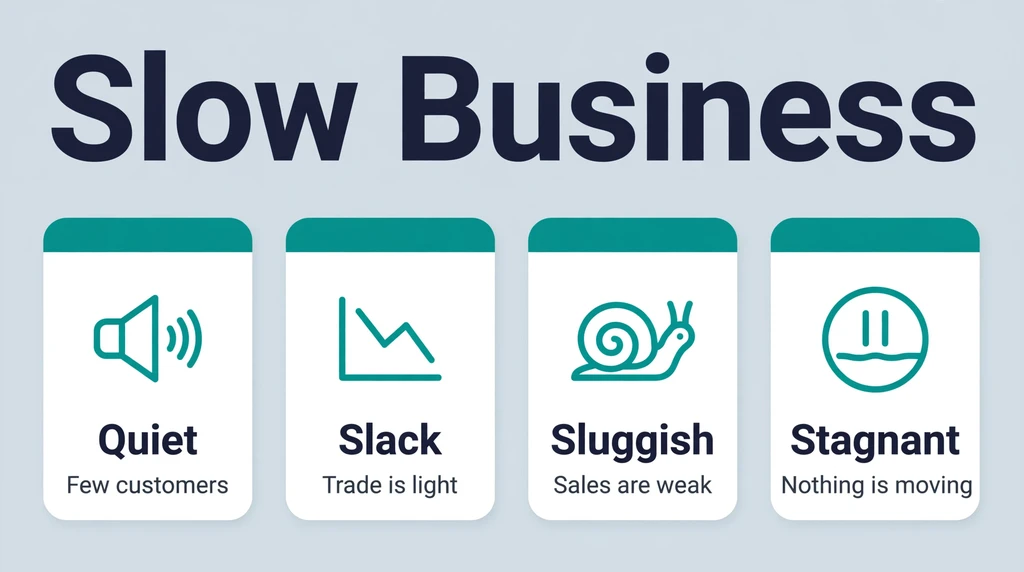
Shops, markets, and towns can all be slow, and here the word says nothing about speed. It means trade is light and activity is low. Merriam-Webster defines this sense as “marked by reduced activity”, with examples like business was slow and a slow news week.
- Quiet: few customers, little happening. Example: Tuesdays are always quiet at the cafe.
- Slack: trade is light, with idle time between jobs. Example: Winter is a slack season for builders.
- Sluggish: sales or growth are weak and heavy. Example: The market stayed sluggish all year.
- Stagnant: nothing is moving or improving at all. Example: Wages sat stagnant for a decade.
- Inactive: no activity is taking place. Example: The account has been inactive since March.
- Dead: completely without trade or life, informal. Example: The town centre is dead after nine.
- Sleepy: quiet in a drowsy, small-scale way. Example: It is a sleepy village with one shop.
- Slow-going: progress is hard and takes long. Example: Selling the house proved slow-going.
Collins even lists one-horse, labelled informal, for a town so quiet it feels tiny. British writers also use dead-and-alive for a place with nothing happening. Both phrases are colourful, but they belong in casual writing only.
The sense also lives in set phrases. A slow day, a slow week, and a slow season all describe low activity rather than low speed. Retail workers talk about the slow season after the holidays. Newsrooms call a quiet stretch a slow news week. In each case, slow measures how much is happening, not how fast anything moves. Recognising that pattern helps you pick quiet or slack instead of a movement word like creeping.
When Slow Means Dull Entertainment
Slow has a neighbouring sense for books, films, and shows: lacking life or excitement. Merriam-Webster glosses it as boring, with the example that the first chapter is a bit slow. The honest synonyms here are dull, tedious, tame, uneventful, and uninteresting.
Keep the two senses apart in your own writing. A slow shop needs customers, while a slow film needs pace. Readers understand both, but mixing the word lists produces muddy sentences. A tedious meeting and a quiet meeting, for instance, are not the same complaint at all.
Slow Clocks and Watches: The “Behind” Sense
One sense of slow has nothing to do with movement at all. When a clock or watch is slow, it shows a time earlier than the correct time. Merriam-Webster defines it as “registering behind or below what is correct”, and gives the plain example: the clock is slow.
In practice, English handles this sense with a small set of exact words.
- Behind: the clearest everyday choice. Example: My watch is five minutes behind.
- Minutes slow: the standard frame itself. Example: The station clock is ten minutes slow.
- Running slow: the natural wording for a clock losing time. Example: The kitchen clock is running slow again.
Collins lists late, tardy, behindhand, and unpunctual for this area, but a word of care is needed. Those four words normally describe people who arrive after the agreed time. A tardy student is late for class. A clock, though, is behind, not tardy. The article keeps them in this section only so you can recognise the difference.
Writers sometimes ask for the opposite pattern too. A clock that shows a later time than the real one is fast, or ahead. So the pair is simple: slow and behind on one side, fast and ahead on the other.
A Sensitive Sense: Slow to Understand
Slow has one more sense, and it needs honest handling. Merriam-Webster defines it directly as “mentally dull”, with the example a slow student. Thesaurus lists for this sense give dull, slow on the uptake, slow-witted, and dense.
Those words exist, and older books use them freely. However, calling a person slow, dull, or dense today sounds like an insult, not a description. Teachers, doctors, and careful writers therefore avoid the sense about people almost completely. The risk is real: the words attack the person, not the problem.
Safer wording describes the pace or the task instead. Say that maths took him longer, or that she needs more time with new ideas. Say a learner is careful, or still building confidence. Each version stays accurate without the sting.
One phrase is softer than the rest. Slow on the uptake means slow to understand something new, and people often use it about themselves as a joke. Even so, it belongs in friendly, informal settings. In reports and references, describe the work, never the mind.
Slow Down: Synonyms for the Verb Slow
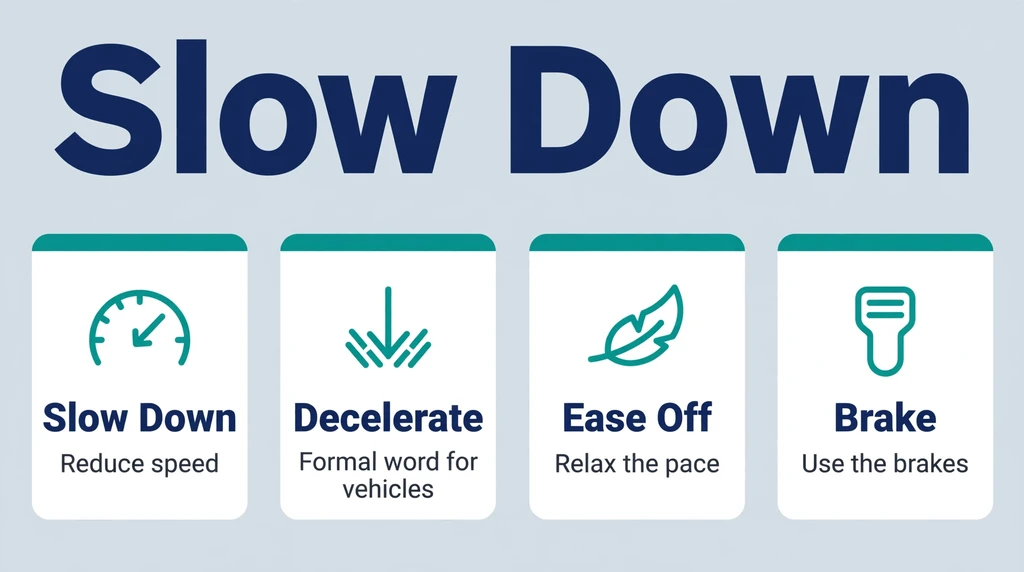
As a verb, slow means to become slower or to make something else slower. Cambridge groups its closest partners under “to get slower”: slow down, decelerate, and lose speed. Collins adds brake for vehicles. The common variant slow up means the same as slow down, though slow down is the safer choice in formal writing.
Becoming Slower
- Slow down: the standard phrasal verb, for people and machines alike. Example: The car slowed down near the school.
- Decelerate: the formal, technical word, common for vehicles. Example: She decelerated as she saw the police car.
- Lose speed: the plain description of the change itself. Example: The plane lost speed on the climb.
- Reduce speed: the wording of signs and official instructions. Example: Drivers must reduce speed in fog.
- Ease off: to relax the pace or pressure gently. Example: Ease off as you reach the bend.
- Slacken: to ease up as effort or power relaxes. Example: Runners slacken their pace in the heat.
- Brake: to use the brakes, so the vehicle slows. Example: He braked hard at the junction.
Merriam-Webster draws a fine line inside this group. Slow often suggests a deliberate intention, as when someone slows her breathing on purpose. Slacken, by contrast, suggests power or effort relaxing. The difference is small, but good writers feel it.
Making Something Else Slower
A second verb group means holding something back so it finishes late. Merriam-Webster groups delay, detain, retard, slow, and slacken together here. All of them mean causing someone or something to be late or behind in progress.
- Delay: hold back, usually by interference. Example: Bad weather delayed our arrival.
- Hold up: stop progress for a while. Example: Roadworks held up the traffic.
- Hinder: make progress harder or slower. Example: Landslides hindered the rescue teams.
- Detain: hold someone back beyond a reasonable time. Example: Unexpected business detained her.
- Check: restrain or slow a spread or growth. Example: The drug checks the spread of the disease.
- Curb: control something so it grows more slowly. Example: The bank curbed lending this year.
- Handicap: put something at a disadvantage, slowing it. Example: Stress can handicap some students.
- Rein in: pull back on spending, growth, or speed. Example: The firm reined in its expansion.
One caution matters here. Retard appears in older thesaurus lists for this sense, but the word is dated in this use and deeply offensive when applied to people. Modern writers simply choose delay, slow down, or hold back instead.
Slow vs Slowly: Which One Is Correct?
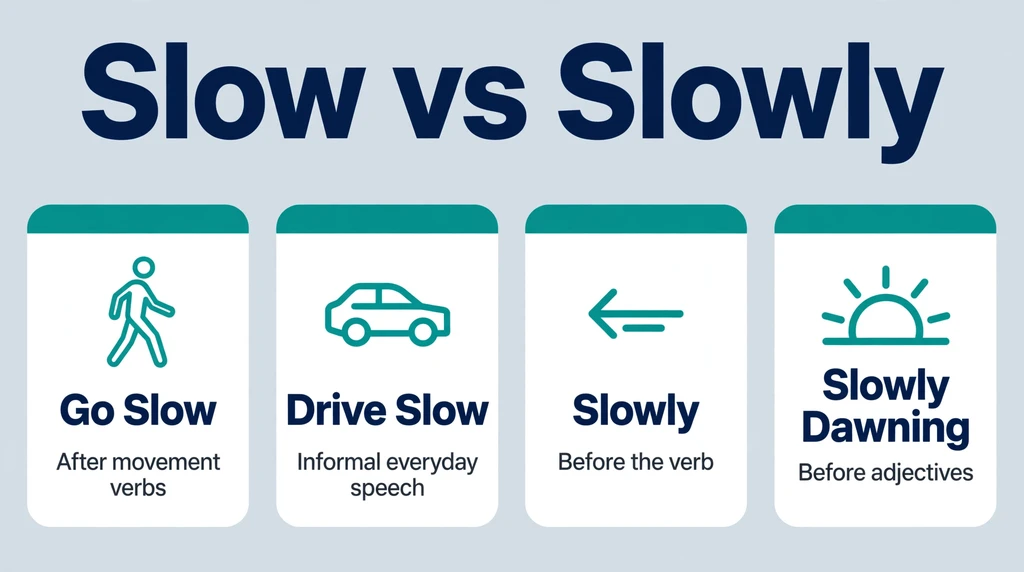
Writers often ask whether slow can work as an adverb at all. The short answer is yes, with limits. Merriam-Webster notes that some commentators claim careful writers avoid the adverb slow. In fact, it has been used for over four centuries. Shakespeare himself wrote of rage going slower.
In practice, the two forms divide the work. Slow almost always goes with verbs of movement or action, and it regularly follows the verb it modifies. That pattern gives us go slow, drive slow, and work slow. A dictionary example makes the point neatly: beans are best cooked long and slow.
Slowly covers the other positions. It goes before the verb, as in a feeling that slowly changed to shame. It also goes with participial adjectives, as in a slowly dawning awareness. After some verbs both forms work, since things can burn slow or slowly. After other verbs, though, slow would sound wrong: leaders turn slowly toward a decision, not slow.
So the rule of thumb is simple. After a movement verb in everyday speech, slow is natural and long established: please drive slow near schools. In formal writing, slowly is the safer default. And before a verb or an adjective phrase, slowly is the only correct choice.
How to Choose the Right Synonym for Slow
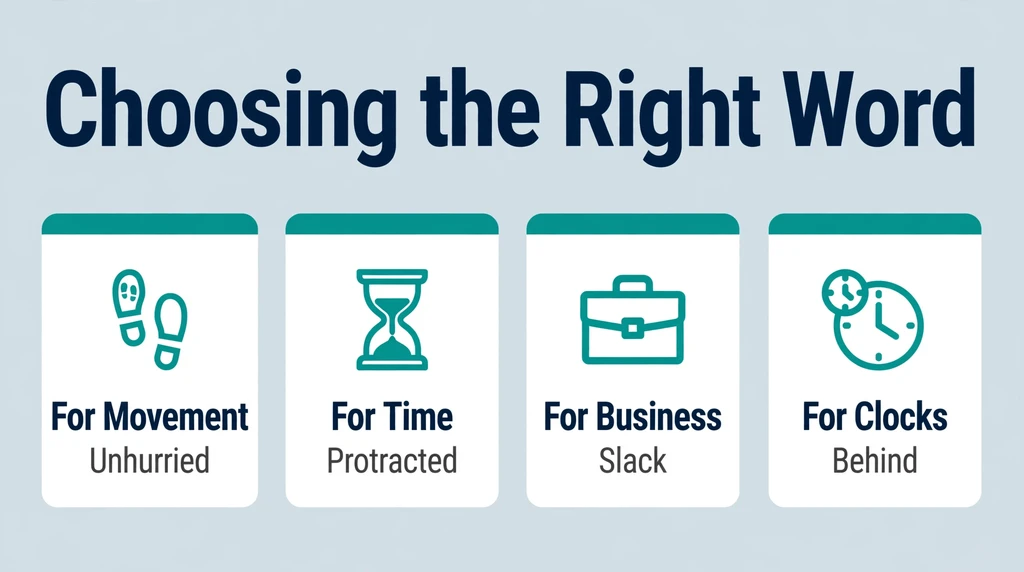
With more than 70 options, the real skill is choosing, not collecting. Three quick questions narrow the field fast. What exactly is slow: movement, time, trade, or a clock? How slow is it: relaxed, steady, or barely moving? And finally, should the tone feel calm, neutral, or annoyed?
Paired examples show how much one word can change a scene. Consider the same road on the same morning:
- The traffic was unhurried. Nobody minds; the town feels peaceful.
- The traffic was creeping. It moves, but only just.
- The traffic was sluggish. It feels heavy, as if the road itself is tired.
- The traffic was crawling. Drivers are going nowhere and know it.
The facts never changed, yet each version tells a different story. That is the power of choosing the precise slow word instead of the plain one.
The same test works for time. A gradual recovery sounds hopeful and healthy. A protracted recovery sounds exhausting. A lingering illness sounds unwelcome, because lingering always hints that something should have left by now. Pick the word whose extra feeling matches your meaning.
A Quick Picker for Common Situations
The quick picker below matches common situations to strong first choices.
| Situation | Strong first choice |
|---|---|
| Relaxed walk or drive | Leisurely |
| Steady change over months | Gradual |
| Traffic in a jam | Crawling |
| Weak sales period | Slack |
| Clock showing the wrong time | Behind |
| Car approaching a junction | Slow down |
| Formal report on vehicles | Decelerate |
Context clues help as well. Engines feel sluggish, meetings turn protracted, and villages stay sleepy. Rivers run lazy, software feels poky, and soup simmers at a gentle pace. When a word sounds wrong, it usually clashes with the subject. Reading the sentence aloud exposes most clashes at once.
The Picture Test
One more test is worth learning. Replace slow with your candidate, then read the sentence as a stranger would. If the stranger pictures the wrong scene, the word is wrong. Leisurely traffic, for example, paints a pleasant village street. Crawling traffic paints a motorway jam. Both sentences use correct grammar, yet only one matches the real picture. Choosing well is mostly that picture test, done honestly.
Formal vs Informal Synonyms for Slow
Register splits this word list cleanly in two. Formal writing prefers measured, technical words. Informal speech prefers colour, humour, and animal comparisons. Matching the register to the document matters more than picking the fanciest option.
Formal choices include gradual, deliberate, prolonged, protracted, and dilatory. Reports also favour the verb decelerate and the phrase reduce speed. A policy paper can say the rollout was protracted and dilatory, and every reader understands the criticism. The same words in a text message, though, would sound like a lawyer wrote it.
Informal choices include poky, snail-paced, snaillike, and dead for business. Friends say the wifi is poky, the queue was snail-paced, and the pub was dead on Monday. Dialogue loves these words because real people actually say them. Narration can use them too, as long as the voice of the piece stays casual.
Essays and exam answers sit in the middle. Students do well with unhurried, gradual, steady, and sluggish, since all four are precise without sounding stiff. Slang weakens an essay instantly. At the other extreme, tortoiselike and ponderous can sound like showing off. Use them once, for effect, or not at all.
Workplace writing follows the same logic. A manager writing to a client chooses quiet or slack for a weak month, never dead. An engineer chooses decelerate. A support agent writes that the app runs slowly, not that it is poky. In short, let the audience decide the register, then pick the word that fits it.
Antonyms for Slow
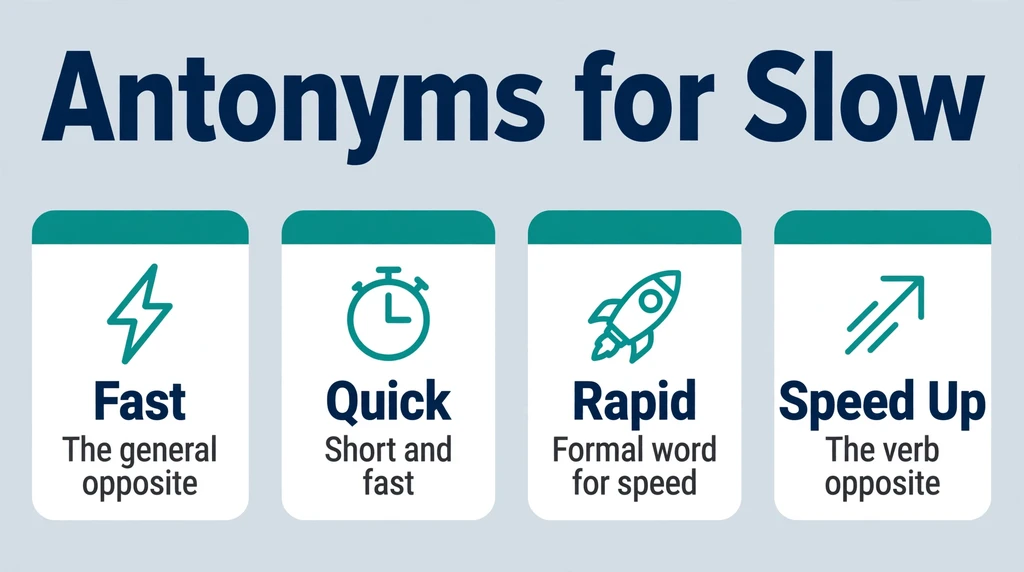
The clearest opposites of slow describe speed directly. Common antonyms include fast, quick, rapid, swift, speedy, brisk, hurried, and prompt. Each one cancels the slowness in a slightly different way. Brisk suggests energy, prompt stresses no delay, and rapid suits formal writing about rates and growth.
Writers who need the full opposite set usually browse synonyms for fast next, since fast has its own large family of near-synonyms. The related adverb guide to synonyms for quickly covers the matching adverbs, such as rapidly and swiftly.
For the verb, the opposites are speed up and accelerate. A driver slows down at a junction and speeds up after it. A business can also accelerate its plans, which is the exact reverse of reining them in. This verb pair, slow down and speed up, is the one learners meet first, and it covers most daily situations well.
A quick test helps in practice. If a word can finish the sentence “instead of slow, it was” in a natural way, it is probably a true antonym. Fast, quick, and rapid all pass that test. Busy also passes for the business sense, since a busy shop is the opposite of a slow one. Context decides which opposite you need.
The clock sense flips too. A slow clock is behind, while a fast clock is ahead of the real time. Even the understanding sense has a bright opposite family, with quick, sharp, and bright describing a fast mind. Notice how each sense of slow brings its own opposite with it. That pattern is a useful memory check: if the antonym sounds wrong, you have probably mixed two senses together.
Common Mistakes: Words That Are Not True Synonyms for Slow
Accuracy matters in a synonym guide, so this section clears up the words that often sneak into slow lists wrongly.
Careful and cautious are not synonyms for slow. A careful driver may drive fast, and a careless one may crawl. Deliberate earns its place because sources list it for slow movement, but even deliberate stresses intention first and speed second. Keep the ideas separate in your own sentences.
Hesitant, reluctant, and unwilling form a neighbouring family. Collins lists them where slow means not easily aroused, as in slow to anger. They describe attitude, not speed. A reluctant runner can still be quick, and a willing one can still be slow.
Backward appears in very old lists for the understanding sense. Today it sounds dated and offensive about people, so modern guides leave it out. The same is true of insulting words like dumb and thick. A good synonym list should help your writing, not hand you words that wound.
Two usage mistakes appear often as well. First, writers use gradual for movement, although it belongs to change over time: a gradual slope is fine, but a gradual pedestrian is odd. Second, writers put slow before a verb, as in slow changing weather. The grammar section above shows why slowly owns that position.
Frequently Asked Questions
What is the best synonym for slow?
There is no single best word, because the right choice depends on the sense. For movement, unhurried and leisurely cover the most ground. For change over time, gradual is the safest pick. Match the word to the situation and you will rarely go wrong.
What is a formal synonym for slow?
Gradual, deliberate, prolonged, and protracted are the standard formal choices. For vehicles and machines, decelerate is the formal verb. Official instructions also use the phrase reduce speed, which is clear in every context.
What is an informal word for slow?
Poky is the classic US informal choice, especially for cars and computers. Snail-paced and snaillike add humour. For a quiet shop or town, dead is common in casual speech, though it is far too blunt for business writing.
What does it mean when a clock is slow?
A slow clock shows a time earlier than the correct time. The clearest wording is behind, as in my watch is five minutes behind. The opposite is a fast clock, which shows a later time than the real one.
Is slow an adverb?
Yes, in established patterns. Slow works as an adverb after verbs of movement, as in go slow or drive slow, and it has done so for over four centuries. Slowly is used before verbs and with participial adjectives, and formal writing usually prefers slowly overall.
What is the difference between slow and slowly?
Slow follows verbs of movement or action, while slowly goes before the verb or with adjectives like dawning. Things can burn slow or slowly, so both forms sometimes work. When in doubt in formal writing, choose slowly.
What is the verb for slow?
The verb is slow itself, usually in the phrasal form slow down. Decelerate is the formal option for vehicles. Slacken suggests easing up as effort relaxes, and ease off is the gentler everyday phrase for reducing pace or pressure.
What is the opposite of slow?
Fast is the general opposite, with quick, rapid, swift, and speedy close behind. For the business sense, the opposite is busy. For the verb slow down, the opposites are speed up and accelerate.
Final Thoughts
Slow looks simple, yet it covers movement, time, trade, clocks, and one sense best avoided about people. Once you sort its synonyms by sense, the right choice usually becomes obvious. Take the leisurely road, let the recovery be gradual, call the quiet month slack, and set the clock that is five minutes behind.
For an even deeper list with related words and near-synonyms, the Merriam-Webster Thesaurus entry for slow is a reliable next step. Keep this guide bookmarked too, and your sentences will never crawl when they should glide, or glide when they should crawl.