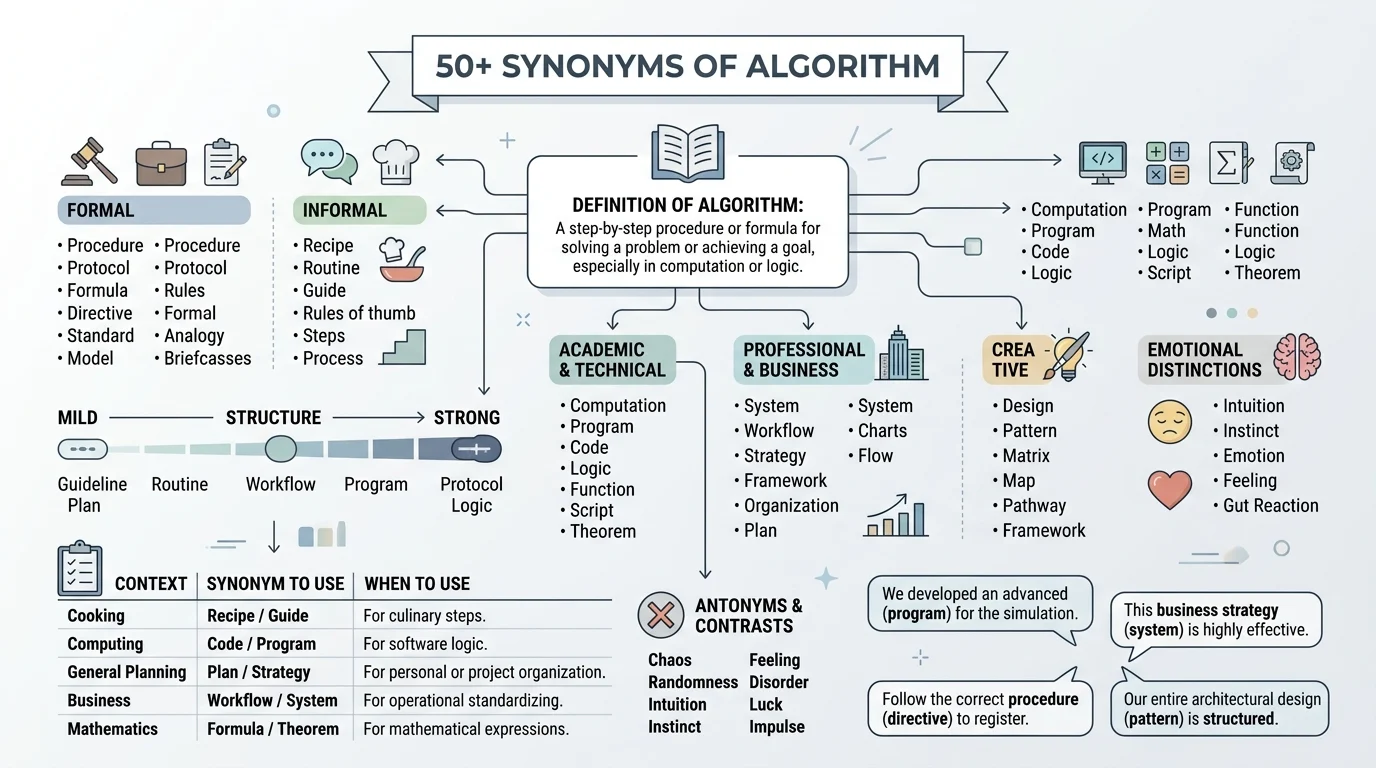
Algorithm sounds technical, but finding the right alternative for it can be surprisingly difficult. In an essay, research paper, blog post, coding guide, or professional report, repeating the same word can make your writing feel flat. You may also need a simpler term when your readers are not familiar with programming language.
That is where the right algorithm synonym can help.
An algorithm is a clear set of steps used to solve a problem, process information, or complete a task. Depending on the context, alternatives such as procedure, method, process, formula, protocol, system, or set of instructions may fit better. However, these words are not always interchangeable. Each one can carry a slightly different meaning.
This guide covers 50+ synonyms of algorithm with clear meanings, practical uses, and real-world examples. You will learn which alternatives work best in technical writing, academic work, business communication, and everyday explanations. You will also see when a synonym may sound inaccurate, so you can choose a word that matches your exact meaning.
What Are the Best Synonyms of Algorithm?
An algorithm is a step-by-step set of rules or instructions designed to solve a problem or complete a task. For formal writing and academic contexts, choose procedure or method. For casual conversation, process or system work well. In professional settings, protocol and framework sound authoritative. For creative writing, consider recipe or blueprint.
Meaning, Tone, and Context
Simple Definition
An algorithm is a finite sequence of well-defined instructions or rules used to perform a computation or solve a specific problem. Think of it as a precise recipe that tells you exactly what to do, step by step, to achieve a desired outcome.
Part of Speech
Overall Tone
Neutral. The word itself does not carry strong positive or negative emotional weight. However, in modern usage, it often implies logic, precision, and automated or machine-driven processes.
Formality Level
Formal. Algorithm is primarily used in technical, academic, and professional contexts. It is less common in everyday conversation unless discussing technology, social media, or data processing.
Common Uses
Native English speakers commonly use algorithm in several areas:
- Computer science and programming: Describing search functions, sorting methods, or machine learning models.
- Mathematics: Referring to step-by-step procedures for calculations.
- Social media: Discussing how platforms decide what content to show users.
- Business and data analysis: Explaining predictive models or decision-making systems.
- Everyday problem-solving: Drawing analogies between computational processes and daily tasks.
Word Forms
- Noun: algorithm
- Adjective: algorithmic
- Adverb: algorithmically
- Related noun: algorithmics (the study of algorithms)
When and How to Use “Algorithm”
Choose algorithm when you need to describe a precise, logical, and repeatable set of steps, especially in technical or formal contexts. Here are seven realistic examples:
- Professional (Software Development): “We need to design a more efficient algorithm for processing customer data.”
- Academic (Computer Science Paper): “This paper presents a novel algorithm for solving the traveling salesman problem.”
- Workplace (Project Planning): “Our team developed an algorithm to prioritize tasks based on urgency and impact.”
- Personal (Everyday Analogy): “My morning routine is basically an algorithm: wake up, brew coffee, check email, then start work.”
- Email (Professional Communication): “I have attached the algorithm we discussed for the new recommendation system.”
- Resume (Technical Role): “Optimized the search algorithm, reducing query response time by 40 percent.”
- Social Media (Explaining Content): “Instagram’s algorithm decides which posts appear at the top of your feed.”
Best Synonyms of “Algorithm”
No synonym is identical in every situation. The right choice depends on your audience, purpose, and the specific nuance you want to convey. Here are the best recommendations for different contexts:
- Professional writing: Protocol – sounds structured and authoritative.
- Academic writing: Methodology – conveys a systematic, research-based approach.
- Business communication: Framework – suggests a strategic, high-level structure.
- Casual conversation: System – familiar and easy to understand.
- Emotional writing: Journey or path – adds a human, narrative feel.
- Creative writing: Recipe – playful and relatable.
- Resume writing: Process or method – clear and professional.
- Workplace communication: Procedure – emphasizes proper steps and compliance.
- Stronger meaning: Blueprint – implies a detailed, comprehensive plan.
- Softer meaning: Approach – suggests a general strategy rather than rigid steps.
When Not to Use “Algorithm”
While algorithm is a useful word, it is not always the best choice. Avoid using it in these situations:
Too general: If you are describing a simple, everyday task, algorithm may sound unnecessarily technical.
- Less effective: “I follow an algorithm to make my morning coffee.”
- Better: “I follow a routine to make my morning coffee.”
Vague: When you need to emphasize the human or creative aspects of a process.
- Less effective: “The artist used an algorithm to choose colors.”
- Better: “The artist used a technique to choose colors.”
Formal: In casual conversations with friends or family.
- Less effective: “What is your algorithm for studying?”
- Better: “What is your method for studying?”
Too weak: When you want to convey a highly structured, rigorous process.
- Less effective: “We need an algorithm for quality control.”
- Better: “We need a protocol for quality control.”
Outdated in some contexts: In very old-fashioned writing, algorism was used, but this term is now obsolete.
Words Commonly Confused With “Algorithm”
Several words are often confused with algorithm. Here is how to distinguish them.
Algorithm vs Procedure
- Difference: An algorithm is a specific, logical set of steps that guarantees a solution. A procedure is a broader set of steps that may not be as rigidly defined.
- When to Use It: Use procedure for general guidelines; use algorithm for precise, computational steps.
- Example: “Follow the safety procedure before operating the machine.”
Vs Process
- Difference: A process is a series of events or changes that happen over time. An algorithm is a deliberate set of instructions.
- When to Use It: Use process to emphasize how something works naturally; use algorithm to emphasize intentional design.
- Example: “Learning a language is a long process.”
Vs Method
- Difference: A method is a planned way of doing something. An algorithm is a more formal, step-by-step method, often used in computing.
- When to Use It: Use method for general approaches; use algorithm for technical, precise instructions.
- Example: “The best method to learn English is to practice every day.”
Algorithm vs System
- Difference: A system is a group of things working together. An algorithm is the set of rules that guides how the system operates.
- When to Use It: Use system for the whole; use algorithm for the rules within.
- Example: “The solar system contains the sun and planets.”
Algorithm vs Formula
- Difference: A formula is a mathematical equation or standard procedure. An algorithm is a broader set of instructions that may include multiple formulas.
- When to Use It: Use formula for mathematical calculations; use algorithm for complex, multi-step processes.
- Example: “Use the quadratic formula to solve the equation.”
Vs Heuristic
- Difference: A heuristic is a practical, rule-of-thumb approach that does not guarantee a perfect solution. An algorithm guarantees a solution if followed correctly.
- When to Use It: Use heuristic for quick, approximate solutions; use algorithm for exact, reliable solutions.
- Example: “Use a heuristic to find a good route quickly, but use an algorithm to find the shortest route.”
Best Synonyms of “Algorithm” by Context
| Context | Best Synonym | Why It Works | Example |
|---|---|---|---|
| Formal writing | Procedure | Emphasizes proper, established steps. | “The laboratory procedure must be followed precisely.” |
| Academic writing | Methodology | Conveys a systematic, research-based approach. | “The research methodology was rigorously tested.” |
| Professional communication | Protocol | Sounds structured and authoritative. | “We need to establish a communication protocol.” |
| Business emails | Framework | Suggests a strategic, high-level structure. | “Please review the new framework for our marketing strategy.” |
| Resume writing | Process | Clear and professional. | “Streamlined the hiring process to reduce time-to-hire.” |
| Workplace communication | System | Familiar and easy to understand. | “Our new filing system has improved efficiency.” |
| Casual conversation | Routine | Relatable and personal. | “My workout routine is pretty simple.” |
| Everyday speaking | Way | Simple and direct. | “Show me the way you do that.” |
| Creative writing | Recipe | Playful and relatable. | “She followed her grandmother’s recipe for success.” |
| Storytelling | Path | Adds a narrative, human feel. | “His path to becoming a chef was unconventional.” |
| Emotional writing | Journey | Conveys personal growth and experience. | “Her journey through grief was documented in her poetry.” |
| Strong emphasis | Blueprint | Implies a detailed, comprehensive plan. | “The CEO presented a blueprint for the company’s future.” |
| Mild tone | Approach | Suggests a general strategy. | “Let’s try a different approach to this problem.” |
| Social media captions | Formula | Short and catchy. | “My formula for a perfect day: coffee, work, and rest.” |
| American English | Algorithm | Standard term. | “The algorithm recommended these products.” |
How to Choose the Best Synonym of “Algorithm”
Choosing the right synonym is about matching the word to your message. Follow this practical decision guide:
- Consider your audience: Are you speaking to experts or general readers? Use algorithm or protocol for experts. Use method or system for general readers.
- Determine your tone: Are you being formal or casual? Choose procedure for formal writing. Choose routine for casual conversation.
- Assess emotional strength: Do you want to add emotion or stay neutral? Use journey or path for emotional writing. Use process or method for neutral writing.
- Evaluate precision: Do you need to emphasize exactness or general guidance? Use algorithm or formula for precise instructions. Use approach or strategy for general guidance.
- Think about your purpose: Are you instructing, describing, or persuading? Use procedure for instructions. Use framework for describing. Use blueprint for persuading.
The goal is always to communicate your intended message as clearly and naturally as possible.
Real Life Examples of “Algorithm”
Here are realistic examples showing how algorithm and its synonyms can be used in various situations.
School: “The math teacher showed us an algorithm for long division.”
- Improved: “The math teacher showed us a method for long division.”
College: “I am studying algorithms for my computer science final.”
- Improved: “I am studying computational procedures for my computer science final.”
Workplace: “The new algorithm has made our data analysis much faster.”
- Improved: “The new process has made our data analysis much faster.”
Business: “Our company uses an algorithm to predict customer behavior.”
- Improved: “Our company uses a predictive model to forecast customer behavior.”
Email: “I have attached the algorithm for the new software update.”
- Improved: “I have attached the technical procedure for the new software update.”
Resume: “Designed and implemented a sorting algorithm for the database.”
- Improved: “Designed and implemented a data-sorting system for the database.”
Conversation: “What is your algorithm for getting things done?”
- Improved: “What is your system for getting things done?”
Storytelling: “He followed an algorithm of deception and charm.”
- Improved: “He followed a blueprint of deception and charm.”
Blogging: “Here is my algorithm for growing a YouTube channel.”
- Improved: “Here is my strategy for growing a YouTube channel.”
Social Media: “The algorithm is not showing my posts to anyone.”
- Improved: “The system is not showing my posts to anyone.”
18 Best Synonyms of “Algorithm”
| Synonym | Simple Meaning | Best Used For | Example Sentence |
|---|---|---|---|
| Procedure | A set of steps to follow correctly | Formal instructions, safety guidelines | “Follow the safety procedure before operating the machine.” |
| Method | A planned way of doing something | General approaches, teaching | “The best method to learn English is to practice every day.” |
| Process | A sequence of events over time | Describing how something works | “Learning a language is a long process.” |
| System | A group of things working together | Describing overall operations | “The solar system contains the sun and planets.” |
| Protocol | A formal set of rules or standards | Professional, medical, or diplomatic contexts | “The medical protocol requires immediate testing.” |
| Formula | A mathematical or standard procedure | Mathematics, computing | “Use the quadratic formula to solve the equation.” |
| Routine | A regular, fixed way of doing things | Daily habits, personal schedules | “My morning routine includes meditation and exercise.” |
| Blueprint | A detailed plan or design | Strategic planning, architecture | “The architect presented a blueprint for the new building.” |
| Framework | A basic structure underlying a system | Business strategies, software development | The new framework will guide our product development.” |
| Technique | A skillful way of doing something | Artistic, athletic, or specialized skills | “The surgeon used a new technique for the operation.” |
| Strategy | A plan of action designed to achieve a goal | Business, military, or personal planning | “Our marketing strategy focuses on social media engagement.” |
| Approach | A way of dealing with something | Problem-solving, general situations | “Let’s try a different approach to this problem.” |
| Plan | A detailed proposal for doing something | General planning, projects | “We need a plan for the upcoming event.” |
| Scheme | A systematic plan or arrangement | Organizing, sometimes negative connotations | “The new scheme for organizing files is much better.” |
| Model | A representation or description of a system | Data analysis, scientific research | “The economic model predicts future trends.” |
| Rule | A prescribed guide for conduct or action | General guidelines, grammar | “The rule for plural nouns is to add an ‘s’.” |
| Guideline | A general rule or piece of advice | Recommendations, best practices | “Follow these guidelines for a healthy diet.” |
| Path | A course of action or way of proceeding | Creative writing, storytelling | “She chose a path of honesty and transparency.” |
Synonyms of “Algorithm” by Usage
Professional vs Personal Synonyms
In professional settings, choose words that sound structured and authoritative, such as protocol, framework, or procedure. In personal conversations, choose words that sound relatable and familiar, such as routine, system, or way.
Formal vs Conversational Synonyms
For reports, essays, and business writing, use formal synonyms like methodology, protocol, or procedure. For casual conversations and texting, use conversational synonyms like process, system, or routine.
Academic Synonyms
In academic writing, precision is key. Methodology to describe a systematic research approach. Use procedure for laboratory or experimental steps. Use model for theoretical representations. These words sound more authoritative and scholarly.
Professional and Business Synonyms
For resumes, interviews, and meetings, choose strong, action-oriented words. Process and system are clear and professional. Framework suggests strategic thinking. Protocol implies adherence to standards. Blueprint conveys detailed planning.
Creative and Literary Synonyms
For storytelling, fiction, and poetry, choose expressive alternatives that add emotion or imagery. Path, journey, and blueprint can create vivid mental pictures. Recipe adds a playful, relatable touch.
Slang or Modern Synonyms
In informal tech circles, algo is a common abbreviation. However, avoid using slang in academic or professional writing. Algo is acceptable in casual conversations among tech-savvy friends but should not appear in formal documents.
Strongest to Mildest Synonyms
| Mild | Moderate | Strong | Very Strong |
|---|---|---|---|
| Way | Method | Procedure | Protocol |
| Routine | Process | System | Framework |
| Approach | Technique | Strategy | Blueprint |
Emotional vs Neutral Synonyms
Emotional Synonyms: Journey, path, blueprint – these words add a human, narrative, or aspirational quality.
Neutral Synonyms: Procedure, method, process, system – these words simply communicate information without adding emotion.
Use emotional synonyms in storytelling, personal writing, or persuasive content. Use neutral synonyms in technical, academic, or professional writing.
Antonyms of “Algorithm”
| Antonym | Meaning | Example Sentence |
|---|---|---|
| Randomness | Lack of pattern or predictability | “The results were due to randomness, not a structured process.” |
| Chaos | Complete disorder and confusion | “The project descended into chaos without a clear plan.” |
| Guesswork | Relying on guessing rather than calculation | “The solution was found through guesswork, not a reliable method.” |
| Intuition | Understanding without conscious reasoning | “She relied on intuition rather than a systematic approach.” |
| Improvisation | Acting without preparation | “The speech was pure improvisation, not a planned algorithm.” |
| Conjecture | Forming an opinion without sufficient evidence | “His theory was based on conjecture, not a rigorous algorithm.” |
| Disorder | Lack of organization | “The files were in complete disorder.” |
| Disorganization | Lack of systematic arrangement | “The disorganization of the office made it hard to find anything.” |
| Unsystematic | Not methodical or organized | “Her unsystematic approach led to many errors.” |
| Spontaneity | Acting on impulse | “The spontaneity of the event made it memorable.” |
| Hunch | A feeling or guess based on intuition | “I had a hunch that the answer was correct.” |
| Instinct | An innate, typically fixed pattern of behavior | “His instinct told him to run.” |
| Serendipity | Making fortunate discoveries by accident | “The discovery was a result of serendipity, not a planned search.” |
| Chance | The occurrence of events without any obvious cause | “The outcome was determined by chance.” |
| Accident | An event that happens by chance | “The discovery was a happy accident.” |
Comparison: “Algorithm” vs Similar Words
Vs Procedure
- Main Difference: An algorithm is a specific, logical set of steps that guarantees a solution. A procedure is a broader set of steps that may not be as rigidly defined.
- Which Is Stronger?: Algorithm – it implies a more rigorous, guaranteed process.
- Which Is More Formal?: Algorithm – it is more technical and precise.
- When to Use Each: Use procedure for general guidelines. Use algorithm for precise, computational steps.
- Examples:
Algorithm vs Process
- Main Difference: A process is a series of events that happen over time. An algorithm is a deliberate set of instructions.
- Which Is Stronger?: Algorithm – it implies intentional design and precision.
- Which Is More Formal?: Algorithm – it is more technical.
- When to Use Each: Use process to emphasize how something works naturally. Use algorithm to emphasize intentional design.
- Examples:
Algorithm vs Method
- Main Difference: A method is a planned way of doing something. An algorithm is a more formal, step-by-step method.
- Which Is Stronger?: Algorithm – it implies a more structured, guaranteed approach.
- Which Is More Formal?: Algorithm – it is more technical and precise.
- When to Use Each: Use method for general approaches. Use algorithm for technical, precise instructions.
- Examples:
Vs System
- Main Difference: A system is a group of things working together. An algorithm is the set of rules that guides how the system operates.
- Which Is Stronger?: Algorithm – it implies a more specific, rule-based approach.
- Which Is More Formal?: Algorithm – it is more technical.
- When to Use Each: Use system for the whole. Use algorithm for the rules within.
- Examples:
Algorithm vs Formula
- Main Difference: A formula is a mathematical equation or standard procedure. An algorithm is a broader set of instructions that may include multiple formulas.
- Which Is Stronger?: Algorithm – it implies a more comprehensive process.
- Which Is More Formal?: Both are formal, but algorithm is broader.
- When to Use Each: Use formula for mathematical calculations. Use algorithm for complex, multi-step processes.
- Examples:
- Algorithm: “The algorithm for predicting weather involves many formulas.”
- Formula: “Use the quadratic formula to solve the equation.”
Vs Heuristic
- Main Difference: A heuristic is a practical, rule-of-thumb approach that does not guarantee a perfect solution. An algorithm guarantees a solution if followed correctly.
- Which Is Stronger?: Algorithm – it guarantees a solution.
- Which Is More Formal?: Algorithm – it is more rigorous and academic.
- When to Use Each: Use heuristic for quick, approximate solutions. Use algorithm for exact, reliable solutions.
- Examples:
- Algorithm: “The algorithm guarantees the shortest path.”
- Heuristic: “The heuristic helps find a good route quickly.”
Common Phrases and Expressions with “Algorithm”
Common Mistakes to Avoid
1: Choosing a vague synonym instead of a precise one.
- Incorrect: “I need a good way to solve this problem.”
- Better: “I need an efficient algorithm to solve this problem.”
- Why: “Way” is too vague. “Algorithm” conveys a structured, reliable approach.
2: Confusing algorithm with a similar word.
- Incorrect: “The heuristic guarantees the correct answer.”
- Better: “The algorithm guarantees the correct answer.”
- Why: A heuristic does not guarantee a solution; an algorithm does.
3: Using an informal synonym in formal writing.
- Incorrect: “The company’s algo for customer service is effective.”
- Better: “The company’s protocol for customer service is effective.”
- Why: “Algo” is slang and inappropriate for formal contexts.
4: Selecting an overly dramatic synonym.
- Incorrect: “The epic journey of our data processing.”
- Better: “The process of our data processing.”
- Why: “Journey” adds unnecessary emotion in a technical context.
5: Repeating the same word too often.
- Incorrect: “The algorithm is fast. The algorithm is reliable. The algorithm is easy to use.”
- Better: “The algorithm is fast. The procedure is reliable. The method is easy to use.”
- Why: Varying synonyms improves readability and engagement.
6: Choosing a synonym with the wrong emotional tone.
- Incorrect: “The blueprint for our project failed.”
- Better: “The plan for our project failed.”
- Why: “Blueprint” sounds too grand for a simple project plan.
7: Using slang in academic or professional writing.
- Incorrect: “The algo we used was super effective.”
- Better: “The algorithm we used was highly effective.”
- Why: Slang undermines credibility in formal settings.
Frequently Asked Questions
1. What are the best synonyms of “algorithm”?
The best synonyms depend on context. Formal writing, use procedure or protocol. Casual conversation, use process or system. For academic work, use methodology or model. For creative writing, use recipe or blueprint.
2. What are the best formal synonyms of “algorithm”?
The best formal synonyms include procedure, protocol, methodology, framework, and formula. These words convey structure, precision, and authority, making them suitable for academic papers, business reports, and professional documents.
3. What are common informal synonyms of “algorithm”?
Common informal synonyms include process, system, routine, and way. In very casual tech conversations, algo is also used. These words are easy to understand and work well in everyday speech.
4. What is another word for “algorithm” in professional writing?
In professional writing, consider protocol, framework, procedure, or system. These words sound structured and authoritative. For example, “We need to establish a communication protocol” sounds more professional than “We need an algorithm for communication.”
5. What is the difference between “algorithm” and “procedure”?
An algorithm is a specific, logical set of steps that guarantees a solution. A procedure is a broader set of steps that may not be as rigidly defined. Think of an algorithm as a precise recipe and a procedure as a general set of guidelines.
6. What is the opposite of “algorithm”?
The opposite of algorithm includes randomness, chaos, guesswork, intuition, and *improvisation**. These words describe approaches that lack structure, predictability, or systematic planning.
Conclusion
The word algorithm describes a step-by-step set of rules or instructions designed to solve a problem or complete a task. While it is a precise and useful term, it is not always the best choice for every situation. The synonyms of algorithm offer a rich variety of alternatives, from the formal procedure and protocol to the casual process and system, and from the creative recipe and blueprint to the emotional journey and path.
No synonym works perfectly in every context. The key is to choose words based on your audience, tone, and purpose. For academic and professional writing, prioritize precision and formality. For creative and personal writing, prioritize emotion and imagery. Casual conversations, prioritize clarity and simplicity.
One practical tip: Before you write, ask yourself what you want your reader to feel and understand. Then choose the synonym that best delivers that message. With practice, you will develop an instinct for selecting the most effective word in every situation.
Definitions, meanings, and usage recommendations should be verified with trusted language references before publication. Recommended sources include Cambridge Dictionary, Oxford English Dictionary, Merriam Webster, Collins Dictionary, and Britannica.