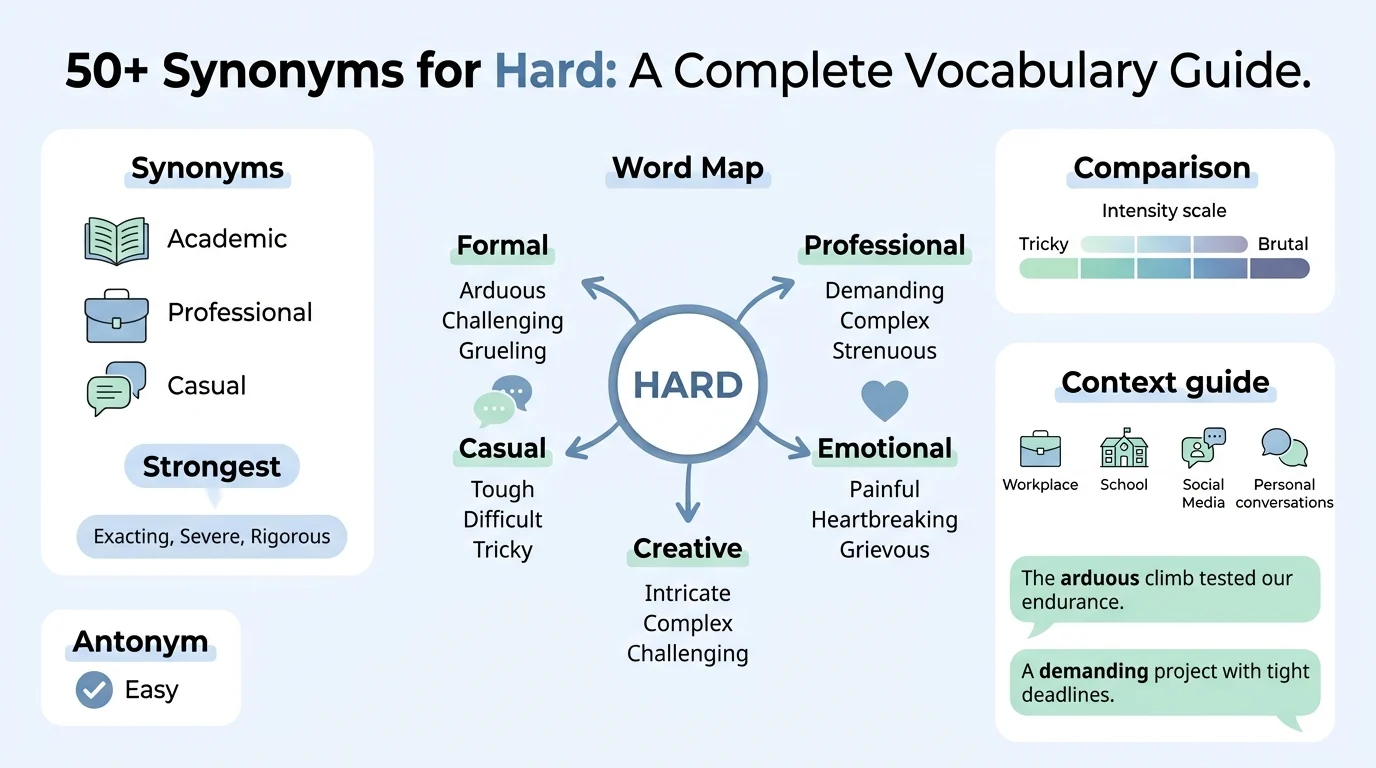
Have you ever caught yourself using the word “hard” five times in a single email? You are not alone. Many writers, students, and professionals rely on this common word without realizing how many precise alternatives exist.
The English language offers dozens of better ways to express difficulty, effort, or firmness. This guide will help you replace “hard” with the perfect synonym for every situation.
What Does “Hard” Mean?
Hard means something requiring significant effort, strength, or determination. It can describe difficult tasks, solid objects, or challenging situations. The best synonyms for hard include difficult for casual use, challenging for professional contexts, complex for academic writing, tough for emotional situations, and demanding for workplace descriptions.
Meaning, Tone and Context
Simple Definition: Hard describes anything that requires a lot of effort, is not easy to do, or has a solid firm surface.
Part of Speech: Adjective
Tone: Hard is generally neutral but can lean negative when describing difficulty and neutral when describing physical firmness.
Formality Level: Informal to neutral. More formal alternatives exist for professional and academic writing.
Common Use Cases:
- Describing challenging tasks or problems
- Referring to physical firmness of objects
- Expressing difficult life situations
- Discussing demanding work or study
- Describing strict or harsh conditions
Important Word Forms:
- Hard (adjective)
- Harder (comparative)
- Hardest (superlative)
- Hardly (adverb, meaning barely)
- Harden (verb)
- Hardened (adjective)
When and How to Use “Hard”
The word hard works well in everyday conversation and general writing. It is appropriate when you want to keep your language simple and direct. However, overusing hard makes your writing feel repetitive and unsophisticated.
Professional Example:
“This project has been hard to complete on schedule.”
Context: Workplace conversation about project challenges
Academic Example:
“The exam questions were hard for most students.”
Context: Discussing test difficulty with classmates
Personal Example:
“Learning to cook has been harder than I expected.”
Context: Casual conversation about new skills
Emotional Example:
It was hard to say goodbye to my childhood home.”
Context: Expressing emotional difficulty
Creative Example:
“The hard ground cracked under the summer sun.”
Context: Descriptive writing about nature
Social Media Example:
“Today’s workout was so hard but so worth it.”
Context: Fitness post on Instagram
Email Example:
“I know this is hard to hear, but we need to change our approach.”
Context: Professional email about difficult news
Another Word for “Hard”
Finding the right replacement depends entirely on your context and audience. Here are the best single word alternatives for every situation:
Professional Writing: Demanding, rigorous, exacting
Academic Writing: Complex, challenging, arduous
Casual Conversation: Tough, rough, heavy
Emotional Writing: Painful, difficult, heartbreaking
Creative Writing: Harsh, unforgiving, solid, unyielding
Resume and Workplace: Challenging, demanding, intensive
Social Media Captions: Intense, grueling, tough
Stronger Meaning: Brutal, punishing, excruciating
Softer Meaning: Tricky, challenging, demanding
When Not to Use “Hard”
Hard becomes problematic when you need precise language or formal tone. It sounds too vague in academic essays and too casual in business reports.
Vague Usage:
“This job is hard.”
Better: “This job is physically demanding and requires long hours.”
Too Casual for Formal Writing:
“The hard economic conditions affected everyone.”
Better: “The challenging economic conditions affected everyone.”
Too General for Resumes:
“I worked hard on the project.”
Better: “I dedicated extensive effort to the project’s successful completion.”
Weak Description:
“The material was hard to understand.”
Better: “The material was conceptually complex and required additional study.”
Words Commonly Confused With “Hard”
Hard vs. Difficult
Difficult is slightly more formal than hard. Use difficult in academic writing and hard in casual conversation. Both mean something is not easy.
Hard vs. Tough
Tough suggests resilience and durability. It often describes people or situations that require mental strength. Hard focuses more on effort and physical properties.
Hard vs. Challenging
Challenging has a more positive tone. It suggests something that tests your abilities but is worthwhile. feels more neutral or negative.
Hard vs. Complex
Complex describes something with many interconnected parts. Hard simply means requiring effort. A task can be complex without being hard.
Hard vs. Firm
Firm describes solid objects that give slightly under pressure. Hard describes objects that do not give at all. Use firm for softer solid objects.
Hard vs. Severe
Severe describes extreme intensity or harshness. Hard describes general difficulty. Severe is much stronger than hard.
Best Synonym by Context for “Hard”
| Context | Best Synonym | Why It Works | Example |
|---|---|---|---|
| Formal Writing | Arduous | It sounds sophisticated and precise | The arduous journey required months of preparation |
| Academic Writing | Complex | It implies intellectual depth | The complex theory challenged even advanced students |
| Professional Use | Demanding | It suggests high standards and expectations | The demanding position requires extensive experience |
| Resume | Challenging | It shows growth and positive attitude | Managed challenging accounts worth over one million dollars |
| Casual Conversation | Tough | It sounds natural and relatable | That exam was really tough |
| Creative Writing | Unyielding | It adds vivid imagery and description | The unyielding stone resisted every attempt to break it |
| Emotional Tone | Painful | It expresses deep emotional impact | The painful conversation changed everything |
| Strong Intensity | Brutal | It conveys extreme difficulty | The brutal training schedule exhausted everyone |
| Soft Tone | Tricky | It sounds manageable and clever | This recipe is a bit tricky but doable |
| Social Media | Intense | It sounds exciting and modern | Today’s workout was so intense |
| Physical Description | Solid | It describes firmness accurately | The solid oak table lasted for generations |
Which Synonym Should You Choose?
Selecting the right word requires considering four key factors. First, think about your formality level. Academic and professional writing needs formal synonyms like arduous or complex. Casual conversations accept tough or tricky.
Second, consider your emotional intensity. Use painful or heartbreaking for deep emotions. Use challenging or demanding for neutral situations. Avoid overly strong words for simple difficulties.
Third, evaluate your professional context. Resumes and interviews benefit from challenging and demanding. These words show you embrace difficulty rather than complain about it.
Fourth, examine your sentence structure. Some synonyms fit certain sentence patterns better than others. Test your chosen word by reading it aloud.
Real Life Examples of “Hard” in Sentences
School Context:
“The final exam proved more challenging than anyone anticipated.”
Workplace Context:
“Her demanding schedule left little time for personal activities.”
Writing Context:
“Editing a novel requires rigorous attention to every single sentence.”
Conversation Context:
“This recipe is tricky because the sauce tends to separate.”
Social Media Context:
“Today’s hill repeats were absolutely brutal but I feel stronger.”
Resume Context:
“Successfully managed complex client relationships and resolved difficult situations.”
Email Context:
“Thank you for tackling this arduous task on such short notice.”
Storytelling Context:
“The painful memories surfaced whenever she visited that town.”
25 Synonyms for “Hard”
| Synonym | Simple Meaning | Best Used For | Example Sentence |
|---|---|---|---|
| Difficult | Not easy to do or understand | General use, all contexts | The difficult puzzle took hours to solve |
| Tough | Strong and able to withstand difficulty | Casual conversation, physical endurance | She is tough enough to handle any challenge |
| Challenging | Testing abilities in a positive way | Professional and personal growth | The challenging project improved my skills |
| Demanding | Requiring a lot of time and effort | Workplace and academic situations | The demanding professor expects perfection |
| Arduous | Requiring strenuous effort | Formal writing, long term projects | The arduous climb exhausted the hikers |
| Complex | Having many interconnected parts | Academic and technical writing | The complex system requires careful maintenance |
| Rigorous | Strict and thorough | Academic, scientific, and professional use | The rigorous training program produces results |
| Strenuous | Needing physical or mental effort | Physical activities and intense work | The strenuous exercise left everyone breathless |
| Exacting | Making great demands on skill | Professional and artistic contexts | The exacting standards of the chef impressed everyone |
| Grueling | Extremely exhausting and demanding | Describing long, difficult experiences | The grueling interview process lasted all day |
| Laborious | Requiring much hard work | Describing repetitive or tedious tasks | The laborious data entry took three weeks |
| Painful | Causing physical or emotional distress | Emotional and physical difficulty | The painful experience changed her perspective |
| Brutal | Extremely harsh or severe | Intense situations, strong emphasis | The brutal winter froze the entire region |
| Severe | Very serious or intense | Formal descriptions of harsh conditions | The severe drought affected crop production |
| Harsh | Unpleasantly rough or severe | Describing conditions or treatment | The harsh criticism affected his confidence |
| Heavy | Requiring great effort | Casual and creative writing | The heavy workload prevented any time off |
| Intense | Very strong or extreme | Social media, modern casual use | The intense workout left me exhausted |
| Tricky | Requiring careful attention | Casual conversation, clever solutions | This tricky problem needs creative thinking |
| Problematic | Posing a difficulty | Professional and academic writing | The problematic situation required immediate attention |
| Unyielding | Not giving way to pressure | Creative writing, physical descriptions | The unyielding rock defied every tool |
| Solid | Firm and stable in structure | Describing physical objects | The solid foundation supported the building |
| Firm | Having some give but still solid | Describing physical objects | The firm mattress supported her back |
| Challenging | Testing abilities | Professional and personal growth | The challenging course improved my skills |
| Stiff | Rigid and difficult to bend | Physical descriptions, formal | The stiff cardboard held its shape |
| Exhausting | Using up all energy | Physical and mental fatigue | The exhausting meeting lasted five hours |
Synonym Groups and Usage Differences
Professional vs. Personal Synonyms
Professional settings demand words that sound capable and competent. Demanding, rigorous, and exacting show you understand workplace standards. Personal situations allow softer words like tough and tricky. These words feel more natural with friends and family.
Formal vs. Conversational Synonyms
Formal writing requires sophisticated vocabulary. Arduous, laborious, and exacting work well in reports and essays. Conversational English prefers simpler alternatives. Tough, rough, and heavy sound natural in everyday speech.
Academic Synonyms
Academic writing needs precise, neutral language. Complex, rigorous, and arduous demonstrate intellectual sophistication. These words show your understanding of scholarly standards. Avoid casual words like tough or rough in academic papers.
Professional and Business Synonyms
Business communication benefits from positive, action oriented language. Challenging and demanding suggest growth and capability. These words frame difficulty as opportunity. Exacting and rigorous show attention to quality standards.
Creative or Literary Synonyms
Creative writing rewards descriptive, vivid language. Unyielding, harsh, and solid create strong imagery. These words paint pictures in readers’ minds. Painful and brutal add emotional depth to storytelling.
Slang or Modern Synonyms
Modern slang offers casual alternatives like heavy, rough, and intense. These words work well on social media and in friendly conversation. They feel current and relatable. Avoid slang in professional or academic writing.
Strongest vs. Weaker Synonyms
Mild to Strong Intensity Scale:
Tricky (mild) → Challenging → Difficult → Tough → Demanding → Rigorous → Arduous → Grueling → Brutal (strongest)
Emotional vs. Neutral Synonyms
Neutral Synonyms: Challenging, demanding, complex, rigorous
These words describe difficulty without emotional weight. They work well for objective descriptions.
Emotional Synonyms: Painful, heartbreaking, brutal, harsh
These words add emotional depth. They describe difficulty that affects feelings and relationships.
Antonyms of “Hard”
| Antonym | Meaning | Example Sentence |
|---|---|---|
| Easy | Requiring little effort | The easy task took only five minutes |
| Simple | Not complicated or difficult | The simple instructions were easy to follow |
| Soft | Yielding to pressure | The soft pillow supported her head comfortably |
| Gentle | Mild and kind | The gentle teacher explained everything clearly |
| Effortless | Requiring no effort | Her effortless performance amazed the audience |
| Manageable | Easy to handle or control | The manageable workload allowed free time |
| Clear | Easy to understand | The clear explanation answered all questions |
| Straightforward | Uncomplicated and direct | The straightforward process saved time |
| Flexible | Able to bend without breaking | The flexible material adapted to any shape |
| Gentle | Not harsh or severe | The gentle breeze cooled the hot afternoon |
| Mild | Not extreme or intense | The mild winter surprised everyone |
| Tender | Easily damaged or soft | The tender meat melted in his mouth |
| Pliable | Easily bent or shaped | The pliable clay allowed creative designs |
| Lenient | Not strict or severe | The lenient policy helped new employees |
| Forgiving | Allowing for mistakes | The forgiving schedule accommodated delays |
Comparison: Hard vs. Similar Words
Hard vs. Difficult
Main Difference: Hard is more casual and versatile. Difficult is slightly more formal and precise.
Which is stronger: They are equally strong in meaning.
Which is more formal: Difficult is more formal.
Example with Hard: “The math problem was hard to solve.”
Example with Difficult: “The difficult equation required advanced calculus knowledge.”
Hard vs. Tough
Main Difference: Tough implies resilience and endurance. Hard focuses on required effort.
Which is stronger: Tough often implies mental strength.
Which is more formal: Hard is neutral. Tough is casual.
Example with Hard: “The ground was too hard to dig.”
Example with Tough: “She is tough enough to handle the pressure.”
Hard vs. Challenging
Main Difference: Challenging has a positive connotation. Hard feels neutral or negative.
Which is stronger: Challenging suggests growth. Hard suggests struggle.
Which is more formal: Challenging is more professional.
Example with Hard: “This job is hard.”
Example with Challenging: “This challenging job offers great learning opportunities.”
Hard vs. Complex
Main Difference: Complex describes many parts. Hard describes general difficulty.
Which is stronger: Complex implies intellectual depth.
Which is more formal: Complex is more formal.
Example with Hard: “The project was hard to finish.”
Example with Complex: “The complex project involved multiple departments.”
Hard vs. Demanding
Main Difference: Demanding focuses on expectations. Hard focuses on effort needed.
Which is stronger: Demanding implies ongoing pressure.
Which is more formal: Demanding is more formal.
Example with Hard: “The test was hard.”
Example with Demanding: “The demanding test required months of preparation.”
Hard vs. Arduous
Main Difference: Arduous suggests prolonged effort. Hard can describe momentary difficulty.
Which is stronger: Arduous is much stronger.
Which is more formal: Arduous is highly formal.
Example with Hard: “The hike was hard.”
Example with Arduous: “The arduous journey took six weeks.”
Common Phrases and Expressions with “Hard”
1. Hard to say
Meaning: Difficult to express or uncertain about
Example: “It is hard to say whether we will finish on time.”
2. Hard work
Meaning: Effort that requires significant energy
Example: “Success comes from hard work and dedication.”
3. Hard feelings
Meaning: Resentment or anger toward someone
Example: “There are no hard feelings between us.”
4. Hard copy
Meaning: A printed version of a document
Example: “Please provide a hard copy of the report.”
5. Hard earned
Meaning: Gained through significant effort
Example: “She spent her hard earned money on the vacation.”
6. Hard pressed
Meaning: Under pressure or experiencing difficulty
Example: “We are hard pressed to meet the deadline.”
7. Hard and fast
Meaning: Strict and unchangeable
Example: “There are no hard and fast rules about this.”
8. Hard times
Meaning: Difficult periods in life
Example: “They supported each other through hard times.”
Common Mistakes to Avoid
Using Hard When a More Precise Synonym is Better
Replacing hard with specific alternatives improves your writing. Instead of “hard job,” say “demanding position” or “challenging role.”
Confusing Hard with Hardy
Hard describes difficulty or firmness. Hardy describes resilience and health. A hardy plant survives winter; a hard plant might mean a difficult plant or a solid plant.
Using Casual Synonyms in Formal Writing
Avoid tough, rough, and heavy in academic papers. These words sound too casual. Choose rigorous, arduous, or exacting instead.
Using Overly Dramatic Synonyms for Simple Situations
Do not describe a mildly difficult task as “brutal” or “excruciating.” Reserve strong words for truly intense experiences.
Repeating Hard Too Often
Vary your vocabulary. Use different synonyms throughout your writing. This keeps readers engaged and shows language skill.
Choosing a Synonym with Wrong Emotional Tone
Painful sounds emotional. Complex sounds intellectual. Match your word to your emotional intent.
Using Slang in Professional Writing
Avoid intense, heavy, and rough in business emails or reports. These words lack professional credibility.
FAQs
What is the best synonym for hard?
Challenging works best in most professional contexts. Difficult is most common in everyday use. Choose based on your audience and situation.
What is a formal synonym for hard?
Arduous, rigorous, and exacting are formal alternatives. Laborious works well in formal writing. Demanding also fits professional contexts.
What is an informal synonym for hard?
Tough, rough, and heavy are informal alternatives. Tricky works well in casual conversation. Intense is popular on social media.
What is another word for hard in professional writing?
Demanding and challenging are excellent for professional writing. Rigorous shows high standards. Exacting suggests precision requirements.
What is the difference between hard and difficult?
Hard is more casual and widely used. Difficult is slightly more formal and precise. Both mean not easy to do or understand.
What is the opposite of hard?
Easy is the most direct opposite. Simple, soft, and gentle also work as antonyms depending on context.
Conclusion
Hard is a useful word, but better alternatives exist for every situation. Understanding context and audience helps you choose the perfect synonym. Challenging works well in professional settings. Demanding fits workplace descriptions. Arduous adds formal sophistication. Tough suits casual conversations. Painful expresses emotional difficulty.
Your vocabulary grows when you explore synonyms. Replace hard with precise alternatives and watch your writing improve. Start with one new synonym today. Use it in your next email or conversation. Small changes create significant improvement over time.