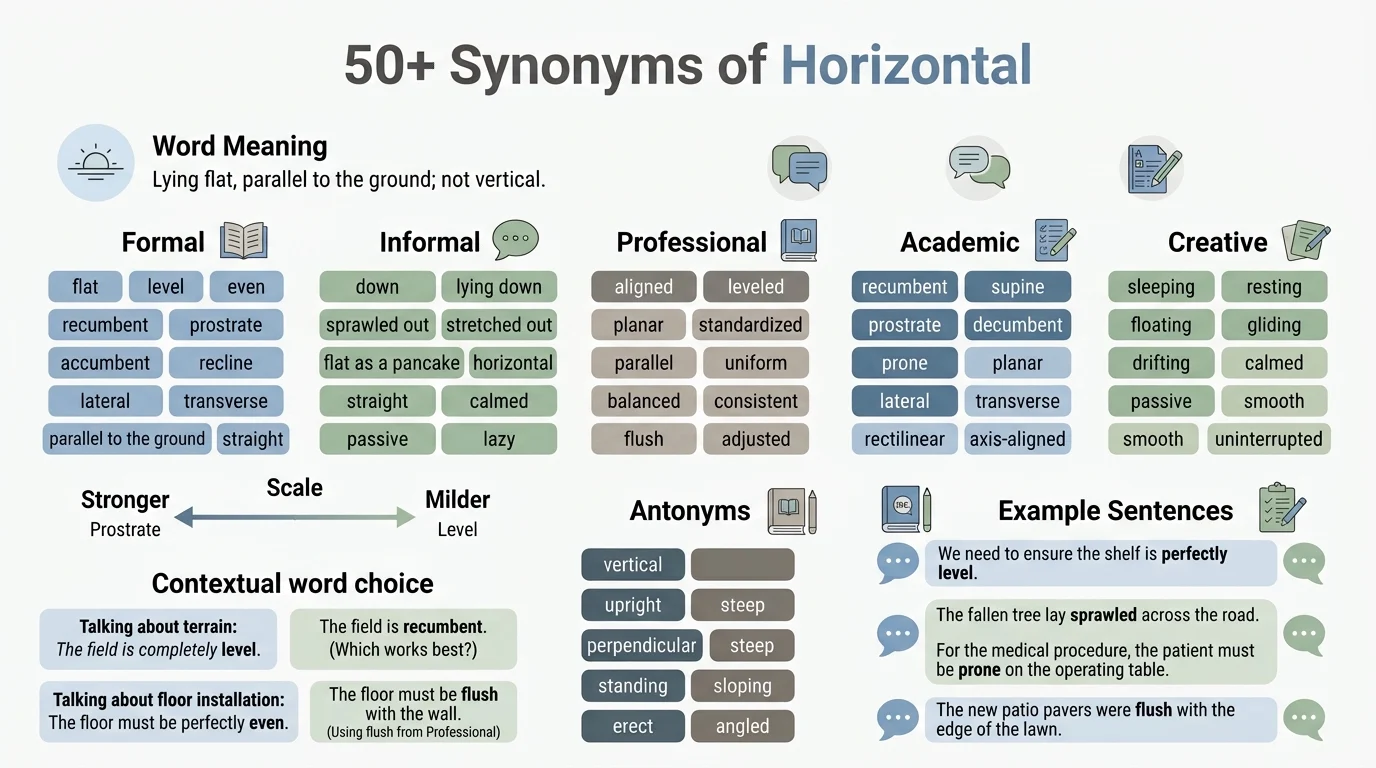
Have you ever stared at a sentence knowing you have used the word “horizontal” too many times? Whether you are writing an email, an essay, a resume, or a social media caption, repeating the same adjective can make your writing feel dull and uninspired. You want to describe something that is flat, level, or positioned from side to side, but the word “horizontal” keeps appearing in every other sentence. This is exactly when you need a strong set of synonyms of horizontal to refresh your vocabulary and make your writing more precise.
Choosing the right synonym improves clarity, tone, and overall communication. The word “horizontal” is perfectly fine on its own, but different situations call for different words. A technical report might benefit from “level” or “plane,” while a creative story might come alive with “supine” or “recumbent.” Understanding these distinctions helps you sound more natural and professional in every context. This guide will teach you exactly which synonym fits each situation so you never have to guess again.
What Are the Best Synonyms of “Horizontal”?
The word “horizontal” describes something parallel to the ground or positioned from side to side rather than up and down. The best synonym depends on your context. Formal writing, use “level” or “plane.” For casual conversation, “flat” works perfectly. Academic or professional communication, choose “even” or “uniform.” For creative writing, consider “recumbent” or “supine.”
Meaning, Tone, and Context
Simple Definition
Horizontal means lying flat, parallel to the ground, or running from side to side rather than up and down. Think of the horizon, which stretches across your field of vision from left to right. That is the direction horizontal describes.
Part of Speech
Horizontal is primarily an adjective. It can also function as a noun referring to a horizontal line, plane, or component.
Overall Tone
Horizontal is neutral. It simply describes a position or orientation without adding positive or negative emotion.
Formality Level
Horizontal is neutral to semi-formal. It works well in most professional, academic, and everyday contexts. In very casual conversation, native speakers often choose simpler words like “flat” or “level” instead.
Common Uses
Native English speakers commonly use horizontal in these situations:
- Describing physical position, such as a sleeping person or a flat surface
- Discussing geometry, design, or architecture
- Referring to business structures, such as horizontal mergers or horizontal promotions
- Explaining data visualizations, like horizontal bars on a chart
- Talking about drilling, construction, or engineering
Word Forms
| Form | Example |
|---|---|
| Adjective | The shelf is perfectly horizontal. |
| Noun | The design uses strong horizontals. |
| Adverb (horizontally) | The bars run horizontally across the screen. |
| Noun (horizontality) | The horizontality of the structure ensures stability. |
When and How to Use “Horizontal”
Choose “horizontal” when you need a clear, accurate, and widely understood word for something that is parallel to the ground or oriented side to side. It is a safe, reliable choice in almost any context. Here are seven realistic examples.
Professional: The architect specified horizontal beams to support the new roof structure.
Academic: The study measured horizontal gene transfer among bacterial species.
Workplace: We need to align the horizontal axis of the chart with the quarterly data.
Personal: I prefer a horizontal sleeping position because it is better for my back.
Email: Please confirm that the shelves are installed in a horizontal orientation.
Resume: Managed horizontal integration of three regional sales teams.
Social Media: Loving this horizontal view of the mountains at sunset. #nature
Best Synonyms of “Horizontal”
No synonym is identical in every situation. The best choice depends on your audience, tone, and purpose. Here are the top recommendations for specific contexts.
Professional writing: Use level. It is precise, widely understood, and sounds competent in business settings.
Academic writing: Use plane or uniform. These words convey technical accuracy and scholarly authority.
Business communication: Use even or aligned. These terms suggest order, consistency, and careful planning.
Casual conversation: Use flat. It is simple, natural, and immediately understood by everyone.
Emotional writing: Use recumbent or supine. These words carry a softer, more descriptive quality.
Creative writing: Use prostrate or recumbent. These alternatives add vivid imagery and stylistic flair.
Resume writing: Use aligned or integrated. These words suggest coordination and strategic thinking.
Workplace communication: Use straight or even. These are direct, clear, and easy to understand.
Stronger meaning: Use dead flat or perfectly level. These phrases emphasize absolute horizontality.
Softer meaning: Use gently sloping or nearly flat. These acknowledge slight deviations from horizontal.
When Not to Use “Horizontal”
Sometimes “horizontal” is not the best word for the job. Here are situations where you should choose a more precise alternative.
When the word sounds too general: Describing a surface as “horizontal” does not tell the reader whether it is smooth, rough, or textured. If you are writing about a tabletop, “smooth” or “even” might be more descriptive. Incorrect: The horizontal surface was difficult to write on. Better: The uneven surface was difficult to write on.
When the word sounds too vague: Saying a person is “horizontal” could mean they are sleeping, lying down, or even unconscious. If you mean resting, say “reclining” or “lying down.” Incorrect: She was horizontal on the couch. Better: She was reclining on the couch.
The word sounds too formal: In a casual text message, “horizontal” can feel stiff and overly technical. Incorrect: The book is horizontal on the table. Better: The book is lying flat on the table.
When the word sounds too weak: If you need to emphasize absolute flatness, “horizontal” might not carry enough weight. Incorrect: The floor is horizontal. Better: The floor is perfectly level.
When the word is outdated: Horizontal is not outdated, but in some creative contexts, more vivid synonyms like “prostrate” or “supine” can add freshness.
Words Commonly Confused With “Horizontal”
Several words are closely related to horizontal but have distinct meanings. Understanding these differences helps you choose the right word every time.
Horizontal vs Vertical
Difference: Vertical describes something that runs up and down, perpendicular to the ground. Horizontal runs side to side, parallel to the ground.
When to use each: Use horizontal for side-to-side orientation. Use vertical for up-and-down orientation.
Example (horizontal): The horizontal line on the graph represents the average.
Example (vertical): The vertical line on the graph shows the peak value.
Horizontal vs Lateral
Difference: Lateral means “to the side” or “pertaining to the side.” Horizontal specifically means parallel to the ground or horizon.
When to use each: Use lateral when referring to sideways movement or position relative to a central point. Use horizontal when referring to orientation relative to the ground.
Example (horizontal): The shelf is mounted in a horizontal position.
Example (lateral): The player made a lateral pass to his teammate.
Horizontal vs Level
Difference: Level means having a flat, even surface without slopes. Horizontal specifically means parallel to the ground. Every level surface is horizontal, but not every horizontal surface is necessarily level (it could be tilted slightly).
When to use each: Use level when emphasizing evenness or flatness. Use horizontal when emphasizing orientation relative to the ground.
Example (horizontal): The beam runs horizontal across the ceiling.
Example (level): The carpenter checked that the table was perfectly level.
Horizontal vs Flat
Difference: Flat means having a smooth, even surface without bumps or curves. Horizontal means parallel to the ground. A wall is flat but vertical, not horizontal.
When to use each: Use flat when describing surface texture. Use horizontal when describing orientation.
Example (horizontal): The painting hangs in a horizontal orientation.
Example (flat): The table has a flat surface that is easy to clean.
Horizontal vs Even
Difference: Even means uniform, consistent, or having no irregularities. Horizontal refers specifically to orientation. A surface can be even without being horizontal.
When to use each: Use even when emphasizing consistency or uniformity. Use horizontal when emphasizing orientation.
Example (horizontal): The horizontal bars on the fence are evenly spaced.
Example (even): The floor is even and free of bumps.
Horizontal vs Supine
Difference: Supine means lying face upward. Horizontal simply means lying flat, regardless of whether the face is up or down.
When to use each: Use supine specifically when describing a person lying face up. Use horizontal for general flat positioning.
Example (horizontal): The patient was placed in a horizontal position.
Example (supine): The patient lay supine on the examination table.
Best Synonyms of “Horizontal” by Context
| Context | Best Synonym | Why It Works | Example |
|---|---|---|---|
| Formal writing | Level | Precise and authoritative | The data were plotted on a level plane. |
| Academic writing | Plane | Technical and scholarly | The study examined the horizontal plane of movement. |
| Professional communication | Aligned | Suggests coordination and precision | The teams are aligned on the project goals. |
| Business emails | Even | Clear and professional | The distribution of resources is even across departments. |
| Resume writing | Integrated | Implies strategic coordination | Integrated horizontal processes across five divisions. |
| Workplace communication | Straight | Direct and easy to understand | Keep the line straight when you install the shelf. |
| Casual conversation | Flat | Simple and natural | The pizza box is flat on the counter. |
| Everyday speaking | Level | Widely understood | Is the picture level? |
| Creative writing | Recumbent | Adds vivid imagery | The recumbent figure rested beneath the tree. |
| Storytelling | Supine | Creates a specific visual | She lay supine, staring at the clouds. |
| Emotional writing | Prostrate | Conveys vulnerability or exhaustion | He was prostrate with grief. |
| Strong emphasis | Perfectly level | Eliminates any doubt | The floor must be perfectly level. |
| Mild tone | Nearly flat | Acknowledges slight variation | The terrain is nearly flat. |
| Social media captions | Side to side | Conversational and visual | Love this side-to-side view of the city. |
| American English | Horizontal | Standard and widely used | The shelf is horizontal. |
| British English | Horizontal | Same as American usage | The shelf is horizontal. |
How to Choose the Best Synonym of “Horizontal”
Choosing the right synonym does not have to be complicated. Follow this practical decision guide.
Consider your meaning. Are you describing physical position, surface texture, or business structure? For physical position, “level” or “flat” work well. Surface texture, “even” or “smooth” are better. For business, “aligned” or “integrated” are more appropriate.
Consider your tone. Formal writing calls for “level” or “plane.” Casual conversation calls for “flat” or “straight.” Creative writing benefits from “recumbent” or “supine.”
Consider your audience. Professionals appreciate precise words like “aligned” and “uniform.” General readers prefer simple words like “flat” and “level.”
Consider emotional strength. If you want to convey exhaustion or vulnerability, “prostrate” carries emotional weight. If you want neutral description, “horizontal” or “level” are safe choices.
Consider your writing purpose. Resumes benefit from action-oriented words like “integrated” and “aligned.” Academic papers benefit from technical words like “plane” and “uniform.” Stories benefit from vivid words like “recumbent” and “supine.”
Trust what sounds natural. Read your sentence aloud with each option. The right synonym will feel smooth and natural in context.
Real Life Examples of “Horizontal”
Here are realistic examples showing how to use horizontal and its synonyms across different situations. Notice how replacing “horizontal” with a stronger synonym improves each sentence.
School: The teacher drew a horizontal line across the board. Better: The teacher drew a level line across the board.
College: The professor explained horizontal integration in the lecture. Better: The professor explained lateral integration in the lecture.
Workplace: We need to install the shelves in a horizontal position. Better: We need to install the shelves in a level position.
Business: The company pursued horizontal growth through acquisitions. Better: The company pursued lateral growth through acquisitions.
Email: Please ensure the banner is horizontal on the webpage. Better: Please ensure the banner is aligned on the webpage.
Resume: Coordinated horizontal communication between departments. Better: Coordinated aligned communication between departments.
Conversation: The book is horizontal on the table. Better: The book is lying flat on the table.
Storytelling: The soldier lay horizontal on the ground. Better: The soldier lay prostrate on the ground.
Blogging: The horizontal layout makes the website easy to read. Better: The even layout makes the website easy to read.
Social media: Check out this horizontal view of the beach. Better: Check out this side-to-side view of the beach.
18 Best Synonyms of “Horizontal”
Synonyms of “Horizontal” by Usage
Professional vs Personal Synonyms
In professional settings, words like aligned, integrated, and uniform convey coordination, strategy, and consistency. These words sound competent and polished in emails, reports, and presentations. In personal conversations, flat, level, and straight are more natural and relaxed. You would tell a friend “the picture is crooked, make it straight,” not “the picture requires horizontal alignment.”
Formal vs Conversational Synonyms
Formal synonyms: plane, uniform, aligned, integrated, accumbent. These words belong in academic papers, business reports, and formal presentations. They sound authoritative and precise. Conversational synonyms: flat, level, straight, sideways. These words work well in everyday speech, text messages, and casual emails. They are simple, clear, and immediately understood.
Academic Synonyms
For research papers, essays, and academic discussions, choose plane, uniform, and parallel. These words carry technical weight and scholarly authority. “The results were plotted on a horizontal plane” sounds more academic than “The results were plotted on a flat surface.” Use uniform when describing consistent patterns or distributions. Use parallel when discussing geometric or comparative relationships.
Professional and Business Synonyms
For resumes, interviews, meetings, and business emails, choose aligned, integrated, and even. Aligned suggests coordination and strategic thinking, which employers value. Integrated implies seamless combination of different elements, a highly desirable business skill. Even suggests fairness and consistency, important qualities in management and client communication.
Creative and Literary Synonyms
For storytelling, fiction, poetry, and descriptive writing, choose recumbent, supine, prostrate, and accumbent. These words add emotion, imagery, and stylistic flair. “She lay recumbent on the grassy hill” paints a more vivid picture than “She lay horizontal on the grass.” Prostrate carries emotional weight, suggesting exhaustion, submission, or vulnerability.
Slang or Modern Synonyms
There are no widely recognized slang synonyms for horizontal. In informal contexts, native speakers simply use flat, level, or lying down. Some might say zonked out to describe someone lying down from exhaustion, but this is not a direct synonym for horizontal. Avoid using slang in professional or academic writing.
Strongest to Mildest Synonyms
| Intensity | Synonym | Context |
|---|---|---|
| Mild | Nearly flat | Acknowledges slight variation |
| Mild | Sideways | Casual description |
| Moderate | Level | Standard, reliable choice |
| Moderate | Flat | Simple and clear |
| Moderate | Even | Emphasizes consistency |
| Moderate | Aligned | Suggests precision |
| Strong | Perfectly level | Emphasizes absolute flatness |
| Strong | Dead flat | Emphasizes complete flatness |
| Very Strong | Prostrate | Conveys exhaustion or submission |
| Very Strong | Supine | Creates a specific, vivid image |
Emotional vs Neutral Synonyms
Emotional synonyms: prostrate, supine, recumbent. These words carry emotional weight. Prostrate suggests vulnerability, exhaustion, or defeat. Supine suggests relaxation, vulnerability, or medical observation. Recumbent suggests rest, leisure, or comfort.
Neutral synonyms: level, flat, even, aligned, plane. These words simply communicate information without adding emotion. They are safe choices for professional, academic, and technical writing where objectivity matters.
Antonyms of “Horizontal”
Comparison: “Horizontal” vs Similar Words
Horizontal vs Vertical
Main Difference: Horizontal runs side to side, parallel to the ground. Vertical runs up and down, perpendicular to the ground.
Which Is Stronger? Neither is stronger; they describe opposite orientations.
Which Is More Formal? Both are equally formal and widely used in all contexts.
When to Use Each: Use horizontal for side-to-side orientation. Use vertical for up-and-down orientation.
Examples:
Horizontal: The horizontal bars on the fence provide stability.
Vertical: The vertical posts support the structure.
Horizontal vs Lateral
Main Difference: Horizontal means parallel to the ground. Lateral means to the side or pertaining to the side.
Which Is Stronger? Lateral is more specific to side positioning. Horizontal is more specific to ground-parallel orientation.
Which Is More Formal? Lateral is more technical and commonly used in medical and scientific contexts. Horizontal is more general.
When to Use Each: Use lateral when referring to sideways movement or position. Use horizontal when referring to ground-parallel orientation.
Examples:
Horizontal: The horizontal line represents the baseline.
Lateral: The lateral movement of the robot was smooth.
Horizontal vs Level
Main Difference: Level means having a flat, even surface without slopes. Horizontal means parallel to the ground.
Which Is Stronger? Level emphasizes evenness and flatness more strongly than horizontal.
Which Is More Formal? Both are equally formal and widely used.
When to Use Each: Use level when emphasizing flatness or evenness. Use horizontal when emphasizing orientation.
Examples:
Horizontal: The horizontal beam spans the width of the room.
Level: The carpenter ensured the table was perfectly level.
Horizontal vs Flat
Main Difference: Flat means having a smooth, even surface without bumps. Horizontal means parallel to the ground.
Which Is Stronger? Flat emphasizes surface texture more strongly. Horizontal emphasizes orientation.
Which Is More Formal? Horizontal is slightly more formal. Flat is more casual and conversational.
When to Use Each: Use flat when describing surface texture. Use horizontal when describing orientation.
Examples:
Horizontal: The horizontal shelf holds the books.
Flat: The flat surface is ideal for writing.
Horizontal vs Even
Main Difference: Even means uniform, consistent, or having no irregularities. Horizontal refers specifically to orientation.
Which Is Stronger? Even emphasizes consistency and uniformity. Horizontal emphasizes orientation.
Which Is More Formal? Both are equally formal.
When to Use Each: Use even when emphasizing consistency. Use horizontal when emphasizing orientation.
Examples:
Horizontal: The horizontal lines create a sense of calm.
Even: The even distribution of weight prevents tipping.
Horizontal vs Supine
Main Difference: Supine means lying face upward. Horizontal simply means lying flat, regardless of face orientation.
Which Is Stronger? Supine is more specific and vivid. Horizontal is more general.
Which Is More Formal? Supine is more technical, commonly used in medical and anatomical contexts. Horizontal is more general.
When to Use Each: Use supine specifically for face-up positioning. Use horizontal for general flat positioning.
Examples:
Horizontal: The patient was placed in a horizontal position.
Supine: The patient lay supine during the examination.
Common Phrases and Expressions with “Horizontal”
Common Mistakes to Avoid
Mistake 1: Choosing a Vague Synonym
Incorrect: The table is horizontal.
Better: The table is perfectly level.
Why: “Horizontal” is accurate but vague. “Perfectly level” emphasizes the evenness and precision you actually mean.
Mistake 2: Confusing Horizontal with Vertical
Incorrect: The vertical line runs across the page.
Better: The horizontal line runs across the page.
Why: Vertical runs up and down. Horizontal runs side to side.
Mistake 3: Using an Informal Synonym in Formal Writing
Incorrect: The data are flat on the plane.
Better: The data are aligned on the horizontal plane.
Why: “Flat” is too casual for academic or technical writing. “Aligned” and “horizontal plane” sound more professional.
Mistake 4: Selecting an Overly Dramatic Synonym
Incorrect: The book lay prostrate on the table.
Better: The book lay flat on the table.
Why: “Prostrate” suggests exhaustion or submission. A book cannot be prostrate. Save dramatic words for appropriate contexts.
Mistake 5: Repeating the Same Word Too Often
Incorrect: The horizontal beam supports the horizontal roof. The horizontal walls are also horizontal.
Better: The level beam supports the roof. The even walls are also aligned.
Why: Repeating “horizontal” makes writing dull. Using synonyms adds variety and precision.
Mistake 6: Choosing a Synonym with the Wrong Emotional Tone
Incorrect: The patient was prostrate on the bed.
Better: The patient was supine on the bed.
Why: “Prostrate” suggests defeat or exhaustion. Supine” is the correct medical term for lying face up.
Mistake 7: Using Slang in Professional Writing
Incorrect: The shelves are wonky and need fixing.
Better: The shelves are uneven and need adjustment.
Why: “Wonky” is casual slang. “Uneven” is professional and precise.
Frequently Asked Questions
1. What are the best synonyms of “horizontal”?
The best synonyms depend on context. Formal writing, use “level” or “plane.” For casual conversation, use “flat.” For professional communication, use “aligned” or “even.” Creative writing, use “recumbent” or “supine.”
2. What are the best formal synonyms of “horizontal”?
The best formal synonyms include “level,” “plane,” “uniform,” and “aligned.” These words sound authoritative and precise in academic papers, business reports, and professional presentations.
3. What are common informal synonyms of “horizontal”?
Common informal synonyms include “flat,” “straight,” “sideways,” and “level.” These words are simple, natural, and widely understood in everyday conversation and casual writing.
4. What is another word for “horizontal” in professional writing?
In professional writing, choose “aligned,” “integrated,” or “even.” These words suggest coordination, consistency, and strategic thinking, which are valued in business contexts.
5. What is the difference between “horizontal” and “lateral”?
Horizontal means parallel to the ground. Lateral means to the side or pertaining to the side. Use horizontal for ground-parallel orientation. Use lateral for sideways movement or position relative to a central point.
6. What is the opposite of “horizontal”?
The opposite of horizontal is vertical, which means running up and down, perpendicular to the ground. Other opposites include perpendicular, upright, inclined, slanted, tilted, and diagonal.
Conclusion
Horizontal is a clear, neutral word that describes anything parallel to the ground or oriented from side to side. While it works well in most contexts, the best communicators know when to choose a more precise synonym. Formal writing, “level” and “plane” add authority. Casual conversation, “flat” and “straight” feel natural. For creative work, “recumbent” and “supine” add vivid imagery. For professional settings, “aligned” and “even” convey competence.
No synonym works perfectly in every situation. The right choice depends on your audience, your tone, and your purpose. Trust what sounds natural, and do not be afraid to experiment with different options. The more you practice choosing the right synonym, the more confident and polished your writing will become.
Here is one practical tip: Before you write, think about the exact image or idea you want to convey. Then choose the word that best matches that image. This simple habit will transform your vocabulary and make every sentence more powerful.