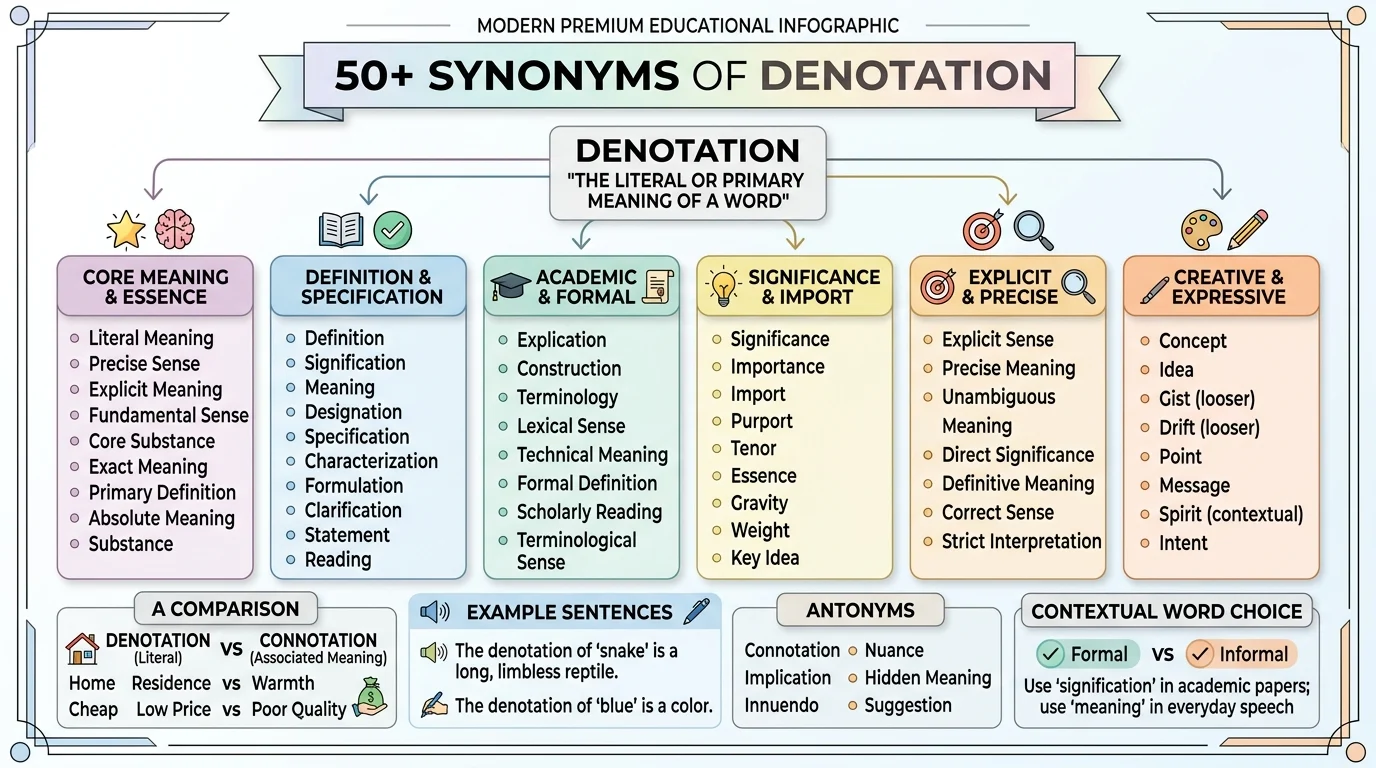
Have you ever found yourself writing an email, an essay, or a social media caption and realized you keep using the same word over and over? You know the meaning you want to convey, but the word on the tip of your tongue just does not feel quite right. This happens to everyone, from students working on essays to professionals drafting important business communications. Finding the perfect word to express your exact idea is a challenge that even experienced writers face daily. When you search for the right term, you might be looking for synonyms of denotation to describe the literal meaning of something without the extra emotional baggage. Choosing the right synonym improves your clarity, sets the correct tone, and makes your communication more effective.
What Are the Best Synonyms of “Denotation”?
Denotation is the literal, dictionary definition of a word, separate from any emotional or cultural associations. The best synonyms depend on your context. For formal writing, use “literal meaning” or “explicit meaning.” In academic work, choose “primary sense” or “lexical meaning.” For professional settings, “dictionary definition” and “objective meaning” work well.
Meaning, Tone, and Context
Understanding the precise meaning of denotation is the first step to using it correctly and finding the right alternatives.
Simple Definition
Denotation is the specific, direct, and literal meaning of a word or expression. It is the definition you find in a dictionary, stripped of any emotional associations, cultural implications, or subjective interpretations. For example, the denotation of the word “home” is simply a place where someone lives. It does not include feelings of warmth, safety, or family; those are connotations.
Part of Speech
Denotation is a noun. The verb form is “denote,” and the adjective form is “denotative.”
Overall Tone
Denotation is a neutral, objective word. It does not carry a positive or negative emotional charge. It is a technical term used in linguistics, semiotics, and logic to discuss the literal meaning of language.
Formality Level
Denotation is a formal word. It is most commonly used in academic writing, professional discussions, and technical contexts. You are unlikely to hear it in casual conversation.
Common Uses
Native English speakers use the word denotation in several specific situations:
- Academic Writing: In essays, research papers, and linguistic analyses to distinguish between literal and implied meanings.
- Professional Communication: In legal documents, contracts, and technical writing where precision is critical.
- Educational Settings: In classrooms when teachers explain the difference between denotation and connotation.
- Literary Analysis: When critics and students examine the specific word choices of authors.
Word Forms
- Noun: Denotation (the literal meaning)
- Verb: Denote (to indicate or signify directly)
- Adjective: Denotative (relating to denotation)
- Adverb: Denotatively (in a denotative manner)
When and How to Use “Denotation”
You should choose the word “denotation” when you need to emphasize the literal, objective meaning of a word, especially in contrast to its emotional or cultural associations. It signals to your reader that you are discussing the factual definition rather than any subjective interpretation.
Here are seven realistic examples showing how to use denotation in different contexts:
Professional:
“The legal team focused on the denotation of the term ‘negligence’ to ensure there was no room for misinterpretation.”
Academic:
“In her linguistics paper, the student carefully distinguished between the denotation and connotation of political slogans.”
Workplace:
“During the training session, the manager clarified the denotation of key performance indicators so everyone understood the metrics.”
Personal:
“When I looked up the word, I was surprised by its denotation, which was completely different from what I had always assumed.”
Email:
“Please review the attached document and confirm that the denotation of each technical term aligns with our project’s definitions.”
Resume:
“Skilled in analyzing complex texts to identify the denotation of specialized terminology and communicate findings clearly.”
Social Media:
“Did you know the denotation of ‘decimate’ is to destroy one tenth, not to destroy completely? Language is fascinating!”
Best Synonyms of “Denotation”
No synonym is identical in every situation. The best choice depends entirely on your context, audience, and purpose. Here are the top recommendations for specific writing scenarios.
Professional writing: Use “dictionary definition.” It is clear, straightforward, and universally understood in business contexts.
Academic writing: Choose “primary sense” or “lexical meaning.” These terms sound authoritative and precise in scholarly work.
Business communication: Opt for “explicit meaning.” It conveys clarity and leaves no room for doubt.
Casual conversation: Use “literal meaning.” It is the most accessible and widely understood alternative.
Emotional writing: Avoid denotation entirely. In emotional or creative writing, you usually want connotation to evoke feelings.
Creative writing: Use “literal sense” when you need to ground your descriptions in factual reality.
Resume writing: Use “objective meaning” to demonstrate your ability to communicate with precision.
Workplace communication: Choose “specific meaning” to ensure everyone is on the same page.
Stronger meaning: “Explicit meaning” emphasizes that something is clearly and fully stated.
Softer meaning: “Basic meaning” suggests a simpler, less technical understanding.
When Not to Use “Denotation”
Using “denotation” is not always the best choice. Here are situations where you should choose a different word.
When the word sounds too formal: In casual conversations, emails to friends, or social media posts, “denotation” can sound overly academic and out of place.
Example: “The denotation of that meme is hilarious.” (Too formal)
Better: “The literal meaning of that meme is hilarious.”
When the word sounds too vague: If you are not specifically contrasting literal meaning with emotional associations, “denotation” might confuse your reader.
Example: “I need to understand the denotation of this project.” (Vague)
Better: “I need to understand the specific meaning of this project’s objectives.”
When the word sounds too weak: In persuasive writing, you might want a word with more emotional weight.
Example: “The denotation of her words was clear.” (Too weak)
Better: “The explicit meaning of her words was clear and undeniable.”
When the word sounds outdated: In modern, fast-paced business environments, simpler terms like “meaning” or “definition” are often more effective.
Words Commonly Confused With “Denotation”
Many people confuse denotation with related but distinct terms. Understanding these differences will help you choose the right word every time.
Denotation vs Connotation
Difference: Denotation is the literal dictionary definition. Connotation is the emotional or cultural association a word carries.
When to Use It: Use denotation when you want the factual meaning. Use connotation when you want to discuss feelings or implied meanings.
Example (Denotation): “The denotation of ‘snake’ is a legless reptile.”
Example (Connotation): “The connotation of ‘snake’ includes deceit and untrustworthiness.”
Denotation vs Definition
Difference: Definition is the general statement of a word’s meaning. Denotation specifically refers to the literal meaning as opposed to connotation.
When to Use It: Use definition in most everyday situations. Use denotation when you are making a specific point about literal versus implied meaning.
Example (Definition): “Look up the definition of that word in the dictionary.”
Example (Denotation): “The poet plays with the word’s denotation and connotation.”
Denotation vs Meaning
Difference: Meaning is a broad, general term. Denotation is a specific type of meaning: the literal, objective one.
When to Use It: Use meaning when you are referring to any sense or significance. Use denotation when you are being precise about the literal sense.
Example (Meaning): “What is the meaning of this sentence?”
Example (Denotation): “The denotation of the sentence is straightforward, but its implication is complex.”
Denotation vs Reference
Difference: Reference is the act of referring to something or the thing referred to. Denotation is the literal meaning of the word itself.
When to Use It: Use reference when discussing what a word points to in the real world. Use denotation when discussing the word’s inherent meaning.
Example (Reference): “The reference of ‘the President’ is the current head of state.”
Example (Denotation): “The denotation of ‘President’ is the elected head of a republic.”
Denotation vs Signification
Difference: Signification is a formal term for the act of signifying or meaning. Denotation is more specific and commonly used in linguistics.
When to Use It: Use signification in philosophical or highly formal contexts. Use denotation in most academic and professional writing.
Example (Signification): “The signification of the symbol is culturally dependent.”
Example (Denotation): “The denotation of the symbol is clearly defined in the manual.”
Denotation vs Indication
Difference: Indication is a sign or piece of information that suggests something. Denotation is the explicit, literal meaning.
When to Use It: Use indication when something points toward a conclusion. Use denotation when you are stating the literal definition.
Example (Indication): “The dark clouds were an indication of rain.”
Example (Denotation): “The denotation of ‘rain’ is water falling from clouds.”
Best Synonyms of “Denotation” by Context
| Context | Best Synonym | Why It Works | Example |
|---|---|---|---|
| Formal writing | Explicit meaning | Sounds authoritative and leaves no room for ambiguity. | “The explicit meaning of the clause is clear.” |
| Academic writing | Lexical meaning | Demonstrates precision and scholarly vocabulary. | “The lexical meaning of the term is well established.” |
| Professional communication | Dictionary definition | Universally understood and straightforward. | “Refer to the dictionary definition for accuracy.” |
| Business emails | Specific meaning | Emphasizes clarity and mutual understanding. | “Let’s clarify the specific meaning of this metric.” |
| Resume writing | Objective meaning | Highlights your ability to communicate clearly and factually. | “Able to convey objective meaning in technical reports.” |
| Workplace communication | Literal sense | Avoids confusion in everyday team discussions. | “In its literal sense, the instruction is simple.” |
| Casual conversation | Literal meaning | The most natural and accessible alternative. | “I meant that in the literal meaning of the word.” |
| Everyday speaking | Basic meaning | Keeps the explanation simple and easy to follow. | “The basic meaning is exactly what you think.” |
| Creative writing | Literal sense | Grounds descriptions in factual reality. | “In the literal sense, the room was empty.” |
| Storytelling | Primary meaning | Helps establish clear definitions for your audience. | The primary meaning of the symbol is hope. |
| Emotional writing | (Avoid denotation) | Denotation is neutral; emotion requires connotation. | Use connotative words to evoke feeling. |
| Strong emphasis | Explicit meaning | Adds weight and certainty to your statement. | “The explicit meaning cannot be disputed.” |
| Mild tone | Basic meaning | Softens the statement and keeps it simple. | “Just the basic meaning, nothing more.” |
| Social media captions | Literal meaning | Clear and relatable for a general audience. | “Literally, that is the literal meaning.” |
| American English | Literal meaning | The most common and preferred term. | “In American English, the literal meaning is clear.” |
How to Choose the Best Synonym of “Denotation”
Choosing the right synonym is about matching your word to your purpose, audience, and tone. Follow this practical decision guide.
1. Consider your audience.
Are you writing for academics, professionals, or the general public? Academics, use “lexical meaning” or “primary sense.” For professionals, use “dictionary definition” or “explicit meaning.” For the general public, use “literal meaning.”
2. Consider your purpose.
Are you trying to be precise, clear, or persuasive? Precision is your goal, “explicit meaning” is excellent. If clarity is most important, “literal meaning” is the best choice. If you are trying to persuade, you might avoid denotation altogether and use connotative language.
3. Consider the level of formality.
Formal writing demands precise, academic vocabulary. Informal writing benefits from simpler, more accessible language. Match your synonym to the formality of your context.
4. Consider the emotional strength.
Denotation and its synonyms are neutral. If you need emotional weight, choose a different type of word entirely.
5. Consider what sounds natural.
Read your sentence aloud with each synonym. The best choice is the one that sounds most natural and fluid in your specific sentence.
Real Life Examples of “Denotation”
Seeing denotation in action across different real-world situations helps solidify your understanding.
School: “The teacher asked us to write down the denotation of each vocabulary word before we discussed its use in the poem.”
College: “In my philosophy class, we debated the denotation of ‘justice’ and how it differs from its connotation in various cultures.”
Workplace: “The project manager emphasized the denotation of each deliverable to prevent any misunderstandings about our goals.”
Business: “Before signing the contract, our lawyer reviewed the denotation of every term to ensure there were no hidden obligations.”
Email: “To avoid confusion, I have attached a glossary that provides the denotation of all technical acronyms used in this report.”
Resume: “Experienced in translating complex regulations into clear language while preserving the precise denotation of legal terms.”
Conversation: “When I said I was ‘fine,’ I meant it in its literal denotation, not as a way to hide my feelings.”
Storytelling: “The wizard’s words carried a denotation that was simple, but their connotation filled the room with dread.”
Blogging: “Understanding the denotation of ‘organic’ is important for consumers who want to make informed choices.”
Social Media: “The denotation of ‘literally’ has changed so much that it now means the opposite of its original definition.”
18 Best Synonyms of “Denotation”
Synonyms of “Denotation” by Usage
Professional vs Personal Synonyms
In professional settings, precision and clarity are paramount. Use synonyms like “explicit meaning,” “specific meaning,” and “objective meaning.” These words signal that you are focused on facts and clear communication.
In personal conversations, simplicity and naturalness matter more. Use “literal meaning” or “basic meaning.” These alternatives are more conversational and less likely to sound stiff or overly formal.
Formal vs Conversational Synonyms
For reports, essays, business writing, and presentations, choose formal synonyms. “Lexical meaning,” “primary sense,” and “signification” are excellent choices for academic and professional documents.
For emails, casual conversations, and texting, choose conversational synonyms. “Literal meaning” and “basic meaning” are clear, friendly, and easy to understand.
Academic Synonyms
In research papers, essays, and academic discussions, precision is essential. “lexical meaning” to demonstrate your command of linguistic terminology. Use “primary sense” to indicate the main definition. Use “objective meaning” to emphasize a fact-based approach. These synonyms sound authoritative and enhance your credibility.
Professional and Business Synonyms
For resumes, interviews, meetings, presentations, performance reviews, client communication, and business emails, choose words that convey clarity and competence. “Explicit meaning” is excellent for legal and contractual language. “Specific meaning” is perfect for project management and team communications. “Dictionary definition” is a safe, universally understood choice.
Creative and Literary Synonyms
In storytelling, fiction, poetry, descriptive writing, and speeches, you usually want to evoke emotion and imagery. Denotation itself is neutral, so you often want to avoid it and focus on connotation instead. However, when you need to ground your writing in reality, use “literal sense” or “plain meaning” to establish a clear baseline before adding emotional layers.
Slang or Modern Synonyms
Denotation does not have widely used slang equivalents. Its meaning is too specific and technical for casual slang. Stick to the standard synonyms listed above.
Strongest to Mildest Synonyms
Mild: Basic meaning, plain meaning
Moderate: Literal meaning, dictionary definition, specific meaning
Strong: Explicit meaning, objective meaning, direct meaning
Very Strong: Lexical meaning, primary sense, signification
The emotional intensity increases as the words become more formal, precise, and technical.
Emotional vs Neutral Synonyms
Emotional Synonyms: Denotation does not have emotional synonyms. Emotion comes from connotation, not denotation. If you need emotional language, choose words with strong connotations.
Neutral Synonyms: All synonyms of denotation are neutral. “Literal meaning,” “explicit meaning,” “dictionary definition,” “objective meaning,” and “lexical meaning” all communicate information without adding emotion.
Antonyms of “Denotation”
| Antonym | Meaning | Example Sentence |
|---|---|---|
| Connotation | The emotional or cultural association of a word. | “The connotation of the word is more important than its denotation.” |
| Implication | Something suggested or implied, not stated. | “The implication of his statement was clear, even if the denotation was not.” |
| Suggestion | An idea or feeling that is indirectly expressed. | “The suggestion of the advertisement was subtle.” |
| Innuendo | An indirect or subtle reference, often negative. | “The innuendo in her comment was unmistakable.” |
| Insinuation | A hint or suggestion, often unpleasant. | “His insinuation was offensive.” |
| Association | A mental connection or link. | “The association of the color red with danger is cultural.” |
| Undertone | A subtle quality or feeling. | “The undertone of the conversation was tense.” |
| Overtone | An additional, often subtle meaning. | “The overtone of the speech was hopeful.” |
| Subtext | An underlying or implicit meaning. | “The subtext of the movie was about loss.” |
| Nuance | A subtle difference in meaning or expression. | “The nuance of her words was lost on him.” |
| Intimation | A hint or subtle suggestion. | “There was an intimation of danger in his voice.” |
| Allusion | An indirect reference. | “The allusion to classical literature was clever.” |
| Figurative meaning | Meaning based on figures of speech, not literal. | The figurative meaning of the phrase is completely different. |
| Metaphorical meaning | Meaning based on a metaphor. | “The metaphorical meaning of the journey is personal growth.” |
| Symbolic meaning | Meaning based on symbols, not literal definitions. | “The symbolic meaning of the dove is peace.” |
Comparison: “Denotation” vs Similar Words
Denotation vs Connotation
Main Difference: Denotation is the literal dictionary definition. Connotation is the emotional or cultural baggage a word carries.
Which Is Stronger? Connotation is stronger in terms of emotional impact. Denotation is stronger in terms of factual precision.
Which Is More Formal? Both are formal terms used in linguistics and literary analysis.
When to Use Each: Use denotation when you need the objective, factual meaning. Use connotation when you want to discuss feelings, associations, or implied meanings.
Examples:
Denotation: “The denotation of ‘home‘ is a dwelling place.
Connotation: “The connotation of ‘home’ includes warmth, safety, and family.”
Denotation vs Definition
Main Difference: Definition is a general statement of meaning. Denotation is specifically the literal meaning as opposed to connotation.
Which Is Stronger? Denotation is more specific and precise. Definition is broader.
Which Is More Formal? Denotation is more formal and technical. Definition is neutral.
When to Use Each: Use definition in everyday situations. Use denotation when you are making a distinction between literal and implied meaning.
Examples:
Definition: “Look up the definition in the dictionary.”
Denotation: “The denotation of the word is simple, but its usage is complex.”
Denotation vs Meaning
Main Difference: Meaning is a broad term for any sense or significance. Denotation is a specific type of meaning: the literal, objective one.
Which Is Stronger? Denotation is more precise and technical. Meaning is more general.
Which Is More Formal? Denotation is more formal. Meaning is neutral and used in all contexts.
When to Use Each: Use meaning when you are referring to any sense. Use denotation when you are being precise about the literal sense.
Examples:
Meaning: “What is the meaning of life?”
Denotation: “The denotation of ‘life’ is the condition of being alive.”
Denotation vs Reference
Main Difference: Reference is the act of referring to something or the thing referred to. Denotation is the literal meaning of the word itself.
Which Is Stronger? Neither is stronger; they serve different purposes.
Which Is More Formal? Both are formal terms used in logic and semantics.
When to Use Each: Use reference when discussing what a word points to in the real world. Use denotation when discussing the word’s inherent meaning.
Examples:
Reference: “The reference of ‘the Sun’ is the star at the center of our solar system.”
Denotation: “The denotation of ‘Sun’ is the star that is the source of light and heat for Earth.”
Denotation vs Signification
Main Difference: Signification is a formal term for the act of signifying or meaning. Denotation is more specific and commonly used in linguistics.
Which Is Stronger? Signification is more philosophical and abstract. Denotation is more concrete and practical.
Which Is More Formal? Both are highly formal.
When to Use Each: Use signification in philosophical or highly formal contexts. Use denotation in most academic and professional writing.
Examples:
Signification: “The signification of the symbol is culturally dependent.”
Denotation: “The denotation of the symbol is clearly defined in the manual.”
Denotation vs Indication
Main Difference: Indication is a sign or piece of information that suggests something. Denotation is the explicit, literal meaning.
Which Is Stronger? Denotation is more definitive. Indication is more suggestive.
Which Is More Formal? Denotation is more formal. Indication is neutral.
When to Use Each: Use indication when something points toward a conclusion. Use denotation when you are stating the literal definition.
Examples:
Indication: “The dark clouds were an indication of rain.”
Denotation: “The denotation of ‘rain’ is water falling from clouds.”
Common Phrases and Expressions with “Denotation”
| Phrase | Meaning | Example Sentence |
|---|---|---|
| Denotation and connotation | The literal and implied meanings of a word. | “The denotation and connotation of the word are both important to understand.” |
| Literal denotation | The strict, factual meaning. | “In its literal denotation, the word has no emotional weight.” |
| Primary denotation | The main or most common literal meaning. | “The primary denotation of the term is widely accepted.” |
| Dictionary denotation | The definition found in a dictionary. | “The dictionary denotation of the word is clear.” |
| Objective denotation | The factual, unbiased meaning. | “The objective denotation of the data is what matters.” |
Common Mistakes to Avoid
1: Choosing a vague synonym instead of a precise one.
Incorrect: “I need to understand the meaning of this contract.” (Vague)
Better: “I need to understand the explicit meaning of this contract.” (Precise)
Why: “Explicit meaning” is more precise and signals that you need clarity, not just any meaning.
2: Confusing denotation with connotation.
Incorrect: “The denotation of the poem is sadness.” (Incorrect)
Better: “The connotation of the poem is sadness.”
Why: Sadness is an emotion, which is a connotation, not a denotation. The denotation would be the literal words on the page.
3: Using an informal synonym in formal writing.
Incorrect: “The basic meaning of the theory is complex.” (Too informal for academic writing)
Better: “The primary sense of the theory is complex.” (More formal)
Why: “Primary sense” sounds more authoritative and appropriate for scholarly work.
4: Selecting an overly dramatic synonym.
Incorrect: “The profound denotation of the word is obvious.” (Overly dramatic)
Better: “The literal meaning of the word is obvious.”
Why: Denotation is neutral; attaching emotional words like “profound” is inappropriate.
5: Repeating the same word too often.
Incorrect: “The denotation is X. The denotation is Y. The denotation is Z.” (Repetitive)
Better: “The denotation is X. The literal meaning is Y. The explicit sense is Z.”
Why: Varying your word choice makes your writing more engaging and readable.
6: Choosing a synonym with the wrong emotional tone.
Incorrect: “The denotation of her words was devastating.” (Wrong tone)
Better: “The explicit meaning of her words was clear.”
Why: “Devastating” is an emotional word that does not belong with neutral “denotation.”
7: Using slang in academic or professional writing.
Incorrect: “The literal meaning of the policy is, like, totally clear.” (Too casual)
Better: “The explicit meaning of the policy is entirely clear.”
Why: Slang undermines your credibility in formal contexts.
Frequently Asked Questions
1. What are the best synonyms of “denotation”?
The best synonyms of denotation depend on your context. Formal writing, use “explicit meaning.” For academic work, choose “lexical meaning” or “primary sense.” For everyday conversation, “literal meaning” is the most natural choice.
2. What are the best formal synonyms of “denotation”?
The best formal synonyms include “explicit meaning,” “lexical meaning,” “primary sense,” “objective meaning,” and “signification.” These words are appropriate for academic papers, legal documents, and professional reports.
3. What are common informal synonyms of “denotation”?
Common informal synonyms include “literal meaning,” “basic meaning,” and “plain meaning.” These alternatives are clear, simple, and work well in casual conversations and everyday writing.
4. What is another word for “denotation” in professional writing?
In professional writing, use “explicit meaning,” “specific meaning,” or “dictionary definition.” These synonyms convey clarity, precision, and a commitment to factual accuracy, which are essential in business contexts.
5. What is the difference between “denotation” and “connotation”?
Denotation is the literal, dictionary definition of a word. Connotation is the emotional or cultural association that a word carries. For example, the denotation of “home” is a dwelling, while its connotation includes warmth and safety.
6. What is the opposite of “denotation”?
The most direct opposite of denotation is connotation. Other opposites include implication, suggestion, innuendo, insinuation, association, undertone, overtone, subtext, nuance, intimation, allusion, figurative meaning, metaphorical meaning, and symbolic meaning.
Conclusion
Denotation is the literal, dictionary definition of a word, free from emotional or cultural associations. It is a neutral, formal term used primarily in academic and professional contexts. The best synonyms depend entirely on your situation. For formal writing, choose “explicit meaning” or “lexical meaning.” For casual conversation, “literal meaning” is the clear winner. No synonym works perfectly in every situation, so always choose your words based on your audience, tone, and purpose. The next time you write, take a moment to consider whether you need the denotation or the connotation of a word. This simple practice will elevate your communication and help you express yourself with greater precision and impact. Remember, the best synonym of denotation is the one that most clearly communicates your intended message to your specific reader.