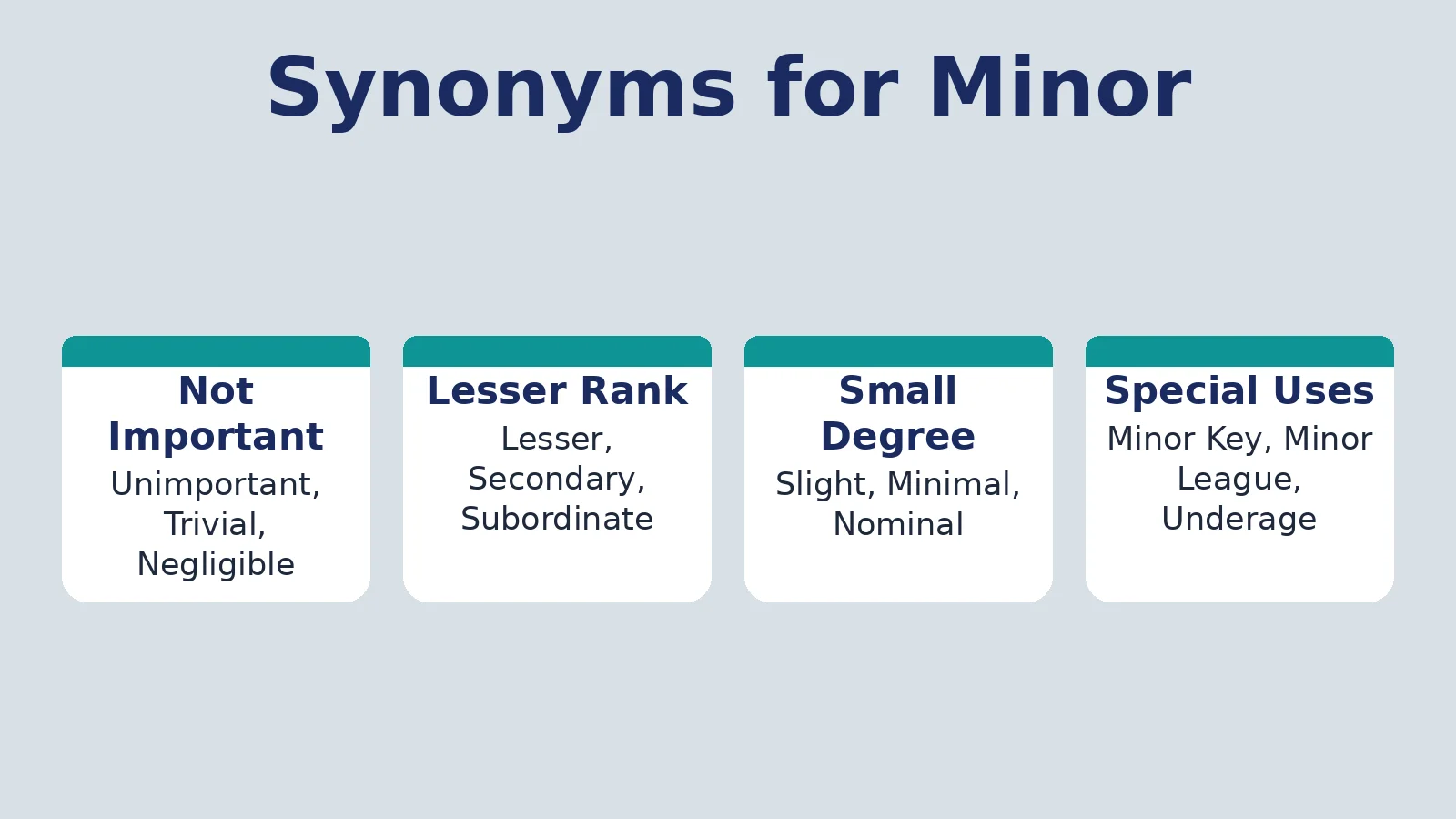
Minor is one of those safe, colourless words that writers lean on far too often. The most useful synonyms for minor include unimportant, insignificant, trivial, negligible, lesser, secondary, and slight, and each one sharpens the sentence in a different direction. Some stress that a thing does not matter. Others stress lower rank, and a few stress a small amount or degree.
This guide groups more than 40 synonyms for minor by meaning, so you can match the word to the job. Every entry carries a short gloss, and the key words include example sentences. As a result, you will know not only what each word means, but also when it sounds helpful and when it sounds rude. Whether you are softening feedback, grading a risk, or describing a supporting role, the right small word is waiting below.
Top Synonyms for Minor: Quick Reference
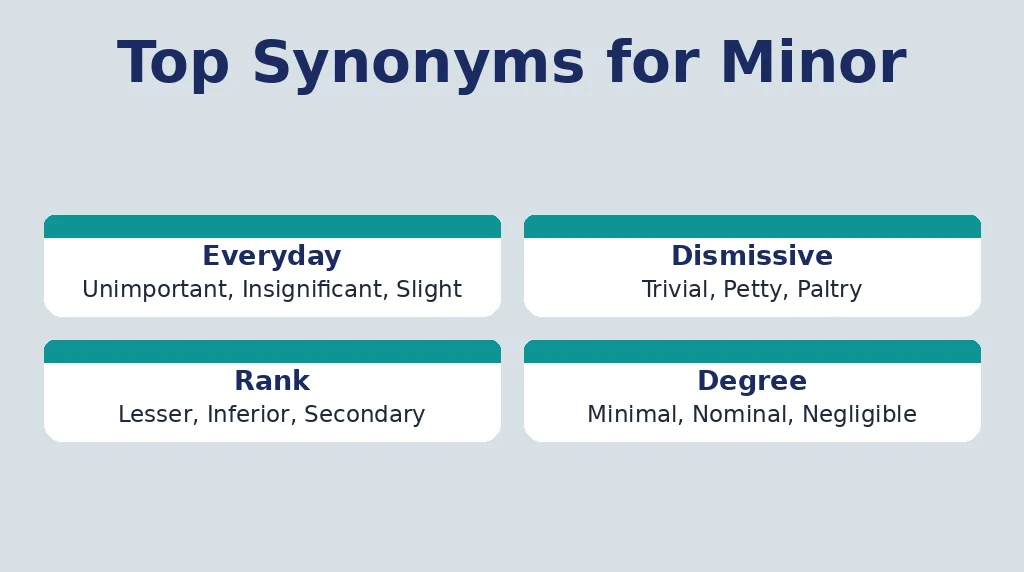
The table below covers the 22 synonyms readers reach for most often. Start here when you need one fast replacement. Later sections sort the full list into finer groups.
| Word | Meaning in one line | Best for |
|---|---|---|
| Unimportant | Not worth much attention | Neutral, everyday use |
| Insignificant | Too small to matter | Reports, formal writing |
| Inconsequential | Having no real effect or result | Formal, analytical tone |
| Trivial | Of little value or importance | Dismissive, slightly rude |
| Trifling | Small and not worth attention | Slightly formal dismissals |
| Negligible | So small it can be ignored | Risk, cost, damage reports |
| Petty | Small and mean-spirited | Quarrels, rules, attitudes |
| Paltry | Disappointingly small in amount | Sums of money, offers |
| Inconsiderable | Not worth considering, formal | Older or formal prose |
| Slight | Small in degree, not severe | Injuries, changes, chances |
| Small | Little in size or amount | Plain, general use |
| Secondary | Second in importance or order | Plans, roles, concerns |
| Lesser | Lower in rank or importance | Comparisons, formal tone |
| Inferior | Lower in quality or rank | Quality judgments, careful use |
| Subordinate | Lower in rank under someone else | Jobs, clauses, teams |
| Junior | Lower in rank or newer in a role | Workplaces, titles |
| Minimal | The smallest possible amount | Risk, effort, design |
| Nominal | In name only, or very small | Fees, charges, roles |
| Immaterial | Not relevant to the matter | Legal and formal writing |
| Irrelevant | Not connected to the subject | Arguments, evidence |
| Nonessential | Not needed, can be skipped | Lists, features, steps |
| Incidental | Minor and happening by chance | Costs, details, music |
| Piddling | Small and contemptible, informal | Speech, informal writing |
What Does Minor Mean?
At its simplest, minor means lesser or smaller in importance, rank, size, or degree. Merriam-Webster’s thesaurus sorts the word into three adjective senses, and the split explains why one replacement never fits everywhere. The first sense covers rank: a minor official holds less importance or standing than the people above them. The second covers value, as in a minor poet whose work few people read. The third covers importance itself, as in a minor detail that everyone can safely disregard.
Because the senses differ, the synonyms split into families. Words like unimportant and trivial answer the question “does it matter?” Words like lesser and junior answer “where does it stand?” Words like slight and minimal answer “how much is there?” Sorting by sense first saves you from most bad swaps later.
Minor also works as a noun. In law, a minor is a person below the age of legal majority, and this guide covers that sense briefly in the special uses section. The word further appears in fixed phrases such as minor key, minor league, and an academic minor. Those are set terms rather than loose synonyms, so they get their own section too.
The word itself comes from Latin *minor*, meaning smaller or less. It belongs to the same family as minus and minimum, which is why minimal sits so close to it in modern English. That family link also explains the word’s flavor: minor always implies a comparison, even when the bigger thing stays unmentioned.
One spelling warning belongs here. Minor and miner sound identical, yet a miner is a person who digs underground. Only the spelling separates the coal worker from the small detail, so proofread with care.
Synonyms for Minor That Mean Not Important
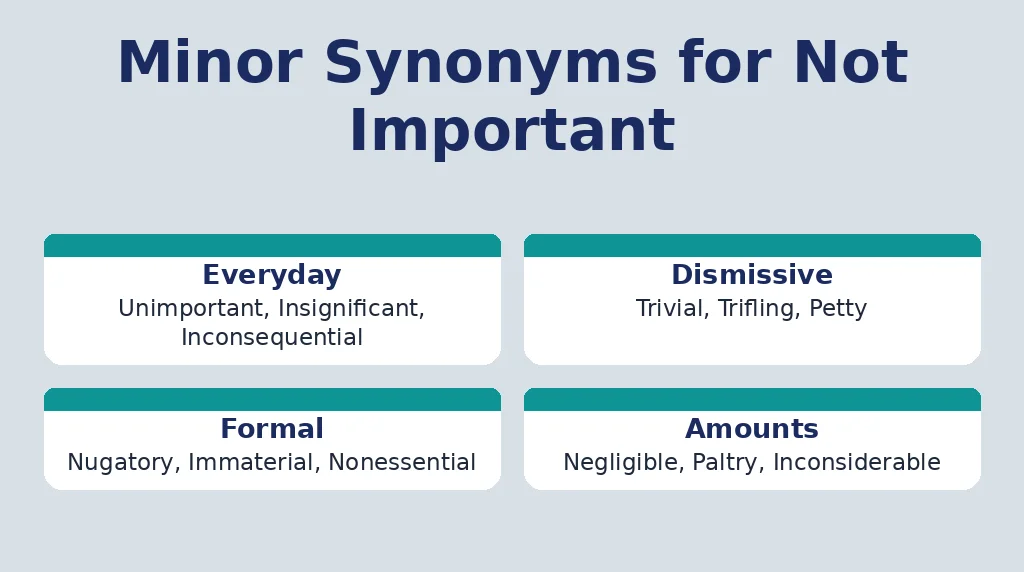
This is the sense most readers need. A minor problem, a minor detail, and a minor point all share one claim: the thing does not matter very much. The words below make that claim at different volumes, so tone is everything here.
Everyday Words for Not Important
These are the safe, neutral choices. They fit reports, emails, essays, and everyday speech without sounding harsh.
- Unimportant: not worth much attention or concern. Example: The date on the form is unimportant; the signature is what counts.
- Insignificant: too small or unimportant to be worth noticing. Example: The price difference is insignificant over a full year.
- Inconsequential: having no important effect or result. Example: The error was inconsequential, and the results stood.
- Slight: small in degree rather than absent. Example: There is a slight chance of rain this evening.
- Small: little in size, amount, or importance. Example: It is a small point, but the committee still debated it.
- Incidental: minor and occurring as a side effect of something bigger. Example: Travel brought incidental costs like taxis and tips.
- Nonessential: not necessary; safe to leave out. Example: Nonessential files were deleted to free up space.
- Peripheral: on the edge of the main issue rather than central. Example: The debate kept drifting into peripheral topics.
Stronger and More Dismissive Words
These words do not just say a thing is minor. They say it is beneath attention, and that edge can offend. Use them when the dismissive tone is deliberate.
- Trivial: of little value or importance, and not worth taking seriously. Example: Do not waste the meeting on trivial complaints.
- Trifling: small and unworthy of attention, slightly formal. Example: They argued for an hour over a trifling sum.
- Petty: small in importance, and often small-minded in spirit. Example: Petty rules about desk tidiness annoyed the whole team.
- Paltry: disappointingly small, especially for money or effort. Example: He was offered a paltry raise after five years.
- Piddling: small and contemptible, informal. Example: The fine was a piddling amount for such a large company.
- Picayune: petty and narrow in outlook, an informal American word. Example: The review was full of picayune complaints about fonts.
- Frivolous: lacking seriousness or sense. Example: The court dismissed the claim as frivolous.
Formal Words for Not Important
Formal writing prefers precision over punch. These words suit legal, academic, and official contexts, although some can sound stiff in casual prose.
- Negligible: so small that it can safely be ignored. Example: The drug showed a negligible effect on blood pressure.
- Inconsiderable: not worth considering, a formal and slightly old-fashioned choice. Example: The cost was inconsiderable next to the savings.
- Nugatory: of no value or importance, rare and very formal. Example: Without funding, the clause was nugatory.
- Immaterial: not relevant to the matter under discussion, common in legal writing. Example: The witness’s opinion was ruled immaterial.
- Irrelevant: not connected to the subject at hand. Example: His school record is irrelevant to this application.
Notice the fine line with the last two words. Something immaterial or irrelevant is off the point entirely, while something minor is on the point but small. That distinction matters in arguments, and the mistakes section returns to it later.
Minor Points in Arguments and Writing
Writers meet this sense constantly, because every draft contains points of uneven weight. A minor point supports the main argument without carrying it. Calling such a point incidental says it arrived as a side effect of the research. Calling it peripheral places it at the edge of the topic, still connected but far from the center.
Editors choose among these words with real care. A reviewer who labels a flaw minor tells the author to fix it quickly and move on. A reviewer who labels it trivial tells the author the flaw was barely worth raising. The first note keeps goodwill; the second can end a working relationship. In your own writing, minor and secondary are the courteous defaults, while trivial belongs to arguments you intend to win outright.
Synonyms for Minor by Rank and Standing
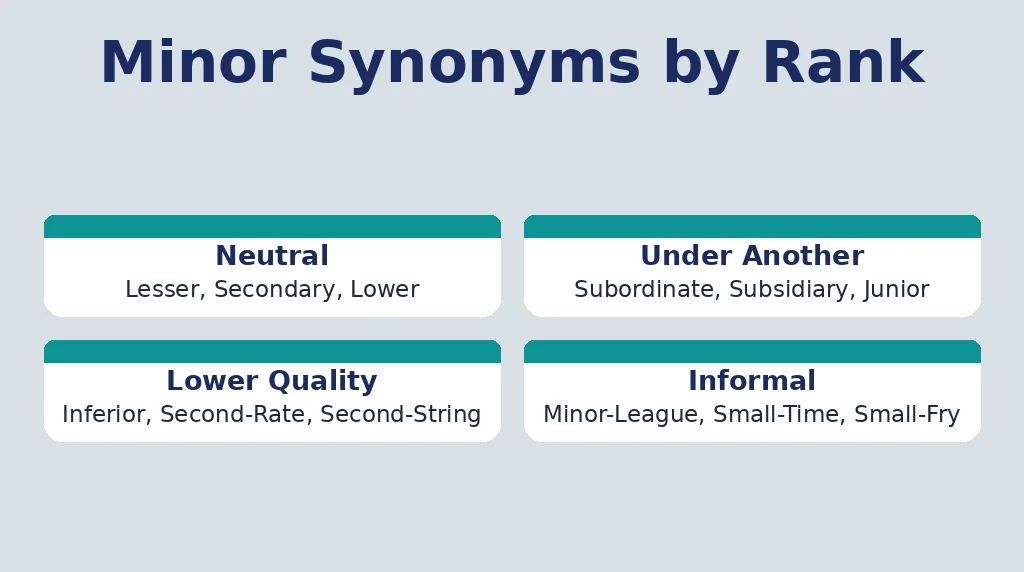
The second family answers a different question: where does this person, role, or thing stand in a hierarchy? A minor official, a minor role, and a minor partner all rank below someone or something else. These words say nothing about size, and they do not always say anything about quality either.
Neutral Words for Lower Rank
Use these when rank is a plain fact. They describe structure without passing judgment on ability or worth.
- Lesser: lower in importance, rank, or degree than another. Example: He chose the lesser of two evils.
- Secondary: second in importance, order, or rank. Example: Cost is a secondary concern; safety comes first.
- Subordinate: lower in rank and under the authority of another. Example: Each manager supervises four subordinate staff.
- Subsidiary: owned or controlled by a larger organisation, or serving to support it. Example: The bank sold its subsidiary insurance arm.
- Junior: lower in rank, or newer in a profession. Example: A junior doctor checked the wound first.
- Lower: below others in position or status. Example: Lower courts must follow the ruling.
Words That Imply Lower Quality
Handle this group with care. Each word moves beyond rank and suggests that the thing is worse, weaker, or less skilled. That extra meaning is useful in reviews, yet it insults when aimed at colleagues.
- Inferior: lower in quality or rank than something else. Example: The cheaper model uses inferior materials.
- Second-rate: of poor or mediocre quality. Example: Critics called it a second-rate sequel.
- Second-string: not among the first choice of players or people, borrowed from sport. Example: The second-string keeper played the cup match.
Informal Labels for Small Players
Informal English loves this territory. These labels shrink people, firms, and projects in a vivid, sometimes mocking way.
- Minor-league: belonging to a minor league in sport, or small-time by extension. Example: The scandal felt like minor-league politics.
- Small-time: operating on a small scale, often slightly shady. Example: Police arrested a small-time dealer near the station.
- Small-fry: unimportant people or things, informal and dismissive. Example: The auditors ignored the small-fry accounts.
- Nickel-and-dime: small and cheap in scale, an American slang phrase from Collins. Example: The nickel-and-dime fees added up quickly.
Rank and quality drift apart in real life. A junior analyst may be brilliant, and a senior one may be lazy. Precise writers keep the two ideas separate, which is why the neutral list above earns its keep.
Minor Roles in Film, Stories and Teams
Stories and squads both run on ranking. A minor character appears briefly and moves the plot only a little, while a secondary character returns often enough to matter. Reviewers use minor for walk-on parts and lesser for talents who deserve better billing, and the gap between those words can start arguments among fans.
Sport uses the same ladder in a friendlier way. A second-string player is a reserve, not a failure, and every cup run needs them. In the workplace, a subordinate role describes reporting lines on a chart. The chart says nothing about skill, which is why careful managers describe posts as junior or subordinate, and never as inferior.
Synonyms for Minor for Small Amounts and Degrees
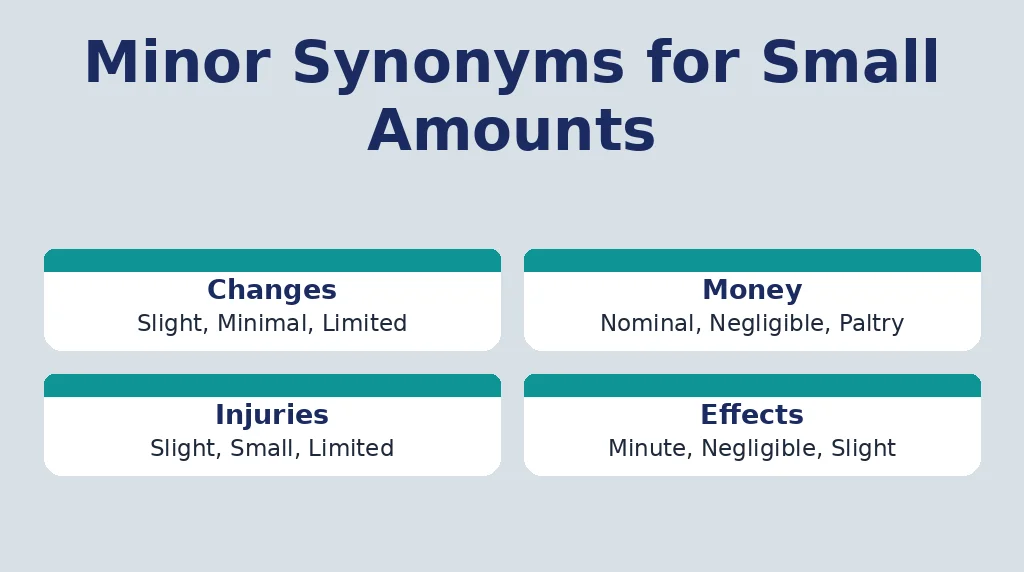
The third family measures quantity rather than importance. A minor change, a minor injury, and a minor fee all say the amount or degree is small. The words overlap with the first family, yet their home ground is measurement, so scientists, doctors, and editors reach for them often.
Small Changes and Effects
- Slight: small in degree, the standard word for injuries, delays, and improvements. Example: She felt a slight pain in her shoulder.
- Minimal: as small as possible, the lowest amount achievable. Example: The update caused minimal disruption to users.
- Limited: small because something restricts it. Example: The damage was limited to one room.
- Minute: extremely small in amount, pronounced my-NOOT. Example: A minute quantity of the chemical remained.
Small Sums and Charges
Money has its own favourites. A minor fee sounds neutral, but the words below shade the same fact in different directions.
- Nominal: so small that it exists in name only. Example: The club charges a nominal fee for guests.
- Negligible: small enough to ignore in the totals. Example: The rounding created a negligible difference.
- Paltry: small in a way that disappoints or insults. Example: Workers rejected the paltry bonus.
Degree words reward precision. Minimal promises that nothing smaller is possible, while slight simply says the degree is low. If you describe how physically small an object is, rather than how small its effect feels, the companion guide to synonyms for big covers the opposite end of the scale, and tiny words sit at yours.
Minor Injuries and Medical Writing
Medicine uses this family more than any other field. A minor injury is one that needs little or no treatment: a slight sprain, a small cut, a limited burn. Triage notes pair minor with major to sort patients by urgency, and the pairing is factual, not dismissive. Nobody hears “minor head injury” as an insult, because the scale itself protects the patient.
Writers outside medicine borrow the same calm tone. Insurance reports speak of minor damage and negligible losses. Product recalls describe a slight risk with limited effects. In each case, the degree word quietly tells the reader how much worry is appropriate, which is exactly why choosing it honestly matters.
Minor in Music, Sports and College: Special Uses
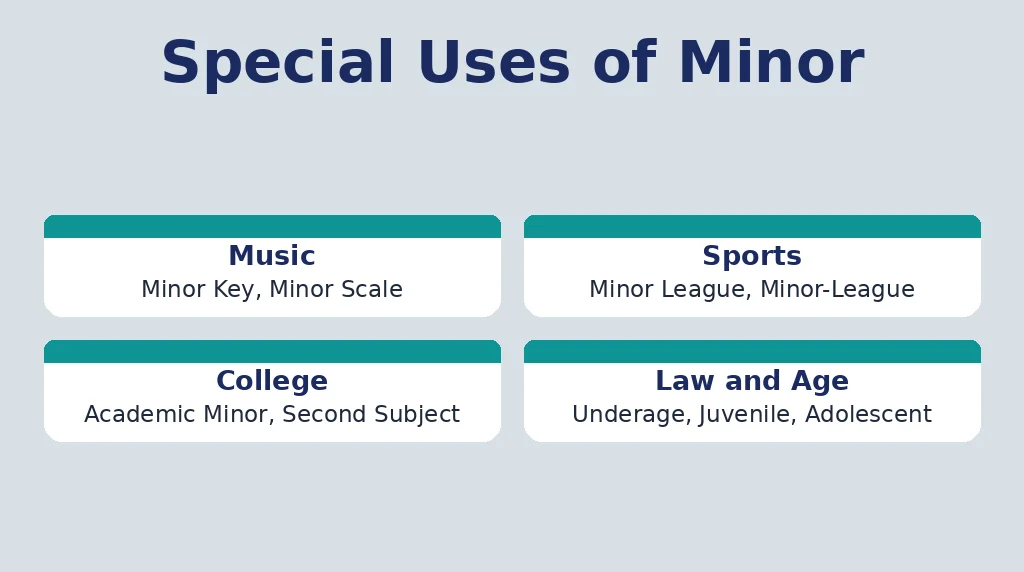
Some uses of minor are fixed terms. They are not loose synonyms at all, and swapping in unimportant or lesser will break them. This section explains the four you will meet most often.
Minor Keys and Scales in Music
In music, minor names a type of scale and key. A minor scale follows its own pattern of steps, and music in a minor key often sounds darker or sadder than music in a major key. The words major and minor here describe structure, not importance. A symphony in A minor can be a huge, serious work.
The Minor Leagues in Sport
In North American baseball, the minor leagues sit below the major leagues. Young players develop there before promotion, and towns across the continent host their teams. Because the system is famous, English borrowed minor-league as a general label for anything small-time, as the rank section showed.
An Academic Minor at College
In American higher education, a minor is a secondary field of study. It needs fewer credits than a major, and students pair it with their main subject, as in “she minored in journalism.” British universities do not use the term in the same way, so context matters for international readers.
Minor as a Noun: A Young Person
Finally, minor is a legal noun for a person below the age of legal majority. Dictionaries define it in exactly those terms, and official writing prefers young person or young adult in many contexts. Juvenile and adolescent appear in legal and medical settings, while kid is the informal everyday word. The exact age of majority varies by country and state, so careful writers avoid tying the word to one birthday.
Minor in Other Fixed Phrases
A few more set phrases round out the picture. Astronomers long called asteroids minor planets, because they orbit the sun like small siblings of the true planets. In contract bridge, diamonds and clubs form the minor suits, ranked below the major suits, hearts and spades. Grammar adds one more: a minor sentence lacks a full main verb, like “No way” or “After you,” yet still works in speech. None of these phrases grades importance in the everyday sense, so none accepts a swap with unimportant.
How to Choose the Right Synonym for Minor
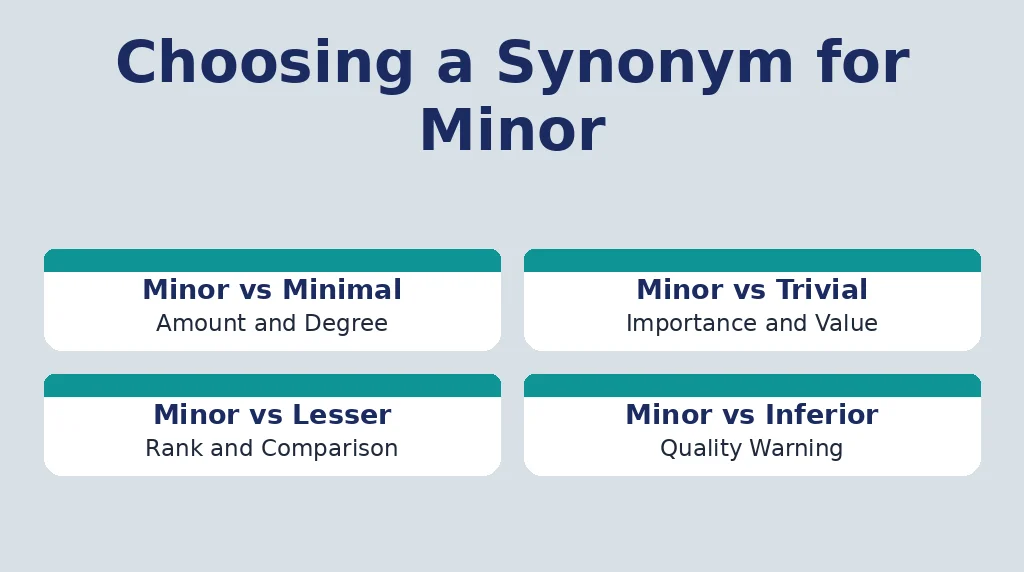
Three near-neighbours cause most of the confusion: minimal, trivial, and lesser. Each shares ground with minor, yet each fails in some sentences where minor works perfectly. The comparisons below separate them.
Minor vs minimal. Minimal means the smallest amount possible, a floor that cannot drop further. Minor simply means small compared with something larger. A hospital can promise minimal waiting times only if waits truly sit near zero. If waits are merely short, minor delays is the honest phrase. Writers who upgrade every minor to minimal end up overclaiming.
Minor vs trivial. Trivial judges worth, not size. A trivial detail is one nobody should care about, while a minor detail might still matter to a careful reader. Tone follows from that gap. Telling a colleague their concern is minor sounds factual. Calling it trivial sounds like a put-down, so save trivial for things, not for people in the room.
Minor vs lesser. Lesser needs a comparison, stated or implied. We speak of the lesser of two evils, a lesser-known artist, and lesser charges than the main count. Use lesser when two or more options are being ranked. Use minor when something is small in itself, with no rival in view.
Minor vs inferior. Inferior attacks quality. A minor role in a film can be played superbly, while an inferior performance cannot. If you only mean lower billing, choose minor, lesser, or supporting. If you truly mean worse workmanship, inferior is fair game.
Paired Examples
Paired examples make the gaps concrete:
- The repair needs a minor adjustment. It is small, and the machine still works.
- The repair needs a minimal adjustment. Almost no adjustment is needed at all.
- It was a minor objection. The point counted, but it did not block the deal.
- It was a trivial objection. The speaker thought the point was silly.
- She holds a junior post. Her rank is low, and nothing is said about her talent.
- She gave an inferior performance. Her work itself was judged poor.
When the word you want means the opposite, major, important, and primary take over. The companion guide to synonyms for major sorts those stronger words by sense, just as this guide sorts the smaller ones.
The Quick Picker
The quick picker below matches common situations to strong first choices.
| Situation | Strong first choice |
|---|---|
| A detail in a report | Minor or insignificant |
| A problem you are dismissing | Trivial or trifling |
| A risk that can be ignored | Negligible |
| A colleague’s lower rank | Junior or subordinate |
| A fee that barely exists | Nominal |
| An injury needing little care | Minor or slight |
| A cost on the side | Incidental |
| A cause below the main one | Secondary |
Formal and Informal Synonyms for Minor
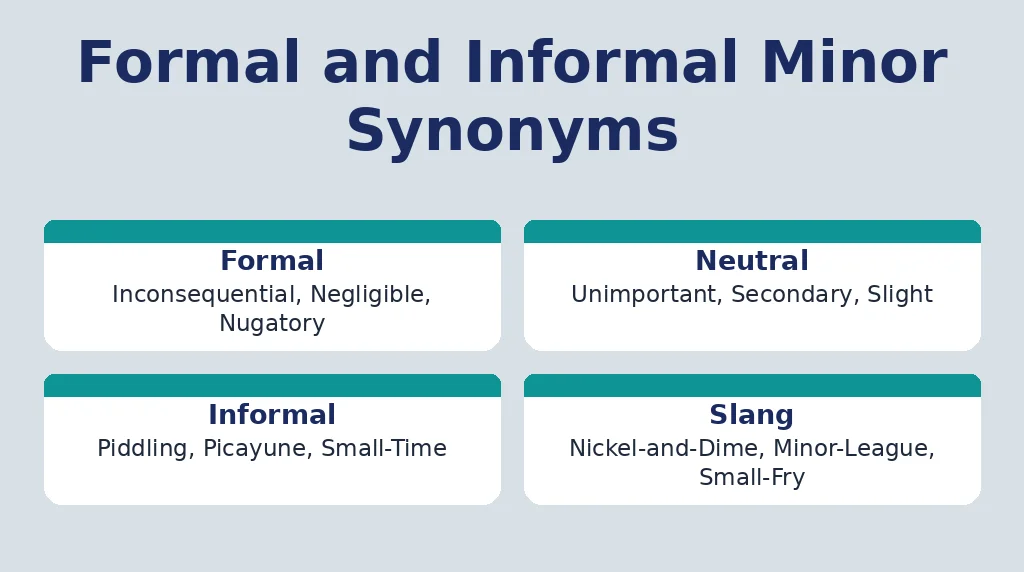
Register decides whether the same fact sounds professional or playful. A hospital report and a group chat can describe the same small injury, yet they should not use the same word for it.
Formal writing favours inconsequential, negligible, subordinate, and secondary. These words appear in legal documents, academic papers, and official reports because they stay neutral and exact. Nugatory and inconsiderable sit even higher on the formal ladder. They impress in the right setting, but they can look like showing off in a routine email.
Neutral everyday words form the safe middle. Unimportant, slight, small, and lesser work almost anywhere. They carry no slang flavor and no legal stiffness, so they are the default choice for general articles, instructions, and business writing.
Informal speech reaches for piddling, picayune, small-time, and small-fry. Nickel-and-dime adds an American slang colouring that Collins marks as slang. These words entertain in dialogue, reviews, and opinion pieces. In a contract or a complaint letter, though, they would sound flippant and weaken your position.
Essays sit between the two poles. Students should prefer insignificant, secondary, and subordinate over both slang and legal Latin. A history essay can call a treaty a secondary cause without sounding casual. A science report can call an effect negligible and sound precise rather than bored. Matching the word to the document is most of the skill.
Minor in Professional and Workplace Writing
Workplaces run on graded language. Performance reviews, project plans, and incident reports all need words that rank issues without starting fights. Minor issue, minor delay, and minor concern are the standard trio, and they work because everyone reads them as size labels, not character judgments.
Trouble starts when stronger words slip in. A manager who logs a subordinate’s error as a petty mistake has judged the person, not the task. A report that calls a supplier second-rate may be accurate, yet it will be quoted back in every later dispute. Professional writers therefore keep a small approved set: minor, slight, secondary, and limited for facts, with trivial and inferior reserved for cases they can prove.
Antonyms for Minor
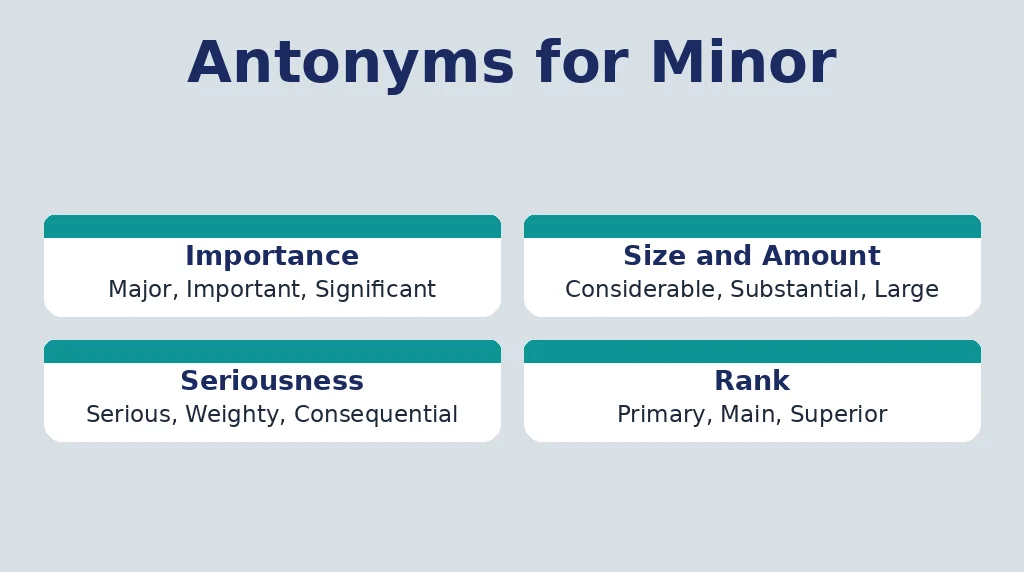
The natural opposite of minor is major, and most antonyms cluster around it. Collins lists major, important, significant, considerable, substantial, serious, and weighty among the opposites, and each one answers a different sense of minor.
For the importance sense, the opposites are important, significant, and consequential. A significant result changes decisions, while a consequential one changes outcomes. For the amount sense, considerable, substantial, and appreciable describe quantities too big to ignore. For the rank sense, primary, main, and superior mark the top of the ladder instead of the bottom.
Serious deserves a special note. A serious injury is the direct opposite of a minor injury, and doctors use the pair daily. Serious can also mean solemn in manner, so context must show which sense you intend. If your sentence needs the importance end of the scale in full, the guide to synonyms for important gathers those heavyweight words in one place.
Paired sentences show the switch clearly. The committee treated it as a minor item becomes the committee treated it as a major item, and the agenda suddenly changes. A minor role in the firm becomes a leading role, and a slight chance becomes a strong chance. Reading your sentence with the antonym in place is a quick test: if the swap reverses the meaning cleanly, your original word was doing honest work.
Common Mistakes: Words That Are Not True Synonyms for Minor
Accuracy matters in a synonym guide, so this section clears up the words and uses that often sneak into minor lists wrongly.
Irrelevant is not a free swap. An irrelevant point is off the subject entirely. A minor point is on the subject but small. A judge can call evidence both relevant and minor, which proves the words measure different things.
Minimal is not a fancier minor. As the choosing section explained, minimal claims the lowest possible level. A minimal service runs at the bare floor. A minor service is simply smaller than the full one, and it may still be generous.
Inferior does not mean junior. Inferior judges quality; junior and subordinate judge rank. Writing that a junior nurse gave inferior care accuses her of bad work. Writing that she is a minor member of the team, while clumsy, at least stays neutral. Choose the word that matches the claim you can defend.
Spelling and Sense Traps
A minor is not a miner. The homophone trap catches fast typists every day. One letter swaps a small detail for a coal worker, and spellcheckers stay silent because both words exist. Search your draft for miner before you publish anything about minor offences or minor keys.
Major and minor in music are not grades. A minor key is not a failed major key, and a minor chord is not an unimportant chord. The terms name scale patterns. Any sentence that treats them as praise or criticism has misunderstood the vocabulary.
Venial is a near miss worth knowing. Theology calls forgivable sins venial rather than mortal, and some lists offer venial for minor offences. The word belongs to that religious frame, though. Outside it, readers will simply puzzle over it, so minor or trivial serves better.
Calling a person minor can insult. Dictionaries record the “of little merit” sense with examples like a minor poet. Aim that wording at a living colleague and it stops being a rank label and becomes a review of their talent. If you mean junior staff, say junior staff. If you mean a small role, name the role. Precision protects both the sentence and the working relationship.
Frequently Asked Questions
What is the best synonym for minor?
Unimportant is the safest all-purpose choice, and insignificant is close behind. For rank, lesser and secondary work best, while slight suits injuries, changes, and chances. The best word always depends on which sense of minor you mean.
What is a formal synonym for minor?
Inconsequential and negligible are the standard formal choices. Legal writing also uses immaterial for points that do not affect a case. Nugatory exists at the far formal end, but it is rare enough to distract many readers.
What is the difference between minor and minimal?
Minor means small compared with something larger. Minimal means the smallest amount possible, with nothing left to trim. Minimal risk is a stronger promise than minor risk, so writers should not swap the two casually.
What is the opposite of minor?
Major is the direct opposite in most contexts. Depending on the sense, important, significant, considerable, serious, and primary also work. A major operation, for instance, is the natural opposite of a minor operation.
Is minor the same as trivial?
No. Minor is neutral and factual, while trivial adds a judgment that something is not worth attention. Calling a delay minor reports its size. Calling it trivial dismisses it, which can sound rude about a person’s problem.
What does minor mean in music?
In music, minor describes a scale, key, or chord pattern, not an importance level. Music in a minor key often sounds darker or sadder than music in a major key. The terms name structures that composers choose deliberately.
How do you spell the word for a person who digs: minor or miner?
The digging worker is a miner, with an e. Minor, with an o, means lesser or a person under the legal age of adulthood. The two words sound the same, so only the spelling and context separate them.
What does the noun “a minor” mean in law?
In law, a minor is a person below the age of legal majority in their country or state. The term appears in contracts, safeguarding rules, and age-restricted services. Official writing often prefers young person, because minor can sound like a label rather than a description.
Final Thoughts
Minor looks like a plain little word, yet it covers importance, rank, and degree at once. Once you sort its synonyms by sense, the right choice usually becomes obvious. A detail can be negligible, a role can be subordinate, and a change can be slight, and each sentence becomes sharper for the effort.
For an even deeper list with related words and near-synonyms, the Merriam-Webster Thesaurus entry for minor is a reliable next step. Keep this guide bookmarked too, and your small words will never sound vague again. The next time a draft defaults to minor for the fifth time, you will know exactly which sharper word the sentence has been waiting for.