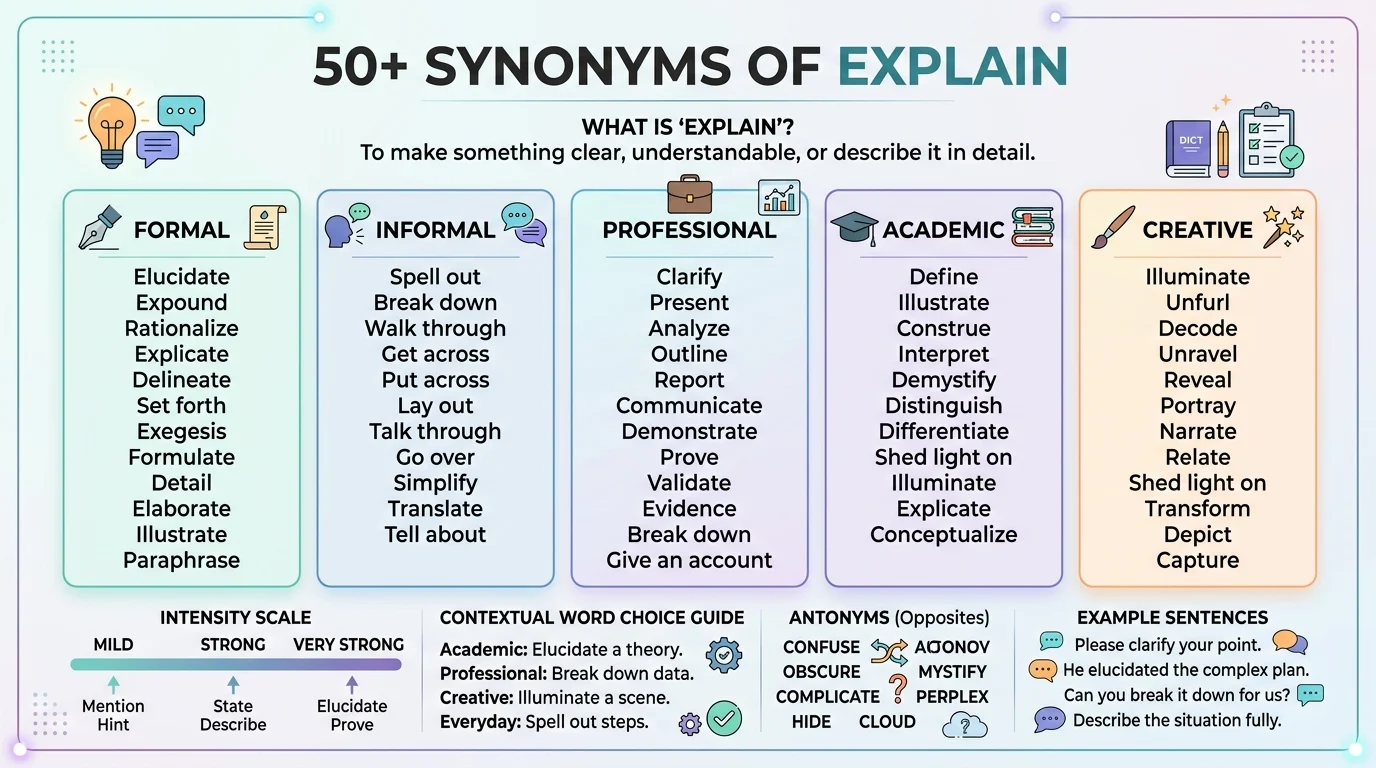
Have you ever finished writing an email, an essay, or a social media post and realized you used the word “explain” five times in three sentences? It happens to everyone. You know what you want to say, but the same word keeps appearing, and your writing starts to feel repetitive and flat.
The good news is that English is full of powerful alternatives. This guide covers the most useful synonyms of explain to help you communicate with greater clarity, precision, and confidence.
Choosing the right synonym is not about sounding fancy. It is about matching your word to your meaning, your audience, and your purpose. A word that works perfectly in a casual conversation might sound out of place in a business report. The best writers know that word choice shapes how their message is received.
This guide will help you understand what “explain” really means, discover the best synonyms for every situation, and avoid common mistakes that weaken your writing.
What Are the Best Synonyms of “Explain”?
“Explain” means to make something clear or understandable by describing it in detail or providing reasons. The best synonym depends on your context. Formal writing, use “elucidate” or “explicate.” For casual conversation, try “spell out” or “walk through.” Professional settings, choose “clarify,” “articulate,” or “demonstrate.” For academic work, “expound” and “interpret” work well.
Meaning, Tone, and Context
Simple Definition
To explain something is to make it plain, clear, or intelligible. You explain when you help someone understand something that was not immediately obvious or fully known.
Part of Speech
Explain is a verb. Its forms include explains, explained, and explaining.
Overall Tone
Explain is neutral. It does not carry a strong positive or negative emotional charge on its own. The tone depends entirely on how you use it and the words you pair with it.
Formality Level
Explain is neutral in formality. It works in almost every setting: casual conversation, professional emails, academic papers, and everyday writing. This versatility is why it is so widely used, but it is also why it can feel overused and vague.
Common Uses
Native English speakers use “explain” in countless situations:
- Teaching someone how to do something
- Giving reasons for a decision or action
- Clarifying a confusing topic
- Describing how something works
- Justifying a position or belief
- Answering a question
Word Forms
| Form | Word | Example |
|---|---|---|
| Verb | explain | Please explain your reasoning. |
| Noun | explanation | His explanation was clear. |
| Adjective | explanatory | She provided explanatory notes. |
| Adverb | explanatorily | He spoke explanatorily. |
| Opposite | confuse, obscure | The instructions confused me. |
When and How to Use “Explain”
Choose “explain” when you need a straightforward, neutral word that works in almost any context. It is the safest choice when you are unsure which synonym fits best. However, relying on it too often makes your writing feel repetitive and unsophisticated.
Here are seven realistic examples showing how “explain” sounds in different contexts:
Professional
“Could you explain the reasoning behind this budget adjustment?”
Academic
“The researcher explained the methodology in the first chapter.”
Workplace
“I need you to explain the new procedure to the morning shift.”
Personal
“Let me explain why I made that decision.”
“I will explain the changes in our next team meeting.”
Resume
“Explained complex technical concepts to non-technical stakeholders.”
“Can someone explain this trend to me? I am completely lost.”
Best Synonyms of “Explain”
No two synonyms are identical. Each carries its own shade of meaning, level of formality, and emotional weight. The best synonym for your sentence depends on who you are talking to, what you are trying to say, and how you want to sound.
Best for Professional Writing
Articulate – Use this when you express an idea clearly and effectively, especially complex or abstract concepts. It suggests skill and precision.
“She articulated the new strategy in a way everyone understood.”
Best for Academic Writing
Elucidate – This word means to shed light on something complex or difficult. It is formal and scholarly, perfect for research papers and academic discussions.
“The professor elucidated the theory with several compelling examples.”
Explicate – Use this for detailed, logical analysis, often of texts or complex ideas.
The scholar explicated the poem’s hidden meanings.”
Best for Business Communication
Clarify – Choose this when you need to remove confusion or make something less ambiguous. It focuses on clearing up misunderstanding.
“Let me clarify our position on this issue.”
Best for Casual Conversation
Spell out – This informal phrase means to explain something very clearly and in detail, leaving no room for confusion.
“Can you spell out exactly what you need from me?”
Walk through – Use this when you guide someone through a process step by step.
“I will walk you through the setup process.”
Best for Emotional Writing
Justify – Use this when you need to defend or prove that something is right or reasonable.
“She had to justify her actions to the board.”
Best for Creative Writing
Illuminate – This word adds imagery and elegance. It means to brighten or shed light on a subject.
“His words illuminated the darkness of the situation.”
Best for Resume Writing
Demonstrate – Use this to show that you proved something through action or example.
“Demonstrated new procedures to the team, reducing errors by 20%.”
Trained – Use this when your explaining taught others a skill that they can now use.
“Trained 15 staff members on the new software system.”
Best for Workplace Communication
Brief – Use this for concise, decision-oriented updates.
“Briefed the executive team on the project’s status.”
For Stronger Meaning
Expound – This means to explain in careful, elaborate, and often learned detail.
“He expounded his philosophy for over an hour.”
For Softer Meaning
Describe – Use this when you simply give details without the pressure of making something fully understood.
“She described the process briefly.”
When Not to Use “Explain”
When It Sounds Too General
Problem: “Explain” is so general that it often fails to communicate exactly what you did.
Incorrect: “Explained the new policy to employees.”
Better: “Trained 30 employees on the new policy, achieving 95% compliance within one week.”
Why: The second sentence shows impact and results, not just the act of talking.
When It Sounds Too Vague on a Resume
Problem: On a resume, “explained” describes effort, not results. It tells recruiters you talked about something but not what changed afterward.
Incorrect: “Explained technical requirements to the marketing team.”
Better: “Simplified technical requirements into a one-page brief, cutting design rework by 40%.”
Why: The improved version shows a concrete outcome.
When It Sounds Too Informal in Academic Writing
Problem: In academic papers, “explain” can feel too basic for complex analysis.
Incorrect: “This section explains the findings of the study.”
Better: “This section elucidates the findings of the study.”
Why: “Elucidates” sounds more scholarly and precise.
When It Sounds Too Formal in Casual Conversation
Problem: Using formal synonyms like “elucidate” or “explicate” in everyday conversation can sound pretentious.
Incorrect: “Can you elucidate what you mean?”
Better: “Can you clarify what you mean?” or “Can you spell that out?”
Why: The alternatives sound natural and approachable.
When It Sounds Too Weak
Problem: Sometimes you need a word that carries more weight and authority.
Incorrect: “I explained why the project was behind schedule.”
Better: “I justified the delay with a detailed risk analysis.”
Why: “Justified” implies you provided solid reasoning, not just a description.
When It Sounds Outdated
Problem: “Explain” is never truly outdated, but using it repeatedly in modern writing can feel lazy. Rotating your word choice keeps your writing fresh and engaging.
Words Commonly Confused With “Explain”
Explain vs Clarify
Difference: Explain is broad and general. Clarify specifically means to remove confusion or make something less ambiguous.
When to Use Explain: When you are giving any kind of description or reason.
When to Use Clarify: When there is existing confusion that needs clearing up.
Example with Explain: “Let me explain how this works.”
Example with Clarify: “Let me clarify what I meant in my previous email.”
Explain vs Describe
Difference: Describe focuses on giving details about what something is like. Explain focuses on making something understood, often including reasons and causes.
When to Use Explain: When you need to provide reasons or make something comprehensible.
When to Use Describe: When you are painting a picture with words or giving an account of appearances or events.
Example with Explain: “Explain why you chose this approach.”
Example with Describe: “Describe the scene you witnessed.”
Explain vs Elucidate
Difference: Elucidate is much more formal and means to shed light on something complex. It is rarely used in conversation.
Which Is Stronger: Elucidate is stronger and more scholarly.
Which Is More Formal: Elucidate is highly formal.
When to Use Each: Use “explain” in most situations. Use “elucidate” in academic writing or when you need a sophisticated word.
Example with Explain: “The teacher explained the lesson.”
Example with Elucidate: “The researcher elucidated the findings in her paper.”
Explain vs Justify
Difference: Explain simply makes something clear. Justify specifically means to prove that something is right, reasonable, or necessary.
Which Is Stronger: Justify carries more emotional weight and implies defense.
Which Is More Formal: Both are neutral, but justify is more common in professional and academic contexts.
When to Use Each: Use “explain” when you are simply providing information. Use “justify” when you need to defend a position or action.
Example with Explain: “Explain your decision.”
Example with Justify: “Justify your decision with evidence.”
Explain vs Demonstrate
Difference: Explain tells someone how something works. Demonstrate shows them how it works through action or example.
Which Is Stronger: Demonstrate is often more convincing because it involves proof through action.
Which Is More Formal: Both are neutral, but demonstrate is highly valued in professional contexts.
When to Use Each: Use “explain” when words are enough. Use “demonstrate” when showing is more effective than telling.
Example with Explain: “Explain the procedure to the team.”
Example with Demonstrate: “Demonstrate the procedure so everyone can see how it is done.”
Explain vs Expound
Difference: Explain is general. Expound means to explain in elaborate, methodical, and often lengthy detail.
Which Is Stronger: Expound is stronger because it implies depth and thoroughness.
Which Is More Formal: Expound is more formal and scholarly.
When to Use Each: Use “explain” for everyday explanations. Use “expound” when you are delivering a detailed, systematic explanation of a complex topic.
Example with Explain: “Explain your idea briefly.”
Example with Expound: “Expound on your theory in the next chapter.”
Best Synonyms of “Explain” by Context
| Context | Best Synonym | Why It Works | Example |
|---|---|---|---|
| Formal writing | Elucidate | Sounds scholarly and precise | “The author elucidates the central argument.” |
| Academic writing | Explicate | Implies detailed analysis | “The paper explicates the philosophical framework.” |
| Professional communication | Articulate | Suggests clear, effective expression | “She articulated the vision clearly.” |
| Business emails | Clarify | Removes ambiguity | “Let me clarify the next steps.” |
| Resume writing | Demonstrate | Shows proof through action | “Demonstrated new techniques to the team.” |
| Workplace communication | Brief | Concise and decision-oriented | “Briefed the manager on the situation.” |
| Casual conversation | Spell out | Clear and approachable | “Spell out what you need.” |
| Everyday speaking | Walk through | Guides step by step | “Walk me through the process.” |
| Creative writing | Illuminate | Adds imagery and elegance | “His words illuminated the truth.” |
| Storytelling | Reveal | Suggests uncovering hidden meaning | “The twist revealed the character’s true motive.” |
| Emotional writing | Justify | Implies defense and reasoning | “She justified her choice with passion.” |
| Strong emphasis | Expound | Conveys thorough, detailed explanation | “He expounded his views at length.” |
| Mild tone | Describe | Simple and non-pressuring | “Describe what happened.” |
| Social media captions | Break down | Casual and digestible | “Breaking down this recipe step by step.” |
| American English | Explain | The default choice for all contexts | “Explain it to me one more time.” |
How to Choose the Best Synonym of “Explain”
Choosing the right synonym is simpler than it seems. Ask yourself these five questions before you write.
1. Who is my audience?
If you are writing for experts or academics, choose formal words like “elucidate” or “explicate.” If you are writing for friends or a general audience, choose casual words like “spell out” or “walk through.”
2. What is my purpose?
Are you removing confusion? Use “clarify.” Are you defending a position? Use “justify.” Are you showing how something works? Use “demonstrate.” Are you giving a detailed analysis? Use “expound.”
3. How formal should my tone be?
Match your word to the setting. Academic papers and business reports call for formal alternatives. Emails to colleagues and conversations with friends call for neutral or casual words.
4. How much emotional weight do I need?
Neutral words like “describe” and “outline” simply inform. Stronger words like “justify” and “defend” carry emotional weight and imply conviction.
5. Does it sound natural?
Read your sentence aloud. If the synonym feels forced or awkward, choose a different one. The best word is the one that sounds like you.
Real Life Examples of “Explain”
School
“The teacher explained the water cycle using a simple diagram.” (Replace with: “The teacher illustrated the water cycle using a simple diagram.”)
College
“The professor explained the theory in great detail.” (Replace with: “The professor expounded the theory in great detail.”)
Workplace
“I explained the new protocol to my team.” (Replace with: “I briefed my team on the new protocol.”)
Business
“The CEO explained the company’s financial position.” (Replace with: “The CEO articulated the company’s financial position.”)
“I am writing to explain the delay.” (Replace with: “I am writing to clarify the reasons for the delay.”)
Resume
“Explained product features to clients.” (Replace with: “Demonstrated product features to clients, increasing conversion rates.”)
Conversation
“Let me explain how to set this up.” (Replace with: “Let me walk you through the setup.”)
Storytelling
“He explained his past to her.” (Replace with: “He revealed his past to her.”)
Blogging
“This post explains how to start a business.” (Replace with: “This post breaks down how to start a business.”)
“Explaining this recipe in three simple steps.” (Replace with: “Breaking down this recipe in three simple steps.”)
18 Best Synonyms of “Explain”
| Synonym | Simple Meaning | Best Used For | Example Sentence |
|---|---|---|---|
| Clarify | To remove confusion and make something easier to understand | Professional communication and business emails | “Let me clarify the timeline for this project.” |
| Elucidate | To shed light on something complex or difficult | Academic writing and formal explanations | “The study elucidates the relationship between the two variables.” |
| Explicate | To analyze and explain in detail, often a text or complex idea | Literary analysis and scholarly work | “The critic explicated the poem’s symbolism.” |
| Expound | To explain in careful, elaborate, and learned detail | Academic lectures and detailed presentations | “The professor expounded his theory for two hours.” |
| Articulate | To express an idea clearly and effectively | Professional writing and public speaking | “She articulated her vision for the company.” |
| Interpret | To explain the meaning of something using special knowledge | Analysis and translation of meaning | “How do you interpret these results?” |
| Demonstrate | To show how something works through action or example | Teaching, training, and resumes | “He demonstrated the new software to the team.” |
| Justify | To explain why something is right or reasonable | Defending decisions and positions | “She justified her recommendation with data.” |
| Illustrate | To clarify by using examples, comparisons, or visuals | Teaching and making abstract ideas concrete | “The chart illustrates the growth trend clearly.” |
| Describe | To give details about what something is like | Everyday conversation and descriptive writing | “She described the accident in detail.” |
| Outline | To give the main points in a structured way | Planning, presentations, and summaries | “Let me outline the key points of the proposal.” |
| Define | To state the exact meaning of something | Giving precise meanings and setting boundaries | “The contract defines each party’s responsibilities.” |
| Spell out | To explain very clearly and in detail | Casual conversation and giving instructions | “Spell out exactly what you want me to do.” |
| Walk through | To guide someone step by step through a process | Teaching and on-the-job training | “I will walk you through the entire setup.” |
| Break down | To simplify something into smaller, understandable parts | Explaining complex topics in simple terms | “Let me break down the budget for you.” |
| Illuminate | To brighten or shed light on a subject | Creative writing and vivid explanations | “His words illuminated the complex issue.” |
| Reveal | To make something known that was hidden | Storytelling and uncovering truth | “The report revealed the cause of the problem.” |
| Brief | To give concise, decision-oriented information | Workplace updates and executive communication | “I briefed the director on the latest developments.” |
Synonyms of “Explain” by Usage
Professional vs Personal Synonyms
In professional settings, choose words that demonstrate competence and impact. “Articulate,” “demonstrate,” “clarify,” and “brief” signal that you communicate with purpose and achieve results. In personal conversations, choose words that feel natural and approachable. “Spell out,” “walk through,” “break down,” and “describe” keep the tone friendly and accessible.
Formal vs Conversational Synonyms
| Formal Synonyms | Conversational Synonyms |
|---|---|
| Elucidate | Spell out |
| Explicate | Walk through |
| Expound | Break down |
| Articulate | Go over |
| Interpret | Talk through |
Formal synonyms fit reports, essays, business writing, presentations, and professional emails. Conversational synonyms fit casual conversations, texting, and social media.
Academic Synonyms
Academic writing demands precision and authority. “Elucidate,” “explicate,” and “expound” are excellent choices for research papers, essays, and academic discussions. These words signal that you are engaging with material at a scholarly level. “Interpret” works well when you are analyzing meaning. “Articulate” is valuable when you need to express complex ideas clearly.
Professional and Business Synonyms
For resumes, interviews, meetings, presentations, performance reviews, client communication, and business emails, choose words that show impact. “Demonstrate,” “train,” “brief,” “clarify,” “articulate,” and “simplify” are powerful choices. These words do more than describe talking. They show that your communication led to results.
Creative and Literary Synonyms
Storytelling, fiction, poetry, descriptive writing, and speeches benefit from expressive alternatives. “Illuminate,” “reveal,” “unfold,” and “unravel” add emotion and imagery. These words turn explanations into experiences.
Slang or Modern Synonyms
“Break down” and “spell out” are modern and casual. They are widely used in everyday speech and work well in social media, blog posts, and casual conversations. Avoid them in formal writing.
Strongest to Mildest Synonyms
| Intensity | Synonyms |
|---|---|
| Mild | Describe, outline, define |
| Moderate | Explain, clarify, interpret |
| Strong | Articulate, demonstrate, justify |
| Very Strong | Expound, explicate, elucidate |
The emotional intensity increases as you move down the scale. Mild synonyms simply inform. Strong synonyms imply depth, conviction, or proof.
Emotional vs Neutral Synonyms
Emotional Synonyms
“Justify,” “defend,” “rationalize,” and “vindicate” express stronger feelings. They suggest that the speaker has a position to protect or a case to make. Use these when you need to convey conviction or when you are addressing a sensitive topic.
Neutral Synonyms
“Describe,” “outline,” “define,” “clarify,” and “demonstrate” simply communicate information. They do not add emotional weight. Use these when you want to stay objective and professional.
Antonyms of “Explain”
Comparison: “Explain” vs Similar Words
Explain vs Elucidate
Main Difference: Explain is general and widely applicable. Elucidate is formal and means to shed light on something complex.
Which Is Stronger: Elucidate is stronger and more scholarly.
Which Is More Formal: Elucidate is highly formal.
When to Use Each: Use “explain” in most everyday situations. Use “elucidate” in academic writing or when you need a sophisticated word.
Examples:
- Explain: “Can you explain this concept to me?”
- Elucidate: “The paper elucidates the complex mechanisms involved.”
Explain vs Clarify
Main Difference: Explain makes something understandable. Clarify removes confusion or ambiguity.
Which Is Stronger: Clarify is more specific and often more useful when confusion exists.
Which Is More Formal: Both are neutral, though clarify is common in professional writing.
When to Use Each: Use “explain” when you are providing information. Use “clarify” when something is unclear and needs to be made simpler.
Examples:
- Explain: “Explain the process to me.”
- Clarify: “Clarify your position on this issue.”
Explain vs Justify
Main Difference: Explain simply provides information. Justify defends or proves that something is right or reasonable.
Which Is Stronger: Justify is stronger and carries more emotional weight.
Which Is More Formal: Both are acceptable in formal contexts.
When to Use Each: Use “explain” when you are describing. Use “justify” when you are defending a decision.
Examples:
- Explain: “Explain your decision.”
- Justify: “Justify your decision with evidence.”
Explain vs Demonstrate
Main Difference: Explain uses words. Demonstrate uses actions or examples to show how something works.
Which Is Stronger: Demonstrate is often more convincing because it involves proof.
Which Is More Formal: Both are neutral.
When to Use Each: Use “explain” when words are sufficient. Use “demonstrate” when showing is more effective than telling.
Examples:
- Explain: “Explain the procedure.”
- Demonstrate: “Demonstrate the procedure so everyone can see.”
Explain vs Interpret
Main Difference: Explain makes something clear. Interpret reveals the underlying meaning using special knowledge or insight.
Which Is Stronger: Interpret implies deeper analysis.
Which Is More Formal: Interpret is more formal and analytical.
When to Use Each: Use “explain” for straightforward clarification. Use “interpret” when you are analyzing meaning or translating information for a specific audience.
Examples:
- Explain: “Explain the data to me.”
- Interpret: “Interpret the data for our stakeholders.”
Explain vs Expound
Main Difference: Explain is general. Expound means to explain in elaborate, methodical detail.
Which Is Stronger: Expound is much stronger and implies thoroughness.
Which Is More Formal: Expound is formal and scholarly.
When to Use Each: Use “explain” for everyday explanations. Use “expound” when you are delivering a detailed, systematic explanation.
Examples:
- Explain: “Explain your idea briefly.”
- Expound: “Expound on your theory in detail.”
Common Phrases and Expressions with “Explain”
Explain away
Meaning: To dismiss or minimize the significance of something by giving an explanation.
Example: “He tried to explain away his absence, but no one believed him.”
Explain oneself
Meaning: To give reasons for one’s actions or to make one’s meaning clear.
Example: “The manager asked him to explain himself after the incident.”
Explain the situation
Meaning: To describe what is happening in a particular set of circumstances.
Example: “Can you explain the situation to the new team members?”
Explain in detail
Meaning: To give a thorough and complete explanation.
Example: “The report explains the findings in detail.”
Explain the reasoning
Meaning: To describe the logical process behind a decision or belief.
Example: “Please explain the reasoning behind your proposal.”
Explain the rules
Meaning: To describe how a system or set of guidelines works.
Example: “The coach explained the rules before the game started.”
Explain the process
Meaning: To describe the steps involved in completing a task.
Example: “She explained the process from start to finish.”
Common Mistakes to Avoid
1: Choosing a Vague Synonym Instead of a Precise One
Incorrect: “I explained the new software to the team.”
Better: “I trained the team on the new software.”
Why: “Trained” is more precise and shows that you built capability, not just talked.
2: Confusing “Explain” with “Describe”
Incorrect: “Describe why you made that choice.” (When you actually want reasons)
Better: “Explain why you made that choice.”
Why: “Explain” asks for reasons. “Describe” asks for details about appearance or events.
3: Using an Informal Synonym in Formal Writing
Incorrect: “This paper will break down the results of the study.”
Better: “This paper will elucidate the results of the study.”
Why: “Break down” is too casual for academic writing. “Elucidate” sounds scholarly and appropriate.
4: Selecting an Overly Dramatic Synonym
Incorrect: “I will elucidate my weekend plans to you.” (In casual conversation)
Better: “I will explain my weekend plans to you.”
Why: “Elucidate” sounds overly formal and pretentious in everyday conversation.
5: Repeating the Same Word Too Often
Incorrect: “The teacher explained the lesson. Then she explained the homework. Then she explained the test format.”
Better: “The teacher explained the lesson. Then she clarified the homework expectations. Finally, she outlined the test format.”
Why: Varying your word choice keeps your writing engaging and professional.
6: Choosing a Synonym with the Wrong Emotional Tone
Incorrect: “I need to justify my choice of restaurant.” (When no one is challenging you)
Better: “I need to explain my choice of restaurant.”
Why: “Justify” implies defense or confrontation. “Explain” is neutral and fits casual situations.
7: Using Slang in Academic or Professional Writing
Incorrect: “This section will break down the methodology.” (In a research paper)
Better: “This section will elucidate the methodology.”
Why: “Break down” is too casual for academic writing.
Frequently Asked Questions
What are the best synonyms of “explain”?
The best synonyms depend on your context. Formal writing, use “elucidate” or “explicate.” For casual conversation, use “spell out” or “walk through.” For professional settings, use “clarify,” “articulate,” or “demonstrate.”
What are the best formal synonyms of “explain”?
The best formal synonyms include “elucidate,” “explicate,” “expound,” “articulate,” and “interpret.” These words are suitable for academic papers, business reports, and professional presentations.
What are common informal synonyms of “explain”?
Common informal synonyms include “spell out,” “walk through,” “break down,” “go over,” and “talk through.” These are perfect for casual conversations, texting, and social media.
What is another word for “explain” in professional writing?
In professional writing, use “articulate,” “clarify,” “demonstrate,” “brief,” or “outline.” These words show that you communicate with purpose and achieve results.
What is the difference between “explain” and “elucidate”?
“Explain” is a general word for making something clear. “Elucidate” is a formal word that means to shed light on something complex. Use “elucidate” in academic or highly formal contexts.
What is the opposite of “explain”?
The opposites of “explain” include “confuse,” “obscure,” “complicate,” “mislead,” and “mystify.” These words mean to make something unclear or difficult to understand.
Conclusion
“Explain” is one of the most useful words in the English language. It means to make something clear or understandable, and it works in almost any situation. But using it too often makes your writing feel repetitive and vague.
The best writers know that no synonym works perfectly in every situation. The right word depends on your audience, your tone, and your purpose. Formal writing, choose “elucidate” or “explicate.” For casual conversation, choose “spell out” or “walk through.” For professional settings, choose “clarify,” “articulate,” or “demonstrate.”
The next time you write an email, an essay, or a social media post, pause before you type “explain.” Ask yourself who you are talking to and what you really mean. Then choose the synonym that communicates your message with clarity and confidence.
A simple vocabulary tip: keep a list of your favorite synonyms of explain nearby. Refer to it when you write. Over time, choosing the right word will become second nature.