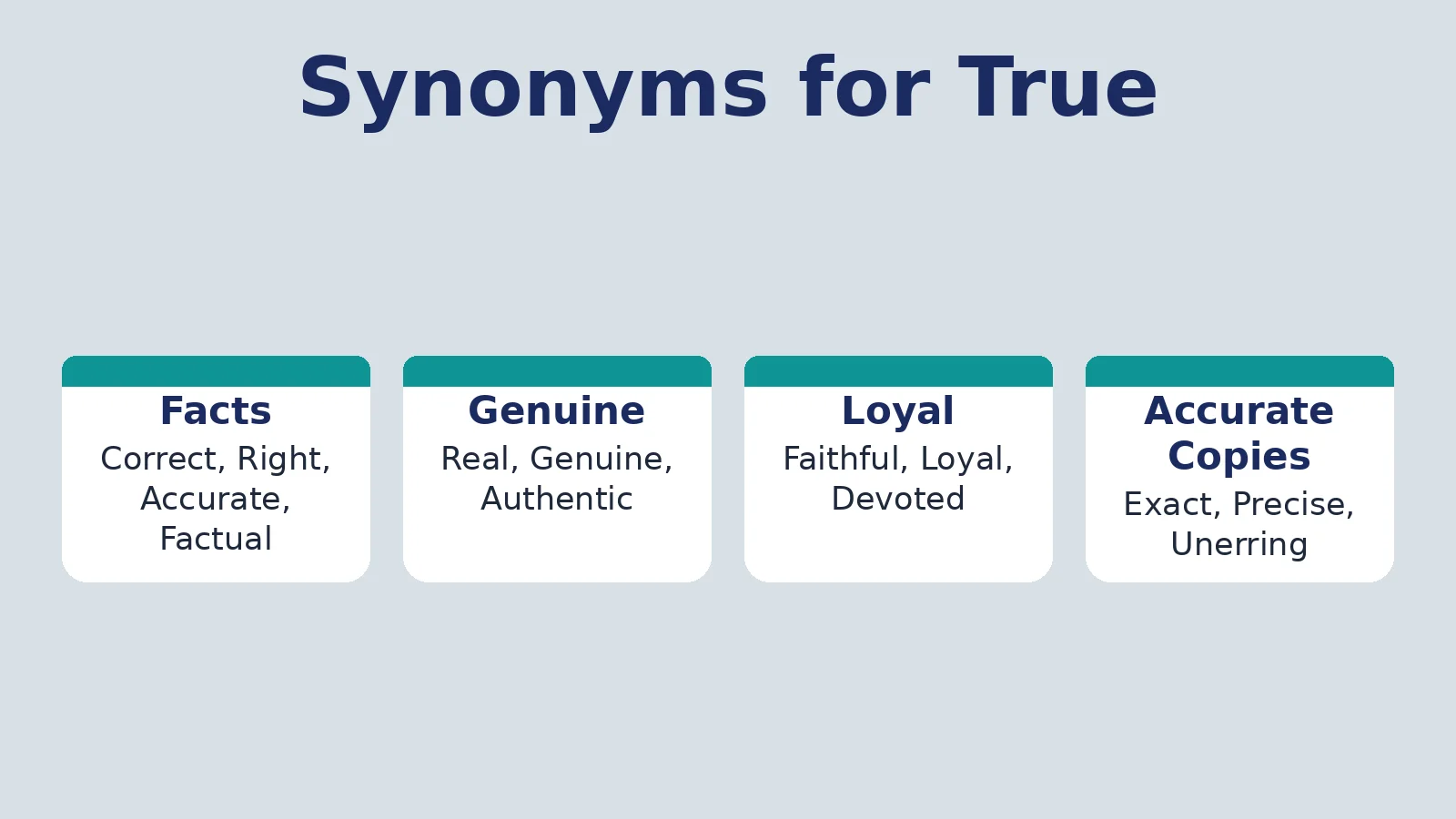
True looks simple until you try to replace it. The most useful synonyms for true are correct, right, accurate, and factual when a statement matches the facts; real, genuine, and authentic when something is the real thing rather than a fake; and faithful, loyal, and devoted when a person stands by someone. Each sense has its own word family, and borrowing across families is where mistakes creep in.
This guide sorts more than 60 synonyms for true by sense, from news claims to wedding vows. Every word comes with a short meaning, and the key words include example sentences. You will also find the tricky neighbors, real, actual, and factual, explained side by side, so the word you pick says exactly what you mean.
Top Synonyms for True: Quick Reference
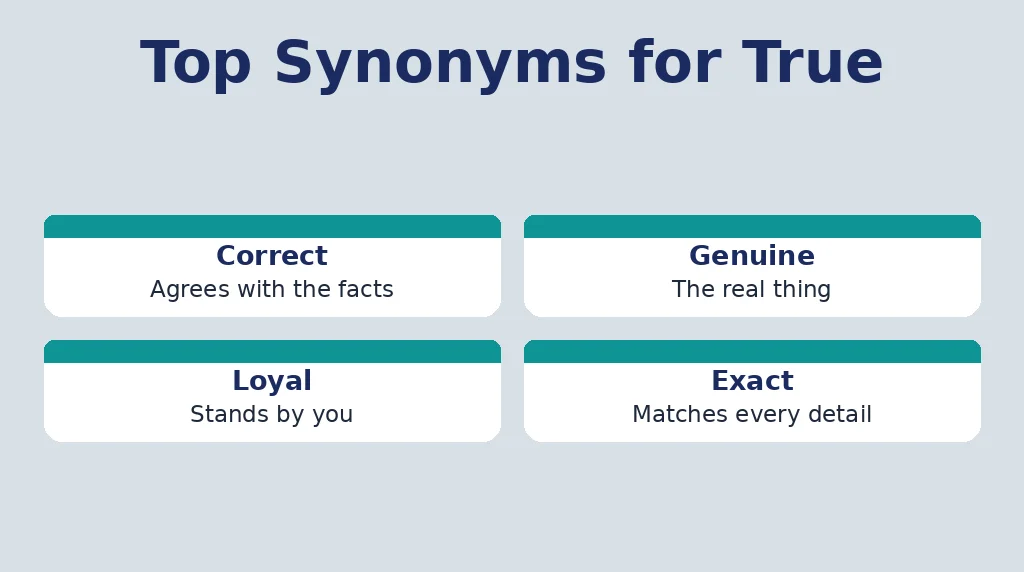
The table below covers the 26 synonyms readers reach for most often. Start here for one fast replacement, then use the later sections for finer shades of meaning.
| Word | Meaning in one line | Best for |
|---|---|---|
| Correct | In agreement with the facts | Answers, statements, claims |
| Right | Matching the facts exactly | Answers, judgments, guesses |
| Accurate | True in every detail | Reports, copies, measurements |
| Factual | Built on facts, not opinion | Reports, accounts, documentaries |
| Truthful | Telling the truth | People, accounts, answers |
| Valid | Sound and acceptable | Arguments, claims, documents |
| Historical | Based on real past events | Stories, dramas, accounts |
| Faithful | True to the original, or loyal | Copies, translations, friends |
| Dead-on | Perfectly true or accurate | Estimates, predictions |
| Spot-on | Exactly true, informal | Judgments, British speech |
| Real | Actually existing, not imagined | Things, feelings, problems |
| Actual | Existing in fact, not supposed | Numbers, events, costs |
| Genuine | The real thing, not fake | Antiques, leather, feelings |
| Authentic | Proven to be real | Documents, art, experiences |
| Sincere | Honestly felt, not pretended | Apologies, thanks, feelings |
| Heartfelt | Deeply and truly felt | Sympathy, gratitude, apologies |
| Loyal | Standing by someone faithfully | Friends, fans, partners |
| Devoted | Loving and loyal in action | Parents, partners, supporters |
| Constant | Steady and unchanging in loyalty | Companions, support, friendship |
| Staunch | Firmly loyal, never wavering | Supporters, allies, defenders |
| Exact | True in every precise detail | Copies, amounts, wording |
| Precise | Exactly accurate, sharply defined | Measurements, descriptions |
| Perfect | Exactly true to a pattern | Copies, examples, imitations |
| Unerring | Never missing the truth or target | Judgment, aim, instinct |
| Rightful | Truly and legally belonging | Owners, heirs, rulers |
| Bona fide | Genuine, in good faith | Offers, organizations, credentials |
What Does True Mean?
True works in at least four directions. First, it judges statements: “The report is true.” Second, it judges things: “This is true gold,” meaning real rather than fake. Third, it judges people: “She stayed true to her friends,” meaning loyal. Fourth, it judges copies and aim: “The portrait is true to life,” or “his aim was true,” meaning accurate. Merriam-Webster’s thesaurus spreads the word across ten sense anchors, from real and correct to loyal and typical, which shows how much ground one small adjective covers.
The practical lesson is simple. Before you swap true for another word, ask what is being judged: a claim, a thing, a person, or a copy. The sections below follow that split. Words from the wrong section rarely break grammar, but they bend meaning. A “loyal statement” and a “factual friend” both sound off, and readers feel the bend even when they cannot name it.
A fifth use hides inside the others. “A true professional” and “a true disaster” call something a perfect example of its kind, typical in every trait. Merriam-Webster files this under its typical anchor. You will meet it again in the accurate section, because a thing that shows its kind perfectly also matches a pattern exactly. Small senses like this one explain why true keeps turning up in idioms, titles, and vows long after simpler words retire.
Synonyms for True That Mean in Agreement with Facts
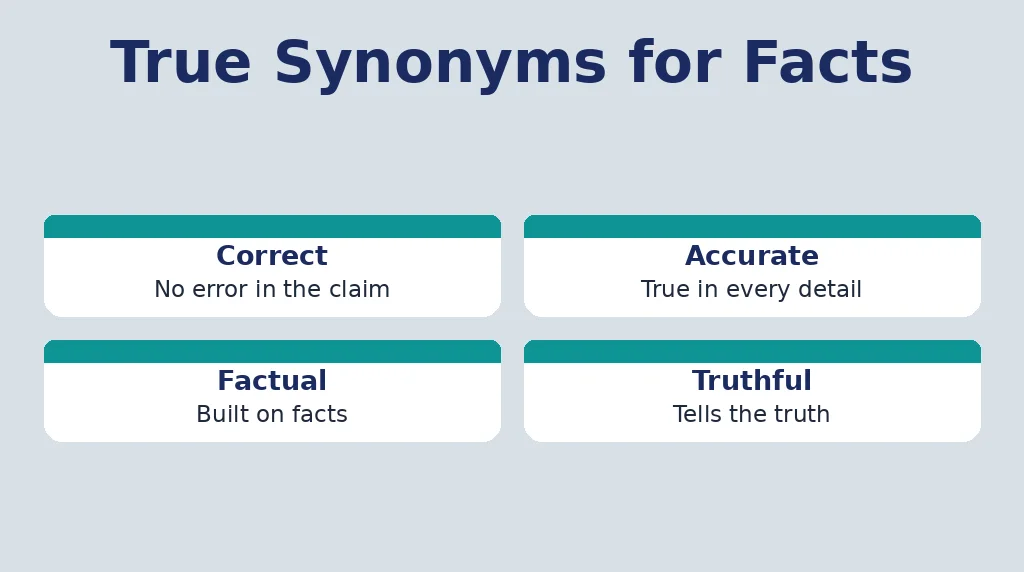
This is the lead sense, the one behind “Is it true?” A statement, report, or belief is true when it matches what actually happened or what is actually the case. Dictionaries build this group around agreement with fact and truth, so the words here judge claims rather than things or people.
Statements, Claims and Reports
- Correct: in agreement with the facts, free from error. Example: “His claim about the date was correct.”
- Right: matching the facts exactly. Example: “All her answers were right, every single one.”
- Accurate: true in every detail, with care taken. Example: “The article gives an accurate account of the trial.”
- Factual: built on facts rather than opinion or rumor. Example: “Keep the summary factual and skip the gossip.”
- Truthful: telling the truth, used for people and their accounts. Example: “She gave a truthful answer, even though it hurt.”
- Valid: sound, logical, or officially acceptable. Example: “Both sides made valid points.” Save valid for arguments and documents.
- Historical: based on real events in the past. Example: “The film stays close to the historical record.”
- Authoritative: based on the best sources, so it can be trusted as true. Example: “It is the authoritative account of the war.”
- Faithful: true to the source or the original facts, for accounts and reports. Example: “Her diary is a faithful record of those years.”
Exactly Right: Informal Praise for Facts
When a guess or estimate lands perfectly, speech reaches for livelier words than correct. These options praise precision, and most of them sound wrong in formal writing.
- Dead-on: perfectly true or accurate. Example: “You said an hour, and you were dead-on.”
- Spot-on: exactly true; British informal. Example: “Her analysis of the problem was spot-on.”
- On the money: exactly true, informal, often about amounts and predictions. Example: “His forecast was right on the money.”
- On the nose: exactly true, informal, often about exact figures. Example: “The repair cost two hundred dollars on the nose.”
- On target: true or accurate, hitting the point aimed at. Example: “The reviewer’s criticism was on target.”
True in Science, Tests and Research
Careful fields split this group even finer. A test is accurate when its results match reality, and a method is valid when it truly measures what it claims to measure. A study earns the label authoritative when experts accept its sources and methods. Findings reported without opinion stay factual, even when later work corrects them.
Writers outside science borrow these habits loosely, and the looseness shows. Calling an everyday claim “valid” because it sounds right skips the testing that gives the word its force. Calling a rumor “factual” because it mentions real places confuses ingredients with results. When precision matters, save this shelf for claims that someone has actually checked, measured, or proved, and let correct and right carry the everyday load.
Synonyms for True That Mean Genuine and Real
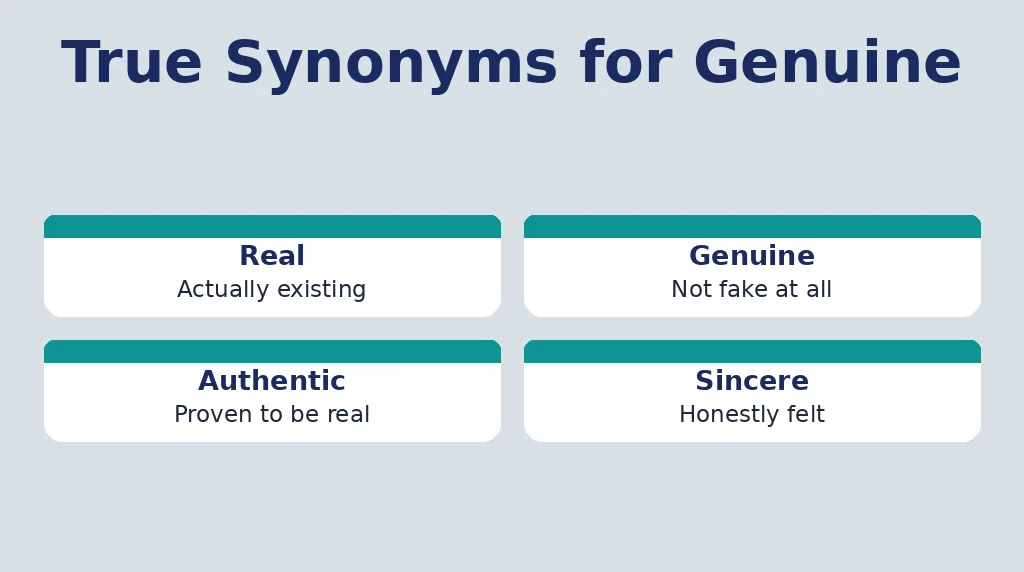
The second sense judges things rather than statements. A true diamond is a real one. True feelings are not performed. True repentance is meant. Collins groups these words under “real or genuine,” and Merriam-Webster anchors this sense with real, actual, and genuine. Watch the overlap with the facts group: a genuine letter is a real object, while a truthful letter is an honest account. Same paper, different judgment.
Shops and markets run on this sense. Leather, gold, antiques, and spare parts all invite fakes, so buyers ask whether goods are genuine or authentic before they ask the price. Feelings invite the same checking in softer language. Everyone has heard an apology that sounded performed, which is why sincere and heartfelt exist: they certify that the inside matches the outside. Whenever the fear is fakery, in goods or in people, this is the family of words that answers it.
The Genuine Article: Real and Authentic
- Real: actually existing, not imagined or copied. Example: “Is that real leather?”
- Actual: existing in fact, often against what was expected. Example: “The actual cost was higher than the quote.”
- Genuine: the real thing, not fake or pretended. Example: “The shop sells genuine spare parts.”
- Authentic: proven to be real and not a copy. Example: “The letter is an authentic wartime document.”
- Natural: in its true state, not artificial or forced. Example: “Her natural warmth won over the crowd.”
- Pure: true and unmixed, the real thing throughout. Example: “The ring is pure gold.”
- Proper: true to type, the real thing in everyday British use. Example: “After weeks of snacks, he wanted a proper meal.”
- Bona fide: genuine and offered in good faith; formal, from Latin. Example: “Only bona fide charities received funds.”
True Feelings: Sincere and Heartfelt
Feelings get their own corner of this sense, because English distrusts performed emotion and keeps special words for the real kind.
- Sincere: honestly felt and meant, not pretended. Example: “He offered a sincere apology.”
- Heartfelt: deeply and truly felt. Example: “She wrote a heartfelt letter of thanks.”
- Unfeigned: not pretended; formal and literary. Example: “His unfeigned surprise made everyone laugh.”
- Unpretended: genuine and not faked; rare and formal. Example: “She showed unpretended interest in their work.”
What you actually feel decides which of these words fits. Sincere suits apologies and thanks, heartfelt suits sympathy and gratitude, and genuine suits joy, interest, and concern. A “true apology” and a “sincere apology” both work, yet sincere names the quality readers are checking for, so it usually wins the slot.
The True Owner: Rightful and Legal
One compact sense hides in law and inheritance. The true owner, the true heir, and the true ruler are the rightful ones, the people with the legal or moral claim.
- Rightful: truly belonging by law or justice. Example: “The painting returned to its rightful owner.”
- Legitimate: lawful and recognized as true. Example: “He was the legitimate heir to the estate.”
- Lawful: allowed and recognized by law. Example: “She is the lawful owner of the house.”
- Legal: recognized by law. Example: “The legal heir lived abroad.”
- Recognized: officially accepted as the true one. Example: “He is the recognized leader of the party.”
True in Everyday Phrases
Some of the most common uses of true live inside phrases, where no single synonym can take its place. A dream comes true when it happens as hoped. A story feels true to life when it matches real experience. A person shows their true colors when their real character finally appears, usually not in a good way. A claim rings true when it sounds believable. A friend who stays true to form behaves as expected. Learn these as whole units, because swapping in real or genuine breaks every one of them.
Two more phrases deserve a place in your notebook. True north names the real direction to the pole, and speakers borrow it for any fixed guiding principle: “Her true north is honesty.” Too good to be true warns that an offer sounds perfect because it is probably fake, which makes it a cousin of the genuine sense. Both phrases survive because they compress a whole judgment into three or four words. When a phrase this efficient exists, reach for it whole instead of building a synonym swap that says less.
Synonyms for True That Mean Loyal and Faithful
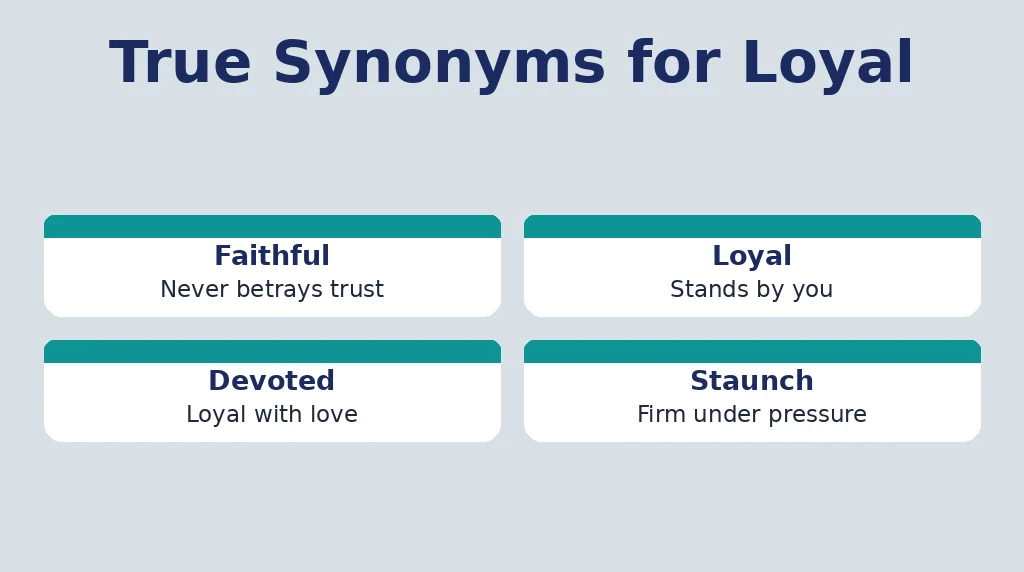
The third sense judges people. A true friend does not leave. A true partner does not betray. Collins groups this sense under “faithful and loyal,” and Merriam-Webster anchors it with loyal and reliable, as in “he will be true to his word” and “a true friend when you need one.” Notice that facts play no part here. A loyal friend can be completely wrong about the score and still be true in this sense.
This sense also governs promises and principles. To stay true to your word is to keep it. To stay true to yourself is to refuse every pressure to pretend. To stay true to a cause is to keep serving it when serving costs something. Each phrase tests a person against a standard they chose, which quietly links this group back to the facts group: in both, true means matching a standard. The difference is who sets the standard. Facts set it for claims; character sets it for people.
True Friends and Partners
- Faithful: loyal and constant, never betraying trust. Example: “A faithful dog waits by the door.”
- Loyal: standing by a person, team, or cause. Example: “She is a loyal friend in hard times.”
- Devoted: loyal with love and effort behind it. Example: “He is a devoted father of three.”
- Constant: steady and unchanging in support. Example: “She was his constant companion for decades.”
- Reliable: able to be trusted every time. Example: “A true car and a reliable car both earn trust,” though only one is about loyalty.
- Trusty: trusted through long service; warm and slightly old-fashioned. Example: “He packed his trusty old map.”
- Fast: fixed firmly in friendship, as in “fast friends”; old-fashioned and literary. Example: “They remained fast friends for life.”
True to a Cause or Belief
- Staunch: firmly loyal, never wavering under pressure. Example: “He is a staunch supporter of the club.”
- Unswerving: never moving away from a belief or promise. Example: “Her unswerving honesty cost her the deal.”
- Steady: calm, regular, and dependable in loyalty. Example: “His steady support kept the project alive.”
- Firm: strong and not easily shaken. Example: “She held a firm belief in fair play.”
- True-blue: completely loyal, informal, often about politics. Example: “He is a true-blue fan who never misses a match.”
- Honest: truthful and fair in character. Example: “An honest partner tells you the hard part too.”
- Upright: honest and moral in conduct. Example: “The town trusted its upright mayor.”
- Honorable: deserving respect for keeping a high moral standard. Example: “She was a true and honorable leader.”
Loyalty words shade from quiet to loud. Constant and steady describe calm, daily faithfulness. Staunch and unswerving describe loyalty under attack, the kind that gets tested. Devoted adds affection, while faithful adds a promise kept. A strong bond is the result readers picture, but the loyalty words describe the behavior that builds it.
Synonyms for True in News, Stories and Love
Watching the senses at work in real settings makes the borders easier to remember. Three common settings pull three different families out of the same small word.
In the News and Public Life
News writing lives in the facts group. Reporters check whether a claim is true, keep reports factual, and quote authoritative sources. Editors correct errors because accurate accounts are the product being sold. When a politician’s promise survives checking, opinion pages may call it valid or simply right. When it fails, the verdict words flip to false and untrue. This setting also loves historical for stories set in the real past, where one invented scene can sink an otherwise honest drama.
In Stories, Film and Song
Stories mix the senses for warmth. A memoir promises a true story, and readers test it against the facts group. A biopic stays faithful to a life, or it does not. Heroes find true love, which belongs to the genuine group with a loyal heart inside it. Ballads praise true friends and curse faithless ones. Writers of fiction reach for heartfelt and sincere when a character finally stops performing. Notice how rarely a novel wants the word factual: fiction trades in emotional truth, and its adjectives confess that trade openly.
In Love and Friendship
Everyday speech keeps the loyal sense busy. Vows promise that partners will stay true, meaning faithful. Friends earn the label true friend by showing up, which is why devoted, constant, and reliable cluster here. A breakup letter complains that love was not real or not genuine, sliding into the second sense. Even insults follow the map: calling someone “not a true friend” attacks loyalty, never accuracy. Nobody has ever ended a friendship over a friend’s factual errors alone.
Synonyms for True That Mean Accurate and Exact
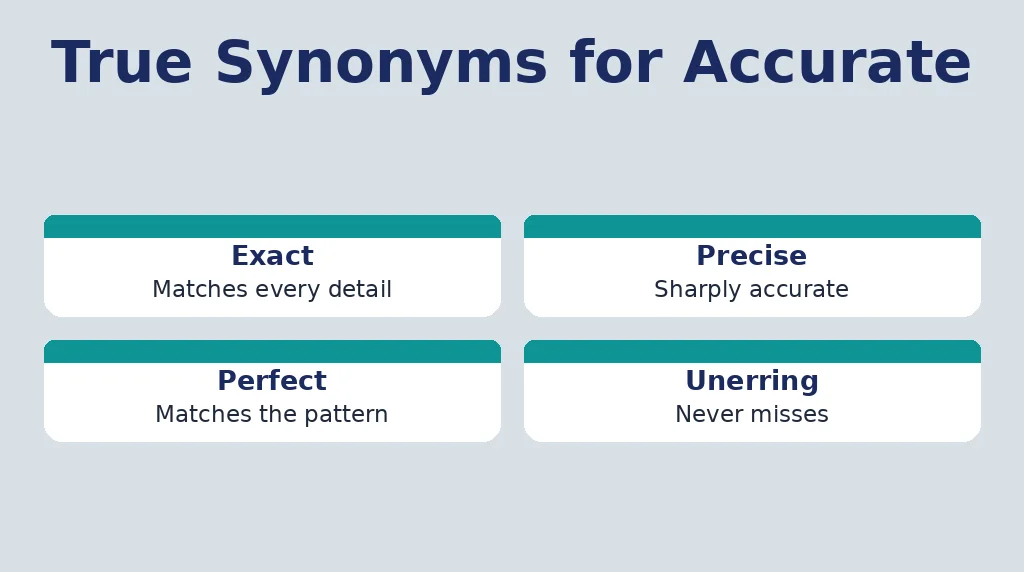
The fourth sense judges how closely one thing follows another. A true copy matches its original. A true aim hits its mark. A true reflection shows things as they are. Merriam-Webster anchors this sense with accurate, in the example of a reproduction that fails because the original is much larger. The words here promise a close match, not a fact and not a feeling.
Copies, Reflections and Aim
- Exact: matching in every detail, with nothing added or missing. Example: “She spoke in an exact copy of his voice.”
- Precise: sharply accurate, with fine detail controlled. Example: “The clock keeps precise time.”
- Perfect: matching a pattern or original completely. Example: “The building is a perfect example of the style.”
- Unerring: never missing or making a mistake. Example: “She has an unerring eye for color.”
- Faithful: matching the original closely, used for copies and adaptations. Example: “The remake stays faithful to the book.”
- Spot-on: exactly accurate; British informal. Example: “The actor’s accent was spot-on.”
- On target: hitting the intended mark. Example: “Every shot landed on target.”
Aim gives this group its oldest picture. An arrow or bullet that flies true flies straight to the mark, which is why “his aim was true” and “the shot flew true” survive in stories. The adverb forms follow the same idea: something done truly in this sense is done accurately, precisely, correctly, or properly. Modern prose mostly keeps this sense for copies, reflections, mirrors, and measurements, where a standard exists to match against.
True as in Straight and Level
Builders and engineers keep one more technical sense. A surface, wheel, or wall is true when every part sits in line.
- Even: level and regular, with no part higher or lower. Example: “Sand the board until it is even.”
- Level: flat and in line, not tilted. Example: “The shelf is level at last.”
- Straight: in line, not bent or crooked. Example: “Check that the seam runs straight.”
- Typical: showing the true character of a kind, as in “a true dinosaur.” Example: “The fossil is a typical early bird.”
Typical earns its place through that last example. Calling something a true member of a group means it shows the group’s real qualities. A true professional, a true gentleman, and a true disaster all borrow this pattern: the noun’s qualities, fully present.
Formal and Informal Synonyms for True
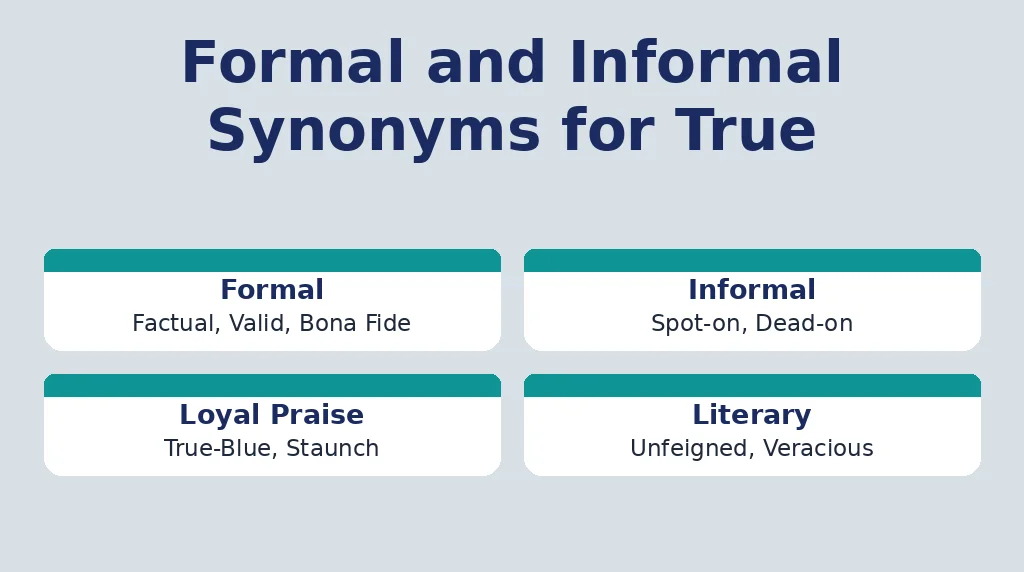
Register changes which words feel at home. A court filing, a news report, and a text message can all say something is true, yet each setting pulls different words from the groups above.
Formal Choices for Essays, Law and Reports
Formal writing prefers factual, accurate, valid, and authoritative for claims. For things and claims of ownership, it uses bona fide, legitimate, and rightful. For character in formal praise, unfeigned, unswerving, and honorable carry weight without sounding casual. Old-fashioned options like veracious, meaning truthful in a formal or literary way, survive mostly in classic books. Its adverb partner veritably appears in phrases like “veritably bursting with pride.” Use these antiques knowingly, for flavor, never by accident.
Essays often need the facts group with a scholarly tone. “The account is factual and authoritative” sounds at home in a paper. “The account is spot-on” does not, however true the account may be. Formal prose also likes truthfully and rightly as adverbs: “As she rightly observed, the data had changed.”
Informal Choices for Speech and Stories
Speech loves spot-on, dead-on, on the money, and on the nose for perfect guesses. True-blue keeps loyalty cheerful, and Australian and New Zealand speech adds dinkum and fair dinkum for genuine people and statements. Fiction borrows all of these for dialogue, because characters sound human when they praise a guess as dead-on rather than accurate. The one caution is range: informal praise words judge facts and aim only. A “dead-on friend” is not a compliment anyone can decode.
How to Choose the Right Synonym for True

Most confusion around true involves three neighbors: real, actual, and factual. They overlap with true and with each other, yet each one owns a home ground. Learning the borders once will fix hundreds of future sentences.
True or Real?
True judges against a standard of fact or pattern. Statements, stories, claims, and copies are true or untrue. Real judges existence and authenticity. Diamonds, problems, feelings, and dangers are real or unreal. The test is easy: if you can ask “Is it true?” about a sentence someone said, use true. If you can touch it, fear it, or fake it, use real. So a true story is a story that matches events, while a real story can also mean a story that actually happened to someone. The overlap is real, but the centers differ, and careful writers keep them apart.
True or Actual?
Actual stresses what exists in fact, often against a guess or a plan. “We expected forty guests; the actual number was sixty.” It belongs with things, numbers, and events. It does not judge whether a claim is correct. “The actual answer” sounds like the answer that exists, whatever it is, while “the true answer” promises the right one. When a sentence corrects an expectation, actual wins. When it settles truth, true wins. Prices, costs, and counts are actual’s home ground, which is why reports pair it with figures so often.
True or Factual?
Factual describes material built from facts or concerned with facts. A factual report deals in checkable information. But factual is about method, not success: a factual report can still contain an error, and then it is factual in style and untrue in one detail. A novel can be entirely invented and still carry a true theme. Use factual when you praise the ingredients, and true when you vouch for the result. Teachers, editors, and judges lean on this split more than any other in this article.
True or Truthful?
Truthful needs a teller. People are truthful, and so are the accounts they give: answers, reports, testimonies, and stories told in someone’s voice. A bare fact, with no teller in the sentence, takes true instead. “The date is true” sounds spare but works; “the date is truthful” quietly invents a speaker who never appears. Interviews, witnesses, and children get graded as truthful. Data, dates, and measurements get graded as true, correct, or accurate. Keep the teller test in mind and this pair will never trouble you again.
A final shortcut: name what follows the word. If a claim, story, or answer follows, start in the facts group. If a thing or a feeling follows, start in the genuine group. If a person or a friend follows, start in the loyal group. If a copy or a reflection follows, start in the accurate group. That one habit resolves most choices before they become problems.
Antonyms for True
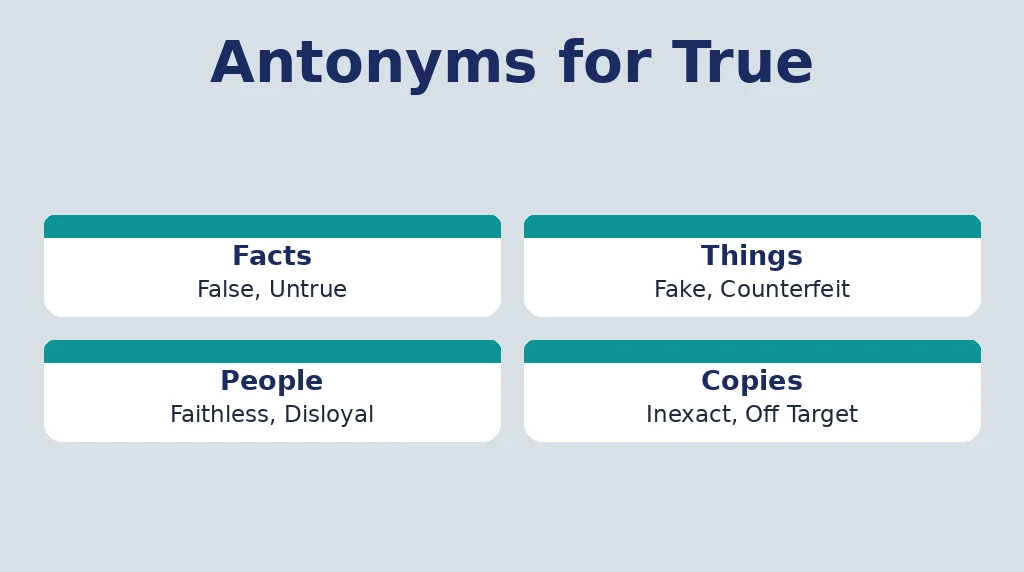
Opposites split by sense again, so here they are in matching groups.
- Facts and statements: false, untrue, incorrect, inaccurate, erroneous, nonfactual. A claim is false; a careless claim is inaccurate; a formal claim may be erroneous.
- Genuine things and feelings: fake, counterfeit, fictitious, fictional, imaginary, made-up, bogus (informal), spurious, phony (informal), make-believe. Counterfeit belongs to money and goods; fictitious belongs to invented names and stories.
- Loyal people: faithless, disloyal, unfaithful, treacherous. Faithless is the classic opposite of the loyal sense, and the sharpest.
- Copies and aim: inexact, unfaithful, off target. A copy that betrays its original is unfaithful, the mirror image of the faithful copy above.
Notice how the strongest opposites differ in temperature. False is cold and final; a false claim is simply the opposite of a true one. Untrue sounds slightly softer and often appears in polite corrections. Bogus and phony add scorn, because they accuse someone of faking. Spurious accuses an argument of dressing up as logic. Choosing an opposite is therefore a tone decision as well as a meaning decision. A teacher marks work false; a friend calls a rumor bogus; a judge may call evidence spurious. Match the heat to the setting.
Common Mistakes: Words That Are Not True Synonyms for True
- Honest: honest describes people and the statements they make, not facts themselves. “An honest answer” works, because someone gave it. “An honest fact” fails, because facts do not speak.
- Valid: valid judges arguments, reasoning, tickets, and documents. A story is true or untrue, never valid, unless a rule or a court is deciding whether it counts.
- Literally: literally means “in the basic sense of the words.” It is not a stronger true. “He literally flew” claims wings; writers who mean truly should say truly.
- Right: right overlaps true for answers, as the linked article above shows, but right also means suitable and moral. “The true tool for the job” fails, because suitability is right’s territory alone.
- Real: as the guide above explains, real judges existence. “The real reason” is fine, but “a real claim” does not say the claim is true; it says the claim exists.
- Truthful: truthful describes a person, or an account presented by a person. A single date, price, or measurement is true, not truthful, until someone reports it.
- Certain and sure: these words report confidence, not truth. “I am certain the shop is open” can still be wrong, because certainty lives in the speaker’s mind. A claim becomes true by matching the facts, not by being believed hard. Dictionaries keep certain and sure in the confidence family, which is why careful writers never use them to certify a fact.
Frequently Asked Questions
What is the best synonym for true?
Correct and right are the safest swaps for statements and claims. For things, genuine and real work best. For people, faithful and loyal lead. The best synonym always depends on which sense of true your sentence uses.
What is a fancy or formal word for true?
For claims, try factual or authoritative. For genuine things, bona fide sounds formal and legal. For loyal character in formal writing, unswerving and honorable carry the most weight.
What is the opposite of true?
False and untrue cover statements. Fake and counterfeit cover things. Faithless and disloyal cover people. The opposite must match the sense, just as the synonyms do.
Is true the same as real?
No. True judges statements, claims, and copies against the facts. Real judges whether things exist or are authentic. A true story matches events; a real diamond is not glass.
What does “come true” mean?
Come true means to happen in the way someone hoped or predicted. Dreams, wishes, and forecasts come true. The phrase works as a whole unit, so no single synonym can replace true inside it.
What is a true friend called in one word?
Faithful and loyal are the classic choices. Devoted adds love and effort, constant adds years of steady presence, and staunch adds loyalty that survives pressure.
Can true describe a copy or a picture?
Yes. A true copy, a true reflection, and a portrait that is true to life all match their originals closely. Faithful, exact, and accurate serve this sense best.
Final Thoughts
True is a judge with four courtrooms: claims, things, people, and copies. Its synonyms stay loyal to their own rooms. Correct and factual guard the claims, genuine and authentic guard the things, faithful and loyal guard the people, and exact and unerring guard the copies. Name the courtroom first, and the right word is usually waiting inside it.
One habit will serve you beyond this page. When true appears in your own draft, pause and ask which courtroom the sentence sits in. Half the time the answer hands you a sharper word for free: a claim becomes correct, a gem becomes genuine, a friend becomes devoted. The other half of the time, true itself is the sharpest word available, and it earns its place. For the dictionary’s own sense map and word lists, the Merriam-Webster Thesaurus entry for true is the best single reference to keep open while you write.