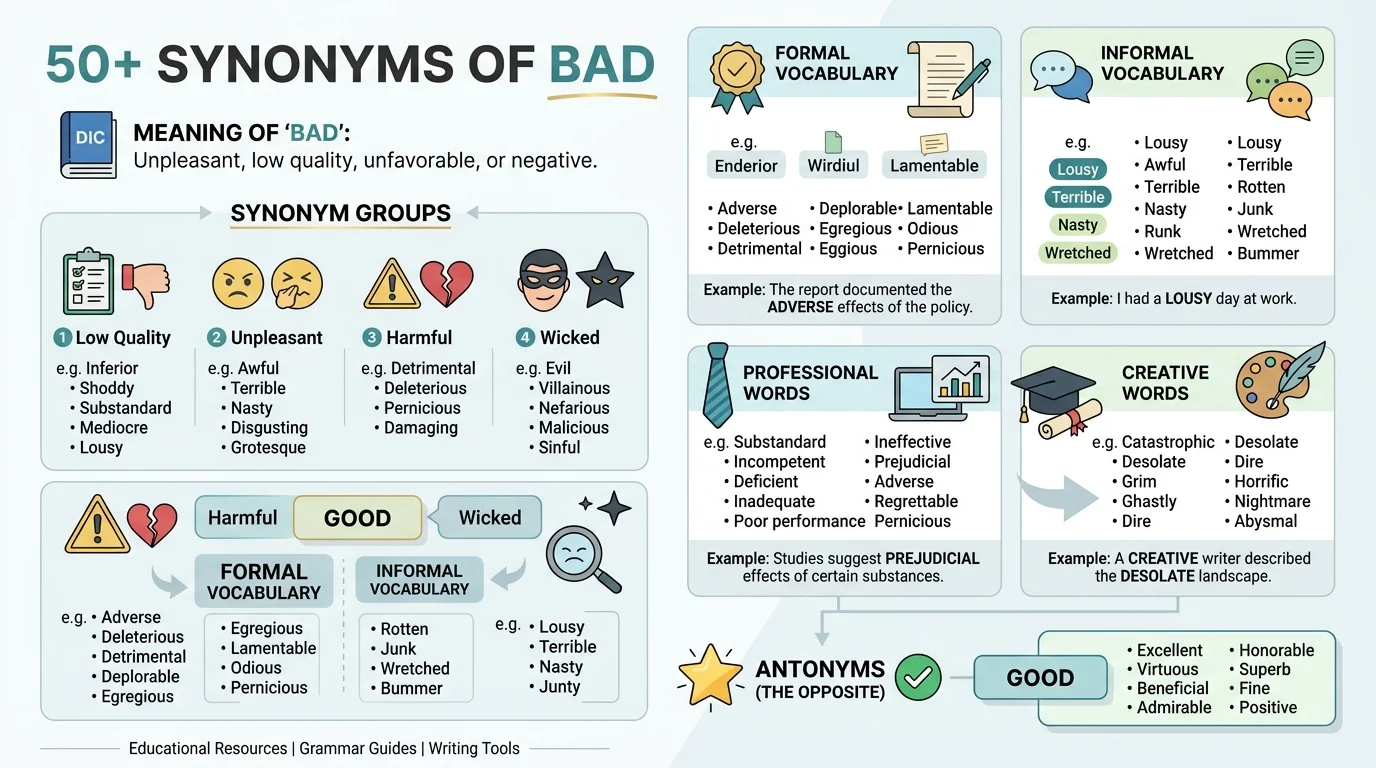
Have you ever found yourself writing an email, essay, or social media post and realized you have used the word “bad” three times in two sentences? You are not alone. Most writers reach for this common adjective when they need to describe something negative, unpleasant, or low quality. But relying on the same word repeatedly makes your writing feel flat and unimaginative.
The good news is that English offers dozens of precise alternatives for “bad.” Each synonym carries a slightly different shade of meaning, emotional weight, and level of formality. Learning the best synonyms of “bad” will transform your communication across every setting, from casual conversations to professional reports.
This guide will help you understand what “bad” truly means, explore the best synonyms for every situation, avoid common mistakes, and choose the perfect word with confidence every time.
What Are the Best Synonyms of “Bad”?
“Bad” describes something unpleasant, harmful, low quality, or morally wrong. For professional writing, choose “poor,” “substandard,” or “unsatisfactory.” Casual conversation, try “terrible,” “awful,” or “lousy.” For academic work, use “inadequate,” “insufficient,” or “deficient.” Emotional impact, select “dreadful,” “horrible,” or “atrocious.” Each synonym fits different contexts and tones.
Meaning, Tone, and Context
Simple Definition
“Bad” is an adjective that describes anything that is not good. It can refer to quality, behavior, health, weather, experiences, or moral character. The word covers everything from minor disappointments to serious problems.
Part of Speech
Adjective. The comparative form is “worse.” The superlative form is “worst.”
Overall Tone
Negative. This word always carries a disapproving or critical tone. It signals that something falls below expected standards.
Formality Level
Neutral. “Bad” works in casual conversation, everyday writing, and even some professional contexts. However, more precise words often sound stronger and more authoritative.
Common Uses
Native English speakers use “bad” in countless situations. They describe bad weather, bad food, bad news, bad behavior, bad decisions, and bad days. The word is so common that it often becomes a verbal crutch.
Word Forms
- Noun: Badness (not commonly used)
- Adjective: Bad (comparative: worse, superlative: worst)
- Adverb: Badly
When and How to Use “Bad”
Choose “bad” when you need a simple, straightforward word that everyone understands. It works well in everyday situations and casual writing. The word is direct and familiar, making it effective when you want clear communication without fancy vocabulary.
Realistic Examples
Professional Context:
“The quarterly numbers look bad, so we need to adjust our strategy immediately.”
Academic Context:
“The research methodology was bad because the sample size was too small.”
Workplace Context:
“His attitude during the meeting was bad and it affected team morale.”
Personal Context:
“I felt bad about forgetting my friend’s birthday party.”
Email Context:
“I apologize for the bad service you experienced during your recent visit.”
Resume Context:
(Use with caution) “I inherited a bad situation and turned it into a profitable department.”
Social Media Context:
“This storm is so bad, we are staying inside all weekend.”
Best Synonyms of “Bad”
No synonym of “bad” works perfectly in every situation. Each alternative carries its own nuance, intensity, and appropriate context. Here are the best choices for common writing scenarios.
Professional Writing: Use “poor” to describe work quality or performance. It sounds objective and measured.
Academic Writing: Use “inadequate” when something fails to meet required standards. It shows analytical thinking.
Business Communication: Use “unsatisfactory” in formal reviews or client feedback. It maintains professionalism while being honest.
Casual Conversation: Use “terrible” to express strong dislike in everyday speech. It is natural and common.
Emotional Writing: Use “dreadful” to create strong negative feelings. It adds weight to your message.
Creative Writing: Use “foul” to create vivid sensory descriptions. It paints a clear picture.
Resume Writing: Avoid using any synonym for “bad.” Focus on achievements instead.
Workplace Communication: Use “subpar” to describe work that did not meet expectations. It sounds factual.
Stronger Meaning: Use “atrocious” when something is shockingly bad. It signals extreme disapproval.
Softer Meaning: Use “not ideal” to soften criticism. It sounds gentler than “bad.”
When Not to Use “Bad”
When It Sounds Too General
“Bad” often fails to provide specific information. Saying “the food was bad” does not tell anyone if it was cold, bland, overcooked, or spoiled. Specific synonyms are clearer.
Weak: The presentation was bad.
Better: The presentation was disorganized and lacked supporting data.
When It Sounds Too Vague
Using “bad” in professional writing makes you sound imprecise. Colleagues and clients expect more detailed feedback.
Weak: Our sales numbers are bad.
Better: Our sales numbers are unsatisfactory for this quarter.
When It Sounds Too Informal
Some situations require formal vocabulary. Resumes, cover letters, and academic papers need stronger word choices.
Weak: My previous job had bad management.
Better: My previous workplace had poor leadership.
When It Sounds Too Weak
Sometimes “bad” does not express enough emotion. In dramatic situations, choose stronger alternatives.
Weak: The accident was bad.
Better: The accident was devastating.
When It Sounds Too Strong
In other cases, “bad” might sound overly critical. When you need gentle feedback, choose softer alternatives.
Harsh: Your work is bad.
Softer: Your work is below our usual standards.
Words Commonly Confused With “Bad”
Bad vs Evil
Difference: “Bad” describes poor quality or unpleasantness. “Evil” describes deliberate cruelty or moral wickedness. Evil is far more serious than bad.
When to Use It: Use “evil” only for genuinely harmful or malicious people and actions.
Example: The villain’s evil plan endangered the entire city.
Bad vs Wrong
Difference: “Bad” focuses on quality or effect. “Wrong” focuses on accuracy, morality, or correctness.
When to Use It: Use “wrong” when something is incorrect or immoral.
Example: She realized the answer she gave was wrong.
Bad vs Poor
Difference: “Poor” describes deficiency or lack of quality. It sounds more measured and less emotional than “bad.”
When to Use It: Use “poor” in professional settings to describe work or performance.
Example: The employee received a poor performance review.
Bad vs Terrible
Difference: “Terrible” is much stronger than “bad.” It conveys fear, shock, or extreme disappointment.
When to Use It: Use “terrible” when you need to express strong negative feelings.
Example: The hotel room had a terrible smell that never went away.
Bad vs Harmful
Difference: “Harmful” specifically describes something that causes damage or danger. “Bad” is more general.
When to Use It: Use “harmful” when discussing health, safety, or environmental impacts.
Example: Smoking is harmful to your lungs.
Bad vs Lousy
Difference: “Lousy” is informal and often used in casual conversation. It suggests incompetence or dissatisfaction.
When to Use It: Use “lousy” in friendly, everyday conversation, not in professional writing.
Example: I had a lousy day at work.
Best Synonyms of “Bad” by Context
| Context | Best Synonym | Why It Works | Example |
|---|---|---|---|
| Formal Writing | Unsatisfactory | It sounds professional and objective | The results were unsatisfactory for the research team |
| Academic Writing | Inadequate | It suggests failure to meet standards | The evidence provided was inadequate to support the theory |
| Professional Communication | Substandard | It clearly signals below-expectation quality | The product quality was substandard for the premium price |
| Business Emails | Poor | It is direct but professional | We received poor feedback from the client |
| Resume Writing | Avoid “bad” | Negative words hurt your application | Focus on accomplishments instead |
| Workplace Communication | Below expectations | It provides specific feedback | Your performance has been below expectations this month |
| Casual Conversation | Terrible | It expresses strong feelings naturally | The movie was absolutely terrible |
| Everyday Speaking | Not great | It softens criticism | The soup is not great today |
| Creative Writing | Foul | It creates strong sensory imagery | A foul odor came from the abandoned house |
| Storytelling | Dreadful | It adds emotional weight | The dreadful news left everyone in shock |
| Emotional Writing | Horrible | It conveys deep negative feelings | The horrible experience changed her perspective |
| Strong Emphasis | Atrocious | It signals extreme disapproval | The working conditions were atrocious |
| Mild Tone | Unfavorable | It sounds neutral and measured | The weather forecast is unfavorable for tomorrow |
| Social Media Captions | Awful | It is common and relatable | Awful traffic on the highway today |
How to Choose the Best Synonym of “Bad”
Choosing the right synonym depends on several factors. Start by considering your audience. Are you writing for a professor, a boss, a friend, or a customer? Professional audiences expect formal synonyms like “unsatisfactory” or “substandard.” Friends and family respond better to casual words like “terrible” or “awful.”
Next, think about emotional intensity. Some situations call for mild criticism while others require strong disapproval. A slightly disappointing meal might be “not great,” while a serious error deserves “atrocious.”
Your writing purpose also matters. Academic papers need precise vocabulary. Creative writing benefits from vivid words. Business communication requires measured language.
Finally, trust your ear. Read your sentence aloud with each synonym. Choose the word that sounds most natural and communicates your message clearly.
Real Life Examples of “Bad”
School Assignment:
“The student received bad feedback on her history essay.” → “The student received unfavorable feedback on her history essay.”
College Application:
“His grades were bad, so he worked hard to improve.” → “His grades were inadequate, so he worked hard to improve.”
Workplace Evaluation:
“Her time management skills are bad.” → “Her time management skills are unsatisfactory.”
Business Meeting:
“The quarterly earnings report is bad.” → “The quarterly earnings report is subpar.”
Professional Email:
“I am writing about the bad customer service I received.” → “I am writing about the unsatisfactory customer service I received.”
Resume:
“He left his previous job because the culture was bad.” → Omit this statement entirely. Focus on achievements instead.
Daily Conversation:
“This coffee tastes bad.” → “This coffee tastes terrible.”
Storytelling:
“Bad weather ruined the outdoor wedding.” → “Dreadful weather ruined the outdoor wedding.”
Blog Post:
“These are the bad habits that destroy productivity.” → “These are the harmful habits that destroy productivity.”
Social Media:
“Bad vibes only today.” → “Awful vibes only today.”
18 Best Synonyms of “Bad”
| Synonym | Simple Meaning | Best Used For | Example Sentence |
|---|---|---|---|
| Awful | Extremely unpleasant or bad | Casual conversation and social media | The food at that restaurant is awful |
| Terrible | Very bad or serious | Expressing strong negative feelings | The team played terrible defense yesterday |
| Poor | Below standard or lacking quality | Professional and academic writing | Poor planning caused the project delay |
| Unsatisfactory | Not meeting requirements or expectations | Formal evaluations and feedback | The contractor delivered unsatisfactory work |
| Substandard | Below expected quality level | Business and product reviews | The materials used were substandard |
| Inadequate | Not enough or not good enough | Academic and analytical writing | The training was inadequate for the new system |
| Deficient | Lacking essential qualities | Technical and professional contexts | The report was deficient in key data |
| Dreadful | Causing fear or suffering | Emotional and storytelling writing | The dreadful news spread through the office |
| Horrible | Very unpleasant or shocking | Everyday expression of disgust | She had a horrible experience at the dentist |
| Atrocious | Shockingly bad or cruel | Strong emphasis and extreme disapproval | The conditions in the prison were atrocious |
| Foul | Extremely offensive or disgusting | Sensory descriptions and creative writing | The garbage left a foul smell in the alley |
| Lousy | Very poor in quality | Informal and casual American English | The service at that diner is lousy |
| Abysmal | Extremely bad or hopeless | Academic and strong negative statements | The student’s test scores were abysmal |
| Mediocre | Only average or below average | Describing performance or quality | The book received mediocre reviews |
| Second-rate | Inferior in quality | Comparative descriptions | The company sold second-rate electronics |
| Unacceptable | Not satisfactory or allowable | Formal complaints and professional settings | The behavior was unacceptable in a workplace |
| Shoddy | Poorly made or done | Describing craftsmanship or work | They used shoddy materials in the construction |
| Not ideal | Less than perfect but not terrible | Softening criticism | The location is not ideal for the restaurant |
Synonyms of “Bad” by Usage
Professional vs Personal Synonyms
Professional settings call for measured vocabulary. Words like “poor,” “substandard,” and “unsatisfactory” sound objective. They convey criticism without attacking anyone personally. In personal conversations, words like “terrible,” “awful,” and “lousy” sound natural and expressive.
Formal vs Conversational Synonyms
Formal writing requires precise, academic vocabulary. “Inadequate,” “deficient,” and “substandard” fit reports, essays, and official documents. Conversational English relies on shorter, more emotional words. “Terrible,” “awful,” and “horrible” are common in everyday speech.
Academic Synonyms
Academics use words that sound analytical and evidence-based. “Inadequate” suggests something fails research criteria. “Deficient” indicates a measurable lack of something. “Substandard” implies comparison against established benchmarks. These words carry authority in scholarly writing.
Professional and Business Synonyms
Business communication benefits from “unsatisfactory” in formal reviews, “subpar” in internal feedback, and “unacceptable” in complaints. “Poor” works well in client communications because it is direct but diplomatic. “Below expectations” sounds factual rather than emotional.
Creative and Literary Synonyms
Writers use vivid alternatives to paint mental pictures. “Foul” describes smells and tastes. “Dreadful” creates atmosphere. “Horrible” evokes strong reader reactions. These words add texture to descriptive writing and dialogue.
Slang or Modern Synonyms
“Lousy” remains common in American English. “Terrible” is widely used. “Awful” sounds natural in most casual contexts. Avoid using any synonym in slang contexts unless you are very familiar with current American usage.
Strongest to Mildest Synonyms
Mild: Not ideal, unfavorable
Moderate: Poor, mediocre, unsatisfactory
Strong: Terrible, awful, dreadful
Very Strong: Atrocious, abysmal, horrible
Emotional vs Neutral Synonyms
Emotional Synonyms: Terrible, awful, dreadful, horrible, atrocious
These words express strong feelings and opinions. Use them when you want to emphasize your reaction.
Neutral Synonyms: Poor, unsatisfactory, inadequate, deficient, substandard
These words state facts without dramatic emotion. Use them in professional and academic writing.
Antonyms of “Bad”
| Antonym | Meaning | Example Sentence |
|---|---|---|
| Good | Of high quality or favorable | She received a good performance review |
| Excellent | Extremely good | The dinner was excellent from start to finish |
| Wonderful | Inspiring delight or admiration | We had a wonderful vacation in the mountains |
| Outstanding | Exceptionally good | His presentation was outstanding |
| Superior | Higher in quality or rank | Their product is superior to the competition |
| Great | Very good or significant | That was a great movie |
| Exceptional | Unusually good | She demonstrated exceptional leadership skills |
| Top-notch | Of the highest quality | The hotel provided top-notch service |
| Fine | Of high quality | The restaurant serves fine cuisine |
| Satisfactory | Meeting expectations | The repairs were satisfactory |
| Adequate | Sufficient or acceptable | The training was adequate for the position |
| Excellent | Extremely good | The students achieved excellent results |
| Marvelous | Extremely good or wonderful | We had a marvelous time at the party |
| Splendid | Magnificent or impressive | The view from the mountain was splendid |
| Superb | Very good or excellent | The chef prepared a superb meal |
Comparison: “Bad” vs Similar Words
Bad vs Evil
Main Difference: “Bad” describes quality, effect, or minor wrongdoing. “Evil” describes deliberate cruelty or profound moral wickedness. Evil is a much more serious accusation.
Which Is Stronger? Evil is far stronger.
Which Is More Formal? Both work in formal contexts, but evil is more dramatic.
When to Use Each: Use “bad” for everyday negative situations. Use “evil” only for genuinely malicious actions or people.
Examples:
Bad: The bad weather ruined our plans.
Evil: The evil dictator committed terrible crimes.
Bad vs Wrong
Main Difference: “Bad” focuses on quality. “Wrong” focuses on correctness or morality.
Which Is Stronger? Wrong can be stronger when discussing moral issues.
Which Is More Formal? Both are neutral formality.
When to Use Each: Use “bad” for quality and pleasantness. Use “wrong” for facts and moral choices.
Examples:
Bad: This is a bad time to call.
Wrong: That answer is wrong.
Bad vs Poor
Main Difference: “Poor” sounds more objective and professional. “Bad” sounds more casual and emotional.
Which Is Stronger? They are similar in strength.
Which Is More Formal? Poor is more formal.
When to Use Each: Use “poor” in professional writing. Use “bad” in casual contexts.
Examples:
Bad: The service was bad.
Poor: The service was poor.
Bad vs Terrible
Main Difference: “Terrible” is more intense than “bad.” It signals fear, shock, or serious disappointment.
Which Is Stronger? Terrible is stronger.
Which Is More Formal? Terrible works in formal contexts but is more emotional.
When to Use Each: Use “bad” for ordinary complaints. Use “terrible” for strong negative reactions.
Examples:
Bad: The food was bad.
Terrible: The food was terrible.
Bad vs Harmful
Main Difference: “Harmful” specifically describes damage. “Bad” is general.
Which Is Stronger? Harmful is more precise and often more serious.
Which Is More Formal? Harmful is more formal.
When to Use Each: Use “harmful” when discussing physical or environmental damage.
Examples:
Bad: The chemicals are bad.
Harmful: The chemicals are harmful.
Bad vs Inferior
Main Difference: “Inferior” compares two things and suggests one is lower quality. “Bad” does not require comparison.
Which Is Stronger? Inferior is more precise.
Which Is More Formal? Inferior is formal.
When to Use Each: Use “inferior” when making comparisons.
Examples:
Bad: This product is bad.
Inferior: This product is inferior to the competition.
Common Phrases and Expressions with “Bad”
Bad news
Meaning: Unpleasant information that causes disappointment or worry.
Example Sentence: I have some bad news about the budget cuts.
Bad mood
Meaning: Feeling irritable, angry, or unhappy.
Example Sentence: She is in a bad mood today after the argument.
Bad habit
Meaning: A regular action or behavior that is harmful or undesirable.
Example Sentence: Biting your nails is a bad habit.
Bad luck
Meaning: Unfortunate circumstances that are not your fault.
Example Sentence: It was just bad luck that the train was delayed.
Bad taste
Meaning: A lack of judgment or appropriateness.
Example Sentence: That joke was in bad taste for a business dinner.
Bad egg
Meaning: A dishonest or unpleasant person.
Example Sentence: Everyone in the office knew he was a bad egg.
Bad apple
Meaning: One person whose negative behavior affects a larger group.
Example Sentence: The manager is a bad apple who brings down team morale.
Common Mistakes to Avoid
Mistake: Choosing a Vague Synonym
Incorrect: The company made bad decisions.
Better: The company made poor decisions regarding budget allocation.
Why It Is Better: “Poor” specifically describes the quality of the decisions. It sounds more professional and measured.
Mistake: Using an Informal Synonym in Formal Writing
Incorrect: The research methodology was lousy.
Better: The research methodology was inadequate.
Why It Is Better: “Inadequate” is the standard academic word. “Lousy” sounds unprofessional in academic contexts.
Mistake: Selecting an Overly Dramatic Synonym
Incorrect: The cafeteria food is atrocious.
Better: The cafeteria food is mediocre.
Why It Is Better: “Mediocre” matches the actual situation. “Atrocious” is too dramatic for typical cafeteria food.
Mistake: Using “Bad” on a Resume
Incorrect: I left my previous job because of bad management.
Better: Omit this statement entirely.
Why It Is Better: Resumes should focus on positive achievements. Negative statements hurt your application.
Mistake: Confusing “Bad” with “Badly”
Incorrect: I felt badly about the situation.
Better: I felt bad about the situation.
Why It Is Better: “Feel” is a linking verb that takes an adjective. “Bad” describes your emotional state. “Badly” would mean poor performance, not emotions.
Mistake: Repeating the Same Word
Incorrect: The weather was bad, and the service was bad too.
Better: The weather was terrible, and the service was poor too.
Why It Is Better: Varying vocabulary makes your writing more interesting and precise.
Mistake: Using Slang in Professional Settings
Incorrect: The quarterly numbers are lousy.
Better: The quarterly numbers are unsatisfactory.
Why It Is Better: “Lousy” is too casual for professional communication. “Unsatisfactory” maintains the appropriate tone.
Frequently Asked Questions
What are the best synonyms of “bad”?
The best synonyms depend on your context. Professional writing, choose “poor” or “unsatisfactory.” For casual conversation, choose “terrible” or “awful.” For academic work, choose “inadequate” or “deficient.” The right word always depends on your audience and purpose.
What are the best formal synonyms of “bad”?
The best formal synonyms include “unsatisfactory,” “inadequate,” “substandard,” “deficient,” and “unacceptable.” These words sound professional in business reports, academic papers, and official documents. They also provide more specific meaning than the general word “bad.”
What are common informal synonyms of “bad”?
Common informal synonyms include “terrible,” “awful,” “horrible,” “lousy,” and “not great.” These words are natural in everyday conversation, social media posts, and casual emails. They are widely understood and help you express negative opinions without sounding too formal.
What is another word for “bad” in professional writing?
The best professional alternative to “bad” is “poor.” It sounds objective, measured, and appropriate for workplace communication. Other professional options include “substandard,” “unsatisfactory,” and “below expectations.” Choose the word that best matches your specific situation.
What is the difference between “bad” and “poor”?
The main difference is tone. “Bad” sounds more casual and emotional. “Poor” sounds more professional and objective. Both describe low quality, but “poor” is the preferred choice in business reports, academic writing, and formal feedback situations where you need a neutral tone.
What is the opposite of “bad”?
The most direct opposite of “bad” is “good.” Other strong opposites include “excellent,” “wonderful,” “outstanding,” “superior,” and “exceptional.” The best antonym depends on your context, just like the best synonym depends on what you are trying to communicate.
Conclusion
The word “bad” is one of the most common adjectives in English, and for good reason. It covers a wide range of negative situations. But when you rely on it too often, your writing loses impact and precision. By learning the best synonyms of “bad,” you gain the ability to express exactly what you mean in every context.
From formal synonyms like “unsatisfactory” and “inadequate” to casual alternatives like “terrible” and “awful,” the English language provides countless ways to describe negative situations. The key is choosing the word that fits your audience, your tone, and your purpose.
Remember that no single synonym works perfectly in every situation. Professional writing demands measured vocabulary. Creative writing benefits from vivid imagery. Academic work requires precise terminology. And casual conversation rewards natural, expressive words.
The next time you reach for the word “bad,” pause for a moment. Consider whether a more specific alternative would serve your message better. Your readers will appreciate the clarity, and your writing will become stronger and more engaging. This small vocabulary adjustment is one of the most effective ways to improve your communication across every setting.