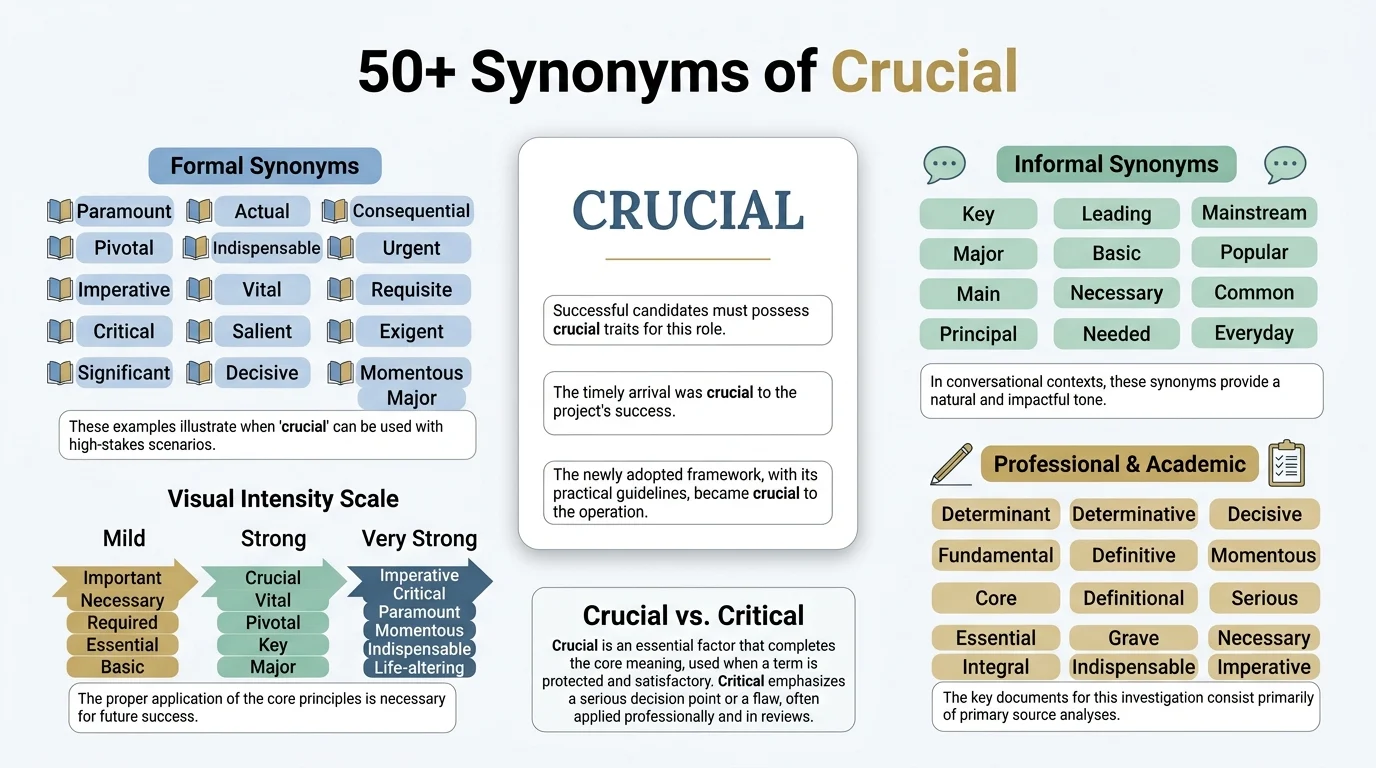
Have you ever found yourself writing an email, an essay, or a social media caption and realized you have used the word “important” three times in two sentences? Or perhaps you default to “crucial” for everything, from a major business decision to what you are having for dinner. Repeating the same word makes your writing feel flat and less engaging. Understanding the synonyms of crucial can transform your communication. This guide will help you move beyond simple repetition and choose the exact word that fits your meaning, tone, and audience. Whether you are a student, a professional, or someone who simply wants to speak and write more effectively, mastering these alternatives will make your language clearer and more powerful.
What Are the Best Synonyms of “Crucial”?
The word “crucial” means extremely important or decisive, especially in determining the outcome of a situation. It is a neutral-to-strong word used in both formal and semi-formal contexts. The best synonyms depend on your needs: use “critical” or “pivotal” for decisive moments, “vital” or “essential” for absolute necessity, “paramount” for top priority in professional settings, and “key” or “major” for everyday importance.
Meaning, Tone, and Context
Simple Definition
Something that is crucial is of extreme importance and has a significant impact on the outcome or future of a situation. It is the point on which everything else turns.
Part of Speech
Crucial is an adjective. It is used to describe a noun, such as a moment, decision, factor, or role.
Overall Tone
The word “crucial” carries a neutral to strong tone. It conveys seriousness and urgency without being overly emotional. It is often used to highlight a turning point or a make-or-break moment.
Formality Level
Semi-formal to formal. “Crucial” is appropriate for academic writing, professional reports, and business communication. It is less common in casual conversation, where simpler words like “key” or “really important” are often used.
Common Uses
Native English speakers commonly use “crucial” to describe:
- Pivotal moments in time (“a crucial moment”).
- Decisive factors in a process (“a crucial element”).
- Essential steps or requirements (“a crucial step”).
- Significant issues or questions (“a crucial issue”).
Word Forms
- Adjective: crucial
- Noun: crucialness (rare) or cruciality
- Adverb: crucially
When and How to Use “Crucial”
You should choose “crucial” when you want to emphasize that something is not just important, but is a deciding factor for success or failure. It is the word for moments that change the course of events.
Here are 7 realistic examples showing how to use “crucial” in different contexts:
- Professional: “Building a strong company culture is crucial for retaining top talent.”
- Academic: “The researcher identified a crucial variable that had been overlooked in previous studies.”
- Workplace: “Your feedback on this project is crucial before we send the final version to the client.”
- Personal: “Getting enough sleep is crucial for maintaining good health and focus.”
- Email: “It is crucial that we finalize the budget by Friday to meet the deadline.”
- Resume: “Played a crucial role in launching a new product line that increased revenue by 20%.”
- Social Media: “A good support system is crucial for navigating life’s challenges.”
Best Synonyms of “Crucial”
No two synonyms are perfectly identical. The best word depends on the nuance you want to convey. Here are the top recommendations for different situations:
- For Professional Writing: Paramount is an excellent choice. It signifies that something is of the highest importance and takes precedence over all else.
- For Academic Writing: Pivotal is ideal. It suggests that something is of central importance and is the point on which other things turn or depend.
- For Business Communication: Critical works well. It implies that something is essential and that its absence would lead to failure.
- For Casual Conversation: Key is the most natural choice. It is a simple, everyday word that means important or essential.
- For Emotional Writing: Momentous adds a layer of significance, suggesting that an event or decision is historically or personally very important.
- For Creative Writing: Decisive is powerful. It emphasizes that an action or moment is the one that determines the final outcome.
- For Resume Writing: Instrumental is a strong choice. It shows that you were not just involved but were a key factor in achieving a result.
- For Workplace Communication: Essential is a safe and effective word. It means something is absolutely necessary.
- For a Stronger Meaning: Imperative is more forceful. It suggests that something is not just important but is an urgent and unavoidable duty or necessity.
- For a Softer Meaning: Significant is a milder alternative. It means something is important or notable without the life-or-death urgency that “crucial” can imply.
When Not to Use “Crucial”
Using “crucial” too often or in the wrong context can weaken your message. Here are situations where you should choose a different word.
- When it sounds too general: If you use “crucial” to describe everything, it loses its impact.
- Less Effective: “It is crucial to bring a pen to the meeting.”
- Better: “It is helpful to bring a pen to the meeting.”
- When it sounds too vague: “Crucial” doesn’t specify how something is important.
- Less Effective: “She played a crucial role.”
- Better: “She played a decisive role in securing the contract.”
- When it sounds too formal: In a casual text or conversation, “crucial” can sound stiff.
- Less Effective: “It is crucial that you pick up milk.”
- Better: “It’s really important that you pick up milk.”
- When it sounds too weak: If you need to express absolute, non-negotiable necessity, “crucial” might not be strong enough.
- Less Effective: “Water is crucial for survival.”
- Better: “Water is essential for survival.”
- When it sounds too strong: Describing a minor preference as “crucial” can make you sound dramatic.
- Less Effective: “It is crucial that we get a window seat.”
- Better: “It would be nice to get a window seat.”
Words Commonly Confused With “Crucial”
Many words are similar to “crucial,” but they have distinct meanings. Understanding the differences will help you choose the most accurate word.
Crucial vs. Important
Difference: “Important” is a general term for something that has significance or value. “Crucial” is a specific type of important: it is decisive for the outcome of a situation.
When to Use It: Use “important” for general significance. Use “crucial” when the success or failure of something depends on it.
- Important: “It is important to eat a balanced diet.”
- Crucial: “The final witness’s testimony is crucial to the case.”
Crucial vs. Critical
Difference: While often used interchangeably, “critical” can imply a sense of danger or emergency, or a moment of intense scrutiny. “Crucial” focuses more on the decisive nature of the moment. “Critical” is also often used in more objective, technical contexts.
When to Use It: Use “critical” when there is an element of risk or when discussing technical or scientific matters. Use “crucial” for a broader range of decisive moments.
- Critical: “The patient is in critical condition.”
- Crucial: “This is a crucial election that will determine the country’s future.”
Crucial vs. Essential
Difference: “Essential” means absolutely necessary and fundamental. Something can be essential without being crucial to the outcome of a specific event.
When to Use It: Use “essential” when something is a basic requirement. Use “crucial” when it is a deciding factor in a specific process.
- Essential: “Fuel is essential for a car to run.”
- Crucial: “The driver’s reaction time was crucial in avoiding the accident.”
Crucial vs. Vital
Difference: “Vital” means absolutely necessary or essential for life or success. It is similar to “essential” but often has a stronger connotation of being life-sustaining.
When to Use It: Use “vital” when something is indispensable and of life-or-death importance, or simply when you want to sound more emphatic than “essential”.
- Vital: “Oxygen is vital for all animals.”
- Crucial: “The CEO’s decision was crucial to the company’s turnaround.”
Crucial vs. Pivotal
Difference: “Pivotal” specifically means that something is of central importance and is the point on which other things turn or depend.
When to Use It: Use “pivotal” to describe a central figure, event, or idea that everything else revolves around.
- Pivotal: “She played a pivotal role in the negotiations, bringing both sides together.”
Crucial vs. Decisive
Difference: “Decisive” means having the power to determine an outcome. It is often used to describe actions or events that settle a question or end a conflict.
When to Use It: Use “decisive” when referring to an action or event that settles a matter definitively.
- Decisive: “The general’s decisive victory ended the war.”
Best Synonyms of “Crucial” by Context
| Context | Best Synonym | Why It Works | Example |
|---|---|---|---|
| Formal Writing | Paramount | It signifies the highest level of importance, taking precedence over all else. | “Data security is of paramount importance to our organization.” |
| Academic Writing | Pivotal | It describes a central idea or finding on which the entire argument depends. | “This study provides a pivotal insight into the causes of the phenomenon.” |
| Professional Communication | Critical | It clearly states that something is essential and its absence would lead to failure. | “Meeting this deadline is critical for the project’s success.” |
| Business Emails | Key | It is a concise and professional way to highlight a main point or requirement. | “The key points from our meeting are outlined below.” |
| Resume Writing | Instrumental | It shows you were an essential driving force behind a success. | “Was instrumental in developing a new customer retention strategy.” |
| Workplace Communication | Essential | It is a clear, straightforward word for something that is absolutely necessary. | “A positive attitude is essential for effective teamwork.” |
| Casual Conversation | Big | It is an informal, simple word for something that matters a lot. | “This is a big decision for us.” |
| Everyday Speaking | Major | It is a natural way to say something is significant. | “That’s a major issue we need to deal with.” |
| Creative Writing | Momentous | It adds a sense of great importance and historical or personal significance. | “The day of the launch was a momentous occasion for the company.” |
| Storytelling | Fateful | It suggests that an event will have significant and usually negative consequences. | “It was a fateful decision that changed his life forever.” |
| Emotional Writing | Heart-wrenching | While not a direct synonym, it conveys the emotional weight of a crucial, difficult decision. | “It was a heart-wrenching decision to leave her hometown.” |
| Strong Emphasis | Imperative | It conveys an urgent, unavoidable necessity. | “It is imperative that we act now to prevent a crisis.” |
| Mild Tone | Significant | It acknowledges importance without the urgency or high stakes of “crucial.” | “There has been a significant improvement in sales.” |
| Social Media Captions | Game-changing | A modern, impactful term for something that creates a major shift. | “This new app is an absolute game-changer.” |
| American English | Crucial | The standard and widely understood term. | “It’s crucial that we get this right.” |
How to Choose the Best Synonym of “Crucial”
Choosing the right word is about more than just swapping one word for another. It is about matching your language to your intent. Ask yourself these questions:
- What is my exact meaning? Am I saying something is necessary, decisive, or just very significant?
- What is my tone? Do I want to sound urgent, professional, academic, or casual?
- Who is my audience? Will they understand and appreciate a formal word like “paramount,” or would “key” be more effective?
- How strong do I need to be? Is this a life-or-death situation (“vital”), a major turning point (“pivotal”), or a simple preference (“helpful”)?
- What is my writing purpose? Is this a resume where “instrumental” shows achievement, or an email where “critical” emphasizes a deadline?
Choose the synonym that communicates your intended message with the greatest clarity and precision.
Real Life Examples of “Crucial”
Seeing these words in action is the best way to understand their nuances. Here are examples from various situations.
- School: “Studying for the final exam is essential if you want to pass the class.”
- College: “Choosing a major is a pivotal decision that will shape your career path.”
- Workplace: “Effective communication is key to a productive team environment.”
- Business: “This merger is a critical moment for our company’s future.”
- Email: “It is imperative that you review the attached documents before our meeting.”
- Resume: “Was instrumental in launching the company’s first international branch.”
- Conversation: “Getting a good night’s sleep is really important for the big game tomorrow.”
- Storytelling: “The detective made a fateful choice that led him to the killer.”
- Blogging: “Building an email list is a vital step for any new blogger.”
- Social Media: “This new skincare product is a total game-changer for my routine.”
18 Best Synonyms of “Crucial”
Synonyms of “Crucial” by Usage
Professional vs Personal Synonyms
In the workplace, words like paramount, instrumental, and imperative convey a high level of professionalism and seriousness. They are perfect for reports, presentations, and client communication. In personal conversations, key, major, and big sound more natural and less stiff. For example, you might say, “It’s key that we coordinate our schedules,” to a family member, but “This deal is of paramount importance to the firm,” to a colleague.
Formal vs Conversational Synonyms
Formal: Use paramount, pivotal, imperative, and momentous for essays, research papers, official reports, and formal speeches. Conversational: Use key, major, big, and even huge for texting, casual emails, and everyday chatting.
Academic Synonyms
For research and academic writing, precision is key. Pivotal and fundamental are excellent choices. Seminal is another strong word used to describe work that has a major influence on a field. Paramount is also appropriate when discussing issues of primary importance in a study.
Professional and Business Synonyms
Resumes and cover letters benefit from strong, action-oriented synonyms. Instrumental and critical are powerful. In meetings and presentations, paramount, key, and central help you highlight the most important points concisely and professionally.
Creative and Literary Synonyms
Writers can use momentous, fateful, and pivotal to add drama and significance to their storytelling. Crucial itself is a favorite among writers for describing a key moment in a plot. For descriptive writing, all-important or life-changing can be effective.
Slang or Modern Synonyms
While there are no direct slang synonyms for “crucial,” modern, informal alternatives like game-changing and make-or-break are popular. You might also hear huge or massive used to express great importance. Use these in casual contexts, but avoid them in formal or academic writing.
Strongest to Mildest Synonyms
Understanding the intensity of a synonym helps you choose the right emotional weight for your message.
- Mild (Important, notable): Significant, major, key
- Moderate (Very important, necessary): Important, central, primary
- Strong (Extremely important, decisive): Crucial, critical, vital, pivotal
- Very Strong (Absolutely necessary, urgent): Paramount, imperative, indispensable, urgent
Emotional vs Neutral Synonyms
Emotional Synonyms
Words that carry a strong emotional charge include momentous (awe, significance), fateful (doom, destiny), and urgent (anxiety, pressure). These are great for speeches, storytelling, and persuasive writing.
Neutral Synonyms
Key, major, and primary are neutral. They simply communicate importance without adding extra feeling. Use these when you want to be factual and objective, such as in technical reports or neutral summaries.
Antonyms of “Crucial”
Comparison: “Crucial” vs Similar Words
Crucial vs Essential
Main Difference: “Crucial” is about being decisive for a specific outcome. “Essential” is about being a fundamental, necessary part of something.
Which Is Stronger? “Essential” can be stronger in the sense of being non-negotiable, but “crucial” carries a different kind of weight related to the final result.
Which Is More Formal? Both are formal, but “essential” is slightly more common in academic and technical writing.
When to Use Each: Use “essential” for basic requirements. Use “crucial” for a specific, make-or-break factor.
- Essential: “A valid passport is essential for international travel.”
- Crucial: “The pilot’s decision to land was crucial for the safety of the passengers.”
Crucial vs Vital
Main Difference: “Vital” is closely linked to life or living things (“vital organs,” “vital signs”), while “crucial” is linked to the outcome of a situation or crisis.
Which Is Stronger? “Vital” is often perceived as stronger because it relates to life itself.
Which Is More Formal? Both are used in formal and informal contexts.
When to Use Each: Use “vital” when something is indispensable for existence or success. Use “crucial” when something is the deciding factor.
- Vital: “Clean water is vital for human health.”
- Crucial: “Her testimony was crucial in winning the case.”
Crucial vs Critical
Main Difference: “Critical” can imply a state of danger, emergency, or extreme disapproval (e.g., “a critical review”). “Crucial” is more neutral, focusing solely on importance and decisiveness.
Which Is Stronger? “Critical” can be stronger in a medical or emergency context.
Which Is More Formal? Both are formal.
When to Use Each: Use “critical” when there is an element of risk or for technical matters. Use “crucial” for general decisive moments.
- Critical: “The patient is in critical condition.”
- Crucial: “This is a crucial moment in the negotiations.”
Crucial vs Pivotal
Main Difference: “Pivotal” means something is of central importance and is the point on which other things turn. “Crucial” emphasizes the decisive impact on the final outcome.
Which Is Stronger? “Crucial” is often stronger because it suggests a direct impact on the success or failure of something.
Which Is More Formal? Both are formal, but “pivotal” is particularly common in academic writing.
When to Use Each: Use “pivotal” to describe a central element or person. Use “crucial” to emphasize the make-or-break nature of a factor.
- Pivotal: “He played a pivotal role in the company’s founding.”
- Crucial: “The marketing campaign was crucial to the product’s success.”
Crucial vs Decisive
Main Difference: “Crucial” describes the importance of a moment or factor. “Decisive” describes an action or event that settles a matter and determines the outcome.
Which Is Stronger? “Decisive” is stronger in the sense of finality.
Which Is More Formal? Both are formal.
When to Use Each: Use “crucial” to talk about an important moment. Use “decisive” to talk about an action that ends a debate or conflict.
- Crucial: “The final game of the season was crucial.”
- Decisive: “The team’s decisive victory secured the championship.”
Crucial vs Important
Main Difference: “Important” is a general term for something that has value or significance. “Crucial” is a specific type of important: it is decisive for a future outcome.
Which Is Stronger? “Crucial” is stronger because it implies a higher stakes.
Which Is More Formal? “Important” is neutral; “crucial” is more formal.
When to Use Each: Use “important” for general significance. Use “crucial” when the success or failure of something depends on it.
- Important: “It is important to exercise regularly.”
- Crucial: “The final stage of the experiment is crucial to its success.”
Common Phrases and Expressions with “Crucial”
Common Mistakes to Avoid
- Choosing a vague synonym instead of a precise one. “Important” is often too vague when you really mean “pivotal” or “decisive.
- Incorrect: “The CEO’s decision was important.”
- Better: “The CEO’s decision was decisive for the company’s future.”
- Confusing “crucial” with “critical.” While similar, “critical” can imply a sense of danger that “crucial” does not.
- Incorrect: “The situation is very crucial.” (This can sound odd. “Critical” is better for danger.)
- Better: “The situation is very critical.”
- Using an informal synonym in formal writing. Using “big” or “huge” in an academic paper can sound unprofessional.
- Incorrect: “This is a huge finding.”
- Better: “This is a significant finding.”
- Selecting an overly dramatic synonym. Calling a minor inconvenience “catastrophic” or “vital” is an overstatement.
- Incorrect: “It is vital that we have coffee for the meeting.”
- Better: “It would be good to have coffee for the meeting.”
- Repeating the same word too often. Even the best word becomes boring and loses its impact if used multiple times in a short space.
- Incorrect: “The crucial factor was X. The crucial decision was Y. The crucial moment was Z.”
- Better: “The pivotal factor was X. The critical decision was Y. The decisive moment was Z.”
- Choosing a synonym with the wrong emotional tone. Using a neutral word like “key” in a persuasive speech may not be as impactful as “paramount.”
- Incorrect: “This is a key issue for our future.”
- Better: “This is a paramount issue for our future.”
Frequently Asked Questions
1. What are the best synonyms of “crucial”?
The best synonyms depend on context. Formal writing, use “paramount” or “pivotal.” For everyday speech, “key” or “major” work well. For emphasizing necessity, “vital” and “essential” are excellent choices.
2. What are the best formal synonyms of “crucial”?
The best formal synonyms include “paramount,” “pivotal,” “imperative,” “decisive,” and “momentous.” These words are appropriate for academic papers, business reports, and professional correspondence.
3. What are common informal synonyms of “crucial”?
Common informal synonyms include “key,” “major,” “big,” and “huge.” These are perfect for casual conversations, texts, and social media posts.
4. What is another word for “crucial” in professional writing?
“Critical,” “paramount,” and “instrumental” are excellent choices for professional writing. They convey a high level of importance and seriousness, making them ideal for resumes, reports, and business emails.
5. What is the difference between “crucial” and “critical”?
“Crucial” emphasizes the decisive impact on an outcome, while “critical” often implies a sense of danger, urgency, or a turning point. “Critical” is also more common in technical and medical contexts.
6. What is the opposite of “crucial”?
The opposite of “crucial” includes words like “unimportant,” “minor,” “insignificant,” “trivial,” and “inconsequential.” These words describe things that have little to no impact on an outcome.
Conclusion
The word “crucial” is a powerful adjective that helps you highlight the most important, make-or-break elements of any situation. However, the English language is rich with alternatives. By understanding the subtle differences between synonyms like pivotal, critical, vital, and paramount, you can choose the exact word that conveys your intended meaning, tone, and level of formality. Remember that no synonym works perfectly in every situation. The key to great writing is to consider your audience, your purpose, and the specific nuance you want to express. To improve your vocabulary, try replacing “crucial” with a more precise synonym the next time you write. Keep exploring the synonyms of crucial and other powerful words to make your communication more vibrant and effective.