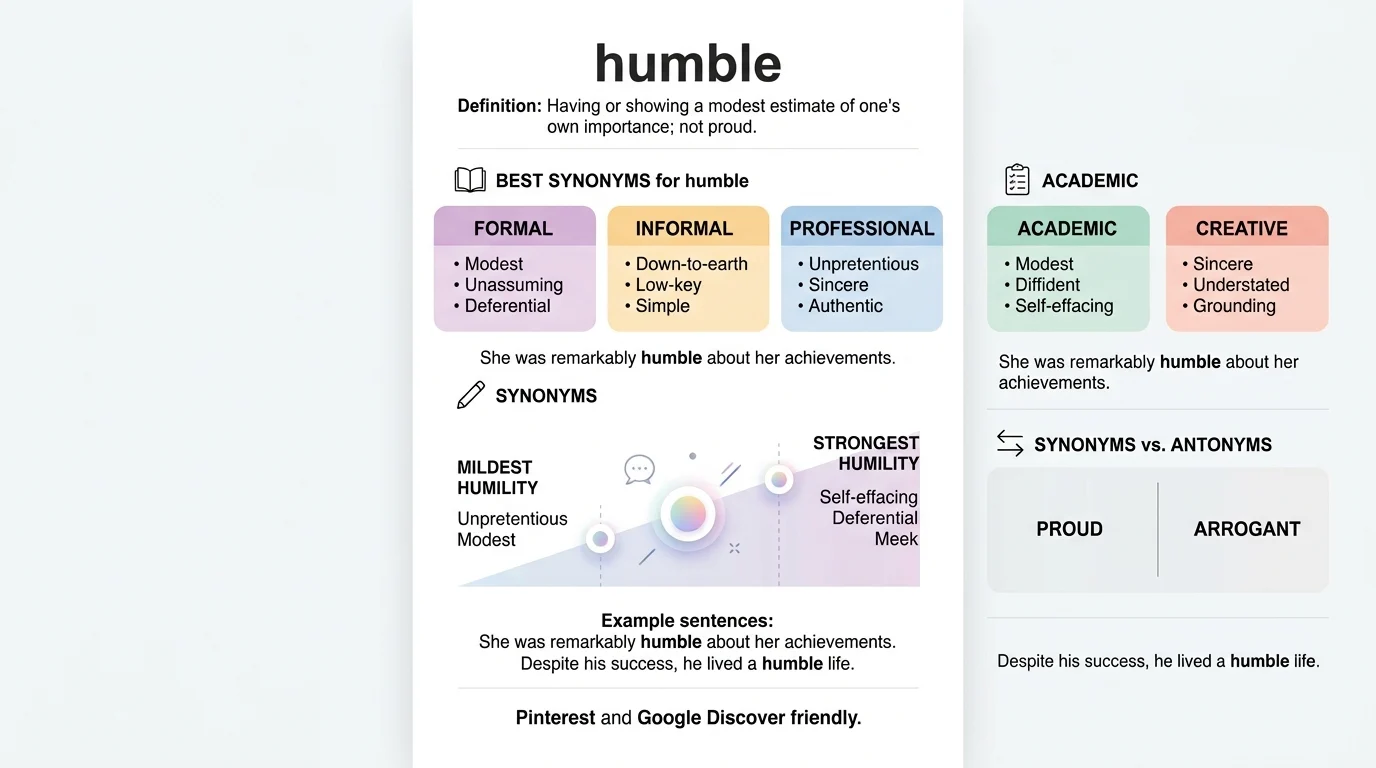
Have you ever been writing an email, an essay, or a social media caption and found yourself typing the word “humble” over and over again? You know the feeling. You want to describe someone who is modest, but the word just doesn’t seem to capture the exact nuance you are looking for. Maybe you are writing a recommendation letter and need a more professional term. Or perhaps you are crafting a story and need a word with more emotional depth. This is where exploring the synonyms of humble becomes essential. Choosing the right synonym improves clarity, refines your tone, and makes your communication more powerful. It is not just about avoiding repetition; it is about saying exactly what you mean.
What Are the Best Synonyms of “Humble”?
The word “humble” describes someone who is not proud or arrogant and has a modest view of their own importance. The best synonym depends on your context. For professional writing, use “modest” or “unpretentious.” For academic work, “unassuming” or “self-effacing” are excellent choices. In casual conversation, “down-to-earth” works well. For emotional or creative writing, try “meek” or “lowly.”
Meaning, Tone, and Context
Simple Definition
The adjective “humble” primarily describes a person who does not think they are better than others. It is the quality of being modest and not arrogant. A humble person does not boast about their achievements or seek excessive attention.
Part of Speech
“Humble” is primarily an adjective. It can also be used as a verb, meaning to make someone feel less important or to lower someone in dignity.
Overall Tone
The tone of “humble” is generally positive. It is a trait that is widely admired and considered a virtue in many cultures. However, it can sometimes have a slightly negative or self-deprecating connotation if used to describe someone who underestimates their own worth excessively.
Formality Level
“Humble” is a neutral word. It is appropriate for both formal and informal settings. You can use it in a professional email, an academic essay, or a casual conversation with friends.
Common Uses
Native English speakers use “humble” in various situations. They use it to describe a person’s character, as in “She is a humble leader.” They use it to describe an apology, like “Please accept my humble apologies”. It is also used to describe a person’s origins or background, for example, “He rose from humble beginnings”.
Word Forms
- Noun: Humbleness, Humility
- Verb: Humble (to humble someone), Humbled (past tense)
- Adverb: Humbly
When and How to Use “Humble”
Choosing the word “humble” is most effective when you want to emphasize a lack of ego or a grounded sense of self. It is a safe and widely understood choice. Here are seven realistic examples showing how to use it in different contexts.
- Professional: “Despite his decades of experience, the CEO remained a humble and approachable leader.”
- Academic: “The researcher presented her findings in a humble manner, acknowledging the limitations of her study.”
- Workplace: “He gave a humble apology for the error and immediately set to work fixing it.”
- Personal: “My grandfather was a humble man who never spoke of his many accomplishments.”
- Email: “I would like to offer my humble thanks for your generous support of our project.”
- Resume/Cover Letter: “I am a humble professional who believes in letting my work speak for itself.”
- Social Media: “Feeling incredibly humble and grateful to have been invited to speak at this year’s conference.”
Best Synonyms of “Humble”
No synonym is an identical match for “humble” in every situation. Each alternative carries its own subtle shade of meaning, formality, and emotional weight. Here are the best synonyms of humble for specific contexts.
- For Professional Writing: Modest. It is the closest and most direct synonym. It suggests a person who does not boast or exaggerate their abilities, which is highly valued in a professional environment.
- For Academic Writing: Unassuming. This word implies a quiet, gentle nature without any desire to attract attention, making it perfect for scholarly work.
- For Business Communication: Unpretentious. This is ideal for describing a company culture or a business approach that is not showy or overly concerned with appearances.
- For Casual Conversation: Down-to-earth. This is a friendly, informal term for someone who is practical, realistic, and easy to relate to.
- For Emotional Writing: Meek. While it can imply weakness, in an emotional context, it conveys a gentle and patient spirit.
- For Creative Writing: Lowly. This word adds a literary and often poignant touch, suggesting a person of humble origins or low status.
- For Resume Writing: Self-effacing. This is a strong, professional word that means a person does not draw attention to themselves, which can be a positive trait when highlighting teamwork.
- For Workplace Communication: Respectful. When “humble” is used in the sense of showing deference, “respectful” is a more precise and professional choice.
- For a Stronger Meaning: Humbled. This describes the feeling of being made to feel less important or proud, often by a significant event or honor.
- For a Softer Meaning: Simple. This suggests a lack of sophistication or pretension in a gentle, non-judgmental way.
When Not to Use “Humble”
Using the word “humble” is not always the best choice. Here are situations where it falls short and what to use instead.
- When It Sounds Too Vague: “Humble” can be a catch-all term. If you need to be specific about how someone is modest, a more precise word is better.
- Incorrect: “She was a humble worker.”
- Better: “She was a diligent and unassuming worker who never sought the spotlight.” (“Unassuming” is more specific here.)
- When It Sounds Too Formal: In very casual text messages or with close friends, “humble” can feel stiff.
- Incorrect: “I am so humble that I won a prize!”
- Better: “I am so blown away and grateful to have won a prize!” (This sounds more natural.)
- When It Sounds Too Weak: “Humble” might not carry enough weight if you want to emphasize a lack of ego in a powerful leader.
- Incorrect: “The director was a humble person.”
- Better: “The director was a magnanimous leader who always credited his team.” (“Magnanimous” is stronger and more specific.)
- When It Sounds Too Strong: Describing someone as “humble” can sometimes imply a lack of confidence or assertiveness.
- Incorrect: “He was too humble to ask for a promotion.”
- Better: “He was too modest to ask for a promotion, despite his clear qualifications.” (“Modest” is a softer and more neutral choice here.)
- When It Sounds Outdated: While not outdated, “humble” can feel old-fashioned in some modern, fast-paced business contexts where confidence is highly prized.
- Incorrect: “Our humble company is pleased to offer…”
- Better: “Our company is pleased to offer…” (Sometimes, simply removing the modifier is the most modern and confident choice.)
Words Commonly Confused With “Humble”
Humble vs. Modest
- Difference: “Modest” is often the preferred choice for describing someone who takes no credit for what they do. While “humble” relates to a person’s overall sense of self-importance, “modest” often relates to not exaggerating one’s abilities or achievements.
- When to Use It: Use “modest” when you want to emphasize a person’s restraint in talking about their talents.
- Example: “She is a modest winner, always thanking her team instead of boasting about her own performance.”
Humble vs. Meek
- Difference: “Meek” has a more negative tone, implying passive obedience and a potential for weakness. “Humble” is usually a positive trait, suggesting a healthy lack of ego.
- When to Use It: Use “meek” in a literary or descriptive context to paint a picture of a gentle, submissive character.
- Example: “The meek character in the novel never stood up for himself, allowing others to walk all over him.”
Vs. Unassuming
- Difference: “Unassuming” specifically means not attracting attention or admiration. “Humble” is a broader term that encompasses a person’s entire attitude.
- When to Use It: Use “unassuming” to describe someone who is quiet and doesn’t draw attention to themselves.
- Example: “The unassuming professor was a world-renowned expert in her field, but you would never know it from talking to her.”
Humble vs. Self-effacing
- Difference: “Self-effacing” is a more active form of modesty. It means a person deliberately avoids drawing attention to themselves.
- When to Use It: This is a strong, professional word suitable for resumes or performance reviews.
- Example: “His self-effacing nature made him an excellent team player, as he always prioritized the group’s success over his own recognition.”
Humble vs. Lowly
- Difference: “Lowly” often refers to a person’s social status or position rather than their character. It means low in rank or importance.
- When to Use It: Use “lowly” to describe someone’s humble origins or a low-status position.
- Example: “He started his career in a lowly assistant position but worked his way up to become the CEO.”
Vs. Down-to-earth
- Difference: “Down-to-earth” is an informal synonym that emphasizes being practical, realistic, and easy to relate to. “Humble” is more about a person’s internal attitude.
- When to Use It: Use “down-to-earth” in casual conversation or when describing someone who is approachable despite their success.
- Example: “Even though she is a famous actress, she is incredibly down-to-earth and friendly with everyone she meets.”
Best Synonyms of “Humble” by Context
| Context | Best Synonym | Why It Works | Example |
|---|---|---|---|
| Formal Writing | Modest | It is the most direct and accepted formal synonym. | “The committee gave a modest reception for the visiting dignitaries.” |
| Academic Writing | Unassuming | It suggests a quiet, scholarly demeanor without self-promotion. | “The unassuming professor was revered for her groundbreaking research.” |
| Professional Communication | Unpretentious | It conveys a lack of showiness, which is valued in business. | “Our company culture is unpretentious and focused on results.” |
| Business Emails | Respectful | It emphasizes politeness and deference, key in client communication. | “We are respectful of your time and will keep this meeting brief.” |
| Resume Writing | Self-effacing | It highlights a team-first attitude, which employers appreciate. | “Self-effacing and always ready to help others achieve their goals.” |
| Workplace Communication | Down-to-earth | It describes a manager or colleague who is approachable. | “Our new manager is very down-to-earth, and we feel comfortable sharing ideas with her.” |
| Casual Conversation | Down-to-earth | It is the most natural and friendly choice for everyday talk. | “I really like him; he’s so down-to-earth and easy to talk to.” |
| Everyday Speaking | Modest | A simple, clear, and widely understood alternative. | “He’s very modest about his achievements.” |
| Creative Writing | Lowly | It adds a literary, often poignant tone. | “The lowly servant dreamed of a life beyond the castle walls.” |
| Storytelling | Meek | It helps paint a picture of a gentle, often vulnerable character. | “She was a meek woman who never raised her voice.” |
| Emotional Writing | Humbled | It expresses a powerful feeling of being made to feel small or grateful. | “I was humbled by the outpouring of support from my community.” |
| Strong Emphasis | Humbled | It carries a stronger emotional weight than the simple adjective. | “He was humbled by the experience and vowed to change his ways.” |
| Mild Tone | Simple | It suggests a lack of pretension in a very gentle way. | “They lived a simple life in a small cottage by the sea.” |
| Social Media Captions | Grateful | While not a direct synonym, this is often what people mean. | “Feeling so grateful and blessed today.” |
How to Choose the Best Synonym of “Humble”
Choosing the right synonym doesn’t have to be difficult. Ask yourself these questions to guide your decision:
- What is my audience? Are you writing for a professor, a boss, a friend, or the general public?
- What is my tone? Do you want to sound professional, emotional, casual, or authoritative?
- What is the emotional strength? Do you want to express a mild lack of ego or a profound sense of being humbled?
- What is the purpose? Are you describing a person’s character, their origins, or an apology?
The goal is to choose the word that communicates your intended message most clearly and naturally. If you are unsure, “modest” is almost always a safe and effective alternative to “humble” in any formal context.
Real Life Examples of “Humble”
Here are examples of “humble” and its synonyms used in various real-life situations.
- School (Humble): “In her essay, she took a humble approach, acknowledging that her conclusions were just one interpretation of the data.”
- College (Unassuming): “The unassuming student sat quietly in the back of the lecture hall, never raising his hand, but his grades were among the highest in the class.”
- Workplace (Self-effacing): “His self-effacing leadership style made the team feel valued and empowered, as he never took credit for their successes.”
- Business (Unpretentious): “The company’s unpretentious office space was a deliberate choice, reflecting their commitment to functionality over flashy appearances.”
- Email (Respectful): “I am writing to you with a respectful request for your time to discuss a potential collaboration.”
- Resume (Modest): “A modest and dedicated professional with a proven track record of exceeding sales targets.”
- Conversation (Down-to-earth): “My new neighbor is so down-to-earth; we talked for hours about gardening and local news.”
- Storytelling (Meek): “The meek girl finally found the courage to speak her mind, shocking everyone who had always dismissed her.”
- Blogging (Grateful): “I am so incredibly grateful for every single one of you who reads this blog. It means the world to me.”
18 Best Synonyms of “Humble”
Synonyms of “Humble” by Usage
Professional vs Personal Synonyms
In the workplace, synonyms like “modest,” “unpretentious,” and “self-effacing” are excellent choices. They project a positive, team-oriented image. In personal conversations with friends and family, “down-to-earth” and “grateful” are more natural and warm.
Formal vs Conversational Synonyms
For formal reports, essays, and business writing, “modest,” “unassuming,” and “unpretentious” are your best options. For casual conversations, text messages, and social media posts, “down-to-earth,” “grateful,” and “blown away” (in the sense of being humbled) sound much more natural.
Academic Synonyms
In academic writing, precision is key. Words like “unassuming,” “self-effacing,” and “deferential” sound more authoritative and scholarly than the simpler “humble.” For example, “The researcher’s unassuming presentation belied the significance of her findings.”
Professional and Business Synonyms
For resumes, interviews, and professional emails, you want to sound confident yet collaborative. “Modest” and “self-effacing” are perfect for this. They suggest you have accomplishments but are not arrogant about them. “Respectful” is ideal for client communications to show politeness and deference.
Creative and Literary Synonyms
If you are writing a story, poem, or speech, you need more evocative language. “Meek,” “lowly,” “servile,” and “deferential” are excellent for building character and atmosphere. “Lowly” can create a sense of pathos or humble origins, while “meek” can paint a picture of a gentle, perhaps even tragic, figure.
Slang or Modern Synonyms
“Humble” doesn’t have many direct slang equivalents. However, the phrase “humble brag” has become a popular modern term. It refers to a statement that sounds modest but is actually a way of boasting. For example, “I’m so humbled to be named one of the top 10 most influential people” is a classic humble brag.
Strongest to Mildest Synonyms
- Mild: Simple, Unobtrusive
- Moderate: Modest, Unassuming, Down-to-earth, Unpretentious
- Strong: Self-effacing, Humbled, Meek
- Very Strong: Servile, Submissive
The emotional intensity changes significantly across this scale. “Servile” and “submissive” are often negative, implying a lack of dignity, while “humbled” is a powerful and often positive emotional state.
Emotional vs Neutral Synonyms
- Emotional Synonyms: Humbled, Meek, Lowly, Grateful. These words carry a strong emotional charge, often relating to feelings of vulnerability, gratitude, or pathos.
- Example: “I felt utterly humbled by the generosity of the community.”
- Neutral Synonyms: Modest, Unassuming, Unpretentious, Down-to-earth. These words simply describe a state of being without adding a heavy emotional layer.
- Example: “He is a modest man who prefers to stay out of the limelight.”
Antonyms of “Humble”
| Antonym | Meaning | Example Sentence |
|---|---|---|
| Proud | Having or showing a high opinion of one’s own importance. | “He was too proud to admit he had made a mistake.” |
| Arrogant | Having an exaggerated sense of one’s own importance. | “Her arrogant attitude alienated her from her colleagues.” |
| Conceited | Excessively proud of oneself. | “The conceited actor spent hours looking at himself in the mirror.” |
| Haughty | Arrogantly superior and disdainful. | “She gave him a haughty look and walked away without a word.” |
| Pretentious | Attempting to impress by affecting greater importance than is actually possessed. | “His pretentious art was nothing more than a collection of random splatters.” |
| Egotistical | Excessively conceited or absorbed in oneself. | “His egotistical behavior made him impossible to work with.” |
| Superior | Higher in rank, status, or quality. | “He always acted superior, as if he were better than everyone else.” |
| Boastful | Showing excessive pride and self-satisfaction. | “His boastful stories about his wealth bored everyone at the party.” |
| Snooty | Showing disapproval of others because they are considered inferior. | “The snooty waiter looked down his nose at the casually dressed customers.” |
| Self-important | Having an excessively high opinion of one’s own importance. | “The self-important manager insisted on being called ‘sir’ by everyone.” |
| Grandiose | Impressive and imposing in appearance or style, especially pretentiously so. | “His grandiose plans for the company were completely unrealistic.” |
| Vain | Having or showing an excessively high opinion of one’s appearance, abilities, or worth. | “She was so vain that she checked her reflection in every window.” |
| Cocky | Conceited or arrogant, especially in a bold or cheeky way. | “The cocky young rookie thought he knew everything.” |
| Overbearing | Unpleasantly or arrogantly domineering. | “His overbearing personality made everyone feel uncomfortable.” |
| Insolent | Showing a rude and arrogant lack of respect. | “The insolent student talked back to the teacher.” |
Comparison: “Humble” vs Similar Words
Humble vs Modest
- Main Difference: “Modest” is often the preferred choice for describing someone who takes no credit for what they do. “Humble” is broader, relating to a person’s overall sense of self-importance.
- Which Is Stronger? “Humble” can be stronger when describing a deep-seated personal trait.
- Which Is More Formal? Both are formal, but “modest” is more commonly used in professional contexts.
- When to Use Each: Use “modest” to describe restraint about achievements. Use “humble” to describe a person’s overall character.
- Examples:
- Humble: “Despite his fortune, he remained a humble man.”
- Modest: “She was modest about her Nobel Prize win.”
Humble vs Meek
- Main Difference: “Meek” often implies weakness or being easily imposed upon. “Humble” is a positive trait. A humble person can be confident, while a meek person is often submissive.
- Which Is Stronger? “Humble” is stronger as a positive virtue.
- Which Is More Formal? Both are formal, but “meek” is more literary.
- When to Use Each: Use “humble” to praise someone. Use “meek” to describe a character in a story.
- Examples:
- Humble: “The humble king listened to the advice of his subjects.”
- Meek: “The meek clerk never dared to question his boss.”
Vs Unassuming
- Main Difference: “Unassuming” is more specific. It means a person does not attract attention. “Humble” is a broader term.
- Which Is Stronger? “Humble” implies a deeper internal state.
- Which Is More Formal? Both are formal.
- When to Use Each: Use “unassuming” to describe someone who is quiet and low-key.
- Examples:
- Humble: “He is a humble person who never boasts.”
- Unassuming: “He is an unassuming person who never draws attention to himself.”
Humble vs Self-effacing
- Main Difference: “Self-effacing” implies a deliberate effort to avoid attention. “Humble” can be an innate trait.
- Which Is Stronger? “Self-effacing” is a stronger, more active form of modesty.
- Which Is More Formal? Both are formal, but “self-effacing” is excellent for professional settings.
- When to Use Each: Use “self-effacing” in a resume or performance review.
- Examples:
- Humble: “He was humble in victory.”
- Self-effacing: “She was self-effacing, always crediting her team for her successes.”
Humble vs Lowly
- Main Difference: “Lowly” refers to a person’s social status or rank. “Humble” refers to a person’s character.
- Which Is Stronger? “Lowly” is stronger in describing a lack of status.
- Which Is More Formal? “Lowly” is more literary.
- When to Use Each: Use “lowly” when describing someone’s humble origins.
- Examples:
- Humble: “He was a humble man despite his high rank.”
- Lowly: “He started as a lowly clerk.”
Vs Down-to-earth
- Main Difference: “Down-to-earth” is an informal term meaning practical and relatable. “Humble” is more about a lack of ego.
- Which Is Stronger? They are equally strong in their respective contexts.
- Which Is More Formal? “Humble” is more formal.
- When to Use Each: Use “down-to-earth” in casual conversation.
- Examples:
- Humble: “The CEO is a humble leader.”
- Down-to-earth: “My neighbor is so down-to-earth.”
Common Phrases and Expressions with “Humble”
| Phrase | Meaning | Example Sentence |
|---|---|---|
| Humble beginnings | Starting from a low social or economic position. | “From humble beginnings, she built a global empire.” |
| In my humble opinion (IMHO) | A polite way to introduce an opinion, often used ironically online. | “In my humble opinion, this is the best pizza in town.” |
| My humble apologies | A very polite and formal way to apologize. | “I offer my humble apologies for the delay in responding.” |
| Eat humble pie | To admit you were wrong and apologize. | “He had to eat humble pie after his prediction turned out to be completely false.” |
| Humble abode | A modest and often small home or dwelling. | “Welcome to my humble abode.” |
| Humble servant | A formal and old-fashioned way to refer to oneself, showing deference. | “I remain your humble servant.” |
Common Mistakes to Avoid
- Choosing a vague synonym: Don’t use “good” when you mean “humble.” Be specific.
- Incorrect: “He was a good person.”
- Better: “He was a humble and kind person.” (This is more specific.)
- Confusing “humble” with “humiliated”: “Humble” is a virtue; “humiliated” means to be made to feel ashamed or foolish.
- Incorrect: “I felt so humble after I tripped in front of everyone.”
- Better: “I felt so humiliated after I tripped in front of everyone.”
- Using an informal synonym in formal writing: Don’t use “down-to-earth” in a formal business proposal when “unpretentious” or “modest” is more appropriate.
- Incorrect: “Our company culture is very down-to-earth.”
- Better: “Our company culture is unpretentious and focused on collaboration.”
- Selecting an overly dramatic synonym: Don’t use “servile” or “submissive” to describe a polite person. These words have a negative connotation.
- Incorrect: “He was a servile and polite waiter.”
- Better: “He was a courteous and polite waiter.”
- Repeating the same word: Variety is the spice of writing. Don’t use “humble” five times in a paragraph. Use its synonyms!
- Incorrect: “The humble man lived in a humble house and offered a humble apology.”
- Better: “The humble man lived in a modest house and offered a sincere apology.”
- Using slang in academic writing: Avoid modern slang like “humble brag” in academic essays.
- Incorrect: “The politician’s statement was a humble brag.”
- Better: “The politician’s statement was a thinly veiled boast.”
- Misunderstanding the tone: “Meek” is not always a compliment. Ensure the context makes your intended meaning clear.
- Incorrect: “I am looking for a meek and assertive employee.”
- Better: “I am looking for a modest and assertive employee.” (This is a more logical combination.)
Frequently Asked Questions
1. What are the best synonyms of “humble”?
The best synonyms of humble include “modest,” “unassuming,” and “unpretentious.” Your choice depends on the context. For casual conversation, “down-to-earth” is excellent. For professional settings, “self-effacing” is a strong choice.
2. What are the best formal synonyms of “humble”?
The best formal synonyms of humble are “modest,” “unassuming,” and “unpretentious”. These words are appropriate for academic papers, business reports, and professional correspondence because they maintain a high level of formality while being precise.
3. What are common informal synonyms of “humble”?
The most common informal synonym of humble is “down-to-earth”. It is a friendly, relatable word that is perfect for everyday conversations, text messages, and social media posts.
4. What is another word for “humble” in professional writing?
In professional writing, another word for “humble” is “self-effacing”. This term is particularly effective in resumes and performance reviews because it highlights a team-first attitude and a lack of ego.
5. What is the difference between “humble” and “modest”?
The main difference is that “humble” relates to a person’s overall sense of self-importance, while “modest” often relates to not exaggerating one’s abilities. “Modest” is frequently the preferred choice to describe someone who takes no credit for what they do.
6. What is the opposite of “humble”?
The opposite of “humble” is “proud,” “arrogant,” or “conceited”. An arrogant person has an exaggerated sense of their own importance, while a humble person does not think they are better than others.
Conclusion
The word “humble” is a powerful and positive term that describes a person who is modest and not arrogant. While it is a great word, exploring its many synonyms can dramatically improve your writing and communication. From the formal “unassuming” to the casual “down-to-earth,” each synonym offers a unique shade of meaning that allows you to be more precise and engaging. Remember that no synonym works perfectly in every situation. The best choice always depends on your audience, tone, and purpose. So, the next time you are about to write “humble,” take a moment to consider if another word might be a better fit. A strong vocabulary is one of the most effective tools for clear and confident communication.
2 thoughts on “50+ Synonyms of Humble | Meanings, Uses, Examples, and Best Alternatives”