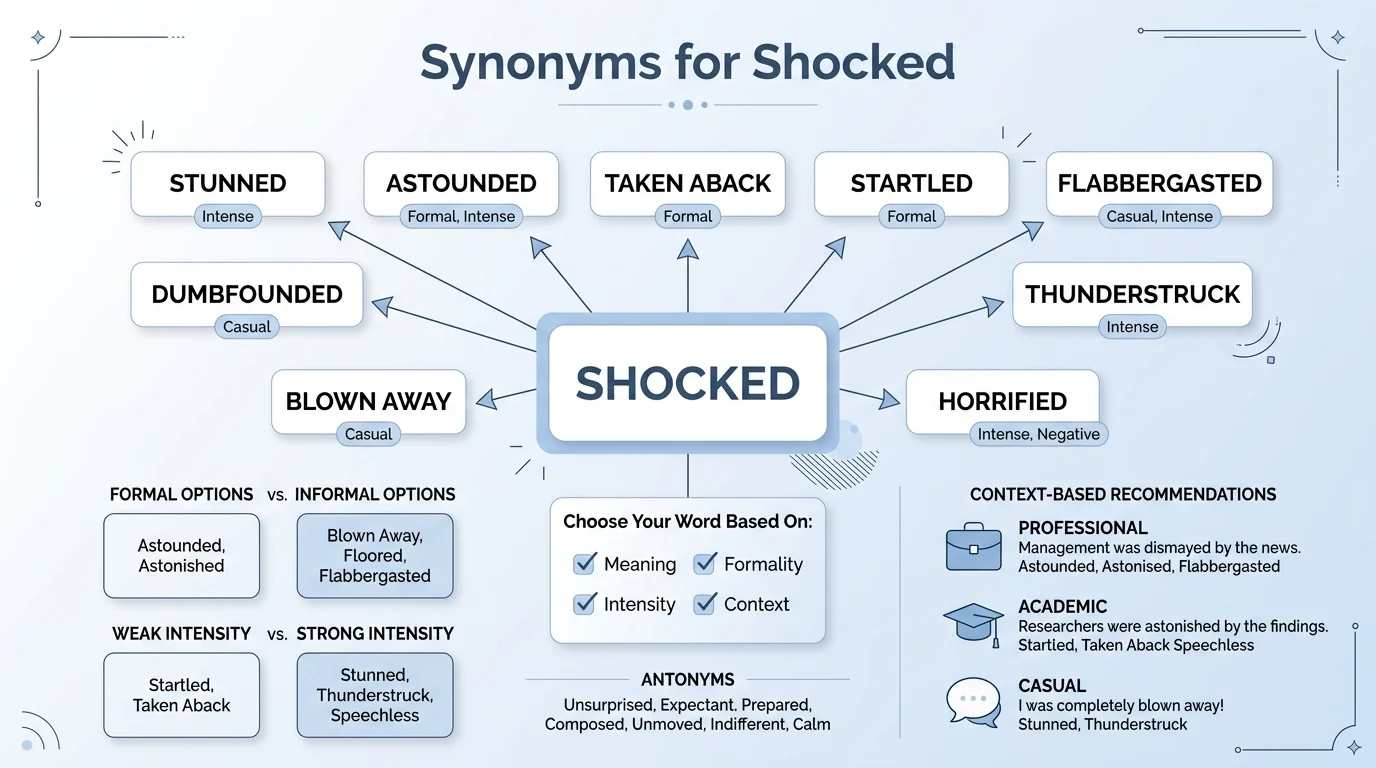
Have you ever written an email or a story and used the word “shocked” five times in one paragraph? You are not alone. Many writers, students, and professionals overuse this common word without realizing how many better alternatives exist.
When you describe a surprising event, a sudden change, or an emotional reaction, the word “shocked” often comes to mind first. But using the same word repeatedly makes your writing feel flat and uninteresting. This guide will help you discover the perfect synonym for every situation.
Whether you are writing a formal business report, a creative story, a social media caption, or an academic essay, you will find the right word here. Let us explore the rich vocabulary of surprise and astonishment together.
What Does “Shocked” Mean?
The word “shocked” means experiencing a sudden and intense feeling of surprise, distress, or disbelief. For formal writing, use “appalled” or “dismayed.” For casual conversation, try “stunned” or “taken aback.” Academic work prefers “astounded” or “startled.” Professional contexts benefit from “alarmed” or “disturbed.” Emotional writing often uses “devastated” or “traumatized.”
Meaning, Tone and Context
- Simple definition: Shocked describes a state of being greatly surprised, upset, or confused by something unexpected or disturbing.
- Part of speech: Shocked functions primarily as an adjective and as the past tense verb form of “shock.”
- Tone: The tone can be negative, neutral, or dramatic depending on the context. It ranges from mild surprise to intense emotional disturbance.
- Formality level: This word sits comfortably in the middle range. It works in casual and professional settings but may lack precision for academic or formal writing.
- Common use cases: News reports, personal stories, professional emails, creative writing, social media posts, and everyday conversations about unexpected events.
- Important word forms: Shock is the noun form. Shocking describes something that causes shock. Shocked describes the person experiencing the feeling. Shockingly serves as the adverb form.
When and How to Use “Shocked”
The word “shocked” should be used when you want to convey a genuine moment of surprise or disbelief. It works best for events that are truly unexpected and emotionally significant.
Professional context:
“The board was shocked by the sudden resignation of the CEO.”
Personal context:
“I felt genuinely shocked when my best friend told me she was moving across the country.”
Academic context:
“Researchers were shocked to discover that the ancient civilization had developed advanced mathematics.”
Emotional context:
“She was shocked into silence by the news of her grandfather’s passing.”
Creative context:
“The hero stood shocked as the castle crumbled before his eyes.”
Social media context:
“I am absolutely shocked by the ending of that show. Did anyone else see that coming?”
Email context:
“We were shocked to receive your cancellation notice after five years of partnership.”
Another Word for “Shocked”
The best single replacement depends entirely on your context and the intensity you wish to convey.
- Professional writing: Alarmed or disturbed work better when you need to sound composed and formal.
- Academic writing: Astounded or perplexed add precision and scholarly tone to your research descriptions.
- Casual conversation: Stunned or taken aback feel natural and conversational.
- Emotional writing: Devastated or traumatized convey deeper emotional impact.
- Creative writing: Aghast or flabbergasted add dramatic flair and vivid imagery.
- Resume or workplace use: Disconcerted or unsettled show professional awareness without overstatement.
- Social media captions: Gobsmacked or mind blown add personality and modern appeal.
- Stronger meaning: Appalled, horrified, or traumatized indicate extreme reactions.
- Softer meaning: Surprised, startled, or taken aback suggest milder reactions.
When Not to Use “Shocked”
The word “shocked” often sounds too vague or too dramatic for ordinary situations. You should avoid using it for minor inconveniences or predictable events.
Weak example:
“I was shocked that my coffee was cold this morning.”
Improved version:
“I was disappointed that my coffee was cold this morning.”
Weak example:
“She was shocked when her phone battery died.”
Improved version:
“She was annoyed when her phone battery died.”
Weak example:
“He was shocked by the traffic on his commute.”
Improved version:
“He was frustrated by the traffic on his commute.”
Weak example:
“We were shocked that the meeting ran long.”
Improved version:
“We were surprised that the meeting ran long.”
Weak example:
“The team was shocked by the small budget increase.”
Improved version:
“The team was pleased by the small budget increase.”
Using “shocked” for everyday occurrences diminishes its impact. Reserve it for genuinely unexpected or emotionally charged situations.
Words Commonly Confused With “Shocked”
“Shocked” is frequently confused with similar words that express different intensities or types of surprise. Understanding these differences will help you choose the right word.
Surprised vs. Shocked
Surprised describes mild to moderate unexpectedness. Shocked implies a much stronger, often negative reaction.
Example: “I was surprised by the pop quiz” versus “I was shocked by the sudden layoffs.”
Startled vs. Shocked
Startled refers to a brief, physical reaction to a sudden stimulus. Shocked describes a deeper mental and emotional state.
Example: “The loud noise startled me” versus “The tragic news shocked everyone.”
Astonished vs. Shocked
Astonished suggests wonder and amazement. Shocked often carries negative connotations of distress.
Example: “We were astonished by the magician’s performance” versus “We were shocked by the scandal.”
Appalled vs. Shocked
Appalled specifically means shocked by something morally wrong or offensive. Shocked is more general.
Example: “I was appalled by the racist comments” versus “I was shocked by the election results.”
Stunned vs. Shocked
Stunned implies temporary inability to react or think clearly. Shocked suggests a broader emotional response.
Example: “The boxer was stunned by the punch” versus “The family was shocked by the diagnosis.”
Best Synonym by Context for “Shocked”
| Context | Best Synonym | Why It Works | Example |
|---|---|---|---|
| Formal writing | Appalled | Shows strong disapproval with appropriate dignity | The committee was appalled by the findings. |
| Academic writing | Astounded | Adds scholarly precision to research results | Scientists were astounded by the data. |
| Professional business | Alarmed | Conveys concern without emotional excess | Management was alarmed by the sales decline. |
| Resume writing | Disconcerted | Shows professional awareness of challenges | Disconcerted by the market shift, I adapted quickly. |
| Casual conversation | Stunned | Feels natural and conversational | I was totally stunned when I heard the news. |
| Creative writing | Aghast | Adds dramatic and vivid imagery | She stood aghast at the destruction before her. |
| Emotional tone | Devastated | Expresses deep personal pain | He was devastated by the breakup. |
| Strong intensity | Horrified | Indicates extreme shock and fear | They were horrified by the accident. |
| Soft or moderate | Startled | Suggests brief, mild surprise | The sudden question startled her. |
| Social media captions | Gobsmacked | Adds personality and modern appeal | Absolutely gobsmacked by this view. |
Which Synonym Should You Choose?
Choosing the right synonym requires considering four key factors: meaning, formality, emotional intensity, and context.
Start with the exact emotion you want to express. Are you describing mild surprise, deep distress, or somewhere in between? mild reactions, choose “surprised” or “startled.” For moderate shock, try “stunned” or “astonished.” For intense reactions, select “appalled” or “horrified.”
Next, consider your audience and setting. Formal documents require composed words like “alarmed” or “disturbed.” Academic writing benefits from “astounded” or “perplexed.” Social media and casual conversation welcome colorful options like “gobsmacked” or “mind blown.”
Think about the emotional weight you want to carry. Some words like “devastated” and “traumatized” carry heavy emotional baggage. Others like “surprised” and “startled” feel lighter and less intense.
Finally, match the synonym to your specific situation. A professional email about disappointing results needs “alarmed” or “disturbed.” A creative story about a shocking twist benefits from “aghast” or “flabbergasted.” A personal conversation about surprising news works best with “stunned” or “taken aback.”
Real Life Examples of “Shocked” in Sentences
School context:
“The students were shocked when their teacher announced a pop quiz on Friday afternoon. Many of them had not studied at all.”
Workplace context:
“The entire department was shocked by the sudden closure announcement. Employees gathered in the conference room to process the news together.”
Writing context:
“When I reread my first draft, I was shocked by how many times I had used the word ‘shocked.’ I immediately started searching for better alternatives.”
Conversation context:
“I was absolutely shocked when my neighbor told me she had won the lottery. She had always been so modest about her finances.”
Social media context:
“Just finished the final episode and I am completely shocked. That plot twist came out of absolutely nowhere.”
Email context:
“We were shocked to learn that our proposal had been rejected. We would appreciate any feedback you can provide.”
Storytelling context:
“The young soldier was shocked by the devastation he witnessed. The images would stay with him forever.”
15 Synonyms for “Shocked”
| Synonym | Simple Meaning | Best Used For | Example Sentence |
|---|---|---|---|
| Astounded | Greatly surprised and amazed | Academic and formal writing | Researchers were astounded by the discovery. |
| Appalled | Shocked by something morally wrong | Formal criticism and ethical discussions | The community was appalled by the discrimination. |
| Stunned | Temporarily unable to react | Casual conversation and personal stories | She stood stunned by the unexpected proposal. |
| Aghast | Filled with horror or shock | Creative and dramatic writing | He stared aghast at the burning building. |
| Horrified | Filled with terror and shock | Intense emotional reactions | Parents were horrified by the dangerous playground. |
| Flabbergasted | Extremely surprised and confused | Informal and humorous situations | I was flabbergasted by his ridiculous excuse. |
| Disconcerted | Mildly unsettled and confused | Professional and formal contexts | The manager felt disconcerted by the conflicting reports. |
| Alarmed | Suddenly frightened or worried | Business and safety communications | Investors were alarmed by the dropping stock prices. |
| Startled | Briefly surprised by something sudden | Everyday mild surprises | The sudden noise startled the sleeping cat. |
| Dismayed | Discouraged and shocked by disappointment | Professional and personal setbacks | Team members were dismayed by the project cancellation. |
| Traumatized | Deeply shocked and emotionally scarred | Serious psychological impacts | The witness was traumatized by the accident. |
| Astonished | Filled with wonder and amazement | Positive surprising events | Guests were astonished by the beautiful decorations. |
| Perplexed | Confused and puzzled by something | Academic and analytical contexts | The professor was perplexed by the contradictory evidence. |
| Dumbfounded | Speechless with shock | Extreme and sudden surprises | The actor was dumbfounded by the standing ovation. |
| Bewildered | Completely confused and shocked | Situations of overwhelming surprise | Shoppers were bewildered by the sudden store closure. |
Synonym Groups and Usage Differences
Professional vs. Personal Synonyms
Professional settings require measured language that maintains composure. Alarmed, disturbed, and disconcerted work well because they acknowledge concern without losing professional dignity. Personal situations allow for more emotional and dramatic language. Words like devastated, horrified, and gutted fit naturally in personal conversations and stories.
Formal vs. Conversational Synonyms
Formal writing benefits from appalled, dismayed, and astounded. These words carry weight and sophistication. Reports, essays, and speeches use these terms effectively. Conversational contexts welcome stunned, flabbergasted, and gobsmacked. These words feel natural and authentic in everyday speech and casual writing.
Academic Synonyms
Academic writing demands precision and scholarly tone. Astounded, perplexed, and astonished appear frequently in research papers and analytical writing. These words suggest thoughtful surprise rather than emotional reaction. They work well when describing unexpected research results or puzzling phenomena in academic work.
Professional and Business Synonyms
Business communication requires careful word choice. Alarmed, disconcerted, and disturbed work best for professional contexts. These words maintain professionalism while showing appropriate concern. Emails, presentations, and reports benefit from these measured alternatives.
Creative or Literary Synonyms
Creative writing thrives on vivid and evocative language. Aghast, dumbfounded, and horrified add dramatic power to stories and poems. These words create strong imagery and emotional impact. Novelists, poets, and screenwriters often choose these colorful alternatives.
Slang or Modern Synonyms
Modern language offers options like gobsmacked, shook, and blown away. These words work well on social media and in casual conversation. Use them in text messages, tweets, and informal writing. Avoid them in professional, academic, or formal settings where they sound inappropriate.
Strongest vs. Weaker Synonyms
The intensity of shock ranges widely. Mild options include surprised and startled. Moderate synonyms include stunned and astonished. Strong words include horrified and appalled. The strongest options are traumatized and devastated. Choose your intensity level carefully to match your situation.
Emotional vs. Neutral Synonyms
Emotional synonyms add feeling and personal reaction to your writing. Devastated, horrified, and traumatized carry strong emotional weight. Neutral synonyms stay factual and composed. Alarmed and disturbed acknowledge the event without heavy emotional language. Choose emotional words for personal stories and neutral words for professional documents.
Antonyms of “Shocked”
| Antonym | Meaning | Example Sentence |
|---|---|---|
| Unfazed | Not affected or disturbed | She remained unfazed by the criticism. |
| Composed | Calm and in control | He stayed composed during the difficult interview. |
| Calm | Peaceful and untroubled | The teacher remained calm despite the chaos. |
| Indifferent | Showing no interest or concern | He was indifferent to the surprising news. |
| Unimpressed | Not impressed or moved | She was unimpressed by the grand announcement. |
| Unconcerned | Not worried or anxious | The CEO appeared unconcerned about the rumors. |
| Nonchalant | Casually calm and relaxed | He was nonchalant about the sudden change. |
| Unexcited | Not enthusiastic or eager | The audience seemed unexcited by the revelation. |
| Unmoved | Not emotionally affected | She remained unmoved by the tragic story. |
| Unruffled | Not agitated or disturbed | The pilot stayed unruffled during the emergency. |
| Collected | Calm and self controlled | She remained collected throughout the crisis. |
| Impassive | Not showing emotion | His impassive face revealed nothing. |
| Sedate | Calm and dignified | The judge maintained a sedate demeanor. |
| Serene | Peaceful and untroubled | The serene expression never changed. |
| Stoic | Enduring without complaint | He remained stoic in the face of bad news. |
Comparison: Shocked vs. Similar Words
Shocked vs. Surprised
The main difference lies in intensity. Surprised describes a mild reaction to something unexpected. Shocked indicates a much stronger, often negative response. Surprised is more common and versatile. Shocked carries more emotional weight and is better for serious situations.
Example of surprised: “I was surprised to see my friend at the grocery store.”
Example of shocked: “I was shocked to learn my friend had been hiding a serious illness.”
Shocked vs. Astonished
Astonished suggests a positive or neutral feeling of wonder and amazement. Shocked often indicates a negative reaction to disturbing news. Astonished works well for impressive achievements and beautiful surprises. Shocked fits unfortunate events and upsetting revelations.
Example of astonished: “We were astonished by the incredible magic trick.”
Example of shocked: “We were shocked by the fraudulent behavior uncovered in the investigation.”
Shocked vs. Appalled
Appalled specifically describes shock at something morally offensive or wrong. Shocked covers a broader range of unexpected events. Use appalled when discussing ethical violations, discrimination, or injustice. Use shocked for a wider variety of surprising situations.
Example of appalled: “I was appalled by the discriminatory hiring practices.”
Example of shocked: “I was shocked by the company’s sudden bankruptcy.”
Shocked vs. Stunned
Stunned implies a temporary state of being unable to think or react clearly. Shocked suggests a broader emotional response that may last longer. Stunned works well for sudden, overwhelming surprises. Shocked fits situations with more lasting impact.
Example of stunned: “The boxer was stunned by the unexpected punch.”
Example of shocked: “The community was shocked by the long term effects of the pollution.”
Shocked vs. Traumatized
Traumatized describes a much deeper and lasting psychological impact. Shocked can describe a temporary reaction. Traumatized suggests permanent or long term emotional damage. Use traumatized only for severe, life altering events.
Example of traumatized: “The survivors were traumatized by the natural disaster.”
Example of shocked: “The survivors were shocked by the initial destruction.”
Shocked vs. Bewildered
Bewildered emphasizes confusion and inability to understand what happened. Shocked focuses more on the emotional reaction. Bewildered works well for complex or confusing situations. Shocked fits clear but unexpected events.
Example of bewildered: “The students were bewildered by the complex math problem.”
Example of shocked: “The students were shocked by their failing exam grades.”
Common Phrases and Expressions with “Shocked”
1. Shocked to the core
Meaning: Deeply and profoundly affected emotionally.
Example sentence: “The devastating diagnosis shocked the entire family to their core.”
2. Shocked beyond belief
Meaning: So shocked that it is difficult to accept or process.
Example sentence: “The community was shocked beyond belief by the senseless tragedy.”
3. Shocked into silence
Meaning: So surprised that one cannot speak.
Example sentence: “The shocking revelation shocked the audience into complete silence.”
4. Shocked and dismayed
Meaning: Experiencing both surprise and disappointment.
Example sentence: “The employees were shocked and dismayed by the sudden layoffs.”
5. Shocked and horrified
Meaning: Experiencing both surprise and terror.
Example sentence: “Onlookers were shocked and horrified by the accident.”
6. Shocked to discover
Meaning: Surprised to learn something unexpected.
Example sentence: “I was shocked to discover that my grandfather had been a war hero.”
7. Shocked at the news
Meaning: Reacting with surprise to information received.
Example sentence: “Her mother was shocked at the news of her engagement.”
8. Shocked by the response
Meaning: Surprised by someone’s reaction or answer.
Example sentence: “The politician was shocked by the overwhelmingly negative response.”
Common Mistakes to Avoid
- Using “shocked” when a more precise synonym is better
Many writers default to “shocked” for any surprising situation. This creates vague and repetitive writing. Instead, match your word to the specific emotion. Use “appalled” for moral outrage. Use “astounded” for impressive surprises. Choose “startled” for mild reactions. - Confusing “shocked” with “surprised”
These words are not interchangeable. “Surprised” describes mild unexpectedness. “Shocked” indicates a stronger, often negative reaction. Use “surprised” for everyday events. Save “shocked” for genuinely serious or intense situations. - Using a casual synonym in formal writing
Words like “flabbergasted” and “gobsmacked” have no place in professional documents. These casual terms undermine your credibility. Choose “alarmed” or “disturbed” for formal contexts. Reserve casual language for social media and personal conversation. - Using an overly dramatic synonym for a simple situation
Avoid exaggerating minor events with intense words. Do not describe a small inconvenience as “traumatizing” or “devastating.” Save these powerful words for truly serious situations. Using them for trivial matters diminishes their impact. - Repeating the same word too often
Repetition makes writing dull and unprofessional. Use this guide to find fresh alternatives. Vary your vocabulary to keep readers engaged. A thesaurus is your friend, but choose synonyms wisely. - Choosing a synonym with the wrong emotional tone
Every synonym carries emotional weight. “Aghast” sounds dramatic and literary. “Alarmed” sounds professional and concerned. “Gobsmacked” sounds casual and playful. Match your word’s emotional tone to your situation. - Using slang in academic or professional writing
Avoid colorful slang in serious contexts. Words like “shook” and “mind blown” belong on social media. They sound unprofessional in essays and business communications. Choose more formal alternatives for important writing.
FAQs
What is the best synonym for shocked?
The best synonym depends on context. “Stunned” works for casual situations. “Appalled” fits formal criticism. “Astounded” suits academic writing. “Devastated” expresses emotional depth.
What is a formal synonym for shocked?
“Appalled” and “dismayed” are excellent formal synonyms. They convey strong reaction while maintaining professional composure. Use these in business emails and official correspondence.
What is an informal synonym for shocked?
“Stunned” and “flabbergasted” work well in casual settings. “Gobsmacked” and “shook” add personality to social media posts. These words feel natural in everyday conversation.
What is another word for shocked in professional writing?
“Alarmed” and “disturbed” are professional alternatives. They show appropriate concern without emotional excess. These words maintain credibility in workplace communication.
What is the difference between shocked and surprised?
“Surprised” describes mild unexpectedness. “Shocked” indicates a stronger, more intense reaction. Use “surprised” for ordinary events. Choose “shocked” for serious or upsetting situations.
What is the opposite of shocked?
“Unfazed,” “composed,” and “calm” are common opposites. These words describe people who remain untroubled by surprising events. They suggest emotional stability and control.
Conclusion
The word “shocked” serves an important purpose in our vocabulary, but overusing it weakens your writing. Understanding the full range of synonyms allows you to express surprise, dismay, and astonishment with precision. Remember that context, tone, and emotional intensity should guide your word choice. Formal writing demands composed language like “alarmed” and “dismayed.” Casual conversation welcomes colorful options like “stunned” and “flabbergasted.” Creative work thrives on dramatic words like “aghast” and “horrified.” The next time you feel tempted to write “shocked” for the fifth time, consult this guide. Your readers will appreciate the variety and precision. Choose your words carefully, and your writing will become more engaging and professional.