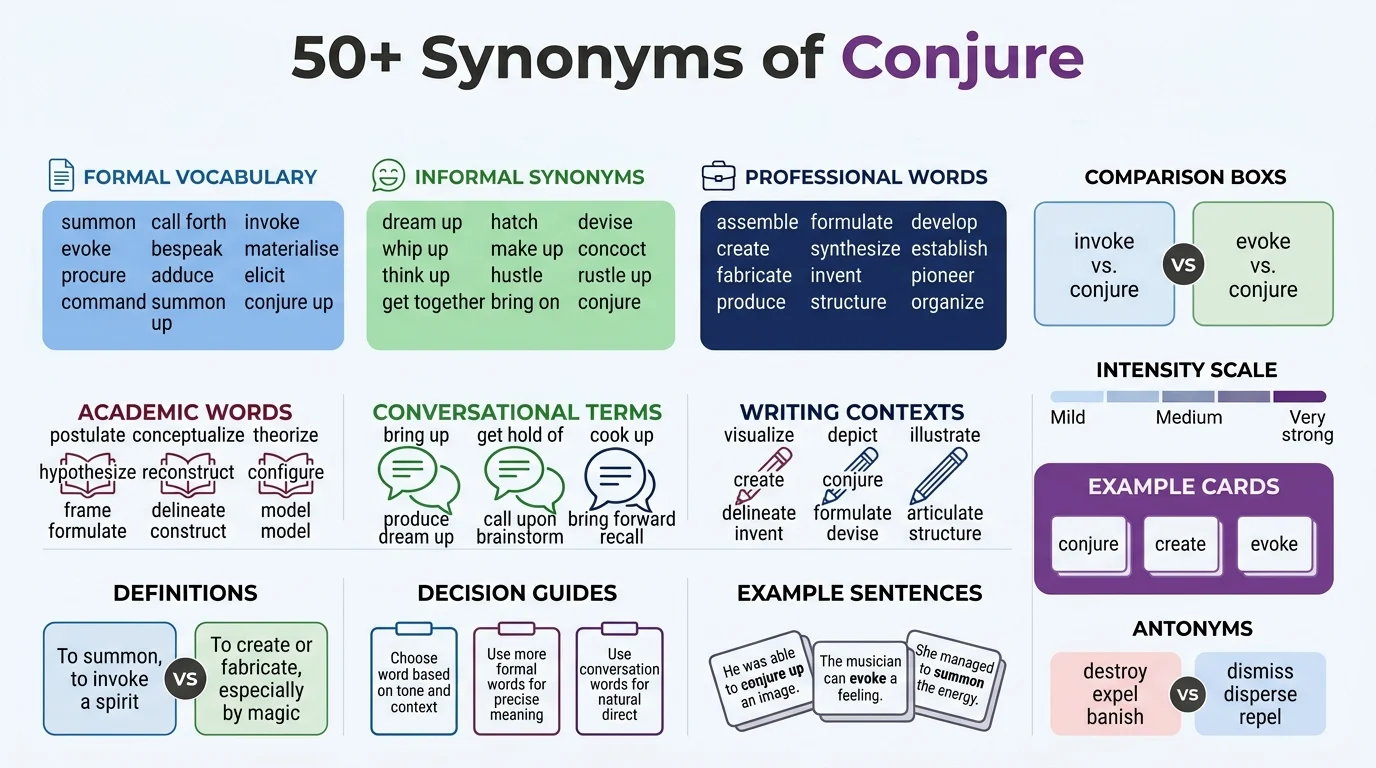
You are writing an important email, and you realize you have used the word “bring” four times in two paragraphs. The sentence feels flat, and you know it needs more impact. The same happens with essays, social media captions, and even casual conversations. Repetition drains the life out of your writing. When you start searching for synonyms of conjure, you are looking for words that add precision and power to your communication. Choosing the right synonym improves clarity, tone, and how your message lands with your audience. This guide will help you understand exactly what “conjure” means, when to use it, and which synonyms work best in every situation.
What Are the Best Synonyms of “Conjure”?
“Conjure” means to call something to mind, bring into existence, or produce something as if by magic. The best synonyms depend on your context. Use “evoke” for emotions and memories, “invoke” for formal appeals, “summon” for calling forth courage or images, and “generate” for producing ideas or results. “Elicit” works well for drawing out responses.
Meaning, Tone, and Context
Simple Definition
Conjure means to make something appear, create something seemingly from nothing, or bring an image or idea into someone’s mind.
Part of Speech
Verb
Overall Tone
Neutral to slightly formal. The word carries a subtle sense of wonder, creativity, or effort, but it is not overly emotional.
Formality Level
Semi-formal. “Conjure” fits comfortably in academic writing, professional communication, and literature. It is less common in casual everyday speech.
Common Uses
Native English speakers use “conjure” in three main ways:
- Calling something to mind, such as memories or images
- Producing or creating something, often with effort or skill
- Calling upon a spirit or supernatural force in a magical context
Word Forms
| Form | Word | Example |
|---|---|---|
| Verb | conjure | She can conjure a complete meal from leftover ingredients. |
| Noun | conjuration | The conjuration of spirits was part of the ancient ritual. |
| Noun | conjurer/conjuror | The conjurer amazed the audience with his tricks. |
| Adjective | conjurable | The resources were conjurable with enough effort. |
When and How to Use “Conjure”
“Conjure” is most effective when you want to describe creating or calling forth something with a sense of skill, effort, or imagination. It works well in writing that needs a slightly elevated tone.
Professional Context
The marketing team managed to conjure a successful campaign from limited resources.
Academic Context
The author conjures vivid images of rural life through careful descriptive language.
Workplace Communication
We need to conjure a solution before the client meeting tomorrow.
Personal Communication
She can conjure the most amazing meals from whatever is in the fridge.
Email Writing
Can you conjure a few more examples for the presentation by Friday?
Resume Writing
Conjured innovative solutions that increased team productivity by twenty percent.
Social Media
This recipe will conjure memories of your grandmother’s kitchen.
Best Synonyms of “Conjure”
No synonym matches “conjure” perfectly in every situation. The best choice depends on your audience, purpose, and the specific meaning you want to convey. Here are the top recommendations for different contexts.
Professional Writing
Choose “generate” for business and professional writing. It implies producing results through effort and skill without magical overtones.
Academic Writing
Use “evoke” when discussing literature, art, or emotions. It suggests calling forth responses or images through language or imagery.
Business Communication
Select “produce” for straightforward business communication. It is clear, professional, and avoids any hint of magic.
Casual Conversation
Go with “come up with” for everyday speaking. It is natural, informal, and commonly used in American English.
Emotional Writing
Choose “summon” when describing inner strength, courage, or memories. It implies calling forth something from within yourself.
Creative Writing
Use “envision” when describing the act of imagining or creating mental pictures. It fits well in descriptive and narrative writing.
Resume Writing
Select “devised” for resumes. It suggests careful planning and creative problem-solving.
Workplace Communication
Use “formulate” in workplace settings. It implies careful creation and thoughtful development.
Stronger Meaning
Choose “materialize” when you want to emphasize bringing something from thought into reality.
Softer Meaning
Select “suggest” when you want a milder word that implies hinting or implying rather than actively creating.
When Not to Use “Conjure”
Using “conjure” in the wrong context can make your writing sound forced, overly dramatic, or simply unclear. Here are situations to avoid.
When the Word Sounds Too Vague
Using “conjure” without specific context leaves readers guessing what you actually mean.
Less Effective
The team conjured results for the project.
Better Alternative
The team produced results for the project.
Why It Is Better
“Produced” clarifies that the team created or delivered tangible outcomes. It sounds professional and precise.
When the Word Sounds Too Formal
Using “conjure” in casual conversation with friends can sound stiff and unnatural.
Less Effective
Can you conjure some snacks for the movie?
Better Alternative
Can you get some snacks for the movie?
Why It Is Better
“Get” is the natural choice for informal requests. It sounds friendly and spontaneous.
When the Word Sounds Too Dramatic
Using “conjure” for routine actions adds unnecessary drama to your writing.
Less Effective
I conjured a cup of coffee this morning.
Better Alternative
I made a cup of coffee this morning.
Why It Is Better
“Made” is simple and accurate. It does not exaggerate a mundane action.
When the Word Is Not Strong Enough
Sometimes “conjure” does not convey the intensity or effort you want to express.
Less Effective
She conjured a new business plan overnight.
Better Alternative
She created a new business plan overnight.
Why It Is Better
“Created” suggests actual production and effort. “Conjured” might sound like she magically produced it without work.
When the Word Is Outdated
In modern American English, “conjure” is rarely used for magic in serious writing unless you are writing fantasy. For everyday magic tricks, “perform” or “do” sound more natural.
Less Effective
The magician conjured a rabbit from his hat.
Better Alternative
The magician produced a rabbit from his hat.
Why It Is Better
“Produced” is the standard term for magic performances. It sounds professional and accurate.
Words Commonly Confused With “Conjure”
Conjure vs Evoke
Difference
“Conjure” often implies bringing something into existence or calling it forth actively. “Evoke” suggests calling forth memories, feelings, or images without implying creation.
When to Use It
Use “evoke” when describing emotions, memories, or sensory experiences triggered by something.
Example
The photograph evokes fond memories of our summer vacation.
Conjure vs Invoke
Difference
“Conjure” is about bringing something into being or calling it up. “Invoke” means to call upon something for support, authority, or assistance.
When to Use It
Use “invoke” when referring to laws, rules, principles, or higher powers being called upon.
Example
The lawyer decided to invoke the fifth amendment.
Conjure vs Summon
Difference
“Conjure” implies producing something with a sense of skill or magic. “Summon” suggests calling someone or something to come to you with authority.
When to Use It
Use “summon” when calling upon courage, strength, or when officially requiring someone’s presence.
Example
She summoned the courage to speak in front of the audience.
Conjure vs Create
Difference
“Conjure” often implies producing from nothing or with minimal resources. “Create” suggests bringing something into existence through effort, planning, and process.
When to Use It
Use “create” for tangible products, art, and anything requiring deliberate construction.
Example
The artist created a beautiful sculpture from recycled materials.
Conjure vs Generate
Difference
“Conjure” has a slightly magical or imaginative quality. “Generate” suggests systematic production, often of ideas, data, or outcomes.
When to Use It
Use “generate” in business, science, and professional contexts where results come from process.
Example
The new strategy generated higher sales figures.
Conjure vs Elicit
Difference
“Conjure” is about producing or bringing forth. “Elicit” means to draw out a response, reaction, or information from someone.
When to Use It
Use “elicit” when you want to describe getting a reaction, answer, or emotion from people.
Example
The teacher’s question elicited enthusiastic responses from the students.
Best Synonyms of “Conjure” by Context
| Context | Best Synonym | Why It Works | Example |
|---|---|---|---|
| Formal writing | Evoke | Elegant and precise for emotional or sensory responses | The poem evokes a sense of longing. |
| Academic writing | Evoke | Commonly used in literary and artistic analysis | The imagery evokes cultural memory. |
| Professional communication | Generate | Clear and results-oriented for business settings | We need to generate more leads. |
| Business emails | Provide | Straightforward and professional | Can you provide the necessary documents? |
| Resume writing | Devised | Shows creative problem-solving ability | Devised a new workflow system. |
| Workplace communication | Formulate | Implies thoughtful creation and planning | Let’s formulate a response. |
| Casual conversation | Come up with | Natural and relaxed for everyday use | I need to come up with an excuse. |
| Everyday speaking | Think of | Simple and commonly used | Can you think of a better idea? |
| Creative writing | Envision | Perfect for describing imagination | She envisioned a world without borders. |
| Storytelling | Summon | Creates drama and intensity | He summoned all his strength. |
| Emotional writing | Summon | Suggests inner effort and courage | She summoned hope from despair. |
| Strong emphasis | Materialize | Implies something becoming real | Her dreams finally materialized. |
| Mild tone | Suggest | Subtle and gentle for implied meaning | The evidence suggests a different outcome. |
| Social media captions | Create | Clear and direct for visual posts | Create your own adventure. |
| American English | Bring to mind | Natural and widely understood | That song brings summer to mind. |
How to Choose the Best Synonym of “Conjure”
Choosing the right synonym requires considering five factors. Start with your audience and work backward to the most precise word.
Consider Your Audience
Who is reading your writing? Choose words that your audience will understand and appreciate. Academic readers expect precise vocabulary. Business readers prefer clear, direct language. Friends and family respond better to casual, natural words.
Consider Your Purpose
What are you trying to accomplish? You are describing memory, “evoke” is your best choice. If you are describing creation, “generate” or “create” work better. If you need to call upon authority or assistance, “invoke” fits perfectly.
Consider Emotional Strength
How intense do you want your language to be? “Suggest” is mild. “Summon” is stronger. “Materialize” is powerful. Match the intensity to your message.
Consider Formality Level
Academic and professional writing call for formal synonyms like “evoke,” “invoke,” and “generate.” Personal emails and social media posts allow for informal choices like “come up with” and “think of.”
Consider Natural Sounding Language
The best synonym sounds natural in your sentence. Read your sentence aloud. If it sounds forced or awkward, choose a different word. Trust your ear.
Real Life Examples of “Conjure”
School Assignment
The student conjured a compelling argument from limited research materials.
College Essay
The author conjures images of isolation through stark descriptions of the landscape.
Workplace Presentation
Our team conjured a solution that saved the company thousands of dollars.
Business Meeting
We need to conjure new ideas for the upcoming product launch.
Professional Email
Please conjure a summary of the client feedback for tomorrow’s meeting.
Resume Entry
Conjured innovative marketing strategies that boosted engagement by forty percent.
Casual Conversation
I can’t conjure a single good reason to stay home tonight.
Storytelling
The old house conjured memories of childhood summers.
Blogging
These simple ingredients conjure a restaurant-quality meal in minutes.
Social Media
A beautiful sunset that conjures feelings of peace and gratitude.
18 Best Synonyms of “Conjure”
| Synonym | Simple Meaning | Best Used For | Example Sentence |
|---|---|---|---|
| Evoke | Bring to mind or recall | Emotional and sensory responses | The painting evokes feelings of nostalgia. |
| Invoke | Call upon for support or authority | Formal appeals and legal contexts | The speaker invoked the principles of democracy. |
| Summon | Call forth with authority or effort | Calling courage, strength, or presence | She summoned the energy to finish the race. |
| Generate | Produce through process and effort | Business and professional contexts | The campaign generated significant interest. |
| Elicit | Draw out a response or reaction | Getting answers, emotions, or feedback | The question elicited a strong response. |
| Envision | Imagine or picture in the mind | Creative writing and future planning | He envisioned a better future for his community. |
| Materialize | Become real or actual | Describing dreams, plans, or ideas becoming real | Her vision finally materialized. |
| Devise | Plan or create with intelligence | Resume writing and problem-solving | The team devised a clever solution. |
| Formulate | Create carefully through thought | Business and academic planning | They formulated a new policy. |
| Produce | Bring into existence | Clear and direct communication | The factory produces high-quality goods. |
| Bring | Cause to come or happen | Simple and direct communication | This song brings joy to everyone. |
| Create | Make something from nothing | General creation across all contexts | She creates beautiful jewelry. |
| Suggest | Imply or hint at | Mild or subtle meaning | The data suggests a trend. |
| Imagine | Form a mental image | Everyday imagination and ideas | Imagine what we could achieve. |
| Inspire | Fill with creative or uplifting influence | Positive emotional impact | The leader inspired confidence. |
| Awaken | Stir to consciousness or awareness | Emotional or intellectual realization | The story awakened her curiosity. |
| Call forth | Bring into action or existence | Literary and formal writing | The crisis called forth the best in people. |
| Bring to mind | Cause someone to remember or think of | Casual and professional memory contexts | His accent brings to mind my grandfather. |
Synonyms of “Conjure” by Usage
Professional vs Personal Synonyms
Professional settings favor clear, businesslike synonyms. Choose “generate,” “formulate,” or “devise” for workplace communication. These words suggest skill and effort without theatrical overtones.
Personal conversations allow for less formal choices. “Come up with,” “think of,” and “bring” sound natural and relaxed among friends and family.
Formal vs Conversational Synonyms
Formal writing requires elevated vocabulary for reports, essays, and business presentations. “Evoke,” “invoke,” and “summon” are excellent formal choices. They sound academic and authoritative.
Conversational English prefers shorter, more common words. “Bring,” “make,” and “get” keep communication natural and spontaneous.
Academic Synonyms
Academic writing demands precise vocabulary that conveys authority. “Evoke” is the standard choice for literary analysis and artistic criticism. “Invoke” appears frequently in legal, philosophical, and political discussions. “Generate” works well in scientific and social science research when describing outcomes.
Professional and Business Synonyms
Resumes and professional documents benefit from action verbs that demonstrate accomplishment. “Devised” shows creative problem-solving. “Formulated” suggests careful planning. “Generated” demonstrates measurable results. “Produced” indicates concrete deliverables.
Creative and Literary Synonyms
Storytelling and creative writing reward expressive language. “Summon” adds drama and intensity. “Envision” captures imagination. “Materialize” creates vivid images of something becoming real. “Awaken” suggests stirring emotions or awareness.
Slang or Modern Synonyms
In contemporary American English, “conjure” has no widely used slang equivalent. Young speakers typically use “come up with” or “pull” in informal contexts, such as “pull a solution out of nowhere.” These phrases should stay in casual conversation and never appear in professional or academic writing.
Strongest to Mildest Synonyms
| Intensity | Synonym | Context |
|---|---|---|
| Mild | Suggest | Hinting or implying |
| Mild | Bring to mind | Casual memory |
| Moderate | Evoke | Emotional recall |
| Moderate | Generate | Business outcomes |
| Moderate | Create | General creation |
| Strong | Summon | Calling with authority or effort |
| Strong | Invoke | Formal calling upon principles |
| Very Strong | Materialize | Bringing into reality |
| Very Strong | Call forth | Dramatic calling into action |
Emotional vs Neutral Synonyms
Emotional Synonyms
Words like “evoke,” “summon,” and “awaken” carry emotional weight. Use them when you want to connect with your reader’s feelings. These words work well in personal writing, storytelling, and persuasive content.
Neutral Synonyms
Words like “generate,” “produce,” and “create” communicate information without added emotion. Use them in professional, academic, and business writing where clarity and objectivity matter most.
Antonyms of “Conjure”
| Antonym | Meaning | Example Sentence |
|---|---|---|
| Banish | Forcefully send away | The king banished the traitor from the kingdom. |
| Disperse | Scatter in different directions | The wind dispersed the clouds. |
| Dismiss | Reject or send away | She dismissed his concerns. |
| Dispel | Make disappear | The teacher dispelled the students’ fears. |
| Suppress | Prevent or hold back | He tried to suppress his anger. |
| Repress | Subdue or hold down | She repressed her emotions. |
| Eliminate | Completely remove | The team eliminated all errors. |
| Erase | Remove or wipe out | Time cannot erase that memory. |
| Destroy | Completely ruin | The fire destroyed the building. |
| Cancel | Call off or annul | They canceled the event. |
| Dissolve | Break apart or end | The organization dissolved. |
| Forget | Fail to remember | I will never forget that moment. |
| Ignore | Pay no attention to | She ignored the warning signs. |
| Neglect | Fail to care for properly | He neglected his responsibilities. |
| Abandon | Give up completely | They abandoned the project. |
Comparison: “Conjure” vs Similar Words
Conjure vs Evoke
Main Difference
Conjure suggests bringing into existence or calling forth actively. Evoke suggests bringing memories or emotions to mind without active creation.
Which Is Stronger?
Conjure is stronger. It implies a more active and forceful process.
Which Is More Formal?
Both are semi-formal, but evoke is more common in academic writing.
When to Use Each
Use conjure when describing creation or production. Use evoke when describing emotional or sensory memories.
Examples
Conjure: The chef conjured a delicious meal from simple ingredients.
Evoke: The melody evokes memories of childhood.
Conjure vs Invoke
Main Difference
Conjure brings something into existence. Invoke calls upon something for support or authority.
Which Is Stronger?
Invoke has more authority and formality. It suggests legal, political, or spiritual weight.
Which Is More Formal?
Invoke is more formal. It appears in legal, political, and philosophical writing.
When to Use Each
Use conjure for creation and imagination. Use invoke for calling upon principles, laws, or higher powers.
Examples
Conjure: He conjured an image of a peaceful world.
Invoke: The attorney invoked the client’s rights.
Conjure vs Summon
Main Difference
Conjure implies producing something with skill or magic. Summon implies calling someone or something with authority.
Which Is Stronger?
Summon suggests authority and command, making it stronger in official contexts.
Which Is More Formal?
Summon is more formal, especially in legal and official usage.
When to Use Each
Use conjure for creative production. Use summon for calling courage, strength, or people.
Examples
Conjure: She conjured a beautiful story from her imagination.
Summon: He summoned the courage to speak.
Conjure vs Create
Main Difference
Conjure suggests producing from nothing or with limited resources. Create suggests deliberate construction.
Which Is Stronger?
Create is more straightforward and concrete. Conjure has a more magical quality.
Which Is More Formal?
Both are appropriate in formal settings, but create is more common in business.
When to Use Each
Use conjure when you want a more imaginative tone. Use create for concrete, deliberate construction.
Examples
Conjure: The artist conjured beauty from discarded objects.
Create: The artist created a sculpture from clay.
Conjure vs Generate
Main Difference
Conjure has imaginative and creative overtones. Generate suggests systematic production.
Which Is Stronger?
Generate is more businesslike and measurable. Conjure is more creative.
Which Is More Formal?
Generate is more appropriate in formal business writing.
When to Use Each
Use conjure for creative and imaginative contexts. Use generate for business, data, and results.
Examples
Conjure: She conjured an original idea.
Generate: The strategy generated impressive results.
Conjure vs Elicit
Main Difference
Conjure produces something into existence. Elicit draws out a response from someone.
Which Is Stronger?
Conjure implies more active creation. Elicit suggests a more passive drawing out.
Which Is More Formal?
Elicit is more formal and academic.
When to Use Each
Use conjure for creation. Use elicit for responses, reactions, and information.
Examples
Conjure: The speaker conjured a vision of progress.
Elicit: The question elicited thoughtful answers.
Common Phrases and Expressions with “Conjure”
Conjure Up
Meaning
Call to mind or produce something, often quickly and with skill.
Example Sentence
The aroma of fresh bread conjures up memories of my grandmother’s kitchen.
Conjure Images
Meaning
Create mental pictures through description or imagination.
Example Sentence
The author conjures images of a bygone era through careful description.
Conjure From Nothing
Meaning
Produce something without apparent resources or starting materials.
Example Sentence
The creative team managed to conjure a marketing campaign from nothing.
Conjure a Spell
Meaning
Perform magic or create a magical effect.
Example Sentence
The witch conjured a spell to protect the village.
Conjure Memories
Meaning
Bring past experiences or recollections to mind.
Example Sentence
Old photographs conjure memories of childhood summers.
Conjure a Solution
Meaning
Quickly create an answer or resolution to a problem.
Example Sentence
We need to conjure a solution before the deadline.
Common Mistakes to Avoid
1: Using a Vague Synonym Instead of a Precise One
Incorrect
The data conjures a clear conclusion.
Better
The data suggests a clear conclusion.
Why It Is Better
“Conjures” is too creative for data analysis. “Suggests” is precise and appropriate.
2: Confusing Conjure with Invoke
Incorrect
The law conjures freedom of speech.
Better
The law invokes freedom of speech.
Why It Is Better
“Invokes” correctly describes calling upon a legal principle. “Conjures” is inaccurate.
3: Using an Informal Synonym in Formal Writing
Incorrect
The author comes up with a sense of mystery.
Better
The author evokes a sense of mystery.
Why It Is Better
“Evokes” is appropriate for academic analysis. “Comes up with” is too casual.
4: Selecting an Overly Dramatic Synonym
Incorrect
I conjured a sandwich for lunch.
Better
I made a sandwich for lunch.
Why It Is Better
“Conjured” is unnecessarily dramatic for routine actions. “Made” is natural and accurate.
5: Repeating the Same Word Too Often
Incorrect
He conjured an idea. Then he conjured another. Finally, he conjured the perfect solution.
Better
He conceived an idea. Then he devised another. Finally, he formulated the perfect solution.
Why It Is Better
Using different synonyms avoids repetition and keeps writing engaging.
6: Choosing a Synonym with the Wrong Emotional Tone
Incorrect
The report conjures positive results.
Better
The report indicates positive results.
Why It Is Better
“Indicates” is neutral and appropriate for factual reports. “Conjures” is too emotional.
Frequently Asked Questions
1. What are the best synonyms of “conjure”?
The best synonyms include evoke, invoke, summon, generate, and elicit. Your choice depends on context. Use evoke for emotions, invoke for formal appeals, and generate for business results.
2. What are the best formal synonyms of “conjure”?
The best formal synonyms are evoke, invoke, and summon. These words work well in academic, legal, and professional writing where precise vocabulary matters.
3. What are common informal synonyms of “conjure”?
Common informal synonyms include come up with, think of, and bring to mind. These phrases are natural choices for casual conversation and personal communication.
4. What is another word for “conjure” in professional writing?
Generate and produce are excellent choices for professional writing. They suggest concrete results and systematic effort without magical connotations.
5. What is the difference between “conjure” and “evoke”?
Conjure means to bring into existence or call forth actively. Evoke means to call memories, feelings, or images to mind without active creation.
6. What is the opposite of “conjure”?
The opposite includes banish, dispel, suppress, dismiss, and dissolve. These words suggest sending away, preventing, or eliminating something that would otherwise exist.
Conclusion
Conjure is a versatile word that captures the act of bringing something to mind or creating something from imagination or skill. The best synonyms depend entirely on your context. Evoke works for emotions and memories. Invoke fits formal appeals. Summon calls forth courage. Generate produces results. No single synonym works perfectly in every situation. Choose words based on your audience, tone, and purpose. The strongest writing uses precise vocabulary that communicates exactly what you mean. The next time you are tempted to overuse a word, explore the synonyms of conjure and choose the one that fits your situation best. Your writing will become clearer, more powerful, and more engaging.
5 thoughts on “50+ Synonyms of Conjure | Meanings, Uses, Examples, and Best Alternatives”