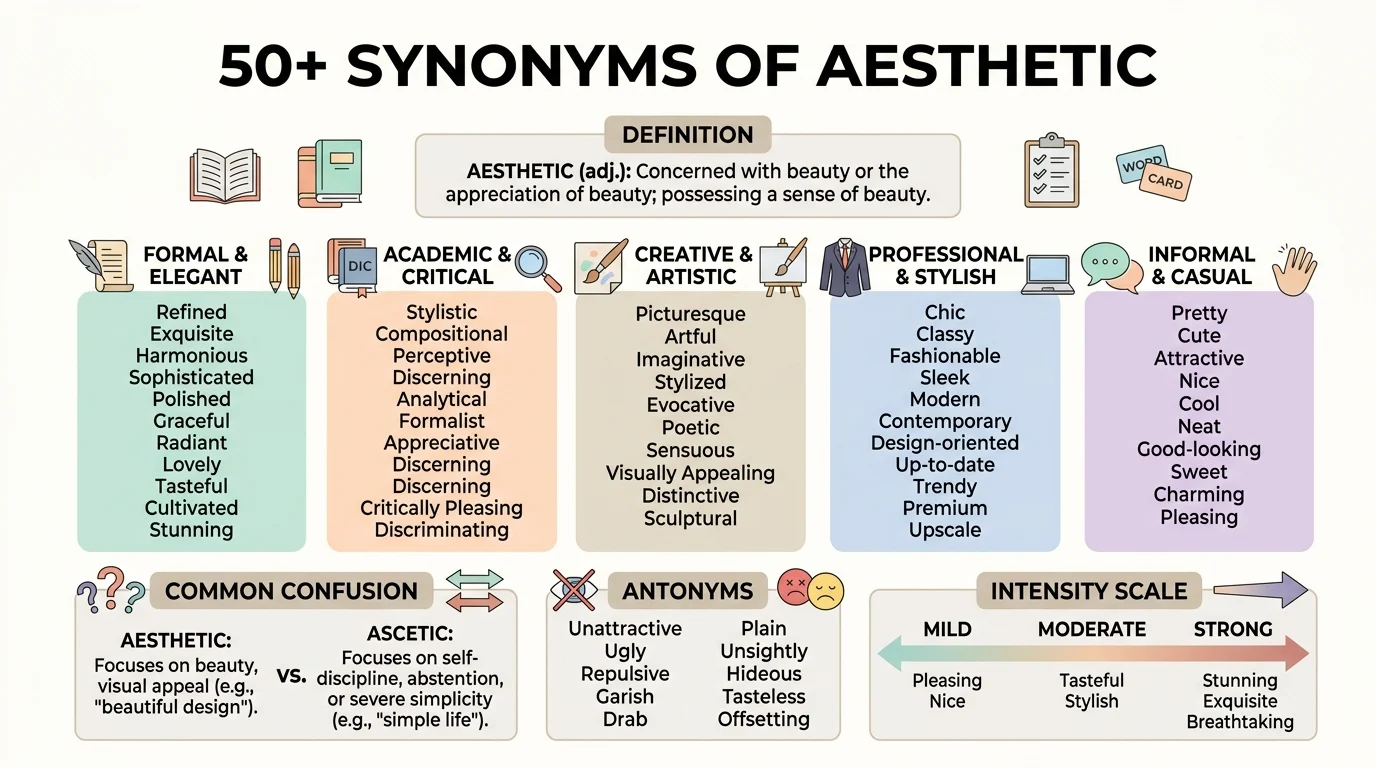
Have you ever found yourself describing a beautiful sunset, a stylish outfit, or a piece of art and realized you have used the word “aesthetic” three times in the same paragraph? You are not alone. Many writers, students, and professionals fall into the trap of overusing this popular word. Whether you are writing an essay, crafting a social media caption, or polishing a resume, relying on the same term can make your writing feel repetitive and dull. That is exactly why you need to explore the best synonyms of aesthetic. Choosing the right alternative does more than just avoid repetition. It sharpens your message, matches your tone, and helps you communicate with greater precision and confidence.
What Are the Best Synonyms of “Aesthetic”?
Aesthetic refers to the appreciation of beauty or good taste, often related to art and design. For formal writing, choose “artistic” or “tasteful.” For casual conversation, use “stylish” or “appealing.” In professional contexts, “refined” and “elegant” work well, while creative writing benefits from “picturesque” or “captivating.”
Meaning, Tone, and Context
Simple Definition
Aesthetic describes something concerned with beauty, art, or good taste. It can be used as an adjective to describe objects or experiences that are visually pleasing, or as a noun to refer to a particular style or set of artistic principles.
Part of Speech
- Adjective: Relating to beauty or the appreciation of beauty.
- Noun: A set of principles or a style related to beauty and art.
Overall Tone
Aesthetic is generally a positive word. It suggests refinement, good judgment, and an appreciation for visual or artistic quality. However, its tone can shift depending on context. In academic writing, it sounds intellectual and precise. In everyday conversation, it can feel trendy or even vague.
Formality Level
Aesthetic is neutral to semi-formal. It works well in academic essays, professional critiques, and casual conversations. However, in very formal philosophical discussions, it carries a specific technical meaning related to the study of beauty.
Common Uses
Native English speakers use aesthetic in several ways:
- To describe visual appeal: “The room has a modern aesthetic.”
- To discuss artistic value: “The film is more aesthetic than commercial.”
- To define a personal style: “Her aesthetic is minimalist and clean.”
Word Forms
- Noun: aesthetic (e.g., “The aesthetic of the brand is rustic.”)
- Adjective: aesthetic (e.g., “The aesthetic design impressed everyone.”)
- Adverb: aesthetically (e.g., “The room is aesthetically pleasing.”)
- Related noun: aesthetics (the study of beauty and art).
When and How to Use “Aesthetic”
“Aesthetic” is the right choice when you want to emphasize the beauty or artistic quality of something. It signals that you are making a judgment based on taste, style, or visual appeal rather than function or utility. Here are seven realistic examples showing how to use it across different contexts.
Professional:
“The design team focused on both functionality and aesthetic appeal to create a product that stands out in the market.”
Academic:
“The philosopher argued that aesthetic experience is fundamental to human understanding of the world.”
Workplace:
“Our new office layout prioritizes aesthetic harmony to create a more pleasant working environment.”
Personal:
“I have always been drawn to the aesthetic of Japanese gardens, with their careful balance of elements.”
Email:
“Could you review the aesthetic elements of the presentation before we send it to the client?”
Resume:
“Developed a cohesive aesthetic for the company’s social media presence, increasing engagement by 20 percent.”
Social Media:
“This café has the perfect aesthetic for a cozy Sunday morning.”
Best Synonyms of “Aesthetic”
No synonym is a perfect substitute for aesthetic in every situation. The best choice depends on your audience, purpose, and the specific shade of meaning you want to convey.
Professional writing: “Elegant” or “refined.” These words suggest sophistication and high quality without sounding overly artistic.
Academic writing: “Artistic” or “theoretical” (when discussing the philosophy of art). These terms sound scholarly and precise.
Business communication: “Polished” or “sophisticated.” These words convey professionalism and attention to detail.
Casual conversation: “Stylish” or “cool.” These words are approachable and fit everyday language.
Emotional writing: “Beautiful” or “captivating.” These words carry stronger emotional weight.
Creative writing: “Picturesque” or “evocative.” These words paint vivid images in the reader’s mind.
Resume writing: “Design-oriented” or “visually driven.” These phrases highlight relevant skills.
Workplace communication: “Tasteful” or “harmonious.” These words suggest balance and good judgment.
Stronger meaning: “Exquisite” or “breathtaking.” These words emphasize exceptional beauty.
Softer meaning: “Pleasing” or “agreeable.” These words are gentle and understated.
When Not to Use “Aesthetic”
Using aesthetic is not always the best choice. Here are situations where you should consider a stronger, clearer, or more appropriate alternative.
When the word sounds too general:
If you are describing something that is merely “nice-looking” without artistic depth, aesthetic may feel overly formal or pretentious.
- Instead of: “The cake has an aesthetic appearance.”
- Better: “The cake has a beautiful, homemade appearance.”
- Why: “Beautiful” is simpler and more direct for describing food.
When the word sounds too vague:
Aesthetic can feel like a buzzword when used without specific details.
- Instead of: “The website has a good aesthetic.”
- Better: “The website has a clean, user-friendly design.”
- Why: “Clean” and “user-friendly” are more precise and meaningful.
The word sounds too formal:
In casual texting or social media comments, aesthetic can feel stiff or out of place.
- Instead of: “Your outfit has an aesthetic quality.”
- Better: “Your outfit looks great.”
- Why: Simple praise sounds more natural in casual conversation.
When the word sounds too weak:
If you want to express powerful admiration, aesthetic may not carry enough emotional weight.
- Instead of: “The view is aesthetic.”
- Better: “The view is absolutely stunning.”
- Why: “Stunning” conveys a stronger emotional reaction.
The word is outdated in a particular context:
While aesthetic remains widely used, its overuse in trendy online spaces has made it feel clichéd to some audiences.
- Instead of: “That aesthetic is so aesthetic.”
- Better: “That style is really striking.”
- Why: “Striking” feels fresher and more original.
Words Commonly Confused With “Aesthetic”
Several words are often confused with aesthetic. Understanding the differences will help you choose the right one every time.
Aesthetic vs Artistic
Difference: Aesthetic focuses on the appreciation of beauty and good taste. Artistic relates to the skill, creativity, or expression involved in creating art.
When to Use It: Use “artistic” when referring to creative ability or the act of making art. Use “aesthetic” when referring to the visual or sensory appeal of something.
Example: “She has an artistic talent for painting.” vs. “The painting has great aesthetic value.”
Aesthetic vs Beautiful
Difference: Beautiful is a broader, more emotional word that describes anything pleasing to the senses or the mind. Aesthetic is more specific to visual or artistic appreciation.
When to Use It: Use “beautiful” for strong emotional responses to anything attractive. Use “aesthetic” for more analytical or taste-based judgments.
Example: “She is a beautiful person inside and out.” vs. “The aesthetic of the room is calming.
Aesthetic vs Stylish
Difference: Stylish refers specifically to fashion, trends, or current tastes. Aesthetic is broader and can apply to art, design, nature, and philosophy.
When to Use It: Use “stylish” when discussing clothing, accessories, or current trends. Use “aesthetic” for more permanent or philosophical qualities.
Example: “She always wears stylish outfits.” vs. “His aesthetic is influenced by modern architecture.”
Aesthetic vs Tasteful
Difference: Tasteful specifically means showing good judgment in matters of style and appropriateness. Aesthetic is more about the quality of beauty itself.
When to Use It: Use “tasteful” when you want to emphasize restraint and good judgment. Use “aesthetic” when discussing visual or artistic qualities.
Example: “The decorations were tasteful and not overdone.” vs. “The decorations had a rustic aesthetic.”
Aesthetic vs Ornamental
Difference: Ornamental describes something that is purely decorative, often with no practical purpose. Aesthetic can include both decorative and functional beauty.
When to Use It: Use “ornamental” when emphasizing decoration over function. Use “aesthetic” when beauty is integrated with purpose.
Example: “The ornamental vase sits on the mantelpiece.” vs. “The chair is both functional and aesthetic.”
Aesthetic vs Sensuous
Difference: Sensuous appeals to the senses, especially physical pleasure. Aesthetic appeals more to the intellect and appreciation of beauty.
When to Use It: Use “sensuous” when describing physical or sensory pleasure. Use “aesthetic” when discussing intellectual or visual appreciation.
Example: “The sensuous texture of the silk was luxurious.” vs. “The aesthetic quality of the sculpture was remarkable.”
Best Synonyms of “Aesthetic” by Context
| Context | Best Synonym | Why It Works | Example |
|---|---|---|---|
| Formal writing | Tasteful | Suggests refined judgment without being overly emotional | “The decor is tasteful and restrained.” |
| Academic writing | Artistic | Sounds scholarly and precise | “The course develops artistic judgment.” |
| Professional communication | Refined | Conveys sophistication and high standards | “The proposal has a refined presentation.” |
| Business emails | Polished | Suggests professionalism and attention to detail | “Please review the polished draft before the meeting.” |
| Resume writing | Design-oriented | Highlights relevant skills and mindset | “Design-oriented professional with 10 years of experience.” |
| Workplace communication | Harmonious | Emphasizes balance and good integration | “The team created a harmonious visual identity.” |
| Casual conversation | Stylish | Approachable and fits everyday language | “That jacket is so stylish.” |
| Everyday speaking | Appealing | Simple, clear, and universally understood | “The new menu looks appealing.” |
| Creative writing | Picturesque | Paints vivid images in the reader’s mind | “The picturesque village nestled in the valley.” |
| Storytelling | Evocative | Suggests strong emotions and vivid imagery | “The evocative description brought tears to her eyes.” |
| Emotional writing | Captivating | Carries strong emotional weight | “The captivating performance held the audience spellbound.” |
| Strong emphasis | Exquisite | Emphasizes exceptional, delicate beauty | “The exquisite craftsmanship was evident in every detail.” |
| Mild tone | Pleasing | Gentle and understated | “The color scheme is pleasing to the eye.” |
| Social media captions | Vibe | Trendy and culturally relevant | “Loving the cozy vibe of this space.” |
| American English | Esthetic | Alternative spelling commonly used in the US | “The esthetic qualities of the building are undeniable.” |
How to Choose the Best Synonym of “Aesthetic”
Choosing the right synonym comes down to understanding your audience, purpose, and the specific shade of meaning you want to convey.
Consider your meaning: Are you describing visual beauty, artistic value, personal style, or philosophical concepts? Each synonym targets a slightly different aspect of aesthetic.
Consider your tone: Do you want to sound formal, casual, emotional, or analytical? Match your word to the mood you want to create.
Consider your audience: A corporate client will respond differently to “refined” than a friend will to “cool.” Choose words that resonate with your readers.
Consider emotional strength: Do you want to make a strong impression or a subtle one? “Breathtaking” packs a punch, while “pleasing” is gentle and understated.
Consider your writing purpose: Are you writing a report, a story, an email, or a caption? Each format calls for a different level of formality and creativity.
Consider naturalness: The best synonym is the one that sounds most natural in your sentence. Read it aloud. If it feels forced, try another option.
Real Life Examples of “Aesthetic”
Seeing aesthetic and its synonyms in action helps you understand how to use them effectively. Here are realistic examples across various situations.
School:
“The art teacher encouraged us to develop our own aesthetic sensibilities.”
College:
“The architecture student wrote her thesis on the aesthetic principles of Brutalism.”
Workplace:
“The marketing team revised the campaign to align with the company’s aesthetic standards.”
Business:
“Our brand aesthetic emphasizes simplicity and authenticity to build trust with customers.”
Email:
“Attached are the mockups. Please let me know if the aesthetic direction matches your vision.”
Resume:
“Curated the visual aesthetic for a lifestyle brand, resulting in a 30 percent increase in social media engagement.”
Conversation:
“I love the aesthetic of that coffee shop. It feels so warm and inviting.”
Storytelling:
“The old library had a dusty, romantic aesthetic that transported visitors to another era.”
Blogging:
“Creating a cohesive aesthetic for your Instagram feed is more important than ever.”
Social Media:
“Obsessed with the minimal aesthetic of this new skincare line.”
18 Best Synonyms of “Aesthetic”
| Synonym | Simple Meaning | Best Used For | Example Sentence |
|---|---|---|---|
| Artistic | Showing creative beauty or style | Academic and creative writing | “The artistic arrangement of flowers impressed everyone.” |
| Tasteful | Showing good judgment in style | Formal and professional contexts | “The tasteful decor made the event feel elegant.” |
| Elegant | Graceful and refined in appearance | Professional and business writing | “She wore an elegant dress to the gala.” |
| Stylish | Fashionable and current in appearance | Casual conversation and social media | “His new haircut is very stylish.” |
| Refined | Cultured and visually polished | Resumes and professional communication | “The restaurant offers a refined dining experience.” |
| Beautiful | Pleasing to the senses or mind | Emotional and descriptive writing | “The sunset over the ocean was beautiful.” |
| Appealing | Pleasant and inviting | Everyday speaking and marketing | “The product design is visually appealing.” |
| Picturesque | Visually charming like a picture | Travel writing and storytelling | “The picturesque village attracted many tourists.” |
| Exquisite | Beautifully delicate and finely made | Strong emphasis and luxury contexts | “The exquisite jewelry was worth a fortune.” |
| Captivating | Holding attention through beauty | Emotional and creative writing | “Her captivating smile lit up the room.” |
| Ornamental | Intended to enhance appearance | Decorative and design contexts | “The ornamental details added character to the building.” |
| Sensuous | Appealing to the senses | Descriptive and literary writing | “The sensuous fabric felt luxurious against her skin.” |
| Polished | Finished with refined style | Business and professional contexts | “The polished presentation impressed the investors.” |
| Harmonious | Forming a pleasing whole | Design and workplace communication | “The harmonious color palette created a calm atmosphere.” |
| Evocative | Suggesting strong beauty or mood | Storytelling and creative writing | “The evocative music brought back childhood memories.” |
| Chic | Smart and stylish | Fashion and lifestyle writing | “The chic boutique attracted a trendy crowd.” |
| Classy | Stylish and sophisticated | Casual and professional praise | “Her classy outfit was perfect for the occasion.” |
| Ethereal | Delicate and otherworldly | Poetic and fantasy writing | “The ethereal light filtered through the trees.” |
Synonyms of “Aesthetic” by Usage
Professional vs Personal Synonyms
In professional settings, choose words that convey competence and high standards. “Refined,” “polished,” and “tasteful” are excellent choices. In personal conversations, simpler and warmer words like “nice,” “pretty,” or “cool” feel more natural and approachable.
Formal vs Conversational Synonyms
Formal writing benefits from precise, scholarly words like “artistic,” “theoretical,” and “aesthetical”. Conversational settings call for simpler, more relatable words like “appealing,” “stylish,” or even “vibe”.
Academic Synonyms
In academic writing, precision is key. “Artistic,” “theoretical,” “philosophical,” and “critical” are strong choices. They sound authoritative and demonstrate a sophisticated understanding of the subject.
Professional and Business Synonyms
For resumes, interviews, and business communication, choose words that project competence and attention to detail. “Refined,” “polished,” “sophisticated,” and “design-oriented” are excellent options.
Creative and Literary Synonyms
Writers and storytellers should reach for vivid, imaginative words. “Picturesque,” “evocative,” “ethereal,” and “captivating” add depth and emotion to descriptive passages.
Slang or Modern Synonyms
In informal online spaces, “vibe” has become a popular alternative. It refers to the overall feeling or atmosphere of something. This word is acceptable in social media, texting, and casual conversation but should be avoided in academic or professional writing.
Strongest to Mildest Synonyms
Understanding the intensity of each synonym helps you choose the right emotional weight.
Mild:
- Pleasing
- Appealing
- Nice
Moderate:
- Attractive
- Stylish
- Tasteful
Strong:
- Beautiful
- Elegant
- Refined
Very Strong:
- Exquisite
- Breathtaking
- Captivating
Emotional vs Neutral Synonyms
Emotional Synonyms: Beautiful, captivating, exquisite, breathtaking, enchanting, glorious. These words express strong feelings of admiration and wonder.
Neutral Synonyms: Artistic, tasteful, ornamental, decorative, stylistic. These words communicate information without adding strong emotion.
Choose emotional synonyms when you want to move your reader. Choose neutral synonyms when you want to inform or analyze objectively.
Antonyms of “Aesthetic”
Comparison: “Aesthetic” vs Similar Words
Aesthetic vs Artistic
Main Difference: Aesthetic focuses on appreciation of beauty. Artistic relates to creative skill or expression.
Which Is Stronger? Neither is inherently stronger, but “artistic” often implies active creation, while “aesthetic” implies passive appreciation.
Which Is More Formal? Both are formal, but “artistic” is slightly more common in everyday language.
When to Use Each: Use “artistic” when discussing creative ability or the process of making art. Use “aesthetic” when discussing visual appeal or taste.
Examples:
- Aesthetic: “The aesthetic appeal of the gallery drew many visitors.”
- Artistic: “Her artistic talent was evident in every painting.”
Aesthetic vs Beautiful
Main Difference: Beautiful is broader and more emotional. Aesthetic is more specific to visual or artistic appreciation.
Which Is Stronger? “Beautiful” often carries stronger emotional weight.
Which Is More Formal? “Aesthetic” is more formal and intellectual.
When to Use Each: Use “beautiful” for strong emotional responses. Use “aesthetic” for analytical or taste-based judgments.
Examples:
- Aesthetic: “The aesthetic quality of the film was praised by critics.”
- Beautiful: “The beautiful melody brought tears to her eyes.”
Aesthetic vs Stylish
Main Difference: Stylish is specific to fashion and current trends. Aesthetic is broader and more timeless.
Which Is Stronger? “Stylish” is more specific; “aesthetic” is more comprehensive.
Which Is More Formal? “Aesthetic” is more formal.
When to Use Each: Use “stylish” for fashion and trends. Use “aesthetic” for broader artistic or design contexts.
Examples:
- Aesthetic: “The minimalist aesthetic of the apartment was calming.”
- Stylish: “She always wears stylish accessories.”
Aesthetic vs Tasteful
Main Difference: Tasteful emphasizes good judgment and appropriateness. Aesthetic emphasizes beauty itself.
Which Is Stronger? “Tasteful” suggests restraint and wisdom. “Aesthetic” suggests visual richness.
Which Is More Formal? Both are formal, but “tasteful” is often used in social contexts.
When to Use Each: Use “tasteful” when praising someone’s judgment. Use “aesthetic” when describing visual qualities.
Examples:
- Aesthetic: “The aesthetic design of the building won awards.”
- Tasteful: “The tasteful centerpiece complemented the table setting.”
Aesthetic vs Ornamental
Main Difference: Ornamental is purely decorative. Aesthetic can include both beauty and function.
Which Is Stronger? “Aesthetic” is broader and more meaningful.
Which Is More Formal? Both are formal.
When to Use Each: Use “ornamental” for purely decorative items. Use “aesthetic” for things that combine beauty with purpose.
Examples:
- Aesthetic: “The chair is both functional and aesthetic.”
- Ornamental: “The ornamental vase is purely for display.”
Aesthetic vs Sensuous
Main Difference: Sensuous appeals to physical senses. Aesthetic appeals to intellectual appreciation.
Which Is Stronger? “Sensuous” can be more visceral and intense.
Which Is More Formal? Both are formal and somewhat literary.
When to Use Each: Use “sensuous” for physical or sensory experiences. Use “aesthetic” for intellectual or visual appreciation.
Examples:
- Aesthetic: “The aesthetic value of the sculpture is undeniable.”
- Sensuous: “The sensuous aroma of the flowers filled the room.”
Common Phrases and Expressions with “Aesthetic”
Aesthetic Appeal
Meaning: The quality of being visually attractive or pleasing.
Example Sentence: “The product’s aesthetic appeal was a key factor in its success.”
Aesthetic Sense
Meaning: The ability to appreciate and create beauty.
Example Sentence: “She has a highly developed aesthetic sense.”
Aesthetic Value
Meaning: The worth of something based on its beauty or artistic quality.
Example Sentence: “The painting has significant aesthetic value.”
Aesthetic Judgment
Meaning: The ability to make informed decisions about beauty and taste.
Example Sentence: “His aesthetic judgment is respected in the art world.”
Aesthetic Experience
Meaning: An experience that involves the appreciation of beauty.
Example Sentence: “The museum visit was a profound aesthetic experience.”
Aesthetic Principles
Meaning: The fundamental ideas that guide artistic and design choices.
Example Sentence: “The architect’s aesthetic principles are rooted in minimalism.”
Common Mistakes to Avoid
1: Using “Aesthetic” as a Synonym for “Good” or “Nice”
Incorrect: “The food was aesthetic.”
Better: “The food was beautifully presented.”
Why: Aesthetic is about visual or artistic beauty, not general quality.
2: Confusing “Aesthetic” with “Artistic”
Incorrect: “He has an aesthetic talent for painting.”
Better: “He has an artistic talent for painting.”
Why: Artistic relates to creative skill. Aesthetic relates to appreciation of beauty.
3: Using Informal Synonyms in Formal Writing
Incorrect: “The proposal has a cool vibe.”
Better: “The proposal has a polished and professional aesthetic.”
Why: “Cool” and “vibe” are too casual for formal contexts.
4: Using Overly Dramatic Synonyms
Incorrect: “The breathtakingly exquisite design was moderately appealing.”
Better: “The design was elegant and refined.”
Why: Too many strong words can sound exaggerated and insincere.
5: Repeating “Aesthetic” Too Often
Incorrect: “The aesthetic design has an aesthetic quality that is aesthetically pleasing.”
Better: “The design has a refined quality that is visually pleasing.”
Why: Repetition makes writing dull and amateurish.
6: Using Slang in Professional Settings
Incorrect: “Our brand’s aesthetic is super trendy.”
Better: “Our brand’s aesthetic is contemporary and sophisticated.”
Why: Slang undermines professionalism.
7: Using “Aesthetic” Without Context
Incorrect: “That is so aesthetic.”
Better: “That room has a beautiful, minimalist aesthetic.”
Why: Without context, “aesthetic” is vague and meaningless.
Frequently Asked Questions
1. What are the best synonyms of “aesthetic”?
The best synonyms depend on context. Formal writing, use “artistic” or “tasteful.” For casual conversation, try “stylish” or “appealing.” For emotional writing, choose “beautiful” or “captivating.”
2. What are the best formal synonyms of “aesthetic”?
Formal synonyms include “artistic,” “tasteful,” “refined,” “elegant,” and “aesthetical.” These words work well in academic papers, professional reports, and business communication.
3. What are common informal synonyms of “aesthetic”?
Common informal synonyms include “stylish,” “cool,” “vibe,” and “appealing.” These words are perfect for social media, texting, and casual conversations.
4. What is another word for “aesthetic” in professional writing?
In professional writing, use “refined,” “polished,” or “sophisticated.” These words project competence and attention to detail, making them ideal for resumes, business emails, and client presentations.
5. What is the difference between “aesthetic” and “beautiful”?
“Aesthetic” is more specific to visual and artistic appreciation. “Beautiful” is broader and more emotional. Use “aesthetic” for analytical judgments about art and design. Use “beautiful” for strong emotional responses.
6. What is the opposite of “aesthetic”?
Common antonyms include “ugly,” “tasteless,” “unattractive,” and “inaesthetic.” These words describe a lack of beauty, style, or good taste.
Conclusion
Aesthetic is a versatile word that describes the appreciation of beauty, art, and good taste. But relying on it too often can make your writing feel repetitive and vague. By exploring the best synonyms of aesthetic, you gain the ability to communicate with greater precision, emotional depth, and stylistic variety. Whether you need a formal word for an academic paper, a casual term for a social media caption, or a powerful adjective for creative writing, there is a perfect synonym waiting for you. The key is to match your word to your audience, tone, and purpose. The next time you reach for “aesthetic,” pause and ask yourself: Is this the most accurate and impactful word for what I want to say? Your writing will thank you.