Have you ever found yourself describing the feel of a fabric, the feedback from a phone screen, or a person’s love for physical contact, only to realize you’ve used the word “tactile” three times in one paragraph? It happens to the best of us. Whether you are writing an email, crafting a product description, or working on a school essay, repeating the same word can make your writing feel dull and uninspired. Finding the right synonyms of tactile can transform your descriptions, adding precision and color to your language. This guide will help you understand the word’s true meaning and choose the perfect alternative for any situation.
What Are the Best Synonyms of “Tactile”?
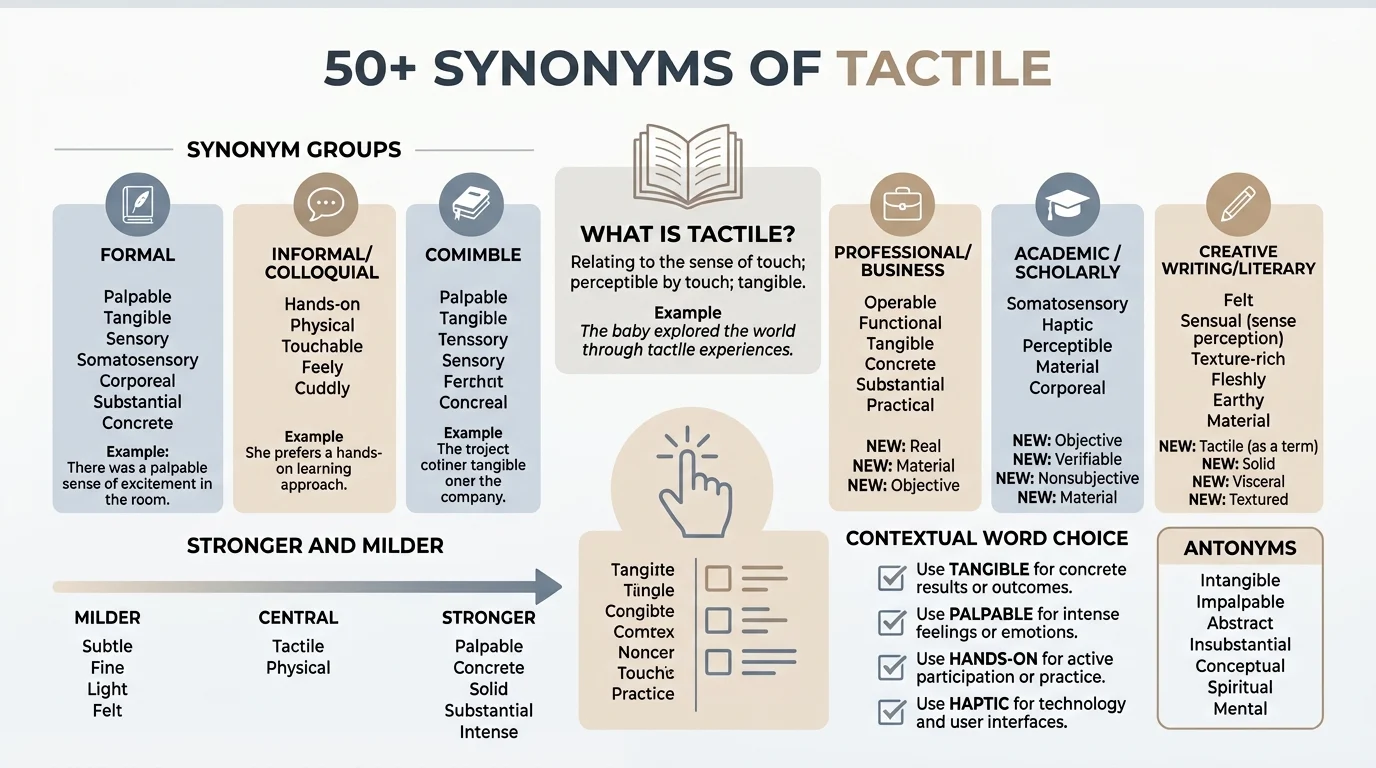
The word “tactile” relates to the sense of touch or describes something that can be felt. The best synonym depends on your context. For formal writing, choose “tangible” or “palpable.” For casual conversation, “touchable” or “hands-on” work well. In professional settings, “haptic” or “physical” are excellent choices.
Meaning, Tone, and Context
Simple Definition
“Tactile” is an adjective that primarily means relating to the sense of touch. It describes anything that can be perceived or felt through physical contact. The word comes from the Latin tactilis, meaning “touchable,” which itself derives from the verb tangere, meaning “to touch”.
Part of Speech
Adjective
Overall Tone
Neutral. The word itself is clinical and descriptive. However, the tone can shift depending on the context. In a scientific report, it is factual. In a design review, it can be positive and appreciative.
Formality Level
Semi-formal to neutral. “Tactile” is appropriate in academic writing, professional reports, and everyday conversation.
Common Uses
Native English speakers use “tactile” in several ways:
- Physiological: Describing the biological sense of touch (e.g., “tactile receptors”).
- Descriptive: Describing an object’s physical texture (e.g., “a tactile fabric”).
- Interpersonal: Describing a person who likes to touch others (e.g., “a very tactile person”).
- Technological: Describing feedback you can feel, like phone vibrations (e.g., “tactile feedback”).
Word Forms
When and How to Use “Tactile”
You should choose “tactile” when you want to be precise about the sense of touch, especially in formal or descriptive contexts. It signals that you are talking about physical sensation rather than visual or auditory experience.
Here are seven realistic examples showing how to use “tactile” in different situations:
- Professional (Product Design): “The new smartphone features improved tactile feedback, making typing feel more responsive.”
- Academic (Psychology): “The study measured tactile sensitivity in children with sensory processing disorders.”
- Workplace (Office Supplies): “I prefer a keyboard with tactile switches because the physical click helps me type faster.”
- Personal (Parenting): “My baby is very tactile; she loves to feel different textures like velvet and corduroy.”
- Email (Client Communication): “We have added tactile samples to the package so you can feel the material quality before placing a large order.”
- Resume (Designer): “Developed a tactile branding experience for a luxury skincare line, emphasizing the premium feel of the packaging.”
- Social Media (Interior Design): “This living room is all about tactile comfort, from the chunky knit throw to the plush velvet cushions.”
Best Synonyms of “Tactile”
No two synonyms are exactly identical. Choosing the right one depends on what you want to emphasize: the physical reality of an object, the sensation of touching it, or the person who loves to touch.
Professional Writing
Best Choice: Tangible
“Tangible” emphasizes that something is real and can be touched or measured. It is excellent for business and legal contexts where you need to prove something exists physically.
Academic Writing
Best Choice: Haptic
“Haptic” is a technical term often used in psychology, neuroscience, and technology. It refers specifically to the perception of touch, especially through active exploration.
Business Communication
Best Choice: Physical
“Physical” is a straightforward and widely understood word that grounds abstract ideas in the real world. It is a safe and clear choice for general business communication.
Casual Conversation
Best Choice: Touchable
“Touchable” is simple, friendly, and instantly understandable. It’s the word you use when you want to tell a friend that a sweater looks incredibly soft.
Emotional Writing
Best Choice: Palpable
While “palpable” can mean touchable, it is often used metaphorically to describe emotions so strong they feel physical, like “a palpable tension in the room”.
Creative Writing
Best Choice: Textured
“Textured” allows you to describe the surface quality of an object in detail. It is perfect for painting a vivid picture for your reader.
Resume Writing
Best Choice: Hands-on
“Hands-on” implies active participation and practical experience. It is a powerful word for resumes because it shows you are not just a thinker but a doer.
Workplace Communication
Best Choice: Concrete
“Concrete” suggests something solid, specific, and definite. When you need a plan or evidence that is not vague, “concrete” is the word.
Stronger Meaning
Best Choice: Palpable
As mentioned, “palpable” carries more weight, especially when describing emotions or sensations that are overwhelmingly obvious.
Softer Meaning
Best Choice: Sensory
“Sensory” is a broader term that includes touch but also smell, taste, sight, and hearing. It is a softer, more general alternative.
When Not to Use “Tactile”
Using “tactile” is not always the best choice. Here are situations where you should consider a different word.
When It Sounds Too Technical
If you are writing for a general audience, “tactile” might sound overly scientific.
- Why it’s less effective: It can create a distance between you and the reader.
- Better synonym: Use “touchable” or “physical.”
- Rewrite: Instead of “The tactile qualities of the blanket are impressive,” say “The blanket feels amazing to touch.”
When You Need a Metaphor for Emotion
“Tactile” is literal. It doesn’t work well for describing emotions.
- Why it’s less effective: It describes physical touch, not feelings.
- Better synonym: Use “palpable.”
- Rewrite: Instead of “The tactile excitement in the room was high,” say “The excitement in the room was palpable.”
When It Sounds Too Vague
Sometimes, “tactile” is too general. You need to be more specific about how something feels.
- Why it’s less effective: It doesn’t tell the reader if something is rough, smooth, soft, or hard.
- Better synonym: Use a descriptive word like “rough,” “smooth,” “velvety,” or “gritty.”
- Rewrite: Instead of “The sculpture had a tactile surface,” say “The sculpture had a rough, gritty surface.”
Words Commonly Confused With “Tactile”
Tactile vs. Tactual
- Difference: They are almost identical in meaning. “Tactual” is simply an older, less common variant.
- When to Use It: Use “tactile.” It is the modern and preferred choice.
- Example: “The tactile (not tactual) sensations were recorded.”
Vs. Haptic
- Difference: In general use, they are synonyms. In technical fields, “haptic” often refers to the perception of touch through active exploration, especially with the hands, while “tactile” is limited to the mechanical stimulation of the skin.
- When to Use It: Use “haptic” in tech and psychology. Use “tactile” for general touch.
- Example (Tactile): “The tactile receptors in her skin were sensitive to temperature.”
- Example (Haptic): “The gaming controller’s haptic feedback made the explosion feel real.”
Tactile vs. Tangible
- Difference: “Tangible” emphasizes that something is real and can be touched or has a physical form. “Tactile” emphasizes the act or sense of touching.
- When to Use It: Use “tangible” to prove something exists. Use “tactile” to describe the experience of touching it.
- Example (Tangible): “We need tangible evidence to support this claim.”
- Example (Tactile): “The silk scarf has a beautiful tactile quality.”
Tactile vs. Palpable
- Difference: “Palpable” means capable of being touched or felt. However, it is more often used metaphorically to describe emotions or atmospheres that are so intense they seem physical.
- When to Use It: Use “palpable” for strong, obvious emotions. Use “tactile” for physical touch.
- Example (Palpable): “There was a palpable sense of relief when the announcement was made.”
- Example (Tactile): “The artist used a variety of tactile materials.”
Vs. Tactical
- Difference: This is a common spelling error. “Tactile” relates to touch. “Tactical” relates to strategy, plans, or military maneuvers.
- When to Use It: Never confuse these two. They mean completely different things.
- Example (Tactical): “The general made a tactical decision to retreat.”
- Example (Tactile): “The phone’s tactile keyboard made typing easy.”
Best Synonyms of “Tactile” by Context
| Context | Best Synonym | Why It Works | Example |
|---|---|---|---|
| Formal Writing | Tangible | It sounds professional and proves physical reality. | “The report provided tangible results from the experiment.” |
| Academic Writing | Haptic | It is the precise technical term used in research. | “The study focused on haptic perception in virtual environments.” |
| Professional Communication | Physical | It is clear, direct, and universally understood. | “The product’s physical characteristics are its main selling point.” |
| Business Emails | Concrete | It suggests a solid, definite plan or idea. | “We need a concrete timeline for this project.” |
| Resume Writing | Hands-on | It highlights practical experience and active involvement. | “Managed hands-on training for new employees.” |
| Workplace Communication | Material | It refers to the physical substance of things. | “The material costs for this project are higher than expected.” |
| Casual Conversation | Touchable | It is simple, friendly, and easy to understand. | “That puppy looks so soft and touchable!” |
| Everyday Speaking | Feelable | It’s a straightforward way to say something can be felt. | “The bump on the wall was easily feelable.” |
| Creative Writing | Textured | It helps paint a vivid picture of the surface. | “The textured walls of the ancient cave told a story.” |
| Storytelling | Sensory | It immerses the reader in the character’s experience. | “The sensory details of the market overwhelmed her.” |
| Emotional Writing | Palpable | It conveys emotions so strong they seem touchable. | “The grief in the room was palpable.” |
| Strong Emphasis | Palpable | It adds intensity and weight to a description. | “Her excitement was palpable.” |
| Mild Tone | Sensory | It is a gentle, general word that is not too intense. | “The sensory garden was designed for all visitors.” |
| Social Media Captions | Touchable | It is engaging and encourages interaction. | “This cake looks almost too good to be touchable!” |
How to Choose the Best Synonym of “Tactile”
Choosing the right word doesn’t have to be complicated. Ask yourself these questions to guide your decision:
- What is the Meaning? Are you describing the literal sense of touch, or are you using a metaphor? If it’s literal, “tactile” or “touchable” is fine. If it’s a metaphor, “palpable” is usually better.
- Who is the Audience? Are you writing for scientists, business professionals, or friends? Use “haptic” for scientists, “tangible” for business, and “touchable” for friends.
- What is the Tone? Do you want to sound formal, emotional, or casual? Match your word to your tone.
- What is the Emotional Strength? Is the feeling mild or intense? Use “sensory” for mild and “palpable” for intense.
- What is the Writing Purpose? Are you trying to prove something exists, or are you trying to describe how it feels? Use “tangible” to prove, and “textured” to describe.
Real Life Examples of “Tactile”
Here are examples showing how to replace a generic use of “tactile” with a stronger, more specific synonym.
- School (Art Class): “We are studying the tactile properties of clay.” → “We are studying the textured properties of clay.”
- College (Psychology): “The experiment measured tactile responses.” → “The experiment measured haptic responses.”
- Workplace (Design Review): “The prototype needs more tactile appeal.” → “The prototype needs more palpable appeal.”
- Business (Marketing): “Our product offers a unique tactile experience.” → “Our product offers a unique sensory experience.”
- Email (Follow-up): “I’ve attached the tactile samples for your review.” → “I’ve attached the physical samples for your review.”
- Resume (Teacher): “Used tactile learning methods for students.” → “Used hands-on learning methods for students.”
- Conversation (At a store): “I love the tactile feel of this wool.” → “I love the touchable feel of this wool.”
- Storytelling (Novel): “The tactile sensation of the key was cold.” → “The palpable sensation of the key was cold.”
- Blogging (Fashion): “This season is all about tactile fabrics.” → “This season is all about textured fabrics.”
- Social Media (Food): “The tactile joy of baking bread.” → “The sensory joy of baking bread.”
18 Best Synonyms of “Tactile”
| Synonym | Simple Meaning | Best Used For | Example Sentence |
|---|---|---|---|
| Tangible | Real and can be touched or measured. | Proving something exists in business or law. | “The company’s success is tangible in their new office building.” |
| Palpable | So obvious it can almost be touched, often used for emotions. | Describing intense feelings or atmospheres. | “The tension in the courtroom was palpable.” |
| Touchable | Can be touched. | Casual conversation and friendly descriptions. | “The baby’s cheeks were so soft and touchable.” |
| Haptic | Relating to the sense of touch, especially via technology. | Technical writing, psychology, and tech reviews. | “The new VR headset provides amazing haptic feedback.” |
| Physical | Relating to the body or material things. | General business and everyday use. | “The job requires a lot of physical stamina.” |
| Concrete | Specific and definite; not abstract. | Business planning and clear communication. | “We need a concrete plan before we start.” |
| Textured | Having a surface that is not smooth. | Creative writing and design. | “The textured wallpaper added depth to the room.” |
| Material | Made of physical matter; substantial. | Discussing costs, supplies, or evidence. | “The material evidence was crucial to the case.” |
| Solid | Firm and stable; not liquid or gas. | Describing reliable plans or sturdy objects. | “He is a solid worker with great experience.” |
| Hands-on | Involving active participation and practical experience. | Resumes and job descriptions. | “She has years of hands-on experience in the field.” |
| Sensory | Relating to the senses (touch, taste, smell, etc.). | Broad descriptions of experiences. | “The spa offered a sensory journey of relaxation.” |
| Tactual | An older word meaning related to touch. | Archaic or very specific historical texts. | “The tactual qualities of the ancient fabric were preserved.” |
| Cutaneous | Relating to the skin. | Medical and dermatological contexts. | “The cream is for cutaneous application only.” |
| Feelable | Capable of being felt. | Very simple, everyday language. | “The lump on the tree trunk was feelable.” |
| Fingertip-oriented | Relating to the use of fingertips. | Describing detailed manual work. | “The surgeon’s work is highly fingertip-oriented.” |
| Somatosensory | Relating to the perception of bodily sensations. | Neuroscience and medical research. | “The somatosensory cortex processes touch information.” |
| Perceptible | Able to be seen or noticed. | Describing subtle changes that can be detected. | “A perceptible shift in the wind indicated a storm.” |
| Substantial | Of considerable importance or size; solid. | Describing something that is real and significant. | “They made a substantial investment in the property.” |
Synonyms of “Tactile” by Usage
Professional vs Personal Synonyms
- Professional: Tangible, concrete, physical, material. These words sound serious and grounded.
- Personal: Touchable, hands-on, feelable. These words are friendly and approachable.
Formal vs Conversational Synonyms
- Formal (Reports, Essays, Business Writing): Tangible, palpable, haptic, material.
- Conversational (Texting, Casual Talks): Touchable, hands-on, feelable, sensory.
Academic Synonyms
For research and essays, choose precise and authoritative words like haptic, somatosensory, and cutaneous. These terms show a deep understanding of the subject and are standard in scientific literature.
Professional and Business Synonyms
For resumes and meetings, use words that project confidence and action. Tangible shows results. Hands-on shows experience. Concrete shows you have a plan. Physical is a clear and reliable choice.
Creative and Literary Synonyms
If you are writing a story or a poem, choose words that create an image. Textured, palpable, and sensory are your best friends. They add depth and emotion to your descriptions.
Slang or Modern Synonyms
“Tactile” doesn’t have a direct slang equivalent. However, the phrase “touchy-feely” is a casual, sometimes slightly negative, way to describe someone who is overly emotional or likes a lot of physical contact. Use it carefully in informal settings.
Strongest to Mildest Synonyms
- Mild: Sensory, touchable, physical.
- Moderate: Tangible, material, concrete.
- Strong: Textured, hands-on, substantial.
- Very Strong: Palpable, haptic.
The emotional intensity increases as you move from mild to very strong. “Palpable” and “haptic” carry the most weight and technical precision.
Emotional vs Neutral Synonyms
Emotional Synonyms
These words express a stronger feeling or create a vivid impression:
- Palpable: Used for emotions that feel physical.
- Textured: Creates a rich, descriptive image.
- Sensory: Evokes a full-body experience.
Neutral Synonyms
These words simply communicate information without adding emotion:
- Tangible: States a fact.
- Physical: States a fact.
- Concrete: States a fact.
Antonyms of “Tactile”
| Antonym | Meaning | Example Sentence |
|---|---|---|
| Intangible | Cannot be touched or grasped physically. | “The value of her advice was intangible.” |
| Abstract | Existing as an idea, not as a physical object. | “The concept of freedom is abstract.” |
| Impalpable | Cannot be felt by touch. | “The difference between the two fabrics was impalpable.” |
| Untouchable | Cannot be touched. | “The celebrity felt untouchable behind the velvet rope.” |
| Immaterial | Not important or not physical. | “The details of the story are immaterial.” |
| Imperceptible | Impossible to see or notice. | “The change in temperature was imperceptible.” |
| Incorporeal | Without a physical body or form. | “In the story, the ghost was an incorporeal being.” |
| Nonphysical | Not relating to the body. | “The benefits of meditation are nonphysical.” |
| Invisible | Cannot be seen. | “The bacteria were invisible to the naked eye.” |
| Theoretical | Based on theory rather than experience. | “The idea is still theoretical and needs testing.” |
| Spiritual | Relating to the spirit, not the body. | “She found spiritual peace in the mountains.” |
| Ethereal | Extremely delicate and light, like it is not of this world. | “The music had an ethereal quality.” |
| Fictional | Not real; invented. | “The events in the book are fictional.” |
| Imaginary | Existing only in the imagination. | “Her fears were imaginary.” |
| Vague | Not clear or definite. | “The instructions were vague and confusing.” |
Comparison: “Tactile” vs Similar Words
Tactile vs Tangible
- Main Difference: “Tactile” emphasizes the experience of touching. “Tangible” emphasizes the reality of being touched.
- Which Is Stronger? “Tangible” is stronger for proving existence.
- Which Is More Formal? Both are formal.
- When to Use Each: Use “tactile” to describe how something feels. Use “tangible” to say something is real.
- Examples:
- Tactile: “The artist focused on the tactile quality of the paint.”
- Tangible: “The artist’s success was tangible in her growing fame.”
Vs Palpable
- Main Difference: “Tactile” is literal. “Palpable” is often metaphorical.
- Which Is Stronger? “Palpable” is much stronger for emotions.
- Which Is More Formal? Both are formal.
- When to Use Each: Use “tactile” for physical touch. Use “palpable” for obvious feelings.
- Examples:
- Tactile: “The tactile sensation of sand between my toes was nice.”
- Palpable: “The disappointment in the room was palpable.”
Tactile vs Haptic
- Main Difference: In general use, they are the same. In technical terms, “haptic” implies active touch, often with the hands.
- Which Is Stronger? “Haptic” is more precise and technical.
- Which Is More Formal? “Haptic” is more formal and academic.
- When to Use Each: Use “tactile” for general touch. Use “haptic” for technology, psychology, and active touch.
- Examples:
- Tactile: “Babies learn about the world through tactile exploration.”
- Haptic: “The haptic interface allows users to ‘feel’ virtual objects.”
Tactile vs Physical
- Main Difference: “Tactile” is specifically about touch. “Physical” is broader and relates to the body in general.
- Which Is Stronger? “Physical” is a stronger, more encompassing word.
- Which Is More Formal? Both are neutral.
- When to Use Each: Use “tactile” when the sense of touch is key. Use “physical” for anything related to the body.
- Examples:
- Tactile: “The sculpture invites tactile interaction.”
- Physical: “Regular physical exercise is good for your health.”
Vs Concrete
- Main Difference: “Tactile” is about touch. “Concrete” is about being solid and specific, not abstract.
- Which Is Stronger? “Concrete” is stronger for ideas and plans.
- Which Is More Formal? Both are formal.
- When to Use Each: Use “tactile” for physical objects. Use “concrete” for definite plans or evidence.
- Examples:
- Tactile: “The tactile buttons on the remote are easy to press.”
- Concrete: “We need concrete proof of your identity.”
Tactile vs Touchable
- Main Difference: “Tactile” sounds more formal and scientific. “Touchable” sounds casual and inviting.
- Which Is Stronger? “Tactile” is more precise.
- Which Is More Formal? “Tactile” is more formal.
- When to Use Each: Use “tactile” in writing. Use “touchable” when speaking or writing casually.
- Examples:
- Tactile: “The product’s tactile feedback was praised by reviewers.”
- Touchable: “That cake looks delicious and touchable.”
Common Phrases and Expressions with “Tactile”
Tactile Feedback
- Meaning: A response you can feel, often from a device or machine.
- Example: “The controller’s tactile feedback made the game more immersive.”
Sensation
- Meaning: A feeling you get from touching something.
- Example: “Running your fingers through sand provides a unique tactile sensation.”
Tactile Learning
- Meaning: A learning style that involves physical activity and hands-on experience.
- Example: “Children often benefit from tactile learning, like using building blocks to understand math.”
- Tactile Experience
- Meaning: An event or activity that focuses on the sense of touch.
- Example: “The museum’s new exhibit is a tactile experience for visitors of all ages.”
Tactile Person
- Meaning: Someone who likes to touch people and things.
- Example: “He is a very tactile person and always gives a warm hug.”
Common Mistakes to Avoid
1: Choosing a Vague Synonym
- Incorrect: “The tactile thing was nice.”
- Better: “The tactile sensation was nice.” or “The texture was nice.”
- Why: “Thing” is too vague. Be specific about what you are describing.
2: Confusing “Tactile” with “Tactical”
- Incorrect: “We need a tactile approach to win this game.”
- Better: “We need a tactical approach to win this game.”
- Why: They are completely different words. “Tactical” means strategic.
3: Using an Informal Synonym in Formal Writing
- Incorrect: “The committee sought touchable evidence.”
- Better: “The committee sought tangible evidence.”
- Why: “Touchable” is too casual for a formal report. “Tangible” is professional.
4: Selecting an Overly Dramatic Synonym
- Incorrect: “The palpable surface of the table was smooth.”
- Better: “The tactile surface of the table was smooth.” or “The surface was smooth.”
- Why: “Palpable” is too strong and emotional for a simple description of a table. Save it for emotions and atmospheres.
5: Repeating the Same Word Too Often
- Incorrect: “The tactile experience was great. The tactile feedback was excellent. The tactile quality was superb.”
- Better: “The sensory experience was great. The haptic feedback was excellent. The physical quality was superb.”
- Why: Varying your word choice makes your writing more interesting and engaging.
6: Choosing the Wrong Emotional Tone
- Incorrect: “The touchable grief in the room was overwhelming.”
- Better: “The palpable grief in the room was overwhelming.”
- Why: “Palpable” is the correct word for describing strong emotions, not “touchable.”
7: Using Slang in Professional Writing
- Incorrect: “We need a more touchy-feely approach to customer service.”
- Better: “We need a more hands-on approach to customer service.”
- Why: “Touchy-feely” can sound unprofessional and dismissive.
Frequently Asked Questions
What are the best synonyms of “tactile”?
The best synonyms are “tangible” for formal contexts, “touchable” for casual use, “haptic” for technical writing, and “palpable” for describing emotions.
What are the best formal synonyms of “tactile”?
The best formal synonyms are “tangible,” “palpable,” “material,” and “concrete.” These words are precise and appropriate for academic and professional writing.
What are common informal synonyms of “tactile”?
Common informal synonyms include “touchable,” “hands-on,” “feelable,” and “sensory.” These words are friendly and easy to understand in everyday conversation.
What is another word for “tactile” in professional writing?
In professional writing, “tangible” is an excellent choice because it emphasizes concrete results. “Physical” and “concrete” are also strong, clear alternatives.
What is the difference between “tactile” and “tangible”?
“Tactile” describes the experience or sense of touch, while “tangible” describes something that is real and can be physically touched or measured. “Tangible” is often used to prove existence.
What is the opposite of “tactile”?
The most common opposites (antonyms) are “intangible” (cannot be touched), “abstract” (existing as an idea), and “impalpable” (cannot be felt).
Conclusion
The word “tactile” is a valuable and descriptive adjective that connects us to the physical world through the sense of touch. While it is a great word, using it too often can make your writing feel repetitive. By understanding the subtle differences between the many synonyms of tactile, you can choose the exact word that fits your context, audience, and purpose. Remember, no synonym is perfect in every situation. The key to great communication is choosing the word that conveys your intended message most clearly and naturally. Whether you are writing a formal report, a creative story, or a simple text message, take a moment to consider your word choice. Your readers will notice the difference.