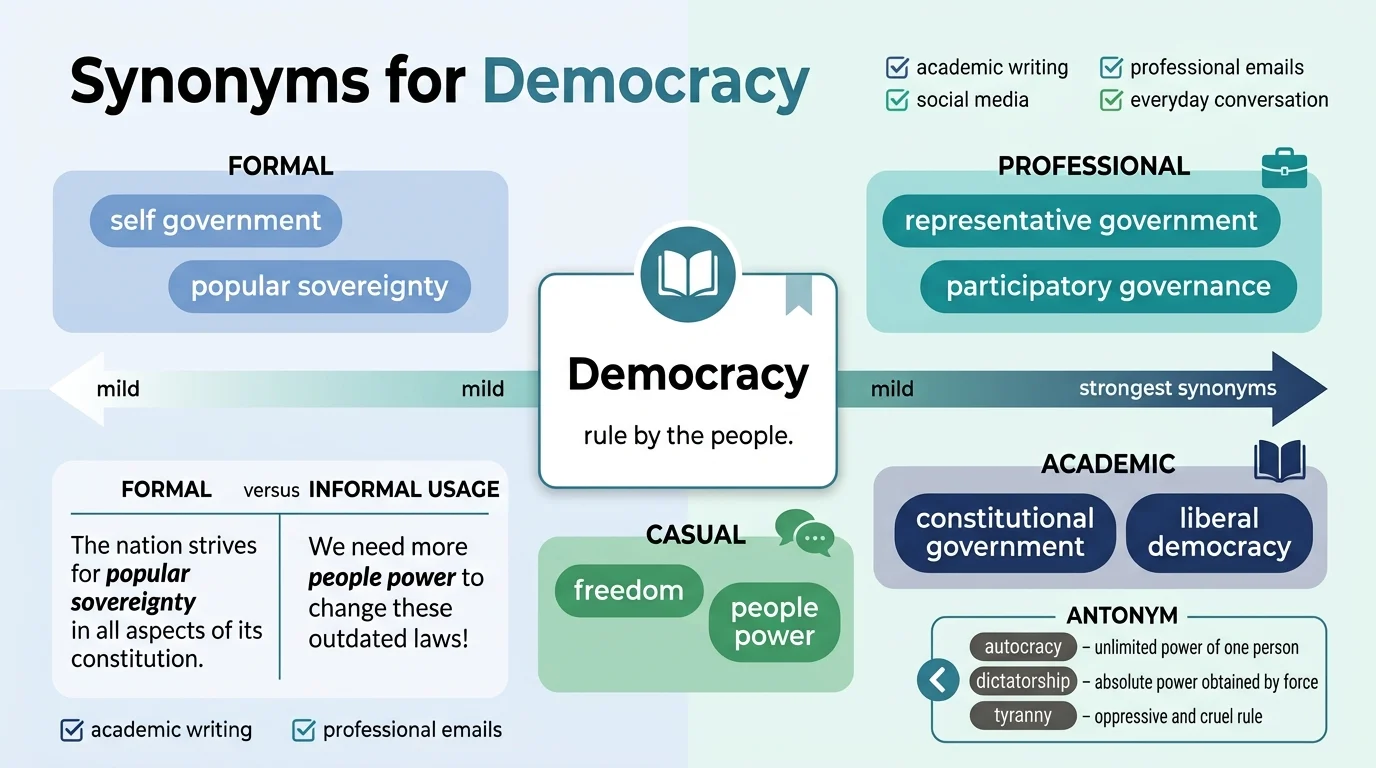
Do you find yourself repeating the word “democracy” too often in your essays, professional emails, or social media posts? Many writers, students, and professionals struggle to find fresh ways to express this important political concept.
Whether you are crafting a persuasive essay, preparing a business presentation, or writing a thoughtful social media caption, varying your vocabulary makes your communication stronger and more engaging.
This guide will help you master the synonyms of democracy so you can choose the right word for every situation with confidence.
What Does “Democracy” Mean?
Democracy is a system of government where the people hold supreme power through voting and representation. The best synonyms of democracy include self government, popular government, and representative government for formal contexts. For casual conversation, you might use freedom or majority rule. Academic writing often prefers constitutional government or republican government depending on the specific meaning you want to convey.
Meaning, Tone and Context
Simple Definition: Democracy means rule by the people. Citizens participate in decision making directly or through elected representatives.
Part of Speech: Noun
Tone: Positive and neutral. The word carries largely favorable associations in most English speaking countries.
Formality Level: Formal to neutral. Democracy is appropriate in academic, professional, and casual contexts.
Common Use Cases: Political discussions, government studies, historical analysis, civic education, news reporting, and social commentary.
Important Word Forms: Democratic (adjective), democratically (adverb), democrat (noun for a supporter), democratize (verb), democratization (noun).
When and How to Use “Democracy”
The word democracy belongs in discussions about government systems, political philosophy, and civic participation. Use it when describing how a country makes collective decisions or when comparing different governance models.
Professional Example: Our company operates on a democracy model where every team member votes on major strategic decisions.
Academic Example: The transition from authoritarian rule to democracy in Eastern Europe transformed the region’s political landscape.
Personal Example: I appreciate living in a democracy where my voice matters through voting.
Social Media Example: Democracy works best when citizens stay informed and engaged beyond election day.
Creative Example: The small town functioned like a pure democracy, with every resident attending monthly meetings to decide local matters.
Resume Example: Led a grassroots initiative that strengthened local democracy by increasing voter participation by 40 percent.
Email Example: The proposed policy changes reflect our commitment to workplace democracy and shared decision making.
Another Word for “Democracy”
The best single replacement depends entirely on your context and intended meaning.
Professional Writing: Representative government is the most precise alternative for business and professional contexts.
Academic Writing: Constitutional government works well in scholarly papers when emphasizing legal structures.
Casual Conversation: Freedom is the most accessible replacement for everyday discussions.
Emotional Writing: Self determination captures the empowering aspect of democracy.
Creative Writing: Popular sovereignty adds literary weight and historical depth.
Resume or Workplace: Participatory governance fits leadership and organizational contexts.
Social Media Captions: People power is concise and impactful for short content.
Stronger Meaning: Direct democracy emphasizes immediate citizen control.
Softer Meaning: Republican government suggests an indirect or representative system.
When Not to Use “Democracy”
Democracy sounds too vague when you are describing specific political mechanisms. For example, saying “the democracy decided” is less precise than “the elected parliament voted on the measure.”
The word feels too formal in casual conversations about simple group decisions. Saying “we used democracy to choose the restaurant” sounds unnatural. Instead say “we took a vote” or “we decided together.”
Democracy becomes too weak when describing systems with limited citizen participation. A country with restricted voting rights might be better described as a flawed democracy or limited suffrage system.
Stronger Alternative Example: Instead of “the democracy passed the law,” try “the legislative body approved the measure through majority vote.
Words Commonly Confused With “Democracy”
Democracy vs. Republic: Democracy emphasizes rule by the people while republic emphasizes rule by law. In practice, these terms overlap significantly. Use democracy when stressing citizen participation. Use republic when emphasizing constitutional constraints.
Democracy vs. Oligarchy: Democracy distributes power among all citizens. Oligarchy concentrates power among a small elite. These are opposite systems of government.
Democracy vs. Autocracy: Democracy has broad citizen participation. Autocracy has single ruler control. The contrast is clear and direct.
Democracy vs. Anarchy: Democracy has organized governance structures. Anarchy has no governance at all. These words are not interchangeable.
Democracy vs. Populism: Democracy is a system of governance. Populism is a political approach that claims to represent ordinary people against elites. Populism can exist within democracies or undermine them.
Democracy vs. Majority Rule: Democracy includes majority rule but also protects minority rights. Majority rule alone is a procedure, not a complete system.
Best Synonym by Context for “Democracy”
| Context | Best Synonym | Why It Works | Example |
|---|---|---|---|
| Formal Writing | Self government | Emphasizes the fundamental principle of citizen control | The nation’s commitment to self government remains unwavering |
| Academic Writing | Constitutional government | Highlights legal frameworks and institutional structures | Constitutional government requires independent courts and free press |
| Professional Business | Participatory governance | Stresses inclusion and collaborative decision making | Our participatory governance model improves employee engagement |
| Resume | Civic leadership | Demonstrates active community involvement | Coordinated civic leadership initiatives across ten neighborhoods |
| Casual Conversation | Freedom | Simple, direct, and universally understood | This country stands for freedom and individual rights |
| Creative Writing | Popular sovereignty | Adds historical depth and philosophical weight | The principle of popular sovereignty shaped the revolution |
| Emotional Tone | Self determination | Captures the personal empowerment aspect | Every community deserves the right to self determination |
| Strong Intensity | Direct democracy | Emphasizes immediate citizen control | The town practiced direct democracy at every local meeting |
| Soft Tone | Representative government | Focuses on structured, moderate governance | Representative government balances efficiency with participation |
| Social Media Captions | People power | Concise and impactful for short content | People power matters most on election day |
| US Context | Republican government | Emphasizes constitutional framework and federal structure | The Founders established a republican government with checks and balances |
| Historical Writing | Democratic governance | Places systems in their proper historical context | Democratic governance evolved gradually over centuries |
| Global Context | Popular government | Avoids Western centric assumptions | Popular government takes different forms across cultures |
| Civic Education | Citizen participation | Emphasizes active engagement rather than passive system | Citizen participation strengthens accountability |
| Political Analysis | Liberal democracy | Specifies the Western model with rights protections | Liberal democracy requires independent media and civil society |
Which Synonym Should You Choose?
Start by identifying your primary meaning. Do you want to emphasize citizen control, legal structures, or personal freedom?
Consider your formality level. Academic and professional writing favors precise terms like representative government and constitutional government. Casual conversation welcomes simpler words like freedom and people power.
Match your emotional intensity. Use self determination for empowering messages. Choose representative government for neutral descriptions.
Evaluate your sentence context. A single sentence about voting needs a different word than a paragraph about government systems.
Think about your audience. US readers understand republican government in its systemic sense. International audiences might prefer democratic governance or popular government.
Test your choice by reading the sentence aloud. The right synonym should sound natural and convey exactly what you mean.
Real Life Examples of “Democracy” in Sentences
School Context: The student council operates as a small democracy where every class member has voting rights.
Workplace Context: Instead of top down decisions, our team practices workplace democracy through regular consensus building meetings.
Academic Writing: Scholars debate whether direct democracy remains practical in large modern nations with millions of citizens.
Social Media Context: Democracy requires constant participation, not just attention during election season.
Resume Context: Implemented democratic decision making processes that increased team satisfaction by 30 percent.
Email Context: The committee will follow democratic principles by allowing all members to propose and vote on initiatives.
Storytelling: The village elders believed their democracy had survived for generations because everyone participated in community decisions.
News Context: Young voters across the country are rediscovering democracy as a tool for meaningful change.
15 Synonyms for “Democracy”
| Synonym | Simple Meaning | Best Used For | Example Sentence |
|---|---|---|---|
| Self government | Citizens governing themselves | Formal political discourse | The colony fought for self government and won independence |
| Popular government | Government controlled by the people | Academic writing | Popular government requires an educated and engaged citizenry |
| Representative government | Citizens elect officials to govern | Professional and legal contexts | Representative government balances efficiency with public input |
| Constitutional government | Government bound by written laws | Legal and historical analysis | Constitutional government protects citizens from arbitrary power |
| Republican government | Government with elected representatives | US political discussions | The United States operates as a republican government with democratic elections |
| Participatory governance | Active citizen involvement in decisions | Community organizing | Participatory governance transformed how the city allocates resources |
| Popular sovereignty | Supreme power belongs to the people | Philosophical and historical writing | Popular sovereignty emerged as a revolutionary idea in the 18th century |
| Democratic governance | System with citizen participation and rights | International development | Democratic governance requires independent courts and free media |
| Self determination | People control their own political future | Empowering and emotional contexts | The region demanded self determination and an end to colonial rule |
| Citizen participation | Active engagement in government | Civic education | Citizen participation strengthens accountability and trust |
| People power | Collective political action of citizens | Social movements and activism | People power defeated the authoritarian regime in peaceful protests |
| Direct democracy | Citizens vote on every issue | Political science discussions | Swiss cantons practice direct democracy on local matters |
| Liberal democracy | Democracy with protections for rights | Comparative politics | Liberal democracy balances majority rule with minority protections |
| Civic republic | Government based on active citizenship | Historical political theory | The founders admired ancient civic republics for their citizen engagement |
| Majority rule | Decisions made by more than half | Simple explanations | The club follows majority rule for all spending decisions |
Synonym Groups and Usage Differences
Professional vs. Personal Synonyms
Professional contexts favor words like representative government, constitutional government, and participatory governance. These terms sound precise and demonstrate subject knowledge. Personal contexts work better with self determination, freedom, and people power. These words connect emotionally and feel more accessible.
Formal vs. Conversational Synonyms
Formal writing requires self government, popular sovereignty, and liberal democracy. These terms appear in academic papers, legal documents, and political analysis. Conversational use welcomes majority rule, freedom, and people power. These words feel natural in casual discussions, social media, and everyday speech.
Academic Synonyms
Academic writing values precision and specificity. Constitutional government emphasizes legal structures. Popular sovereignty stresses philosophical foundations. Liberal democracy specifies the Western rights based model. Democratic governance encompasses broader comparative approaches. These terms demonstrate scholarly understanding and analytical depth.
Professional and Business Synonyms
Workplace settings benefit from participatory governance and representative government. These terms suggest structured, collaborative approaches to decision making. Civic leadership describes active community involvement. Employee voice captures the democratic aspect of modern workplaces.
Creative or Literary Synonyms
Creative writing enjoys popular sovereignty for its historical resonance. Self determination adds emotional weight to narratives. Republic carries classical associations. Commonwealth suggests shared public good. These words enrich descriptive passages and character dialogue.
Strongest vs. Weaker Synonyms
Direct democracy represents the strongest form of citizen control. Popular sovereignty conveys ultimate authority. Representative government indicates a more moderate implementation. Majority rule describes a basic procedure. The strength decreases from direct citizen participation to simple voting mechanisms.
Emotional vs. Neutral Synonyms
Self determination carries strong emotional power and personal meaning. People power inspires collective action. Freedom resonates with deep personal values. Neutral options include representative government, constitutional government, and democratic governance. These terms describe systems without emotional coloring.
Antonyms of “Democracy”
| Antonym | Meaning | Example Sentence |
|---|---|---|
| Autocracy | Single ruler with absolute power | The autocracy ignored citizen concerns and suppressed opposition |
| Dictatorship | Rule by one person without consent | The dictatorship banned all political parties and free speech |
| Tyranny | Oppressive government with no citizen rights | Citizens rose up against the tyranny that had lasted decades |
| Oligarchy | Rule by a small privileged group | The oligarchy controlled wealth and power without public accountability |
| Monarchy | Rule by a single hereditary leader | The monarchy limited citizen participation in government |
| Totalitarianism | Complete state control over all aspects of life | Totalitarianism eliminated any independent civic organizations |
| Authoritarianism | Power concentrated with limited freedoms | The authoritarian regime permitted elections but controlled all outcomes |
| Fascism | Dictatorial rule with nationalist ideology | Fascism suppressed democracy and individual rights |
| Despotism | Absolute power exercised cruelly | The despotism crushed all political opposition |
| Absolutism | Complete governmental control by one ruler | Absolutism left no room for citizen participation |
| One party rule | Single party controls all government | One party rule prevents meaningful political competition |
| Military junta | Government run by military leaders | The military junta suspended elections and civil liberties |
| Police state | Government with extensive surveillance and control | Citizens lived in fear under the police state |
| Theocracy | Government guided by religious authority | The theocracy limited participation to approved religious groups |
| Plutocracy | Government controlled by wealthy citizens | The plutocracy served the rich while ignoring ordinary people |
Comparison: Democracy vs. Similar Words
Democracy vs. Republic
Democracy emphasizes citizen participation and majority decision making. Republic emphasizes constitutional limits and legal protections . Republic is more formal and historically specific to the US system. Example for democracy: The town used democracy to decide every local issue. Example for republic: The Constitution established a republic with checks on government power.
Democracy vs. Autocracy
Democracy has broad citizen participation in governance. Autocracy has one ruler with complete control. Democracy is positive and empowering. Autocracy is negative and oppressive. Example for democracy: Citizens voted on the new environmental policy. Example for autocracy: The emperor made all decisions without consultation.
Democracy vs. Oligarchy
Democracy distributes political power among all citizens. Oligarchy concentrates power among wealthy or elite groups. Democracy suggests fairness and inclusion. Oligarchy suggests corruption and inequality. Example for democracy: Every adult citizen has the right to vote. Example for oligarchy: Only the wealthy land owners could participate in government.
Democracy vs. Populism
Democracy is a complete system of government with institutions and procedures. Populism is a political style claiming to represent ordinary people against elites. Populism can exist within healthy democracies or weaken democratic institutions. Example for democracy: The country has a stable democratic system with regular elections. Example for populism: The populist leader attacked the media and courts as corrupt elites.
Democracy vs. Majority Rule
Democracy includes majority rule but also protects minority rights and individual freedoms. Majority rule is simply a decision making procedure. Democracy is a broader concept with multiple protections. Example for democracy: The constitution protects minority rights even against majority votes. Example for majority rule: The club decided by majority rule to change its meeting time.
Democracy vs. Constitutional Government
Democracy focuses on popular participation and control. Constitutional government emphasizes the legal structure binding government action. Democracy is about who governs. Constitutional government is about how they govern. Example for democracy: Voters chose representatives in the democratic election. Example for constitutional government: The court ruled the law unconstitutional and struck it down.
Common Phrases and Expressions with “Democracy”
1. Direct Democracy
Meaning: Citizens vote on policies directly rather than through representatives.
Example sentence: Ancient Athens practiced direct democracy in its citizen assemblies.
2. Liberal Democracy
Meaning: Democratic system with protection of individual rights and civil liberties.
Example sentence: Liberal democracy combines majority rule with constitutional protections.
3. Parliamentary Democracy
Meaning: Democratic system where the executive branch derives power from the parliament.
Example sentence: The United Kingdom operates as a parliamentary democracy with a ceremonial monarch.
4. Democratic Process
Meaning: The procedures and activities through which democratic decisions are made.
Example sentence: The democratic process includes campaigning, voting, and peaceful transfer of power.
5. Democratic Institutions
Meaning: Organizations and structures that support democratic governance.
Example sentence: Independent courts and free media are essential democratic institutions.
6. Defend Democracy
Meaning: Protect democratic systems against threats.
Example sentence: Citizens must actively defend democracy against misinformation and authoritarianism.
7. Democratic Participation
Meaning: Citizen involvement in political decision making.
Example sentence: Democratic participation extends beyond voting to include community organizing and public comment.
8. Democratic Values
Meaning: Principles such as freedom, equality, and justice that support democracy.
Example sentence: Democratic values guide how citizens treat each other in public life.
Common Mistakes to Avoid
Using Democracy When a More Precise Synonym Is Better
Saying “the democracy passed the law” is vague. Try “the parliament approved the legislation” or “voters supported the measure through a referendum.”
Confusing Democracy with Republic
These terms have distinct historical and legal meanings. A republic is a specific type of constitutional government. Democracy describes broader citizen participation. Use republic when discussing the US system. Use democracy for general citizen governance.
Using Casual Synonyms in Formal Writing
Freedom is too simple for academic papers about political systems. Use popular sovereignty or representative government instead. Save casual words for appropriate contexts.
Using Overly Dramatic Synonyms for Simple Situations
Describing a committee vote as “an exercise in self determination” sounds excessive. Use majority rule or democratic decision making for everyday group choices.
Repeating the Same Word Too Often
Alternate between democracy, self government, popular sovereignty, and representative government to maintain reader interest.
Choosing a Synonym with Wrong Emotional Tone
Self determination carries empowering emotion suitable for human rights discussions. Constitutional government is neutral and factual for legal contexts. Match the tone to your message.
Using Slang in Academic or Professional Writing
Avoid colloquial terms like people power in formal papers. Reserve these for social media and casual conversation.
FAQs
What is the best synonym for democracy?
The best synonym depends on context. Self government works for formal writing. Representative government fits professional use. Freedom works for casual conversation.
What is a formal synonym for democracy?
Popular sovereignty and constitutional government are formal synonyms appropriate for academic and legal writing about political systems.
What is an informal synonym for democracy?
Majority rule and people power are informal synonyms suitable for everyday conversations and social media posts.
What is another word for democracy in professional writing?
Representative government and participatory governance are professional synonyms that work well in business and organizational contexts.
What is the difference between democracy and republic?
Democracy emphasizes citizen participation. Republic emphasizes constitutional limits and legal protections. The US is a republic with democratic elections.
What is the opposite of democracy?
Autocracy, dictatorship, and tyranny are common antonyms. These words describe systems where power is concentrated in one ruler or small group.
Conclusion
Democracy means rule by the people through voting and participation. The best synonyms vary widely based on context, formality, and emotional tone. Self government and popular sovereignty work for formal writing. Freedom and people power suit casual conversation. Representative government fits professional and academic contexts. Your word choice should match your audience and purpose. Remember to consider whether you want to emphasize citizen control, legal structures, or personal empowerment. Vary your vocabulary by choosing precise synonyms that add clarity and impact to your communication.