Have you ever written an email, essay, or social media post and realized you used the word “things” over and over again? It happens to everyone. You read back through your writing and notice the same vague word appearing in every other sentence. This repetition makes your writing feel weak, unclear, and unpolished. Finding better synonyms of things can transform your communication instantly.
The word “things” is one of the most overused words in English. It appears in casual conversation, professional emails, academic essays, and everyday writing. While the word is not incorrect, it often lacks precision and impact. When you use a more specific word, your message becomes clearer, stronger, and more memorable.
This guide will help you understand the meaning of “things,” explore the best synonyms for every situation, and avoid common mistakes. By the end, you will know exactly which word to use in professional writing, casual conversation, academic work, and creative projects.
What Are the Best Synonyms of “Things”?
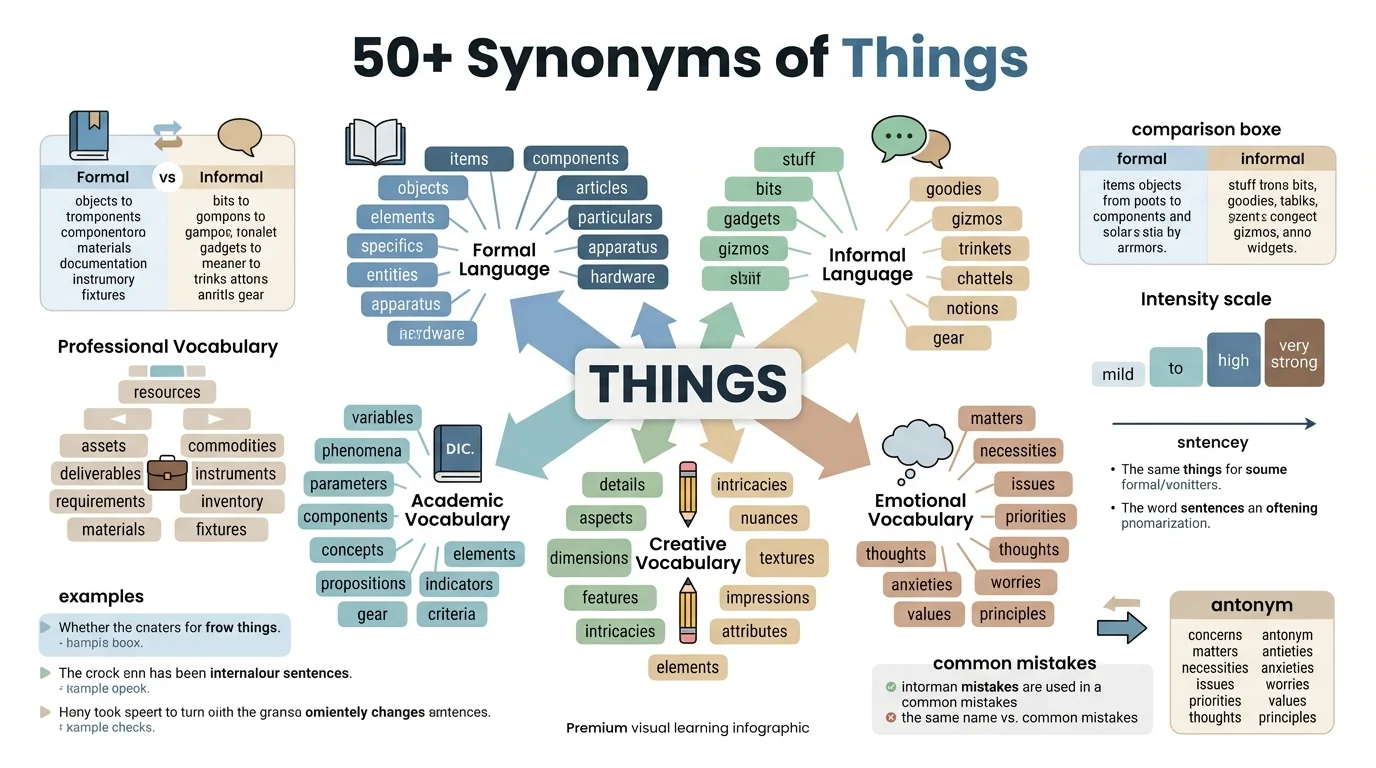
“Things” is a general word for objects, items, ideas, or matters. Formal writing, use items, objects, or materials. For casual conversation, try stuff, bits, or goodies. For professional settings, choose assets, resources, or elements. Academic work, use phenomena, variables, or factors. The best synonym depends on your audience and purpose.
Meaning, Tone, and Context
Simple Definition
“Things” is a general term used to refer to objects, items, ideas, actions, or matters that are not named specifically. It is a placeholder word that covers almost anything you can think of.
Part of Speech
Noun (plural). The singular form is “thing.”
Overall Tone
Neutral. The word itself carries no strong emotion or judgment.
Formality Level
Informal to neutral. “Things” is acceptable in most situations but can sound vague or too casual in formal writing.
Common Uses
Native English speakers use “things” constantly in everyday conversation. You will hear it in casual chats, workplace discussions, and informal writing. It appears when people speak quickly and do not need to name every item specifically. However, in professional writing, reports, and academic essays, more precise words are preferred.
Word Forms
- Thing (singular): Can you hand me that thing?
- Things (plural): We have many things to discuss.
- Thingy (informal): Used when you cannot remember the name of something.
When and How to Use “Things”
“Things” works best in casual situations where specificity is not required. It is perfectly acceptable in everyday conversation and informal writing. However, in professional or academic contexts, it often sounds too vague.
Examples of “Things” in Context
Professional:
“Our team has several things to address before the quarterly review.”
Academic:
“The study examined various things that influence student performance.”
Workplace:
“Can you bring the things we need for the meeting tomorrow?”
Personal:
“I have so many things to do this weekend.”
Email:
“Thanks for sending over those things. I will review them today.”
Resume:
(Use with caution) “Managed various things related to office operations.”
Social Media:
“Here are a few things I learned this year.”
Best Synonyms of “Things”
No single synonym works perfectly in every situation. The best choice depends on what you are describing, who you are writing for, and the tone you want to convey.
Professional Writing
Items works best. It sounds organized and businesslike. Use it when referring to products, documents, or individual elements in a list.
Academic Writing
Factors or variables are excellent choices. These words demonstrate analytical thinking and precision in research contexts.
Business Communication
Assets or resources are ideal. These words show that you understand value and strategic importance.
Casual Conversation
Stuff is the most natural replacement. It is informal, friendly, and widely accepted in spoken English.
Emotional Writing
Matters or concerns add weight to your words. These work well when discussing issues that carry personal significance.
Creative Writing
Elements or details allow you to paint a more vivid picture. These words suggest that you are thinking carefully about composition.
Resume Writing
Achievements, responsibilities, or initiatives are much stronger than “things.” They show action and results.
Workplace Communication
Tasks or deliverables are specific and professional. They help clarify expectations in team settings.
Stronger Meaning
Essentials or necessities convey importance and urgency.
Softer Meaning
Bits or pieces suggest small, manageable items or ideas.
When Not to Use “Things”
When the Word Sounds Too General
Using “things” when you could name specific items makes your writing sound lazy or unprepared. Readers may wonder why you did not take the time to be clear.
Weak: “We need to discuss the things in the report.”
Better: “We need to discuss the recommendations in the report.”
Why: The second sentence shows you read the report and know its contents.
When the Word Sounds Too Vague
If your reader cannot picture what you mean, “things” is not working hard enough. Vague writing loses credibility.
Weak: “She brought the things to the party.”
Better: “She brought snacks and decorations to the party.”
Why: The second sentence creates a clear image in the reader’s mind.
When the Word Sounds Too Informal
In formal reports, legal documents, or academic papers, “things” can undermine your authority. Readers may perceive your writing as amateurish.
Weak: “The experiment measured several things.”
Better: “The experiment measured several variables.”
Why: “Variables” sounds scientific and precise.
When the Word Sounds Too Weak
If you want to emphasize importance or urgency, “things” fails to deliver the impact you need.
Weak: “These are important things for the project.”
Better: “These are critical components for the project.”
Why: “Critical components” conveys urgency and importance.
When the Word Sounds Outdated
“Things” is not outdated, but using it repeatedly while avoiding more specific vocabulary makes your writing feel dated and unsophisticated.
Words Commonly Confused With “Things”
Things vs. Items
Difference: “Items” suggests individual, countable objects or units. “Things” is broader and can include ideas, concepts, and abstract matters.
When to Use It: Use “items” when you are referring to specific objects or entries in a list.
Example: “Please review the items on the agenda before the meeting.”
Things vs. Stuff
Difference: “Stuff” is more informal and often refers to multiple items considered as a mass rather than individually. It is rarely used in professional writing.
When to Use It: Use “stuff” in casual conversation with friends or family.
Example: “Can you help me carry this stuff upstairs?”
Things vs. Objects
Difference: “Objects” typically refers to physical, tangible items. “Things” can also refer to ideas, situations, or abstract concepts.
When to Use It: Use “objects” in technical writing, design contexts, or when describing physical items.
Example: “The museum displays objects from ancient civilizations.”
Things vs. Matters
Difference: “Matters” often refers to issues, concerns, or affairs rather than physical objects. It has a slightly formal tone.
When to Use It: Use “matters” when discussing serious or important topics.
Example: “We need to address these matters immediately.”
Things vs. Elements
Difference: “Elements” suggests component parts of a larger whole. It works well in scientific, artistic, and analytical contexts.
When to Use It: Use “elements” when describing parts that form something complete.
Example: “The design includes several key elements that make it successful.”
Things vs. Factors
Difference: “Factors” are causes or influences that contribute to an outcome. This word is much more specific than “things.”
When to Use It: Use “factors” in analytical or research contexts.
Example: “Several factors contributed to the company’s success.”
Best Synonyms of “Things” by Context
| Context | Best Synonym | Why It Works | Example |
|---|---|---|---|
| Formal writing | Items | Sounds organized and professional | “The committee reviewed all items on the agenda.” |
| Academic writing | Variables | Shows analytical precision | “The researchers identified several key variables.” |
| Professional communication | Resources | Demonstrates strategic thinking | “We have allocated resources to support this initiative.” |
| Business emails | Materials | Clear and direct | “I have attached the materials for your review.” |
| Resume writing | Achievements | Highlights accomplishments | “Managed initiatives that increased revenue by 15%.” |
| Workplace communication | Tasks | Clarifies specific responsibilities | “Please prioritize the tasks on the shared list.” |
| Casual conversation | Stuff | Natural and friendly | “I need to grab my stuff before we leave.” |
| Everyday speaking | Bits | Light and approachable | “Let me tell you a few bits of advice.” |
| Creative writing | Elements | Adds artistic depth | “The story contains elements of mystery and romance.” |
| Storytelling | Details | Creates vivid imagery | “She described every detail with precision.” |
| Emotional writing | Concerns | Adds weight and importance | “These concerns deserve our full attention.” |
| Strong emphasis | Essentials | Conveys necessity | “These essentials must be prioritized.” |
| Mild tone | Pieces | Gentle and modest | “Here are a few pieces of advice.” |
| Social media captions | Moments | Relatable and engaging | “Sharing some moments from my week.” |
How to Choose the Best Synonym of “Things”
Choosing the right word requires considering several factors. Here is a practical decision guide to help you select the best synonym every time.
Consider Your Meaning
Ask yourself what “things” actually refers to. Are you talking about physical objects, ideas, tasks, or concerns? The more specific you can be, the better synonym you will find.
Consider Your Tone
Think about how you want your writing to sound. Formal words create a professional impression. Casual words build rapport. Emotional words connect with readers on a deeper level.
Consider Your Audience
Who is reading your writing? Professionals expect precise vocabulary. Friends appreciate friendly language. Teachers and professors prefer academic rigor. Choose words that match their expectations.
Consider Emotional Strength
Do you want to sound neutral, mild, intense, or urgent? Select a synonym that matches the emotional weight you want to convey.
Consider Your Writing Purpose
Are you informing, persuading, entertaining, or instructing? Each purpose benefits from different vocabulary choices.
Consider Natural Sounding Usage
Read your sentence aloud with the synonym in place. Does it sound natural? If it sounds forced or awkward, try a different word.
Real Life Examples of “Things”
School
Original: “We learned many things in history class.”
Improved: “We studied significant events in history class.”
Why: The improved version sounds more academic and specific.
College
Original: “The professor covered several things in the lecture.”
Improved: “The professor covered several concepts in the lecture.”
Why: “Concepts” sounds more intellectually rigorous.
Workplace
Original: “I have a few things to handle this afternoon.”
Improved: “I have a few tasks to complete this afternoon.”
Why: “Tasks” sounds more professional and organized.
Business
Original: “Our company offers many things to customers.”
Improved: “Our company offers many services and products to customers.”
Why: “Services and products” is more specific and businesslike.
Original: “Can you send the things we discussed?”
Improved: “Can you send the documents we discussed?”
Why: “Documents” is clearer and more professional.
Resume
Original: “Responsible for many things in the marketing department.”
Improved: “Led marketing initiatives that increased engagement by 30%.”
Why: The improved version shows measurable results.
Conversation
Original: “There are so many things to do this weekend.”
Improved: “There is so much to do this weekend.”
Why: The improved sentence flows more naturally in conversation.
Storytelling
Original: “They found strange things in the abandoned house.”
Improved: “They discovered peculiar objects in the abandoned house.”
Why: “Peculiar objects” creates a more vivid, mysterious image.
Blogging
Original: “These are things every traveler should know.”
Improved: “These are essential tips every traveler should know.”
Why: “Essential tips” is more clickable and engaging.
Social Media
Original: “Things I love about summer.”
Improved: “Summer favorites.”
Why: Short and punchy works better on social media.
18 Best Synonyms of “Things”
| Synonym | Simple Meaning | Best Used For | Example Sentence |
|---|---|---|---|
| Items | Individual objects or units | Professional and business contexts | “Please bring the requested items to the meeting.” |
| Stuff | Multiple items or materials | Casual conversation | “I need to pick up some stuff at the store.” |
| Objects | Physical, tangible items | Technical or descriptive writing | “The artist creates objects from recycled materials.” |
| Matters | Issues or concerns | Formal and emotional contexts | “We discussed several important matters.” |
| Elements | Component parts | Creative and analytical writing | “The proposal contains several key elements.” |
| Factors | Influential causes | Academic and research writing | “Economic factors influence consumer behavior.” |
| Resources | Assets or supplies | Professional and business use | “We need more resources to complete this project.” |
| Assets | Valuable items or qualities | Business and financial contexts | “The company’s assets include real estate and equipment.” |
| Materials | Items used for a purpose | Workplace and educational use | “Please gather the materials for the experiment.” |
| Details | Specific pieces of information | Descriptive and creative writing | “She noticed every detail in the painting.” |
| Tasks | Individual duties or jobs | Workplace and professional use | “I have several tasks to finish today.” |
| Concerns | Worries or important issues | Emotional and professional use | “Financial concerns keep me up at night.” |
| Achievements | Accomplishments or successes | Resume and personal development | “My achievements include increasing sales by 20%.” |
| Components | Parts of a larger whole | Technical and analytical writing | “The engine has several critical components.” |
| Essentials | Absolutely necessary items | Strong emphasis contexts | “Pack only the essentials for the trip.” |
| Belongings | Personal possessions | Personal and emotional contexts | “She gathered her belongings and left.” |
| Possessions | Items that you own | Formal and legal contexts | “His possessions were listed in the will.” |
| Aspects | Particular parts or features | Analytical and descriptive writing | “We examined all aspects of the situation.” |
Synonyms of “Things” by Usage
Professional vs Personal Synonyms
In professional settings, words like items, tasks, resources, and deliverables sound organized and competent. They show that you understand workplace expectations and can communicate clearly with colleagues and clients.
In personal conversations, words like stuff, bits, goodies, and things sound friendly and approachable. They create a relaxed atmosphere and help you connect with friends and family members.
Professional: “We have allocated resources for the new project.”
Personal: “I bought some stuff for the party.”
Formal vs Conversational Synonyms
Formal writing benefits from words like factors, phenomena, variables, and components. These words add authority and precision to your writing.
Conversational English embraces words like stuff, bits, goodies, and junk. These words sound natural and unpretentious.
Formal: “Several factors contributed to the outcome.”
Conversational: “A lot of stuff happened this week.”
Academic Synonyms
Academic writing demands precision and analytical vocabulary. Words like variables, factors, phenomena, parameters, and constructs are widely used in research and scholarly work.
Example: “Researchers identified several variables that affect learning outcomes.”
Professional and Business Synonyms
Business writing benefits from strategic vocabulary. Words like assets, resources, deliverables, initiatives, and opportunities demonstrate professional competence.
Example: “Our team is evaluating new initiatives for the coming quarter.”
Creative and Literary Synonyms
Creative writing allows for more expressive vocabulary. Words like elements, details, aspects, facets, and dimensions help you paint vivid pictures and explore complex ideas.
Example: “The novel explores several dimensions of human experience.”
Slang or Modern Synonyms
Goodies is a playful, informal term for desirable things. It works well in casual conversation and social media posts.
Junk refers to unwanted or worthless things. It should be used carefully as it has a negative connotation.
Bits is a friendly, modest term for small things or pieces of information.
Avoid slang in professional writing, academic work, and formal communication.
Strongest to Mildest Synonyms
Mild
- Bits: Very small or insignificant things
- Pieces: Individual parts of a whole
- Details: Specific pieces of information
Moderate
- Items: Individual objects or units
- Elements: Component parts
- Aspects: Particular features or characteristics
Strong
- Resources: Assets that provide value
- Assets: Valuable items or qualities
- Essentials: Absolutely necessary items
Very Strong
- Necessities: Things that are essential or required
- Fundamentals: Basic or foundational elements
- Imperatives: Crucial matters that demand action
Emotional vs Neutral Synonyms
Emotional Synonyms
- Concerns: Carries worry or importance
- Matters: Suggests significance and urgency
- Necessities: Conveys urgency and need
- Treasures: Expresses value and affection
Use emotional synonyms when you want to express feelings, connect with readers, or emphasize importance.
Neutral Synonyms
- Items: Simply names individual objects
- Objects: Describes physical items without emotion
- Elements: Talks about parts without emotional weight
- Factors: Discusses influences without judgment
Use neutral synonyms when you need to communicate information objectively.
Antonyms of “Things”
| Antonym | Meaning | Example Sentence |
|---|---|---|
| Nothing | The absence of all things | “There is nothing in the box.” |
| Empty | Containing nothing | “The room felt empty and cold.” |
| Void | Completely empty space | “She stared into the void.” |
| Nonexistence | The state of not existing | “The concept was relegated to nonexistence.” |
| Emptiness | A state of being empty | “She felt an emptiness inside.” |
| Absence | The lack of something expected | “The absence of evidence was concerning.” |
| Vacancy | An empty or unoccupied state | “The building had several vacancies.” |
| Nullity | A state of having no legal force | “The contract was declared a nullity.” |
| Naught | Nothing at all | “His efforts came to naught.” |
| Zero | The numerical value of nothing | “The score remained at zero.” |
| Nil | Nothing or zero | “The project produced nil results.” |
| Blank | Empty space or expression | “She stared at the blank page.” |
| Vacuum | Empty space with no matter | “The experiment was conducted in a vacuum.” |
| Bareness | The state of being empty or plain | “The bareness of the room was striking.” |
| Inanity | Meaninglessness or emptiness | “The conversation descended into inanity.” |
Comparison: “Things” vs Similar Words
Things vs Items
Main Difference: “Items” specifically refers to individual, countable objects or units. “Things” is a broader term that includes ideas, actions, and abstract matters.
Which Is Stronger? “Items” is stronger for precision. It suggests clear, defined objects.
Which Is More Formal? “Items” is more formal and appropriate for business, academic, and professional contexts.
When to Use Each: Use “items” when you are referring to specific objects or entries in a list. Use “things” when you are being deliberately vague or speaking casually.
Examples
Things: “I have so many things to tell you.”
Items: “Please review the items on the agenda.”
Things vs Stuff
Main Difference: “Stuff” is more informal and often refers to items considered as a mass rather than individually.
Which Is Stronger? “Things” is slightly stronger because it is more widely accepted across contexts.
Which Is More Formal? “Things” is more formal, though both are informal compared to words like “items” or “objects.”
When to Use Each: Use “stuff” only in casual conversation with friends or family. Use “things” in slightly more formal situations.
Examples
Things: “We need to discuss a few things.”
Stuff: “Can you grab my stuff from the car?”
Things vs Objects
Main Difference: “Objects” typically refers to physical, tangible items. “Things” can include abstract concepts.
Which Is Stronger? “Objects” is stronger for clarity about physical items.
Which Is More Formal? “Objects” is more formal and technical.
When to Use Each: Use “objects” in design, scientific, or technical writing. Use “things” in general communication.
Examples
Things: “There are many things to consider.”
Objects: “The exhibit showcases historical objects.”
Things vs Matters
Main Difference: “Matters” usually refers to issues, affairs, or concerns rather than physical objects.
Which Is Stronger? “Matters” is stronger because it suggests importance and seriousness.
Which Is More Formal? “Matters” is more formal and appropriate for serious discussions.
When to Use Each: Use “matters” when discussing important or serious topics.
Examples
Things: “There are things we need to address.”
Matters: “These matters require immediate attention.”
Things vs Elements
Main Difference: “Elements” are component parts of a larger whole. “Things” does not imply this relationship.
Which Is Stronger? “Elements” is stronger for analytical writing.
Which Is More Formal? “Elements” is more formal and sophisticated.
When to Use Each: Use “elements” when analyzing structure or composition.
Examples
Things: “The room had many things in it.”
Elements: “The design includes several key elements.”
Things vs Factors
Main Difference: “Factors” are specific causes or influences that contribute to an outcome.
Which Is Stronger? “Factors” is much stronger and more precise.
Which Is More Formal? “Factors” is highly formal and academic.
When to Use Each: Use “factors” in research, analysis, or problem-solving contexts.
Examples
Things: “Many things affect the economy.”
Factors: “Several factors influence economic growth.”
Common Phrases and Expressions with “Things”
Phrase: “All things considered”
Meaning: When you have thought about all the relevant facts or situations.
Example Sentence: “All things considered, we made the right decision.”
Phrase: “The thing is…”
Meaning: Used to introduce an important point or issue.
Example Sentence: “The thing is, we don’t have enough time to finish.”
Phrase: “One thing led to another”
Meaning: Used to describe a chain of events that happened naturally.
Example Sentence: “One thing led to another, and we ended up buying a house.”
Phrase: “Make a thing of something”
Meaning: To make something seem more important than it really is.
Example Sentence: “Don’t make a thing of it. It was just a small mistake.”
Phrase: “For one thing…”
Meaning: Used to introduce the first reason in a list of reasons.
Example Sentence: “For one thing, it’s too expensive. For another, it’s not practical.”
Phrase: “A thing of beauty”
Meaning: Something that is beautiful or admirable.
Example Sentence: “The old building is a thing of beauty.”
Phrase: “Just one of those things”
Meaning: An unfortunate event that cannot be avoided.
Example Sentence: “I missed the bus. It was just one of those things.”
Common Mistakes to Avoid
1: Using “Things” Repeatedly in One Paragraph
Incorrect: “We learned many things in class. The teacher covered several things about history. These things were very interesting.”
Better: “We learned many concepts in class. The teacher covered several historical events. These topics were very interesting.”
Why: Repeated “things” sounds lazy and vague. Varying your vocabulary makes your writing more engaging.
2: Using “Stuff” in Professional Emails
Incorrect: “Can you send me the stuff for the meeting?”
Better: “Can you send me the materials for the meeting?”
Why: “Stuff” is too casual for professional communication. “Materials” sounds organized and professional.
3: Using “Things” in Resume Bullet Points
Incorrect: “Responsible for many things in the marketing department.”
Better: “Managed marketing campaigns that increased engagement by 25%.”
Why: Resume bullets need to show specific accomplishments. “Things” tells the reader nothing about your actual contributions.
4: Using “Things” Instead of “Concerns” in Emotional Writing
Incorrect: “These things have been bothering me for weeks.”
Better: “These concerns have been bothering me for weeks.”
Why: “Concerns” adds emotional weight and shows the issue matters to you.
5: Using “Things” Instead of “Tasks” in Workplace Communication
Incorrect: “I have a few things to finish before the deadline.”
Better: “I have a few tasks to finish before the deadline.”
Why: “Tasks” sounds more professional and organized. It shows you understand workplace expectations.
6: Overusing “Things” in Academic Writing
Incorrect: “The study examined several things that affect test scores.”
Better: “The study examined several variables that affect test scores.”
Why: “Variables” sounds academic and demonstrates research competence.
7: Using “Junk” Instead of “Things” Without Realizing It Sounds Negative
Incorrect: “I need to go through all the junk in my closet.”
Better: “I need to go through all the items in my closet.”
Why: “Junk” means unwanted items. If you are referring to something you value, “junk” will offend the listener.
Frequently Asked Questions
1. What are the best synonyms of things?
The best synonyms of things depend on your context. Professional writing, use “items” or “resources.” For academic work, use “variables” or “factors.” For casual conversation, “stuff” or “bits” works well.
2. What are the best formal synonyms of things?
The best formal synonyms of things are “items,” “objects,” “components,” “elements,” and “factors.” These words add precision and professionalism to your writing.
3. What are common informal synonyms of things?
Common informal synonyms of things include “stuff,” “bits,” “goodies,” and “junk.” These words are best for casual conversations with friends and family.
4. What is another word for things in professional writing?
In professional writing, you can use “items,” “resources,” “assets,” “materials,” “tasks,” or “deliverables.” The best choice depends on what you are specifically referring to.
5. What is the difference between things and stuff?
“Things” is more neutral and can be used in many contexts. “Stuff” is more informal and often refers to items considered as a mass. Use “stuff” only in casual conversation.
6. What is the opposite of things?
The opposite of things is “nothing,” “emptiness,” or “void.” Other antonyms include “absence,” “vacancy,” “nil,” and “naught.”
Conclusion
“Things” is one of the most common words in English, but it is also one of the most overused. While the word is not wrong, it often fails to communicate with the clarity and precision that good writing demands. Choosing a more specific synonym can transform your communication instantly.
The best synonym of “things” depends on your audience, tone, and purpose. Professional settings, use “items” or “resources.” In academic writing, choose “factors” or “variables.” In casual conversation, “stuff” works perfectly. For creative projects, “elements” or “details” adds depth and artistry.
Remember that no synonym works perfectly in every situation. The key is to consider what you are actually referring to and who you are writing for. When you choose words intentionally, your message becomes clearer, more compelling, and more memorable.
A practical tip for improving your vocabulary: before you write “things,” pause and ask yourself what you really mean. Naming it specifically makes your writing stronger and helps readers understand your message more clearly. Try this practice for one week, and you will notice a significant improvement in your communication.