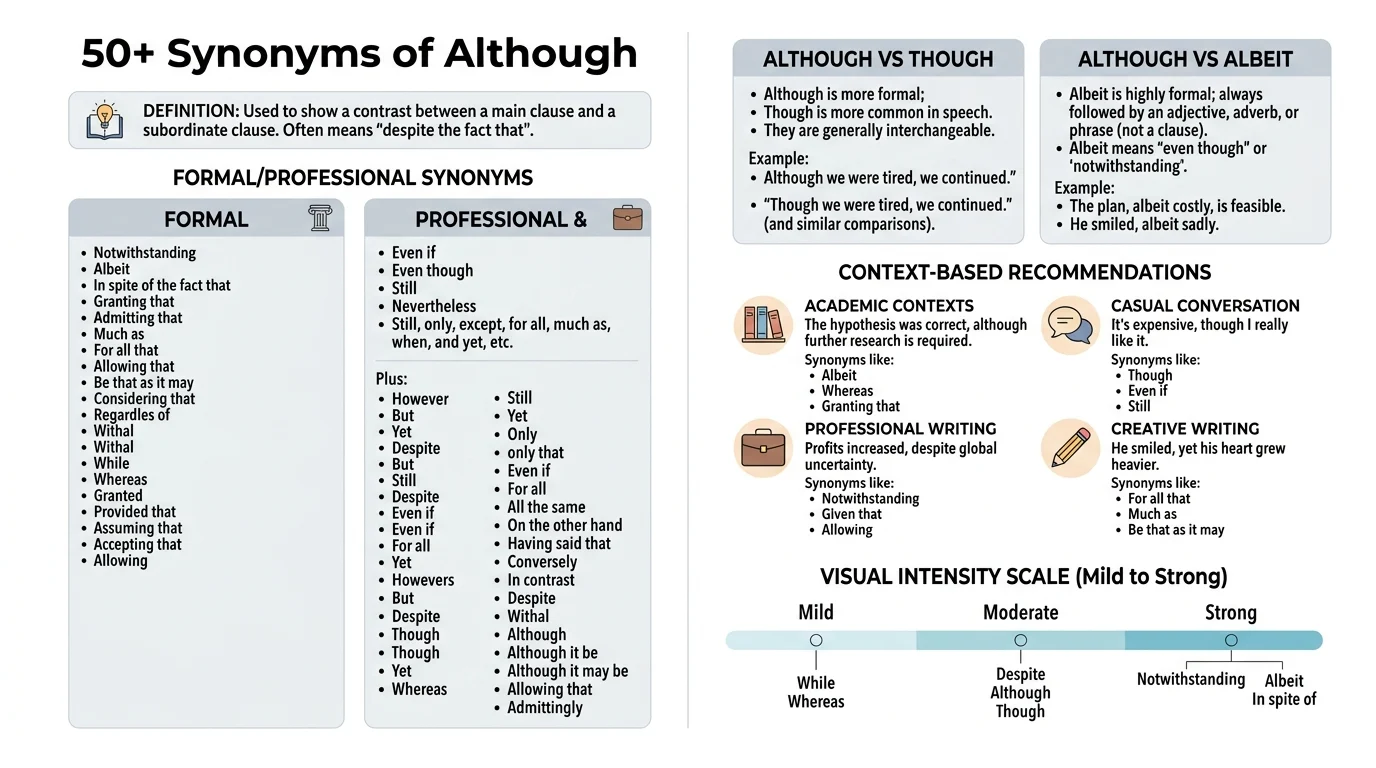
Have you ever read back through an essay, email, or blog post and realized you used the word “although” five times in two paragraphs? It happens to almost every writer. You know you need to show contrast between ideas, but the same conjunction keeps appearing again and again. That is exactly why understanding the synonyms of although can transform your writing from repetitive to refined. When you know which alternatives fit each situation, you gain control over your tone, clarity, and professional polish. The right synonym can make your writing sound more formal, more conversational, or more emphatic without changing your core message. This guide will help you master the synonyms of although so you can choose the perfect word every time.
What Are the Best Synonyms of “Although”?
“Although” is a conjunction that means “in spite of the fact that” or “even though.” It introduces a contrast between two ideas. The best synonyms depend on your context: use “though” for casual conversation, “even though” for strong emphasis, “albeit” for mid-sentence contrast, “notwithstanding” for formal or legal writing, and “while” or “whereas” for comparing two facts.
Meaning, Tone, and Context
Simple Definition
“Although” is a conjunction used to introduce a statement that contrasts with or seems to contradict another statement. It signals that something is true despite a circumstance that might suggest otherwise.
Part of Speech
Conjunction (subordinating conjunction)
Overall Tone
Neutral. “Although” does not carry strong positive or negative emotional weight. It simply presents a factual contrast.
Formality Level
Semi-formal to formal. “Although” is more formal than “though” but less formal than “notwithstanding”. It works well in academic writing, professional communication, and everyday speech. In very formal contexts, longer alternatives like “despite the fact that” may be preferred.
Common Uses
Native English speakers use “although” to:
- Connect two contrasting ideas in a single sentence
- Acknowledge a counterargument before presenting a main point
- Express that something happened despite an obstacle
- Add nuance to a statement without sounding confrontational
- Introduce a concession in academic or professional writing
Word Forms
“Although” does not have noun, verb, adjective, or adverb forms. It functions only as a conjunction.
When and How to Use “Although”
Choose “although” when you need a neutral, clear way to show contrast between two clauses. It works in almost any context where you want to acknowledge one fact while emphasizing another. Unlike “but,” which can feel abrupt, “although” softens the contrast and suggests both statements can be true simultaneously.
Here are seven realistic examples showing how “although” fits different contexts.
Professional: Although the quarterly numbers fell short of projections, our team identified clear growth opportunities for next quarter.
Academic: Although the study had a small sample size, the findings provide valuable insights into consumer behavior.
Workplace: Although Sarah has only been with the company for six months, she has already made significant contributions.
Personal: Although I was exhausted after the long flight, I stayed up to watch the sunset with my family.
Email: Although I understand your concerns, I believe this approach offers the best outcome for our clients.
Resume: Although I come from a non-traditional background, I have developed the skills necessary to excel in this role.
Social Media: Although the recipe looks complicated, it actually comes together in under thirty minutes.
Best Synonyms of “Although”
No synonym is identical in every situation. Each alternative carries slightly different connotations, formality levels, and grammatical rules. Here are the best synonyms for specific contexts.
Professional writing: “Despite the fact that” – This phrase sounds polished and thorough. It works well in reports, proposals, and formal correspondence.
Academic writing: “Notwithstanding” – This formal synonym adds authority to research papers and scholarly articles.
Business communication: “Even though” – This option emphasizes the surprising nature of the contrast, which can be persuasive in business contexts.
Casual conversation: “Though” – Short and natural, “though” fits everyday speech and informal writing.
Emotional writing: “Even though” – The extra emphasis conveys stronger feeling and highlights unexpected outcomes.
Creative writing: “Albeit” – This elegant word adds sophistication and works well mid-sentence.
Resume writing: “Despite” – When followed by a noun phrase, “despite” creates concise, powerful statements about overcoming challenges.
Workplace communication: “While” – This versatile word shows contrast without sounding overly formal.
Stronger meaning: “Even though” – Adds emphasis and highlights that the contrast is particularly surprising or significant.
Softer meaning: “Though” – Feels gentler and less formal, ideal for softening a contrast in conversation.
When Not to Use “Although”
“Although” is not always the best choice. Here are situations where you should consider alternatives.
Too general for emphasis: When you need to stress that something happened despite extreme odds, “although” can feel too平淡. “Even though” creates stronger contrast.
Better: Even though the entire team doubted the plan, Maria pushed forward and proved them wrong.
Too vague for precise comparison: When you are directly comparing two distinct facts or situations, “whereas” is more precise.
Better: The East Coast team exceeded their targets, whereas the West Coast team fell short.
Too formal for conversation: In casual speech or text messages, “although” can sound stiff. “Though” feels more natural.
Better: I wanted to go to the party. I was tired, though.
Too weak for professional emphasis: In resumes or performance reviews, “despite” followed by a noun creates stronger impact.
Better: Despite limited resources, I successfully launched three major initiatives.
Too wordy for concise writing: When brevity matters, “but” or “yet” can replace “although” more efficiently.
Better: She studied hard, but she didn’t pass the exam.
Outdated usage: “Howbeit” is an archaic synonym that modern readers may find confusing. Avoid it in contemporary writing.
Words Commonly Confused With “Although”
Although vs Though
Difference: “Although” is more formal and can only be used as a conjunction. “Though” can be used as both a conjunction and an adverb, and it can appear at the end of a sentence.
When to use each: Use “although” in formal writing and professional contexts. Use “though” in casual conversation or when you want to place the contrast at the end of a sentence.
Example: Although she was nervous, she gave a brilliant presentation. / She was nervous; she gave a brilliant presentation, though.
Although vs Even Though
Difference: Both mean the same thing, but “even though” adds stronger emphasis. It suggests the contrast is more surprising or extreme.
When to use each: Use “although” for neutral contrasts. Use “even though” when you want to highlight that something happened despite considerable odds.
Example: Although it was cold, we went for a walk. / Even though it was freezing, we went for a walk.
Although vs Albeit
Difference: “Although” introduces a full clause with a subject and verb. “Albeit” introduces a phrase, not a full clause, and typically appears in the middle of a sentence.
When to use each: Use “although” at the beginning or middle of a sentence before a clause. Use “albeit” mid-sentence before a phrase.
Example: Although he was reluctant, he accepted the offer. / He accepted the offer, albeit reluctantly.
Although vs While
Difference: “Although” only shows contrast. “While” can show contrast but can also indicate time (“at the same time”).
When to use each: Use “although” when you only mean “in spite of the fact that.” Use “while” when you mean either “although” or “during the time that”.
Example: Although I disagree, I respect your opinion. / While I was cooking, the phone rang.
Although vs Whereas
Difference: “Although” introduces a concession or surprising contrast. “Whereas” directly compares two different facts or situations.
When to use each: Use “although” when one fact makes another surprising. Use “whereas” when you are explicitly comparing two things.
Example: Although he was tired, he finished the race. / He loves classical music, whereas his brother prefers jazz.
Although vs However
Difference: “Although” is a conjunction that joins two clauses within one sentence. “However” is an adverb that connects two separate sentences or independent clauses.
When to use each: Use “although” to connect ideas within the same sentence. Use “however” to start a new sentence or clause showing contrast.
Example: Although I wanted to stay, I had to leave. / I wanted to stay. However, I had to leave.
Best Synonyms of “Although” by Context
How to Choose the Best Synonym of “Although”
Choosing the right synonym depends on several factors. Here is a practical decision guide.
Consider your audience. Are you writing for academics, coworkers, friends, or clients? Formal audiences appreciate “notwithstanding” and “despite the fact that.” Casual audiences prefer “though” and “while.”
Consider your purpose. Are you emphasizing a surprising outcome? Choose “even though.” Are you comparing two facts directly? Choose “whereas.” Are you softening a contrast? Choose “though.”
Consider your sentence structure. Do you need a full clause with a subject and verb? Use “although,” “even though,” or “though.” Do you need a shorter phrase? Use “albeit” or “despite.”
Consider your emotional tone. Do you want to sound neutral? Use “although.” Do you want to sound emphatic? Use “even though.” Do you want to sound elegant? Use “albeit.”
Consider variety. Repeating any word too often weakens your writing. Rotate between synonyms to maintain reader engagement.
Trust your ear. Read your sentence aloud. Does the synonym sound natural? If it feels forced or awkward, try a different option.
Real Life Examples of “Although”
Here are realistic examples showing how “although” and its synonyms work across different situations.
School: Although I studied for weeks, I still felt nervous before the exam.
College: Although the professor’s lectures were challenging, they prepared me well for the career I wanted.
Workplace: Although the team faced numerous setbacks, they never lost sight of their goals.
Business: Although our competitors launched a similar product first, we captured a larger market share through superior customer service.
Email: Although I appreciate your offer, I have decided to pursue a different opportunity.
Resume: Although I am early in my career, I have already led three successful product launches.
Conversation: I really enjoyed the movie, though I thought the ending was a bit rushed.
Storytelling: Although the forest was dark and foreboding, the travelers pressed onward without hesitation.
Blogging: Although minimalist design is trendy, some brands need more visual elements to tell their story.
Social media: Although the recipe took hours, every bite was worth the effort.
18 Best Synonyms of “Although”
| Synonym | Simple Meaning | Best Used For | Example Sentence |
|---|---|---|---|
| Though | Despite the fact that | Casual conversation, informal writing | Though it was raining, we went for a walk |
| Even though | Despite the fact that (emphatic) | Strong contrast, emotional emphasis | Even though she was exhausted, she kept working |
| Albeit | Although (mid-sentence) | Creative writing, elegant contrast | The solution was simple, albeit imperfect |
| While | At the same time or although | Professional writing, versatile contrast | While I agree with your point, I have some concerns |
| Whereas | In contrast to | Direct comparison of two facts | He prefers city life, whereas she loves the countryside |
| Notwithstanding | In spite of | Formal, legal, and academic writing | Notwithstanding the opposition, the policy passed |
| Despite | In spite of (followed by noun) | Concise professional writing | Despite the challenges, we succeeded |
| Even if | Regardless of whether | Conditional contrast | Even if it rains, we will continue the event |
| However | Nevertheless | Starting a new contrasting sentence | The data was incomplete. However, we drew meaningful conclusions |
| Nevertheless | In spite of that | Formal contrast between sentences | The odds were against us. Nevertheless, we prevailed |
| Nonetheless | Despite that | Formal contrast, similar to nevertheless | The project was risky. Nonetheless, we proceeded |
| Yet | But still | Simple contrast, slightly formal | The task was difficult, yet we completed it on time |
| But | However | Simple, direct contrast in any context | She wanted to stay, but she had to leave |
| In spite of | Despite (followed by noun) | Professional and everyday use | In spite of the obstacles, we reached our goal |
| Despite the fact that | In spite of the fact that | Formal, thorough contrast | Despite the fact that funding was cut, the program continued |
| Granting that | Accepting that | Acknowledging a concession | Granting that the plan has flaws, it’s still our best option |
| Admitting that | Conceding that | Acknowledging a counterpoint | Admitting that I was wrong, I still believe we can fix this |
| For all that | Despite that | Literary or emphatic contrast | For all that he achieved, he remained humble |
Synonyms of “Although” by Usage
Professional vs Personal Synonyms
In professional settings, choose synonyms that sound polished and precise. “Notwithstanding,” “despite the fact that,” and “even though” project competence and authority. In personal conversations, “though,” “but,” and “yet” feel more natural and relaxed. “Although” itself works well in both contexts, which is why it remains so popular.
Formal vs Conversational Synonyms
Formal writing favors longer, more explicit phrases: “notwithstanding,” “despite the fact that,” “in spite of the fact that”. These sound thorough and leave no room for ambiguity. Conversational English prefers shorter options: “though,” “but,” “yet”. “While” and “whereas” sit in the middle, working well in both professional reports and everyday writing.
Academic Synonyms
Academic writing demands precision and authority. “Notwithstanding” is an excellent choice for research papers and scholarly articles. “Despite the fact that” provides complete clarity. “Even though” works well when you need to emphasize surprising research findings. Avoid “though” in formal academic contexts, as it is considered too informal.
Professional and Business Synonyms
Resumes, use “despite” for concise impact: “Despite limited resources, I delivered results.” Business emails, “while” offers a professional yet approachable tone. In presentations, “even though” adds persuasive emphasis. Client communication, “notwithstanding” signals sophistication and careful consideration.
Creative and Literary Synonyms
“Albeit” adds elegance and literary flair, especially in mid-sentence contrast. “For all that” sounds poetic and emphatic. “Though” can create a conversational, intimate tone in fiction. “Even though” builds dramatic tension by highlighting surprising outcomes against difficult odds.
Slang or Modern Synonyms
“Although” does not have widely recognized slang equivalents. In very casual digital communication, some writers use “tho” as an abbreviated form of “though” in texts and social media. However, this should be avoided in any formal, professional, or academic writing.
Strongest to Mildest Synonyms
Here is an intensity scale for synonyms of “although,” from mildest to strongest.
Mild: Though, but, yet
Moderate: Although, while, albeit, whereas
Strong: Even though, despite, in spite of
Very Strong: Notwithstanding, nevertheless, nonetheless
Emotional vs Neutral Synonyms
Emotional Synonyms: “Even though” conveys stronger feeling and highlights surprise. “Nevertheless” and “nonetheless” suggest determination in the face of opposition. “For all that” carries a literary, almost wistful tone.
Neutral Synonyms: “Although,” “though,” “while,” and “whereas” simply communicate factual contrast without adding emotional weight. These are your safest choices for objective, professional, or academic writing.
Antonyms of “Although”
| Antonym | Meaning | Example Sentence |
|---|---|---|
| Because | For the reason that | We stayed inside because it was raining |
| Since | For the reason that | Since the weather was bad, we canceled the trip |
| As | For the reason that | As I was tired, I went to bed early |
| For | Because | She was happy, for she had received good news |
| Consequently | As a result | The roads were icy; consequently, schools closed |
| Therefore | For that reason | The evidence was clear; therefore, we acted |
| Thus | As a result | The project succeeded; thus, we celebrated |
| Hence | For this reason | The costs were too high; hence, we abandoned the plan |
| Accordingly | In a way that is appropriate | The rules changed; accordingly, we adjusted our approach |
| So | For that reason | The movie was sold out, so we went home |
| Then | After that; therefore | If you agree, then we can proceed |
| Henceforth | From this time forward | The policy changed; henceforth, all employees must comply |
| Ergo | Therefore (formal) | The data supports the hypothesis; ergo, it is valid |
| Accordingly | In accordance with | The results were clear; accordingly, we made changes |
| Wherefore | For which reason | The goals were set; wherefore, we worked diligently |
Comparison: “Although” vs Similar Words
Although vs Though
Main Difference: “Although” is more formal and only functions as a conjunction. “Though” is less formal and can also function as an adverb placed at the end of a sentence.
Which Is Stronger? Neither is inherently stronger, but “although” carries more formality.
Which Is More Formal? “Although” is more formal.
When to Use Each: Use “although” in formal writing, professional communication, and academic work. Use “though” in casual conversation, informal writing, and when placing the contrast at the end of a sentence.
Examples:
- Although: Although I was tired, I finished the report.
- Though: I was tired; I finished the report, though.
Although vs Even Though
Main Difference: Both mean the same thing, but “even though” adds stronger emphasis and suggests the contrast is more surprising or extreme.
Which Is Stronger? “Even though” is significantly stronger.
Which Is More Formal? Both are acceptable in formal writing, though “although” is slightly more neutral.
When to Use Each: Use “although” for general, neutral contrasts. Use “even though” when you want to emphasize that something happened despite considerable odds.
Examples:
- Although: Although it was cold, we went outside.
- Even though: Even though it was freezing, we went outside.
Although vs Albeit
Main Difference: “Although” introduces a full clause with a subject and verb. “Albeit” introduces a phrase and typically appears mid-sentence.
Which Is Stronger? Both are similar in strength, though “albeit” often sounds more sophisticated.
Which Is More Formal? “Albeit” is considered somewhat formal and literary.
When to Use Each: Use “although” before a full clause. Use “albeit” mid-sentence before a noun phrase or adjective.
Examples:
Although vs While
Main Difference: “Although” only shows contrast. “While” can show contrast or indicate time (“at the same time”).
Which Is Stronger? “Although” is more direct in showing contrast.
Which Is More Formal? Both are used in formal and informal contexts.
When to Use Each: Use “although” when you only mean “in spite of the fact that.” Use “while” when you mean either “although” or “during the time that”.
Examples:
- Although: Although I disagree, I respect your view.
- While: While I was driving, I listened to a podcast.
Although vs Whereas
Main Difference: “Although” introduces a concession or surprising contrast. “Whereas” directly compares two different facts or situations.
Which Is Stronger? Both are neutral in strength.
Which Is More Formal? “Whereas” is often used in formal, legal, and academic writing.
When to Use Each: Use “although” when one fact makes another surprising. Use “whereas” when you are explicitly comparing two things.
Examples:
- Although: Although he was tired, he finished the race.
- Whereas: He loves coffee, whereas she prefers tea.
Although vs However
Main Difference: “Although” is a conjunction that joins two clauses within one sentence. “However” is an adverb that connects two separate sentences or independent clauses.
Which Is Stronger? Both are similar in strength.
Which Is More Formal? Both are used in formal writing, though “however” is extremely common in professional contexts.
When to Use Each: Use “although” to connect ideas within the same sentence. Use “however” to start a new sentence or clause showing contrast.
Examples:
- Although: Although I wanted to stay, I had to leave.
- However: I wanted to stay. However, I had to leave.
Common Phrases and Expressions with “Although”
Although it may seem
Meaning: Used to acknowledge that something appears a certain way before presenting a contrasting perspective.
Example Sentence: Although it may seem complicated, the process is actually quite simple.
Although I must say
Meaning: A polite way to introduce a contrasting opinion or observation.
Example Sentence: Although I must say, I was surprised by the outcome.
Although that may be true
Meaning: Used to acknowledge a valid point before presenting a counterargument.
Example Sentence: Although that may be true, we still need to consider other factors.
Although not always
Meaning: Acknowledges that something is not universally applicable.
Example Sentence: Although not always the case, this approach generally yields good results.
Although at first glance
Meaning: Used to contrast initial appearances with deeper reality.
Example Sentence: Although at first glance the problem seemed simple, it required complex analysis.
Although it is worth noting
Meaning: Introduces an important point that adds nuance to the discussion.
Example Sentence: Although it is worth noting that the data is preliminary, the trends are encouraging.
Although all is said and done
Meaning: A phrase meaning “when everything is considered”.
Example Sentence: Although all is said and done, we made the right decision.
Common Mistakes to Avoid
1: Using “although” with “but” in the same sentence
Incorrect: Although she studied hard, but she still failed the exam.
Better: Although she studied hard, she still failed the exam.
Why: “Although” already expresses contrast; adding “but” creates redundancy.
2: Using “though” in very formal academic writing
Incorrect: Though the sample size was small, the results were significant.
Better: Although the sample size was small, the results were significant.
Why: “Though” is considered too informal for academic writing.
3: Using “albeit” to introduce a full clause
Incorrect: He agreed, albeit he was hesitant.
Better: He agreed, albeit reluctantly.
Why: “Albeit” introduces a phrase, not a full clause with a subject and verb.
4: Using “while” when you mean “although” in a time-sensitive context
Incorrect: While the data was limited, we proceeded with caution.
Better: Although the data was limited, we proceeded with caution.
Why: “While” can mean “at the same time,” creating ambiguity.
5: Overusing “although” in a single paragraph
Incorrect: Although I agree with your point, I have concerns. Although the data supports your claim, the methodology is flawed. Although your conclusion is logical, we need more evidence.
Better: Although I agree with your point, I have concerns. While the data supports your claim, the methodology is flawed. Even though your conclusion is logical, we need more evidence.
Why: Repeating any word weakens your writing. Rotate synonyms for better flow.
6: Using “however” to join two clauses within one sentence
Incorrect: I wanted to stay, however I had to leave.
Better: I wanted to stay. However, I had to leave.
Why: “However” is an adverb that connects separate sentences or independent clauses, not a conjunction that joins clauses within one sentence.
7: Choosing a synonym that doesn’t fit your audience
Incorrect: Notwithstanding the fact that I’m tired, let’s grab coffee.
Better: Even though I’m tired, let’s grab coffee.
Why: “Notwithstanding” is too formal for casual conversation.
Frequently Asked Questions
What are the best synonyms of “although”?
The best synonyms of “although” depend on your context. Use “though” for casual writing, “even though” for strong emphasis, “notwithstanding” for formal documents, and “albeit” for elegant mid-sentence contrast.
What are the best formal synonyms of “although”?
The best formal synonyms of “although” include “notwithstanding,” “despite the fact that,” and “in spite of the fact that.” These options sound polished and authoritative in academic, legal, and professional writing.
What are common informal synonyms of “although”?
Common informal synonyms of “although” include “though,” “but,” and “yet.” These shorter options feel natural in casual conversation, text messages, and everyday writing.
What is another word for “although” in professional writing?
In professional writing, strong alternatives to “although” include “even though,” “while,” and “despite.” These options maintain a professional tone while adding variety to your communication.
What is the difference between “although” and “though”?
The main difference between “although” and “though” is formality. “Although” is more formal and only works as a conjunction. “Though” is less formal and can also be used as an adverb at the end of a sentence.
What is the opposite of “although”?
The opposite of “although” includes words that express cause or result rather than contrast, such as “because,” “since,” “therefore,” and “consequently.” These words show why something happened rather than acknowledging a contrasting fact.
Conclusion
“Although” is a versatile conjunction that helps writers express contrast clearly and gracefully. It means “in spite of the fact that” and works across formal, professional, and casual contexts. The best synonyms of “although” include “though” for casual use, “even though” for strong emphasis, “notwithstanding” for formal writing, and “albeit” for elegant mid-sentence contrast. No single synonym works perfectly in every situation. The right choice depends on your audience, your purpose, and the tone you want to achieve. The next time you write, pay attention to how often you use “although.” Challenge yourself to replace it with a more precise alternative. Your writing will become more varied, more engaging, and more professional.